

True solar time, time zones and daylight saving: what is the difference?
Content version · · Sources & references
Three conversion layers stand between a recorded birth time and the Sun: daylight saving, zone meridian versus birthplace longitude, and the equation of time. Learn the order, a worked example and where schools disagree.
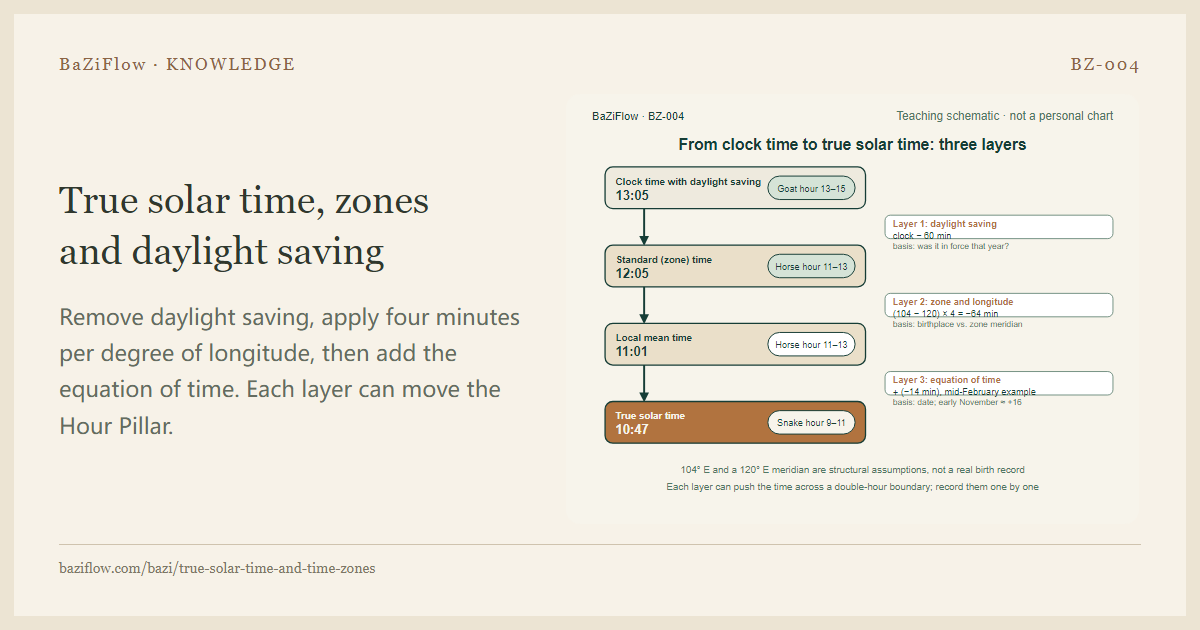
Remove daylight saving, apply four minutes per degree of longitude, then add the equation of time. Each layer can move the Hour Pillar.
Read first
Reading a BaZi chart for the first time: the four pillars and the Day Master ↗
Check for a double correction first
If a charting program already converted the recorded local time using its historical UTC offset, manually subtracting daylight saving again creates an error. This is often a more useful first check than asking whether solar time is more accurate. Civil time, local mean solar time and apparent solar time are different representations of one event; none makes an uncertain birth record precise.
Keep the recorded clock reading and the time-zone source. The IANA database stores offset histories for named locations, including daylight-saving transitions, while acknowledging gaps in historical knowledge. A country name, year or season alone does not identify the offset at a particular instant.
An audit trail for the number 13:05
Consider a deliberately hypothetical clock reading of 13:05 at 104° east. Assume its civil offset is UTC+9, made up of standard UTC+8 and a sixty-minute daylight-saving component. These are arithmetic assumptions, not a claim that a particular place used this combination in February.
Removing the known sixty minutes gives standard time 12:05. UTC+8 corresponds to a reference meridian of 120° east. The longitude difference is −16°, or −64 minutes at four minutes per degree, so local mean solar time is 11:01. The reference meridian represents the offset; it need not pass through the geographical centre of an administrative zone.
Now use an illustrative equation of time of about −14 minutes, typical of mid-February. With apparent minus mean as the sign convention, 11:01 becomes 10:47. Using about +16 minutes for an early-November example instead gives 11:17. Exact boundary work requires the particular date and time, not these rounded teaching values.
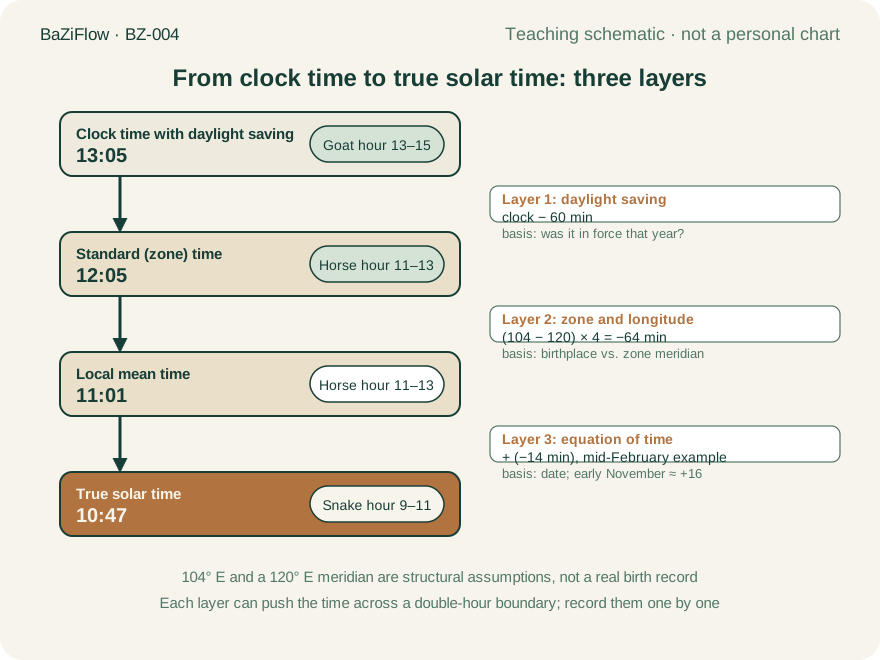
Original BaZiFlow teaching diagram; the three conversion layers with one structural example, not a personal chart.
The three-step explanation is not a mathematical restriction
NOAA's solar-position method combines longitude, the UTC offset and the equation of time in one expression. Splitting them out helps locate errors; it is also valid to calculate directly from the actual civil offset, including any daylight-saving component. Do not mix a standard-time formula with an offset that has already been corrected a second time.
The longitude term reflects four minutes per degree of rotation. The equation of time reflects the changing relation between the apparent Sun and a uniform mean Sun, associated with orbital shape and axial tilt. NOAA's approximation uses the position within the year and the time of day. Describing it as a correction determined only by the month, or as exactly identical every year, would lose relevant precision.
What the Hour Pillar comparison can show
The example's clock labels fall in Goat at 13:05, Horse at 12:05 and 11:01, and Snake at 10:47. It demonstrates that changing the adopted time representation can cross a double-hour boundary. It does not demonstrate that one astrological school predicts better than another.
Charting conventions may use standard time, local mean time or apparent solar time. Record the adopted convention. Near a boundary, keep alternatives when the birth record is too imprecise to resolve them. Crossing 23:00 or midnight also raises the separate day-boundary convention; a longitude calculation cannot settle that choice.
Compare like with like
A useful comparison preserves the birthplace, original date and clock reading, historical offset, source version and selected solar-time setting. Do not use the current residence for longitude or today's zone rules for a historical birth. Around a clock transition, a local reading may be ambiguous or nonexistent, so return to the record before selecting an instant.
The solar-term instant and birth instant must be expressed on a common basis before deciding which side of a month boundary the birth occupies. More digits do not repair a rounded or remembered time: verifying the birth record remains a separate task. Western astrology also uses time and place, but its house calculations should not be confused with the twelve BaZi double-hours.
Sources & references
Continue reading
Why two BaZi charts disagree around midnight ↗