

Harm Gate: the Wood gate at home in Zhen Three
Content version · · Sources & references
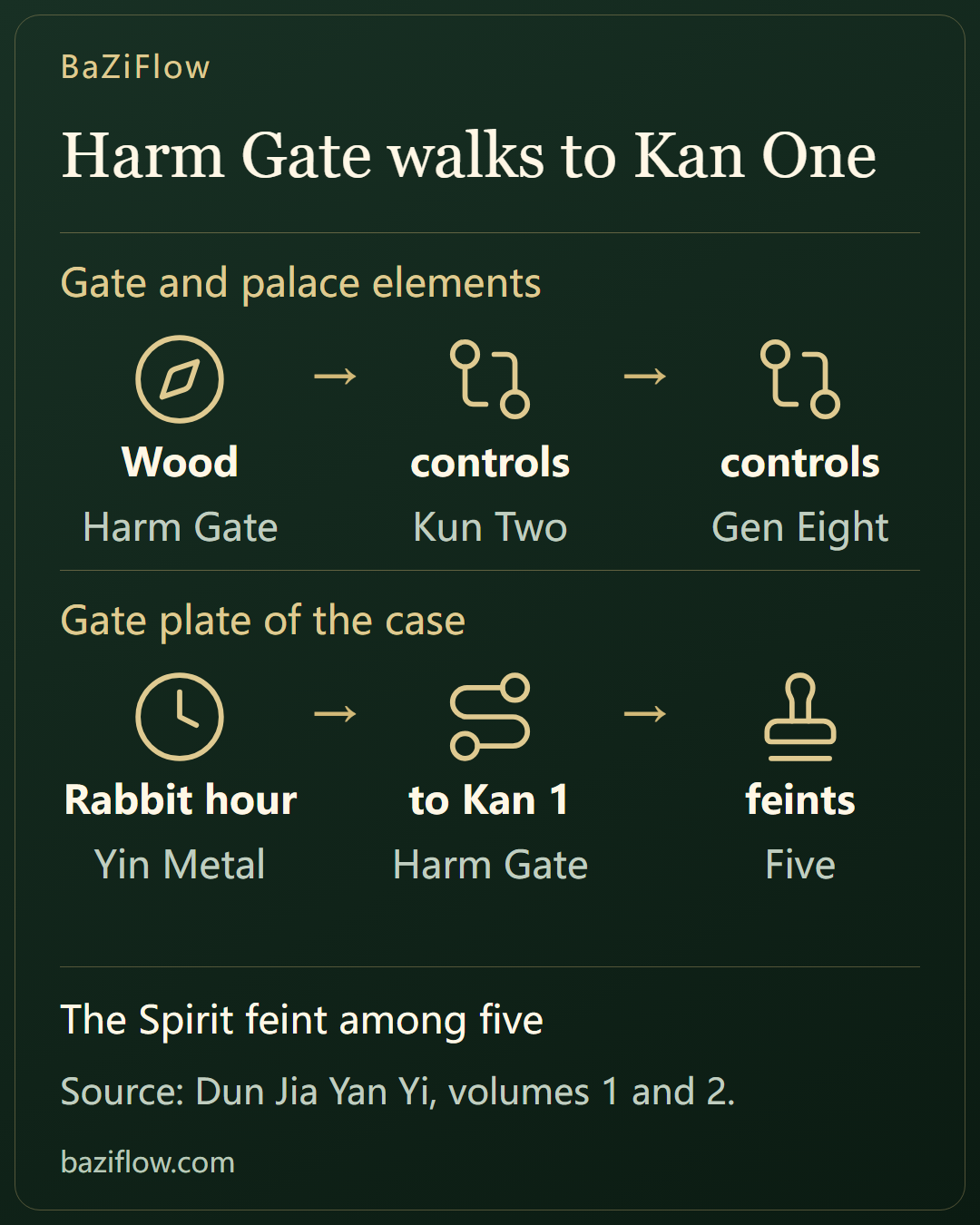
The Harm Gate has its home in Zhen Three and the element Wood. Using the Yan Bo Diao Sou fu, the pressure cases, an Earth-escape example and the ruses-and-feints passage, see why duty gate and pattern gate can differ.
The short version8 min read
"The Harm Gate is good for hunting; in the end you get the catch" is the line the verse gives the Wood gate of Zhen Three, which the book files with the unlucky gates. This article takes that label apart to see what the book actually gives it: one line of verse, two pressure cases, a duty-gate example and a feint.
- Home in Zhen Three, element Wood. The book's unlucky-gate pressure examples name only two boxes for it, Kun Two and Gen Eight, both Wood controlling Earth; it says nothing about the other five outer palaces.
- The Earth-escape example in volume 2 (Yang-mode ju 1, Yin Metal Rabbit hour of a Yang Fire or Yin Metal day) can be worked out: the duty gate walks from Zhen Three to Kan One, while the pattern forms in Kun Two, where the Harm Gate is not.
- In the three ruses and five feints the View, Harm, Shock, Block and Death gates are the five feints; Harm, Block and Death share the same joining and the same landing on Nine Earth, and each gets its own feint name.
Read first
Zhen Three's Wood gate: one verse and two boxes the book names
The short version: the Harm Gate (伤门) lives in Zhen Three, counts as Wood, and the book files it with the unlucky gates. Once it has left home, the picture already shows how each palace stands to Wood (how the gate element is assigned is explained in the Rest Gate). This section covers only the boxes the book itself points at.
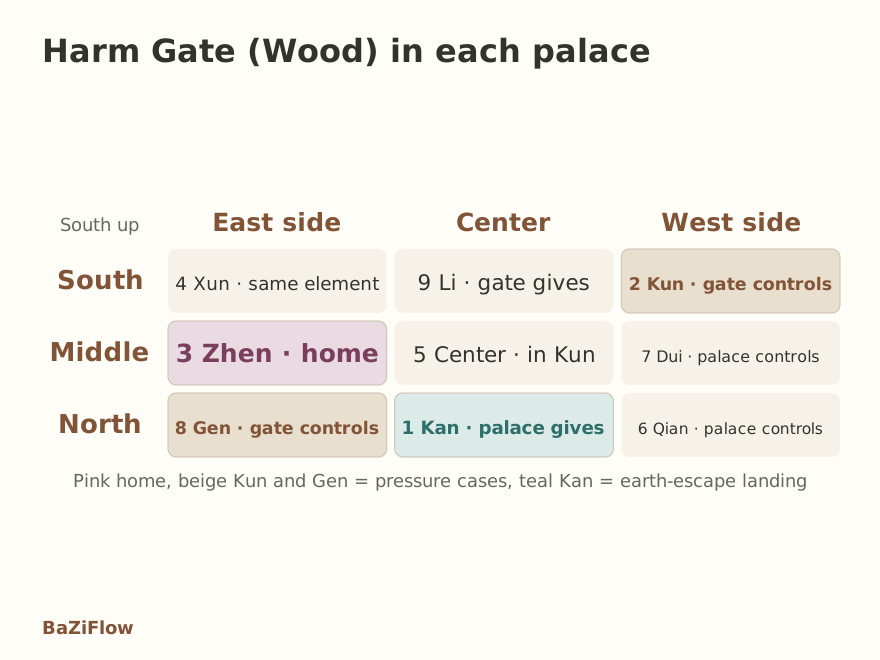
How Wood, the element of the Harm Gate, relates to each palace, with south at the top and east on the left. The gate element is taken from its home palace and palace elements follow the usual assignments; pink is home, beige marks the book's pressure cases and teal the Harm Gate's landing in the Earth-escape example.
The beige boxes are Kun Two and Gen Eight. Wood beats Earth here, the gate-over-palace case, and these are the two palaces where the book's examples of an unlucky gate under pressure put the Harm Gate. Teal Kan One is Water feeding Wood, a palace that supports the gate, and it is where the Harm Gate lands in the Earth-escape example further down. Pink Zhen Three is home.
Volume 1 prints a long rhapsody, the Yan Bo Diao Sou fu (烟波钓叟赋), which hands every gate one line on what it suits. The Harm Gate's reads:
The Harm Gate is good for hunting; in the end you get the catch.
It says what the gate is suited to and attaches no landing place to it. How it reads once it sits in a palace is left to the pressure and stacking passages that come later.
One arrow, two readings: "unaccomplished" for a lucky gate, "all the worse" for an unlucky one
In the pressure passage lucky and unlucky gates go through the same comparison, gate controls palace, and only the reading splits by team. The unlucky half is quoted from a classic the book cites:
When an unlucky gate is under pressure, unlucky affairs are all the worse.
For a lucky gate the sentence just before says the lucky affair is not accomplished; for an unlucky one this sentence says "all the worse". The two lists of examples side by side:
Enlarge diagram · scroll sideways to read
Of the Harm Gate's eight landing places, the book names just these two. Li Nine, Xun Four, Qian Six, Dui Seven and Kan One are not written, and this site does not fill them in.
The duty gate walks to Kan One: the Harm Gate in the Earth-escape example
The Earth escape (地遁) of volume 2 is the Open Gate with Yin Wood joined to Yin Earth. The first example it gives has the Harm Gate as duty gate:
Yang-mode ju 1, a Yang Fire or Yin Metal day, the Yin Metal Rabbit hour: Tian Chong is the duty star and goes onto the hour stem Yin Metal; the Harm Gate is the duty gate and goes to the first palace; the day wonder meets Yin Earth in the second palace. This is the Earth escape.
Working it step by step with the rotating-plate rule: Yin Metal Rabbit is the eighth double-hour of the Yang Wood Monkey (甲申) cycle, whose head is covered by Yang Metal. Look Yang Metal up on the earth plate of Yang-mode ju 1 and it is in Zhen Three, a palace holding Tian Chong and the Harm Gate as home items; that makes Tian Chong the duty star and the Harm Gate the duty gate, both still where they started. The Harm Gate counts seven double-hours from Zhen Three: 3 plus 7 is 10, which wraps to 1, and it lands in Kan One. The hour stem, Yin Metal, is in Xun Four on the earth plate, so the star plate turns one place, and the day wonder, Yin Wood, whose earth-plate position is Li Nine, goes with it to Kun Two and sits on the Yin Earth of the earth plate. That is "the day wonder meets Yin Earth in the second palace".
Enlarge diagram · scroll sideways to read
Carrying the same rule across the whole gate plate puts the Open Gate in Kun Two as well, so Open Gate, Yin Wood wonder and Yin Earth are all there, while the Harm Gate sits in Kan One.
Enlarge diagram · scroll sideways to read
Back to the relation picture: the Harm Gate left Zhen Three and reached Kan One, where Water nourishes Wood and the palace supports the gate. The Earth escape forms in Kun Two through the day wonder, Yin Earth and the Open Gate, and the Harm Gate is not part of it. The duty gate is fixed by the cycle head, while the gate that forms the pattern is picked out by the pattern's own conditions, and the two need not be the same.
Three ruses and five feints: the Harm Gate is the Spirit feint
The book calls the stacking patterns that borrow help from Great Yin (太阴), Six Harmony (六合) and Nine Earth (九地) the "three ruses and five feints". The three ruses (true, double and rest) join the three lucky gates, Rest, Open and Life, to the Three Wonders; the five gates left over, View, Harm, Shock, Block and Death, are given the five feints. The Harm Gate's line:
If the Harm Gate joins Yin Fire, Yin Earth and Yin Water and comes down onto Nine Earth, it is called the Spirit feint, and is good for burial.
Set the five lines side by side and a pattern shows:
Enlarge diagram · scroll sideways to read
The three unlucky gates are stacked the same way but each gets another name: the Harm Gate is the Spirit feint, the Block Gate the Earth feint, the Death Gate the Ghost feint. The name follows the gate, and the shape of the stack is shared by all three. The book also attaches a use to each feint, burial in the case of the Spirit feint. That is the book's entry for this stack, not a judgment on any particular chart.
Try it
Two questions in the book's numbers
A Harm Gate in Gen Eight: who controls whom, and is it one of the book's cases?
Gen Eight is Earth and Wood controls Earth, so the gate is the controller. The pressure passage names it: "the Harm and Block gates in the second and eighth palaces", and Gen Eight is among them.
The Harm, Block and Death gates all join Yin Fire, Yin Earth and Yin Water on Nine Earth. What are they called?
Harm Gate, Spirit feint; Block Gate, Earth feint; Death Gate, Ghost feint.
Read the Block Gate next. The Zhen Three palace shows the Harm Gate's own box, and the Life Gate is its neighbor on the ring.
Questions readers ask next
If the duty gate is the Harm Gate, does the pattern of that hour rest on it?
No. The duty gate is just the gate fixed by the cycle head and then counted out hour by hour. In the Earth-escape example it happens to be the Harm Gate, yet the pattern forms through the day wonder on Yin Earth; with the rotating-plate rule the Open Gate lands in that same palace and the Harm Gate in another.
Does "Harm" mean this gate hurts people?
Harm is the gate's name. In the lines quoted here the Harm Gate is tied to hunting in the Yan Bo Diao Sou fu and, joined to Nine Earth, called the Spirit feint, with burial as its listed use. None of them speaks of injury in real life, and the site glossary says the name cannot predict physical harm.
Why does the pressure passage name only two Harm-Gate boxes?
It gives examples, not a full list: two palaces each for the Harm and Block gates, one for the Death Gate, two for the Shock Gate. Landings it leaves out are not filled in here; sort out gate-controls-palace, palace-controls-gate and the generating relations first, then go back to the school you follow.
Was this article helpful?
Sources & references
Continue reading
Life Gate: Gen Eight Earth Gate, the Middle of the Heaven Escape and the Third Win ↗
Block Gate: Xun Four Wood Gate, Pushed to Kun Two in a Wanli 25 Example Chart ↗