

Two subjects in relationship readings
Content version · · Sources & references
Distinguish reversing a pair from replacing its members, then apply the same discipline to statements, guesses and shared agreements in relationship readings.
The short version6 min read
“Venus–Mars” can hide four ownership combinations. Keep the owner of each body, then distinguish reversing one connection from choosing another. The same distinction helps separate A’s guess about B from an answer B actually supplied.
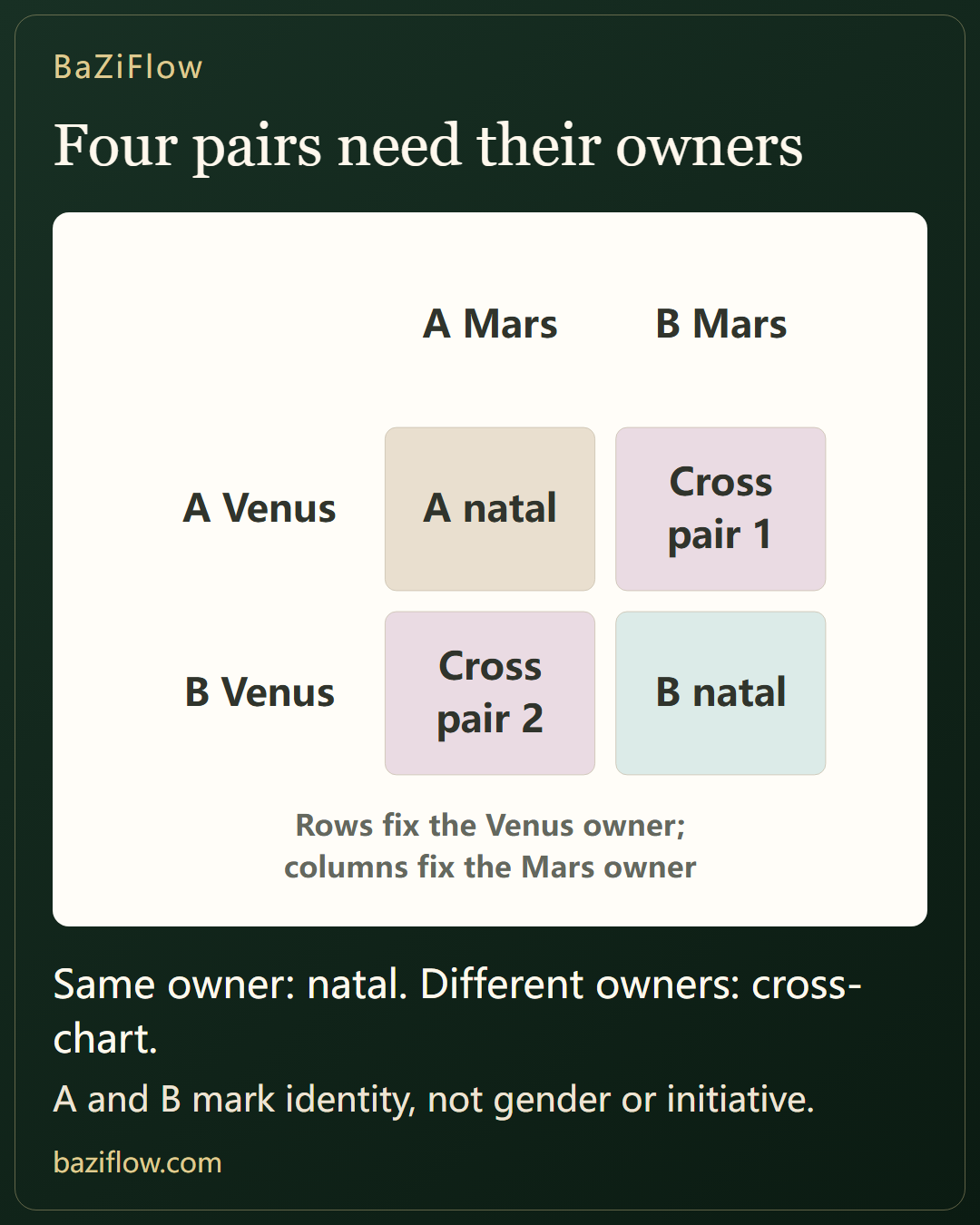
- Each person has Venus and Mars. The two cross-chart pairings differ from each other and from either person’s natal Venus–Mars pair.
- Reversing the order of the same two positions preserves distance. Selecting another person’s body changes the objects being compared.
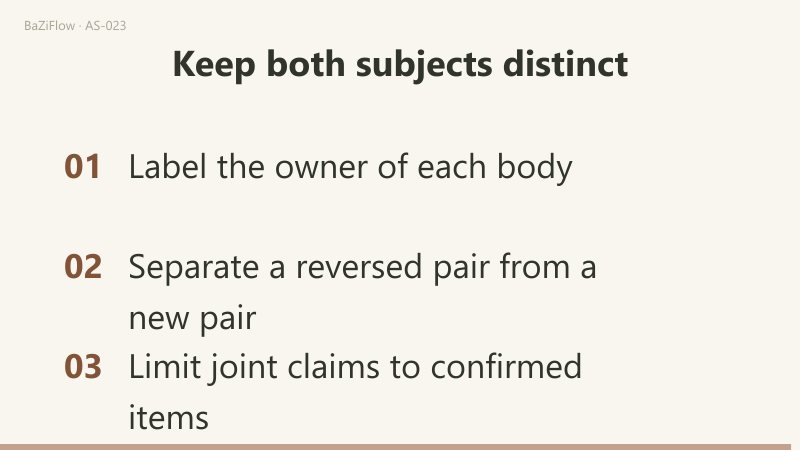
- A joint decision covers the item both people actually confirmed. A’s prediction of B’s wishes is not an answer provided by B.
Read first
Synastry and composite charts: why two correct calculations can differ ↗
Check whether the claim belongs to one chart or crosses two
The TimePassages manual describes a comparison bi-wheel as preserving both natal charts and showing inter-aspects. This distinction matters when a report moves from a cross-chart statement to a claim about one person's natal configuration.
In the example below, A's own Venus and Mars are 155° apart. B's own Venus and Mars are 55° apart. Neither natal pair has the 90° or 120° separation calculated below. Calling A “someone with a natal Venus–Mars square” would therefore be an input error, not an alternative interpretation of the cross-aspect.
House overlays need ownership too. State whose planet is being located in whose house system. If A's birth time is well documented and B's is unknown, the reliable time for A does not repair B's uncertain angles. Keep limitations attached to the affected person's data rather than averaging the quality of two records into one reassuring label.
The same rule applies when a report introduces a composite. A calculated composite position does not become either person's natal position. The comparison of synastry and composites gives a worked example of that change in data type.
Venus↓ Mars→
A Venus
- A Mars
- A natal
- B Mars
- Cross pair 1
B Venus
- A Mars
- Cross pair 2
- B Mars
- B natal
Rows fix the Venus owner; columns fix the Mars owner
Reversing a pair is not replacing its members
Take four invented longitudes: A Venus 45°, A Mars 200°, B Venus 80° and B Mars 135°. The separation between A Venus and B Mars is 90°. Reverse the written order to B Mars–A Venus and the separation remains 90°. You have renamed the same connection from the other end.
Now compare B Venus at 80° with A Mars at 200°. That separation is 120°. It is a different connection, although a shorthand description might call both “Venus–Mars.” If a reading drops ownership, it can quietly transfer the first angle to the second pair and still sound fluent.
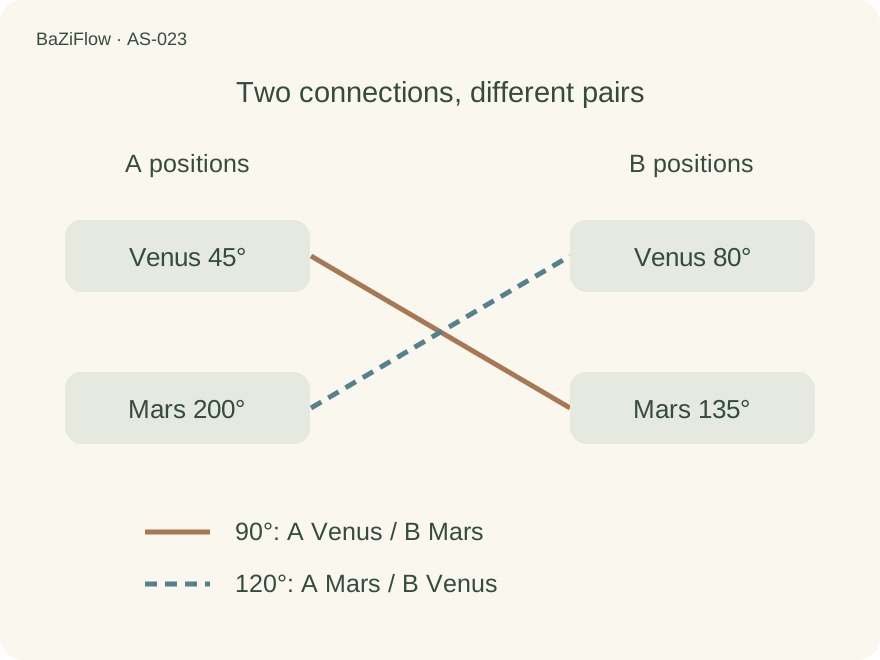
Original ownership diagram using invented positions. Lines show angle comparisons, not the direction of influence or consent.
The letters identify people only. They do not assign gender, initiative, desire or responsibility. Nor does a line indicate that the person at one end causes an experience in the person at the other. At this stage we have four positions and two angular calculations, not an account of a relationship.
A natal Venus → Mars
45° → 200°
B natal Venus → Mars
80° → 135°
Independent relative dials, each natal Venus as zero
Give spoken information its own ownership labels
Consider two people designing an accessible walking route for a neighbourhood group. A says, “I think B has lost interest.” That establishes that A expressed this concern. It does not establish B's preference, let alone an agreement between them to stop the project.
If B later says that a section of pavement still needs to be checked, retain that as B's new contribution. It might explain a delay, but you should not silently rewrite A's earlier guess as if it had always contained the new information. The chronology lets readers see what was known at each stage.
| Statement available to the reader | What it can establish |
|---|---|
| A would like to publish the route next month | A's proposed timing |
| A suspects B is no longer interested | A's interpretation of B |
| B reports an unchecked pavement section | Information supplied by B |
| Both agree to postpone publication until the check | That specific joint decision |
Even the final row has limits. It does not establish agreement on every route change, future deadline or division of work. A local decision should not expand into a claim about the whole relationship just because the prose uses “you both.”
A shared angle does not mean a shared experience
Distance is symmetric, but people's accounts need not be identical. In the walking-route example, one participant might be responsible for maps while the other checks physical access. Their different responsibilities can make the same delay mean different things. Those roles come from the project record, not from assigning one participant the Venus role and the other the Mars role.
Research by Eyal and colleagues in 2018 found no consistent accuracy benefit from simply imagining another person's perspective; directly obtaining information helped in the relevant experiment. This was not a test of astrology. Its relevance here is narrower: a confident reconstruction of someone's view is not the same evidence as information supplied by that person.
Asking is not a guarantee of a complete or final answer, either. A participant may be unsure, unavailable or unwilling to discuss a subject. The record can preserve that limit without filling it with a hidden motive. A relationship reading should not require contact with an absent person merely to make the narrative feel complete.
One shared angle
Reversing its endpoints does not change geometric distance.
Different roles
Map design and access checks have different practical constraints.
Separate accounts
Keep each participant’s response to the same proposed arrangement.
Revise the attribution before revising the adjectives
Suppose a draft says, “B is resisting your shared purpose.” Replacing “resisting” with “hesitant about” leaves the unsupported ownership claim intact. A better correction is to state the actual evidence: A is concerned about the delay; B's current view has not been obtained. If a specific project update is later supplied, identify its speaker and scope.
For a practical next step, the route team could list which sections have been checked and which remain uncertain. This addresses the work already described without assuming why either person feels as they do. If they make an agreement, record the agreement itself instead of treating an aspect as a proxy for consent.
Before sharing a reading, trace every “you,” “they” and “both” back to a person or a clearly bounded joint statement. Repeated names can be preferable to elegant but ambiguous pronouns. Keep chart positions, participant statements and the writer's symbolic proposals distinguishable all the way to the conclusion. The whole-chart reading sequence offers a related way to preserve missing information without inventing a complete story.
Locate the gap
A wants publication; one section of pavement has not been checked.
Ask about the task
Identify the unchecked section and who can inspect it.
Revise the arrangement
Set a check before publication rather than assigning an unconfirmed motive.
Questions readers ask next
Is A Venus–B Mars the same as B Venus–A Mars?
No. In the exercise, the first pair is 45° against 135°, giving 90°. The second is 80° against 200°, giving 120°. Only reversing the order of the identical two positions must preserve the angle.
Can a cross-chart square become one person’s natal square?
No. A’s own 45° and 200° positions are 155° apart; B’s 80° and 135° are 55° apart. The cross-chart 90° uses different owners and cannot be transferred into either natal chart.
Does one confirmed arrangement establish agreement on the whole relationship?
No. An agreement to wait for a pavement check establishes that decision, not every route change or future deadline. A predicting that B will agree is also different from obtaining B’s answer.
Was this article helpful?
Sources & references
Continue reading
Conjunction, Opposition and Square: Learn to Measure the Angle Before Judging Good or Bad ↗