

Hua Ji: ask the star, place and source
Content version · · Sources & references
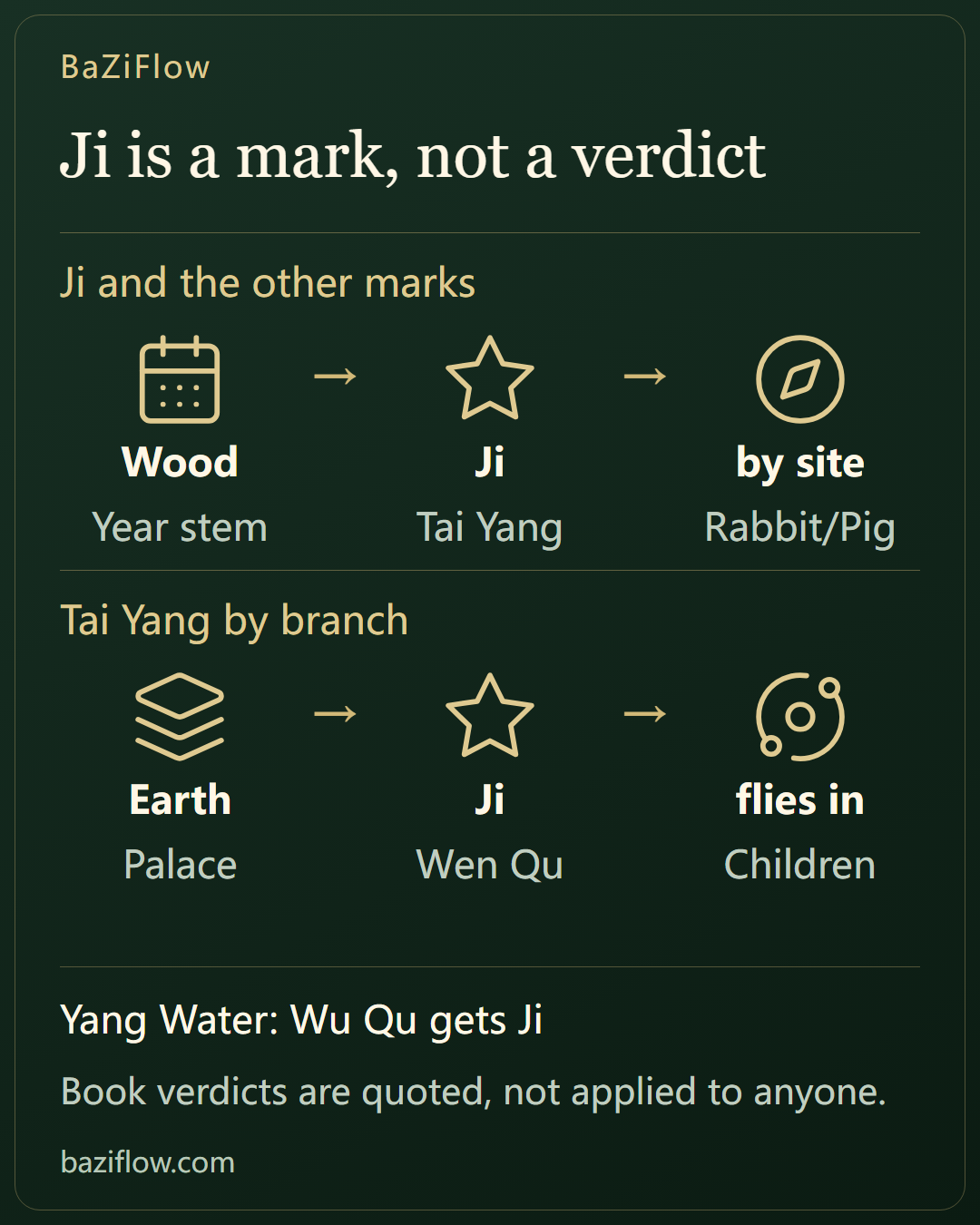
Hua Ji is a mark on a star; Wu Qu, Tian Ji and Tai Yin collect all four marks. Two Yang Wood year charts and the conditions in the Quan Shu's Ji entry show how star, place, brightness and source shape a record.
The short version7 min read
Hua Ji (Ji for short) is the fourth mark a table look-up attaches to a star. The book's verdicts on it are heavy, but they come with conditions of star and position, so before reading it, ask which star carries it, where the star sits and which stem produced it.
- Wu Qu, Tian Ji and Tai Yin each collect Lu, Quan, Ke and Ji somewhere in the table, which shows that Ji is a mark laid on a star and not a trait of the star.
- The Quan Shu's own Ji entry carries conditions: Tai Yang on the Tiger to Horse branches and Tai Yin on Rooster to Rat are labeled a good reading, while the sun or moon in a fallen place is written up very heavily.
- One Yang Wood year's Tai Yang Ji lands in the Rabbit palace (Miao) in one sample chart and in the Pig palace (Xian) in the other; palace-stem and self Ji have records of their own.
Read first
Ji: the fourth mark laid on a star
Hua Ji (化忌), "Ji" for short, closes the set of four marks. Again a stem looked up in the table decides which star receives it, so the first thing to see clearly is whom it was laid on.
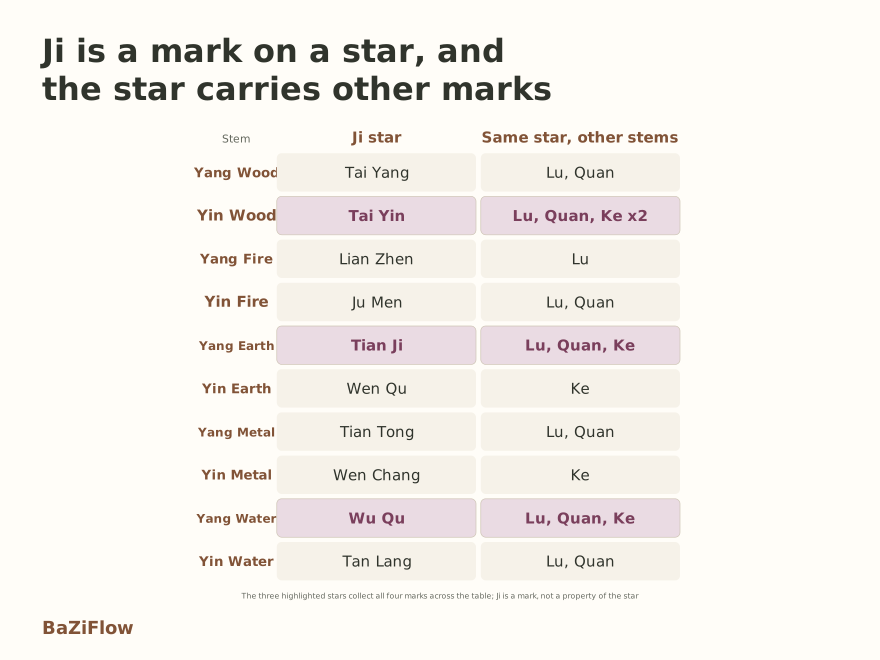
Ji stars come from the engine's four-transformation table (identical cell by cell to the iztro default); the right column lists the marks the same star receives under other stems, and the highlighted rows are the three stars that collect all four.
On the left sits the Ji star for each of the ten stems; on the right, what else that same star becomes under other stems. A star in the Ji column does not belong to Ji alone: Lian Zhen (廉贞) is Ji under Yang Fire and Lu under Yang Wood, and Wen Qu and Wen Chang, outside the Ji column, appear only in the Ke column.
The Quan Shu (紫微斗数全书), second juan, opens its Ji entry by assigning it an element:
The Ji star is Water, the god who manages a great many things.
The verdicts that follow are heavy, but the same entry goes on at once to write a string of conditions, set out in the third section below. First, the facts in the table.
One Wu Qu, four marks
Three rows in the right column are highlighted: Tai Yin (Ji under Yin Wood), Tian Ji (Ji under Yang Earth) and Wu Qu (Ji under Yang Water). Across the whole table these three stars collect Lu, Quan, Ke and Ji, each under a different stem:
Enlarge diagram · scroll sideways to read
Under Yang Water Wu Qu is Ji, and under Yang Wood the very same Wu Qu is Ke. So the words "Wu Qu Hua Ji" describe the result of one look-up, not a condition of Wu Qu, and the first thing to settle is where the stem came from.
What the book itself sets down as conditions
The Ji entry contains a passage written in terms of star plus place:
If Tai Yang is on Tiger, Rabbit, Dragon, Snake or Horse and takes Ji, or Tai Yin on Rooster, Dog, Pig or Rat, it is to be read as fortunate. If sun and moon are in fallen places and take Ji, it is very bad.
The book sorts the same "Ji" into two grades by star and position. Tai Yang's brightness table can be set beside it directly: in the engine Tai Yang is Wang or Miao on the Tiger, Rabbit, Dragon, Snake and Horse, and Xian on the Rooster, Pig and Rat, with Goat and Monkey De and Dog and Ox Bu. The book's Tiger-to-Horse grade is exactly the Wang and Miao stretch of the engine table for Tai Yang.
Enlarge diagram · scroll sideways to read
For Tai Yin only the book's wording is used: Rooster to Rat, labeled the same way. The Tai Yin brightness table in iztro, the library the engine uses, has a problem its author has acknowledged but not yet fixed, so there is no branch-by-branch comparison here. The book's verse on periods has a line pointing the same way: "A Ji star that enters Miao is better instead". All three are the book's own statements, and each carries a condition of star and place.
One Yang Wood row, two charts
Take two hours on the same day: solar 18 March 1994, female, Yang Wood Dog year, lunar month 2, day 7. One chart at the Dog hour (chart A), one at the Horse hour (chart B). Both have the year stem Yang Wood, and the table gives the same row: Tai Yang takes Ji.
Enlarge diagram · scroll sideways to read
Same table row, new hour, and Tai Yang changes branch, palace name and brightness. A birth-year Ji record therefore has to carry the star's place and brightness, and "Tai Yang Hua Ji" alone is incomplete. What the two grades mean in a reading is something the book already says in its own way; this article only lays out the conditions and passes no verdict on either chart.
Palace-stem Ji and self-Ji: the other two sources
Chart A's twelve palaces each have a stem. Take three of them and look at Ji:
Enlarge diagram · scroll sideways to read
The Life palace entry deserves notice: the Ji under Yin Earth is Wen Qu, a supporting star, so a search for star positions has to count supporting stars too (see Hua Ke). Travel and Wealth are self-transformations, the star being in the sending palace itself. The birth-year Ji is in the Partner palace and comes from the year stem, Yang Wood. Each of the three records has its own entrance, and together they must not be written up as "the chart has so many Ji".
Writing down one Ji: three questions first
Which star carries the mark
Look up the star name from the stem first. The same star can be Lu, Quan or Ke under other stems, so write the star name together with the word Ji.
Where it sits and how bright
Find the star's palace and branch in the chart, then read its brightness. The two Tai Yang grades in the example were separated by exactly these two items.
Which kind of source
Birth-year stem, a palace's stem, or self in the same palace: one line each. A different entrance means a different record.
Two table look-ups
A Yang Water year: which star takes Ji, and what else does this star become in the table?
Yang Water gives Ji to Wu Qu, which is Lu under Yin Earth, Quan under Yang Metal and Ke under Yang Wood, so it collects all four marks.
A Yang Fire year gives Ji to Lian Zhen. If Lian Zhen sits on the Pig, what is its brightness in the engine table?
Lian Zhen on the Pig is Xian. For "Lian Zhen on the Pig takes Ji" the book adds a condition about a "water-natured person" without defining the term there, so a note records only the place and brightness and marks the condition as unchecked.
Put Ji back into the whole table: Hua Lu, Hua Quan, Hua Ke and Hua Ji are four columns of one ten-stem table.
Questions readers ask next
The book writes Ji very heavily. Why say it cannot simply be taken as bad?
The same entry goes on to list conditions: when Tai Yang or Tai Yin sits on certain branches, the book itself labels it a good reading, and its verse on periods says a Ji star that enters Miao is better. The book's own method is to look at the star and place before concluding.
If a chart has Hua Ji, will some area of life surely go wrong?
The look-up only says which star carries the mark; it gives no event and no time. You still need to know whether it came from the year stem, a palace stem or a self-transformation, and the star's place and brightness.
Do birth-year Ji, palace-stem Ji and self-Ji need to be read separately?
Yes. Their entrance stems differ and so do the fields of the record. In the sample, Life flying Ji into Children and Travel's self-Ji are two kinds of record and must not be merged into "the chart has two Ji".
Was this article helpful?
Sources & references
Continue reading
Hua Ke (化科): Four Stems Pick Supporting Stars, and the Three Sources ↗