

Eight of Wands: staves over open country
Content version · · Sources & references
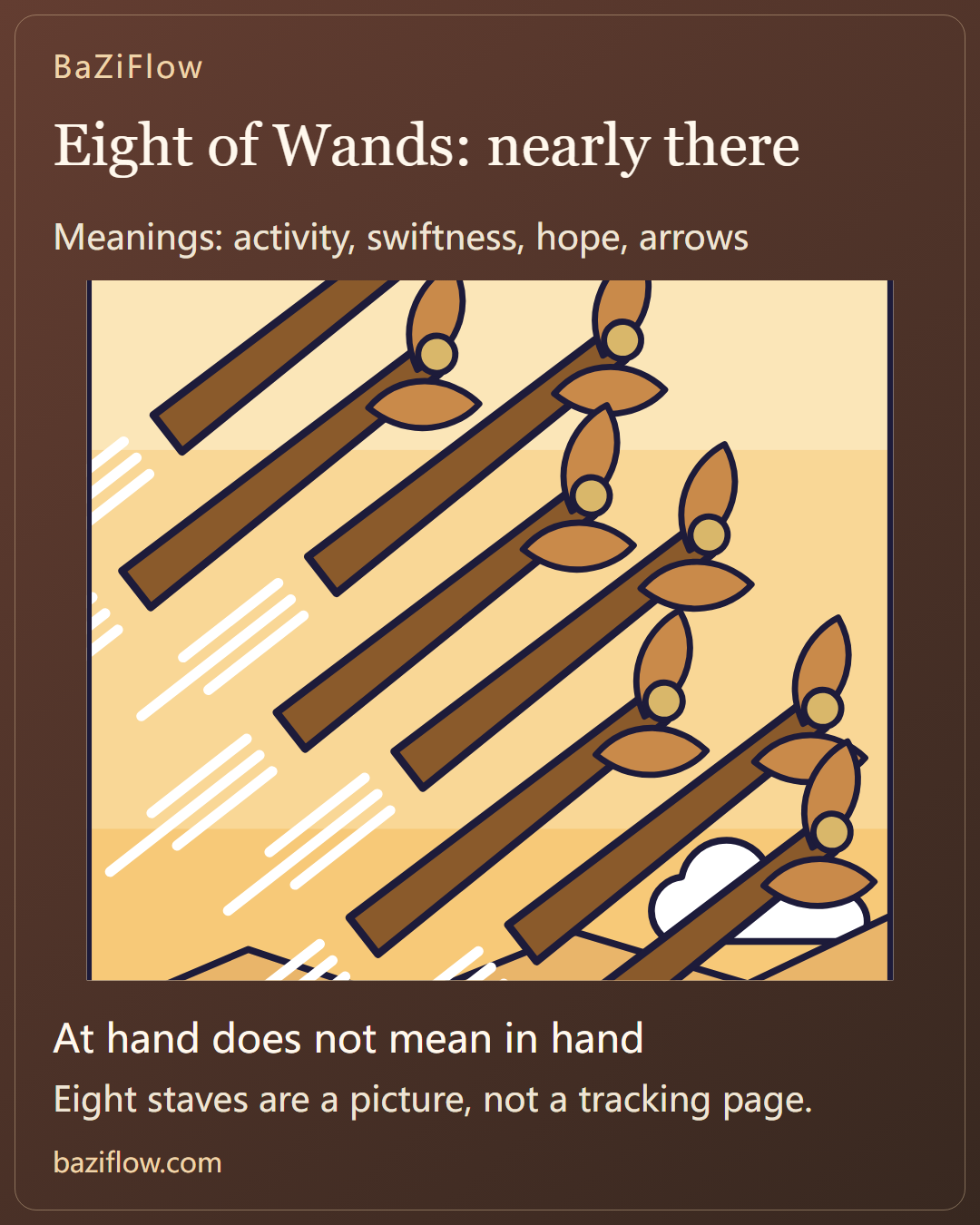
The Eight of Wands shows eight staves flying over open country with no one in sight. Read Waite's "on the threshold" and "arrows of love", then sort shipped parcels by how far each has moved.
The short version7 min read
The Eight of Wands has no person in it, only eight staves slanting across the sky. Waite calls it motion through the immovable, with the wands drawing near the end of their course; so first sort what is moving from what stands still, and how far it has moved.
- Waite reads the picture as wands in flight, near the end of their course, with what they signify close beside you and perhaps already on the doorstep.
- The list circles motion: activity and its path, haste, great hope, summed up as whatever is on the move, and finally "the arrows of love".
- Reversed, the arrow changes direction: jealousy, internal dispute, pangs of conscience, quarrels. The one additional line, domestic disputes for the married, nearly repeats the end of the reversed entry.
Read first
Start with the picture: eight staves across the sky, nobody in sight
Waite's description of this card has no figure in it, only movement. The card represents "motion through the immovable—a flight of wands through an open country; but they draw to the term of their course. That which they signify is at hand; it may be even on the threshold."
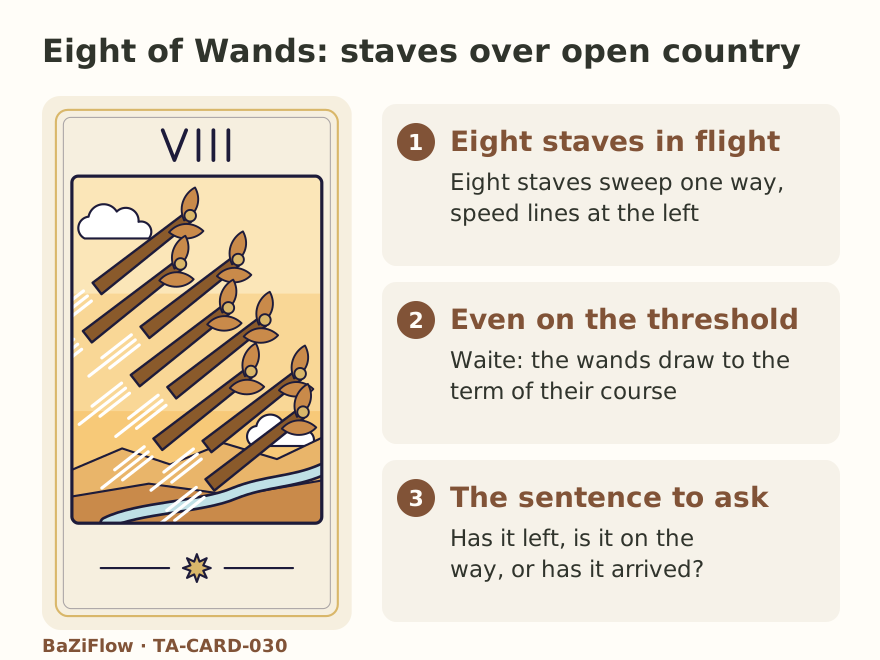
Eight of Wands: staves over open country
In the Rider-Waite-Smith picture eight leafy staves sweep in parallel from upper left to lower right across a blue sky. Below them lie rolling green fields with a watercourse running through, and a building on a distant rise. There is no person and no hand. All eight staves point the same way, and none has strayed from the formation.
Enlarge diagram · scroll sideways to read
What Waite lists: things in motion, speed and "on the threshold"
Waite's divinatory meanings circle around movement: activity in undertakings, the path of such activity, swiftness as that of an express messenger, great haste, great hope, speed towards an end which promises assured felicity; the summing-up line is "that which is on the move", and the last item is "the arrows of love".
Activity in undertakings, the path of such activity, swiftness, as that of an express messenger; great haste, great hope, speed towards an end which promises assured felicity; generally, that which is on the move; also the arrows of love.
Enlarge diagram · scroll sideways to read
Flying staves, open country and "arrows": where each comes from
Three things in this card can be taken apart: the flying staves, the country with nobody in it, and the metaphor of an arrow.
Where the flight, the fields and the arrows come from
- The flying staves
- Waite calls it motion through the immovable and says the wands draw to the term of their course. The express messenger turns up in the list, where the swiftness is "as that of an express messenger".
- The open country
- Waite writes "an open country" and mentions no person and no destination. The hills, water and building in the Rider-Waite-Smith picture he leaves unmentioned. Teaching reads the still background as fixed conditions, which is a borrowing.
- The arrow
- The "arrows of love" at the end of the list and the "arrows of jealousy" in the reversed entry are Waite's figures of speech: staves spoken of as arrows. The picture has no bow and no target.
Enlarge diagram · scroll sideways to read
The pairing country = fixed terms, staves = things in transit comes from teaching, not from Waite. It earns its place by splitting the card into two lists: what moves, and what stays.
How to read it: sort shipped parcels by how far they have moved
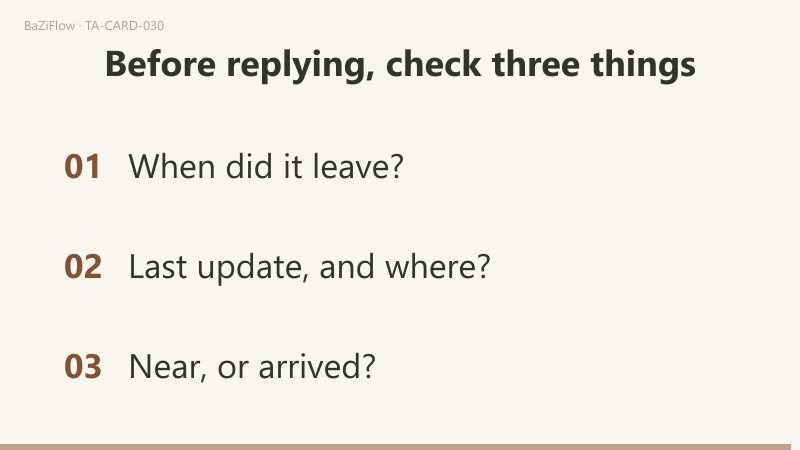
The easy slip with the Eight of Wands is to treat "soon" and "nearly there" as "there". The picture offers three things to ask: when the staves left the hand, how far they have flown, and how close the threshold is. Applied to a batch of parcels already sent, they become three questions:
Start: when did it leave your hands?
Waite's wands are mid-flight, and the start is outside the picture. A parcel is the same: find the pickup record first and write down the time. Without it, "in transit" has nothing behind it.
Path: when did it last move?
Waite writes of "the path of such activity". A path is read from its checkpoints: where the last scan was and how long ago. With no new checkpoint for two days, "in transit" is left as a hope.
Threshold: nearly there, or there?
Waite has the wands at hand, even on the threshold, and never "landed". In tracking terms that is "out for delivery" against "delivered", and a reply to a customer should keep the two apart.
An example: on Friday afternoon a small dried-flower shop sends out eight parcels, and on Sunday evening a customer asks, "Has it arrived?" Set the eight tracking numbers against the carrier records and they fall into four states:
Enlarge diagram · scroll sideways to read
Once the four rows are filled, "has it arrived?" has four different answers instead of one "soon". The first three rows can go straight to the customer, and the fourth has to be checked with the carrier first. The Eight of Wands covers only the states in which something moves, and the stuck parcel falls outside it.
The count before replying
Safe to say
- Signed, with the time
- Out for delivery, unsigned
Hold back
- "Soon", "should be there"
- "In transit" with no scan
To add
- Look up the last scan
- Ask the carrier about the stalled one
Reversed and neighboring cards: arrows of love and of jealousy, and three cards that carry a message
Waite's reversed entry turns the arrow around: arrows of jealousy, internal dispute, stingings of conscience, quarrels, and domestic disputes for persons who are married. The "arrows of love" of the upright have become arrows of jealousy: one figure of speech with opposite content at each end. The additional meanings hold a single line, domestic disputes for a married person, which nearly repeats the end of the main reversed entry and can be read as the same wording over again.
Enlarge diagram · scroll sideways to read
Three cards about carrying things, and where each puts the person
Someone watching from a cliff
Waite writes a figure with his back turned, looking from a cliff's edge at ships bearing his merchandise over the sea. The list is established strength, enterprise, trade and discovery. Unlike the Eight, a person watches and there are goods.
Someone proclaiming news
Waite has a young man standing in the act of proclamation, his tidings strange; the list includes an envoy and a postman. It also concerns carrying word, and here there is a person, where the eight staves have none.
The next card: the one who has stopped
The staves no longer fly: a figure leans on one and the others stand in a row behind him. The list turns to strength set against opposition, and delay and suspension ride along with it.
Questions readers ask next
Does the Eight of Wands mean something will happen soon?
The list does include swiftness and haste, but Waite writes of wands near the end of their course, with what they signify at hand and perhaps on the threshold. Those are phrases for "nearly there"; none says "arrived", and none gives a time. Actual timing comes from your own records.
What does the Eight of Wands mean reversed?
Waite gives arrows of jealousy, internal dispute, stingings of conscience and quarrels, and says domestic disputes for married persons. The "arrows of love" of the upright become arrows of jealousy: one image of an arrow, written with opposite content at each end.
Why is there no person on the Eight of Wands?
Waite's description has no figure at all and speaks only of the flight; the Rider-Waite-Smith picture shows only staves, sky, fields and water. With no clue to who is acting, whoever reads the card has to supply the subject of the question.
Was this article helpful?
Sources & references
Continue reading
Three of Wands: his back to us at the cliff, watching ships, and a look "towards yours" ↗