

Visual index
Every diagram belongs to an article: see the relationship first, then read the reasoning.
Selected diagrams
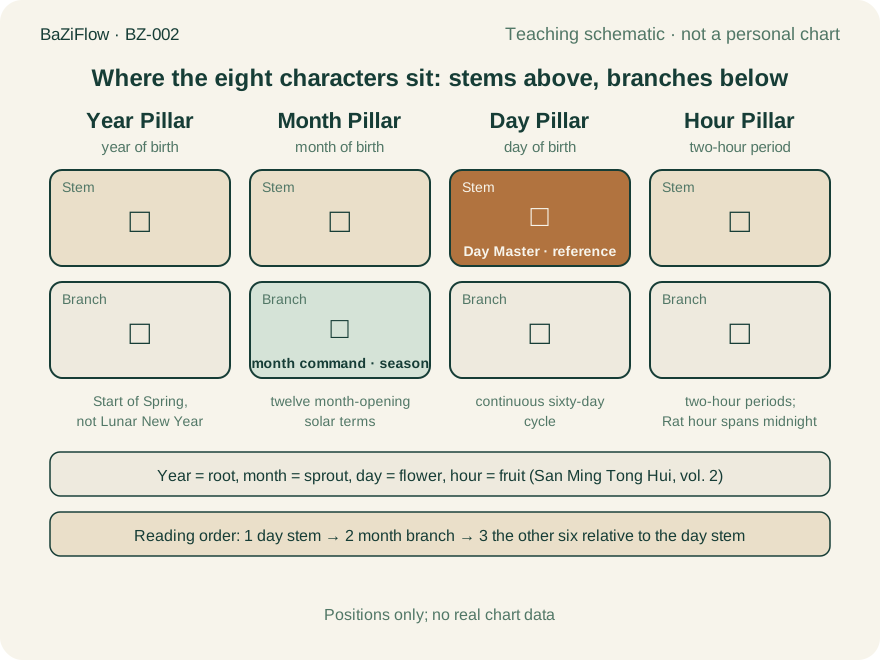 VI-001 / BZ-002
The four pillars and the Day Master at a glance
Read the article: Reading a BaZi chart for the first time: the four pillars and the Day Master
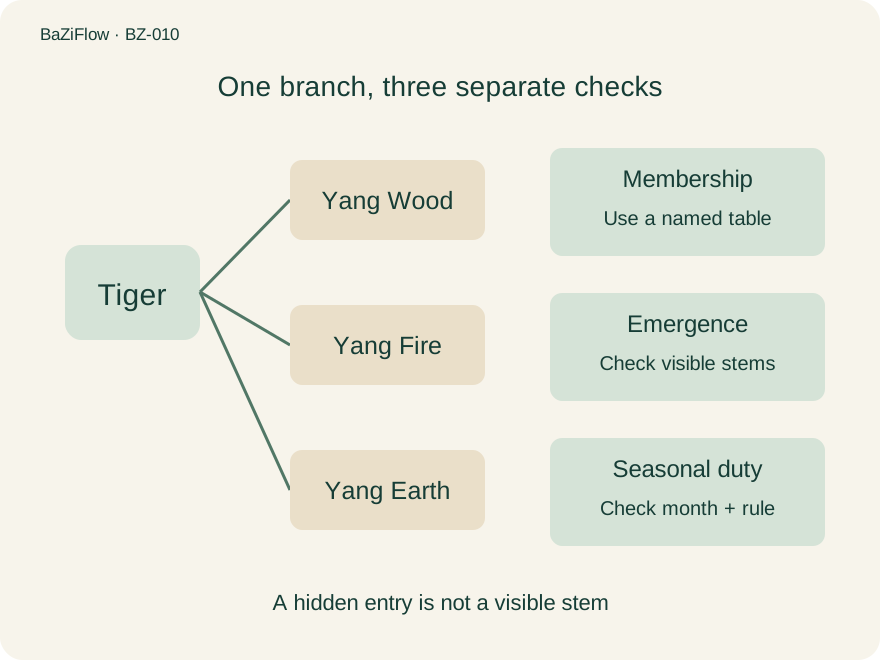 VI-002 / BZ-010
Hidden stems inside the twelve branches
Read the article: Hidden stems: separate the branch list, visible expression and seasonal rulership
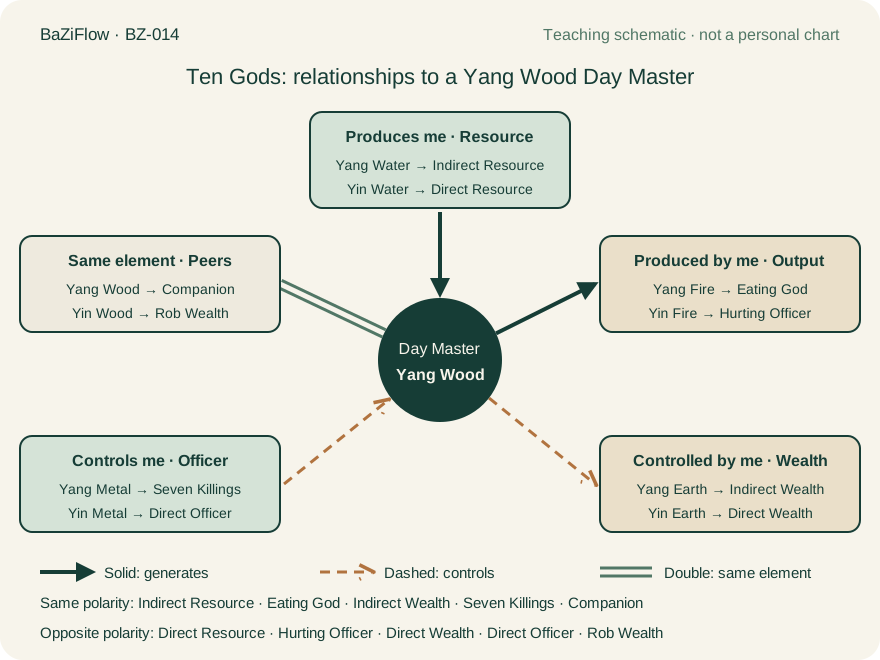 VI-003 / BZ-014
How the Ten Gods radiate from the Day Master
Read the article: How the Ten Gods are derived: five relationships and two polarities
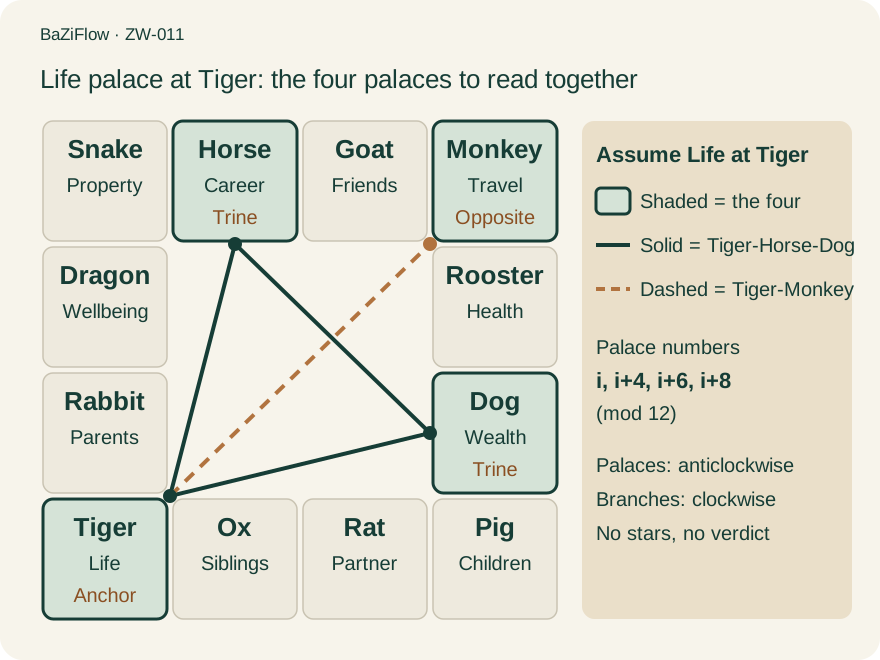 VI-004 / ZW-011
Zi Wei three sides and four directions
Read the article: Three sides, four directions: the four palaces read together
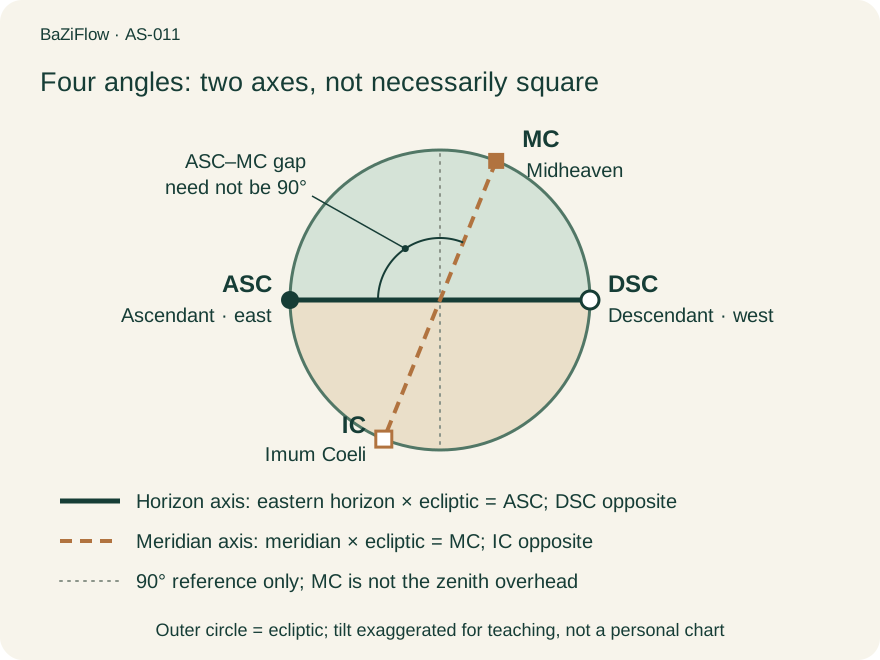 VI-005 / AS-011
The four angles and twelve houses
Read the article: Ascendant, Descendant, MC and IC: Two Axes on the Zodiac
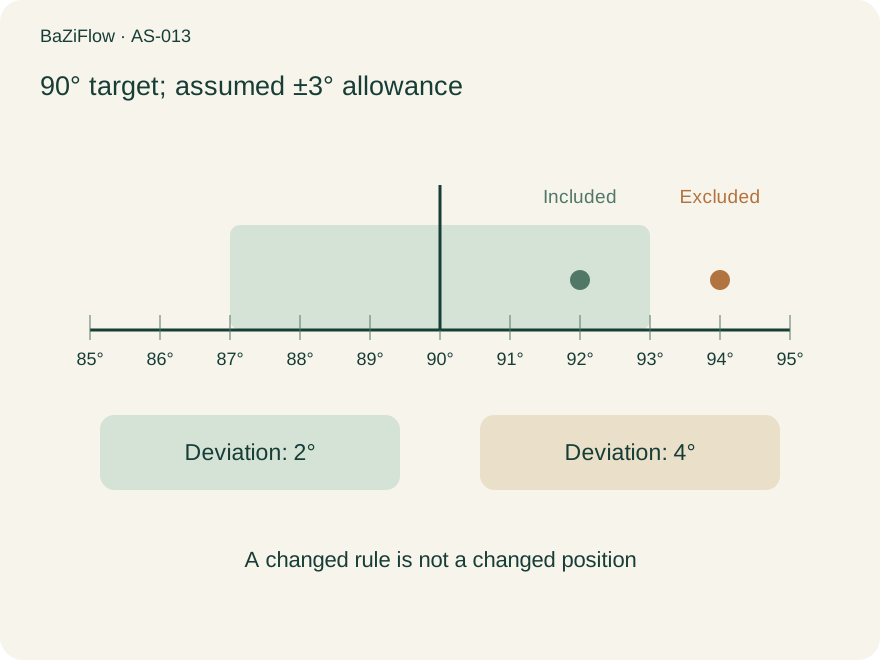 VI-006 / AS-013
Aspect angles and orbs
Read the article: Aspects and orbs in astrology: how to calculate the angle between two planets
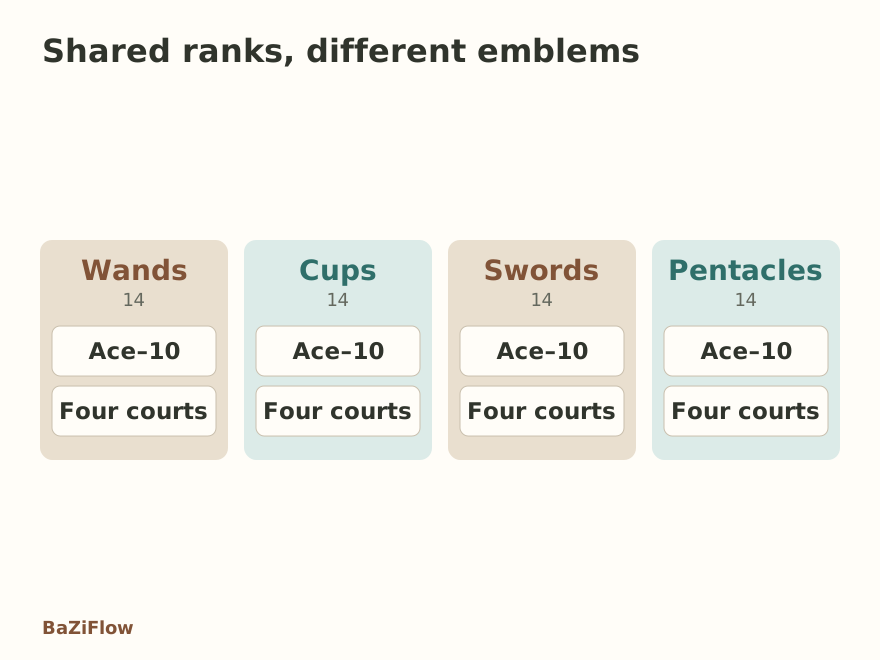 VI-007 / TA-003
Tarot suits and number layers
Read the article: The Four Tarot Suits: Enter Through Objects, Not Four Sealed Areas of Life
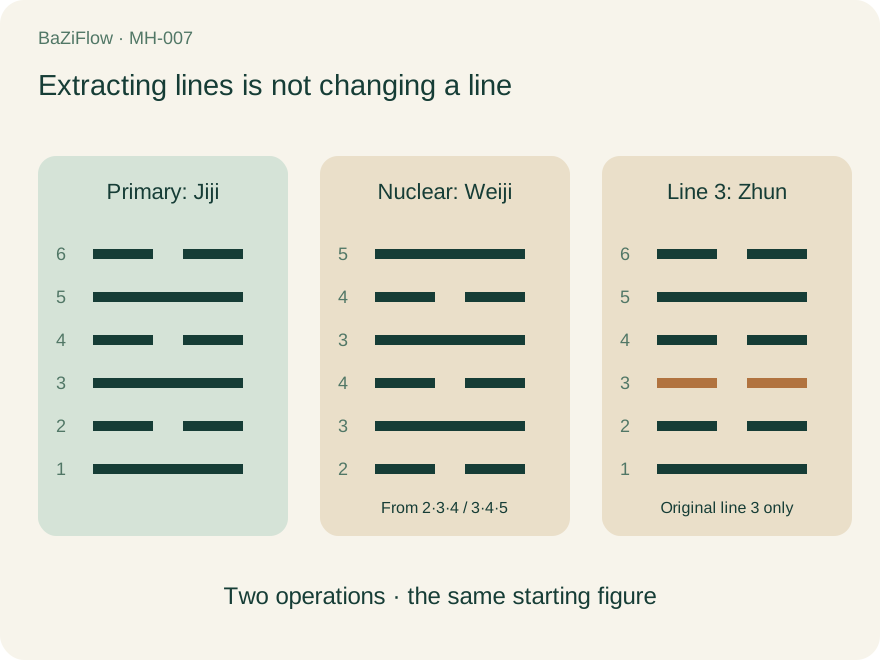 VI-008 / MH-007
Primary hexagram, moving line and changed hexagram
Read the article: Primary, nuclear and changed hexagrams: trace each operation
All diagrams
 ZW-AUX-16 / Zi Wei Dou Shu
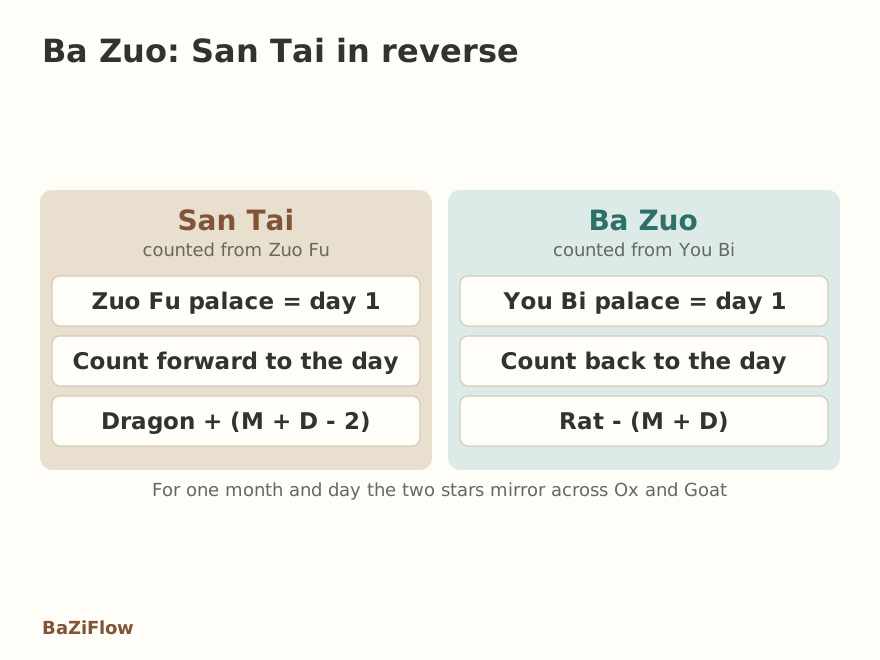
Ba Zuo (八座): The Mirror of San Tai, Counted Back from You Bi
Ba Zuo is counted backward from the You Bi palace, with the first day on that palace. The mirror axis shared with San Tai, when the two share a palace or face each other, and the five places the Quan Shu says "Ba Zuo".
 ZW-AUX-17 / Zi Wei Dou Shu
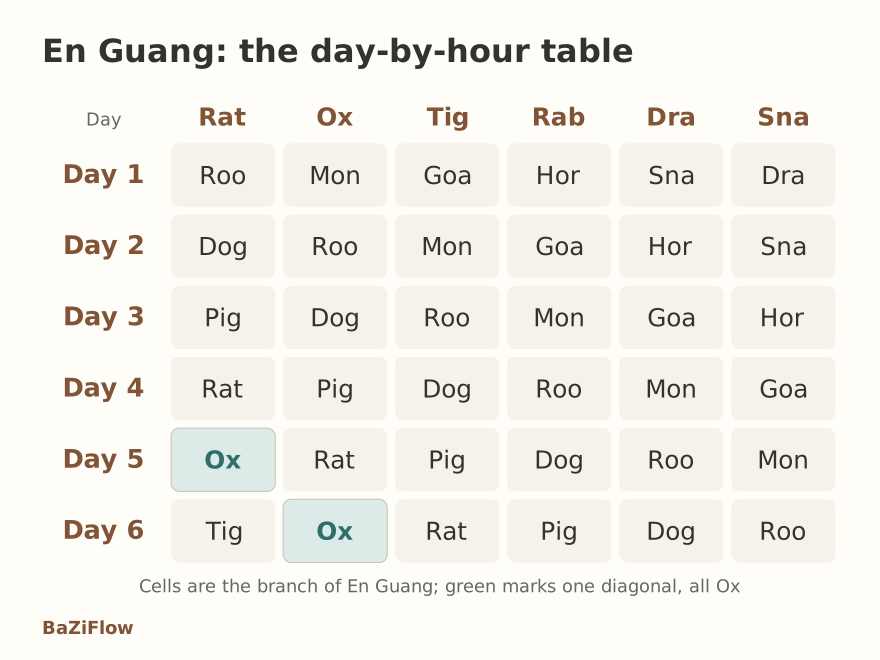
En Guang (恩光): The Minor Star That Ignores the Birth Month
En Guang finds Wen Chang by birth hour, puts day 1 there, counts to the birth day and steps back one, so the month never enters. A day-by-hour table gives the landings, and the book has the words in one verse only.
 ZW-AUX-43 / Zi Wei Dou Shu
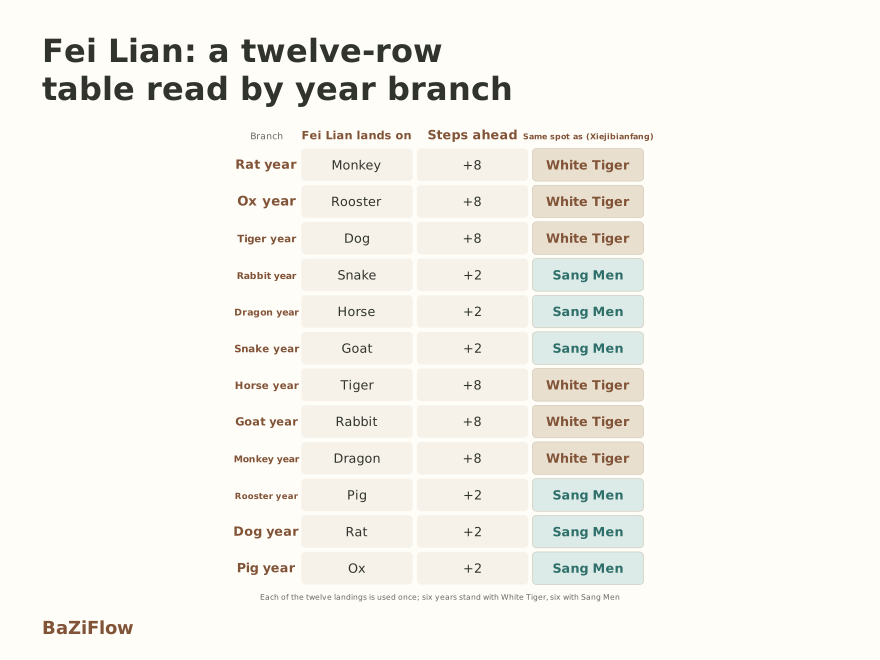
Fei Lian (蜚廉): A Twelve-Row Year-Branch Table, Matching the Xiejibianfang's Year Spirit
Fei Lian lands by a year-branch table: Rat year on Monkey, then three places back per group of three years. Checked row by row against the Xiejibianfang and kept apart from the Bo Shi ring's star of the same name.
 ZW-AUX-20 / Zi Wei Dou Shu
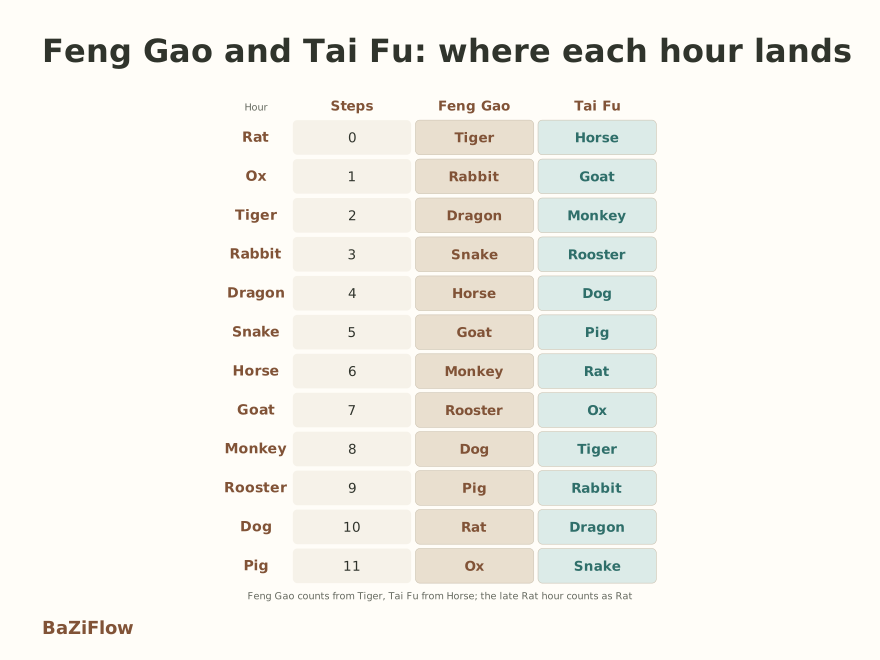
Feng Gao (封诰): An Hour-Only Star That Shows Only Six Palace Names a Month
The branch of Feng Gao comes from the birth hour alone: Rat hour on Tiger, then forward. A twelve-hour table, its four-step link to Tai Fu and a sample chart separate branch, palace name and month.
 ZW-AUX-22 / Zi Wei Dou Shu
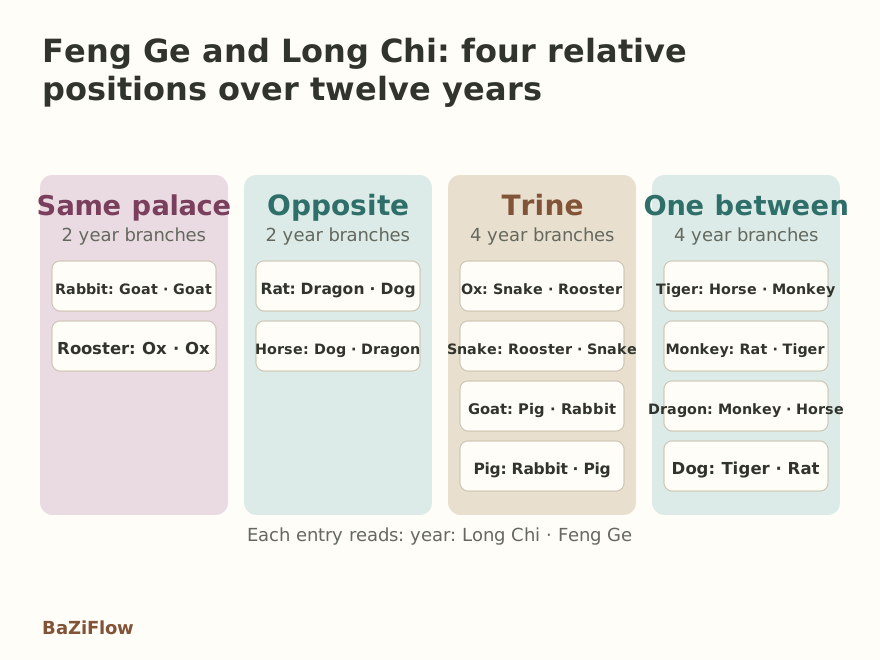
Feng Ge (凤阁): Rat Year on Dog, One Step Back a Year, and Why It Mirrors Long Chi
Feng Ge counts backward from the birth-year branch: Rat year on Dog, one palace back a year. A grouped chart of four relations, its mirror link to Long Chi, a January conversion and three sample charts.
 ZW-AUX-39 / Zi Wei Dou Shu
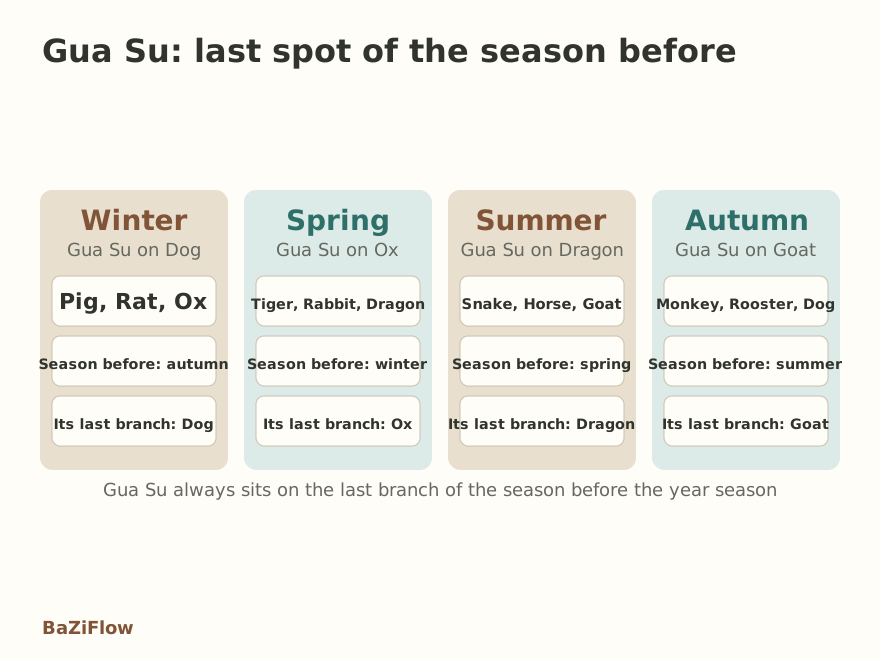
Gua Su (寡宿): Last Branch of the Season Before, Always Eight From Gu Chen
Gua Su follows the birth-year season group and lands on the last branch of the season before. Its fixed distance from Gu Chen, a twelve-year sweep with Life held still, and the Quan Shu use as a name for Wu Qu.
 ZW-AUX-38 / Zi Wei Dou Shu
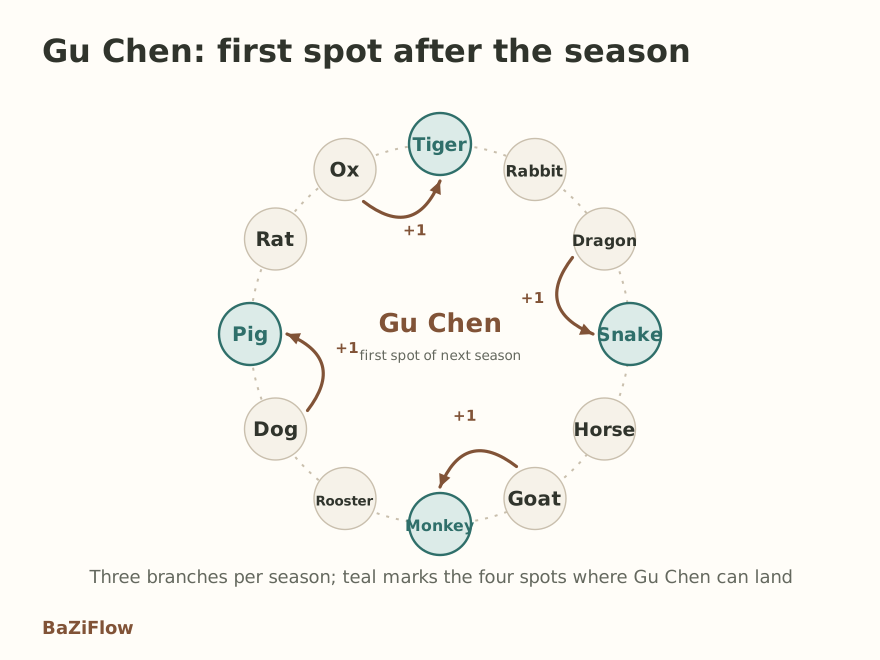
Gu Chen (孤辰): First Branch After the Year Season, Not the Quan Shu Word
Gu Chen follows the season group of the birth-year branch and lands on the first branch of the next season: Tiger, Snake, Monkey or Pig. A season table, three sample charts and a twelve-year staircase.
 ZW-AUX-32 / Zi Wei Dou Shu
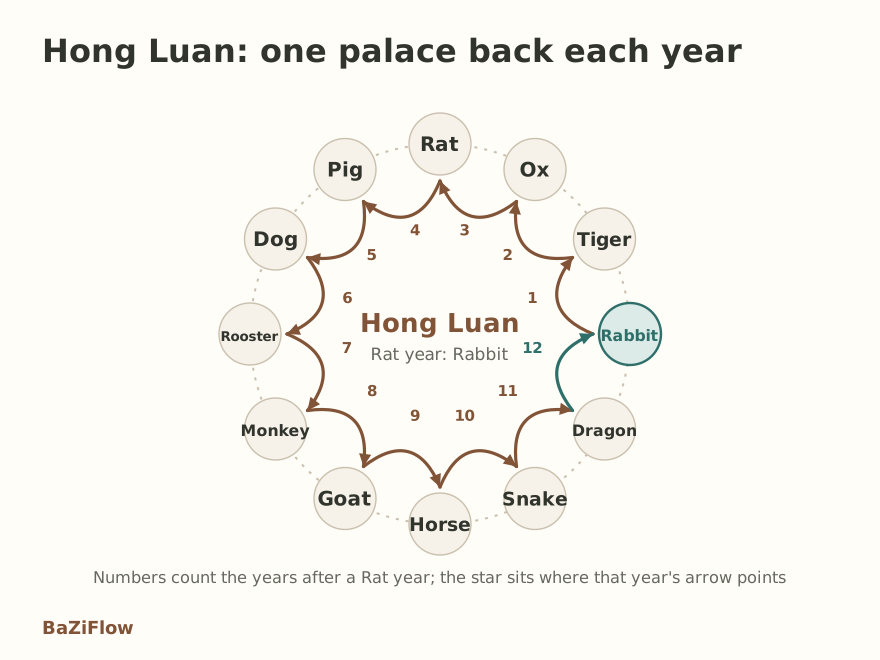
Hong Luan (红鸾): One Palace Back Per Year, and One Rabbit Spot With Twelve Palace Names
Hong Luan is placed by the birth-year branch, one palace back a year, a lap in twelve. This article covers the ring, twelve palace names for one Rabbit spot, the yearly Liu Luan, and the Water line of the book's list.
 ZW-AUX-37 / Zi Wei Dou Shu
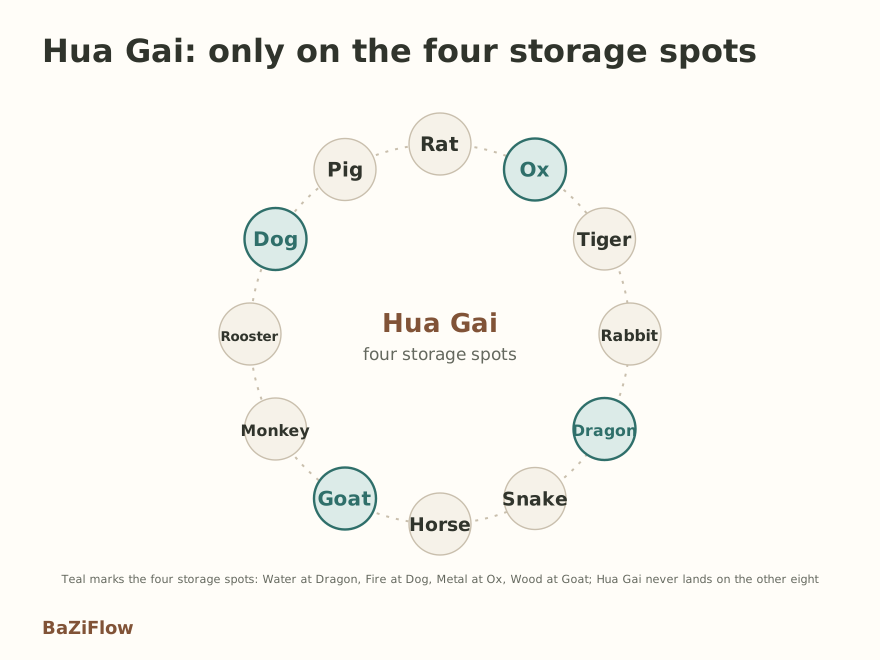
Hua Gai (华盖): The Storage Spot of Each Year Group, Not the Quan Shu Pattern
Hua Gai takes the Storage spot of the birth-year group and lands only on Dragon, Dog, Ox or Goat. The eighth step of the twelve-stage table, a same-named Quan Shu pattern, a year-boundary day and a four-star table.
 ZW-AUX-52 / Zi Wei Dou Shu
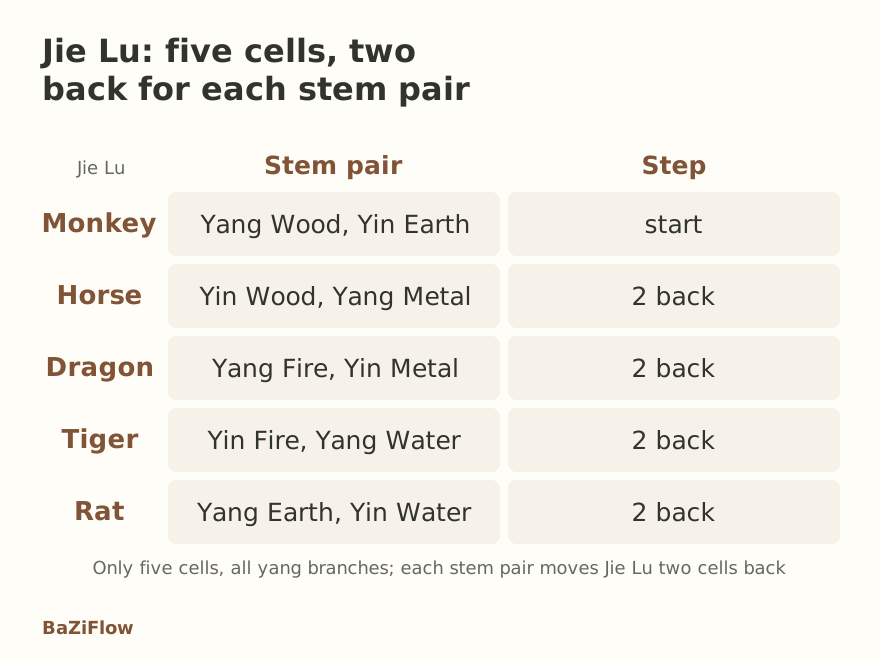
Jie Lu (截路): Five Cells by Year Stem, Two Back Each Pair, and Not the "Broken Bridge"
Jie Lu is placed by the birth-year stem and lands only on Rat, Tiger, Dragon, Horse or Monkey. A stem-and-year table, two book lines pairing it with Lu Cun and Tian Ma, and a same-cell count keep it apart from Duan Qiao.
 ZW-AUX-30 / Zi Wei Dou Shu
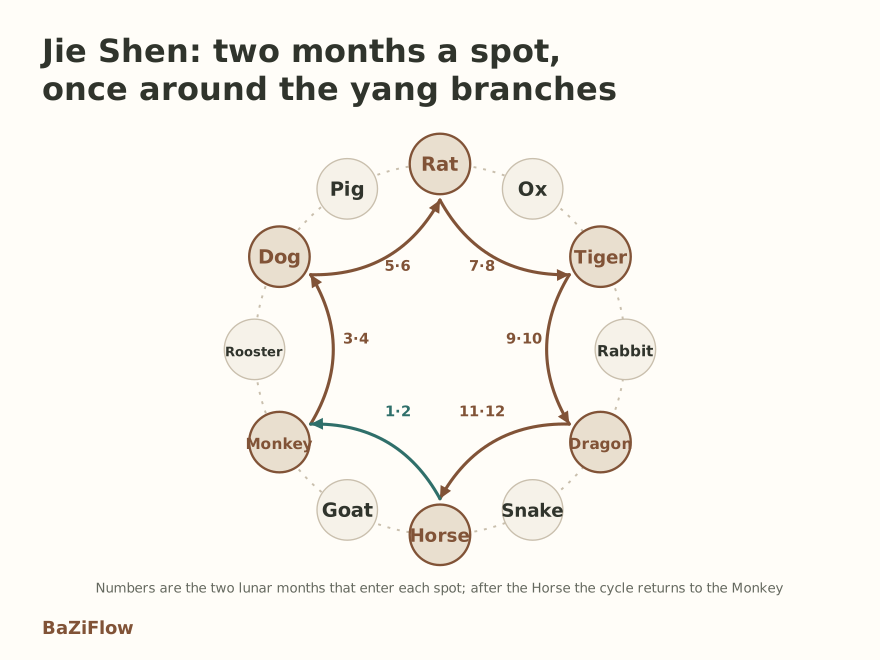
Jie Shen (解神): Two Months a Spot; the Book's Jie Shen Verse Is the Chart's Nian Jie
On the site's chart Jie Shen follows the lunar month, two months a spot, on yang branches only; the book's same-named verse follows the birth year and is the chart's Nian Jie. A hexagon ring and a same-palace pattern.
 ZW-AUX-51 / Zi Wei Dou Shu
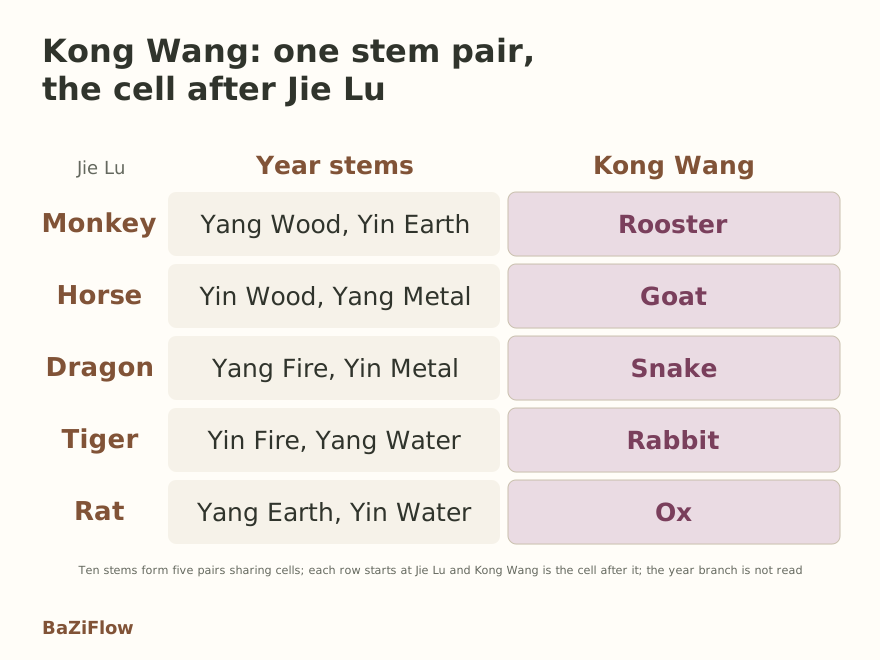
Kong Wang (空亡): The Second Cell of a Stem Pair, and the Word the Book Uses as a Catch-All
Kong Wang is placed by the birth-year stem, on the second cell of a pair. A stem table, the original rule, one real chart with five kinds of void and a same-cell count set the star apart from the catch-all word.
 ZW-AUX-21 / Zi Wei Dou Shu
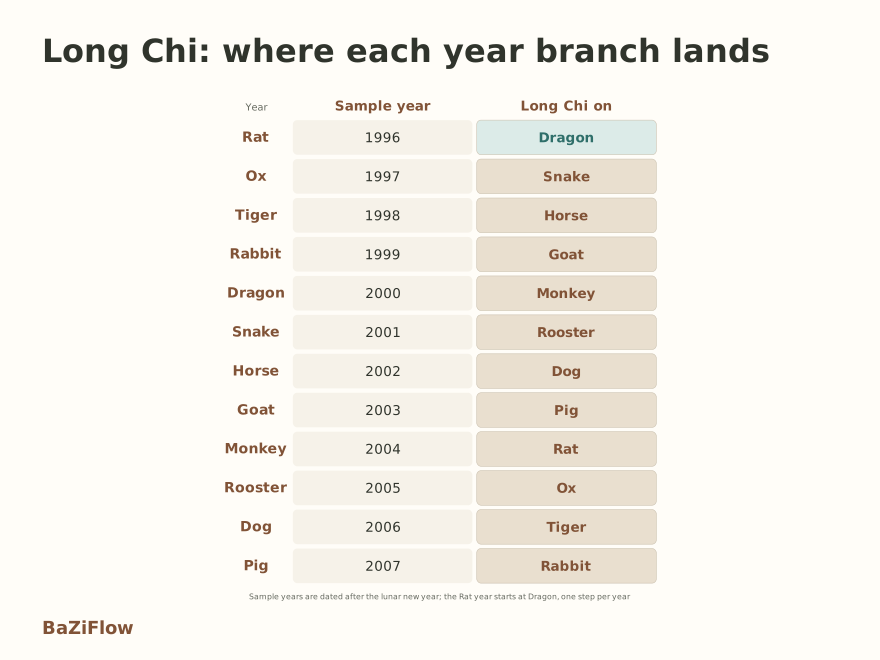
Long Chi (龙池): Rat Year on Dragon, One Step a Year, and How the New-Year Rule Moves It
Long Chi follows the birth-year branch: Rat year on the Dragon palace, one step forward each year. A twelve-year table, a two-step conversion, the two new-year rules in February 1996 and three sample charts.
 ZW-AUX-31 / Zi Wei Dou Shu
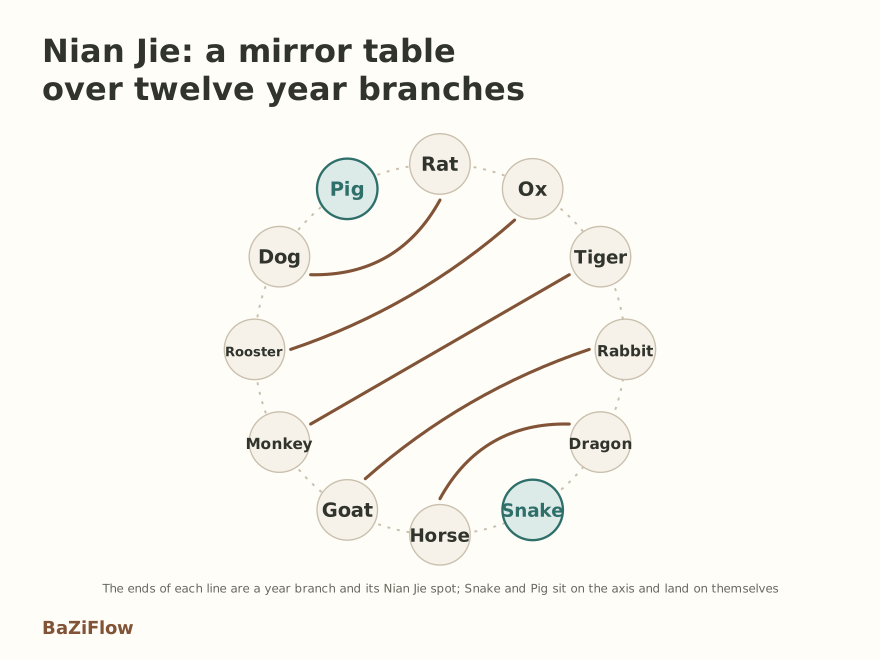
Nian Jie (年解): A Mirror Table over Twelve Year Branches, Locked to Tian Xi and Feng Ge
Nian Jie follows the volume 2 verse that starts at the Dog and counts back to the birth year: a mirror of each year branch. Its fixed ties to Hong Luan, Tian Xi and Feng Ge, year-boundary settings and the yearly layer.
 ZW-AUX-42 / Zi Wei Dou Shu
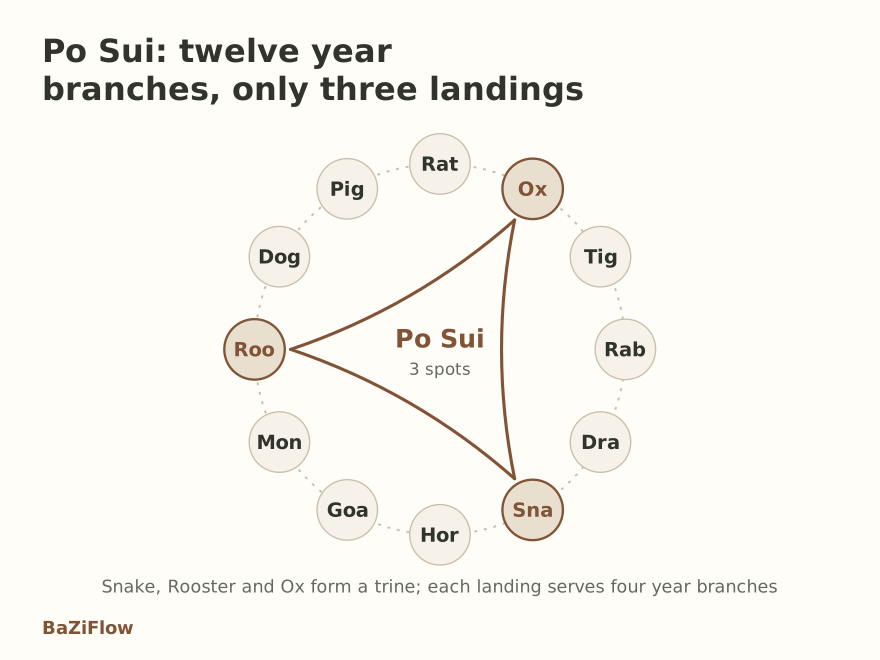
Po Sui (破碎): Three Landings for Twelve Branches, as the Sanming Tonghui Counts Them
Po Sui lands on Snake, Ox or Rooster by year branch. The Sanming Tonghui pre-heaven numbers, the Metal stages, and a twelve-row palace table separate its placement from the same name used elsewhere.
 ZW-AUX-15 / Zi Wei Dou Shu
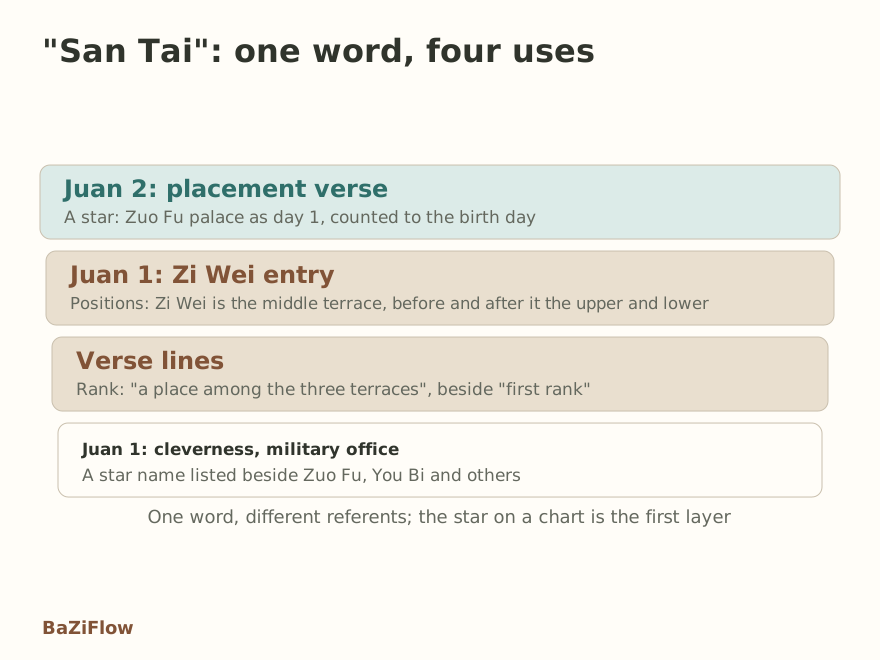
San Tai (三台): One Word, Several Uses, and the Month-Plus-Day Count
San Tai is a minor star counted from the Zuo Fu palace as day 1 to the birth day. First the other places the Quan Shu uses the words "San Tai", then a month-plus-day shortcut with twelve landings and the date to use.
 ZW-AUX-19 / Zi Wei Dou Shu
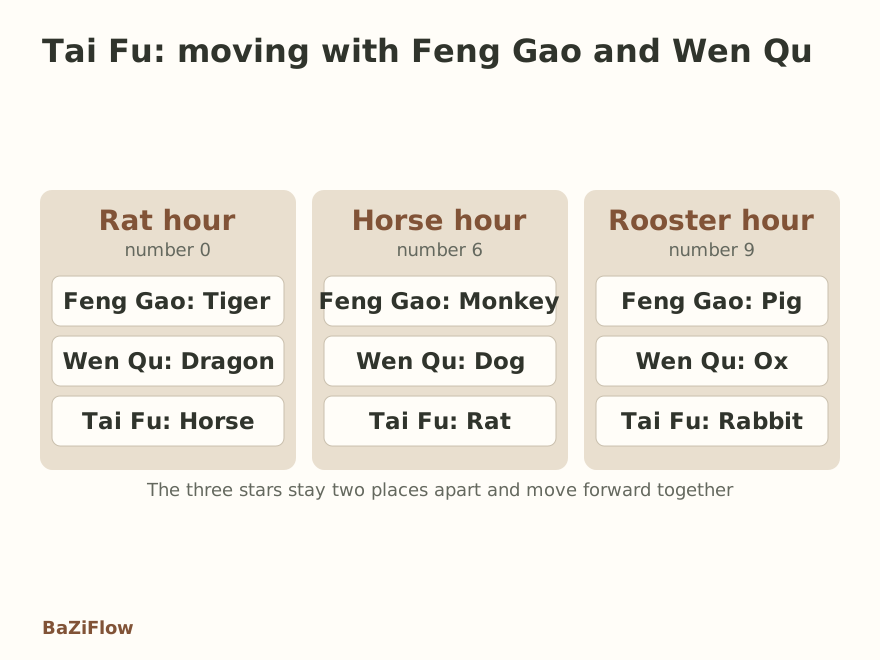
Tai Fu (台辅): Counted from the Horse Palace, Two Places from Feng Gao and Wen Qu
Tai Fu looks only at the birth hour, counting forward from the Horse palace. Twelve landings, its run with Feng Gao and Wen Qu, six hour stars split four forward and two back, and how the book writes the name.
 ZW-AUX-23 / Zi Wei Dou Shu
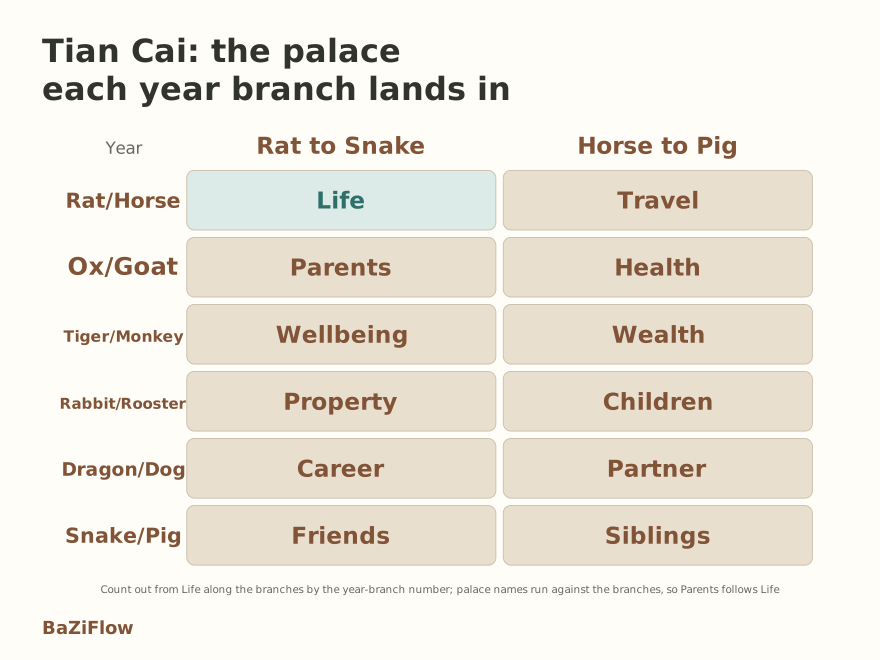
Tian Cai (天才): The Adjective Star Counted Out From Life by the Year Branch
Tian Cai sits at the Life palace plus the number of the birth-year branch. A twelve-branch table, two worked charts and a comparison with Long Chi show why the name depends on the year alone.
 ZW-AUX-27 / Zi Wei Dou Shu
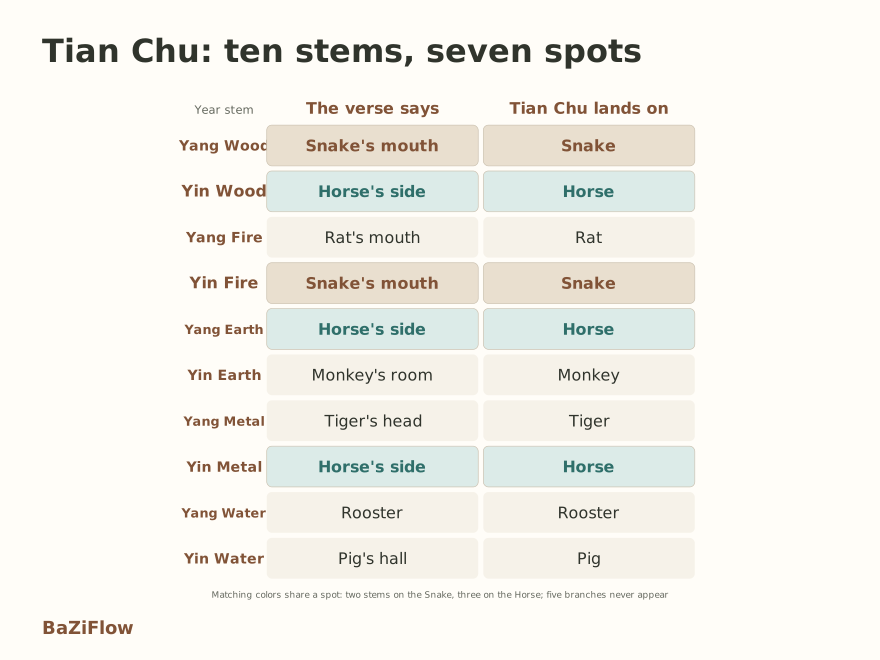
Tian Chu (天厨): Placed by the Birth-Year Stem, Ten Stems on Seven Spots
Tian Chu is a Zi Wei minor star whose position comes from the birth-year stem alone: a ten-row table, seven landing spots, a comparison with BaZi's Heavenly Kitchen, and why one branch gets different palace names.
 ZW-AUX-48 / Zi Wei Dou Shu
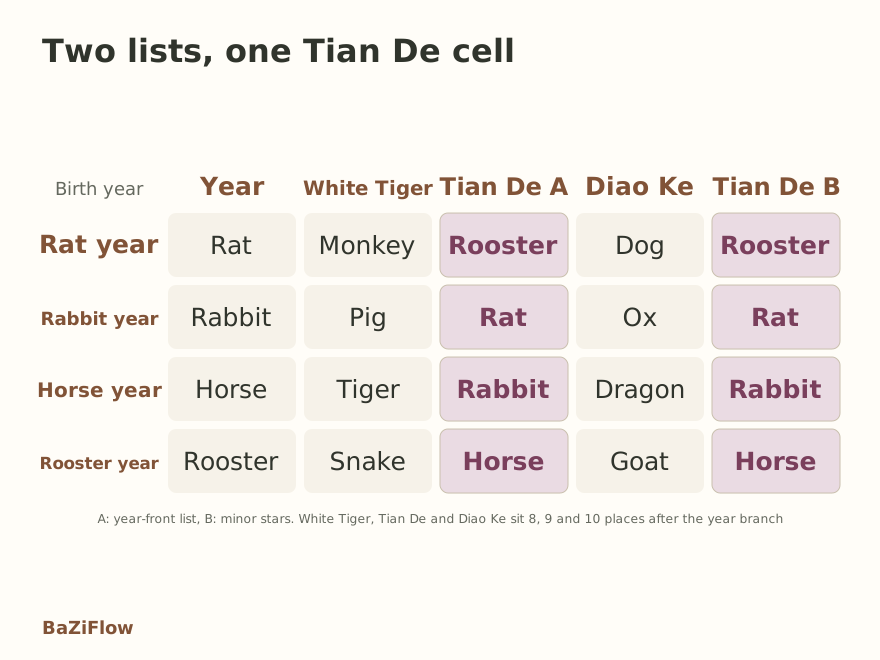
Tian De (天德): Count From Rooster to the Year, and Meet Its Twin List
Tian De is a minor star placed by the birth-year branch, counting from Rooster. A four-year table, four charts of one year and a date between Lunar New Year and Start of Spring show why it matches the year-front Tian De.
 ZW-AUX-26 / Zi Wei Dou Shu
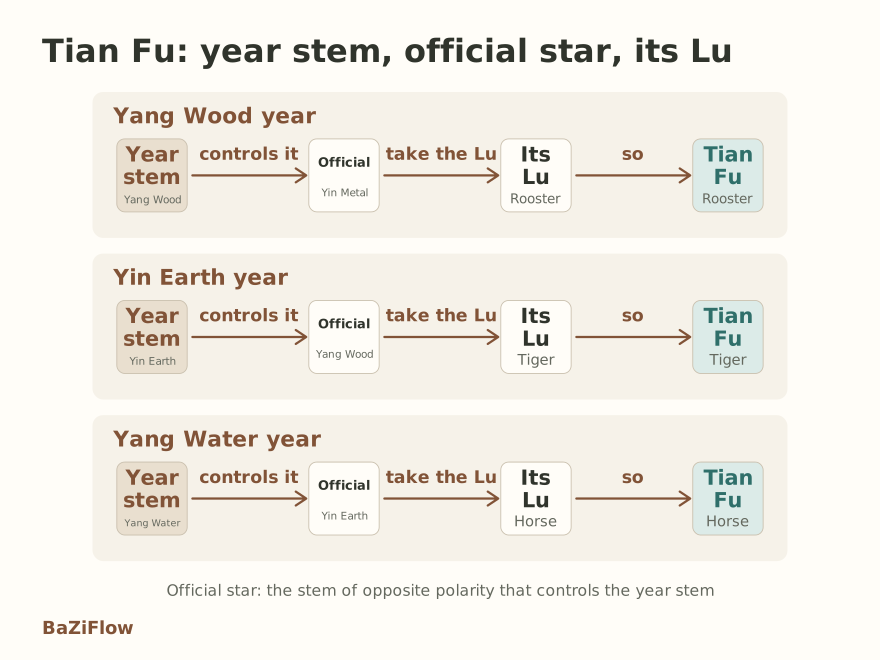
Tian Fu (天福): The Official Star's Lu, Found by Year Stem, Not the Major Star
Tian Fu follows the birth-year stem: find the official star that controls it, then take that star's Lu. The method in juan 5 of the Sanming Tonghui matches the engine for all ten stems. A flow, a table, sample charts.
 ZW-AUX-25 / Zi Wei Dou Shu
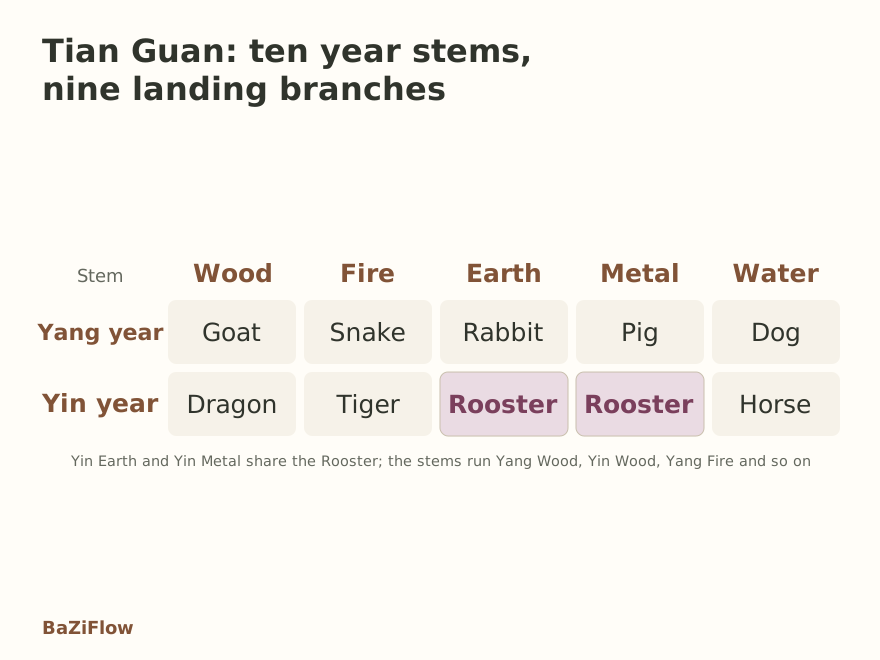
Tian Guan (天官): Ten Stems, Nine Branches, Three Checked in the Sanming Tonghui
Tian Guan is looked up by the stem of the birth year: ten stems land on only nine branches. A table, a ring, three examples from the Sanming Tonghui, the new-year rule and sample charts show where the table comes from.
 ZW-AUX-18 / Zi Wei Dou Shu
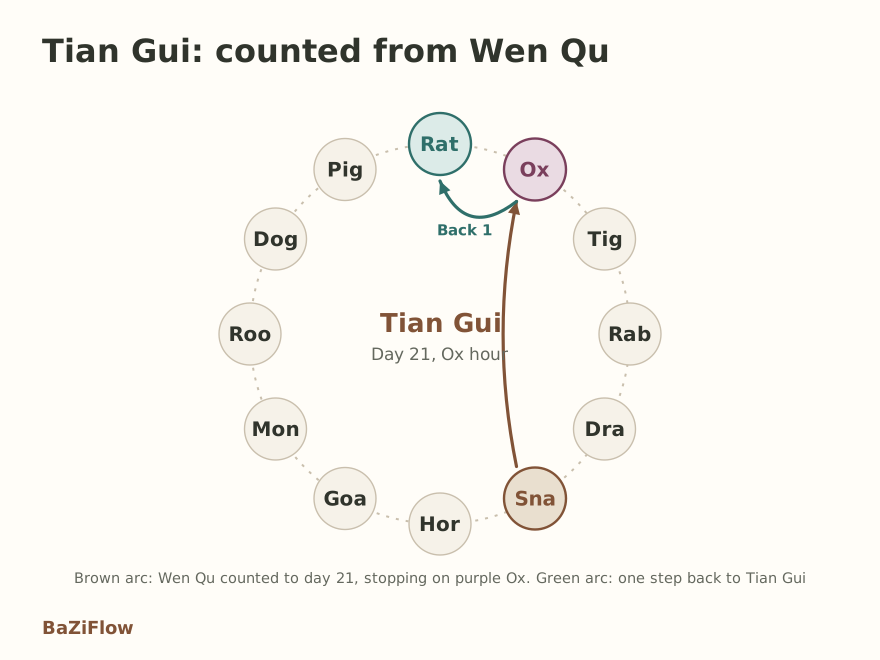
Tian Gui (天贵): The Day-Plus-Hour Star Paired with En Guang, Missing from the Book We Hold
Tian Gui counts from the Wen Qu palace to the birth day and steps back one, so it follows day plus hour number and ignores the month. A worked count, a lookup table, and why juan 1 to 3 of the Quan Shu lack it.
 ZW-AUX-49 / Zi Wei Dou Shu
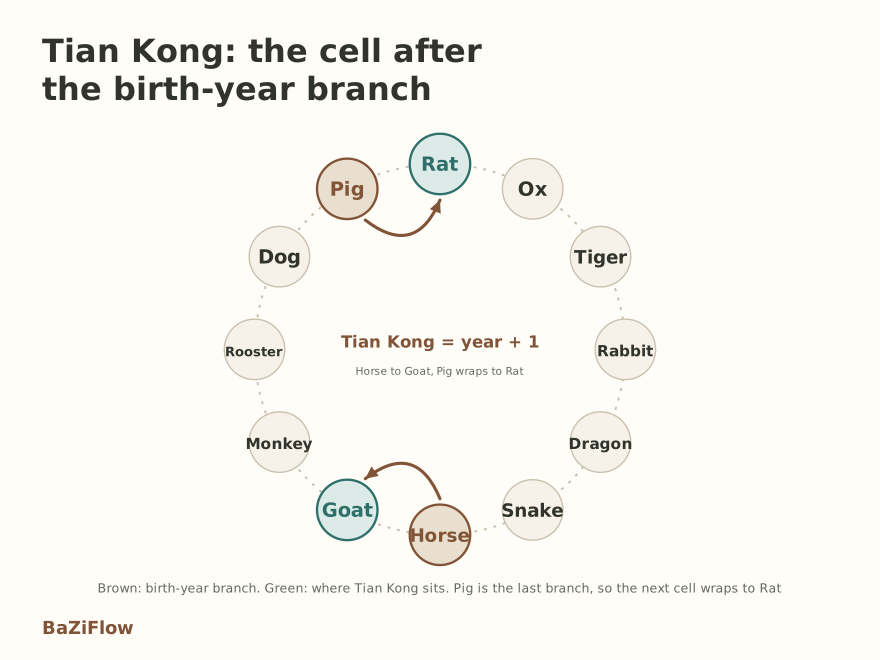
Tian Kong (天空): One Cell After the Birth Year, and Not the Book's Hour-Based "Tian Kong"
Engine Tian Kong reads only the birth-year branch and sits one cell after it. A 12-year table, the Quan Shu hour-based "Tian Kong" versus Di Kong, and the one colliding hour per year tell the two Kong stars apart.
 ZW-AUX-40 / Zi Wei Dou Shu
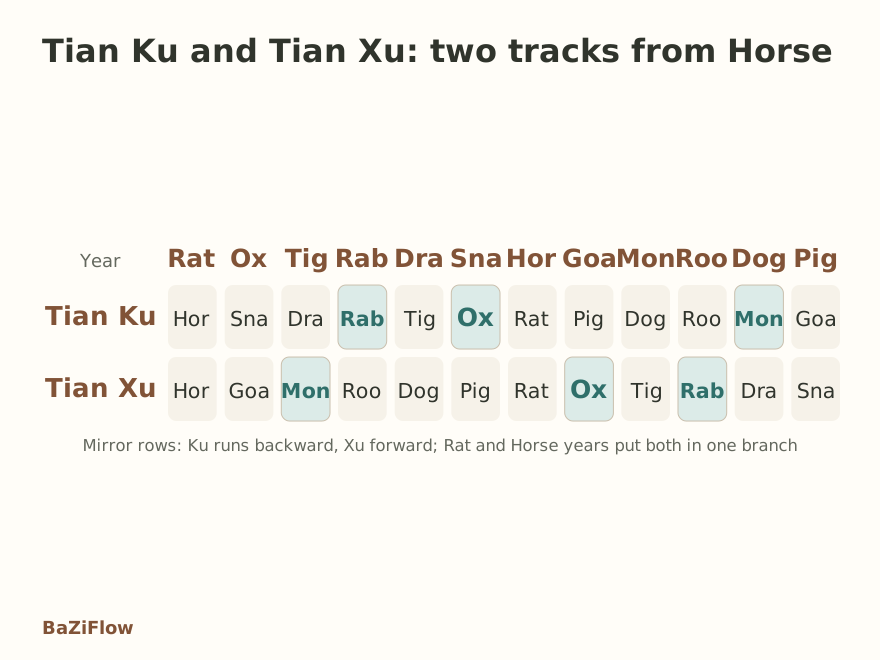
Tian Ku (天哭): Rat on the Horse Branch, Ku Backward and Xu Forward
Tian Ku and Tian Xu share one rhyme of juan 2: the Rat year starts on the Horse branch, Ku counts backward and Xu forward to the birth year. The rhyme line by line, the Rat-Horse mirror and five sample charts.
 ZW-AUX-45 / Zi Wei Dou Shu
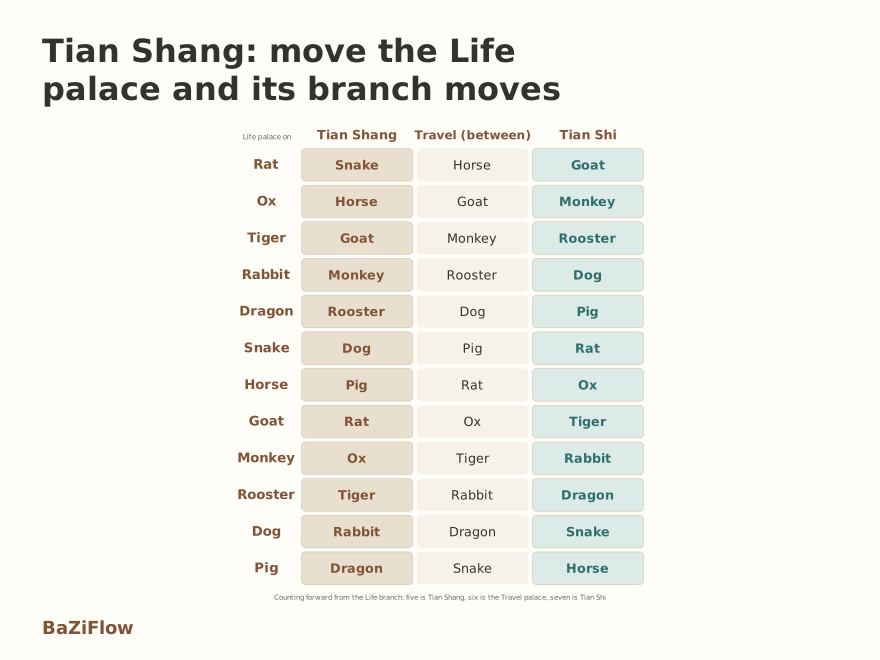
Tian Shang (天伤): Always in the Friends Palace, with Only the Branch Changing
Tian Shang always sits in the Friends palace, so moving the Life palace moves its branch, five places ahead. A twelve-row table, three charts sharing a Life palace, the book example and what can enter the flank.
 ZW-AUX-46 / Zi Wei Dou Shu
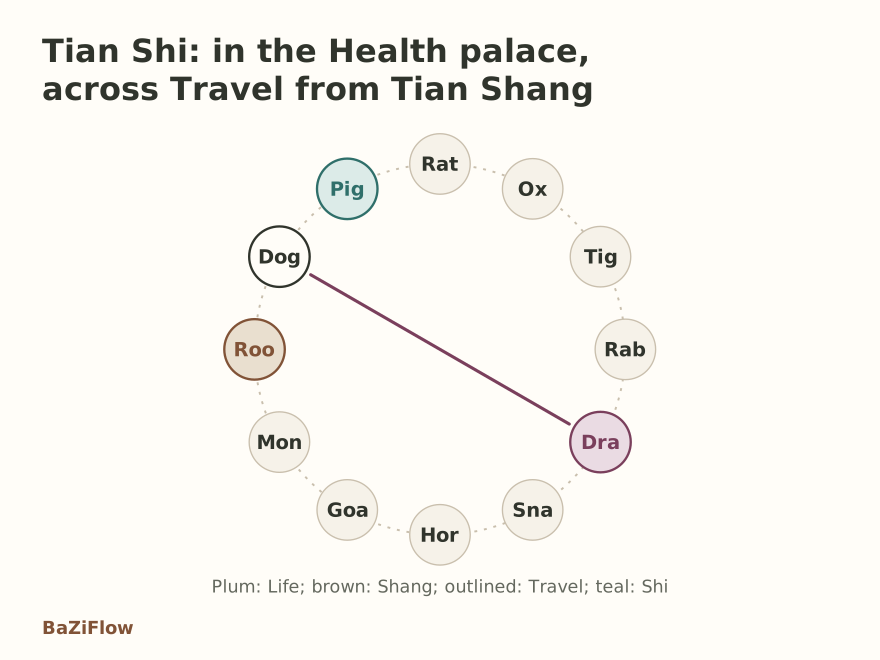
Tian Shi (天使): Fixed in the Health Palace, with Two Placing Methods Giving Two Answers
Tian Shi sits in the Health palace, seven places ahead of the Life branch. An example chart, the opposite counting of palaces and branches, the Zhongzhou swap for yin men and yang women, and the Health decade.
 ZW-AUX-24 / Zi Wei Dou Shu
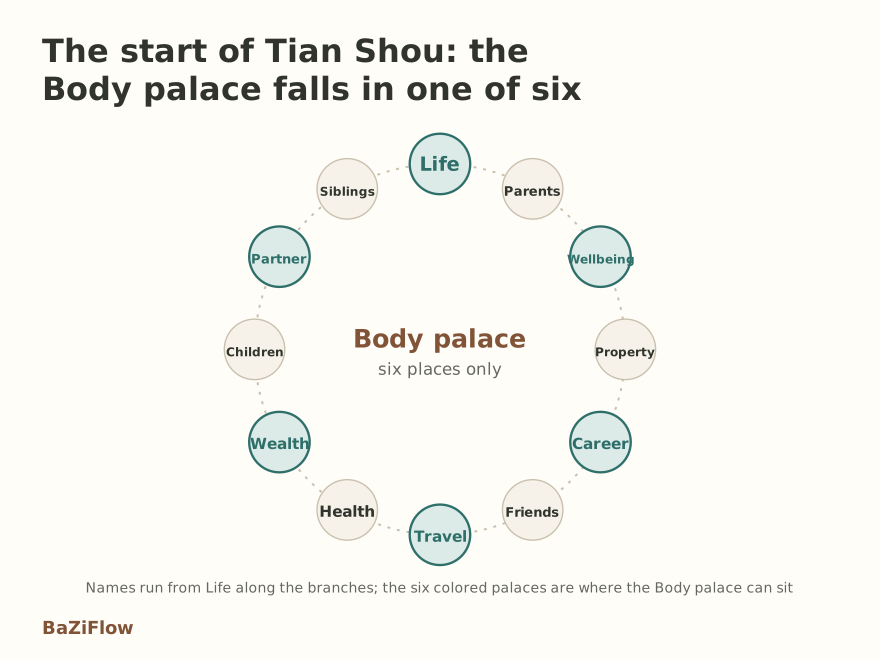
Tian Shou (天寿): Counted From the Body Palace, With a Gap to Tian Cai Set by the Hour
Tian Shou sits at the Body palace plus the birth-year branch number. A ring, a table and four charts show that the Body palace has six possible names and that the gap to Tian Cai depends on the birth hour alone.
 ZW-AUX-28 / Zi Wei Dou Shu
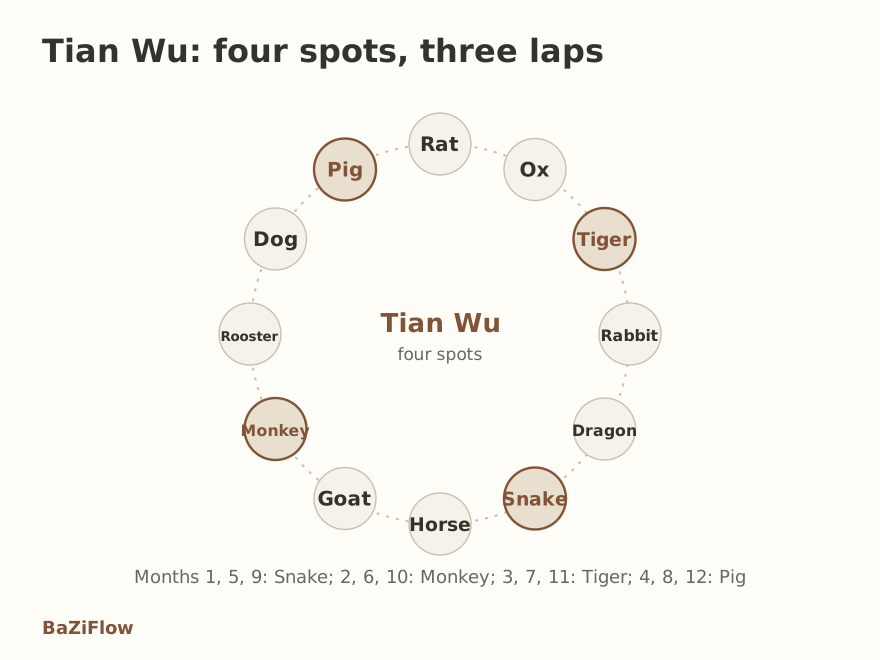
Tian Wu (天巫): Placed by the Lunar Birth Month, Four Spots Repeating Three Times
Tian Wu is a Zi Wei minor star that reads only the lunar birth month: four landing branches, three laps a year. A month table, the branch set it shares with Tian Ma, and leap-month examples.
 ZW-AUX-33 / Zi Wei Dou Shu
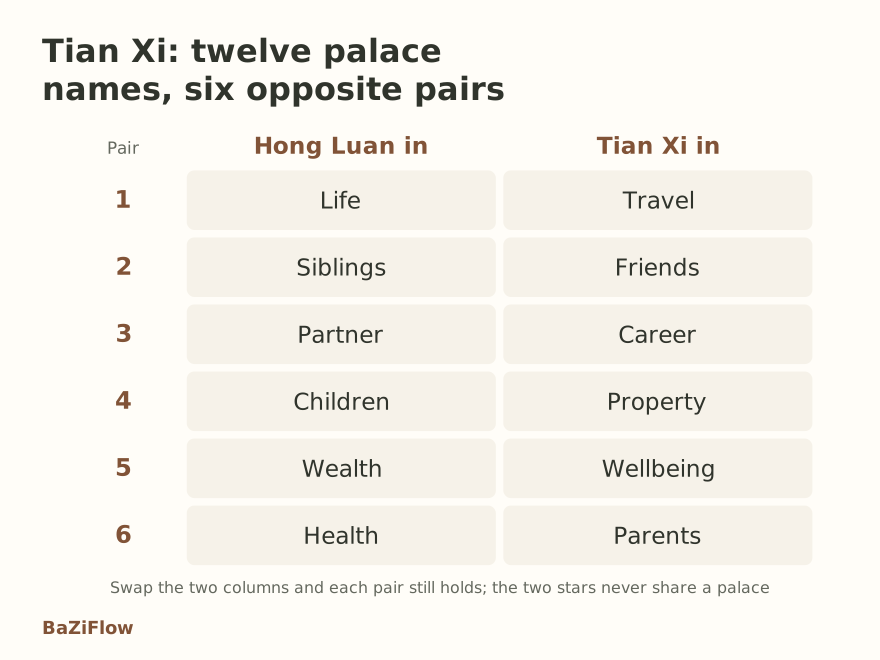
Tian Xi (天喜): Always Opposite Hong Luan, Counted Once Per Layer
Tian Xi sits opposite Hong Luan, six branches away and never in its palace. Six opposite palace-name pairs, natal Tian Xi with decadal Yun Xi and yearly Liu Xi, and the book's other "Tian Xi" spirit.
 ZW-AUX-36 / Zi Wei Dou Shu
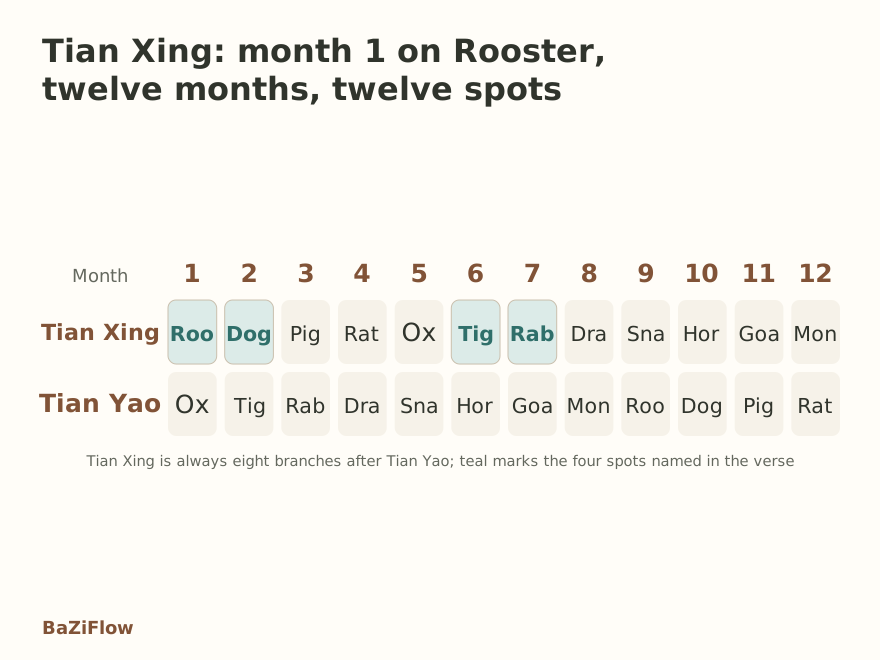
Tian Xing (天刑): Counted From Rooster by Birth Month, Always Eight Branches After Tian Yao
Tian Xing shares a placement rhyme with Tian Yao: month 1 on Rooster, counted forward to the birth month. The two stars keep a fixed distance in one three-branch group. How the book uses the star, and a worked chart.
 ZW-AUX-41 / Zi Wei Dou Shu
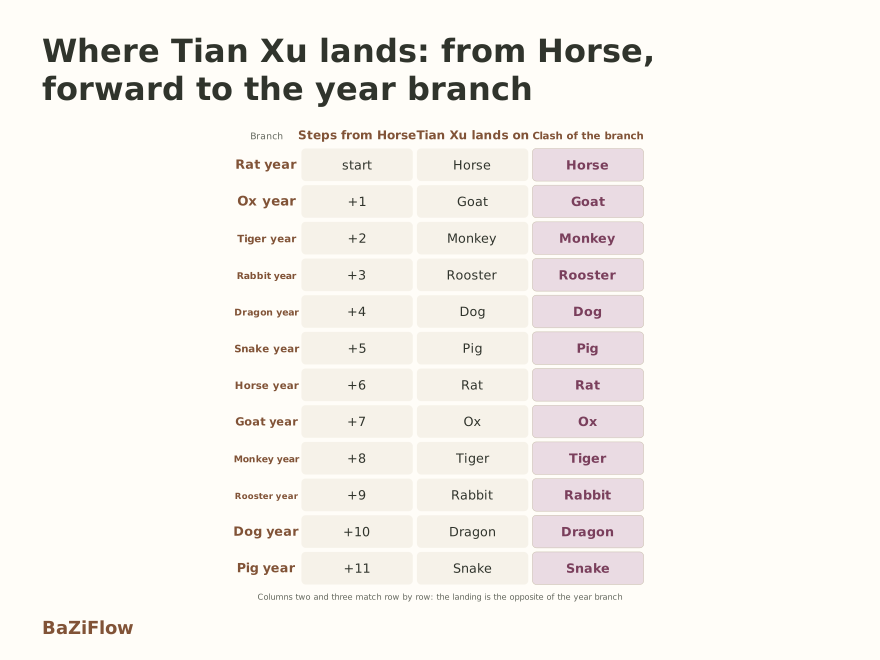
Tian Xu (天虚): Counted from the Horse Palace, Landing Opposite the Birth-Year Branch
Tian Xu is placed by the birth-year branch: count forward from the Horse palace, taken as Rat. A twelve-row table, the clash-position rule, a New Year example and palace names for different Life palaces show the landing.
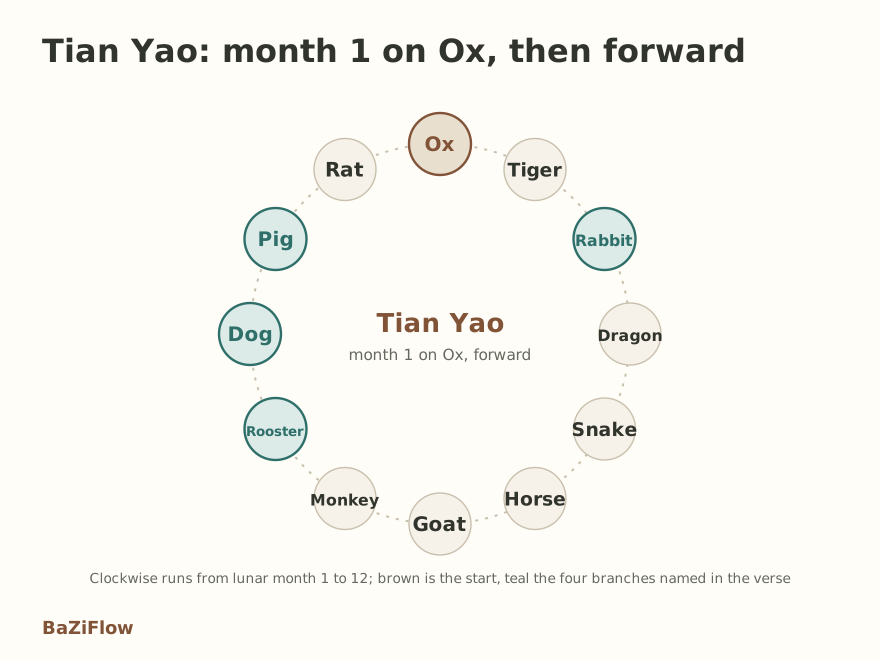 ZW-AUX-35 / Zi Wei Dou Shu
Tian Yao (天姚): Counted From Ox by Birth Month, Placed in a Palace by Birth Hour
Tian Yao is placed from the lunar birth month: month 1 on Ox, then forward. The month cancels between Life and Tian Yao, so the palace follows the birth hour alone. With leap-month examples.
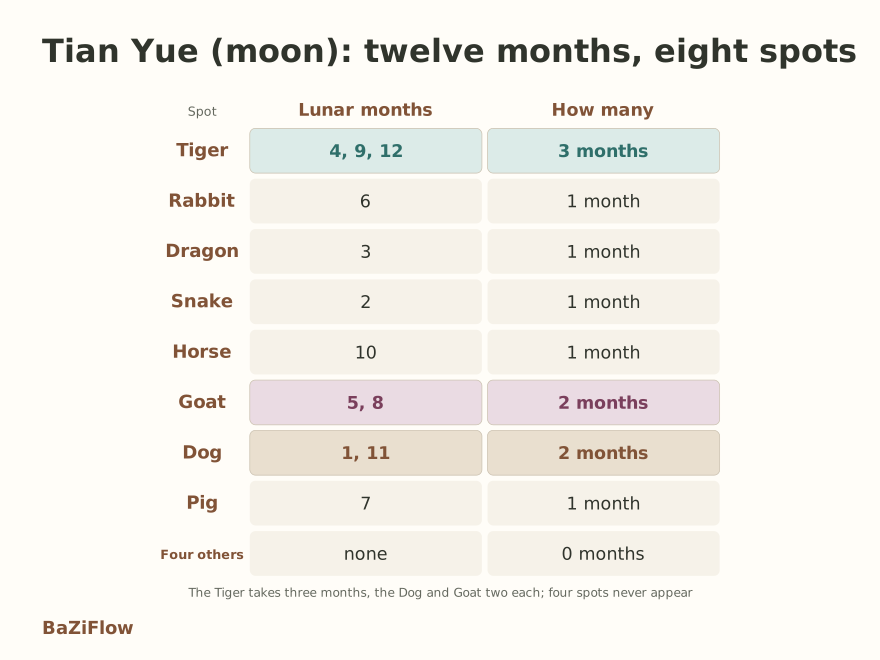 ZW-AUX-29 / Zi Wei Dou Shu
Tian Yue (天月): The Month-Placed Minor Star, Twelve Months on Eight Spots
Tian Yue (天月) is a Zi Wei minor star placed by the lunar birth month: twelve months, eight spots, no formula. Includes a comparison with the homophone Tian Yue (天钺), a month-boundary example and three look-up questions.
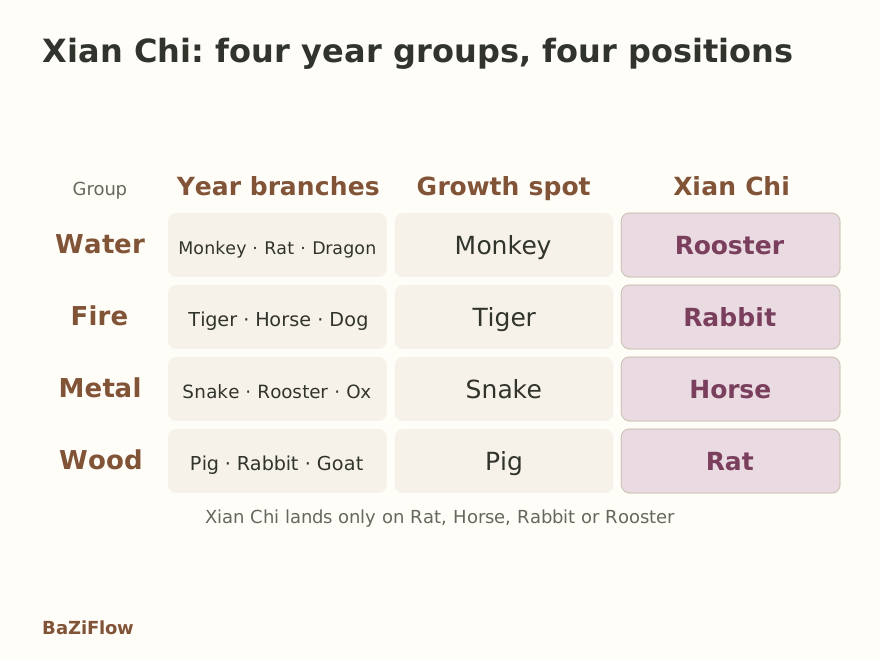 ZW-AUX-34 / Zi Wei Dou Shu
Xian Chi (咸池): Placed by Birth-Year Branch Only, One Step After the Growth Spot
Xian Chi is placed from the birth-year branch alone: four year groups, four landing branches. A table, a ring, three sample charts and a twelve-year line show how a branch becomes a palace; the Quan Shu has no rule.
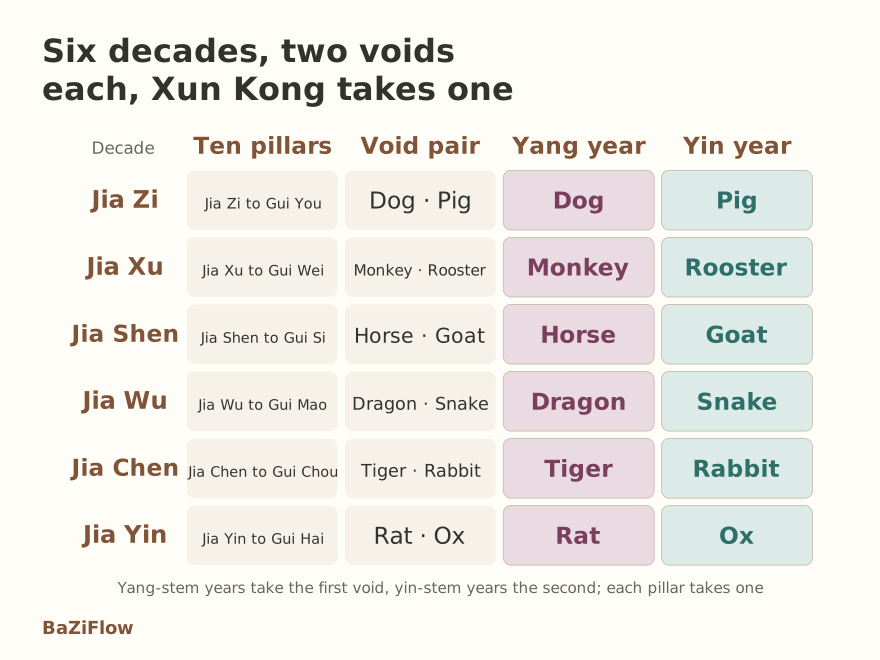 ZW-AUX-50 / Zi Wei Dou Shu
Xun Kong (旬空): Two Voids per Decade, the Engine Takes One by Yin and Yang
Xun Kong follows the decade of the birth-year pillar: each decade leaves two branches unpaired and the engine takes one by yin and yang. A six-decade table, the Quan Shu list of both voids, its ranking and three charts.
 ZW-AUX-44 / Zi Wei Dou Shu
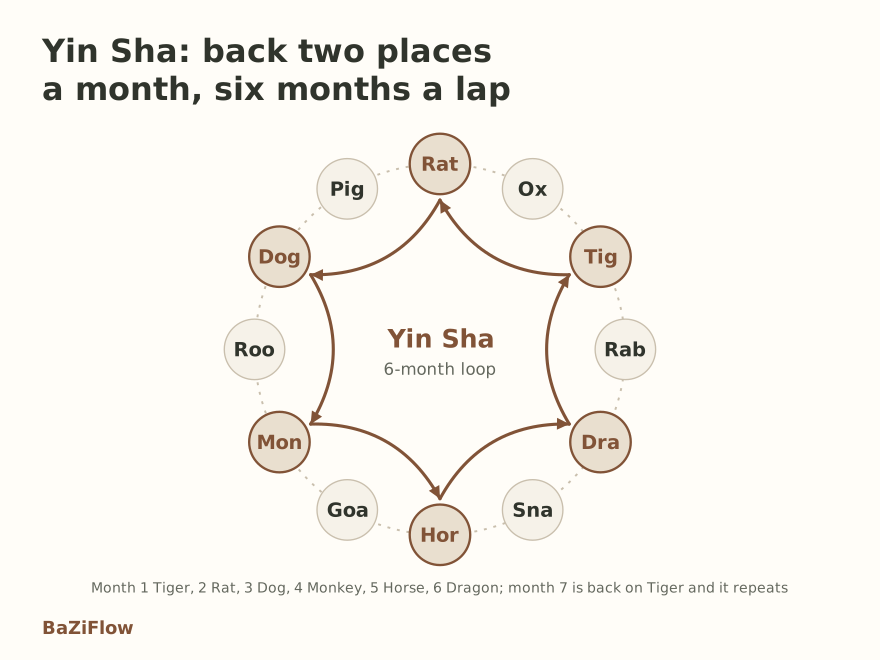
Yin Sha (阴煞): Set by the Lunar Birth Month, Back Two Places a Month on a Six-Month Loop
Yin Sha is set by the lunar birth month: Tiger in month one, then two places back each month, Tiger again in month seven. A six-landing ring, a leap-month example, twelve hours of one month and other month stars.
 ZW-AUX-47 / Zi Wei Dou Shu
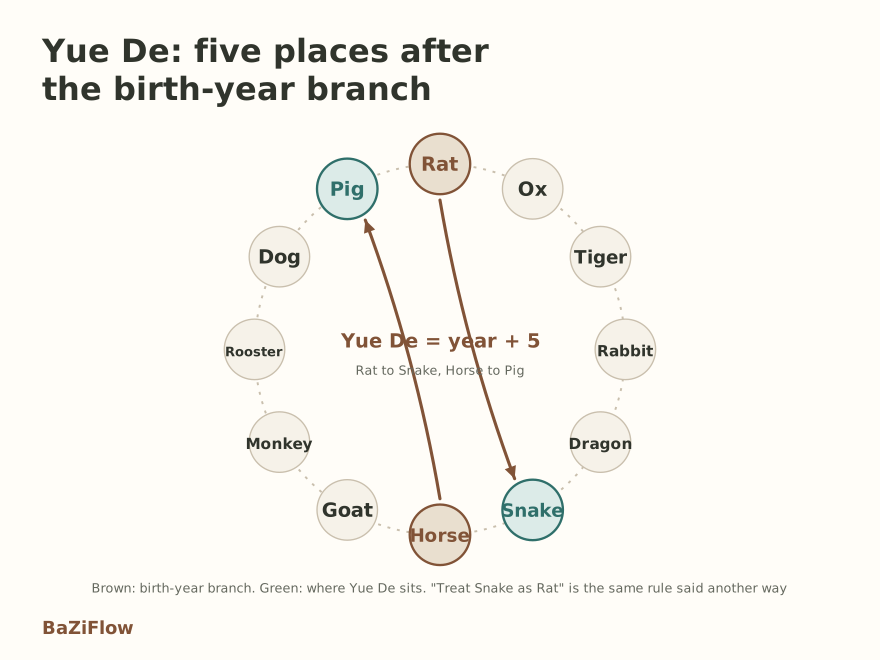
Yue De (月德): Count From Snake to the Birth-Year Branch, 12 Years, 12 Palaces
Yue De is a Zi Wei minor star placed by the birth-year branch: treat Snake as Rat and count forward. A 12-year table, charts with Life at Tiger and a five-place gap with Quan Shu juan 2 set it apart from the BaZi star.
 ST-011 / Cross-system studies
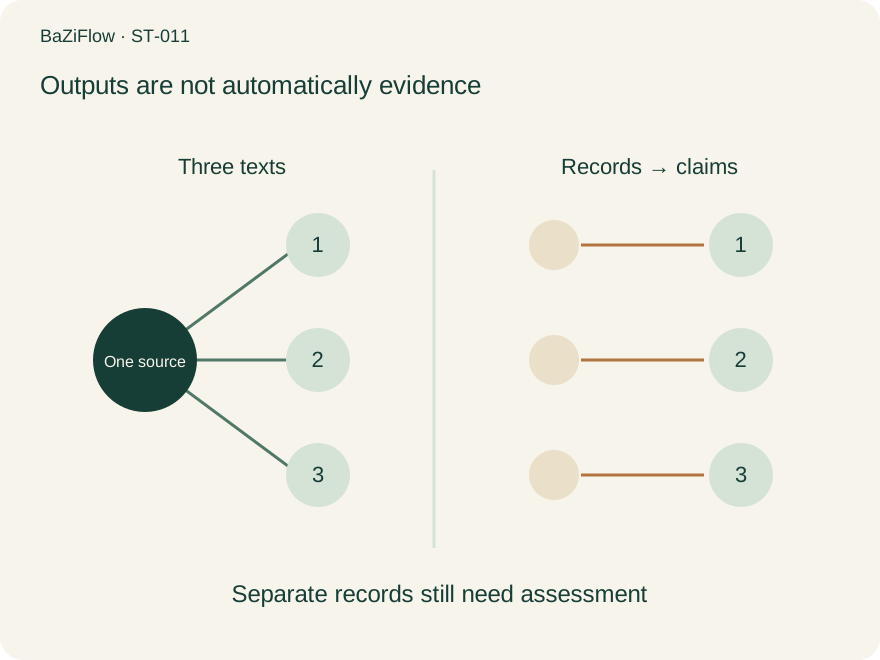
Agreement Between Readings Is Not an Independent Test
Distinguish repeated wording, input-specific explanation and outcome validation. Trace shared sources and define the claim before treating several agreeing readings as evidence.
 SU-008 / Sukuyō astrology
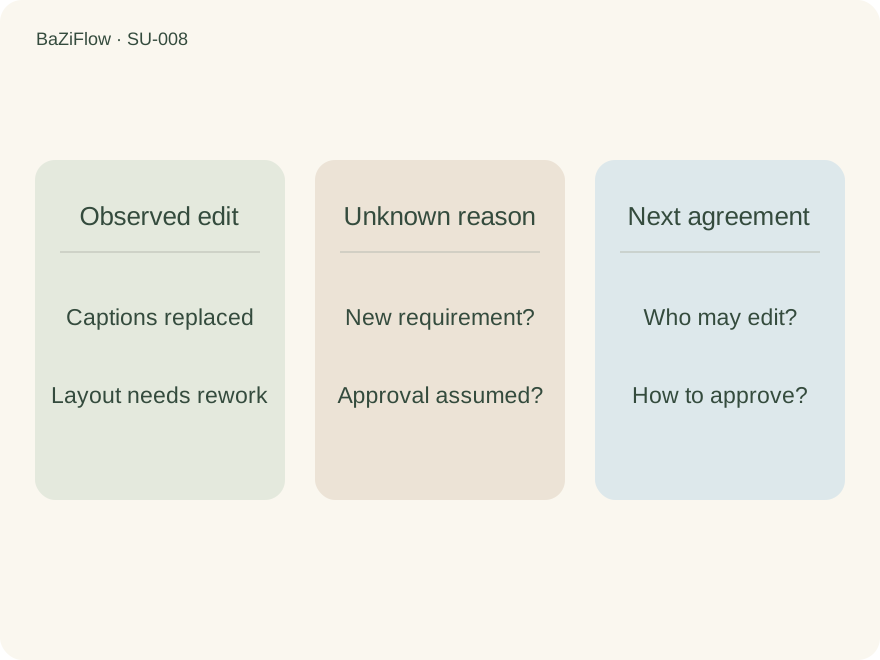
Ease–Break readings: keep labels separate from behavior
An archive-display disagreement separates a traditional category from observed edits, unknown motives and a practical approval agreement.
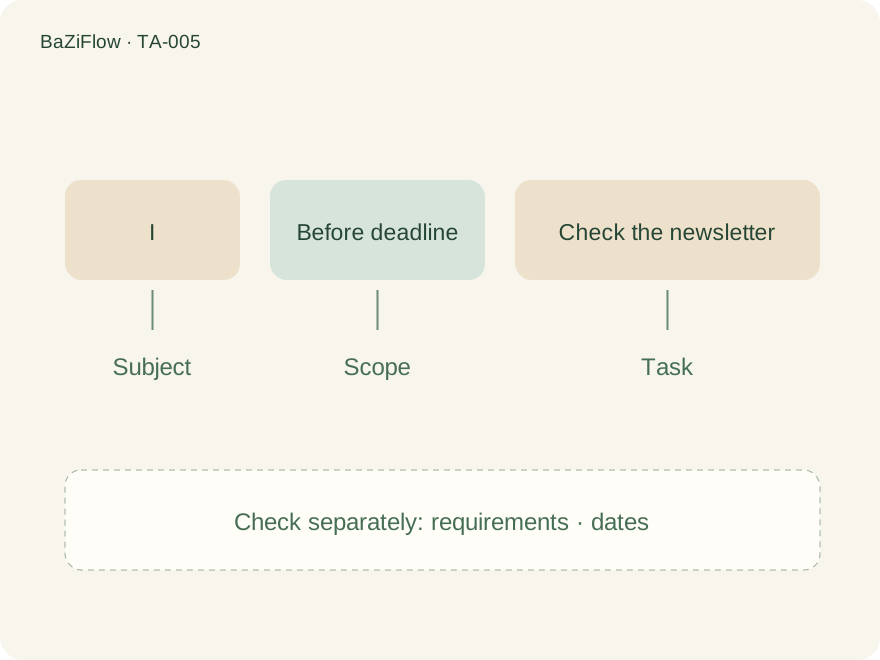 TA-005 / Tarot
Frame a tarot question that leaves room for evidence
Separate a subject, a scope and a task from assumptions smuggled into the wording. A library-newsletter example shows how a specific question can support reflection while leaving facts and decisions with people.
AS-013 / Western astrologyAspects and orbs in astrology: how to calculate the angle between two planets
How aspects and orbs work: find the short arc from 350° to 10°, separate the 2° deviation of 92° from a 3° limit, and use reversed time sequences to tell applying from separating.
 AS-015 / Western astrology
Aspect patterns: test the edges, then restore the chart
Use a near-miss T-square to test recognition rules, compare three complete edge sets, and track overlapping patterns without counting the same positions as independent evidence.
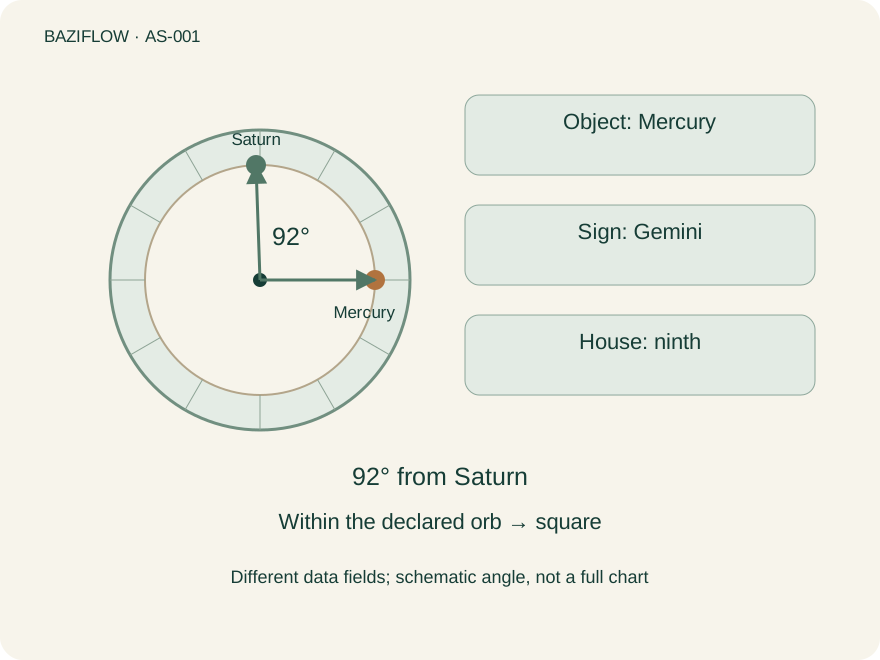 AS-001 / Western astrology
Four Chart Components: Read the Object, Position and Relationship
Separate a Mercury–Gemini–ninth-house record into four fields, then follow the missing steps between coordinates and interpretation.
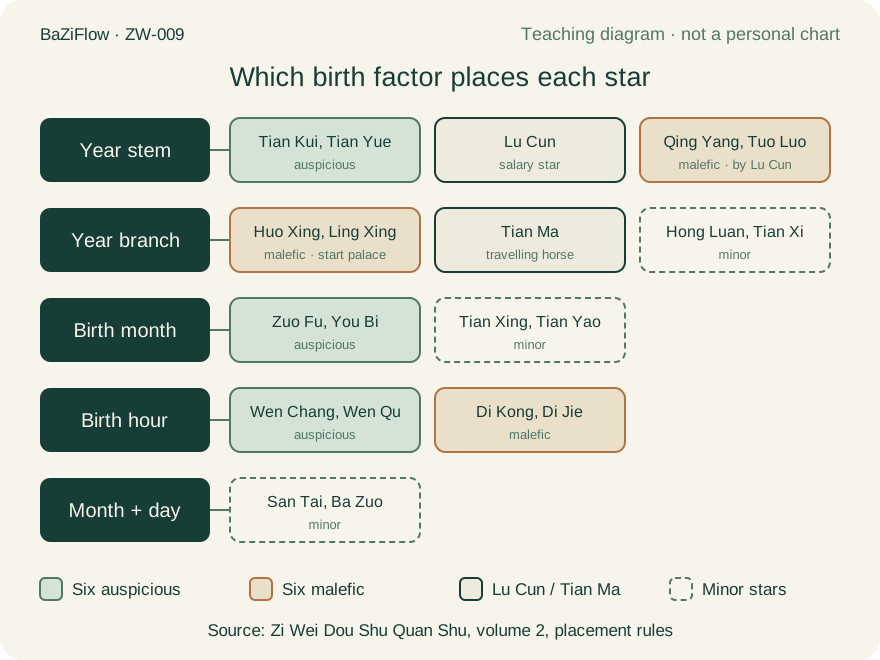 ZW-009 / Zi Wei Dou Shu
What do Zi Wei's supporting, malefic and minor stars actually do?
Start with what a malefic label can establish, then trace placements to their inputs and read classical combinations in their stated conditions.
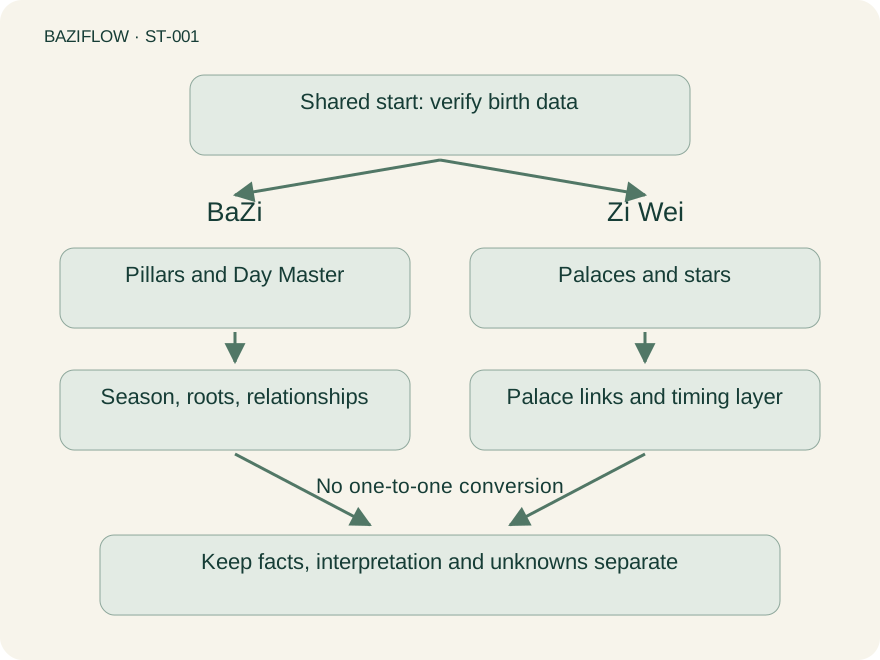 ST-001 / Cross-system studies
BaZi and Ziwei on One Question: Preserve Each Structure Before Comparing
Contrast a Four Pillars relationship table with a twelve-palace map, then use Wealth versus Wealth Palace to practise agreement, disagreement and uncertain-time comparisons.
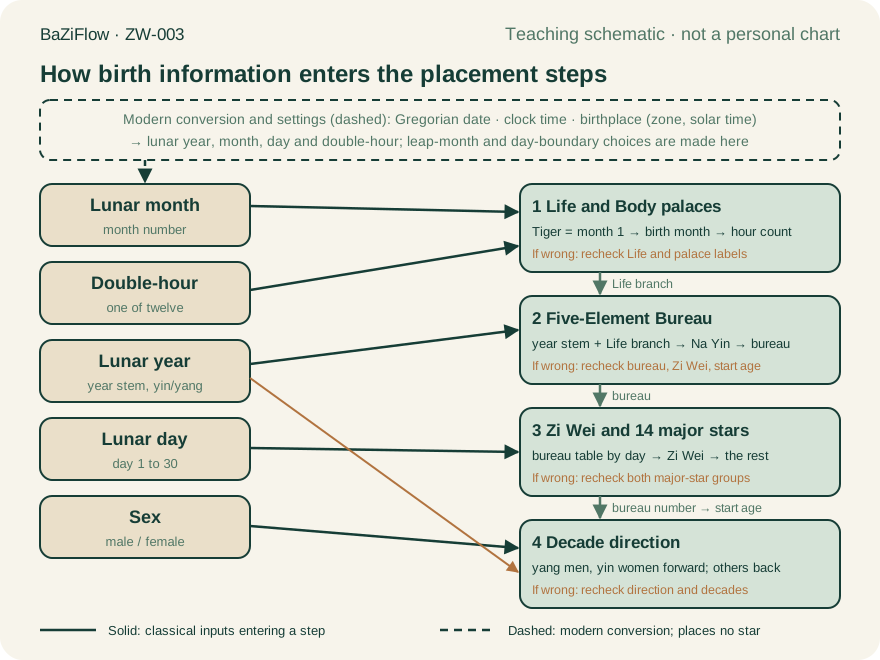 ZW-003 / Zi Wei Dou Shu
What birth information does a Zi Wei chart need, and where does each item go?
Match the fields of a chart-casting form to the placement steps of Zi Wei Dou Shu Quan Shu: lunar year, month, day, double-hour, sex and birthplace each drive a different step, and each error moves something different.
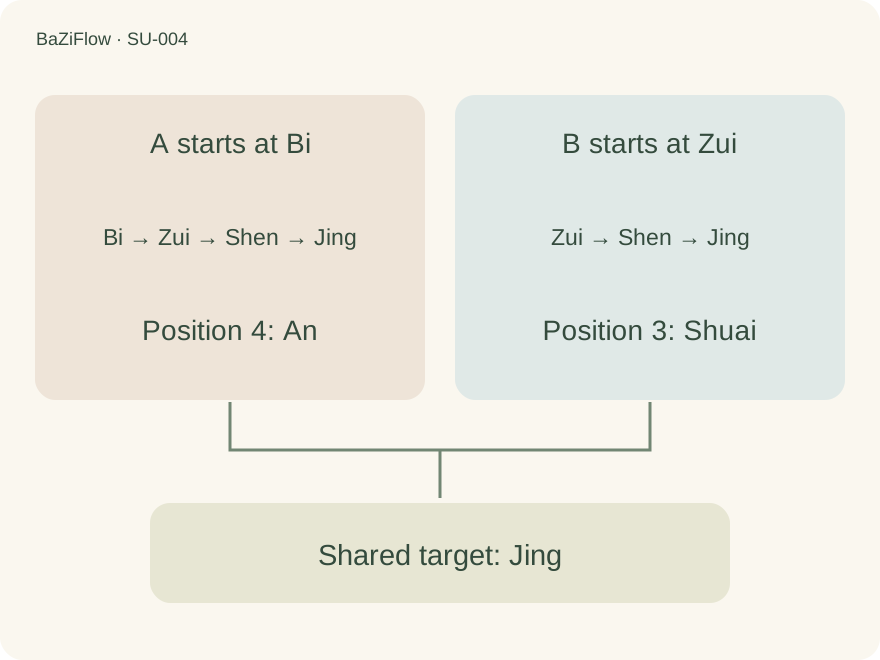 SU-004 / Sukuyō astrology
Birth mansion and daily mansion are separate fields
Use two assumed birth labels and one target to distinguish a calendar entry from a personalised relative position, without presenting the exercise as a forecast.
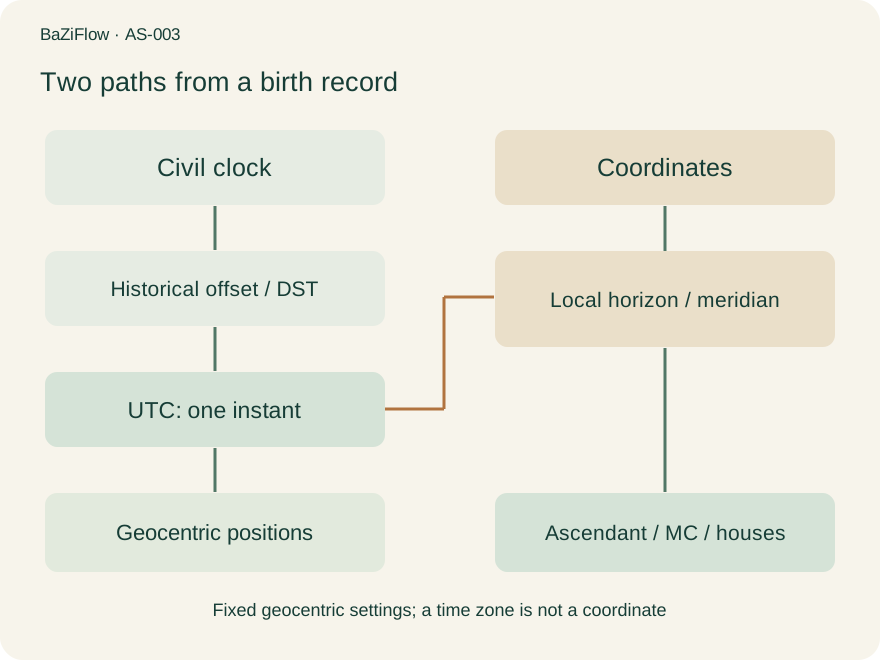 AS-003 / Western astrology
Birth Time and Place: From the Clock Record to the Local Sky
Use a one-hour offset, a same-instant comparison and a date rollover to separate historical time-zone rules from geographical coordinates, while preserving uncertainty.
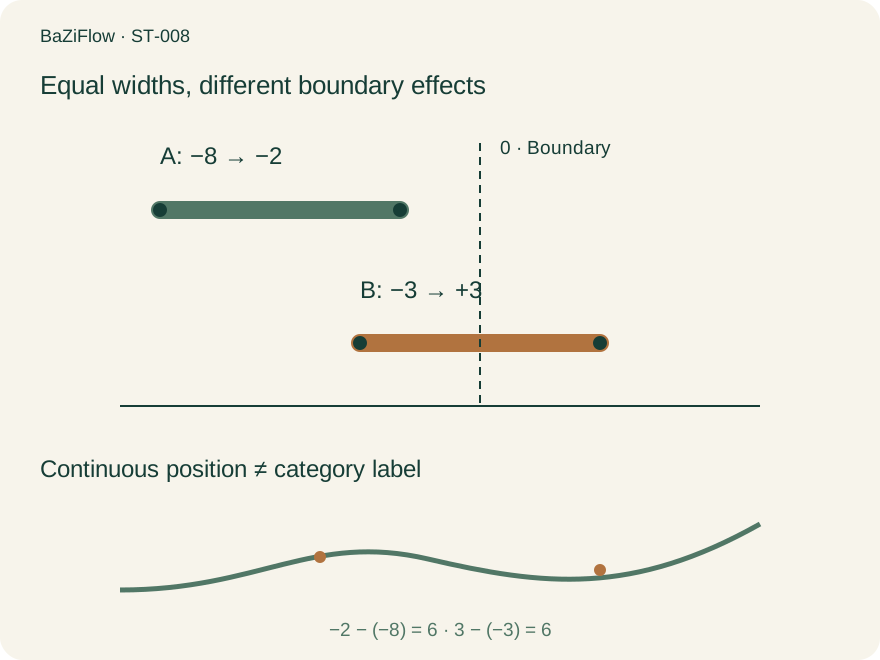 ST-008 / Cross-system studies
Birth-Time Uncertainty: Boundaries, Ranges and Stable Fields
A small time error can cross a classification boundary or alter continuous coordinates. Trace its effect through each system and preserve what is stable, variable or unresolved.
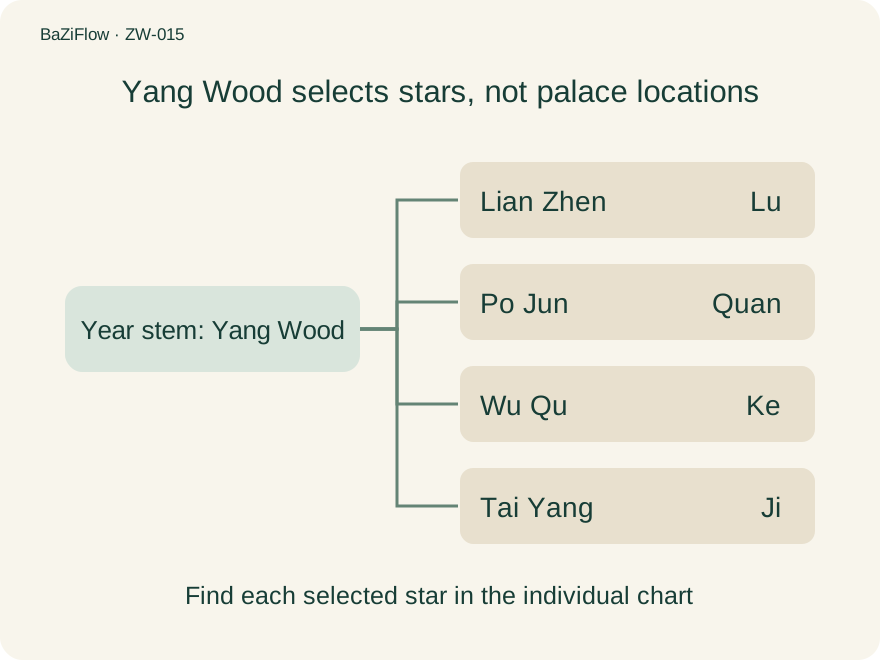 ZW-015 / Zi Wei Dou Shu
Birth-Year Transformations: A Traceable Ziwei Lookup
Learn what a birth-year stem selects in a Four Transformations table, why the selected stars still need chart positions, and how to record a real difference between two published tables.
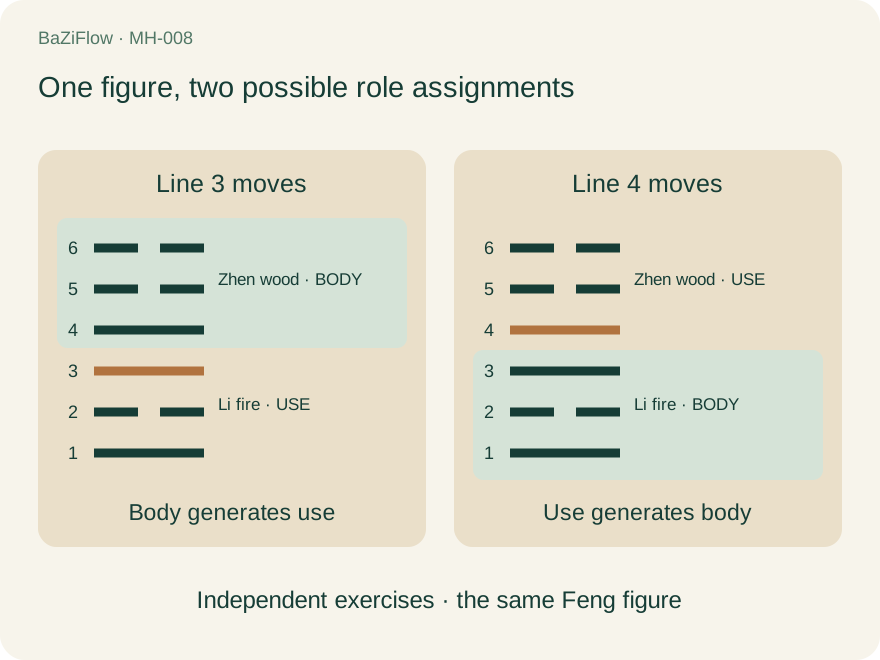 MH-008 / Meihua Yishu
Body and use: assign roles from the moving position
Use two independent Feng exercises to distinguish upper and lower placement from body and use, then separate the primary use trigram from broader influences.
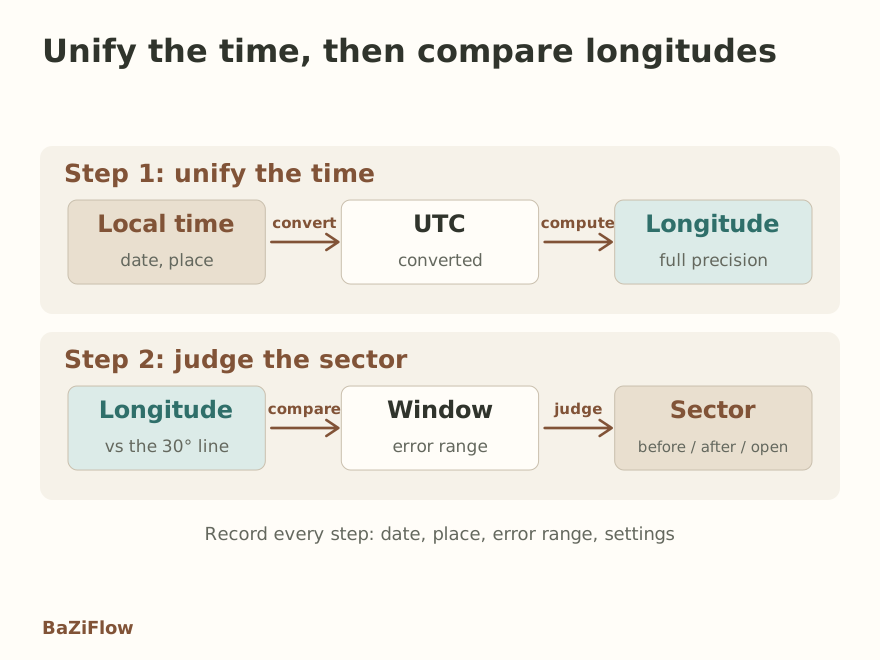 AS-007 / Western astrology
Born on a Sign Boundary: Turn a Date into a Checkable Moment, Then Decide the Side
Two websites can give two signs for a birthday near a sign change. Convert the local clock time to UTC, judge the boundary with full precision, then record a time window as earlier sign, later sign or unresolved.
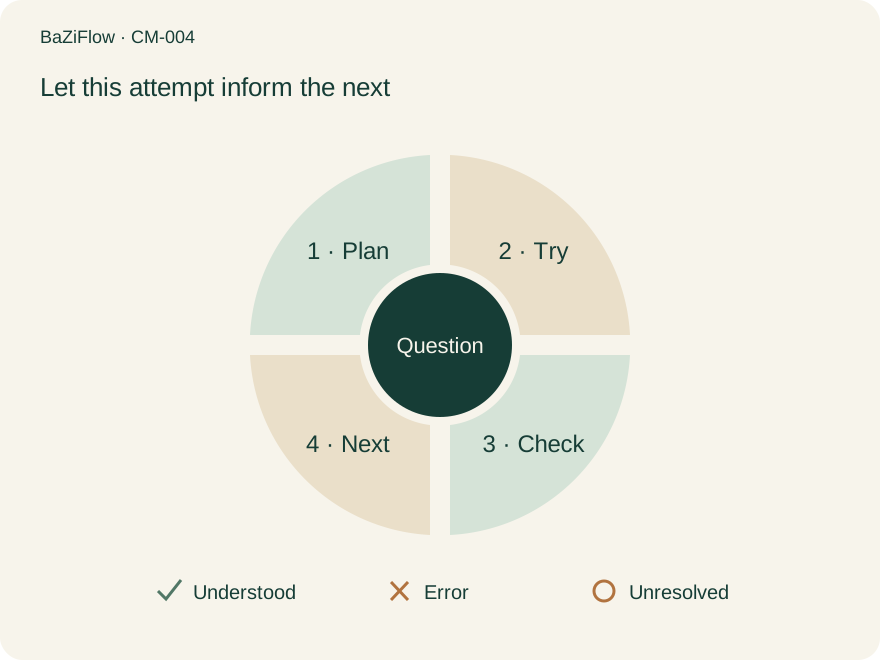 CM-004 / Shared methods
A Learning Log Should Change Your Next Attempt
Build short entries around a question, an unaided attempt, a check and a different follow-up example. Separate learning terminology from applying a convention or evaluating a prediction.
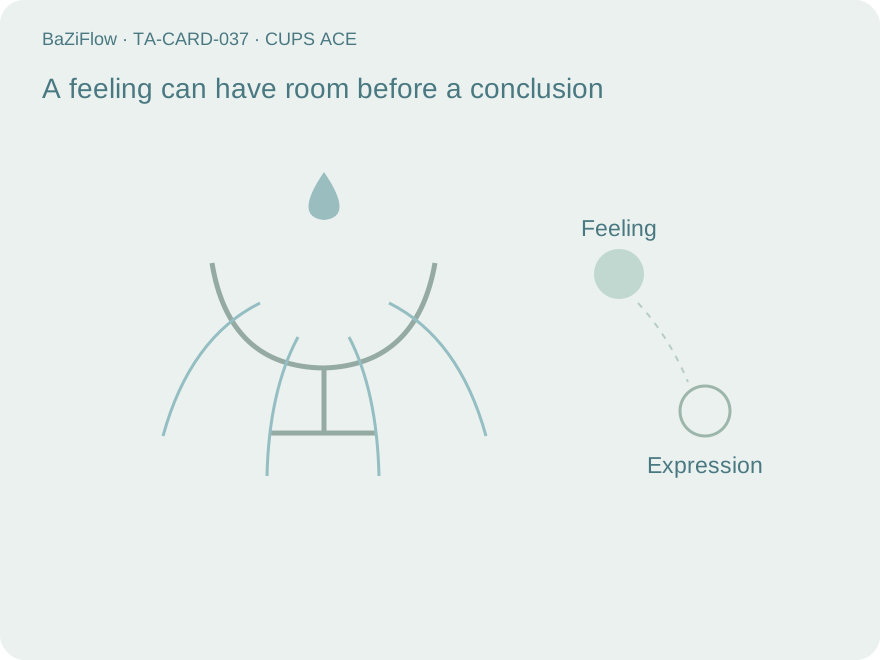 TA-CARD-037 / Tarot
Ace of Cups: a hand holds the cup, and the water spills over
The Ace of Cups shows a hand from a cloud holding a cup, a dove bringing a Host, and streams falling into a lily pond. Sort the picture, Waite's word list and his extras, then split a gift question into three.
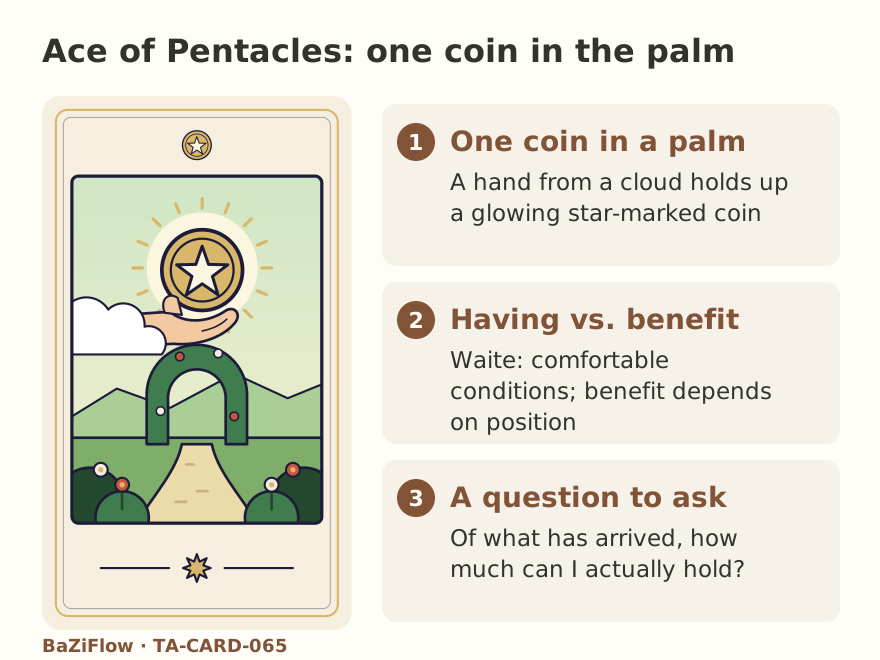 TA-CARD-065 / Tarot
Ace of Pentacles: a hand holds up a coin, and Waite keeps having and benefiting apart
In the Ace of Pentacles a hand from a cloud holds up one coin. Separate Waite's word list, reversed entry and extra meanings, then split "what has arrived" from "what benefits" using a tray of seedlings.
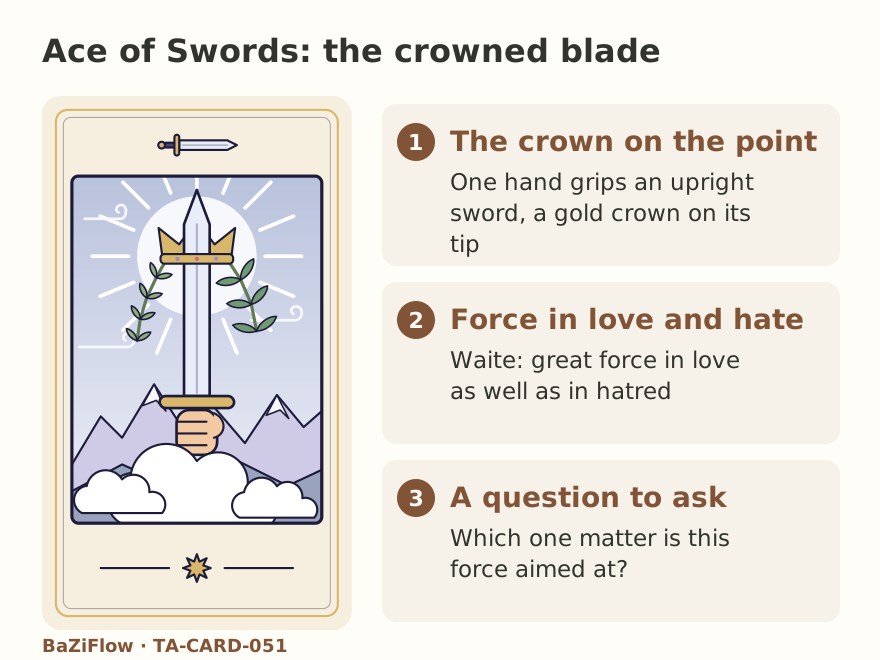 TA-CARD-051 / Tarot
Ace of Swords: a hand, a sword and a crown, and a word list built around force
The Ace of Swords shows a hand from a cloud gripping a sword whose point is circled by a crown. Separate Waite's three layers of meanings, then measure force, direction and crown on a deposit email.
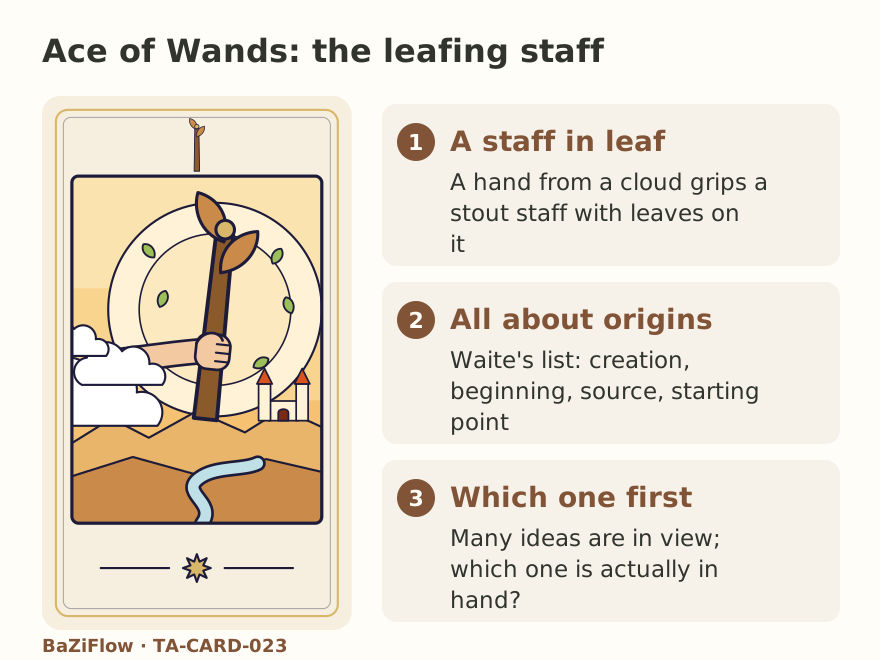 TA-CARD-023 / Tarot
Ace of Wands: a hand grips a staff in leaf, and Waite's list looks back to origins
The Ace of Wands shows a hand from a cloud gripping a stout staff. Separate Waite's main list, his "another account" and the extra meanings, then split a running-group launch into hold, leaf and ground.
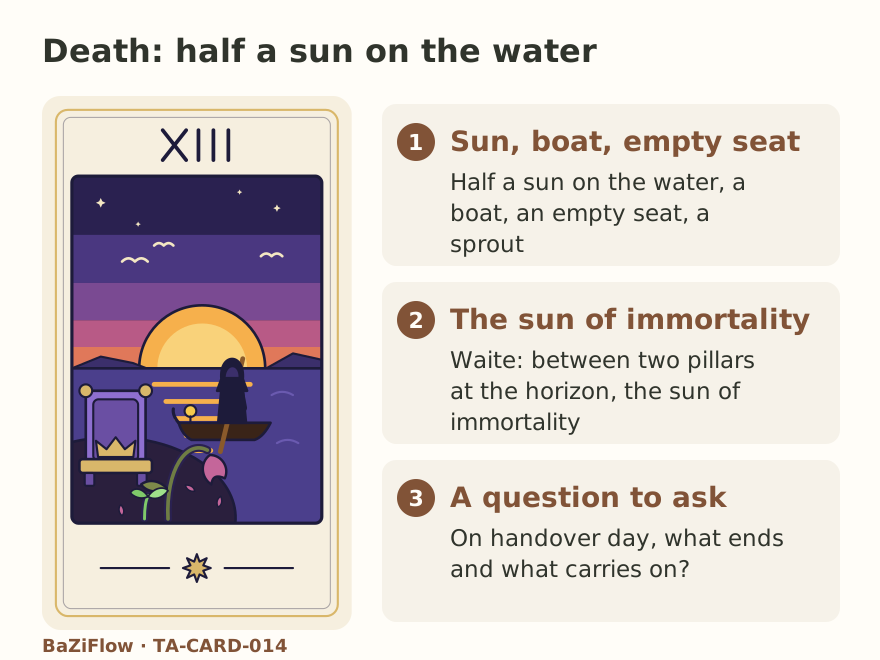 TA-CARD-014 / Tarot
Death: a slow rider, a rose on black, and a word list read as written
Death's word list holds end, mortality, destruction and corruption, while Waite explains the picture as change and passage. Keep the list, the picture and his two kinds of death apart, then practice on a work handover.
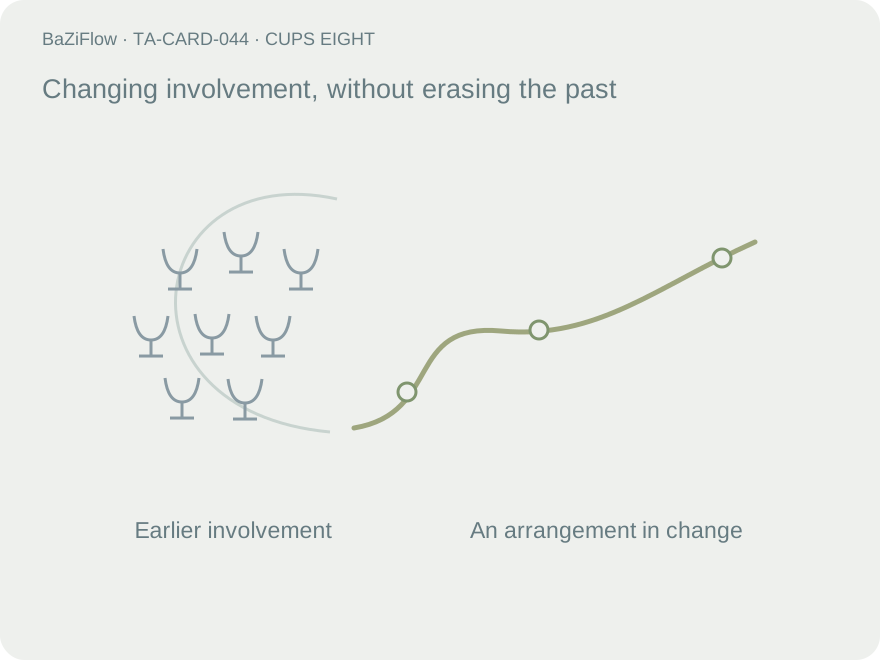 TA-CARD-044 / Tarot
Eight of Cups: the cups stay standing, the figure walks on, two ways to read leaving
In the Eight of Cups a figure turns from eight cups and walks toward distant hills. Separate Waite’s plain reading from the “antithetical” ones, then use a choir member’s doubts to tell decline from a lighter matter.
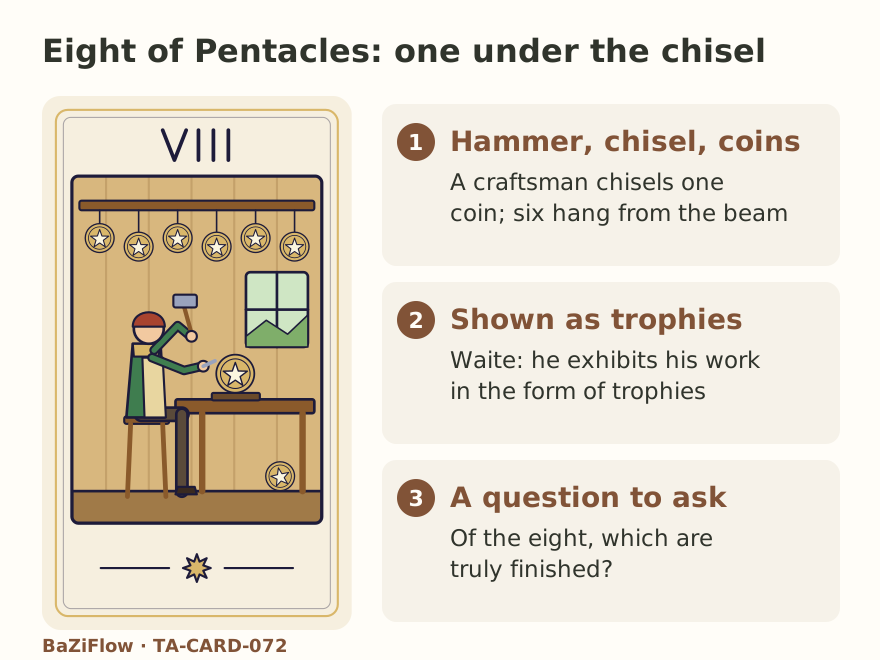 TA-CARD-072 / Tarot
Eight of Pentacles: six hung, one in hand, one on the ground, so count what is finished
The Eight of Pentacles shows a craftsman chiseling a pentacle beside finished ones on display. Read the picture, the word list and Waite's cross-reference apart, then sort a month of expense claims into three places.
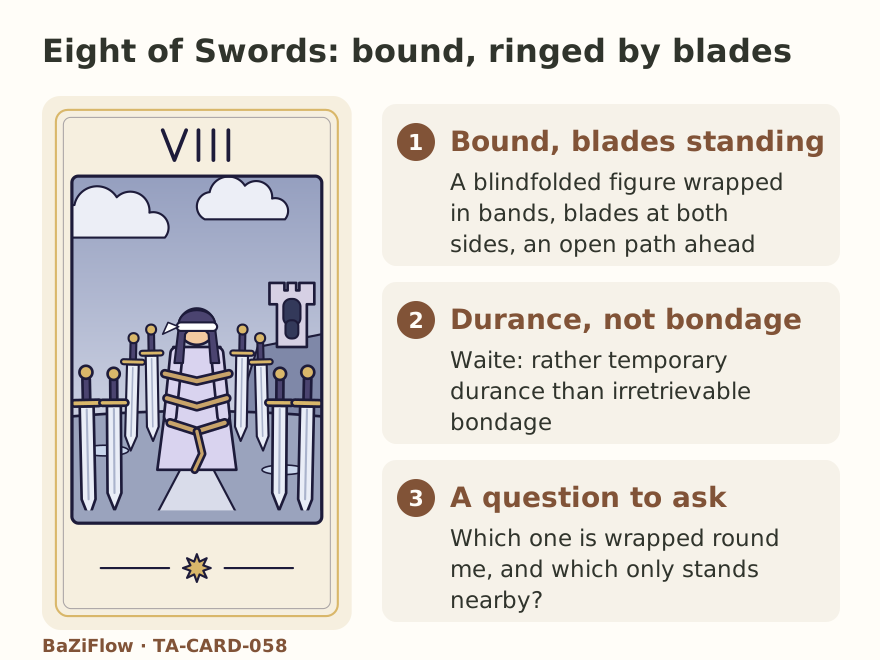 TA-CARD-058 / Tarot
Eight of Swords: bound and blindfolded, blades standing near, and a yardstick of "durance"
The Eight of Swords shows a blindfolded, bound figure with eight swords standing around her. Separate Waite's list from his one-line yardstick, then sort contract clauses into bands, standing blades and an open side.
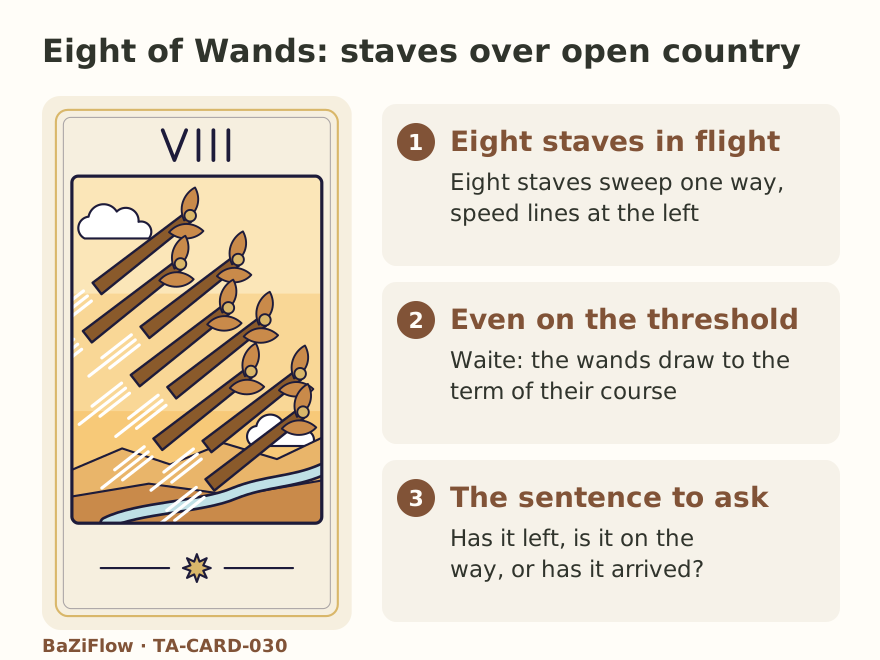 TA-CARD-030 / Tarot
Eight of Wands: eight staves over open country, motion through the immovable
The Eight of Wands shows eight staves flying over open country with no one in sight. Read Waite's "on the threshold" and "arrows of love", then sort shipped parcels by how far each has moved.
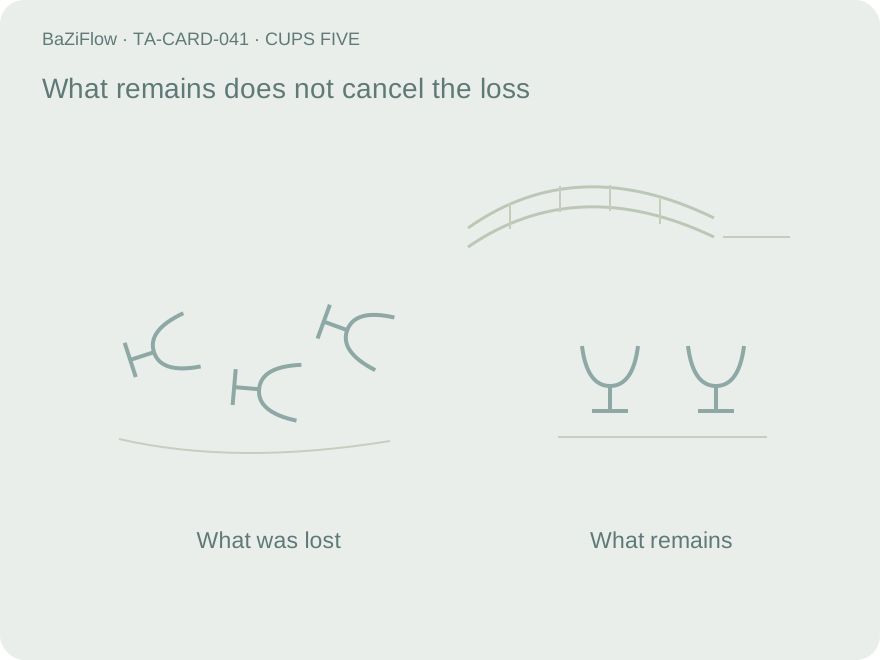 TA-CARD-041 / Tarot
Five of Cups: three cups spilled, two still standing, so count before you apologize
The Five of Cups shows a dark-cloaked figure looking at three fallen cups, with two standing behind and a bridge beyond. Sort picture, word list and extras, then count what fell, what stands and where the bridge goes.
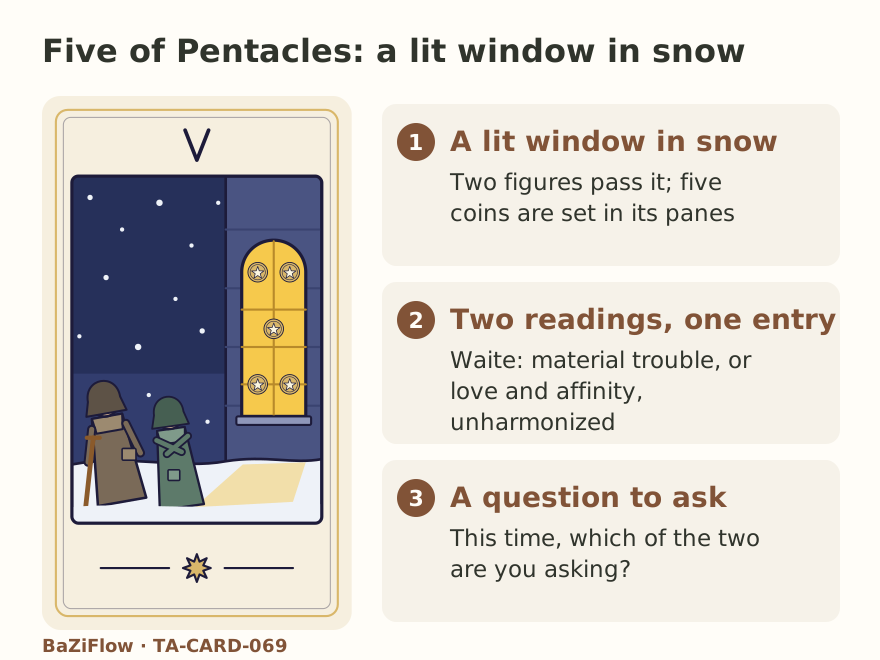 TA-CARD-069 / Tarot
Five of Pentacles: a lit window in the snow, and two readings Waite cannot harmonize
The Five of Pentacles shows two figures passing a lit window in a snow-storm. See Waite's two readings, material trouble and love, then practice choosing one with a nearly empty fridge.
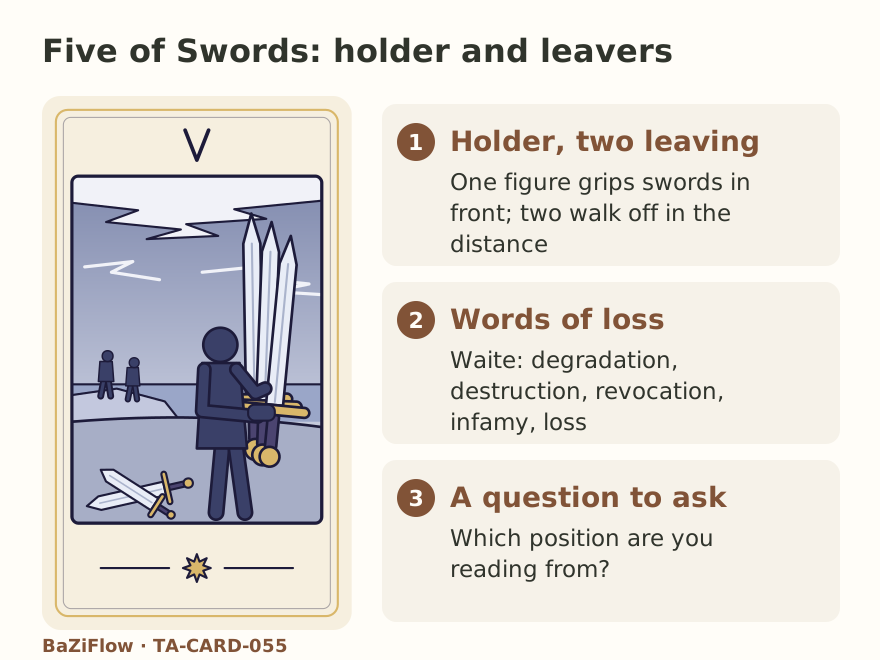 TA-CARD-055 / Tarot
Five of Swords: one holds three blades, two lie fallen, and the list speaks of loss
The Five of Swords shows one figure holding swords while two walk away and their blades lie on the ground. See which words Waite lists, then take a shared-notes dispute from three positions.
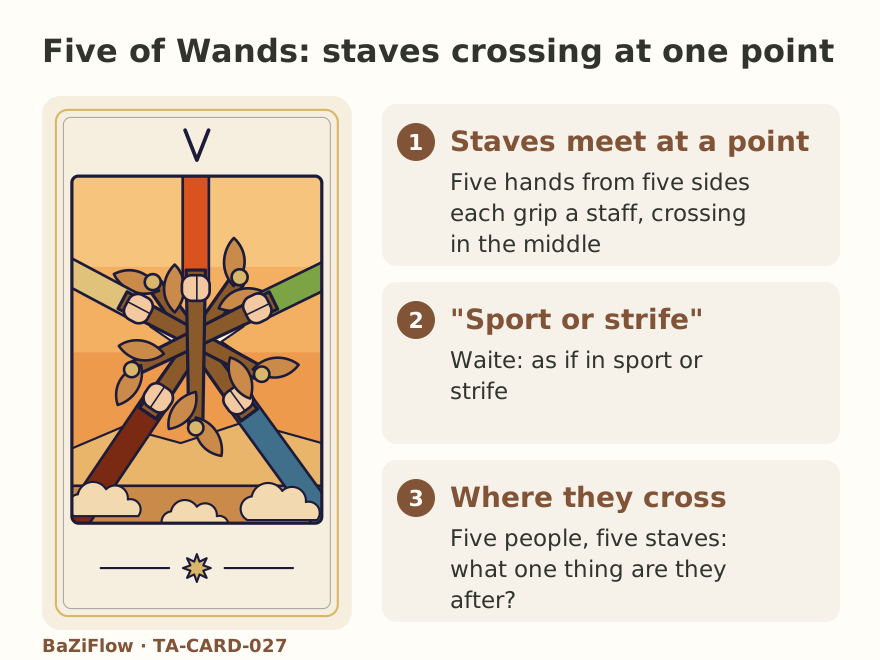 TA-CARD-027 / Tarot
Five of Wands: five staves cross at one point, and Waite himself says "sport or strife"
The Five of Wands shows youths brandishing staves, as if in sport or strife. Separate the picture, the chain from "sham fight" to "gold" and the reversed list, then find where five staves cross in a team kit purchase.
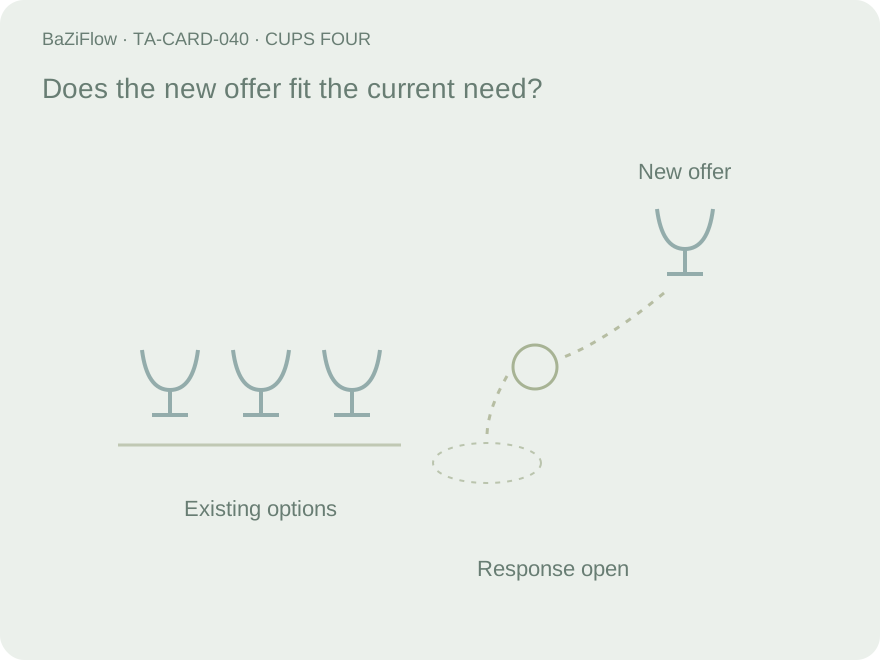 TA-CARD-040 / Tarot
Four of Cups: three cups at his feet, a fourth from a cloud, and what is only imagined
The Four of Cups shows a figure under a tree eyeing three cups on the grass while a hand from a cloud offers a fourth. Sort picture, word list and extras, then split a silent invitation into sent, said and guessed.
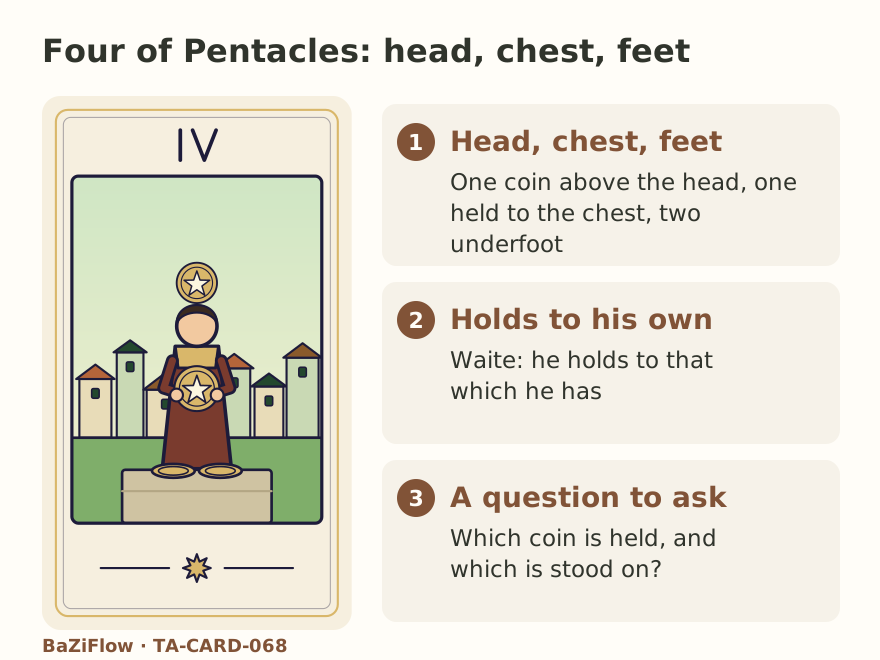 TA-CARD-068 / Tarot
Four of Pentacles: a coin on the head, one at the chest, two underfoot
The Four of Pentacles shows a crowned figure with coins above his head, at his chest and under his feet. See the two directions of Waite's list, then sort a storage room into three layers.
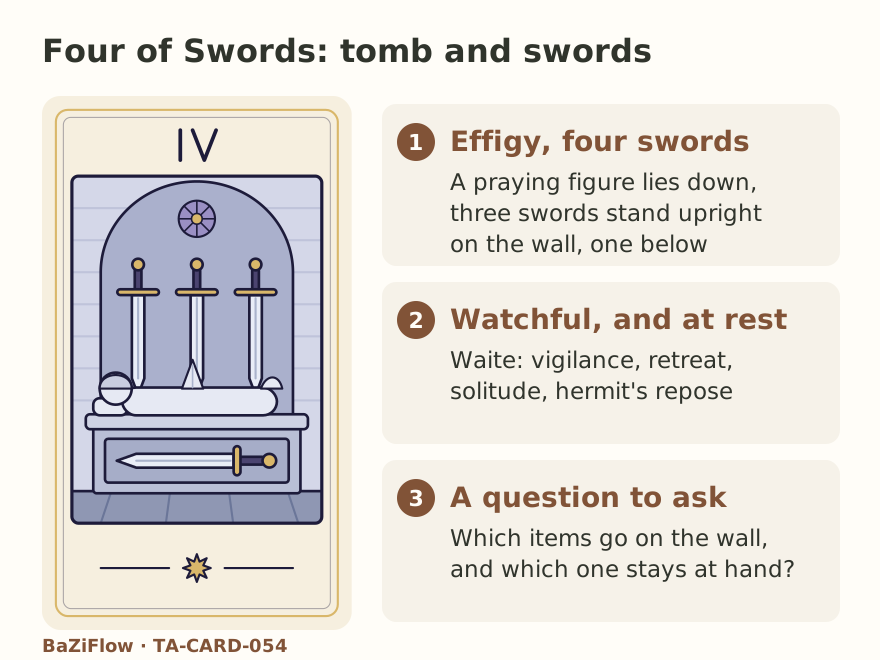 TA-CARD-054 / Tarot
Four of Swords: a knight's effigy on a tomb, and a picture drawn from "tomb and coffin"
The Four of Swords shows a knight's effigy at prayer upon his tomb. See how vigilance and retreat sit in one list of Waite's, then sort a half-day break in exam week by what hangs on the wall and what stays at hand.
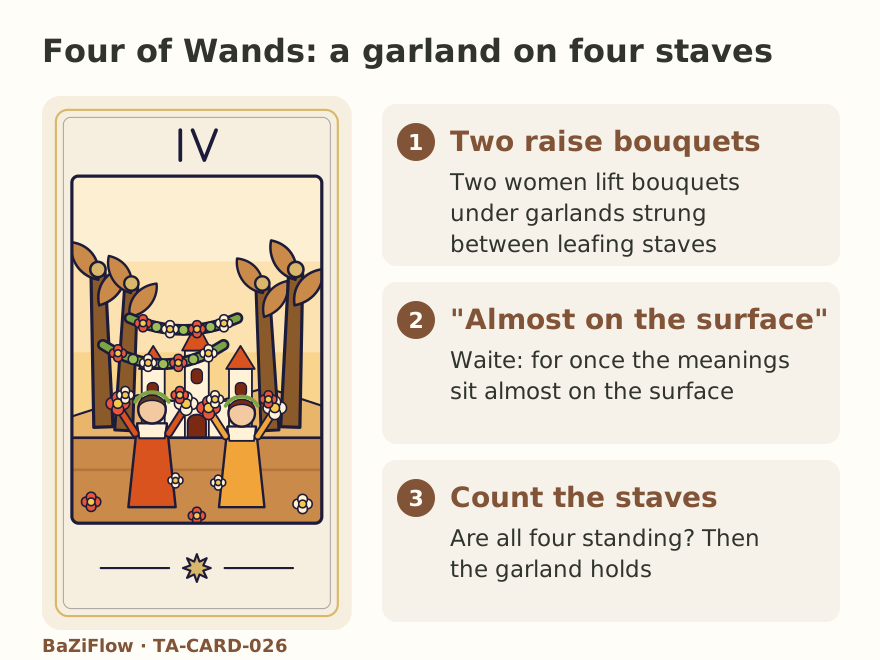 TA-CARD-026 / Tarot
Four of Wands: four staves hold a garland, meanings "almost on the surface"
The Four of Wands shows a garland hung between four great staves, two women with bouquets and an old manor behind. Separate picture from list, then write a finish day into a four-week training plan.
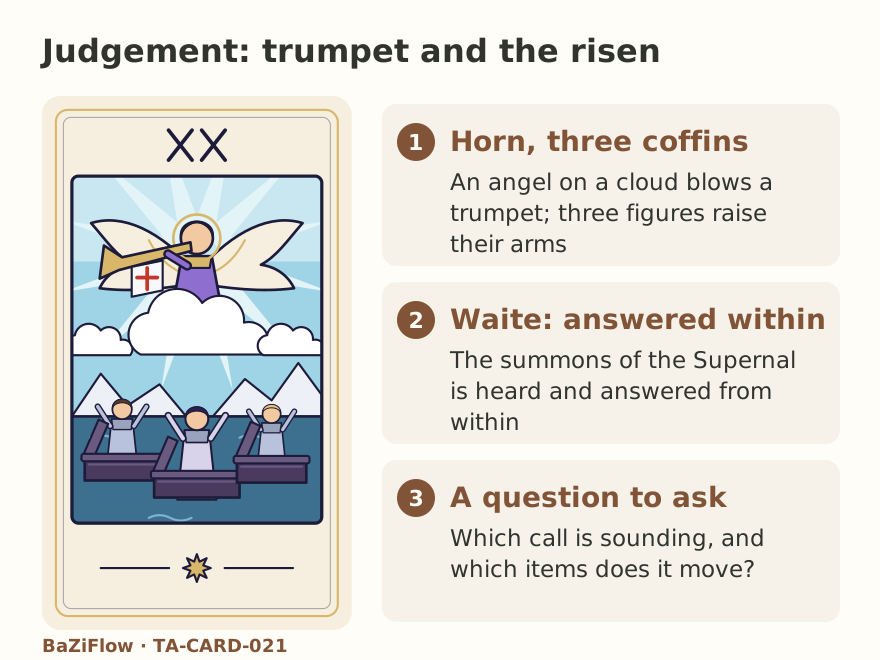 TA-CARD-021 / Tarot
Judgement: the trumpet sounds and the risen raise their arms, Waite’s “Last Judgment”
Judgement, which Waite calls The Last Judgment, shows an angel blowing a trumpet and figures rising from coffins with raised arms. Separate the picture, the list and Waite’s inner-summons reading, then re-plan a route.
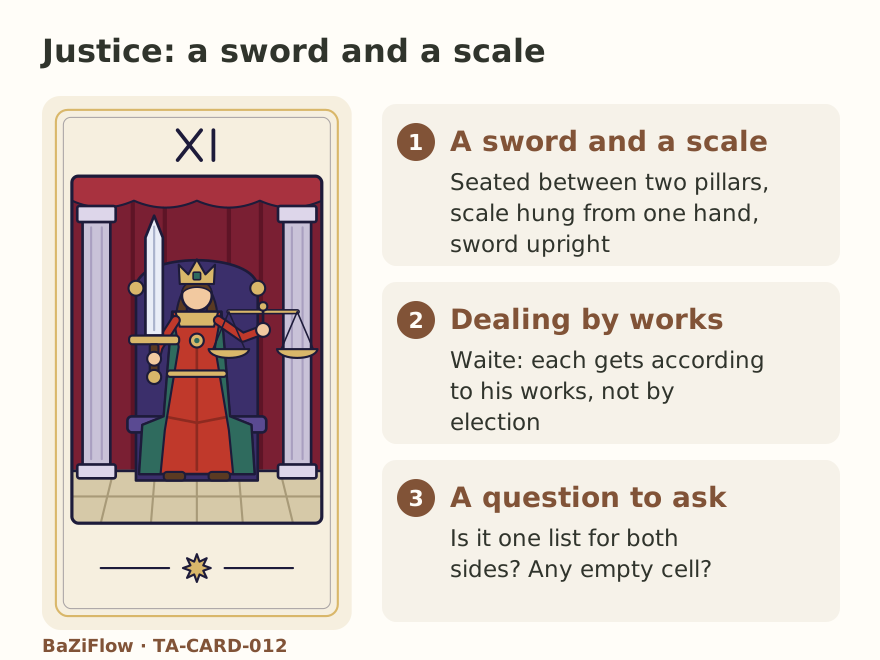 TA-CARD-012 / Tarot
Justice: a sword held up, a scale hung low, and one measure for both sides
Justice seats a figure between two pillars, an upright sword in one hand and scales in the other. Separate Waite's picture, word list and the line he draws, then practice one measure for both sides on a shift schedule.
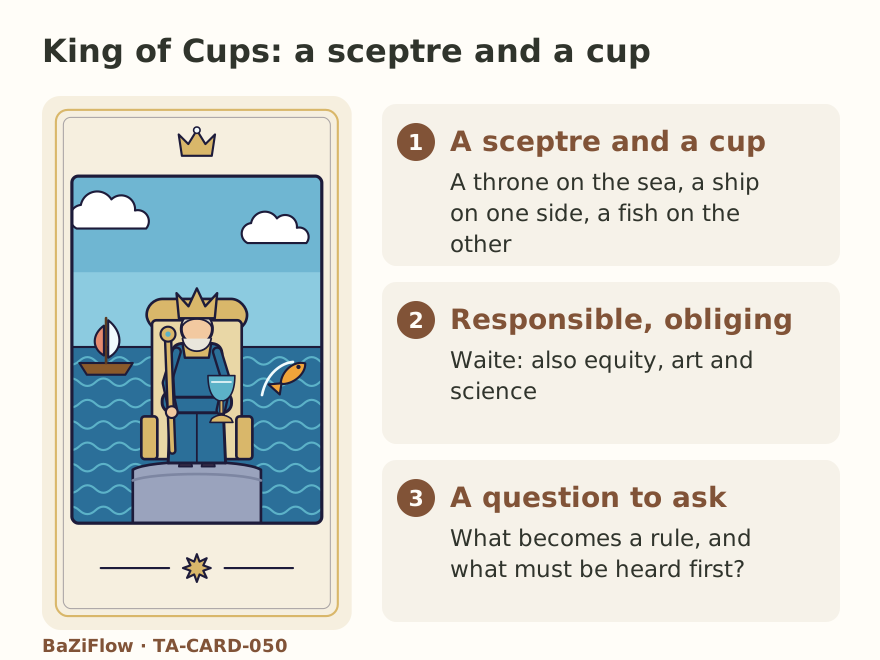 TA-CARD-050 / Tarot
King of Cups: a throne on the sea, with a sceptre in one hand and a cup in the other
The King of Cups holds a short sceptre and a great cup on a throne set in the sea. Separate the picture, the word lists and the warning in the extras, then sort a shared-kitchen problem into sceptre, cup and sea.
 TA-CARD-078 / Tarot
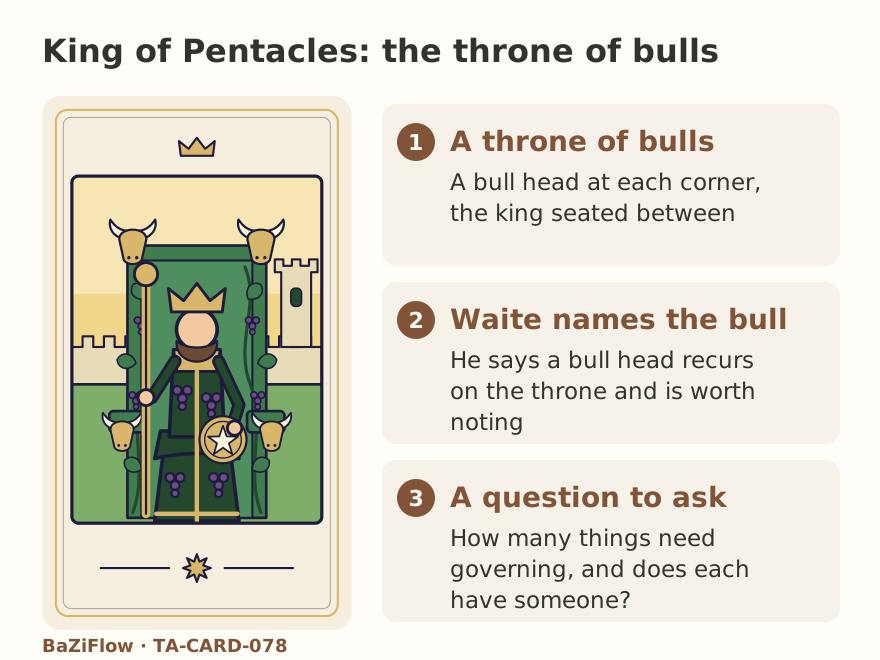
King of Pentacles: the king on a throne of bulls, and a suit note Waite tucked in
The King of Pentacles sits on a throne of bulls’ heads, and Waite uses his entry for a note on the whole suit: the pentagram and the old name “coins”. Separate description, list and extras, then split a show’s jobs.
 TA-CARD-064 / Tarot
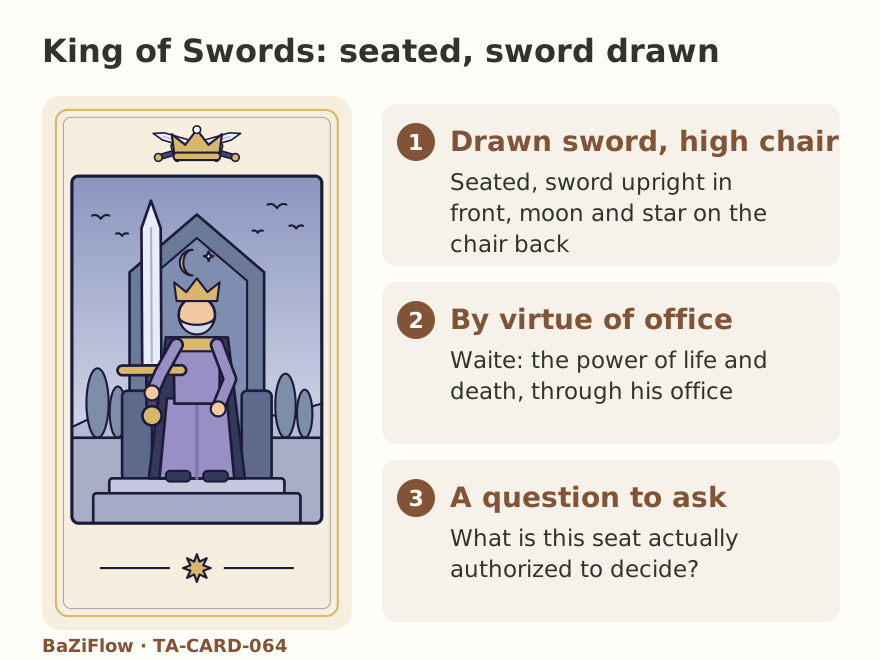
King of Swords: a drawn sword, a seated man, and power that comes from the office
The King of Swords sits on his throne with a drawn sword. Separate the picture, a word list spreading from the idea of judgment and Waite's line between him and Justice, then practice a small-grants review sheet.
 TA-CARD-036 / Tarot
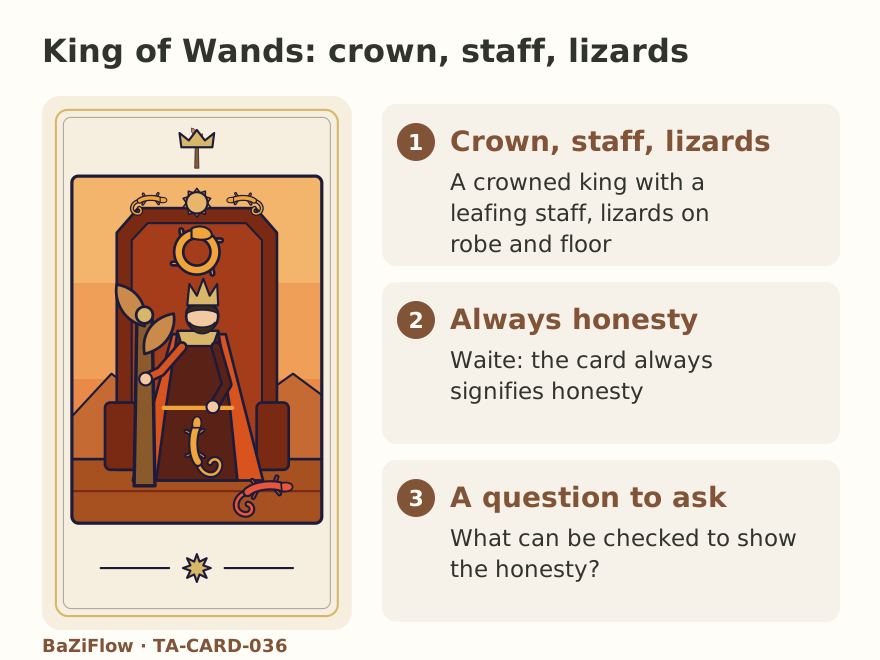
King of Wands: after "always signifies honesty", rules split into fixed and open
The King of Wands lifts a flowering wand, a lion blazoned behind his throne. Separate the picture, Waite's list and his extras, then turn honesty into something checkable and split the rules into fixed and open.
 TA-CARD-048 / Tarot
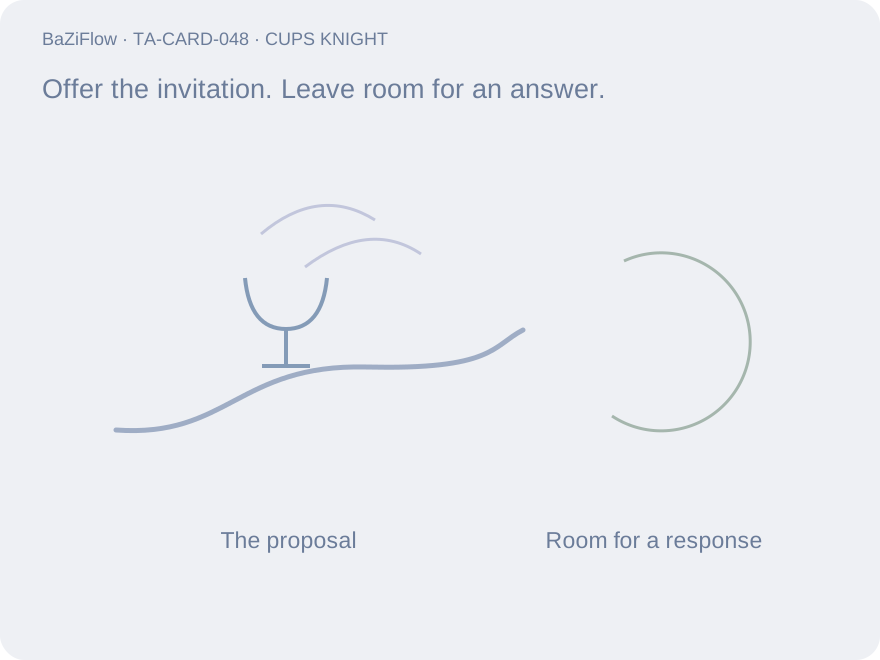
Knight of Cups: a cup held out, and Waite's words of arrival and invitation
In the Knight of Cups an armored rider walks slowly and holds a cup out in front. Separate the picture from Waite's word list and his run of reversed words about trickery, then split an invitation into three parts.
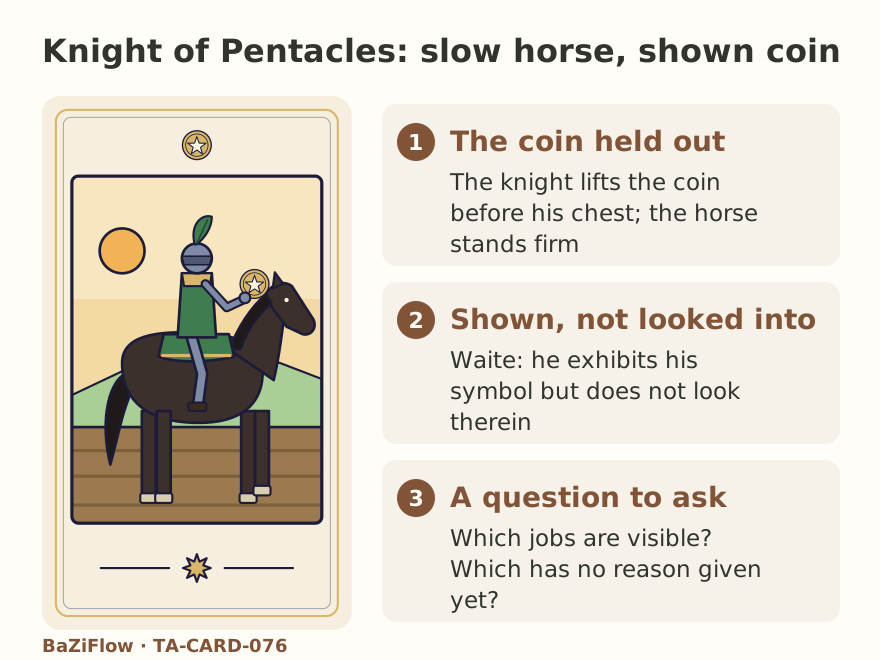 TA-CARD-076 / Tarot
Knight of Pentacles: a slow, heavy horse, a coin shown and not looked into
The Knight of Pentacles rides a slow, heavy horse and shows his coin without looking in. Separate Waite’s word list, its limiting phrase and the extras, then practice pace, a checklist and one stop to look inside.
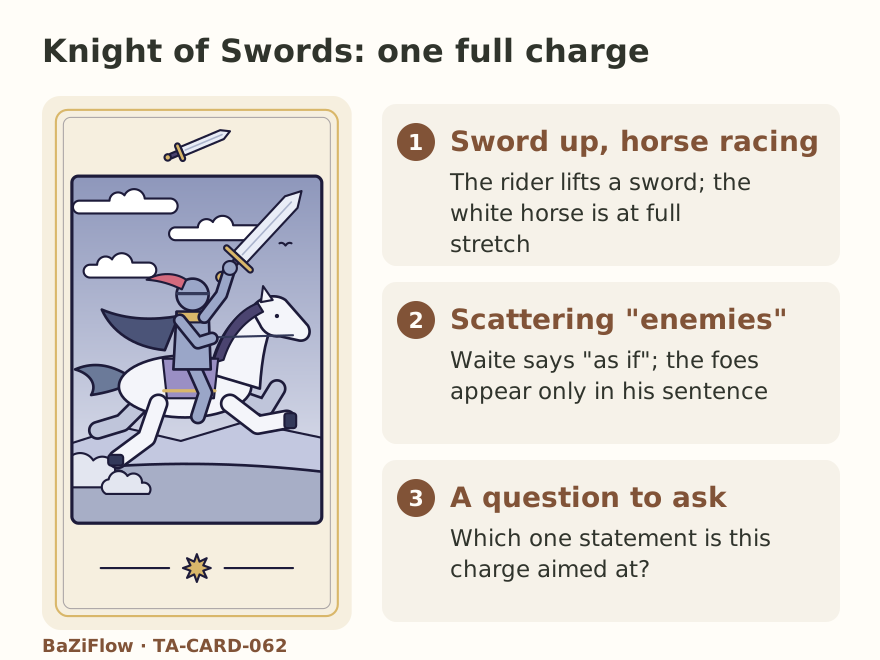 TA-CARD-062 / Tarot
Knight of Swords: a full-speed charge, and no enemy in the picture
The Knight of Swords rides at full course with his sword raised. Separate the picture, Waite's word list, the reversed words and the extras, then practice writing the unseen opponent into a debate-team rebuttal.
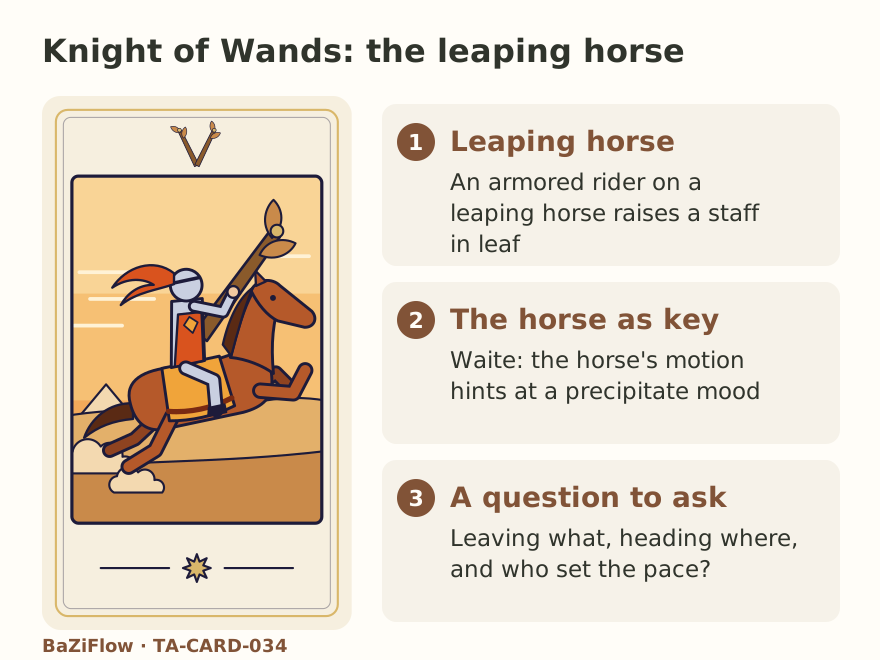 TA-CARD-034 / Tarot
Knight of Wands: the horse is moving, so ask what you leave, where to and how fast
The Knight of Wands is an armored rider on a leaping horse, not going to war. Separate the picture, Waite's list and the extras, then split a departure into leaving, heading and pace.
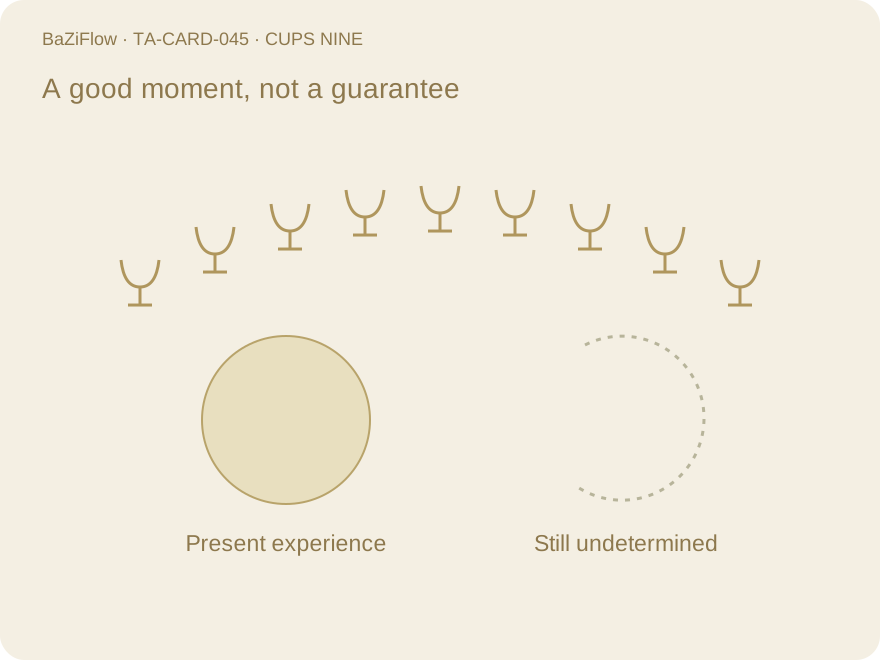 TA-CARD-045 / Tarot
Nine of Cups: one figure seated, nine cups behind, and a reminder of the material side
In the Nine of Cups a figure sits with folded arms before nine cups on an arch. Separate the picture, Waite’s word list and his warning about the material side, then count the layers of satisfaction at a home dinner.
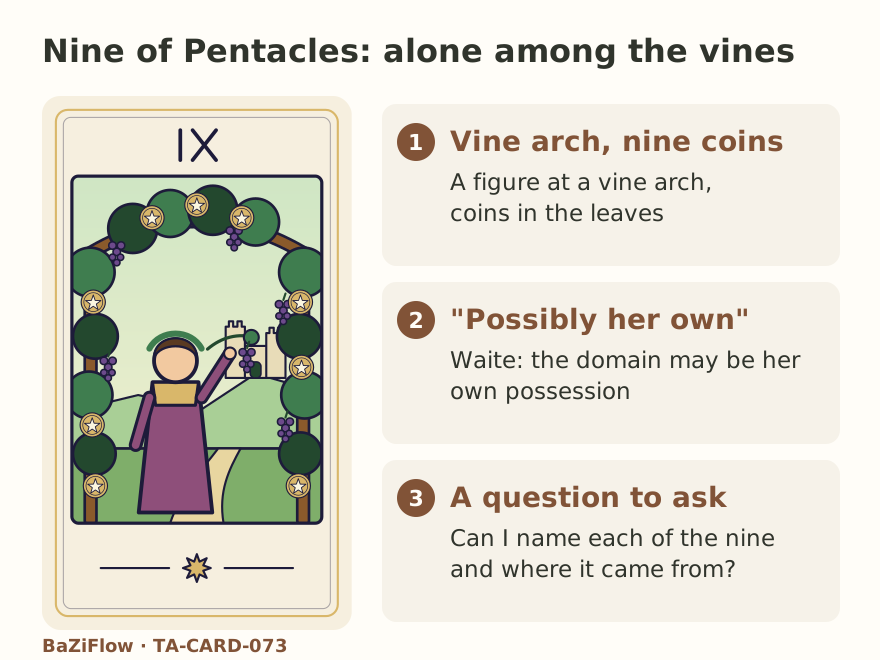 TA-CARD-073 / Tarot
Nine of Pentacles: alone among the vines, with Waite's "possibly her own"
The Nine of Pentacles shows a woman among grapevines in a manor garden. Read the picture, the word list and the hedge "possibly her own" apart, then check a phone bill: boundary, each item, how sure.
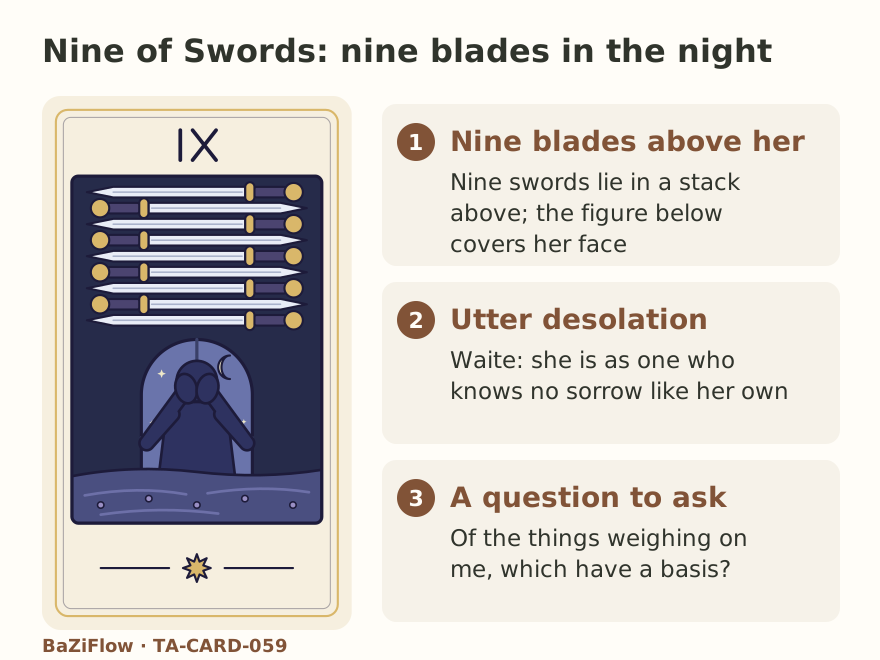 TA-CARD-059 / Tarot
Nine of Swords: nine blades stacked in the dark above a figure with her hands on her face
The Nine of Swords shows nine horizontal swords above a figure sitting up in bed, hands over her face. Separate Waite's list from his line about her own sense of sorrow, then lay worries out in nine lines.
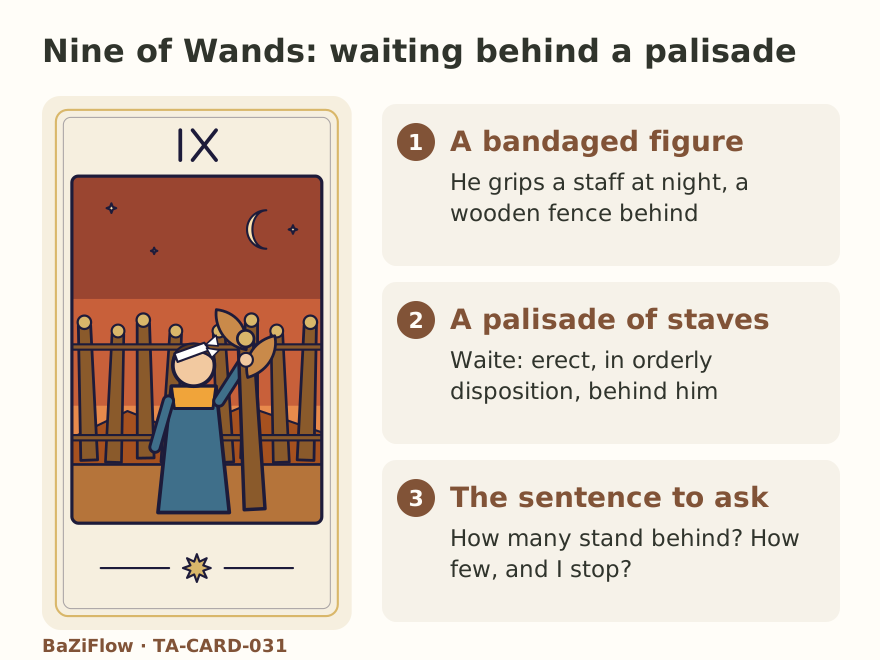 TA-CARD-031 / Tarot
Nine of Wands: a figure leaning on a staff, eight more standing like a palisade
The Nine of Wands shows a bandaged figure leaning on a staff, as if awaiting an enemy, eight staves standing behind like a palisade. Read "strength in opposition", then count stock and set a stopping line.
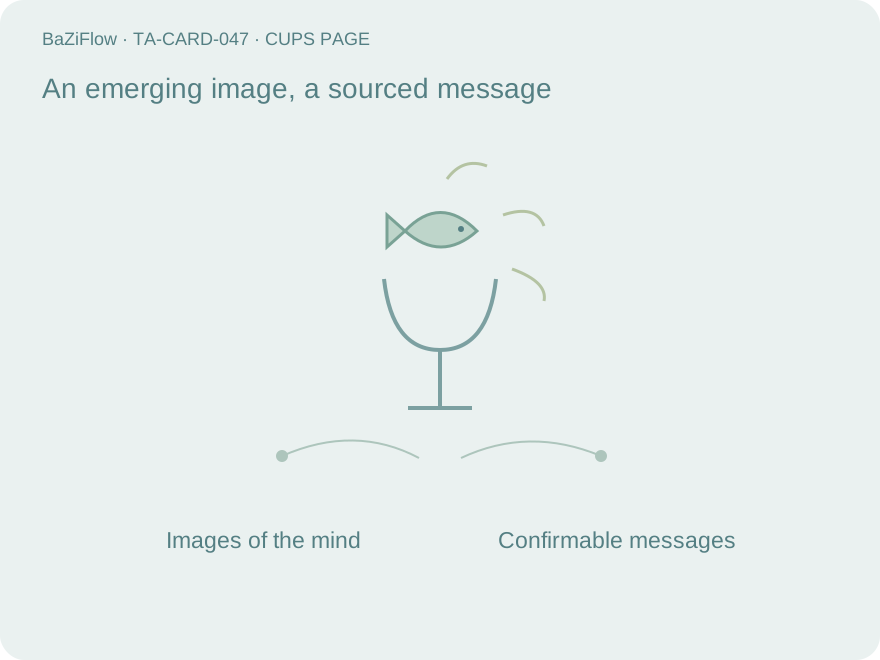 TA-CARD-047 / Tarot
Page of Cups: a fish rises from the cup, and the pictures of the mind take form
In the Page of Cups a young person looks at a fish rising from a cup. Separate picture, word list and historical wording, then use an old photo album to keep “what is on the photo” apart from “what rose in the mind”.
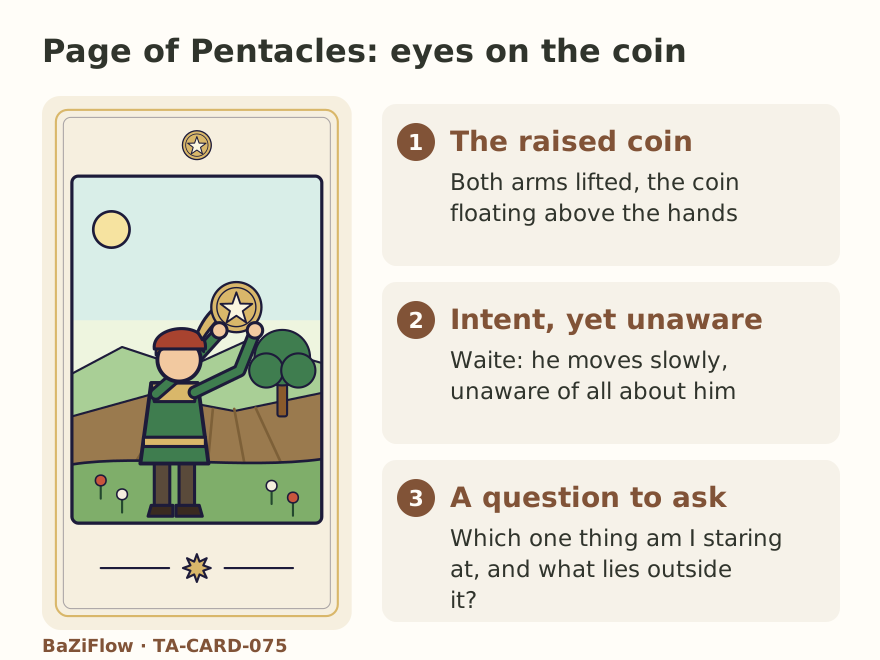 TA-CARD-075 / Tarot
Page of Pentacles: eyes lifted to one coin, and “insensible of that which is about him”
The Page of Pentacles shows a youth staring at a pentacle above his raised hands. Separate Waite’s word list, his “another reading” and the extras, then keep one column for what you stare at and one for what you miss.
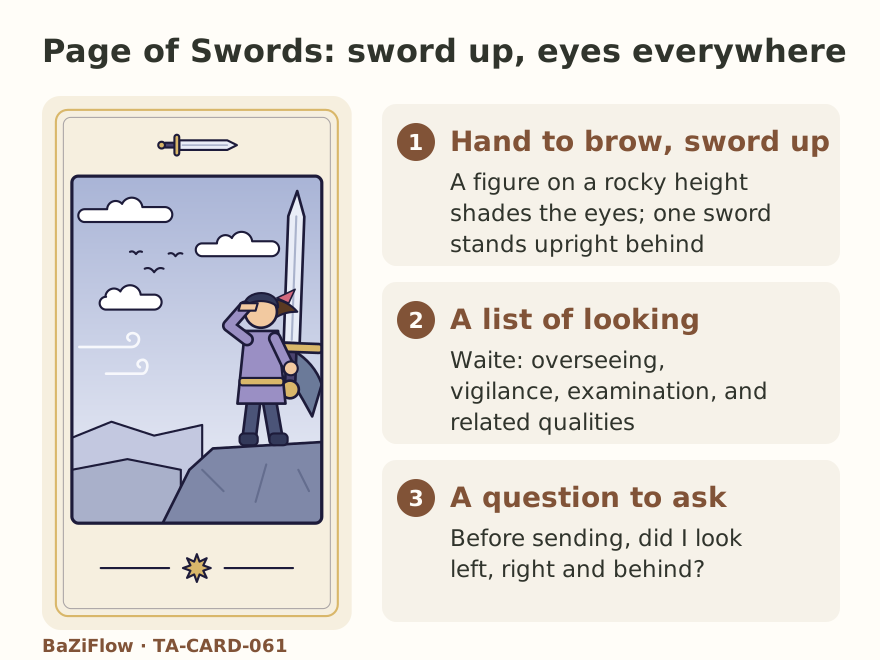 TA-CARD-061 / Tarot
Page of Swords: an upright sword, a fast walker on rough ground, and eyes everywhere
The Page of Swords shows a lithe, alert figure walking fast with an upright sword. Separate Waite's list from his period wording, then sweep a complaint letter left, right and behind before sending it.
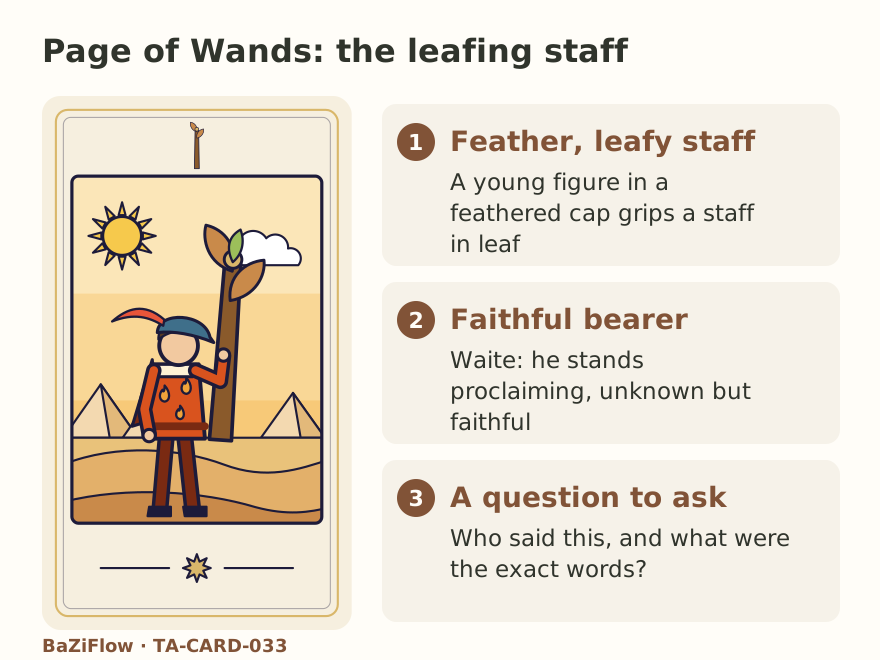 TA-CARD-033 / Tarot
Page of Wands: a faithful bearer and strange tidings, kept in two columns
The Page of Wands shows a young figure grasping a leafing staff and proclaiming something. Separate the picture, Waite's word list and his extras, then practice reading the bearer and the message as two different things.
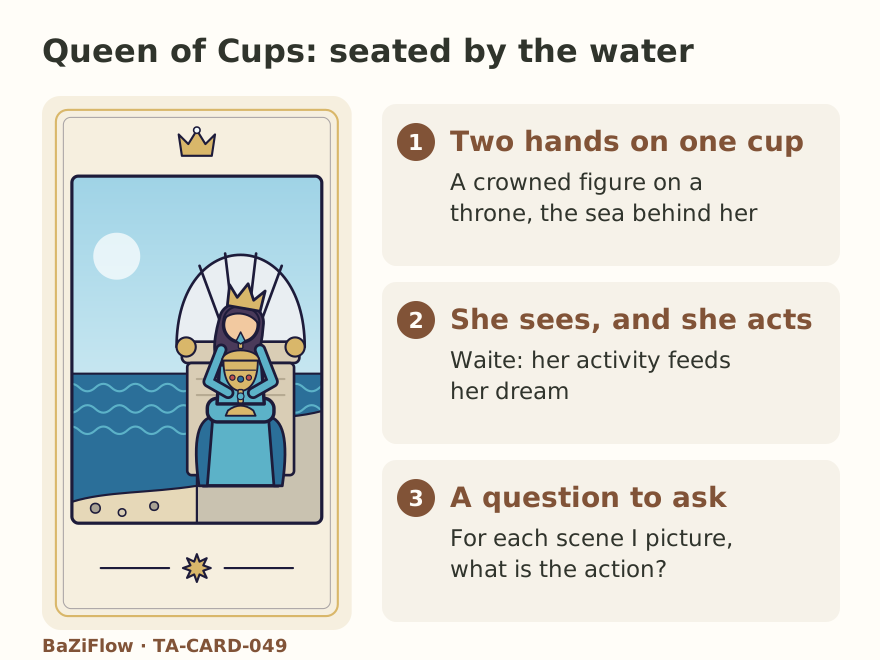 TA-CARD-049 / Tarot
Queen of Cups: a lidded cup by the water, and Waite's line "she sees, but she also acts"
The Queen of Cups sits by the water holding a lidded cup in both hands. Separate the picture, Waite's word list and his split reversed entry, then use a birthday plan to pair each picture with an action.
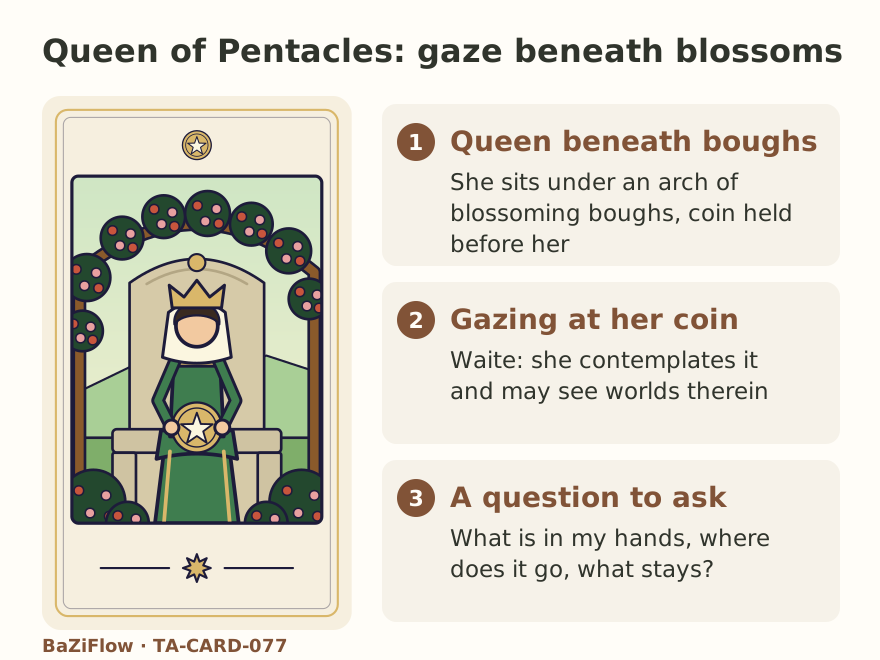 TA-CARD-077 / Tarot
Queen of Pentacles: a gaze at the coin in her lap, and a list of opulence and security
The Queen of Pentacles sits beneath blossoming boughs and gazes at the coin in her lap. Separate Waite’s description, word list and extras, then practice stock-taking, flow and a reserve on a craft workshop’s materials.
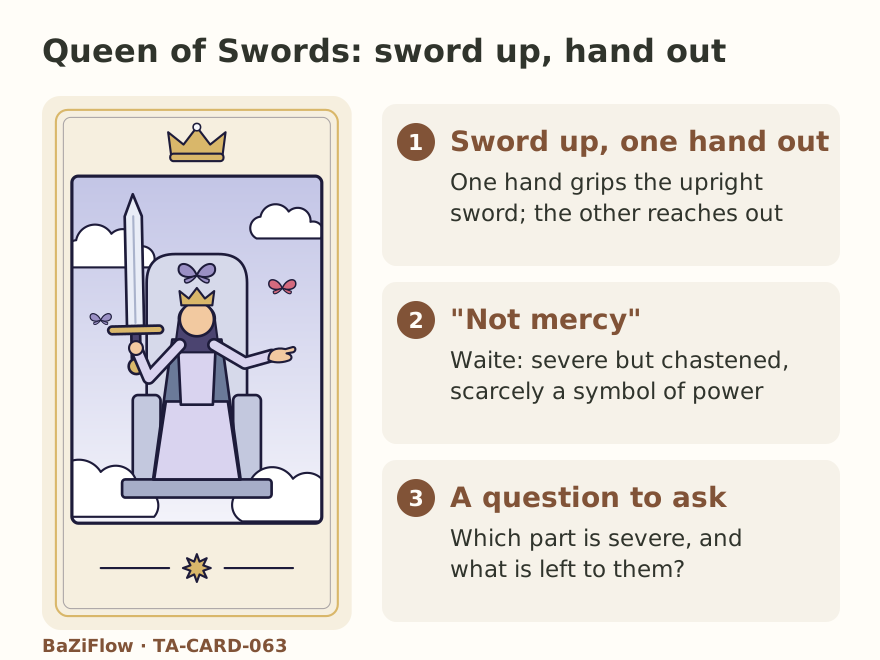 TA-CARD-063 / Tarot
Queen of Swords: sword upright, one hand out, and a card defined by what it is not
The Queen of Swords keeps a sword upright and reaches out with her other hand, severe but chastened. Separate the picture, a list made of absences and the reversed words, then practice a firm markup with reasons.
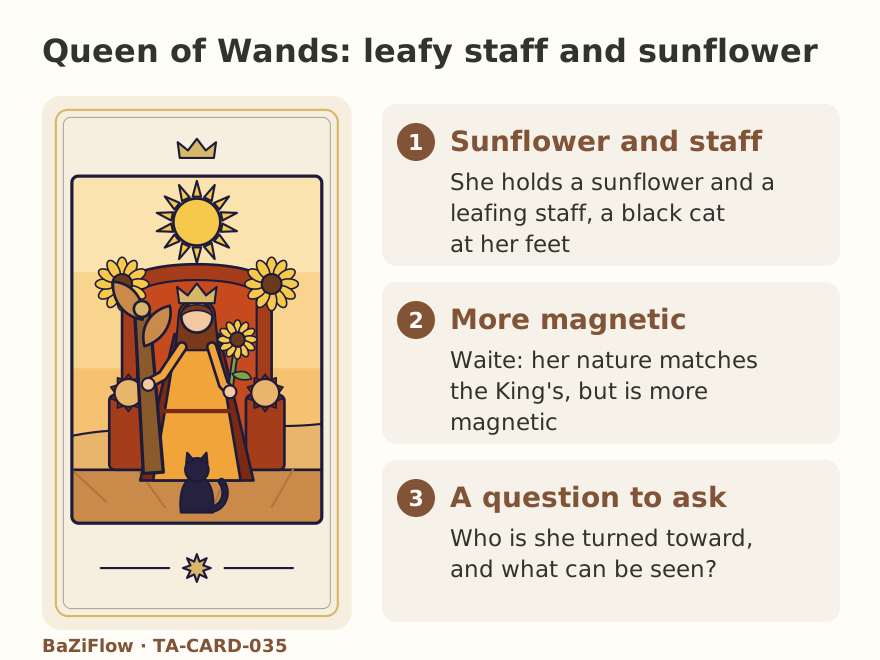 TA-CARD-035 / Tarot
Queen of Wands: magnetism is not an answer, so ask who she faces and whether there is room
The Queen of Wands sits enthroned with a sunflower and a leafing staff. Separate the picture, Waite's word list and his extras, then split her good will into direction, visible signs and opportunity.
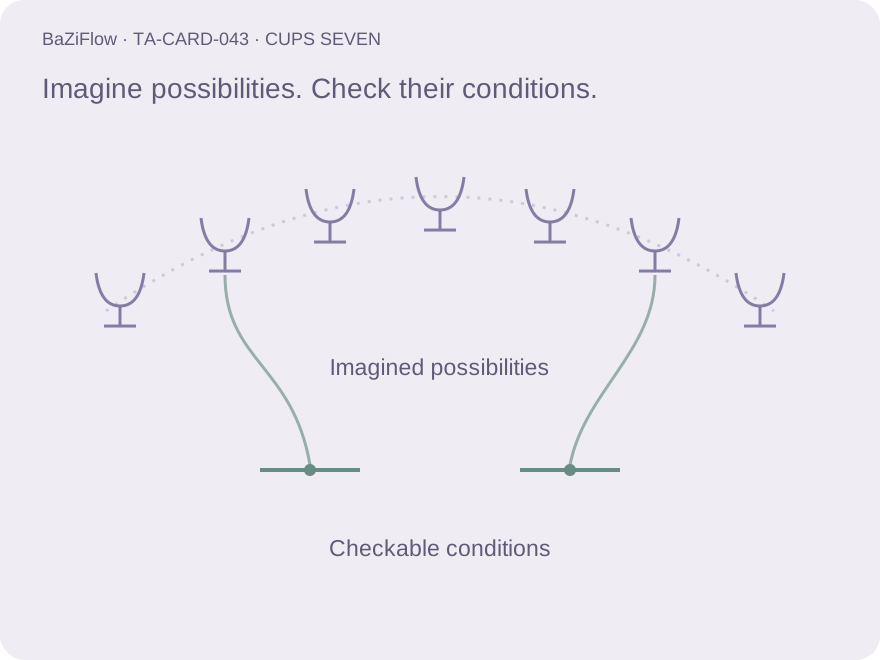 TA-CARD-043 / Tarot
Seven of Cups: seven cups on a cloud, each holding an image, and the gap to holding one
In the Seven of Cups, seven cups float on a cloud, each holding an image. Separate picture, word list and Waite’s extra meanings, then take imagined options down one at a time using a child’s activity classes.
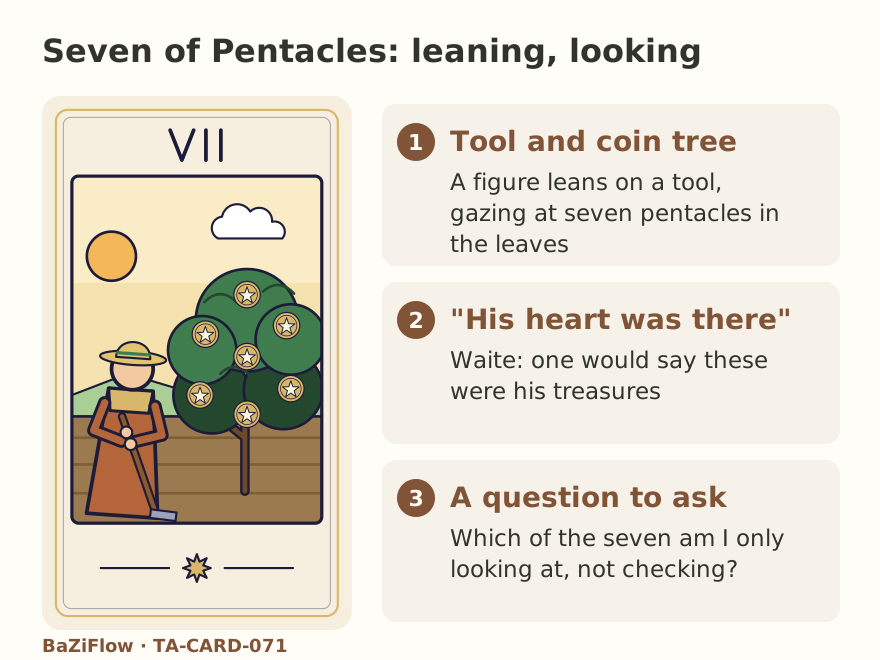 TA-CARD-071 / Tarot
Seven of Pentacles: leaning over seven coins, with a word list that argues with itself
The Seven of Pentacles shows a young man leaning on a staff, gazing at seven pentacles in a clump of greenery. Read the picture, the contradictory word list and the extras apart, then practice on a subscription clean-up.
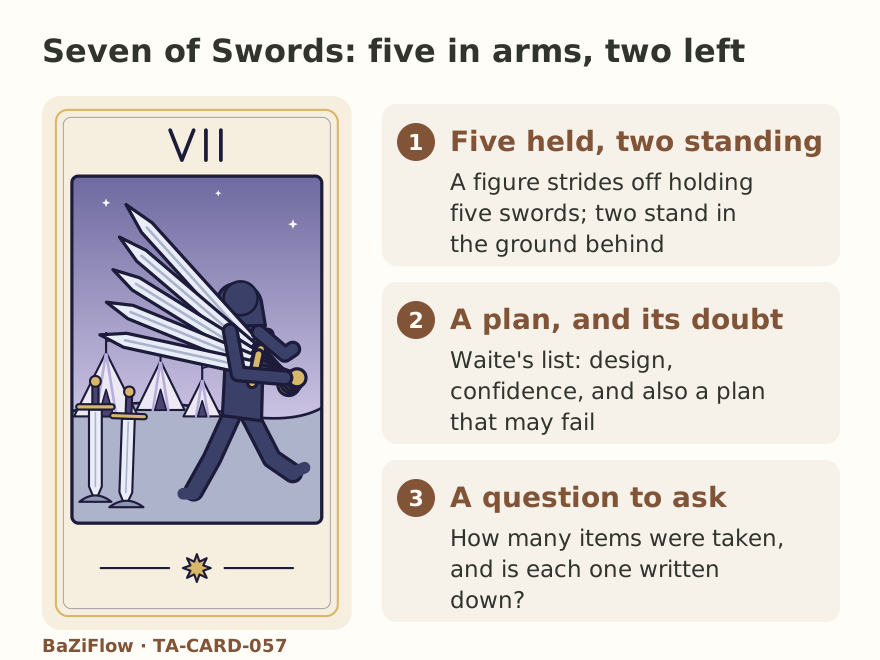 TA-CARD-057 / Tarot
Seven of Swords: five in arms, two in the ground, and a list at odds with itself
The Seven of Swords shows a figure hurrying off with five swords while two are left in the ground and a camp close by. Separate Waite's list, his reservation and the later "sneaking" reading, then try a handover sheet.
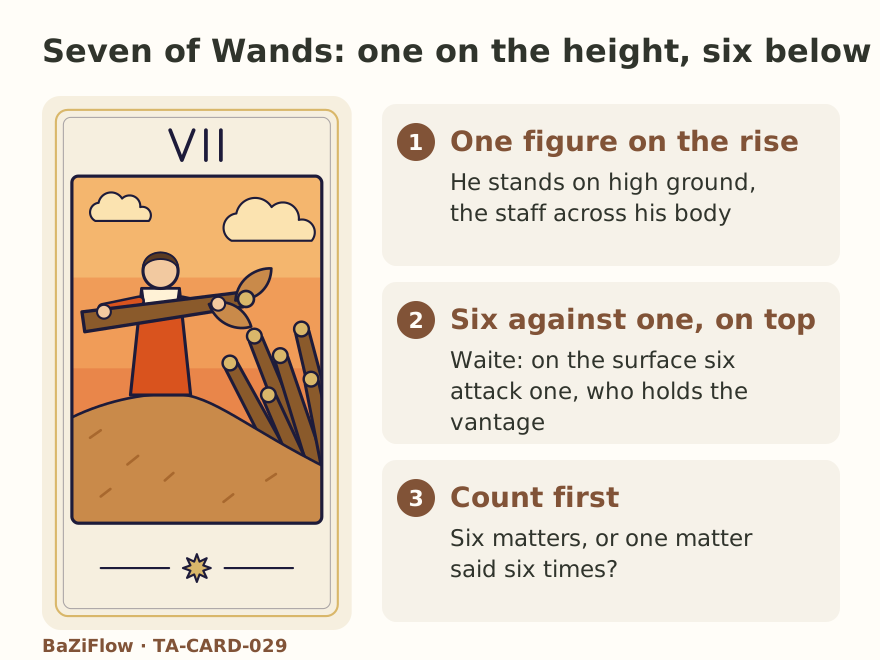 TA-CARD-029 / Tarot
Seven of Wands: one staff on the height, six raised from below
The Seven of Wands shows one figure on craggy high ground swinging a staff while six staves rise toward him. Read Waite's "six against one" and "vantage position", then practice counting six messages that arrive at once.
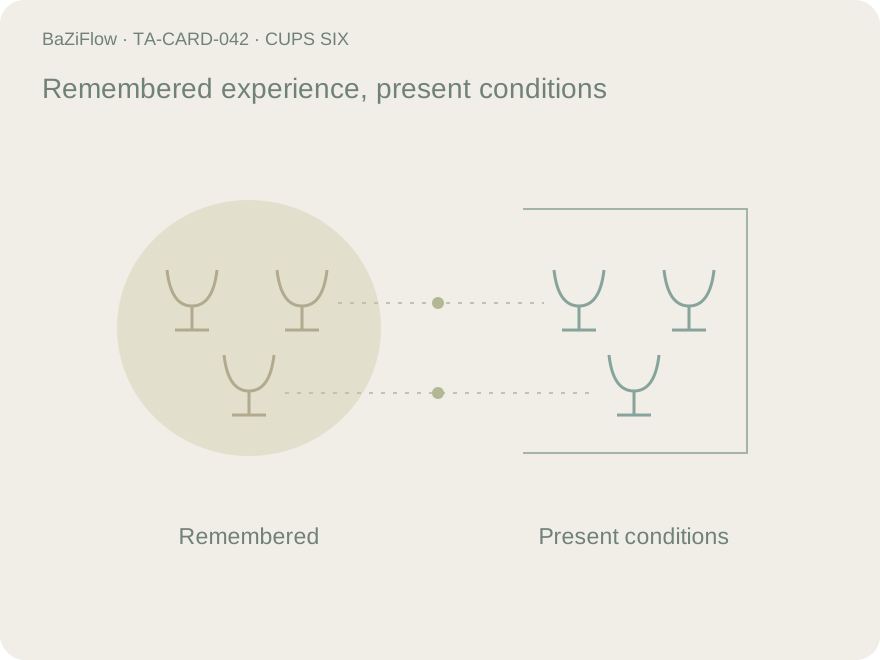 TA-CARD-042 / Tarot
Six of Cups: an old garden, cups full of flowers, and which flowers are from then
The Six of Cups shows children in an old garden, their cups filled with flowers. Sort the picture, Waite's word list and his own reverse reading, then split topics for meeting an old friend into old flowers and new.
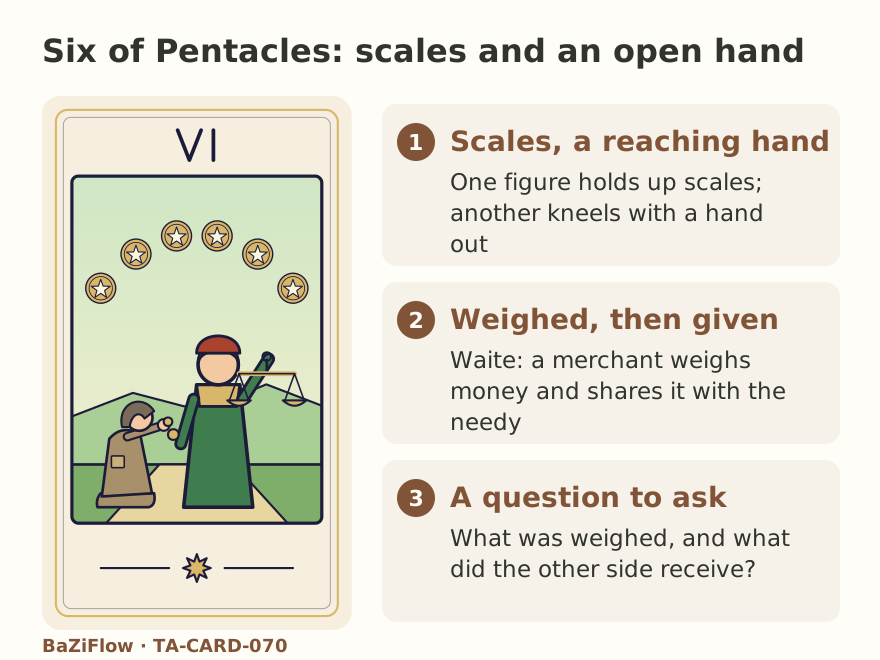 TA-CARD-070 / Tarot
Six of Pentacles: scales in one hand, coins from the other, so ask what was weighed
The Six of Pentacles shows a merchant holding scales while coins fall toward a hand held out from below. Read the picture, Waite's words and the extras apart, then split a second-hand handover into weigh, give, receive.
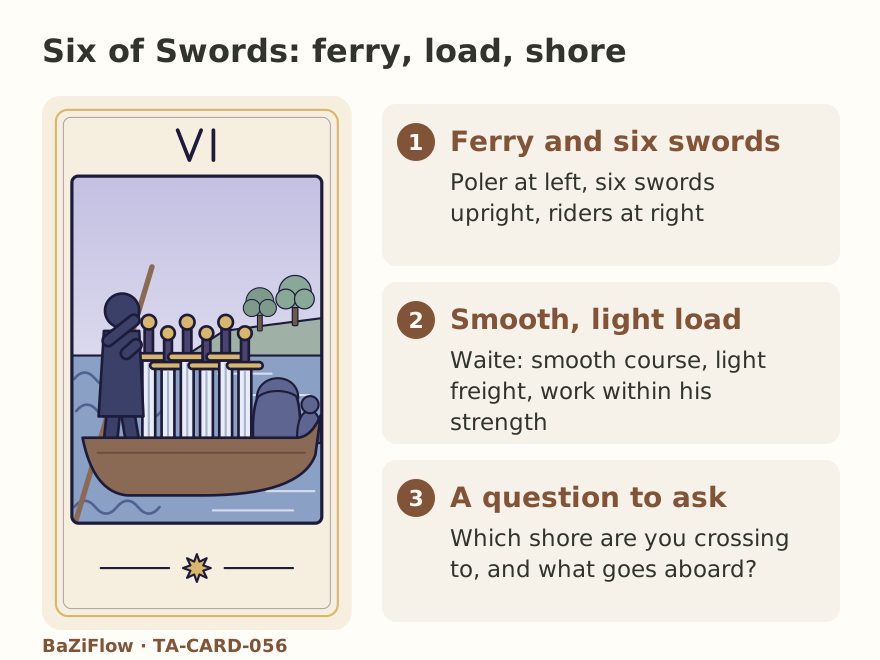 TA-CARD-056 / Tarot
Six of Swords: a punt with six swords crosses over, and Waite notes the load is light
The Six of Swords shows a ferryman poling a punt of passengers and swords to the further shore. See the three notes Waite adds, then use shore, load and strength to sort the items for an internship application.
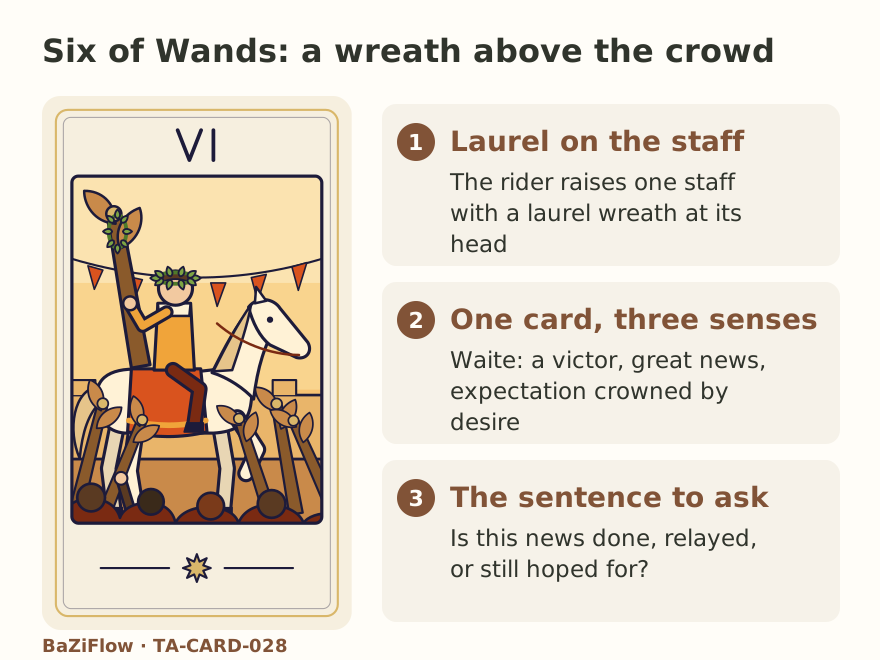 TA-CARD-028 / Tarot
Six of Wands: a white horse, a wreath and walkers, one card with three readings
The Six of Wands shows a laurelled rider lifting a wreathed staff past footmen with staves. Separate Waite's three senses (victor, great news, expectation) and sort a shop promotion's "good news" into them.
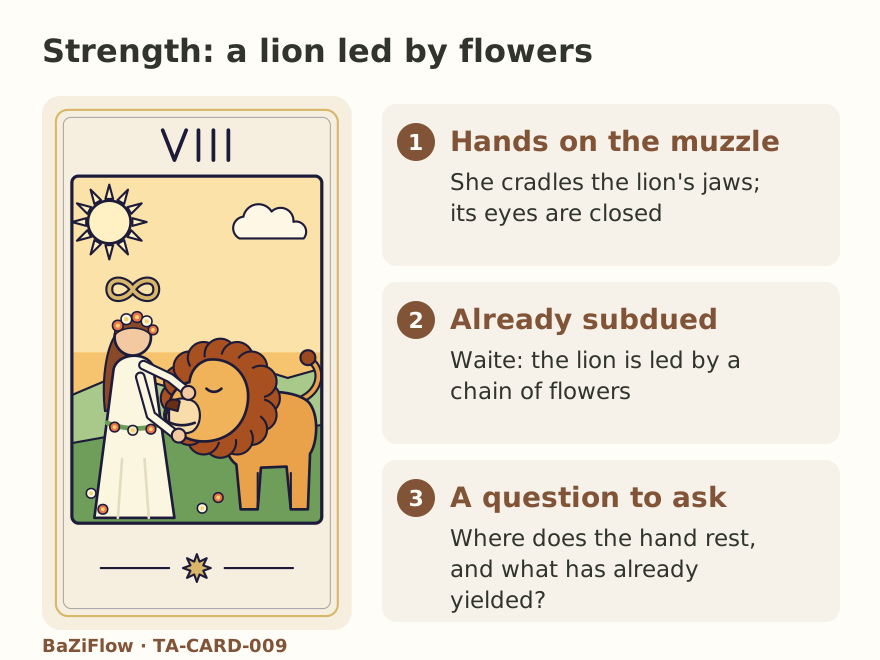 TA-CARD-009 / Tarot
Strength: a lion led by a chain of flowers, already subdued, says Waite
Strength (Waite's Fortitude) shows a woman closing a lion's jaws, the lion led by flowers. Separate picture, word list and Waite's inference, then ask three questions before grooming a cat that dreads clipping.
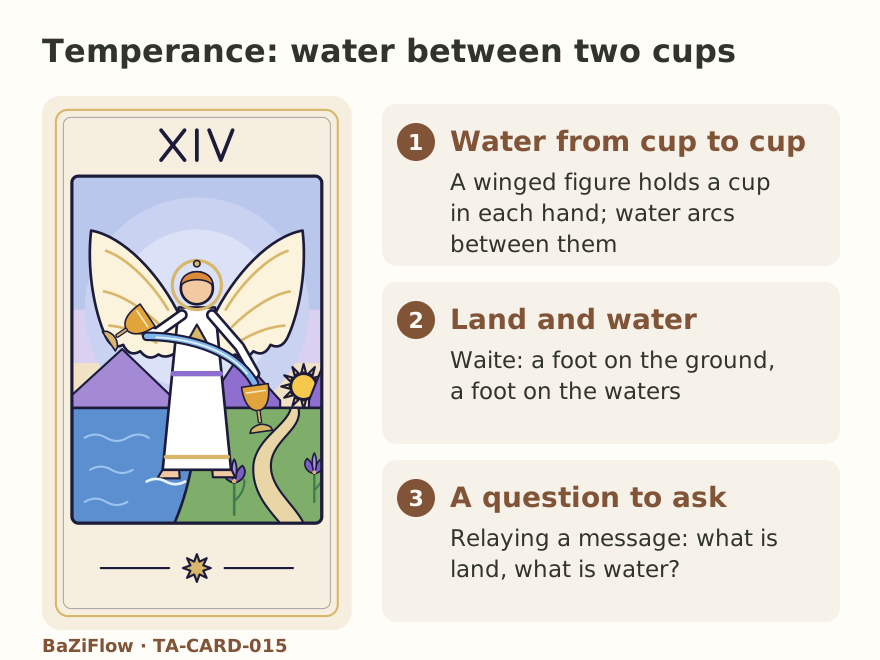 TA-CARD-015 / Tarot
Temperance: a stream between two cups, thrift words, and a name with another origin
Temperance shows a winged figure pouring water between two cups, yet its list is economy, moderation, frugality, management. Separate picture, list and the readings Waite set aside, then practice relaying a complaint.
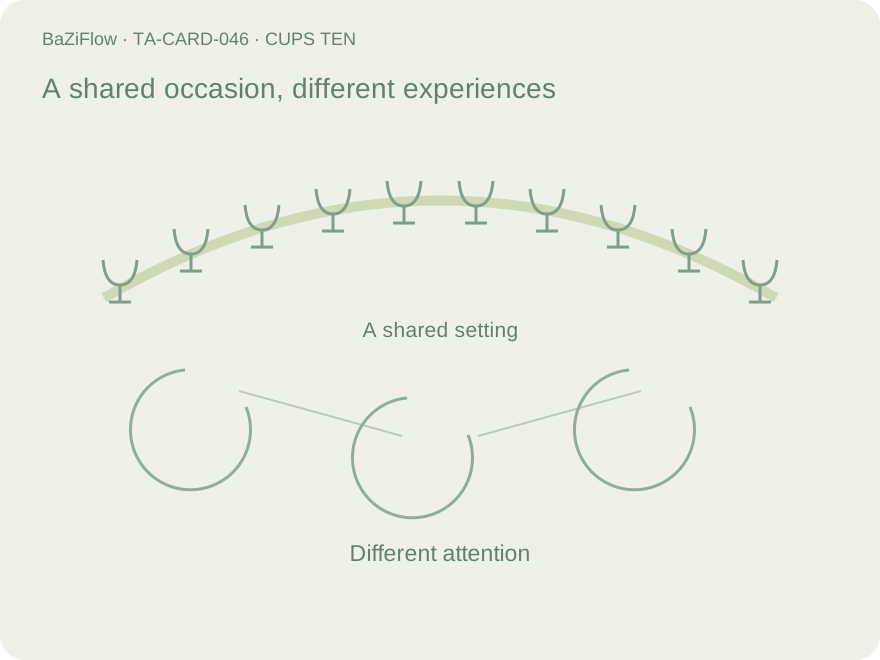 TA-CARD-046 / Tarot
Ten of Cups: ten cups in a rainbow, adults look up, children dance, each happy their way
In the Ten of Cups ten cups appear in a rainbow, a couple look up, children dance beside them and a home lies beyond. Separate picture and word list, then use a family dinner to tell the kinds of happy at one gathering.
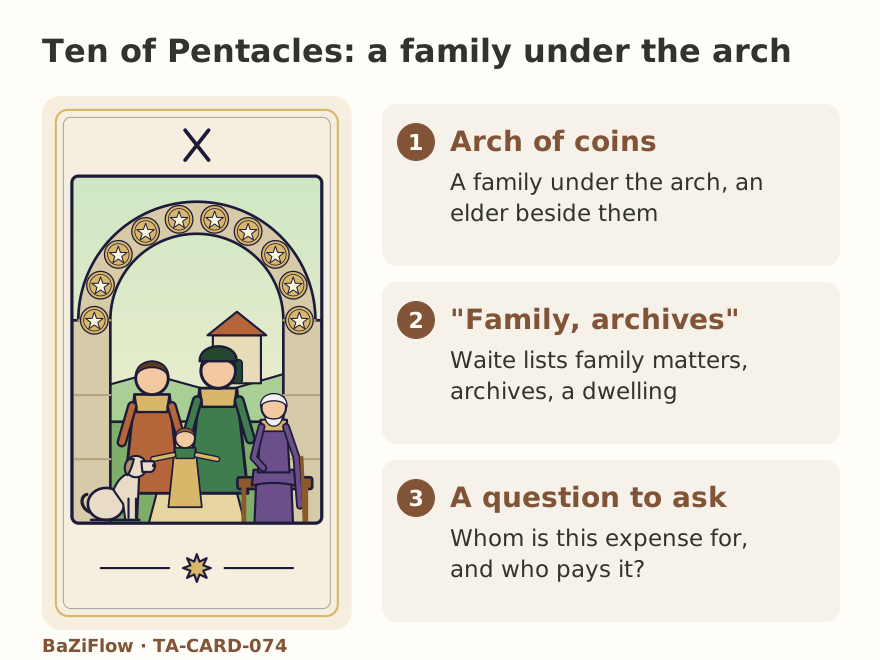 TA-CARD-074 / Tarot
Ten of Pentacles: a family under the arch, and a reversed list that runs two ways
The Ten of Pentacles shows a family beneath an arch, with an old man and two dogs in front. Read the picture, the word list and the extras apart, then sort a household budget by person and keep a monthly copy.
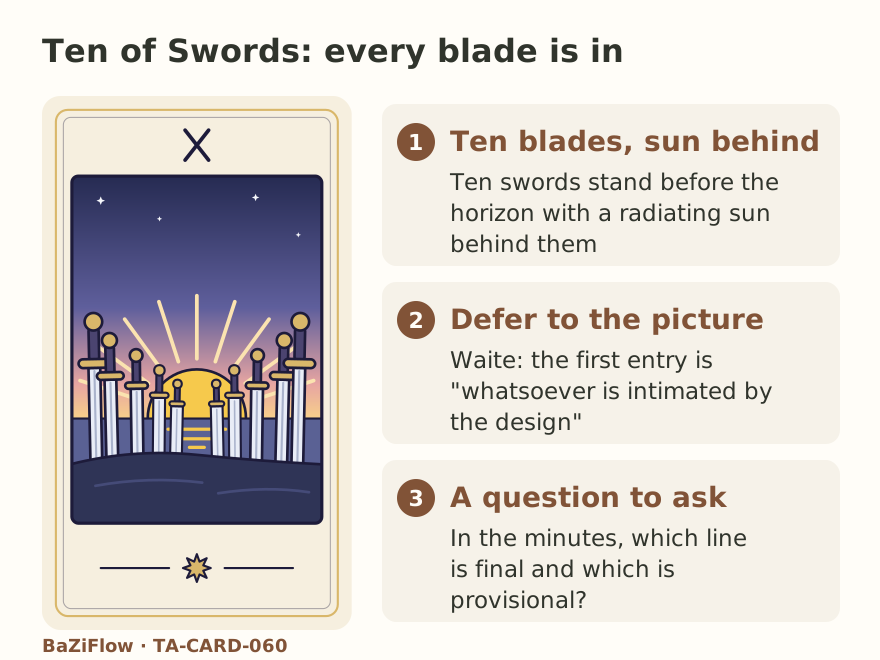 TA-CARD-060 / Tarot
Ten of Swords: every sword in place, and a list that defers to the picture
The Ten of Swords is the last numbered card of its suit. Waite opens its list with "whatsoever is intimated by the design". Compare text, original card and drawing, then close a project in ten lines of minutes.
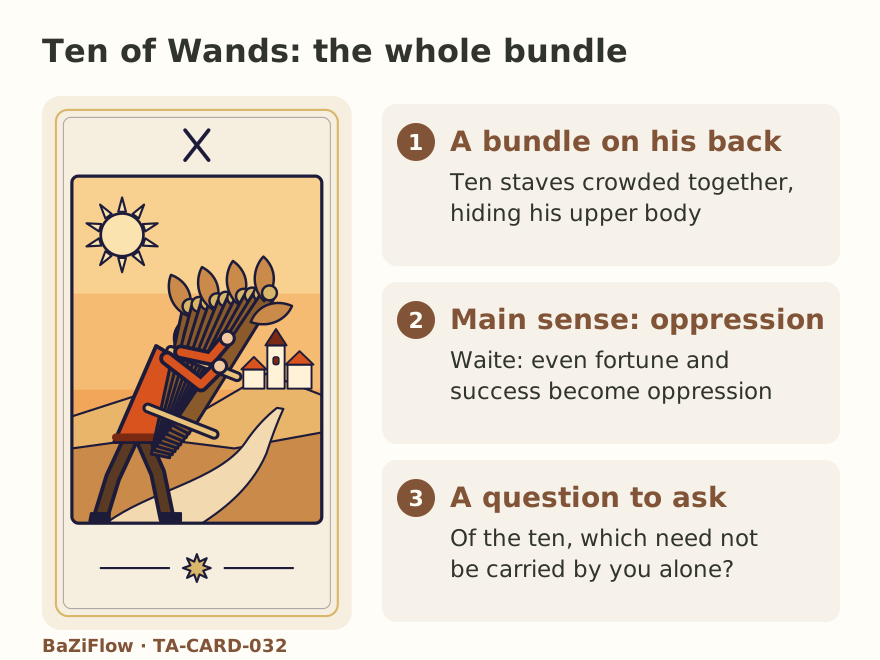 TA-CARD-032 / Tarot
Ten of Wands: one figure under a whole bundle, and oppression that includes success
The Ten of Wands shows a figure bent under ten staves, walking toward a distant village. Read Waite's "oppression" and "the oppression of these things", then unbundle ten tasks from a one-week sale.
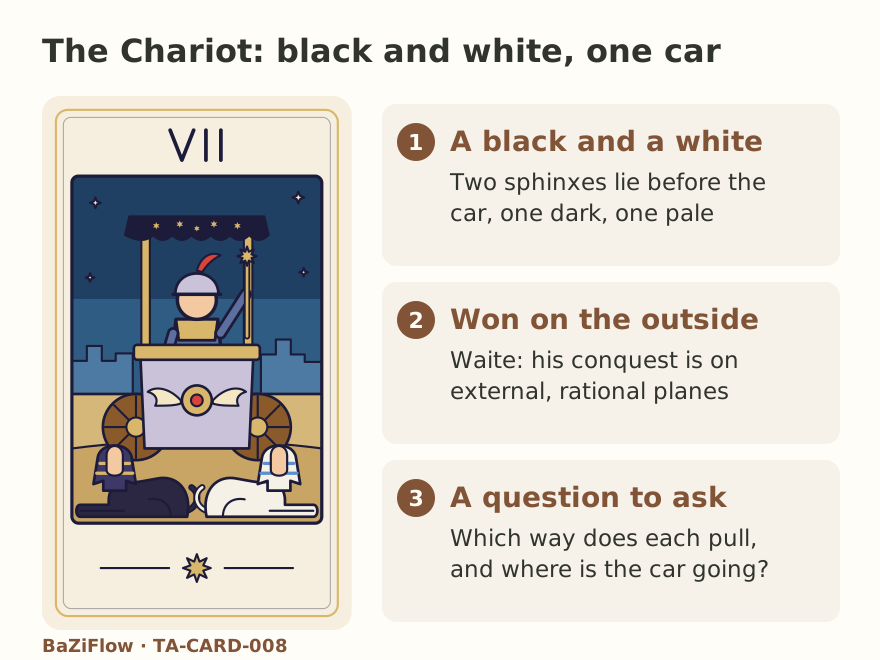 TA-CARD-008 / Tarot
The Chariot: a black and a white sphinx, and a victor who won on the outside
The Chariot shows an armed victor and the two sphinxes before his car. Separate the picture, the word list and the limits Waite draws himself, then use "two pulls, one destination" to plan a holiday dinner.
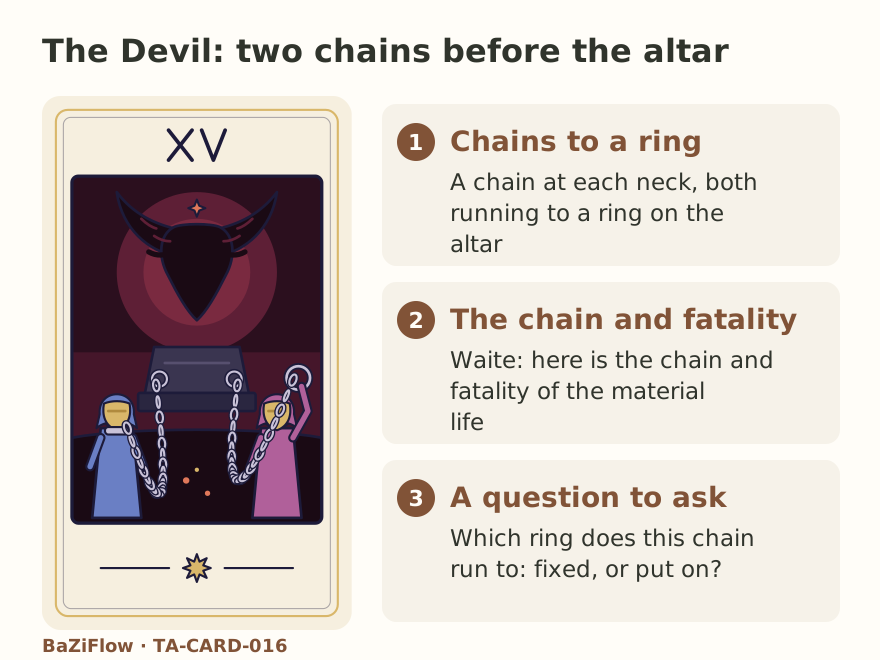 TA-CARD-016 / Tarot
The Devil: two chains before the altar, and a list of force and fatality
The Devil shows a winged, horned figure on an altar with two chained figures before it. Separate Waite's picture, his word list and his own conclusion, then use "find the ring" to sort an interview-prep list.
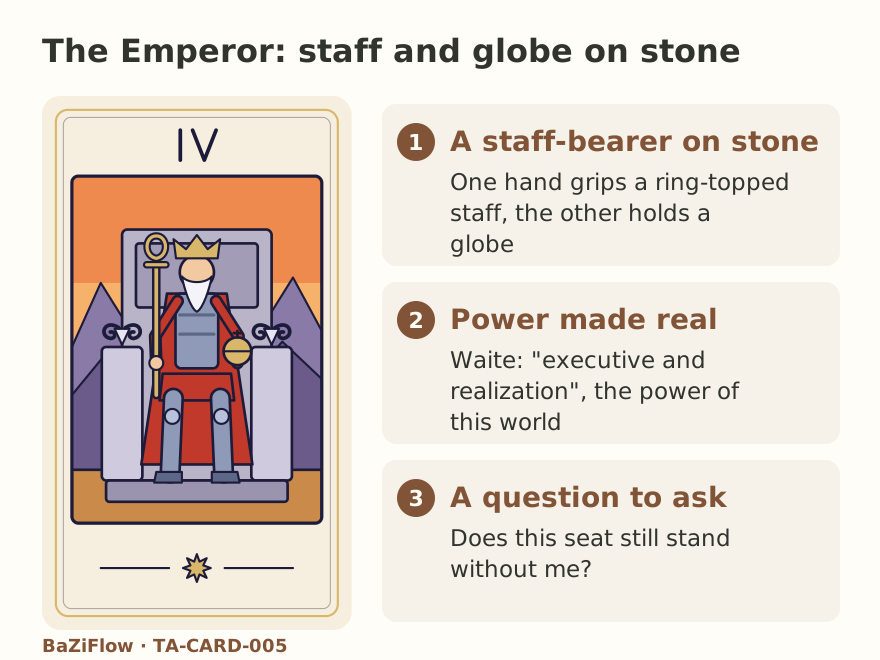 TA-CARD-005 / Tarot
The Emperor: a staff and a globe on a stone seat, and a description made of objects
The Emperor sits on a throne with rams' heads, holding an ankh-shaped staff and a globe. Separate Waite's picture, word list and symbols, then ask three questions (seat, staff, globe) about a student club's recruiting.
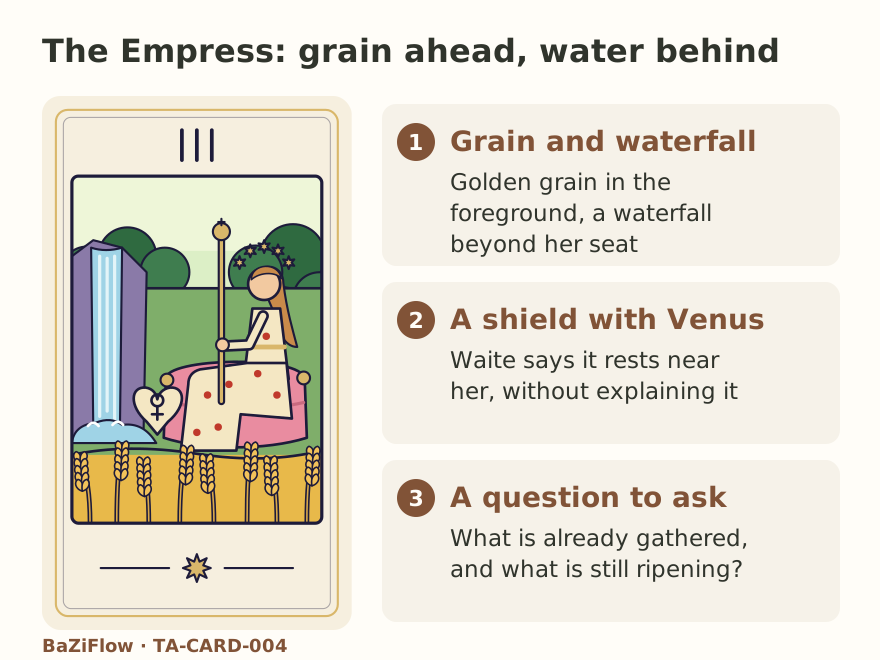 TA-CARD-004 / Tarot
The Empress: grain in front, a waterfall behind, and a dark half in the word list
The Empress sits before ripening grain, a waterfall behind her, a star crown above and Venus on her shield. Separate Waite's picture, words and symbols, then take stock of a new skill in three places.
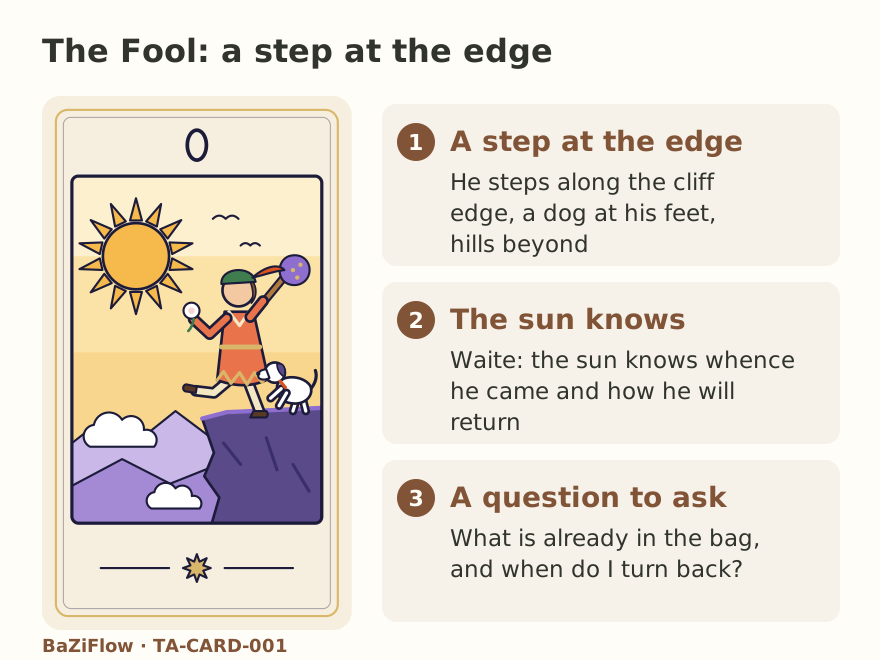 TA-CARD-001 / Tarot
The Fool: one step held at the edge, and two voices from Waite about one card
The Fool shows a young traveler pausing at a cliff edge, eyes on the distance. Separate Waite's picture commentary from his word list, then ask three questions about the bag, company and turning point.
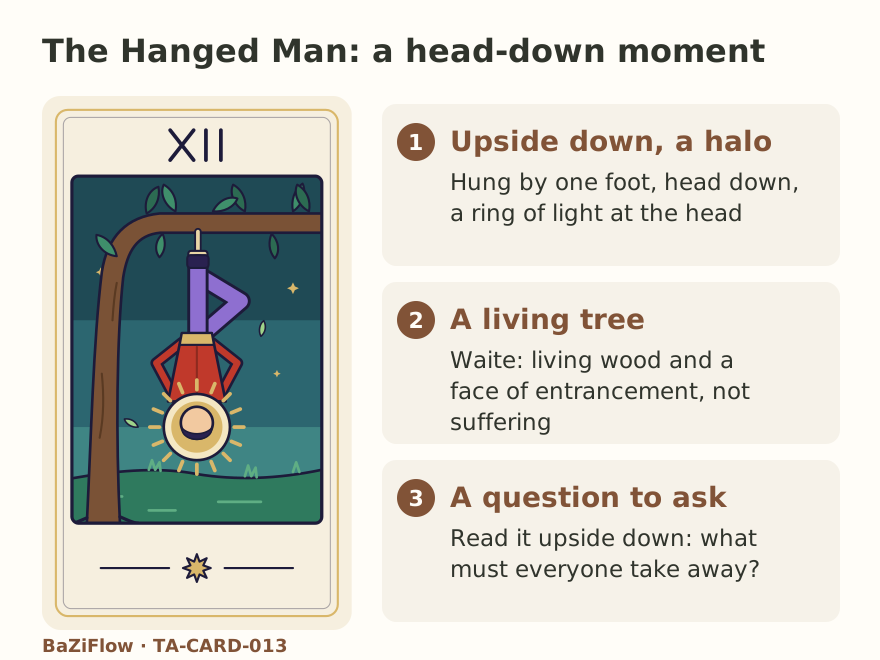 TA-CARD-013 / Tarot
The Hanged Man: living wood, a calm face, and the readings Waite turned down
The Hanged Man shows a figure hung by one foot, a ring of light at the head. Separate the three things Waite points out, his eight-word list and his refusal of other readings, then read an agenda upside down.
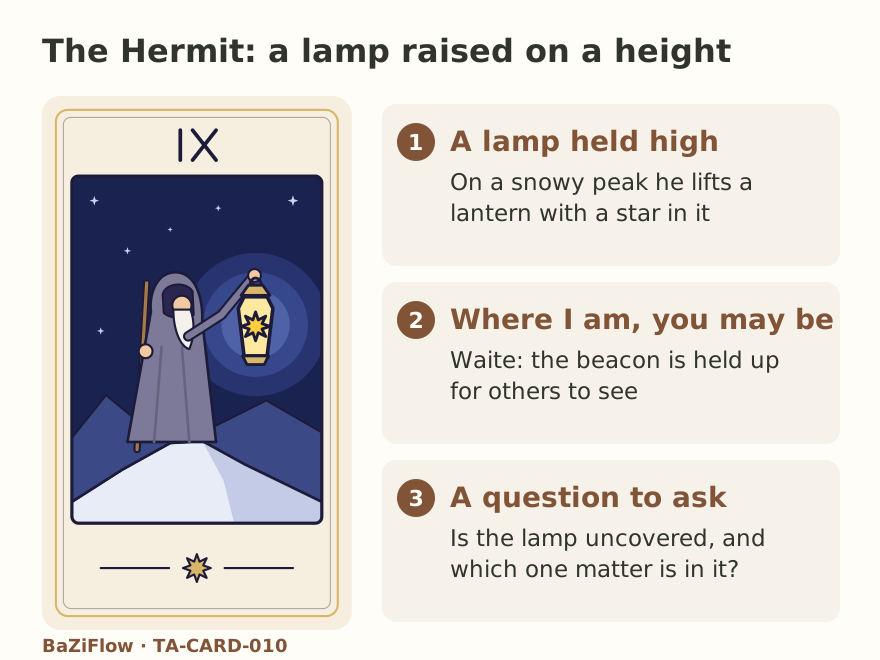 TA-CARD-010 / Tarot
The Hermit: a lamp held high, while Waite's list runs from prudence to treason
The Hermit raises a lantern with a star in it on a height. Separate Waite's picture, a lamp held in the open, from his list, which speaks of dissimulation, then practice "lamp, star, staff" on a talk with a neighbor.
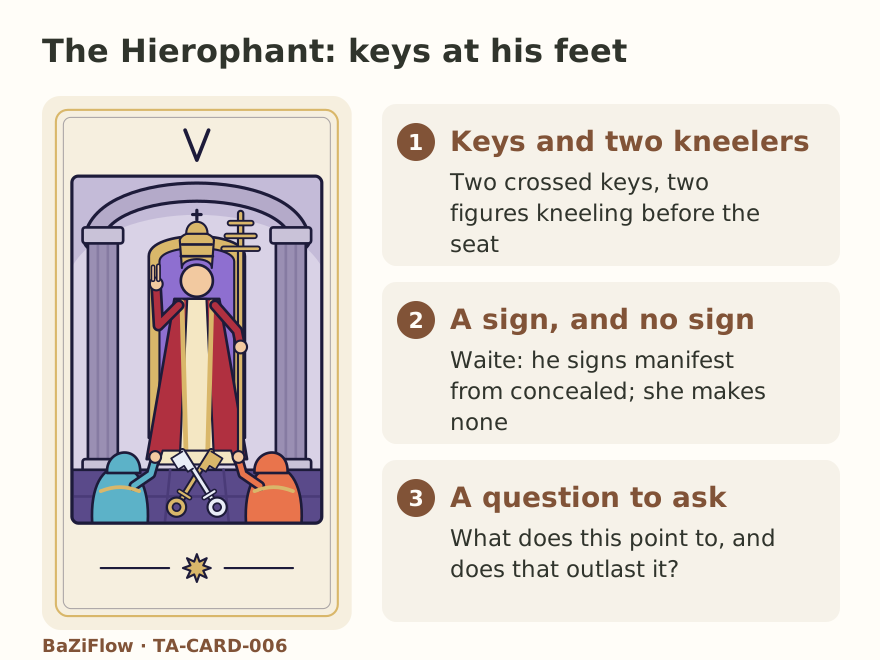 TA-CARD-006 / Tarot
The Hierophant: a raised hand, crossed keys, and two figures kneeling below the seat
The Hierophant sits between two pillars, a hand raised, crossed keys and two kneelers at his feet. Separate Waite's picture, word list and symbols, then use "sign and thing signified" to sort an old drawer before a move.
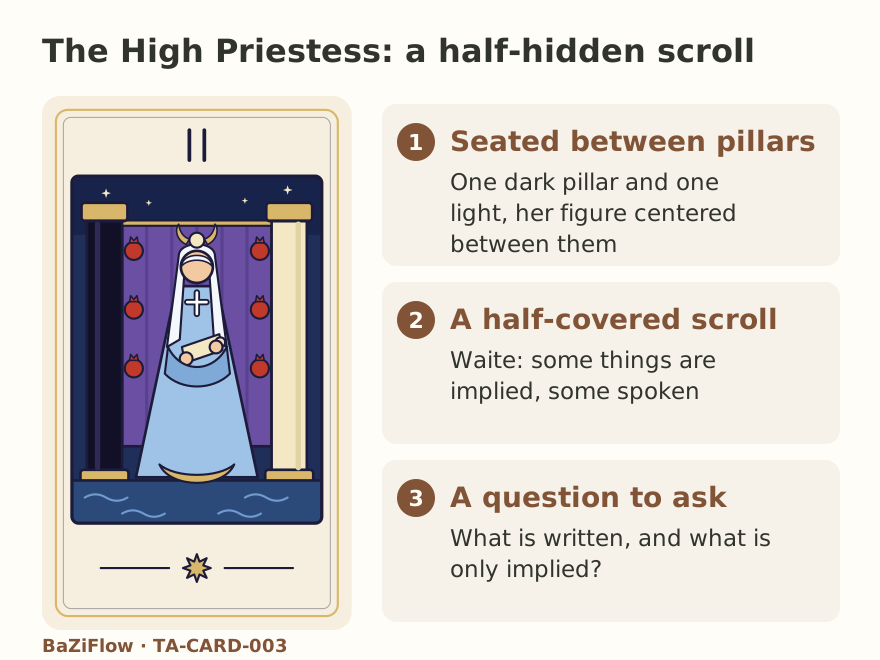 TA-CARD-003 / Tarot
The High Priestess: seated between two pillars, her scroll half covered
The High Priestess sits between a black and a white pillar, a scroll half covered by her mantle. Separate Waite's picture, word list and symbols, then sort a notice into what is written, implied and behind the veil.
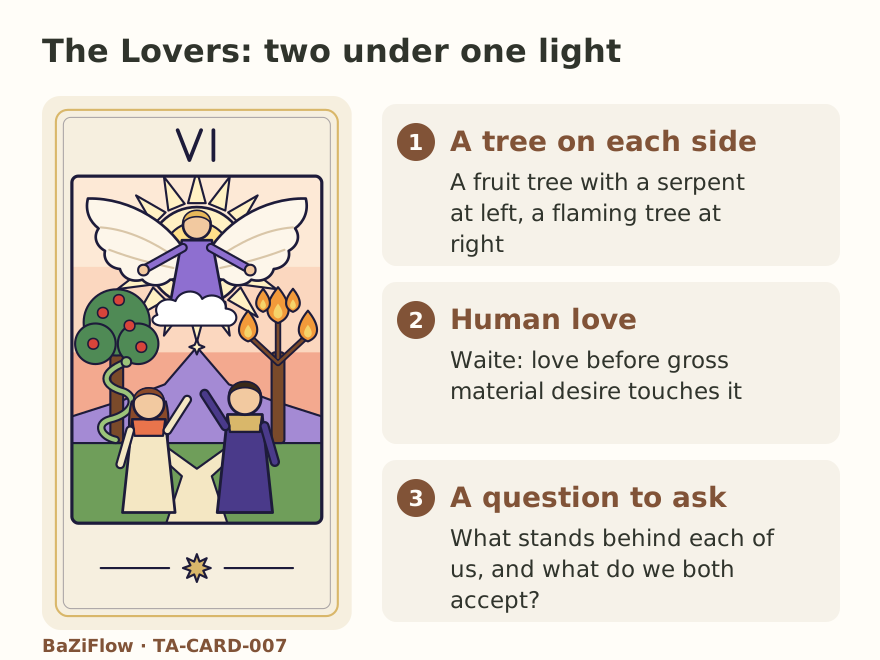 TA-CARD-007 / Tarot
The Lovers: two unveiled people, a light above, a tree behind each
The Lovers shows two people beneath an angel, with a tree behind each. Separate Waite's picture, his word list and the origin of the "choice" reading, then use the trees to plan a talk before sharing a flat.
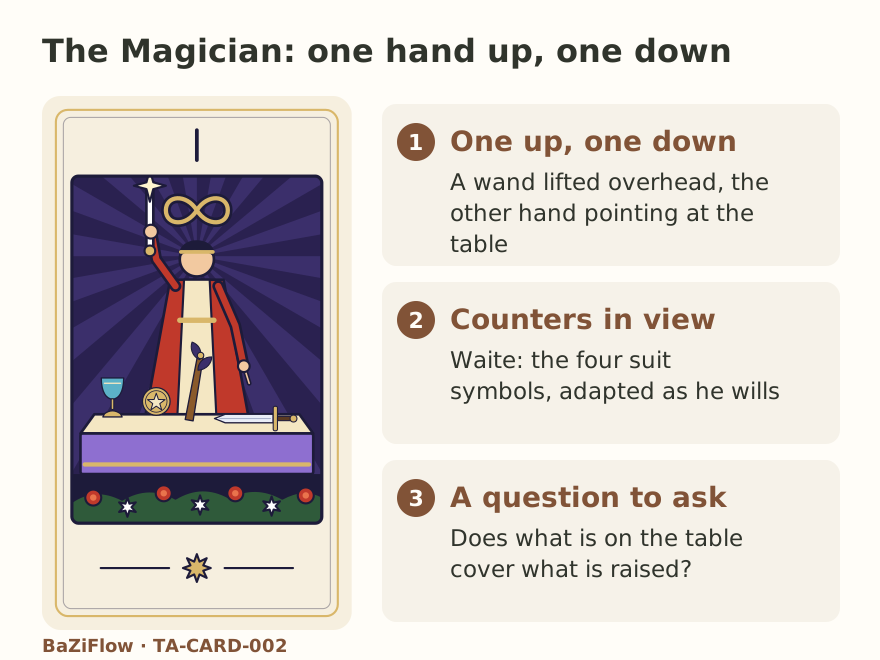 TA-CARD-002 / Tarot
The Magician: one hand to heaven, one to earth, and a table to take stock of
The Magician raises a wand with one hand and points to the ground with the other, four suit symbols laid out on a table. Separate Waite's picture, word list and symbols, then take stock of a handcraft job.
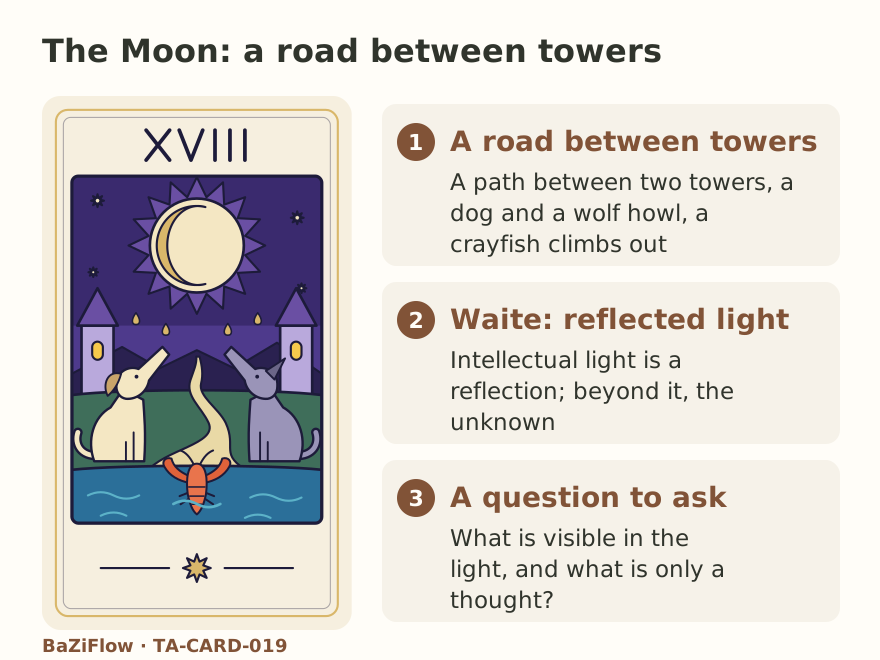 TA-CARD-019 / Tarot
The Moon: a road between two towers, and Waite reads the moonlight as reflected light
The Moon shows a road between two towers, a dog and a wolf howling at the moon, and a crayfish crawling from the water. Separate the picture, the word list and Waite’s reflected-light gloss, then plan a night outing.
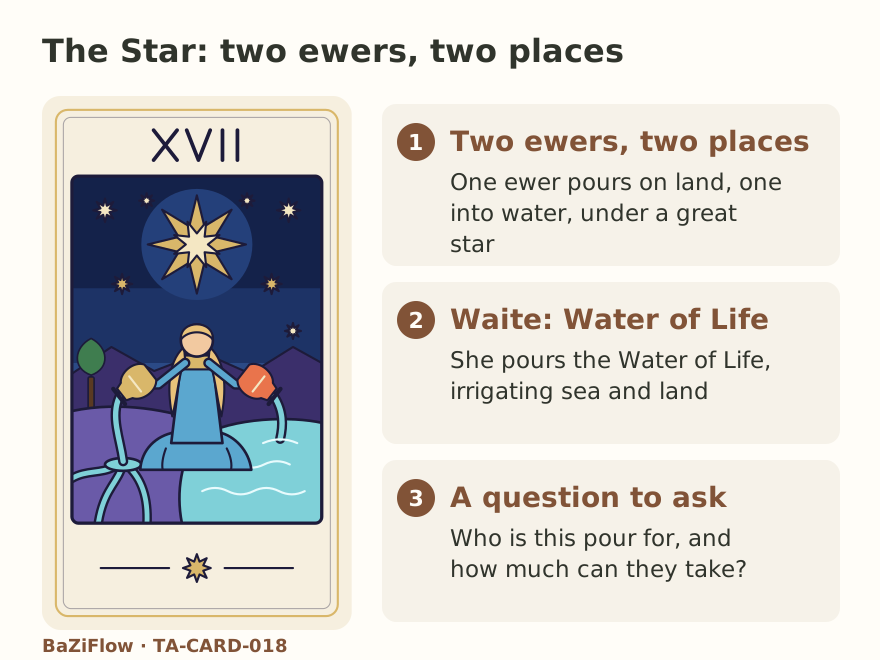 TA-CARD-018 / Tarot
The Star: two ewers pour on water and land, and Waite’s list runs from loss to hope
The Star shows a naked woman at the water’s edge pouring from two ewers under a great eight-rayed star. Separate the picture, the two readings in the list and Waite’s Kabalistic gloss, then plan a camp’s water.
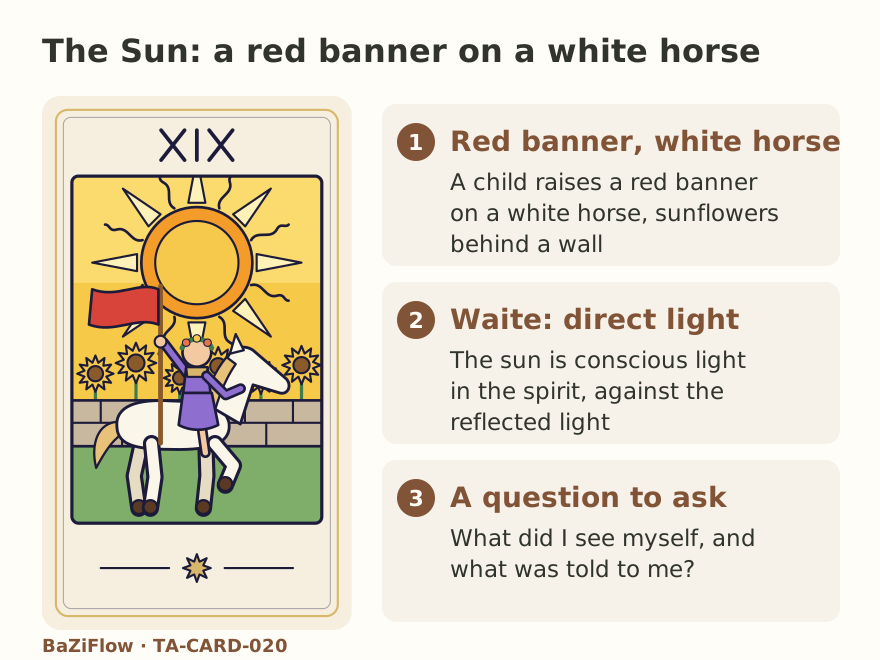 TA-CARD-020 / Tarot
The Sun: a child on a white horse with a red banner, and the light Waite calls direct
The Sun shows a naked child on a white horse with a red banner, and sunflowers behind a wall. Separate the picture, the three-word list and Waite’s direct-light gloss, then practice looking before reading.
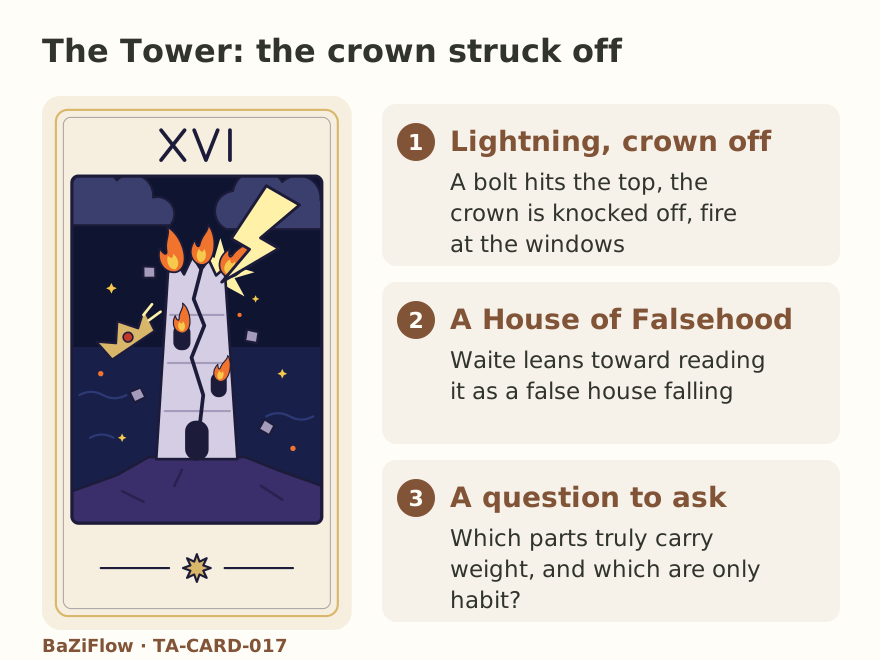 TA-CARD-017 / Tarot
The Tower: a bolt knocks the crown off, and Waite reads a House of Falsehood falling
The Tower shows a tower struck at the top and two figures falling headfirst. Separate the picture, Waite’s word list and his House of Falsehood reading, then split a line closure into notice and assumption.
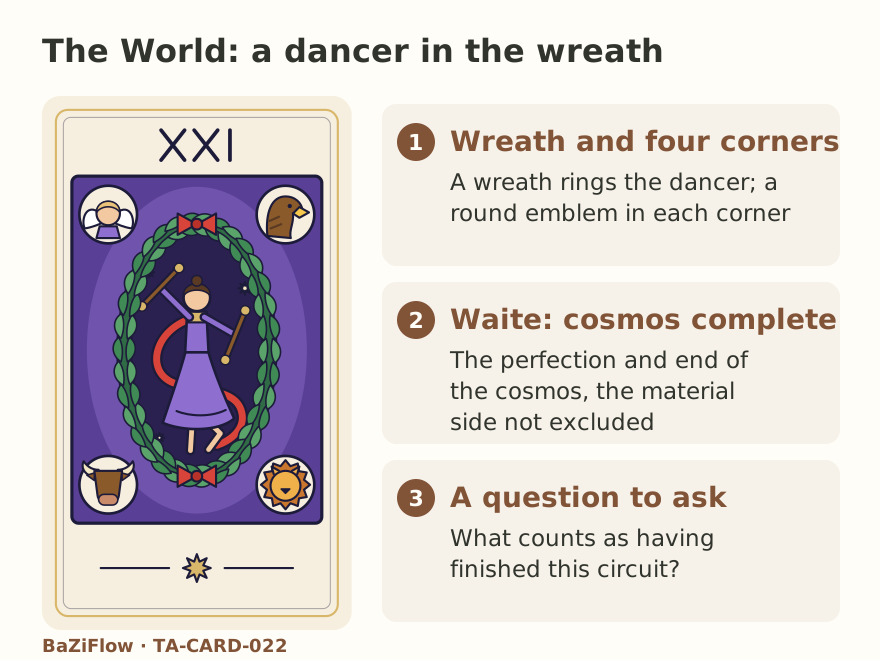 TA-CARD-022 / Tarot
The World: a dancer in the wreath, a design Waite calls unchangeable
The World shows a dancer holding two wands inside an oval wreath, with a figure in each corner. Separate the picture, the two groups of words in the list and Waite’s remarks on the dancer, then plan a round-trip ride.
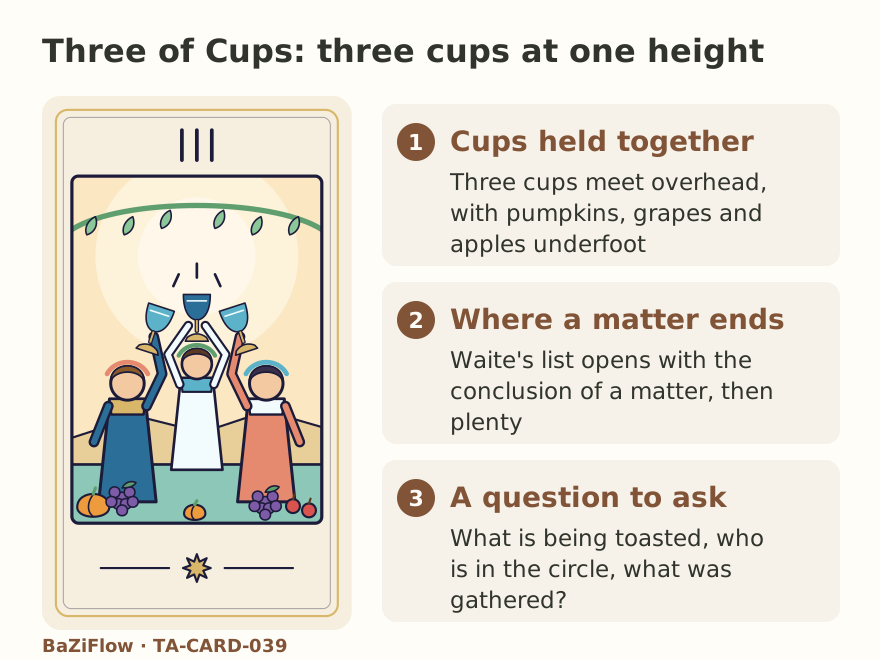 TA-CARD-039 / Tarot
Three of Cups: three cups raised to one height, so ask what has ended
The Three of Cups shows figures raising cups high above a harvest underfoot. Separate the picture, Waite's word list and his extras, then practice asking what is being toasted before planning a class reunion.
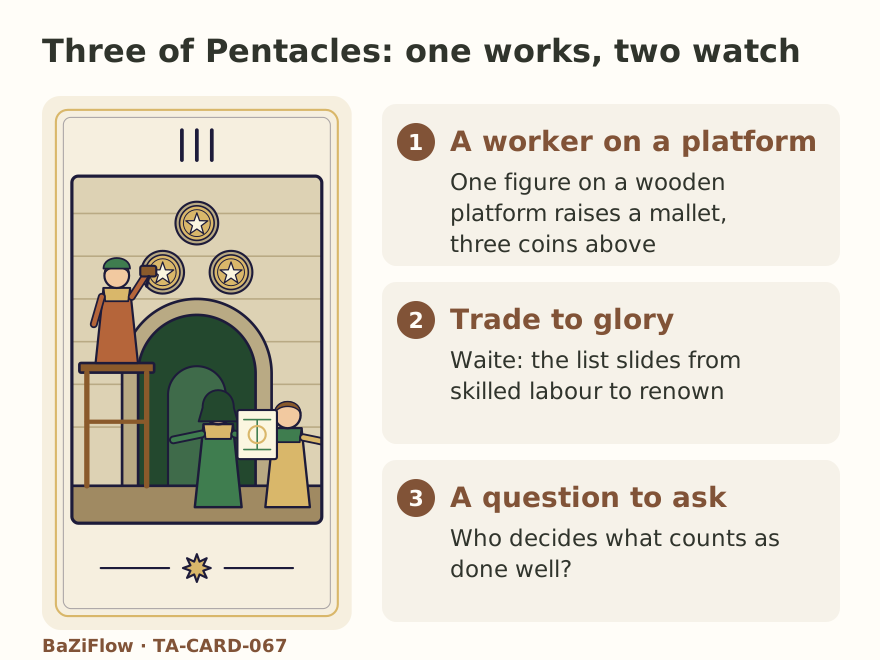 TA-CARD-067 / Tarot
Three of Pentacles: one works on a platform, two look on, and the list slides toward glory
The Three of Pentacles shows a sculptor at work in a monastery. See how Waite's list slides from skilled labour to renown, then use a wobbly dining chair to separate the doer, the standard and the inspector.
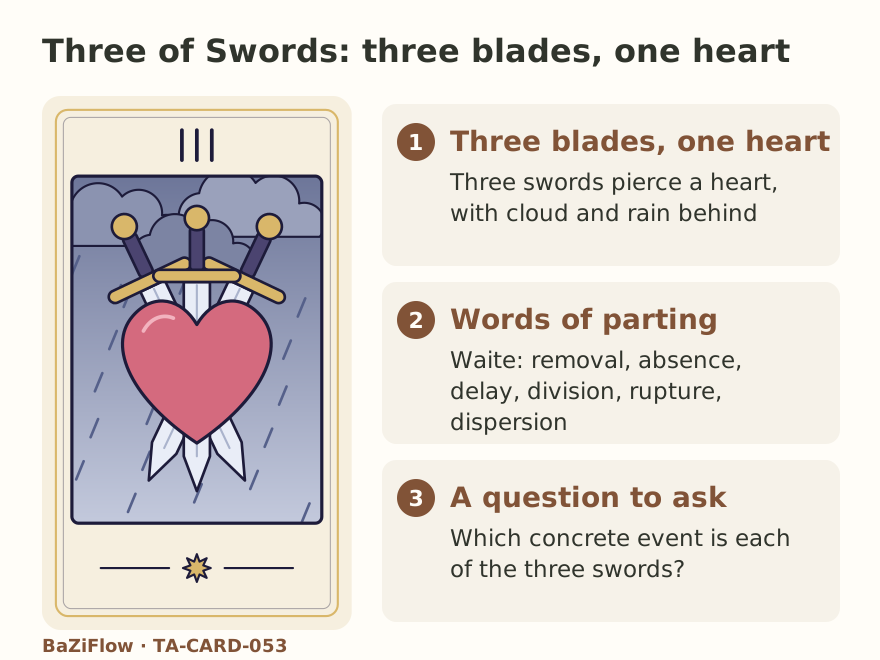 TA-CARD-053 / Tarot
Three of Swords: three blades through a heart, and a list of absence and parting
The Three of Swords shows three swords through a heart, with cloud and rain behind. See which words Waite actually lists, then sort the two weeks before a thesis defense by blades, words and rain.
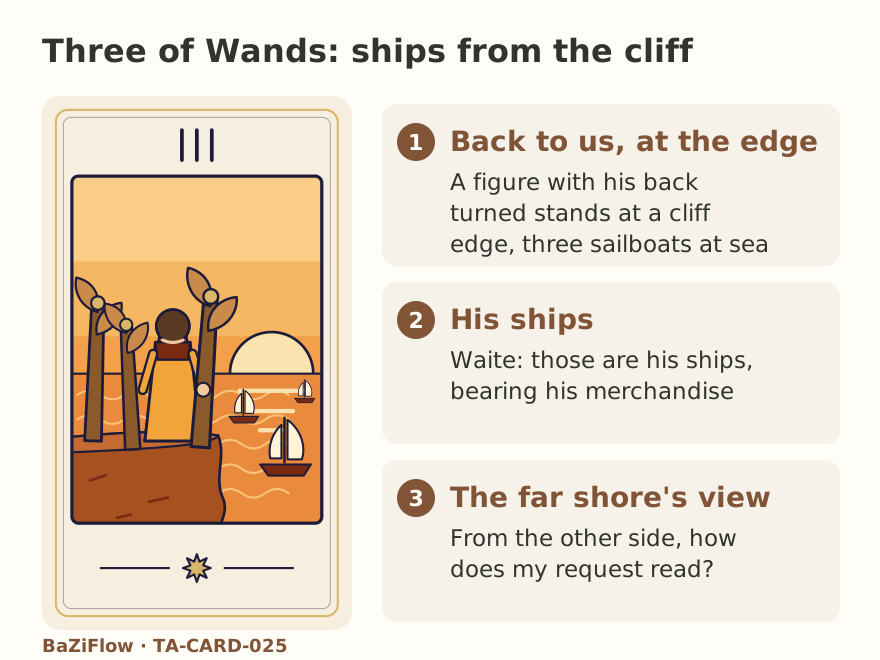 TA-CARD-025 / Tarot
Three of Wands: his back to us at the cliff, watching ships, and a look "towards yours"
The Three of Wands shows a figure with his back turned at a cliff edge, watching ships, three staves beside him. Separate the picture, the list and the reversed entry, then read a field booking from the far shore.
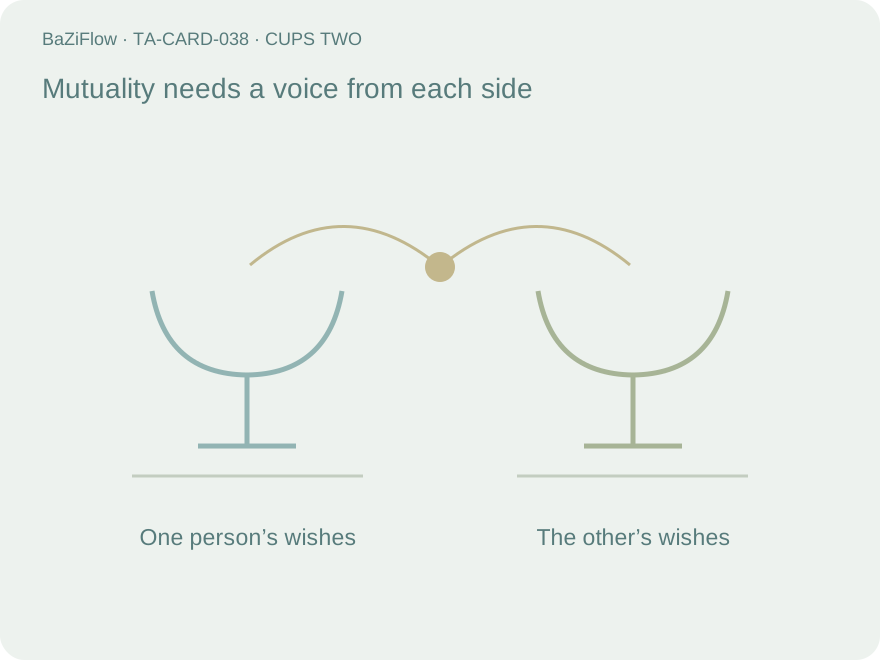 TA-CARD-038 / Tarot
Two of Cups: two cups meet, so read the exchange, not the answer
In the Two of Cups two figures raise cups to one another beneath a caduceus. Separate the picture, Waite's word list and his additional meanings, then practice asking what each side actually said.
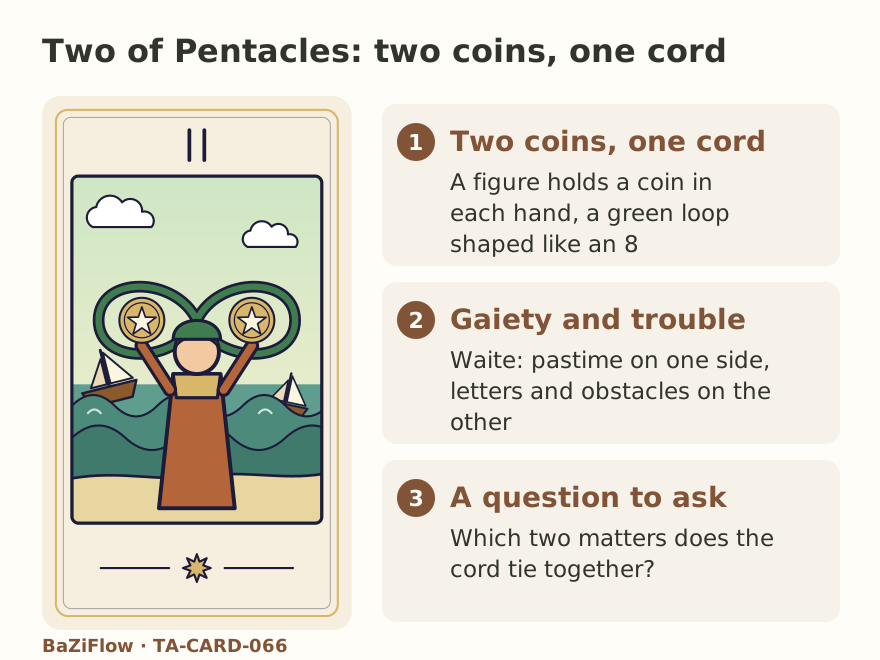 TA-CARD-066 / Tarot
Two of Pentacles: two coins and a reversed 8, with Waite writing both ends of the list
The Two of Pentacles shows a dancing youth with a coin in each hand, joined by a cord shaped like an 8. Separate the gaiety end and the trouble end of Waite's list, then draw a cord between two pots on a stove.
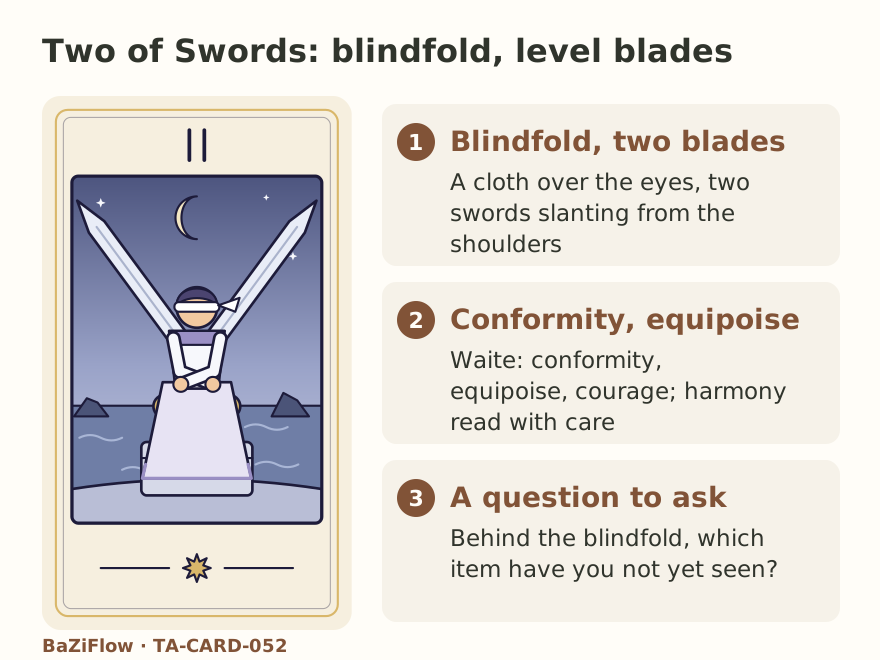 TA-CARD-052 / Tarot
Two of Swords: a blindfold, two level blades, and a qualified harmony
The Two of Swords shows a blindfolded figure balancing two swords on the shoulders. Separate Waite's word list, his reservation about harmony and the reversed words, then take apart a choice between two elective courses.
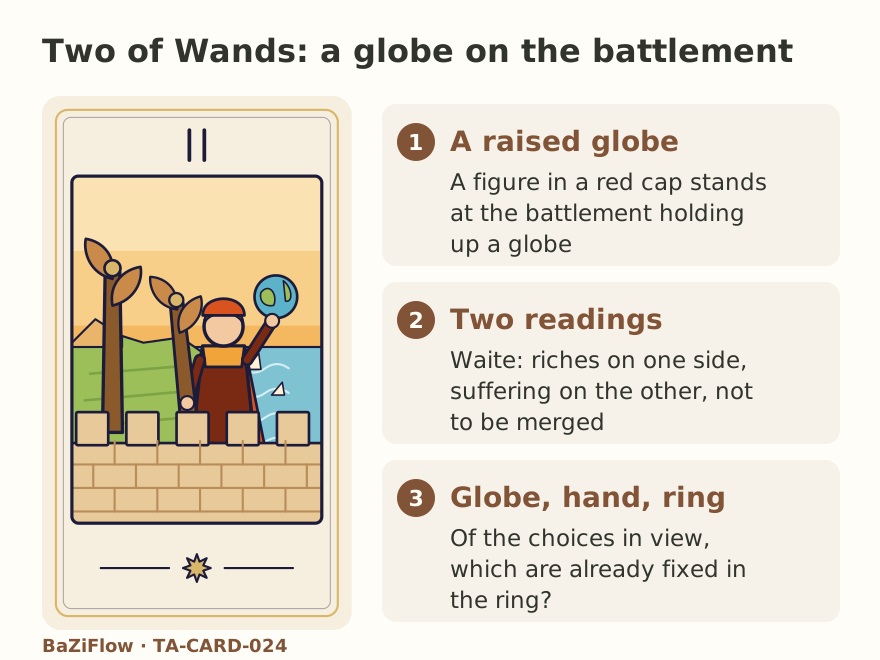 TA-CARD-024 / Tarot
Two of Wands: a globe in hand, and two readings Waite says cannot be married
The Two of Wands shows a figure on a height holding a globe, one staff in hand and another fixed in a ring. Separate the picture, the two readings and the reversed list, then sort a race entry by globe, hand and ring.
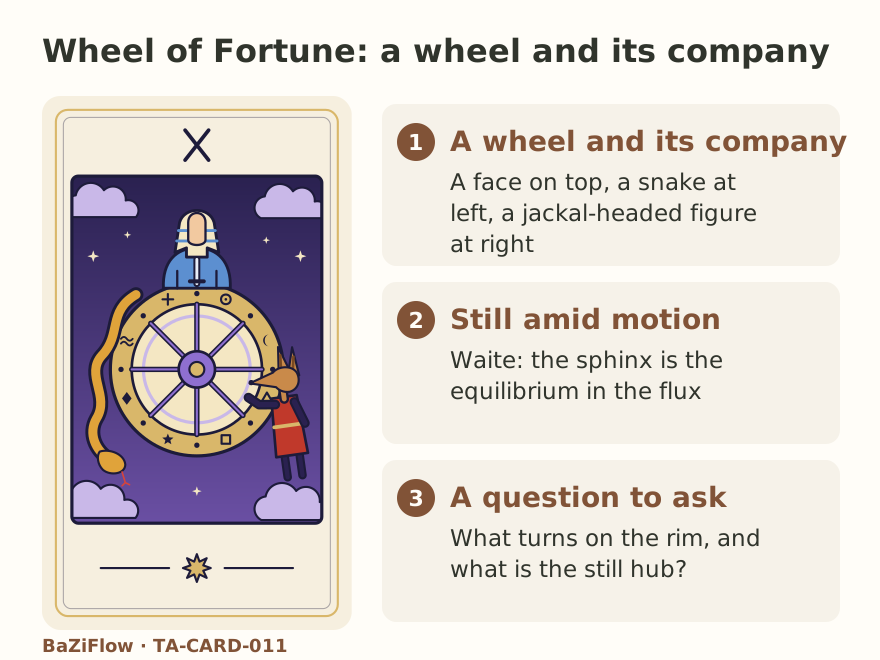 TA-CARD-011 / Tarot
Wheel of Fortune: the list only rises, and the turning lives in the picture
The Wheel of Fortune shows a lettered wheel with a sphinx on top and four creatures at the corners. Separate Waite's picture commentary from his word list, then practice "rim and hub" on a household chore rota.
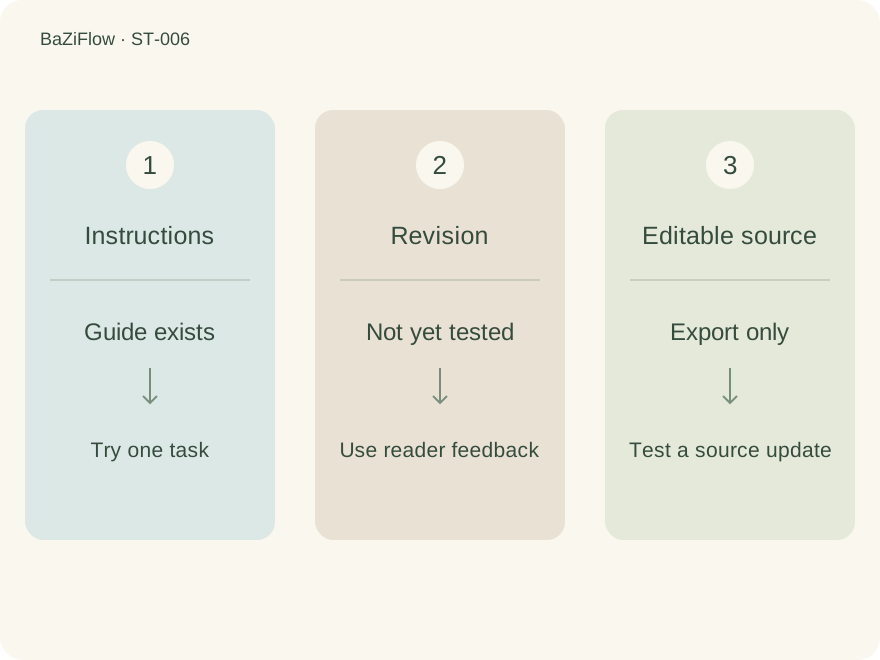 ST-006 / Cross-system studies
Reading career in Ziwei, astrology and Tarot: turn symbolic advice into a work task
How to read career in Ziwei, astrology and Tarot: keep each system in its own terms, then test a small audio-editing task through a deliverable, revision and concrete feedback.
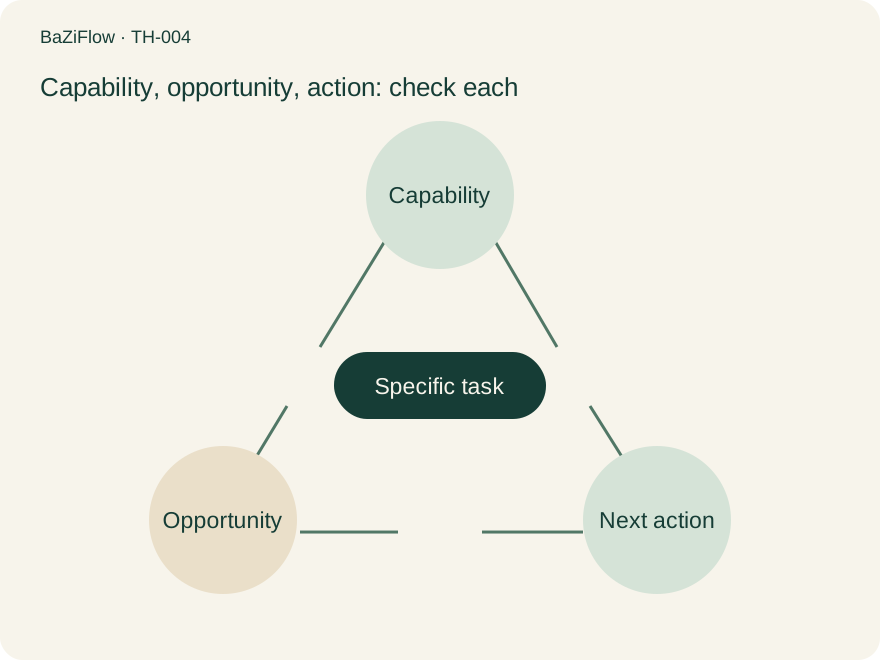 TH-004 / Read by theme
Separate Capability, Opportunity and the Next Action
Use career and learning readings to formulate specific questions. Compare demonstrated work with real requirements, then choose a bounded next step without turning symbolic language into a job verdict.
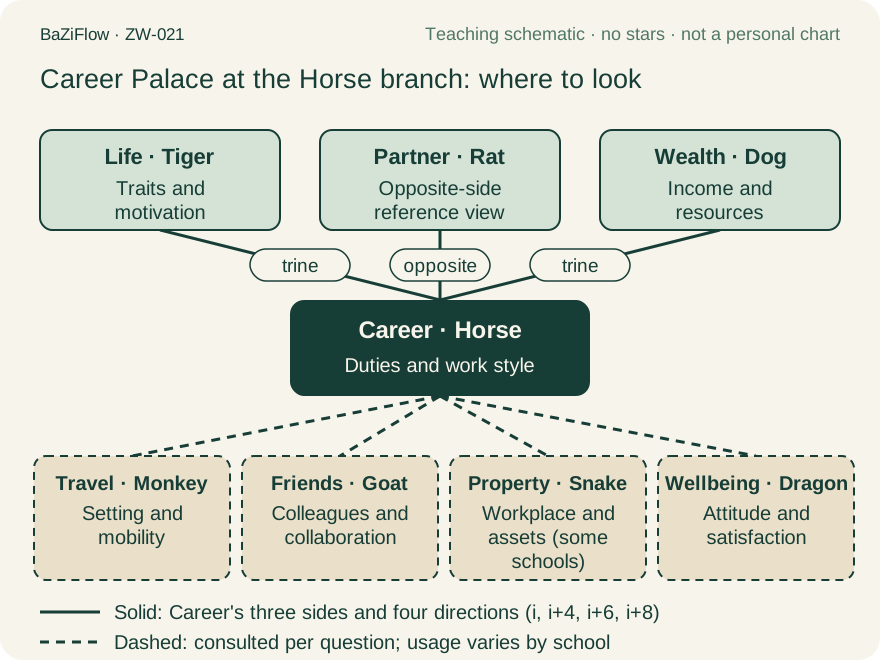 ZW-021 / Zi Wei Dou Shu
Which palaces does a Zi Wei career reading connect?
Start from the Career Palace, recompute its three sides and four directions, and split a work question into parts that each need real-world information.
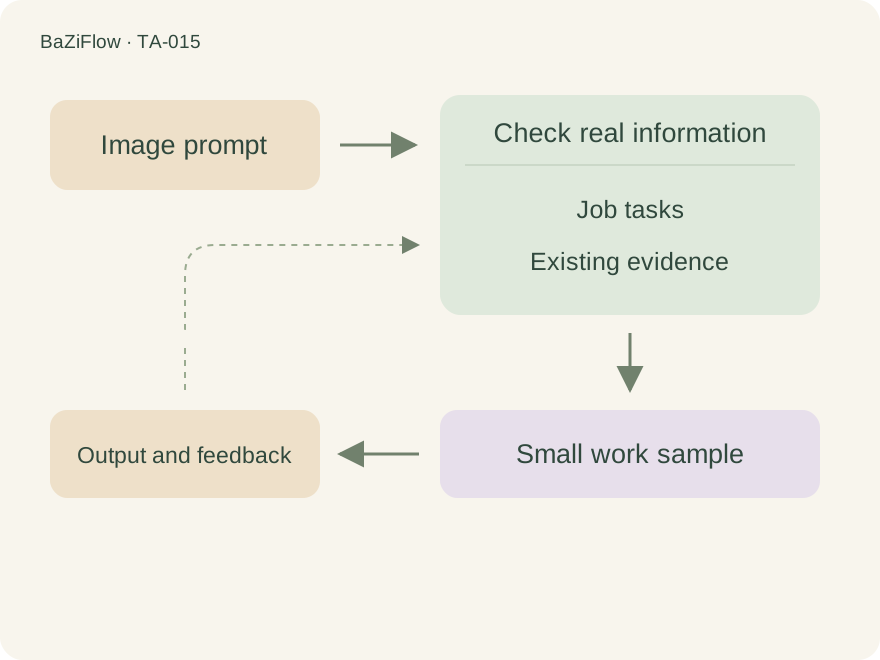 TA-015 / Tarot
Turn a career reading into a work sample you can inspect
A technical-writing example shows how to move from the Eight and Three of Pentacles to role requirements, a bounded work sample and specific feedback, without treating a card as a hiring decision.
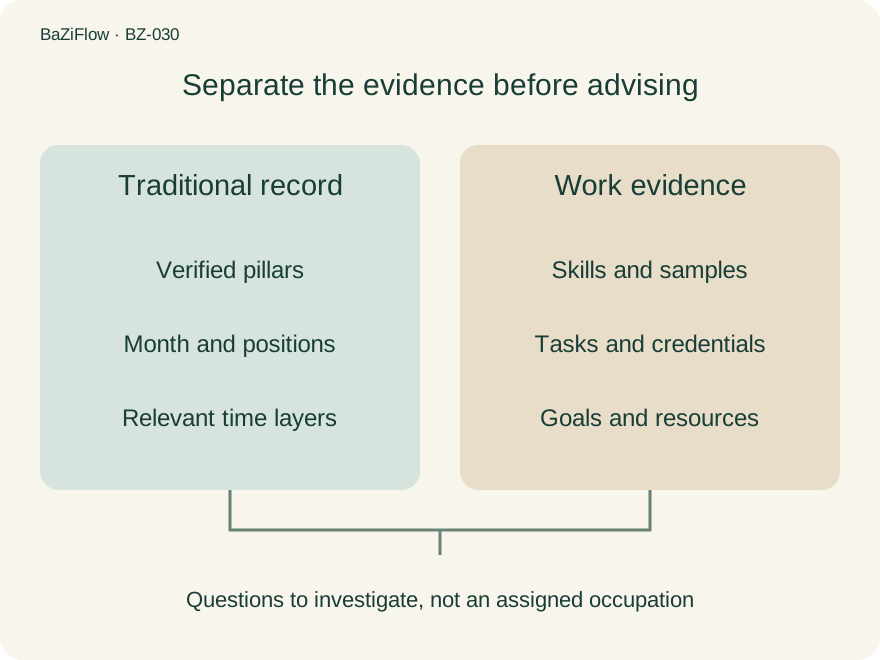 BZ-030 / BaZi
Evidence for a career reading: distinguish chart relations from job requirements
Ten-God names are not job codes. Separate traditional chart reasoning from skills, tasks, qualifications and actual opportunities before turning a career reading into action.
 MH-005 / Meihua Yishu
Casting from an observed sign: object, direction and hour
Follow one named object-based procedure using a round object, east and an hour value, while preserving the reference frame and refusing to invent missing inputs.
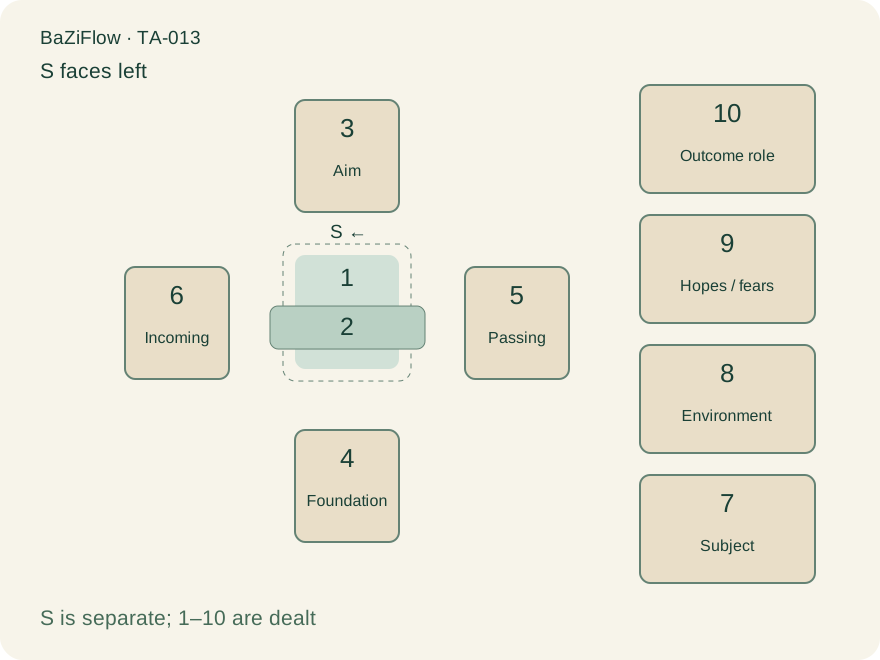 TA-013 / Tarot
Reading the Celtic Cross without collapsing its layers
Follow the specific layout in Waite’s 1911 text, including its separate significator and direction-dependent side positions. Keep aims, foundations, fears and the assigned outcome from becoming interchangeable claims.
 OR-008 / Oracle lots
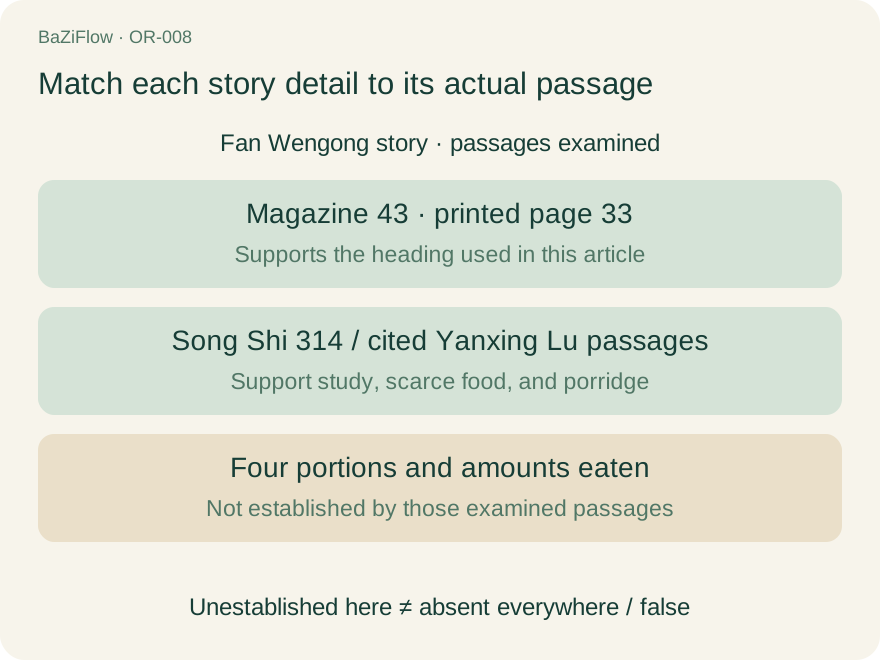
Check an oracle-lot allusion against the passage, not a title
Trace a Fan Zhongyan story from a temple magazine to examined historical passages, distinguishing supported details from an unresolved four-portion claim.
 SU-011 / Sukuyō astrology
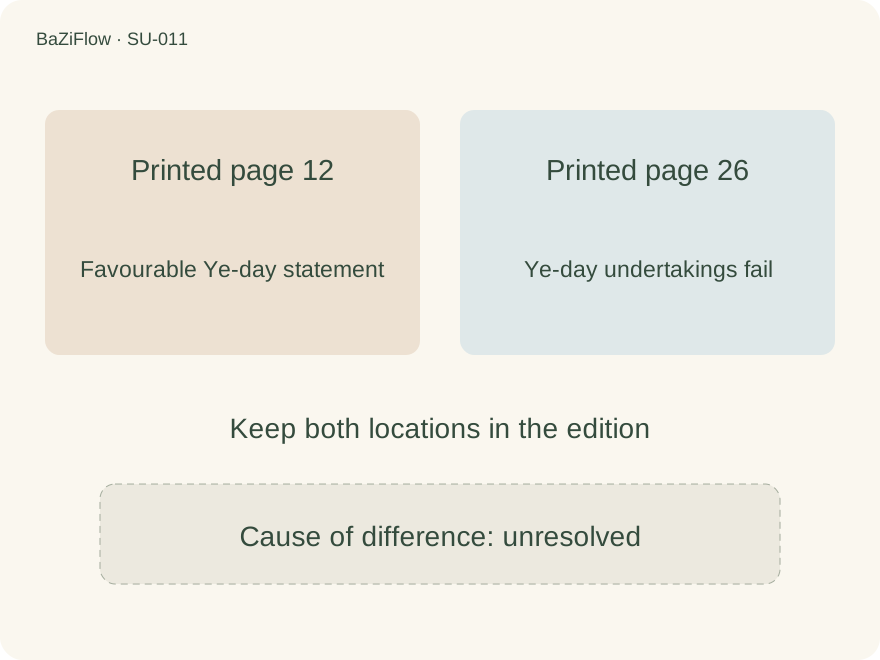
Checking Sukuyō sources: match evidence to claims
Distinguish editions and textual voices, preserve differing Karma-day passages, and document exactly what a source establishes and leaves unresolved.
 LY-005 / Liu Yao
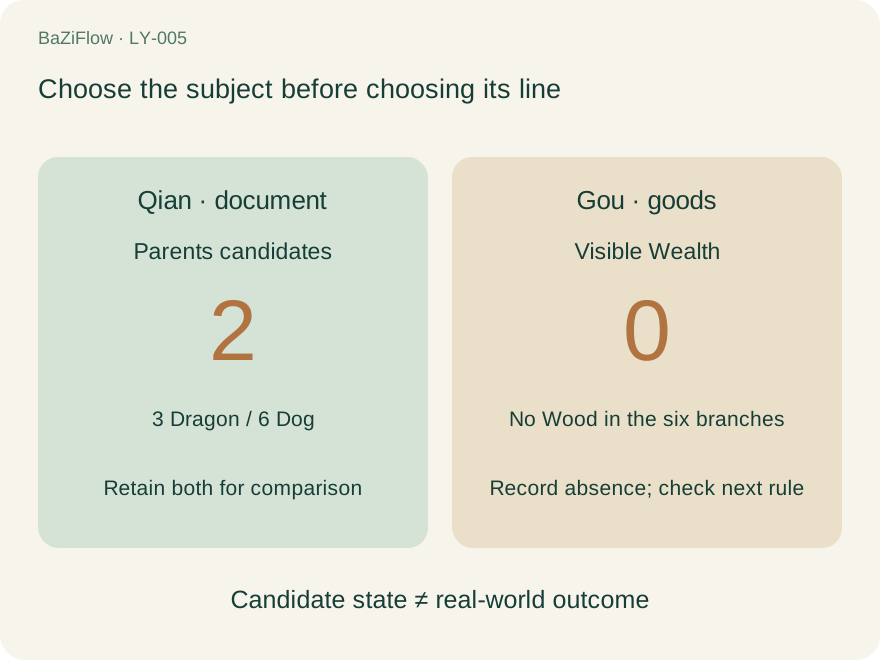
Choosing the useful god: define the subject and retain candidates
Compare the two Parents candidates in a supplied Qian document question with Gou’s lack of visible Wealth in a goods question, keeping selection evidence separate from any predicted outcome.
 BZ-018 / BaZi
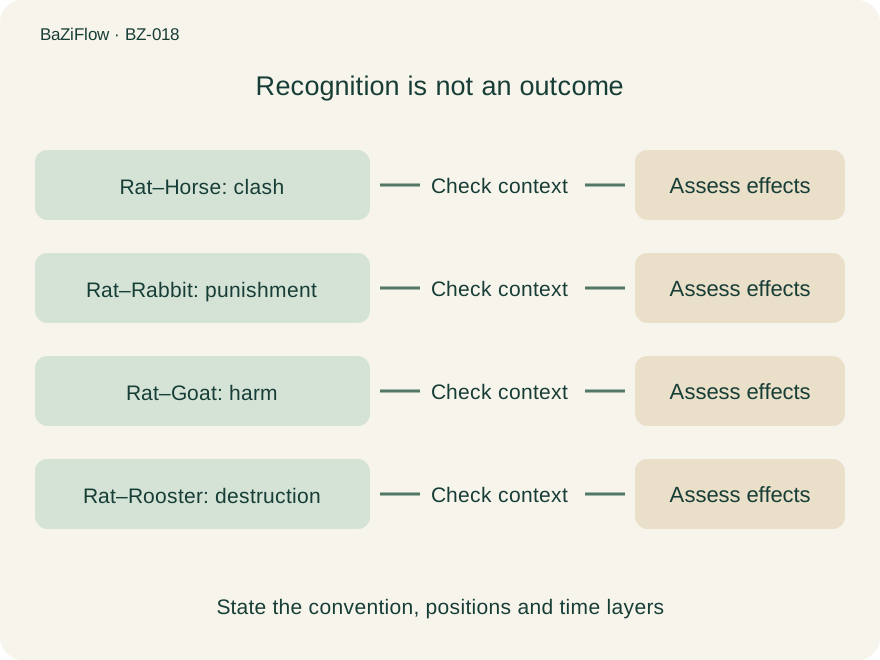
Clash, Punishment, Harm and Destruction Are Not Verdicts
Relationship names identify traditional branch structures, not guaranteed events. Compare their membership rules, a documented variation in destruction tables, and the layers needed for interpretation.
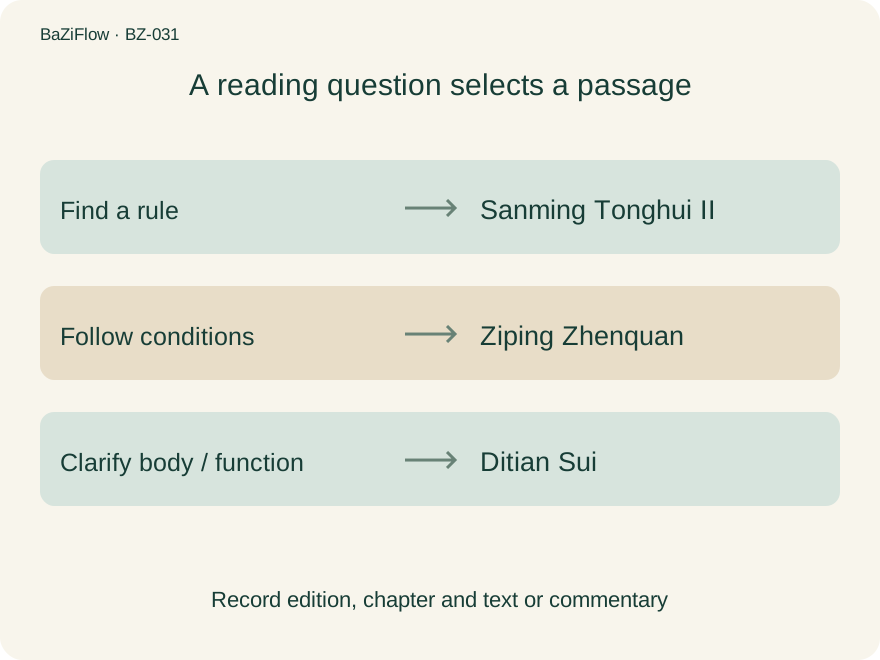 BZ-031 / BaZi
Reading the BaZi classics: questions, passages and textual layers
Use Sanming Tonghui, Ziping Zhenquan and Ditian Sui to practice different reading tasks. Track editions, commentary and local definitions instead of merging every familiar term.
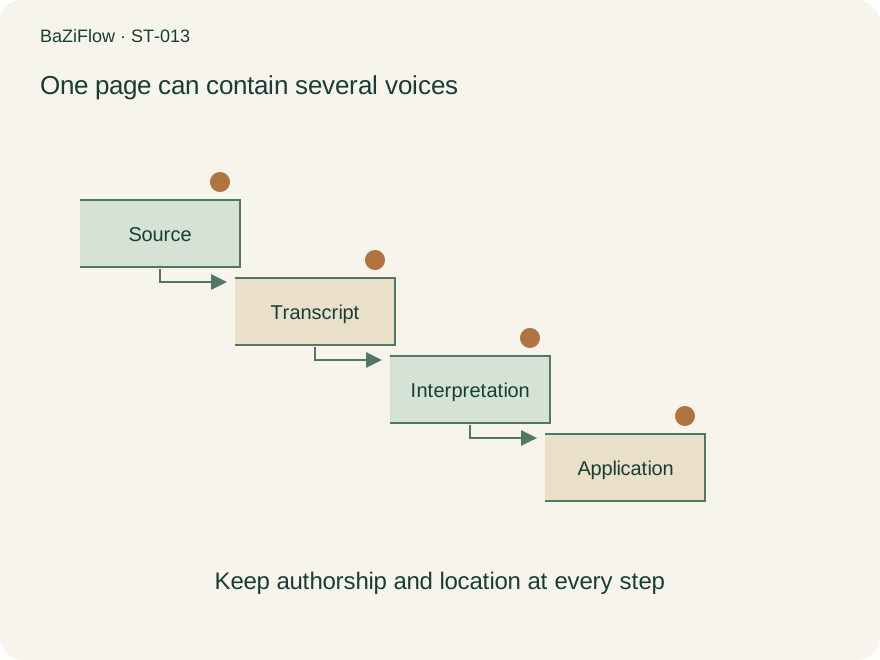 ST-013 / Cross-system studies
A Classical Citation Does Not Cover Every Modern Claim
Audit a claim backwards through application, interpretation, transcription and source. Keep editions, translators and historical values visible rather than treating a book title as proof.
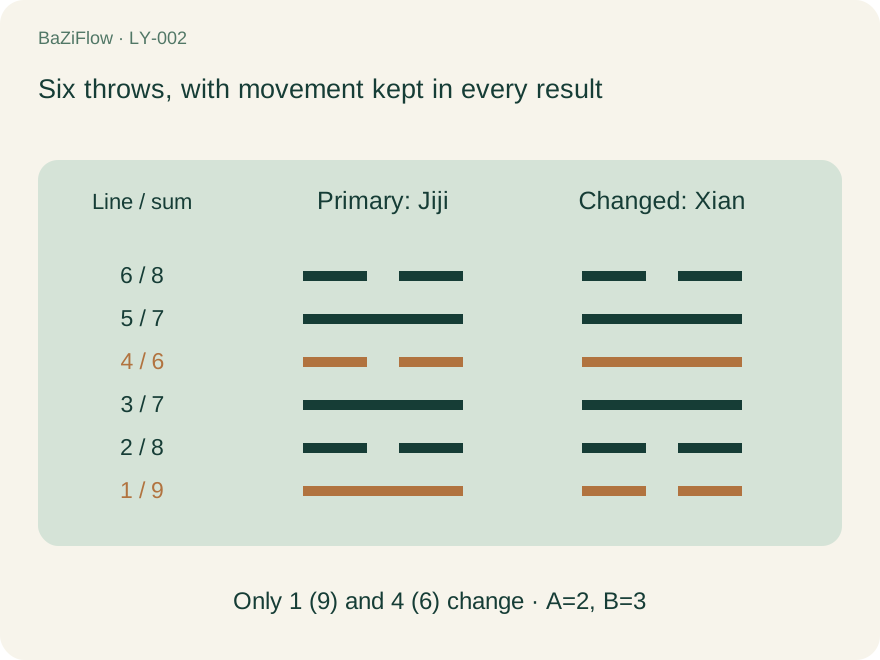 LY-002 / Liu Yao
Recording six coin throws: keep states and moving lines
Declare the two face values, record six throws from the bottom upward, and check a supplied Jiji-to-Xian example without losing its two moving positions.
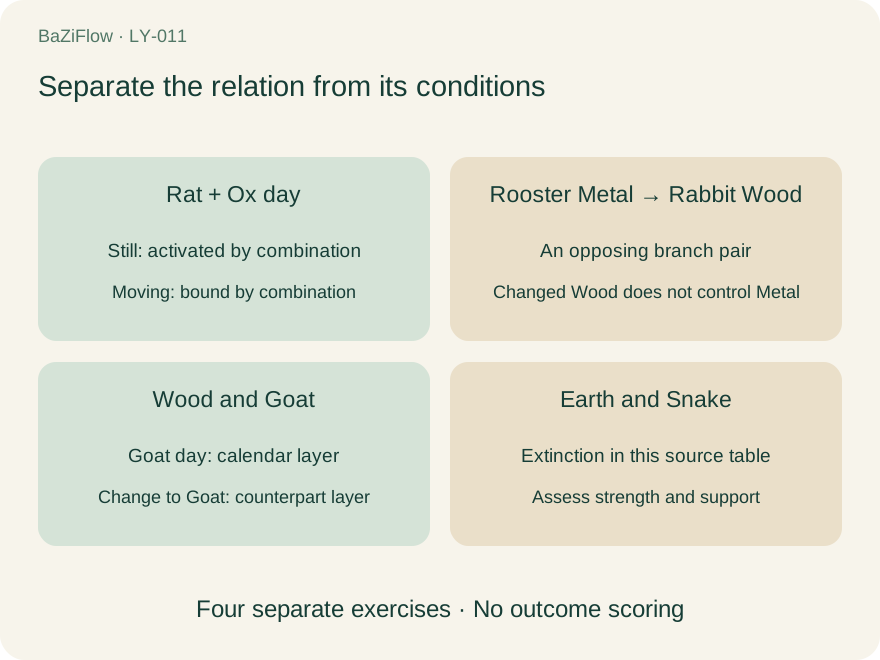 LY-011 / Liu Yao
Combination, clash, tomb, and extinction: keep their layers distinct
Compare four partial exercises to separate movement states, branch opposition, phase direction, and conditional tomb or extinction interpretations.
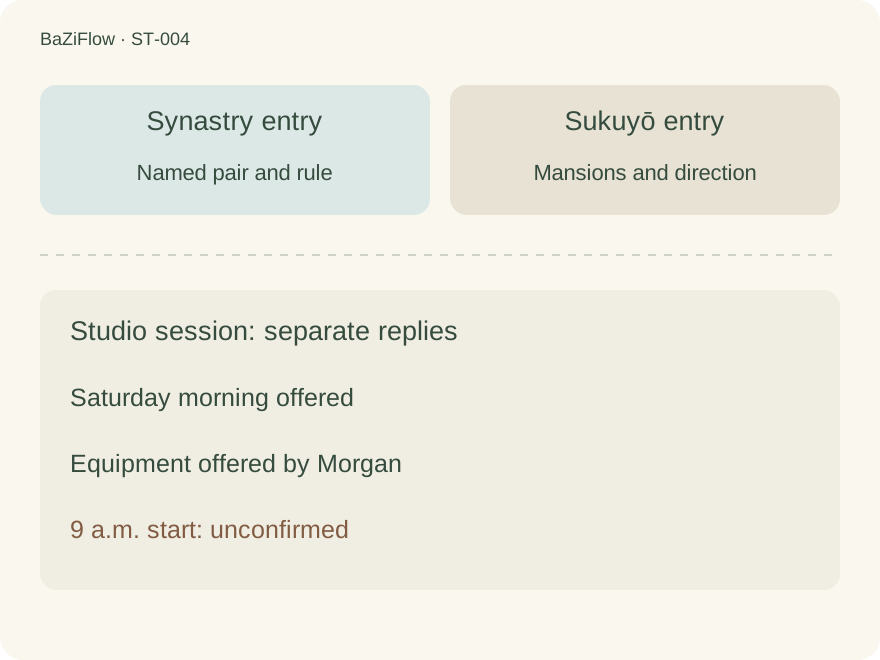 ST-004 / Cross-system studies
Comparing relationship readings with an evidence ledger
Audit a studio-planning example across synastry and Sukuyō, keeping symbolic claims separate from an actual reply about the arrangement.
 BZ-028 / BaZi
Compatibility beyond animal signs: keep chart fields and relationship evidence distinct
A shared animal pairing can conceal different birth records and different relationships. Learn to separate year-branch labels, cross-chart claims and evidence from life together.
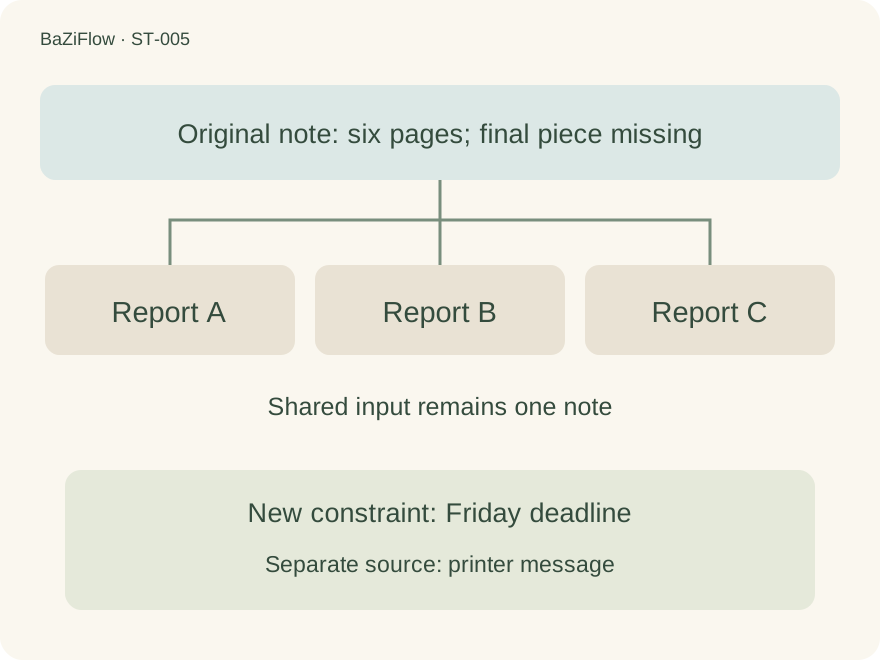 ST-005 / Cross-system studies
Complementary readings or repeated advice?
Trace a newsletter brief through three reports, distinguish new constraints from optional experiments, and use deletion to identify each contribution.
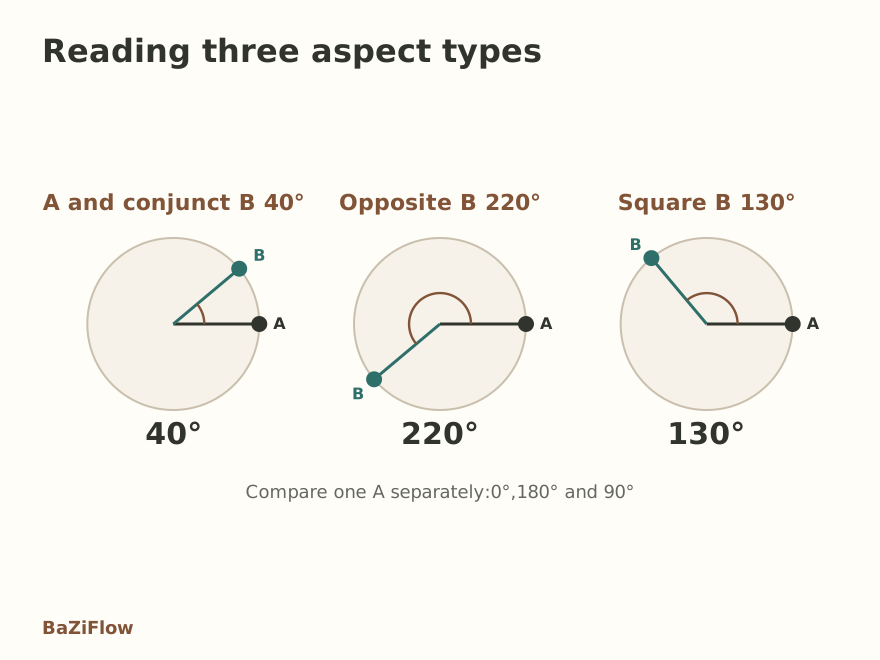 AS-014 / Western astrology
Conjunction, opposition and square aspects: measure the angle before judging good or bad
What conjunction, opposition and square mean: longitude separations of 0°, 180° and 90°. An angle dial, a swap-the-planets test and a three-layer record separate calculation, tradition and evidence.
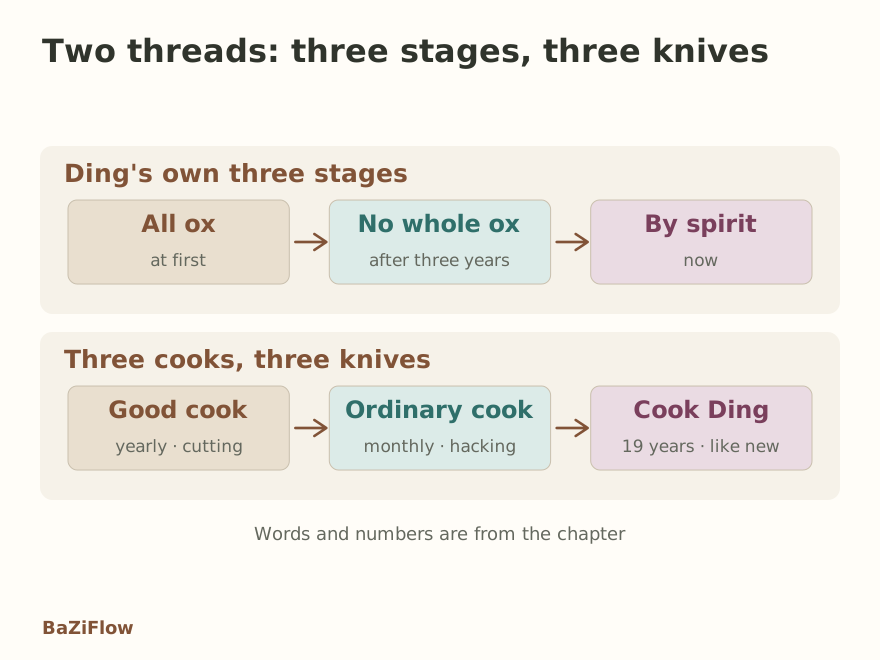 DA-010 / Daoist thought
Cook Ding Carves the Ox: Skill, Attention and Nourishing Life
Cook Ding carving an ox comes from the Zhuangzi chapter on nourishing life. A stage table, three knives compared, four steps at a hard place and a three-layer reading separate the text, tradition and modern borrowing.
 DA-002 / Daoist thought
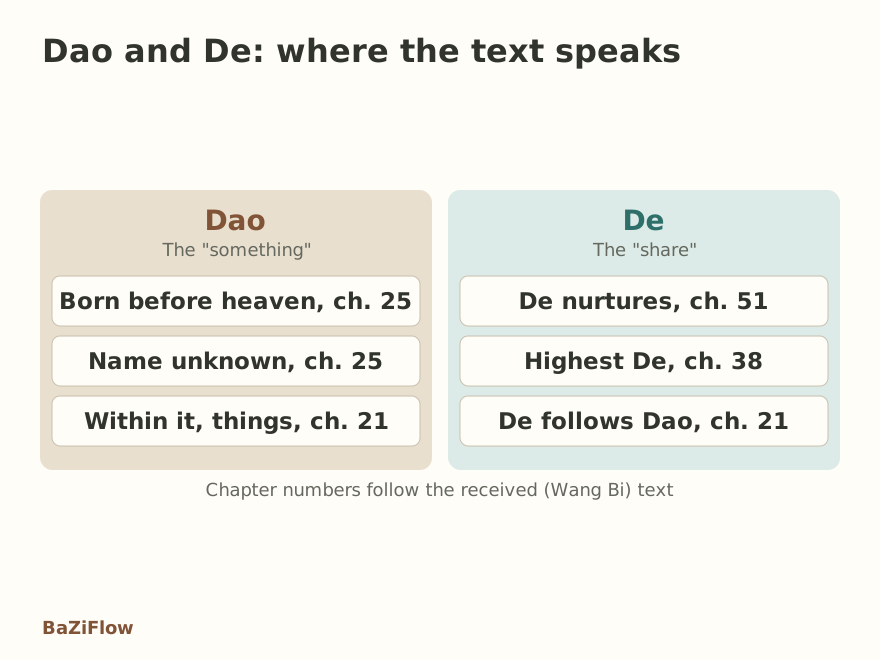
Dao and De in the Laozi: Reading Chapters 1, 21, 25, 38 and 51
Dao and De read through five chapters: a chapter map, the passages on a Dao with no known name, De as what each thing receives, and the ladder of chapter 38, with text, tradition and modern borrowing kept apart.
 LY-006 / Liu Yao
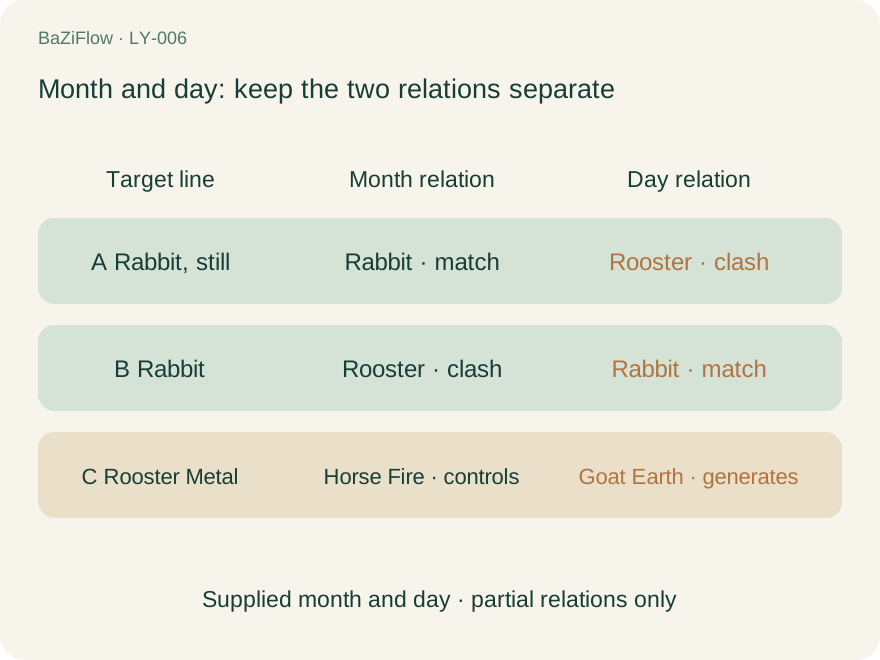
Month and day effects: preserve the evidence behind strength
Compare swapped Rabbit and Rooster month–day roles, distinguish conditional hidden movement from day breakage, and keep opposing phase effects out of invented scores.
 MH-006 / Meihua Yishu
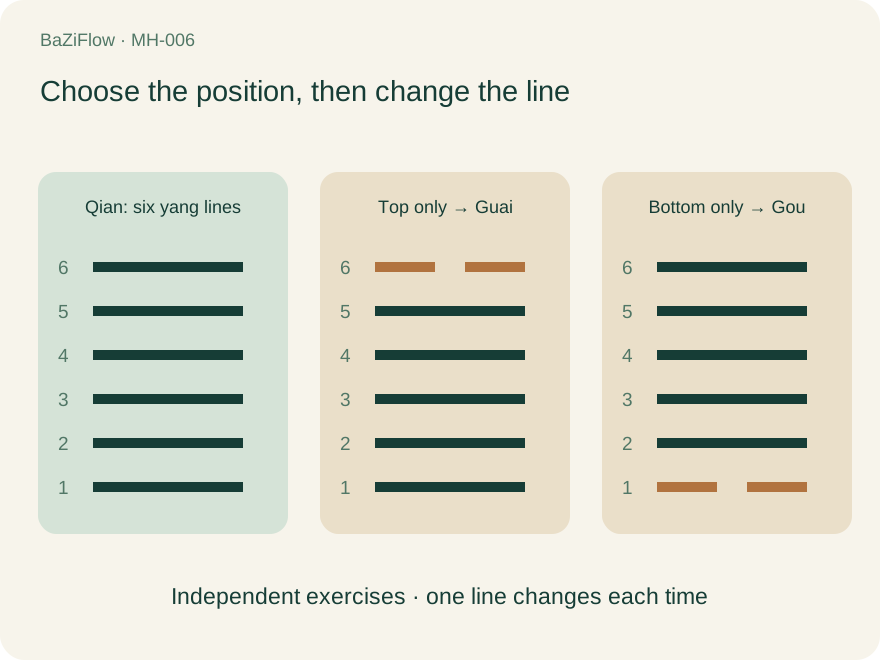
Determining a moving line: position first, then the change
Separate a moving line’s index from its yin–yang change, using a six-position remainder table and two independent changes to the Qian figure.
 CM-002 / Shared methods
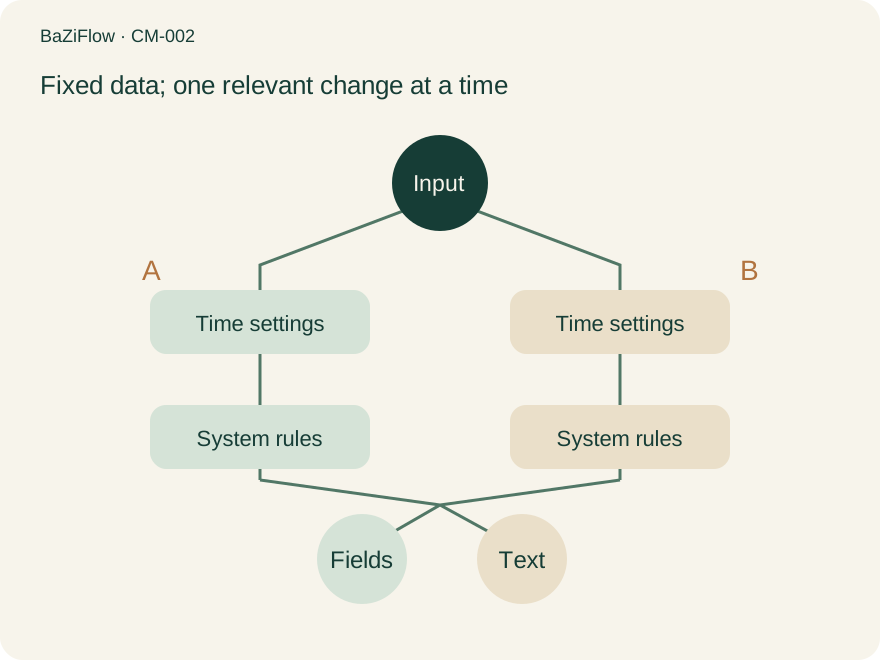
Same-Looking Inputs Can Still Use Different Settings
Build a controlled comparison of calendar, time conversion, location and system rules. Change one relevant condition at a time and separate field differences from interpretation differences.
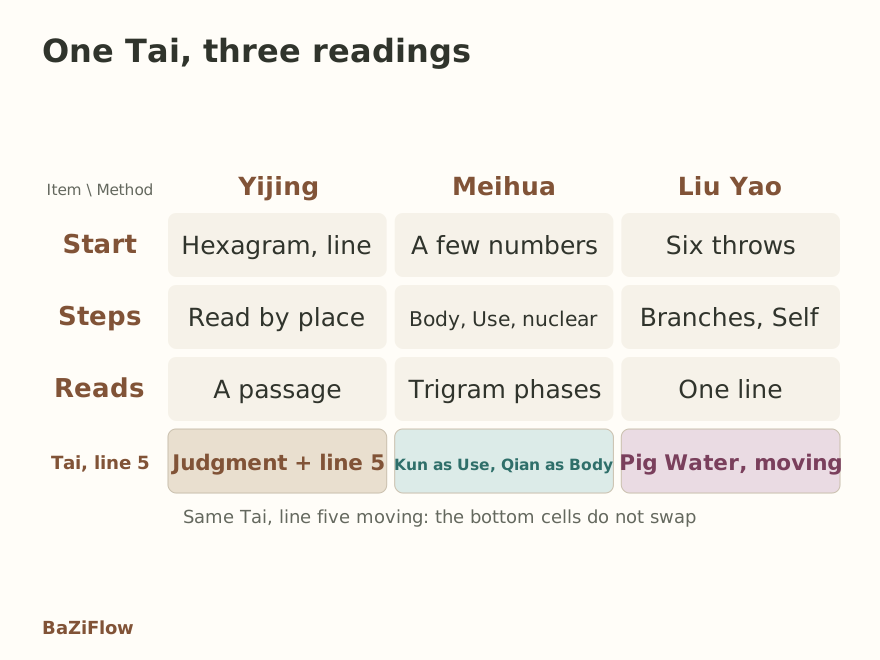 YJ-012 / Yijing
Yijing, Meihua and Liu Yao: Shared Hexagrams, Different Methods
One example, Tai with line five moving, read three ways: the Zhou Yi text by position, Meihua by Body and Use, Liu Yao by Self, Other and Six Relatives. Same figure, different start, steps and unit read.
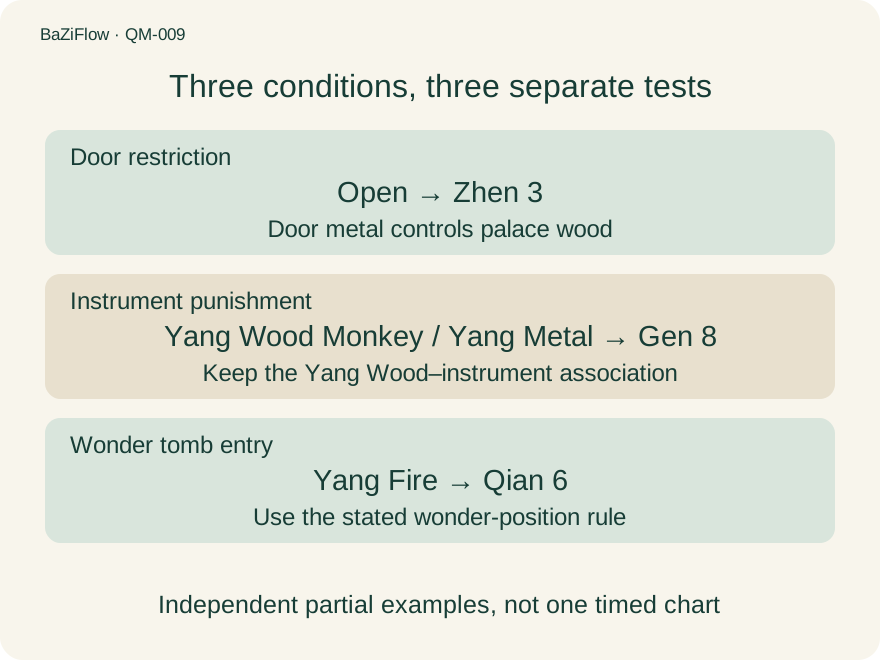 QM-009 / Qimen Dunjia
Door restriction, striking punishment and tomb entry differ
Three separate examples distinguish a door–palace relation, a six-instrument punishment placement and a wonder-stem tomb placement. Check the operands before treating the traditional labels as comparable.
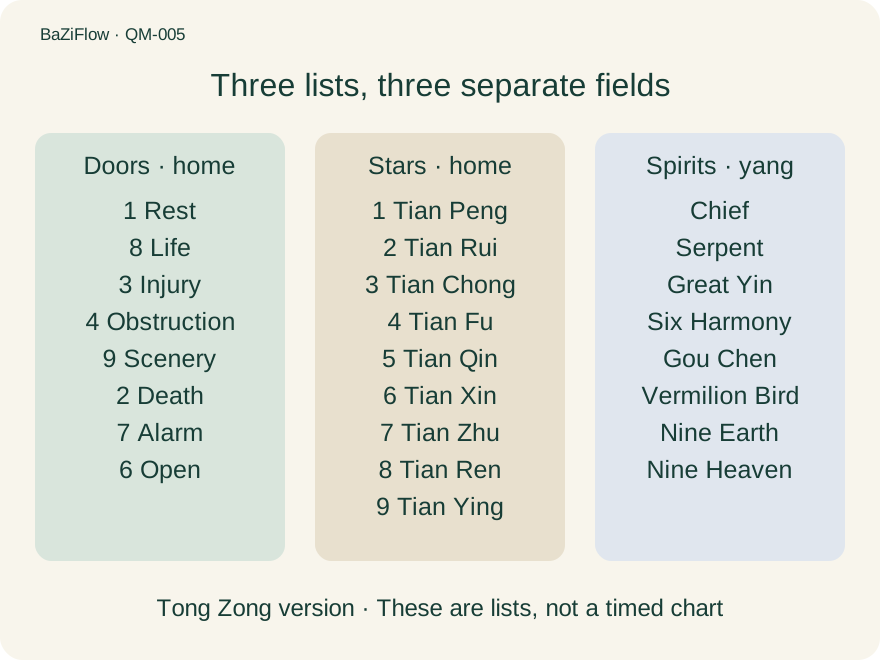 QM-005 / Qimen Dunjia
Doors, Stars and Spirits: Keep the Qimen Layers Distinct
Compare the eight-door home positions, nine-star inventory and a named classical spirit list. Learn why a symbol name, its home position and its placement in a time chart are different records.
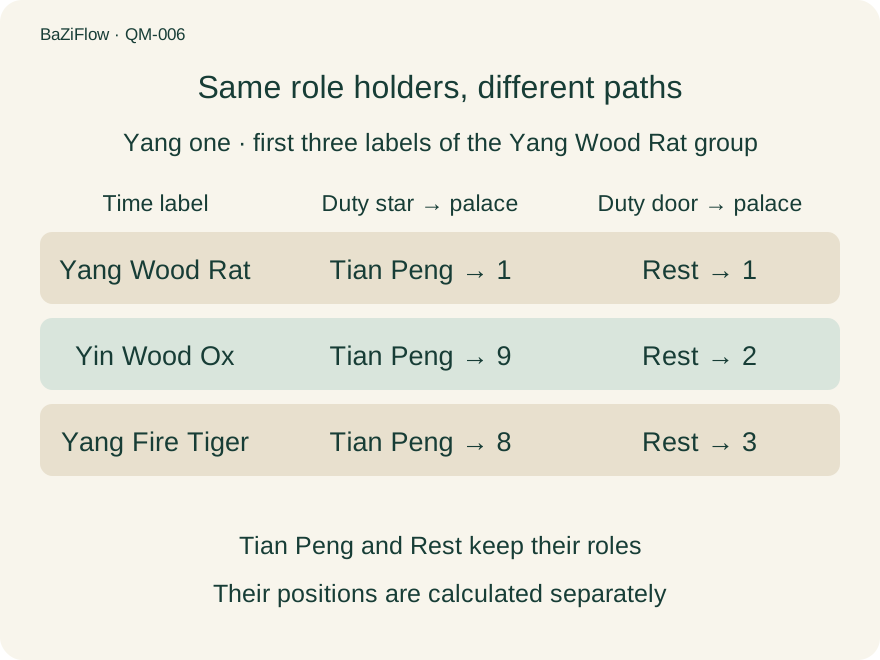 QM-006 / Qimen Dunjia
Duty chief and duty door: track the role before the position
A three-row Yang-one example separates the star serving as duty chief from its changing palace, and tracks the duty door independently. Learn why a palace number cannot identify the star by itself.
 YJ-003 / Yijing
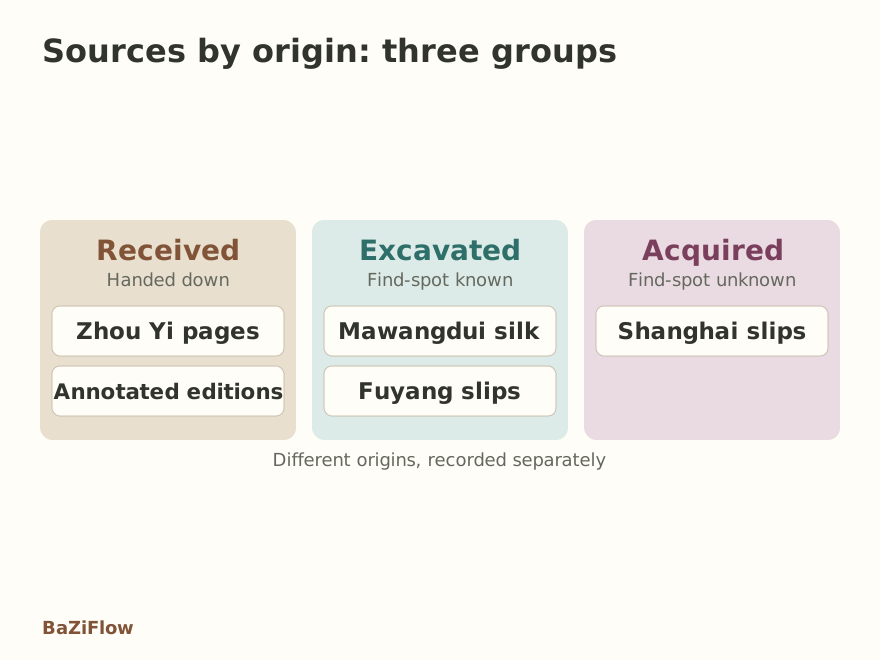
Choosing a Yijing Edition: Received Texts and Excavated Manuscripts
The Zhou Yi comes as received editions, annotated editions, excavated manuscripts and translations. Several comparisons sort the sources, show variant readings and give three questions for recording an edition.
 SU-009 / Sukuyō astrology
Prosper–Kin: a favorable label is not a work agreement
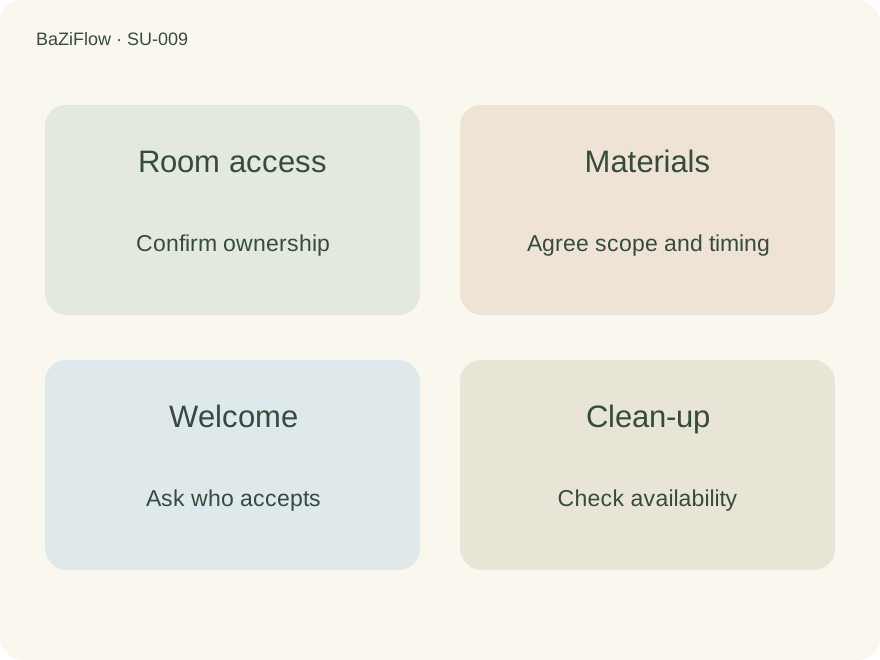
Credit the actions that make a workshop succeed, then audit unassigned roles and distinguish a practitioner’s positive interpretation from individual commitments.
 BZ-EL-03 / BaZi
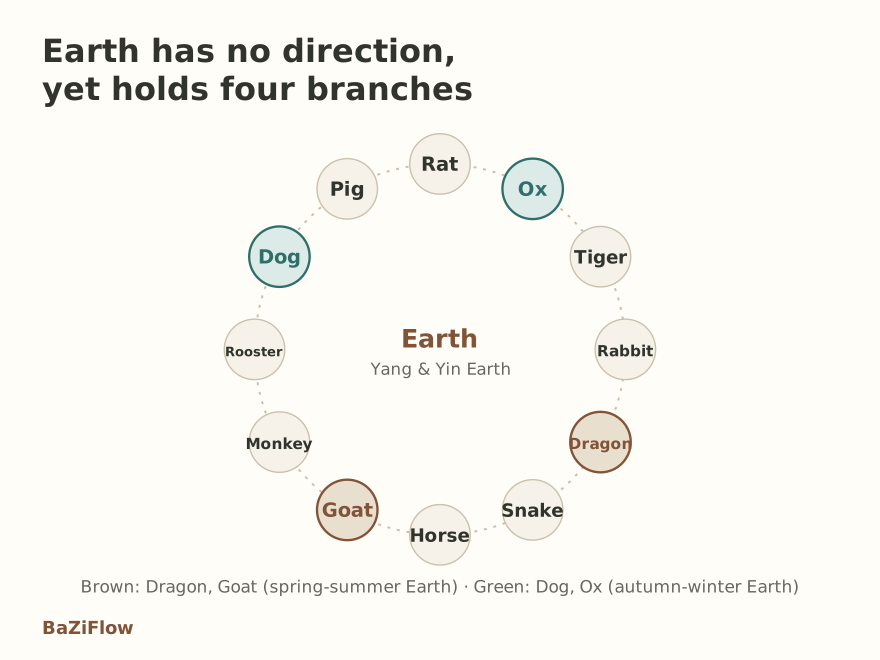
Earth (土): The Center That Holds Four Branches, with Yang Earth and Yin Earth
Where the Sanming Tonghui places Earth: the center that lodges at the four corners, "everything relies on Earth", what each of the four Earth branches hides, spring-summer against autumn-winter Earth, and the four lines.
 BZ-EL-02 / BaZi
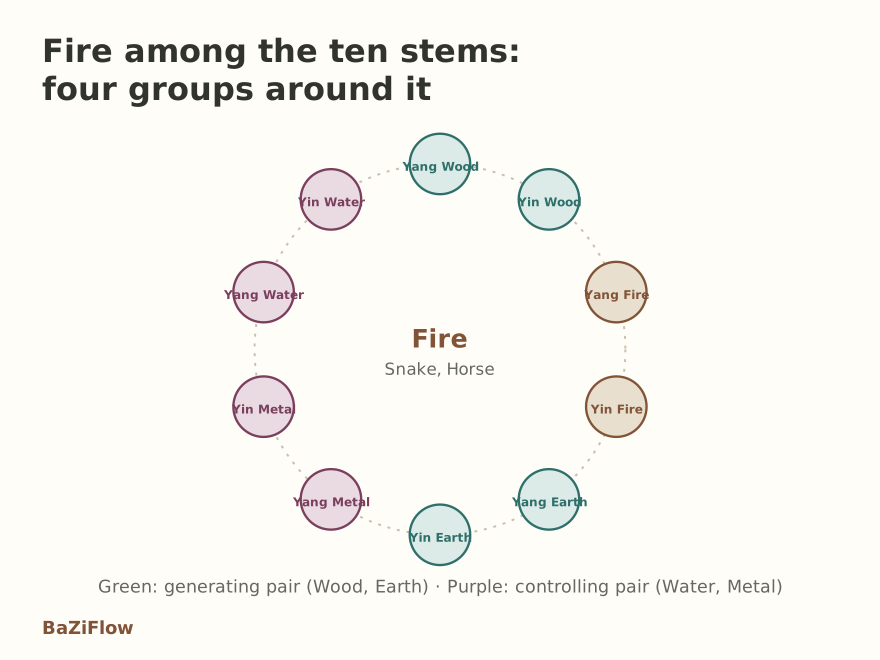
Fire (火): No Body of Its Own, Body and Use, Four Seasons, Yang and Yin Fire
What the Sanming Tonghui says of Fire: "no body of its own", Wood as body and Water as use, one disliked element per season that matches Fire's four lines, Yang against Yin Fire, and the branches that hide Fire.
 BZ-EL-04 / BaZi
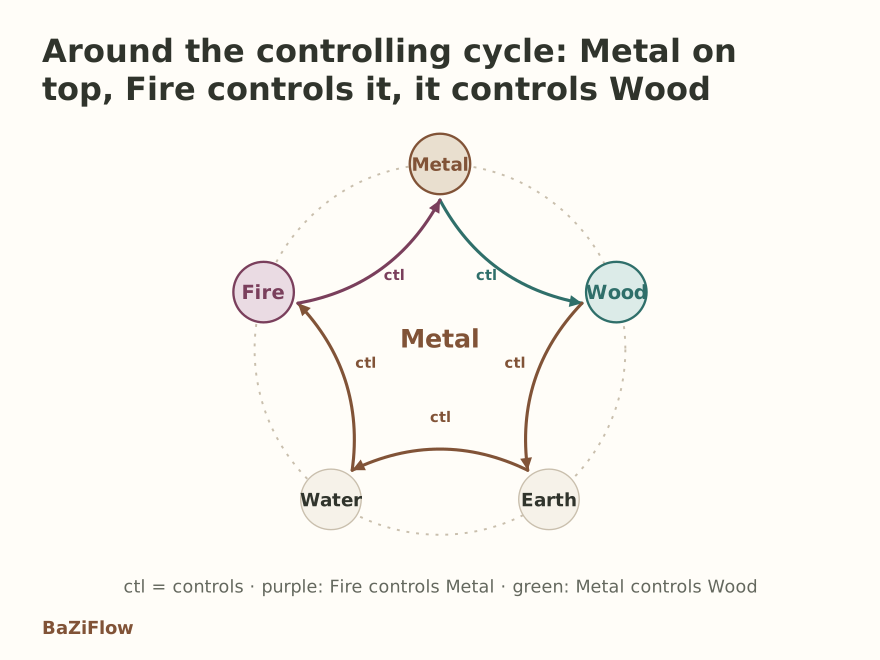
Metal (金): To Hold Back, No Forging No Vessel, Yang and Yin Metal
What the Sanming Tonghui says of Metal: the word for holding back, extreme yin with yang inside, no forging no vessel, Fire before and after the vessel, Yang and Yin Metal, and the branches that hide Metal.
 BZ-EL-05 / BaZi
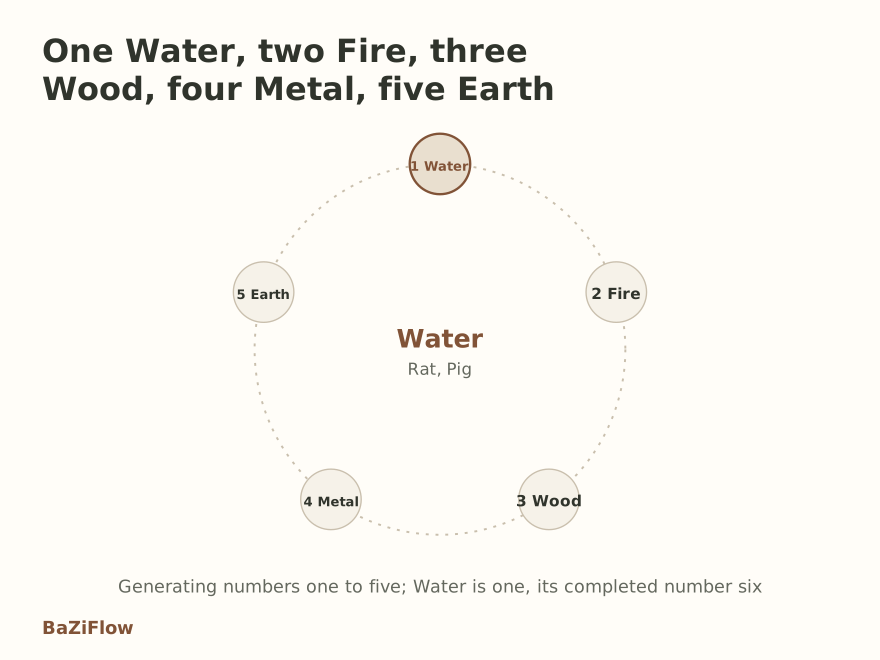
Water (水): Why the Elements Are Counted from Water, and Where It Flows
What the Sanming Tonghui says of Water: why it is first in the numbered order, moistening and flowing down, the Pig as outlet and the Dragon as intake, Yang and Yin Water, four lines, and the branches that hide Water.
 BZ-EL-01 / BaZi
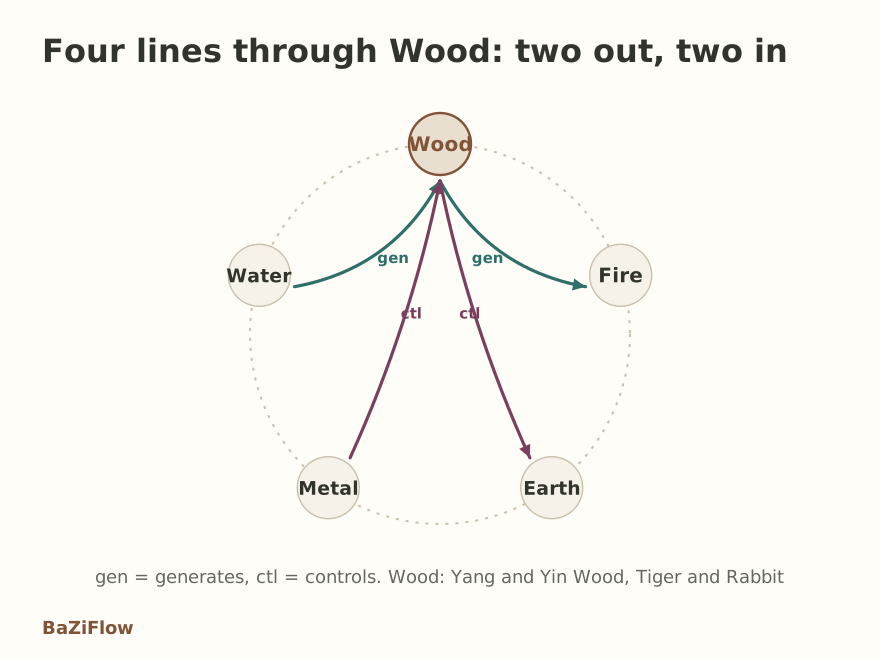
Wood (木): From "Touching Off" to Yang and Yin Wood, Tiger and Rabbit
How the Sanming Tonghui defines Wood: the word for "touching off", "bending and straightening", Yang Wood against Yin Wood, Tiger and Rabbit plus three more branches that hide Wood, and the four lines through it.
 AS-006 / Western astrology
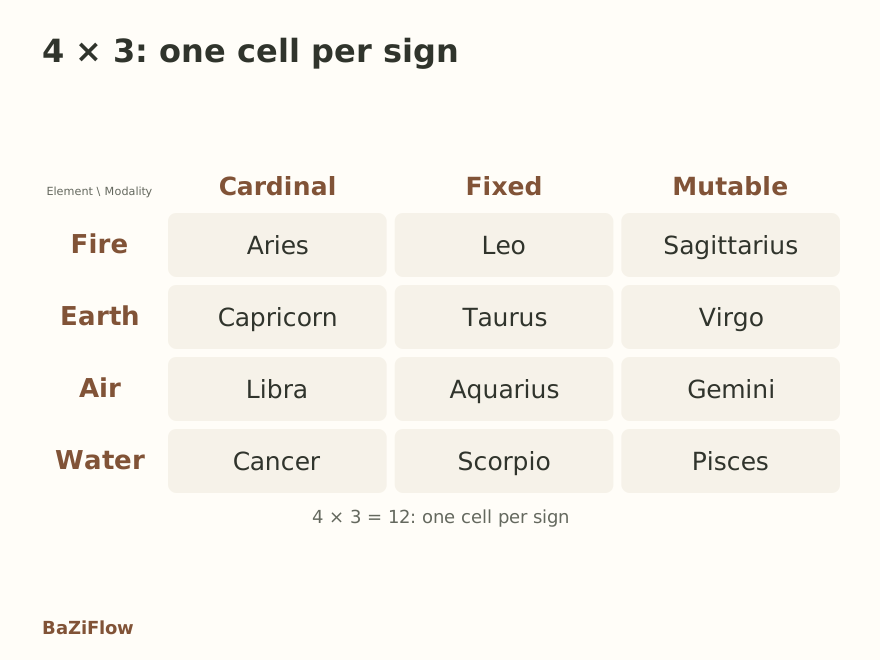
Elements and Modalities: Two Axes for Reading the Twelve Signs
Elements sort the twelve signs into four groups and modalities into three. A four-by-three table, two find-the-sign exercises and one counting example separate classification, counting method and personality claims.
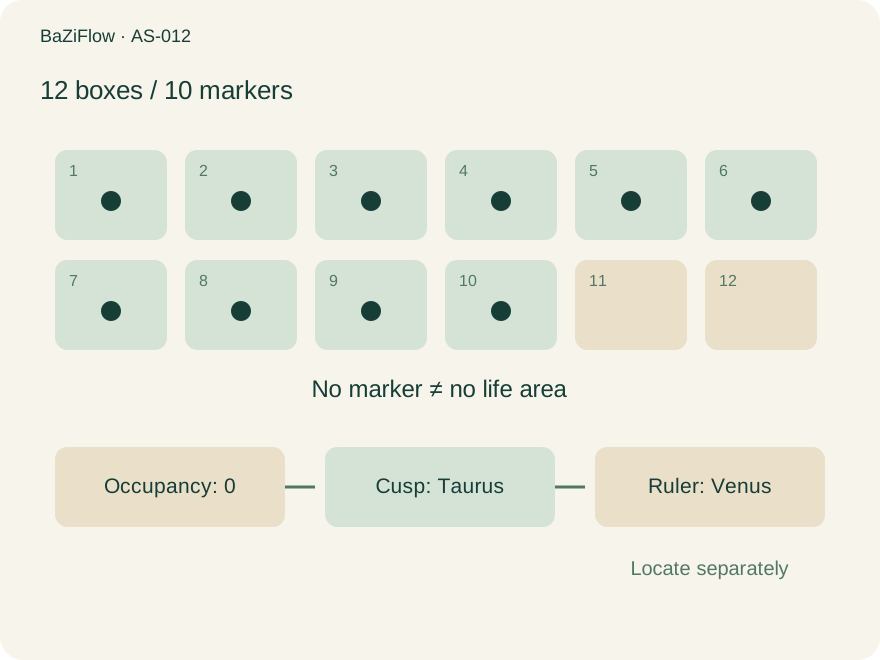 AS-012 / Western astrology
Empty houses: absence of occupants is not absence of a life
Define the object set before calling a house empty. A counting exercise and a ruler lookup separate occupancy from rulership without turning a blank chart sector into a prediction.
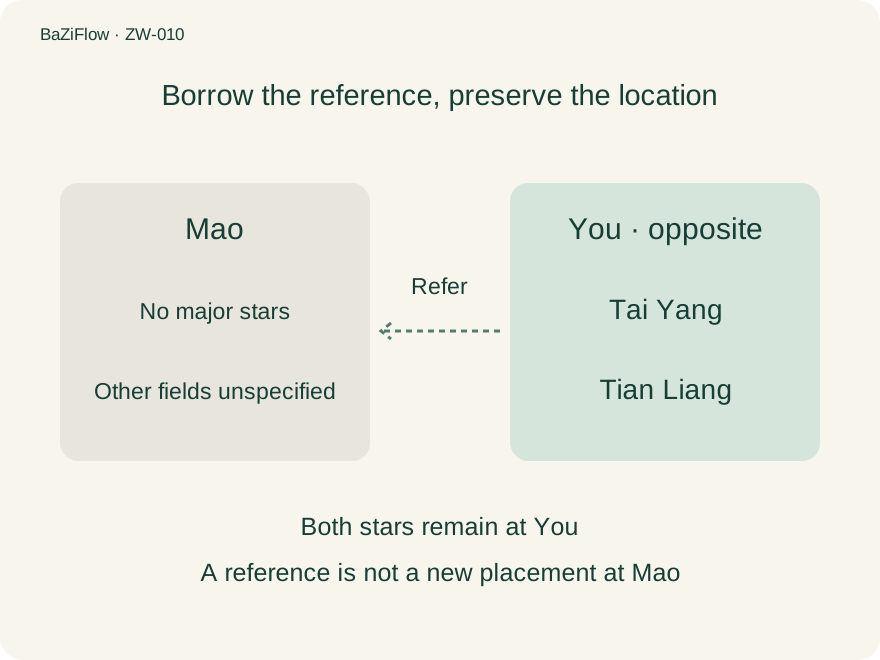 ZW-010 / Zi Wei Dou Shu
Empty palaces and borrowed stars: keep the source location
An empty Zi Wei palace lacks major stars, not all information. Learn how an opposite-palace reference differs from moving stars into the focus palace.
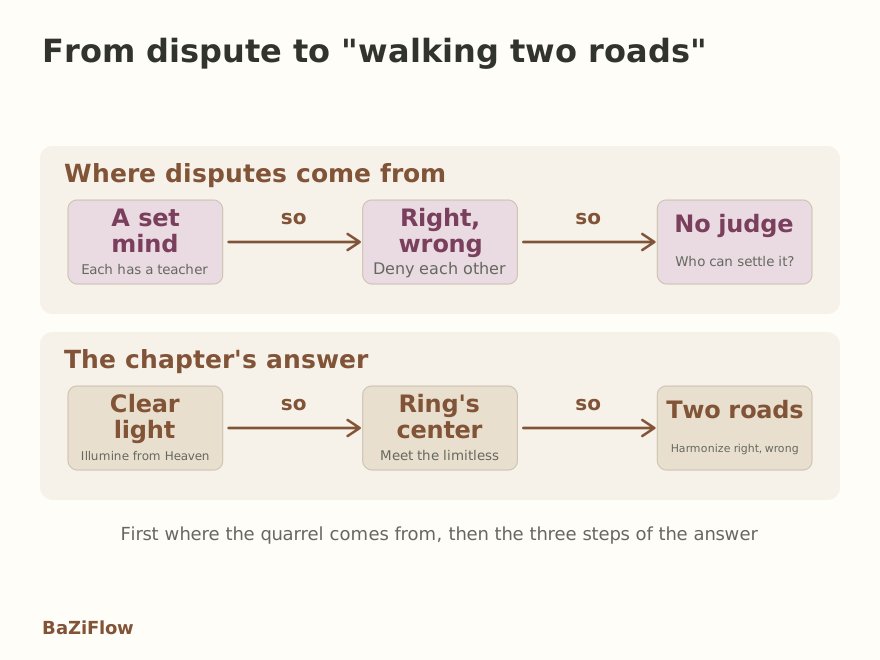 DA-009 / Daoist thought
Equalizing Things: How Different Perspectives Meet, and the Limits of Judging
Three kinds of piping, Wang Ni's three questions, "that" and "this", who can judge, three in the morning and the butterfly: where words and judgments reach their limit, and why that is not "anything goes".
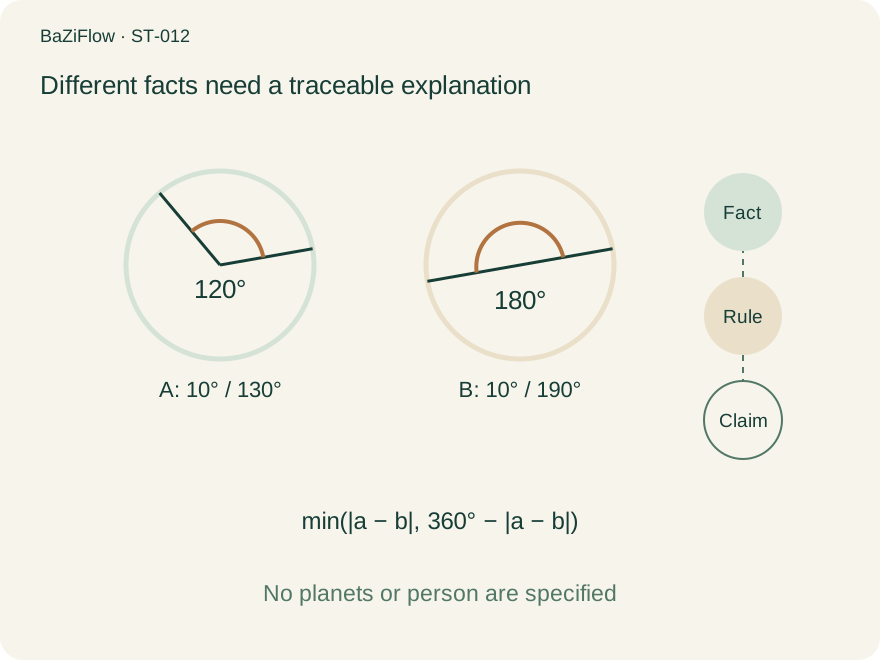 ST-012 / Cross-system studies
Personalization Needs a Reason That Changes with the Input
Use a small geometric contrast to separate accurate fields from supported explanations. Check what survives when names are removed and when structurally different inputs are compared.
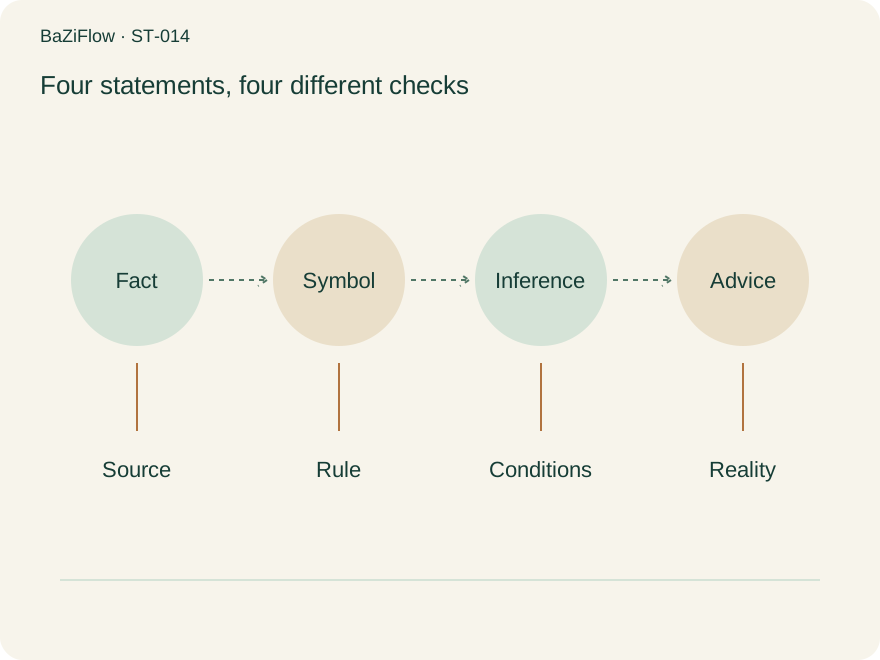 ST-014 / Cross-system studies
Facts, Symbols, Inferences and Advice Have Different Jobs
Separate four kinds of statement before judging a reading. A Strength-card example shows why a documented symbol does not establish a trait or decide an action.
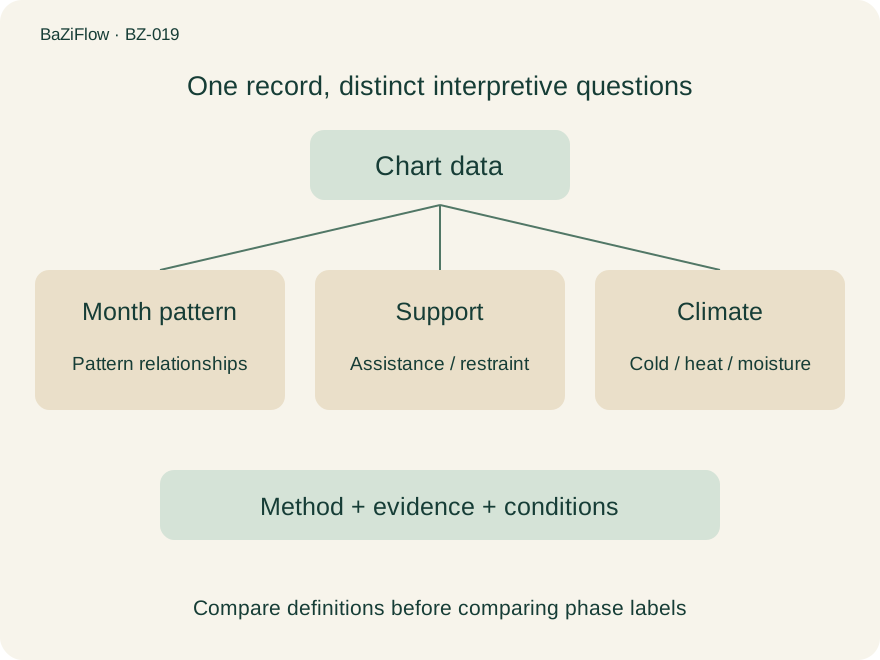 BZ-019 / BaZi
Favourable, Useful and Unfavourable: Terms Need a Method
Useful God does not have one interchangeable meaning across every BaZi text. Compare month-based pattern reading with support and climate approaches, and keep every conclusion tied to its evidence.
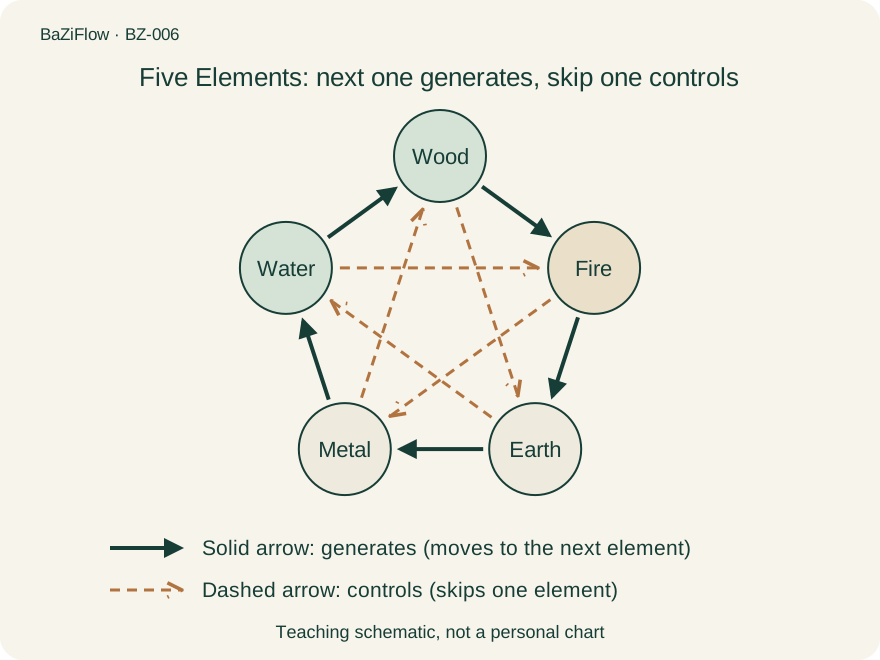 BZ-006 / BaZi
Five Elements cycles: learn the relationships, not just the order
Rebuild the generating and controlling cycles from one diagram, read them as directions rather than verdicts, and practise the five positions relative to a reference element.
AS-011 / Western astrologyAscendant, Descendant, MC and IC: Two Axes on the Zodiac
Build the four angles from horizon and meridian, distinguish MC from the overhead zenith, and test two opposite pairs without assuming four equal right angles.
BZ-002 / BaZiReading a BaZi chart for the first time: the four pillars and the Day Master
Where the eight characters sit, why the day stem is called the Day Master, what to record before judging anything, and why BaZi is neither a zodiac animal nor a personality quiz.
TA-003 / TarotThe Four Tarot Suits: Enter Through Objects, Not Four Sealed Areas of Life
Wands, Cups, Swords and Pentacles each hold Ace through Ten and four court cards. Compare the four Aces, test slogans against the text and run a book-exchange exercise, treating suits as an index.
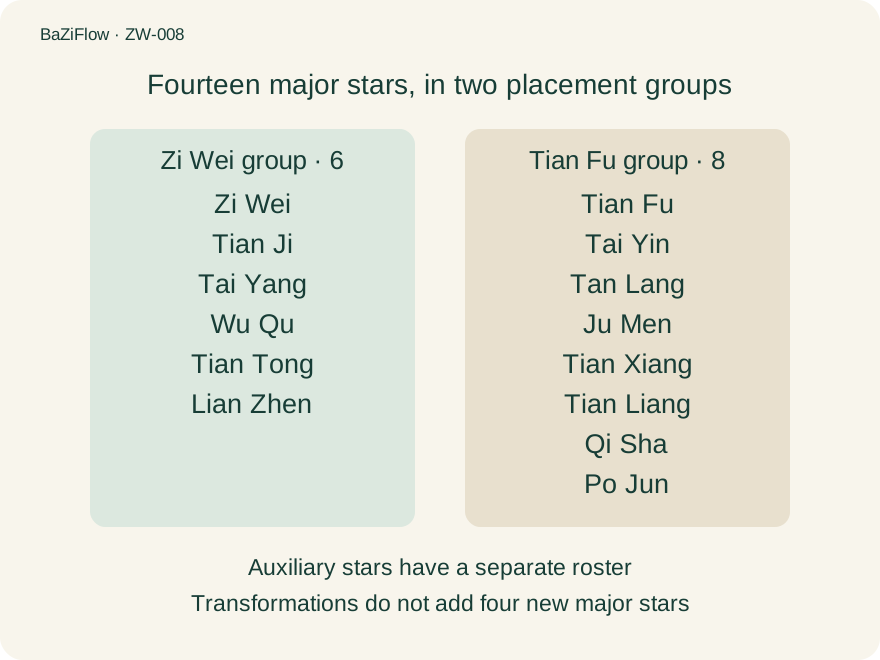 ZW-008 / Zi Wei Dou Shu
The fourteen major stars: learn the roster and its structure
Recognize the fourteen Zi Wei major stars through two placement groups. A six-star exercise shows why names, positions and transformations need separate records.
 DA-008 / Daoist thought
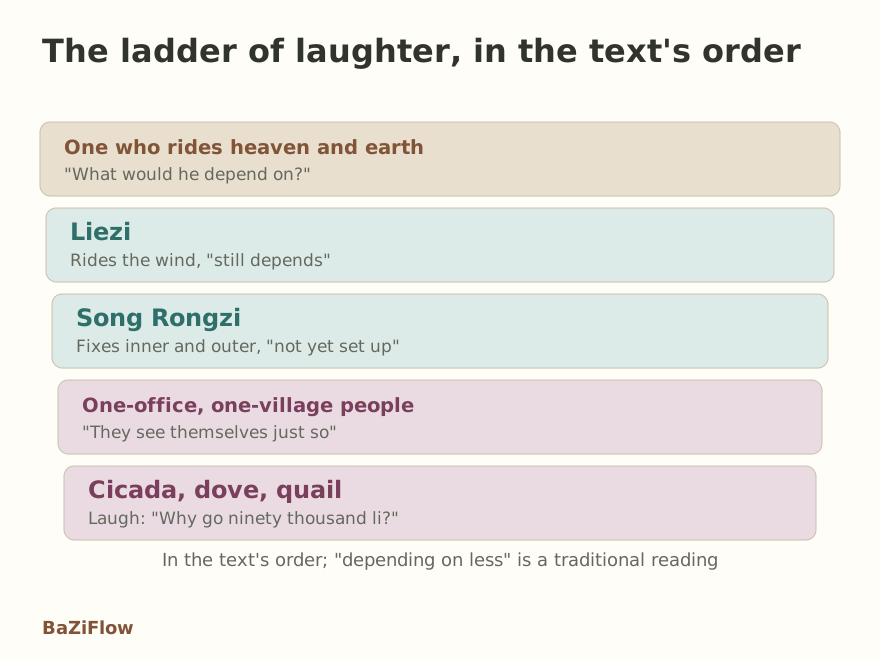
Free and Easy Wandering: What the Great Bird and the Small Birds Argue About
Read the chapter in its own order, from the Peng and the small birds to Song Rongzi and Liezi: each laughs at the one below, and each still depends on something. Then the gourd and the tree.
 QM-010 / Qimen Dunjia
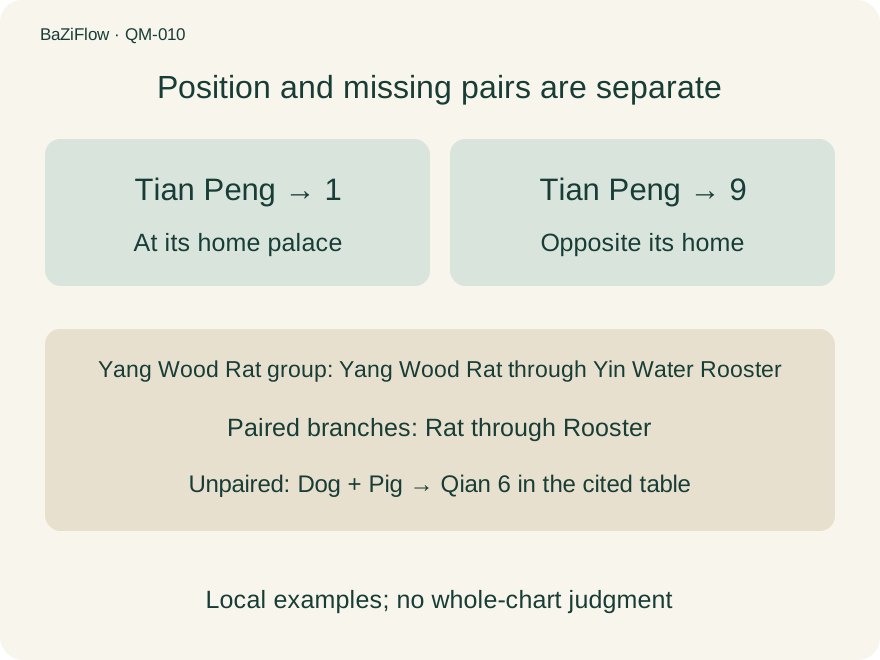
Fu Yin, Fan Yin and void branches need different evidence
A star at its home or opposite palace is a positional relation. Two unpaired branches in a ten-part group are a different calculation. Keep the chart layer and time scope visible when reading these labels.
 CM-006 / Shared methods
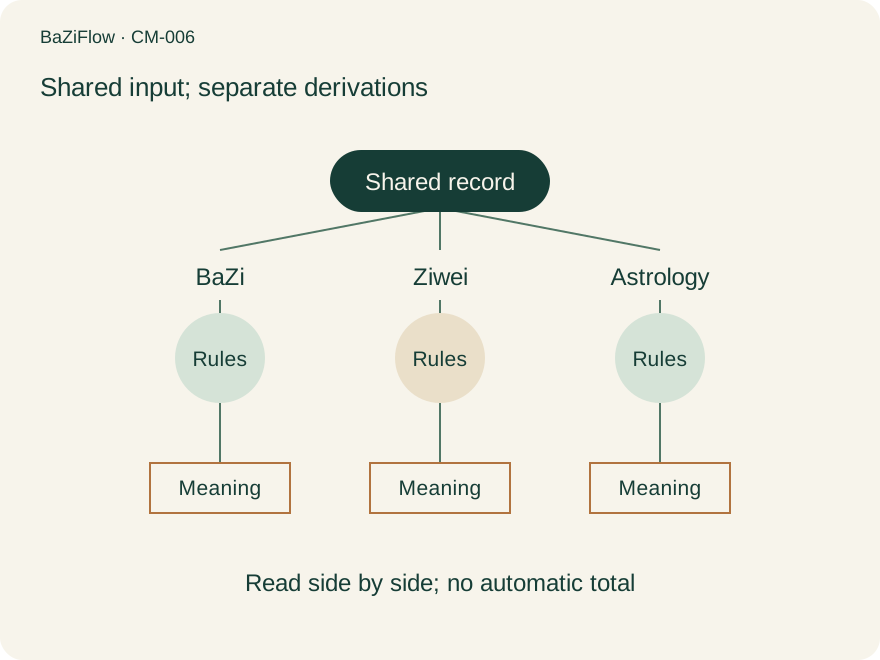
Build a Fusion Reading with Separate Evidence Trails
Track shared inputs, method-specific calculations and interpretations before writing a synthesis. Compare equivalent claims, preserve disagreement and avoid turning repeated descriptions into extra evidence.
 MH-009 / Meihua Yishu
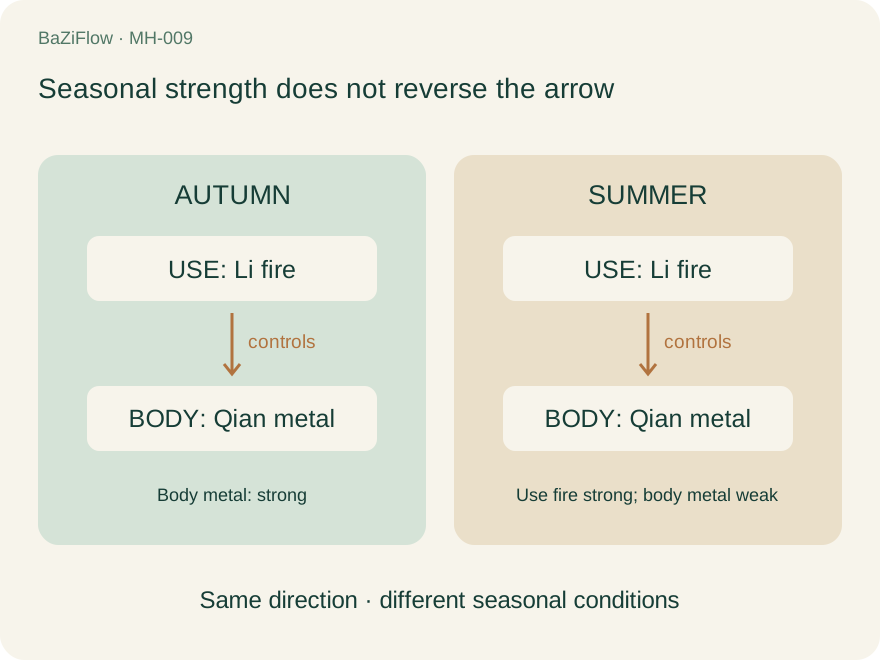
Generation, control and strength: keep the layers separate
Compare five relationships to a supplied Qian body, then contrast summer and autumn without reversing fire’s control of metal or inventing probabilities.
 OR-010 / Oracle lots
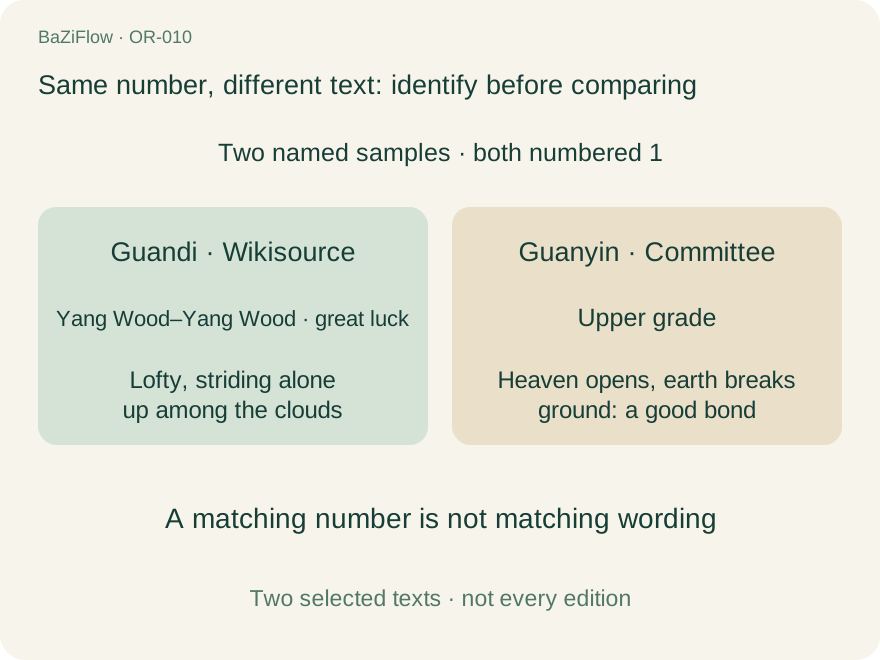
Guandi and Guanyin lots: compare texts before assigning roles
Compare two named first-lot samples, preserve their identifiers and commentary layers, and avoid turning local usage into universal subject rules.
 OR-009 / Oracle lots
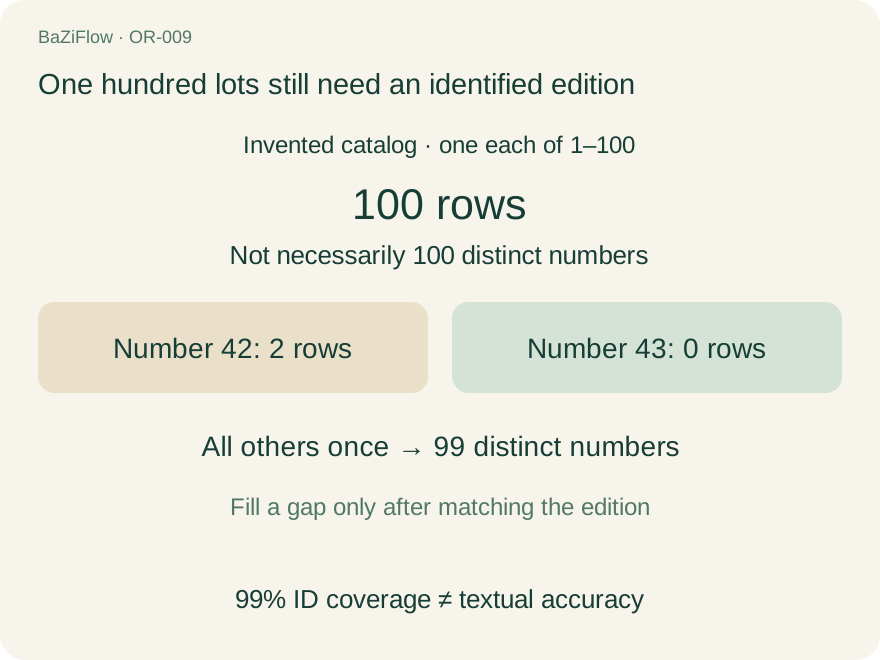
Guanyin Hundred Lots: collection size, editions, and identity
Understand what a hundred-lot title establishes, compare historical and institutional evidence, and test catalog completeness without mixing editions.
 HEX-001 / Shared methods
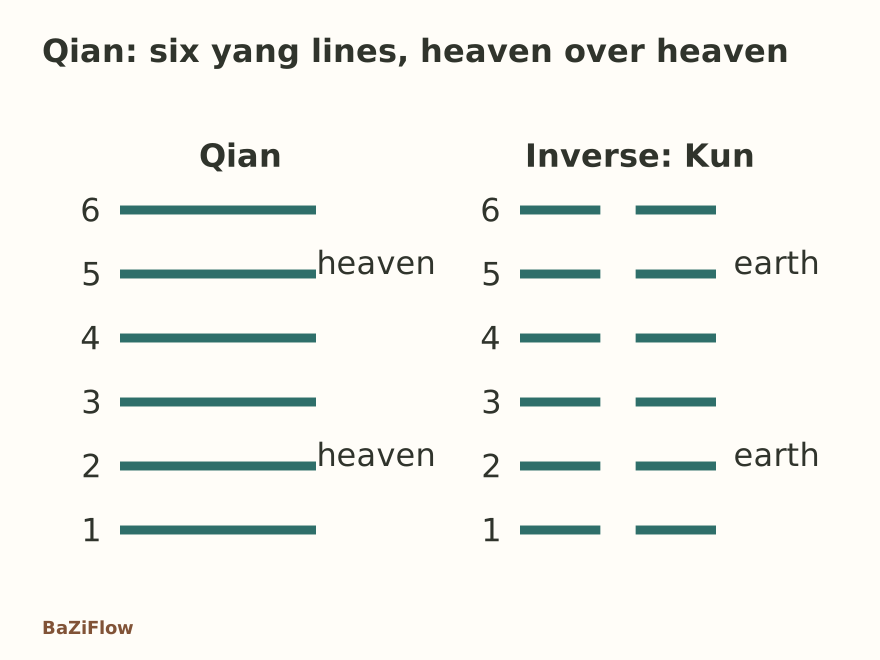
Qian (乾): six yang lines, read from the hidden dragon to the overreaching one
Qian is the first of the 64 hexagrams: six yang lines, with Qian (heaven) as both trigrams. Read its text in layers: the judgment, the Image, and six line statements that move a dragon from the depths to the heights.
 HEX-002 / Shared methods
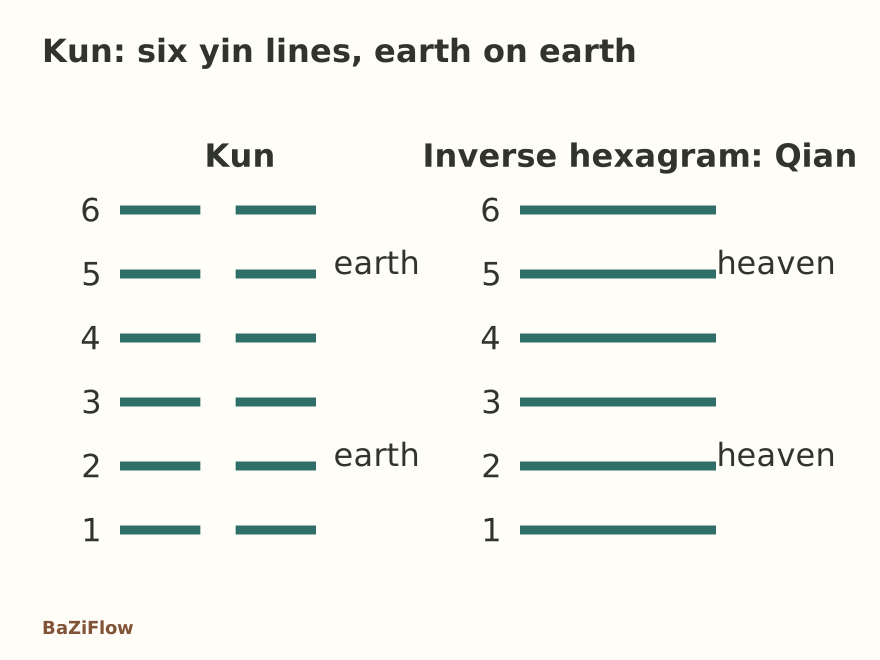
Kun (坤): six yin lines, read from stepping on frost to dragons fighting in the wilds
Kun is the second of the 64 hexagrams: six broken yin lines, with Kun (earth) as both trigrams. Read the mare and compass points of the judgment, the Great Image on carrying, and six lines from frost to blood.
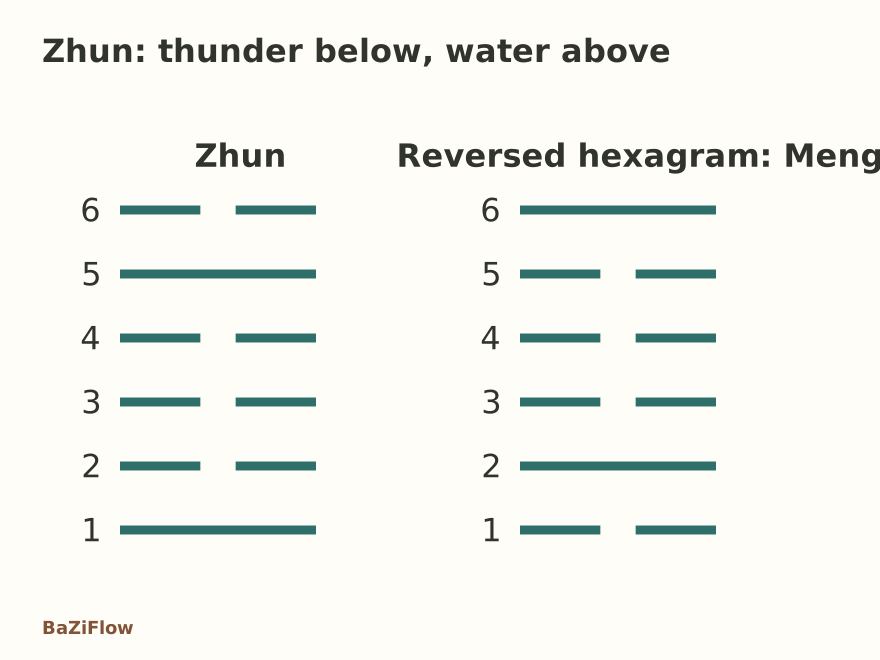 HEX-003 / Shared methods
Zhun: one sentence, "riding a horse, circling", with three different endings
Zhun is the third of the 64 hexagrams, thunder below and water above. Read its judgment, the Great Image of clouds and thunder, and one sentence that opens three lines and ends three different ways.
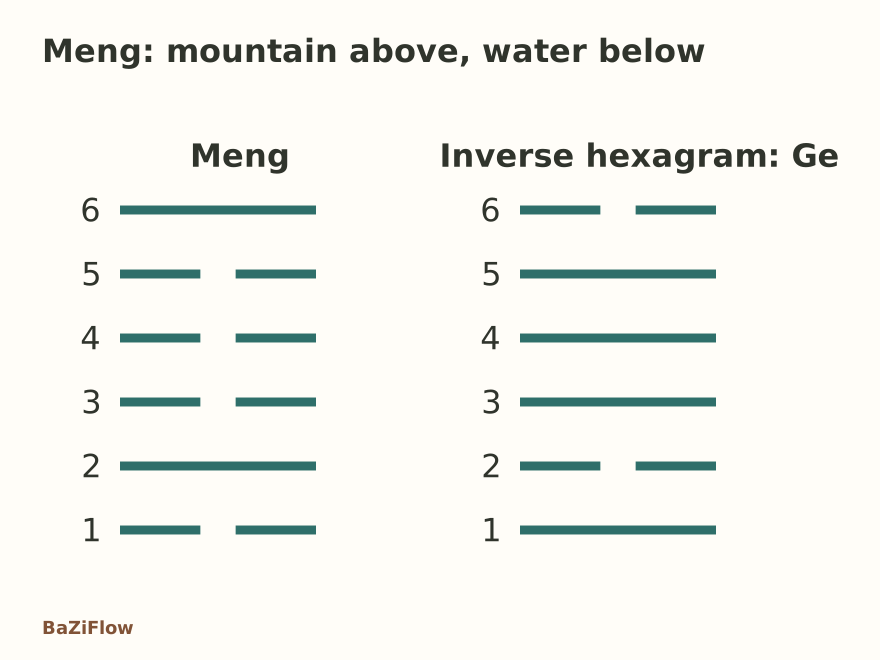 HEX-004 / Shared methods
Meng: from "it is not I who seek the young" to opening, embracing and striking
Meng is the fourth of the 64 hexagrams, water below and mountain above. The judgment sets a rule for asking, the Great Image speaks of resolute action, and five lines treat the word meng in five ways.
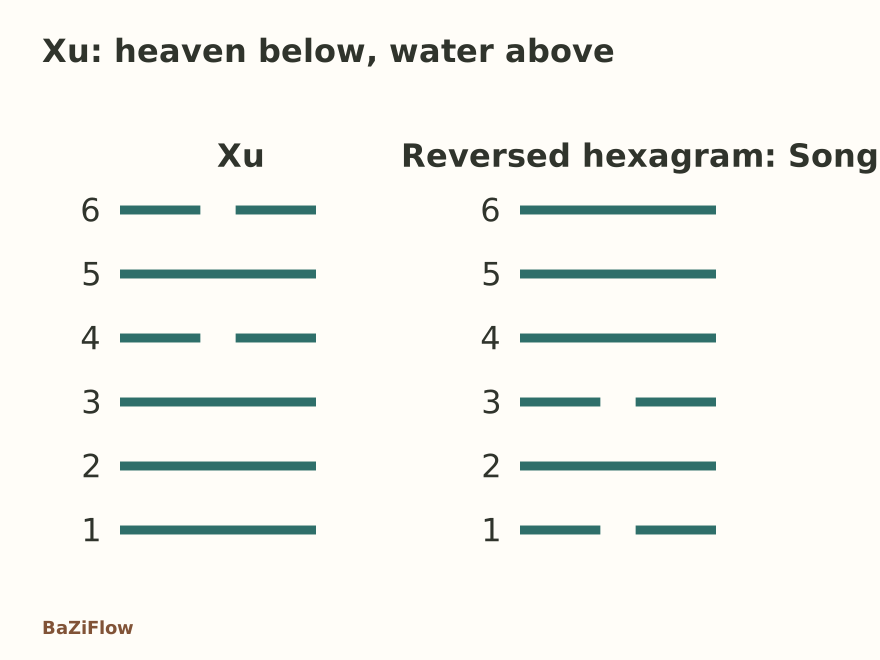 HEX-005 / Shared methods
Xu: from "waiting in the outskirts" to "entering the cave", six places of waiting
Xu is the fifth of the 64 hexagrams, heaven below and water above; its name means waiting. Read the judgment, the Great Image of eating and drinking, and six lines that name six places to wait.
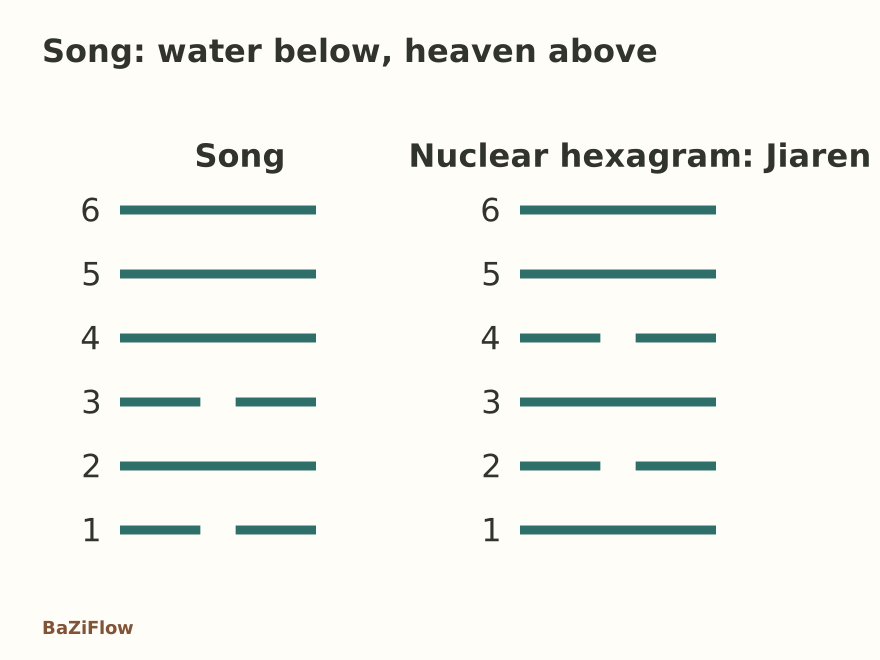 HEX-006 / Shared methods
Song: the judgment sees the end, the Great Image the start, six lines the ways it ends
Song is the sixth of the 64 hexagrams, water below and heaven above, the same trigrams as Xu in swapped places. The judgment says "ominous at the end", the Great Image "plan the start", and two lines are unable to win.
 HEX-007 / Shared methods
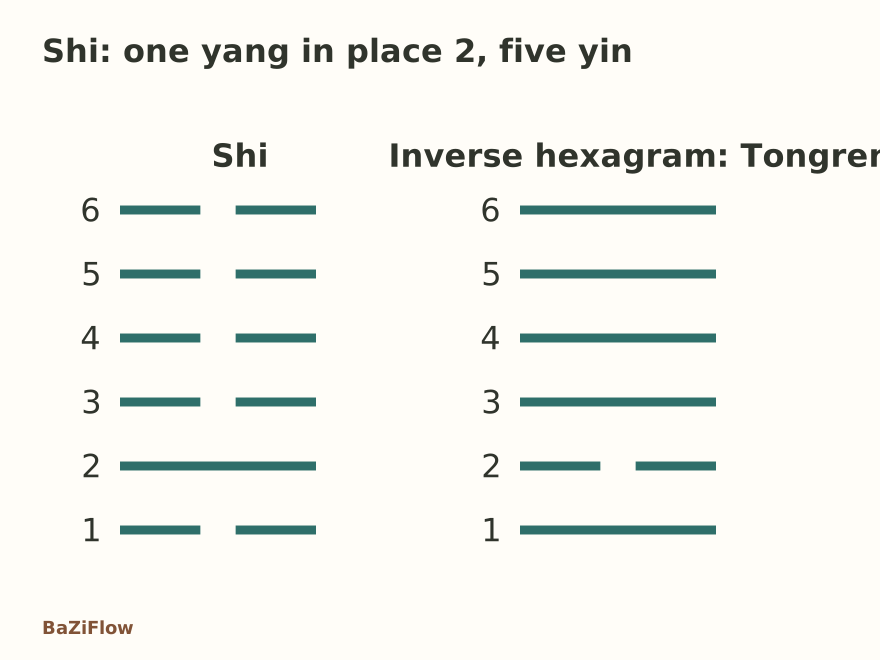
Shi: one yang line leading five yin lines, and who leads the army in each line
Shi is the seventh of the 64 hexagrams, water below and earth above, with a single yang line among five yin lines that stand for the multitude. Read the judgment, the Great Image, and six lines of army posts.
 HEX-008 / Shared methods
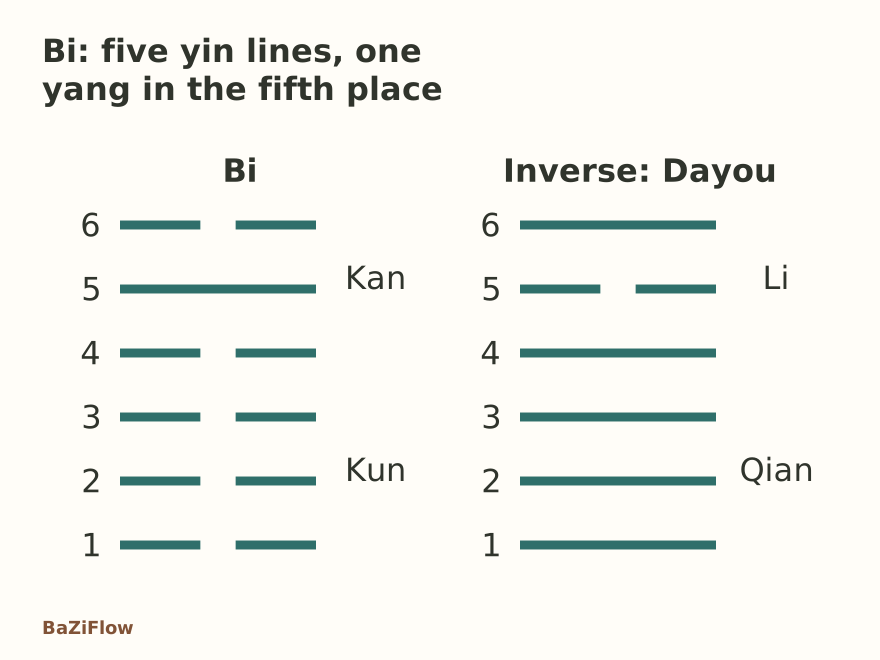
Bi (比): five yin lines, one yang, and the question of whom to join
Bi has Kun (earth) below and Kan (water) above, and only one yang line, in the fifth place. Read its text in layers: the Judgment, the Great Image "water on the earth", and six line statements about six ways of joining.
 HEX-009 / Shared methods
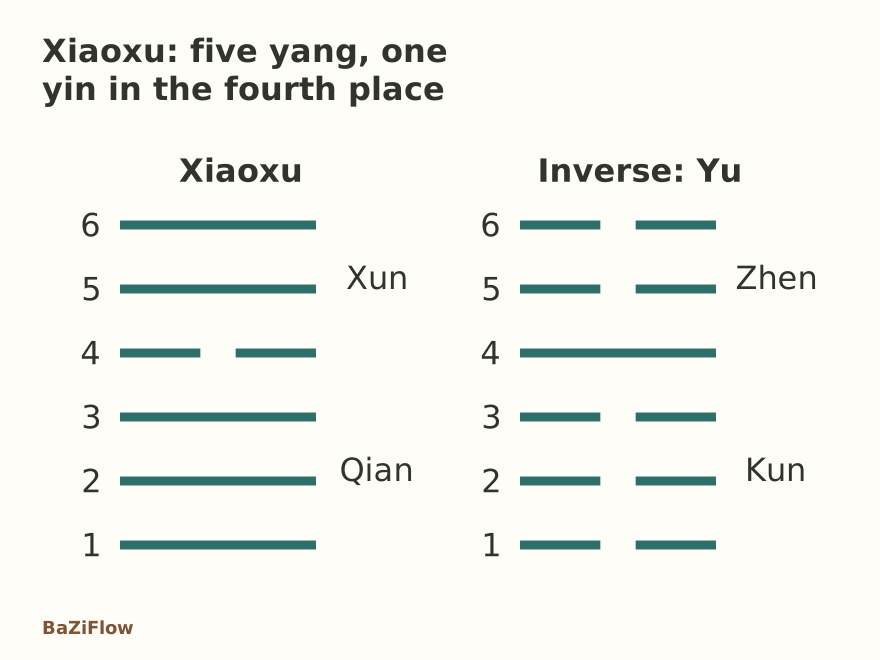
Xiaoxu (小畜): from "dense clouds, no rain" to "it has rained"
Xiaoxu has Qian (heaven) below and Xun (wind) above, with one yin line among five yang. Read the Judgment "dense clouds, no rain", the Great Image "wind over heaven", and the words return, sincerity and rain.
 HEX-010 / Shared methods
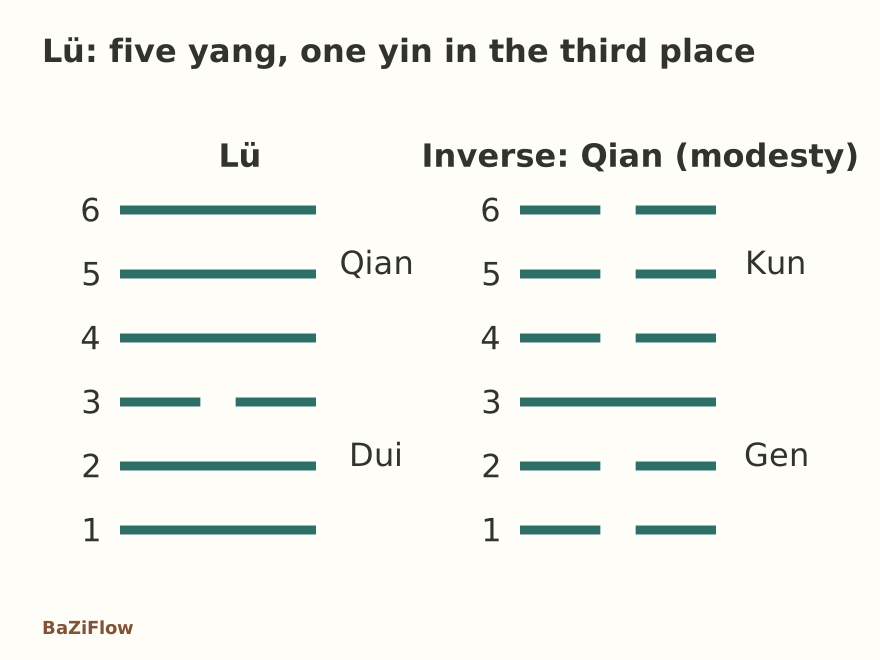
Lü (履): one tiger's tail, three different endings
Lü has Dui (marsh) below and Qian (heaven) above, with one yin line among five yang. Read the Judgment "tread on the tiger's tail", the Great Image "distinguish above and below", and the six ways of walking in its lines.
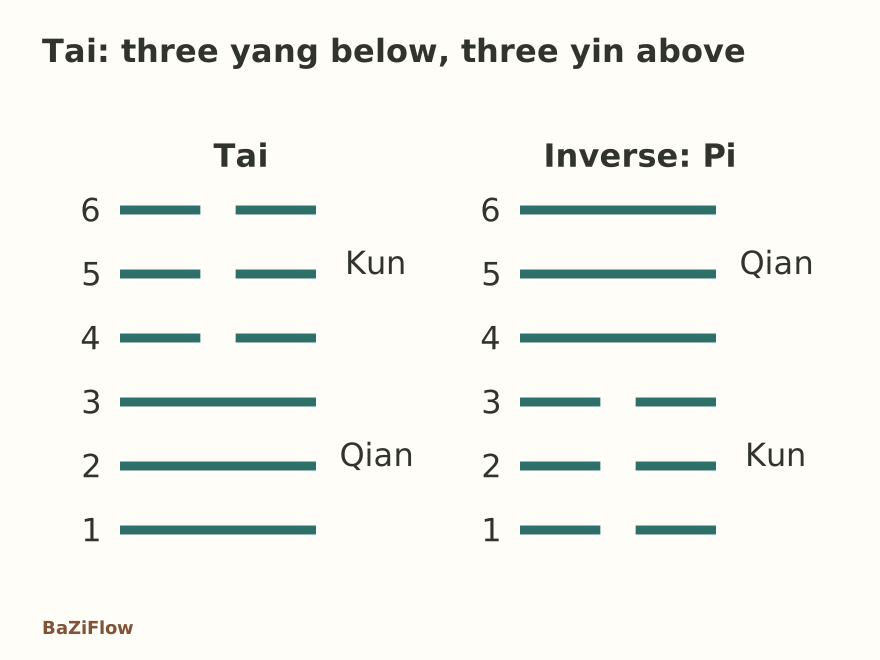 HEX-011 / Shared methods
Tai (泰): heaven below, earth above, and the words "no going without a return"
Tai has Qian (heaven) below and Kun (earth) above: three yang under three yin. Read the Judgment, its inner-outer pairs, line 3 and "no going without a return", and the falling wall of the top line.
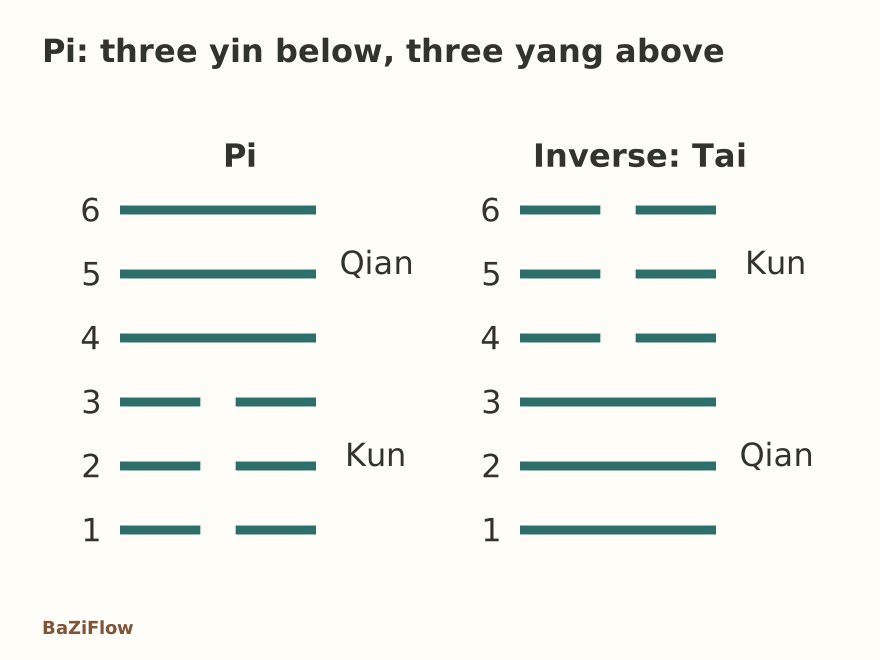 HEX-012 / Shared methods
Pi (否): from "wrapping up" to "overturning", how a blockage runs its course
Pi has Kun (earth) below and Qian (heaven) above: three yin lines under three yang. Read the Judgment, the Great Image "restrain virtue and avoid hardship", and the words wrap, rest and overturn that carry the lines.
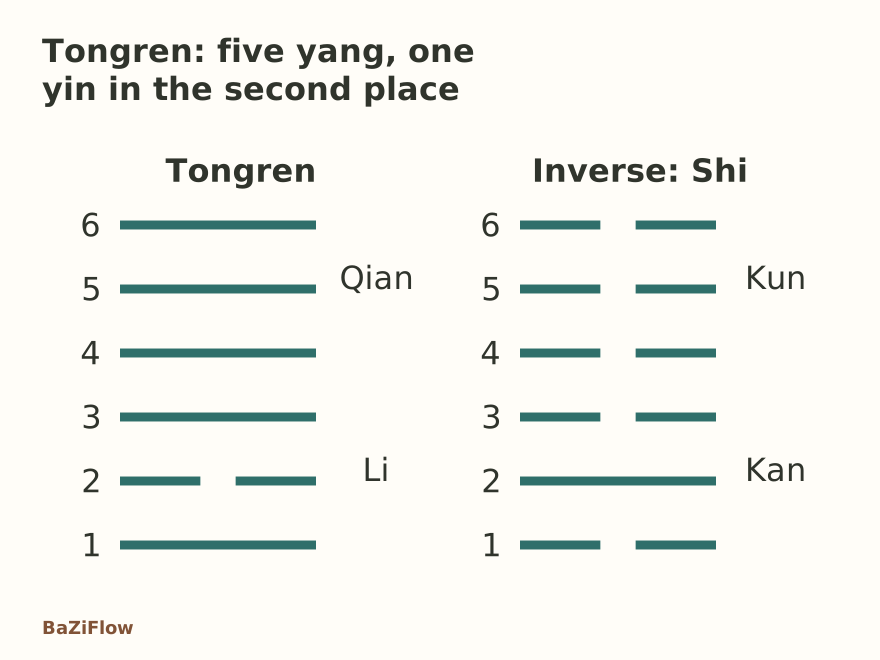 HEX-013 / Shared methods
Tongren (同人): gate, clan, wild and outskirts, how wide is the circle of the same?
Tongren has Li (fire) below and Qian (heaven) above, with one yin line in the second place. Read the Judgment "gathering in the wild", the Great Image "sort the clans", and the places named in the six lines.
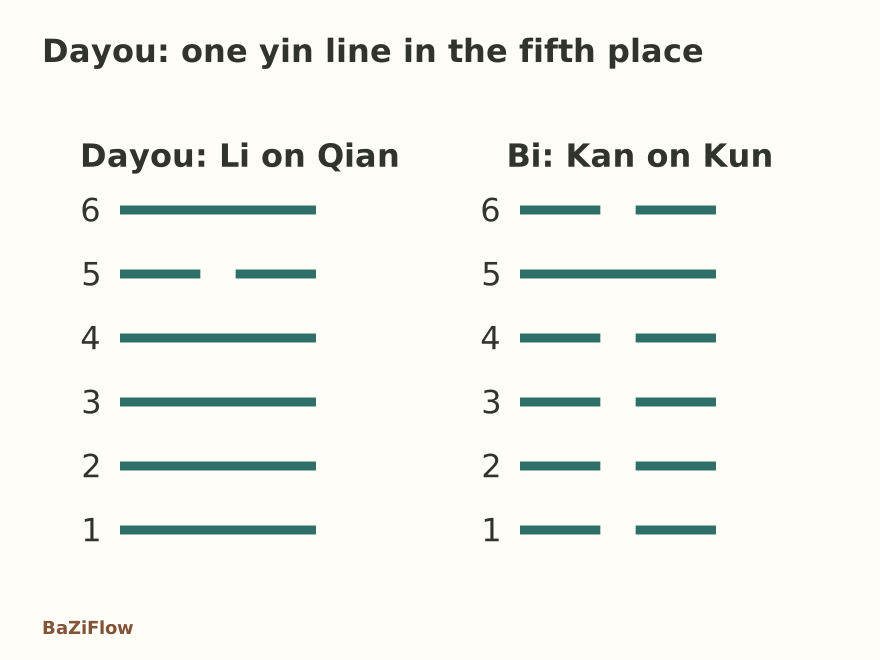 HEX-014 / Shared methods
Dayou: one yin line in the fifth place, held up by five yang lines
Dayou is the 14th hexagram: fire above heaven, with one yin line in the fifth place. The Commentary explains its name by position, not quantity; the lines run from "no contact with harm" to "blessed by heaven".
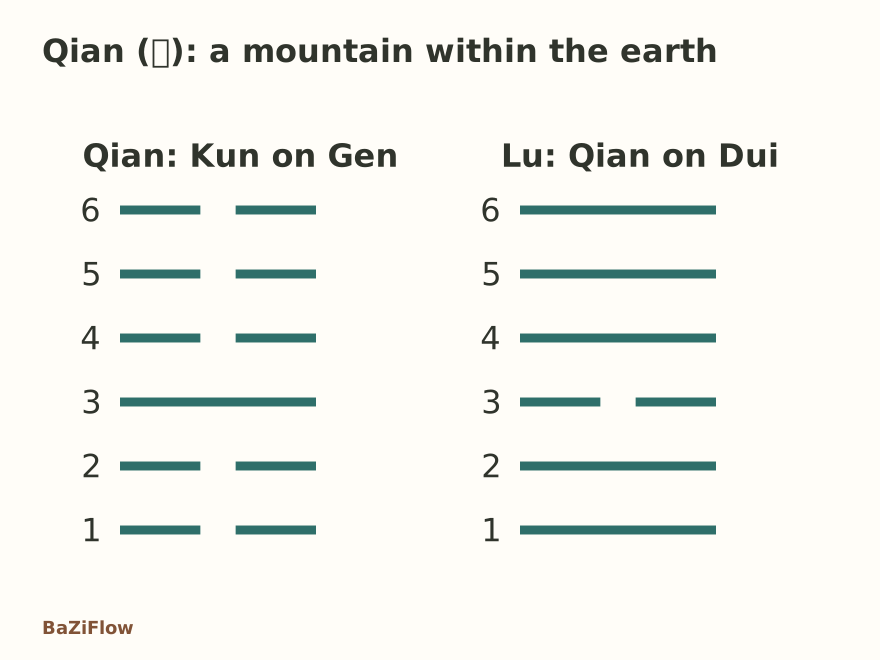 HEX-015 / Shared methods
Qian (謙): a mountain within the earth, and what the Commentary says four times
Qian (謙) is the 15th hexagram: a mountain within the earth, one yang line in the third place. The Commentary states one pattern four times, the Great Image ends on taking from many, and "ringing modesty" appears twice.
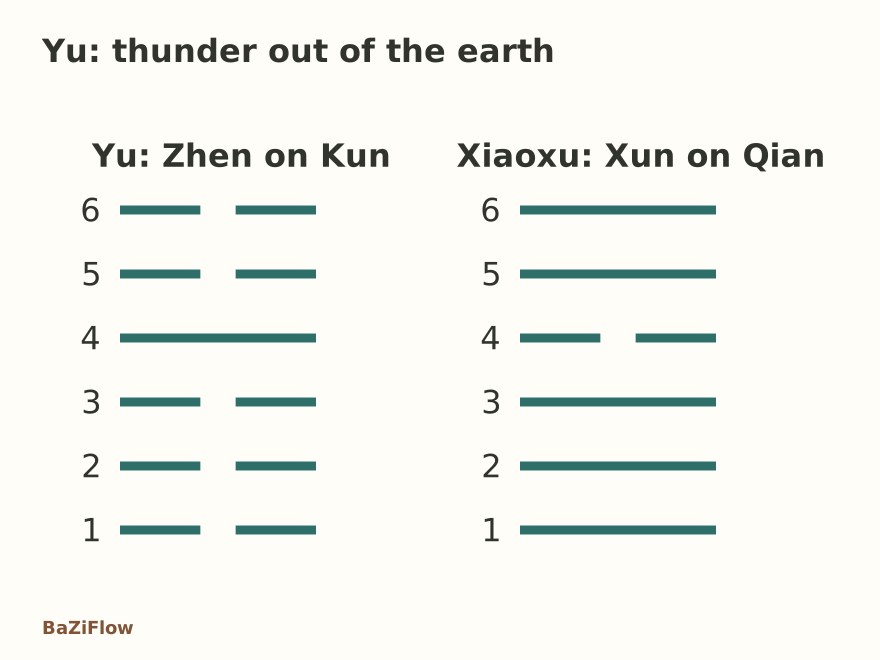 HEX-016 / Shared methods
Yu: thunder out of the earth, and "moving in accord" from hexagram to sage
Yu is the 16th hexagram: thunder out of the earth, one yang line in the fourth place. The Commentary applies "moving in accord" at three levels, the Great Image answers with music, and Yu appears in four lines, not two.
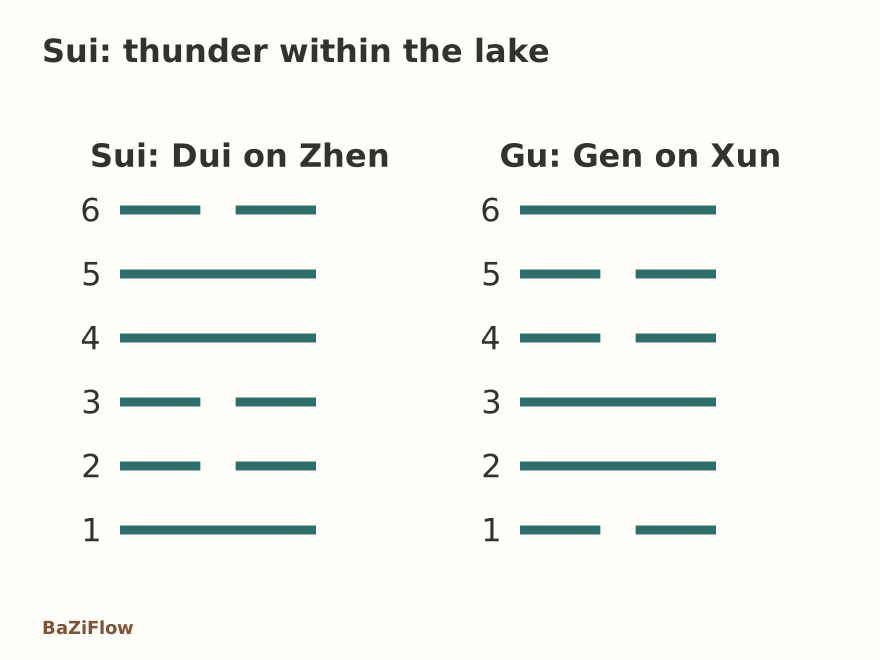 HEX-017 / Shared methods
Sui: thunder within the lake, from "tied to the youngster" to "held and bound"
Sui is the 17th hexagram: thunder below a lake, three yang lines and three yin. Lines two and three mirror each other, the verbs grow heavier up to "held and bound", and the Great Image says only: at dusk, go in to rest.
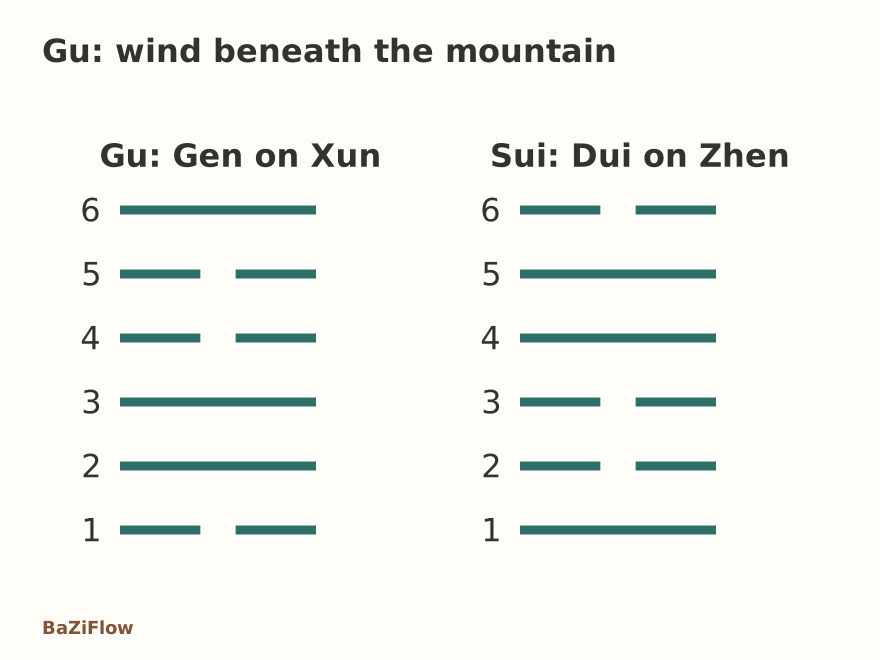 HEX-018 / Shared methods
Gu: wind beneath the mountain, and how to count "three days before and after"
Gu is the 18th hexagram, wind beneath a mountain. "Three days before and after" can be counted on the ten stems, and the six statements run from taking charge of the father's affair to not serving kings.
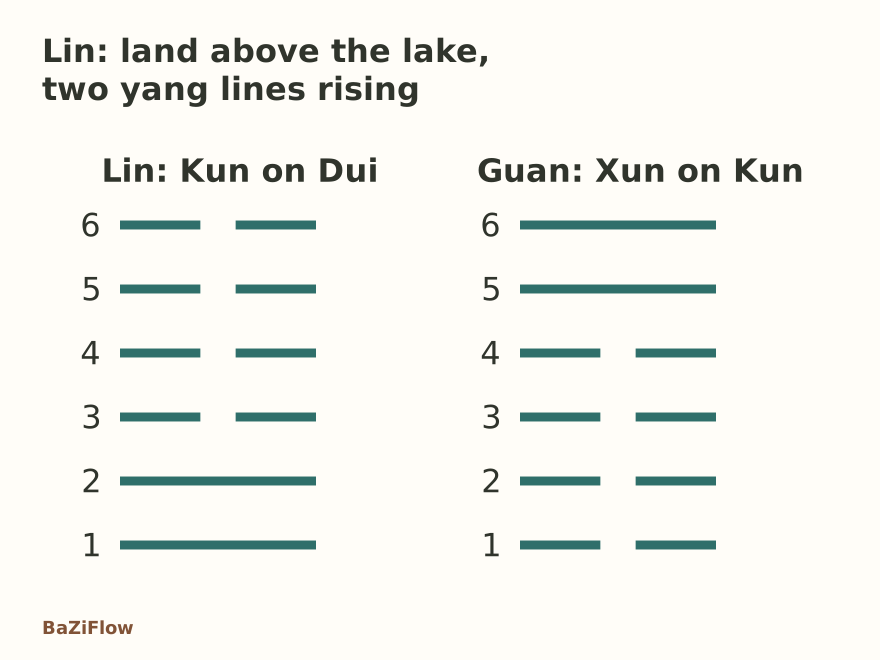 HEX-019 / Shared methods
Lin: land above the lake, six modifiers for one word and a warning about the eighth month
Lin is the 19th hexagram: land above a lake, two yang lines rising from the bottom. The Commentary says "the firm gradually advances" and mentions the eighth month; six statements keep Lin and change the word before it.
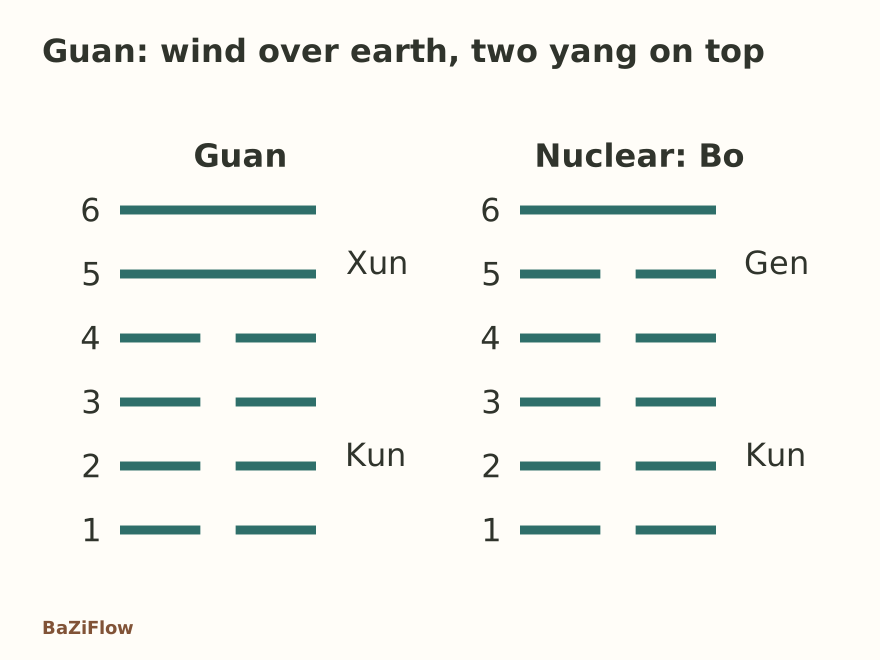 HEX-020 / Shared methods
Guan: wind over the earth, from "washed but not yet offered" to "observing my own life"
Guan is the 20th hexagram: wind over the earth, two yang lines on top of four yin. The judgment stops between the washing and the offering of a rite, and six statements change who looks at what.
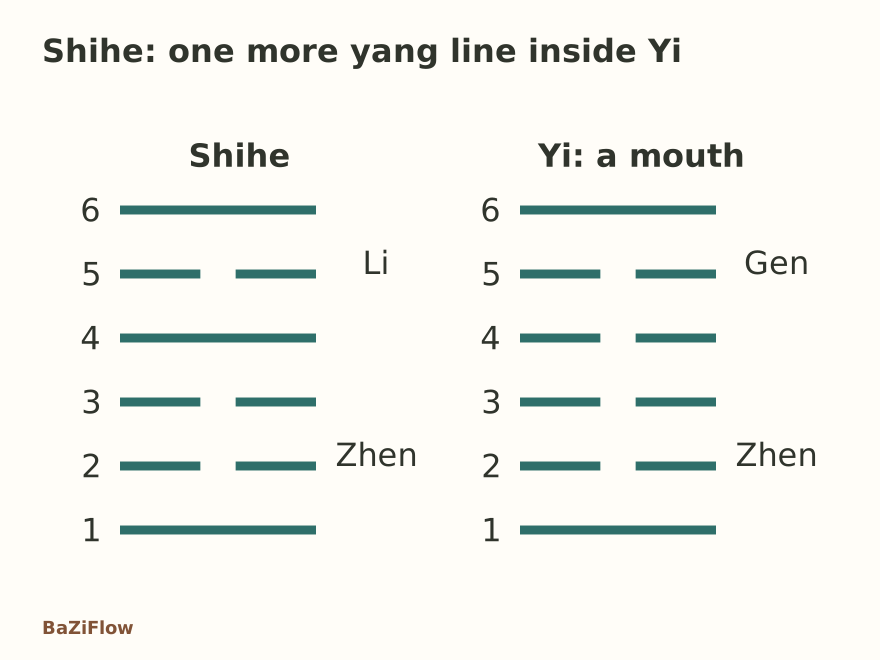 HEX-021 / Shared methods
Shihe: something in the mouth, from "shackle over the toes" to "cangue over the ears"
Shihe is the 21st hexagram: Li above Zhen, the mouth hexagram Yi with one more yang line. The judgment is four characters; in the lines the two ends wear shackles and the middle four bite skin, cured meat and dried meat.
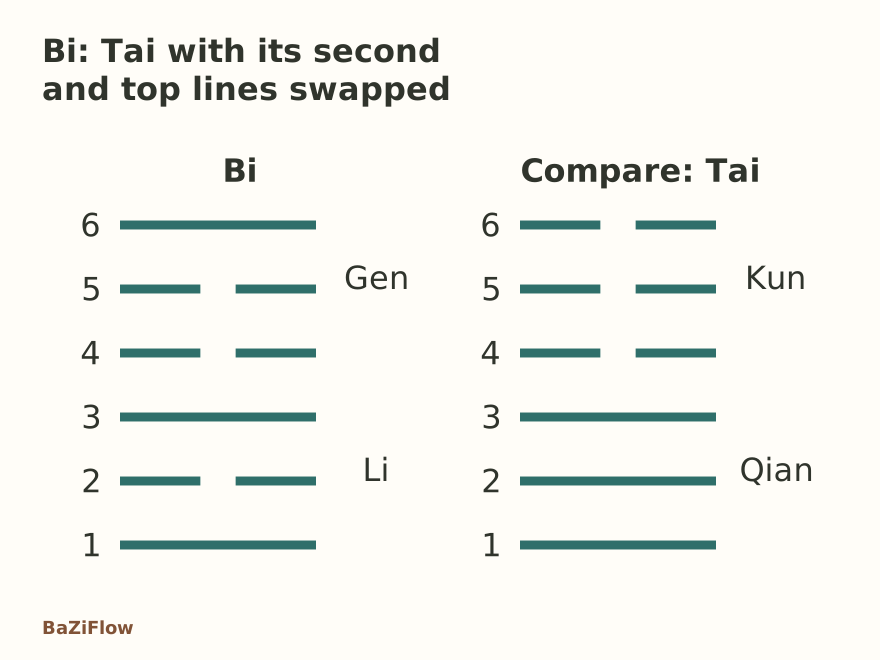 HEX-022 / Shared methods
Bi (賁): fire beneath the mountain, from "adorning the toes" to "plain white adornment"
Bi (賁) is the 22nd hexagram, Tai with two lines exchanged. The Commentary on the Judgments separates the pattern of heaven from that of humankind; the statements run from toes to plain white, the only color named.
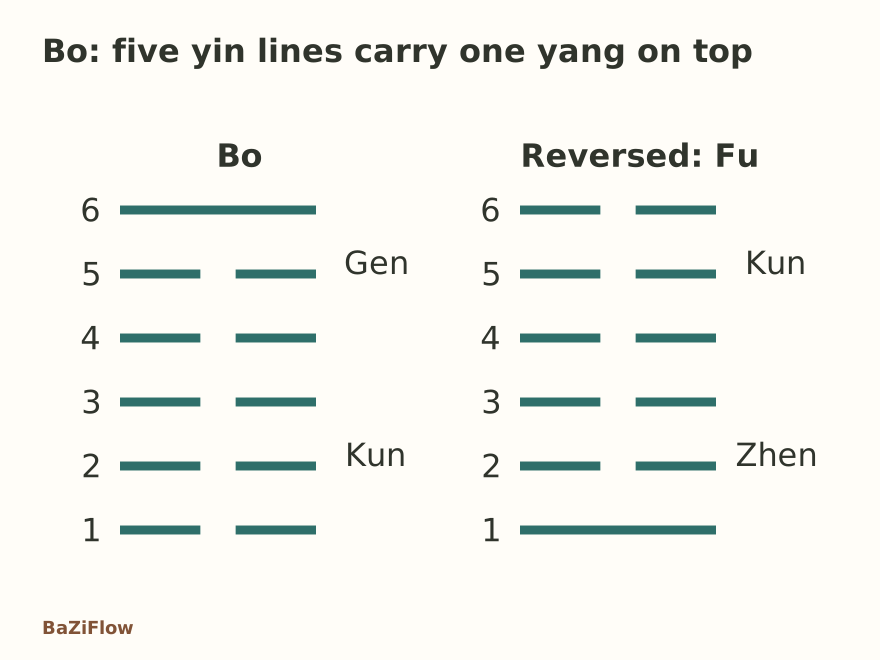 HEX-023 / Shared methods
Bo: a mountain on the earth, from "stripping the bed legs" to "a great fruit uneaten"
Bo (剝) is the 23rd hexagram: a mountain clinging to the earth, five yin lines under one yang. The bed is stripped at legs, joint and skin; line five turns to "a string of fish", and a great fruit is left uneaten.
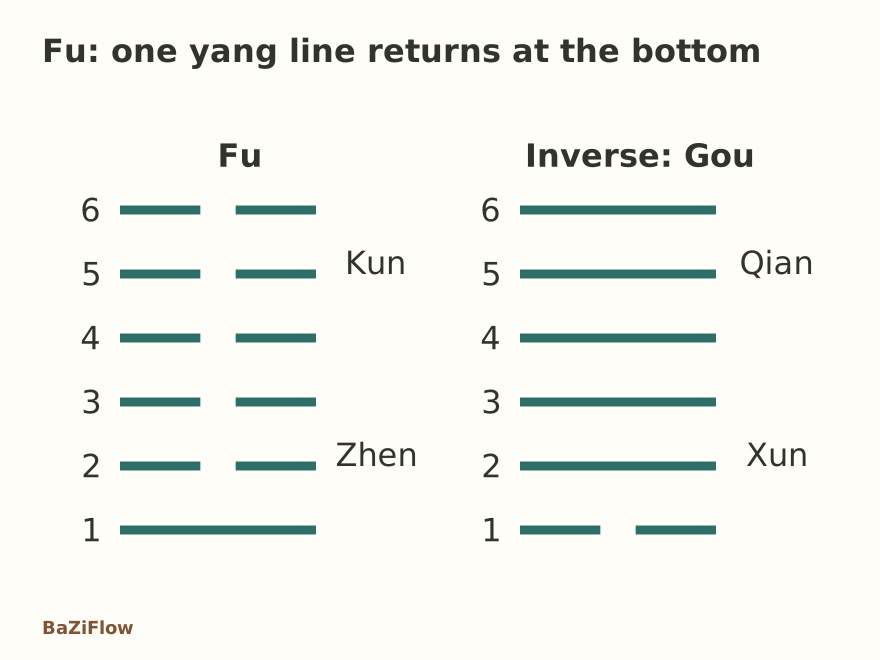 HEX-024 / Shared methods
Fu: thunder within the earth, from "a return not far" to "a lost return"
Fu (復) is the 24th hexagram: thunder within the earth, one yang line back at the bottom. Seven days, the solstice and ten years are counted, and six statements run from a near return to a lost one.
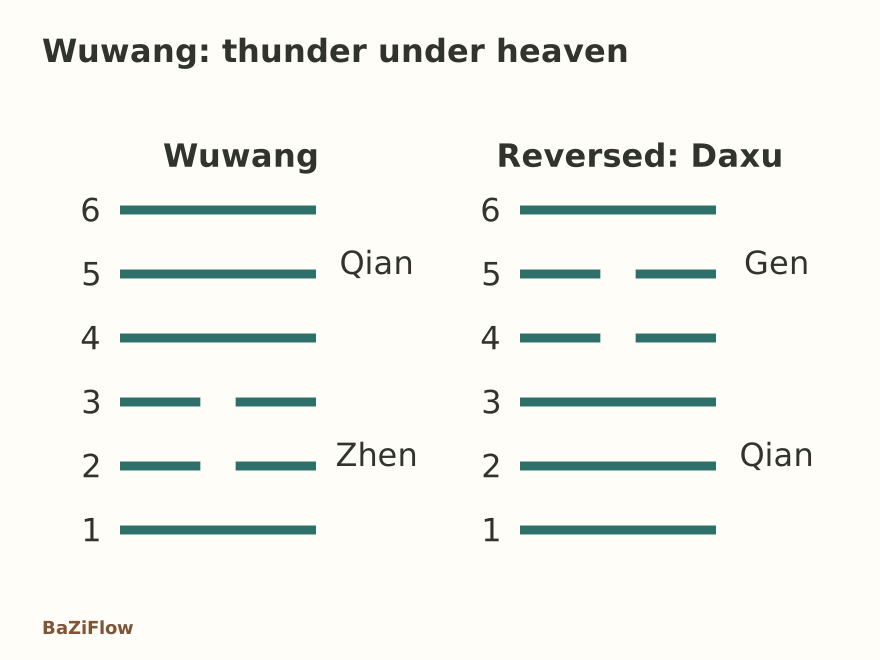 HEX-025 / Shared methods
Wuwang: thunder under heaven, from "no recklessness" to "an undeserved calamity"
Wuwang (无妄) is the 25th hexagram: thunder under heaven. In the statements "wuwang" is followed by going, calamity and illness, the Small Images add medicine and action, and the Commentary ends on questions.
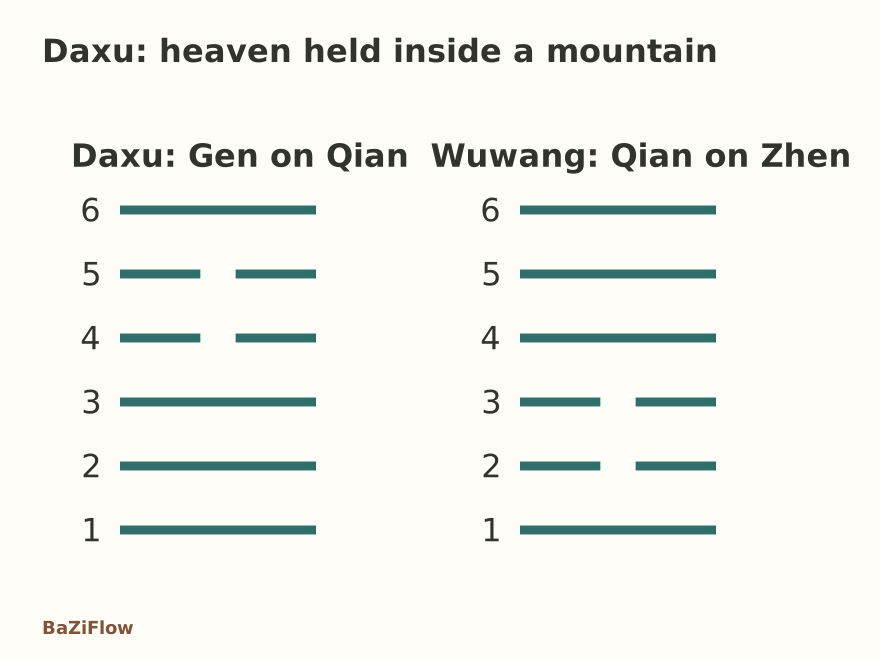 HEX-026 / Shared methods
Daxu: heaven inside a mountain, and the two meanings of one word, xu
Daxu is the 26th hexagram: Qian below, Gen above, heaven inside a mountain. The word xu means holding back in the Commentary on the Judgments and storing up in the Image; six statements run from stopping to an open road.
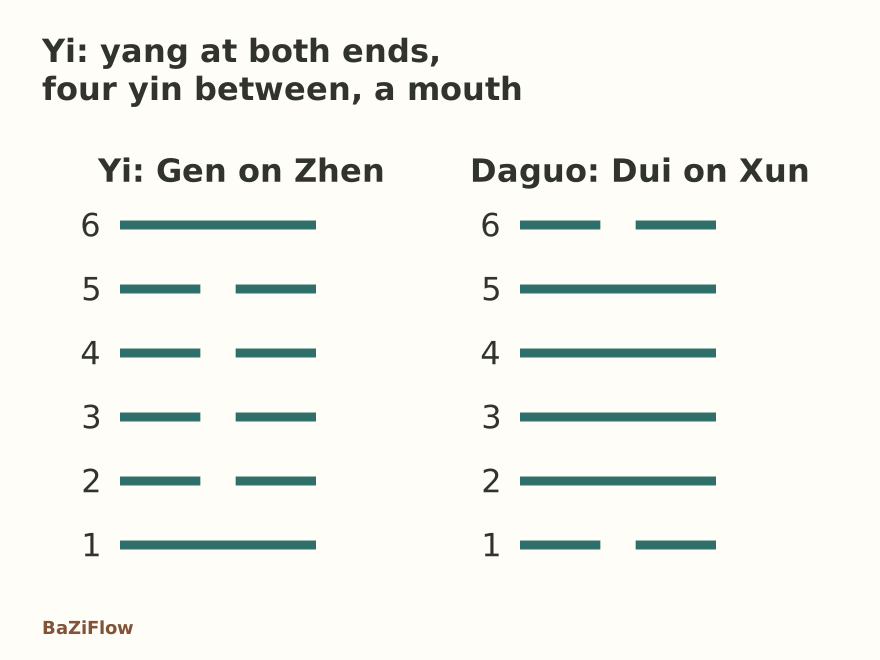 HEX-027 / Shared methods
Yi (頤): a hexagram shaped like a mouth, and the "upside-down" and "against" nourishing
Yi is the 27th hexagram, Gen above Zhen, yang only at bottom and top, a shape often read as a mouth. Judgment, Image and six statements ask who nourishes whom, from "look at the jaws" to "from him comes nourishment".
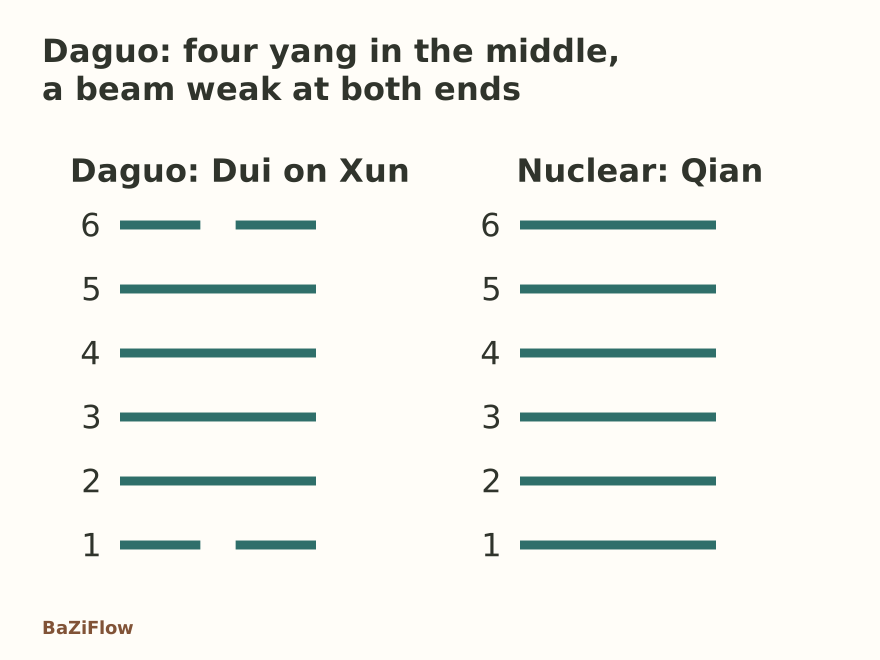 HEX-028 / Shared methods
Daguo: the sagging and the arching ridgepole, two withered poplars, a ford over the head
Daguo is the 28th hexagram: four yang lines between two yin, like a beam heavy in the center and thin at the tips. The judgment says the ridgepole sags; the statements run poplar to poplar and end in water over the head.
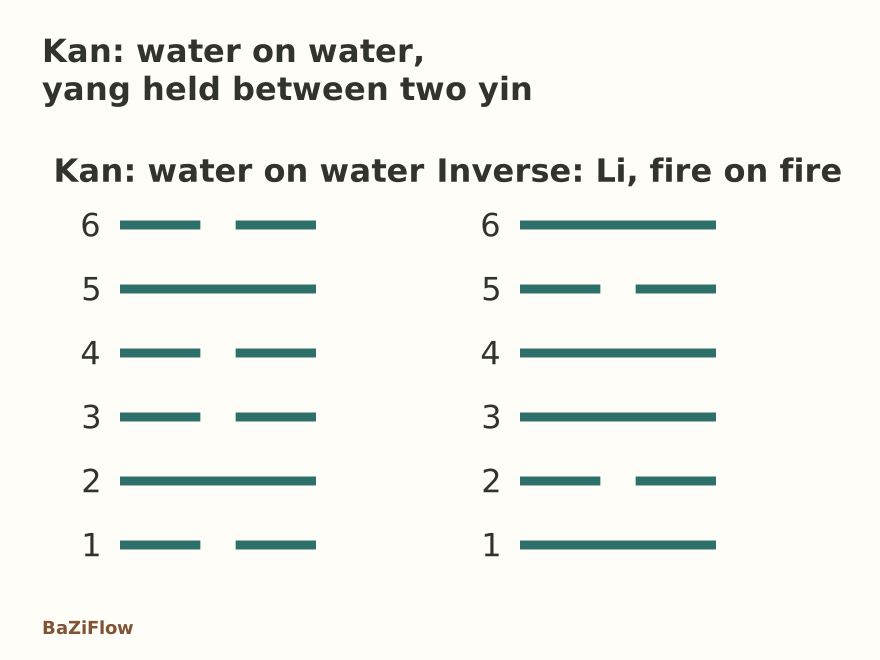 HEX-029 / Shared methods
Kan: repeated pits, "only the heart passes through", and "ill" only at the two ends
Kan is the 29th hexagram: water on water, each trigram yin, yang, yin. The judgment says "have sincerity; only the heart passes through". The Image runs from wave on wave to teaching, and "ill" shows only at the ends.
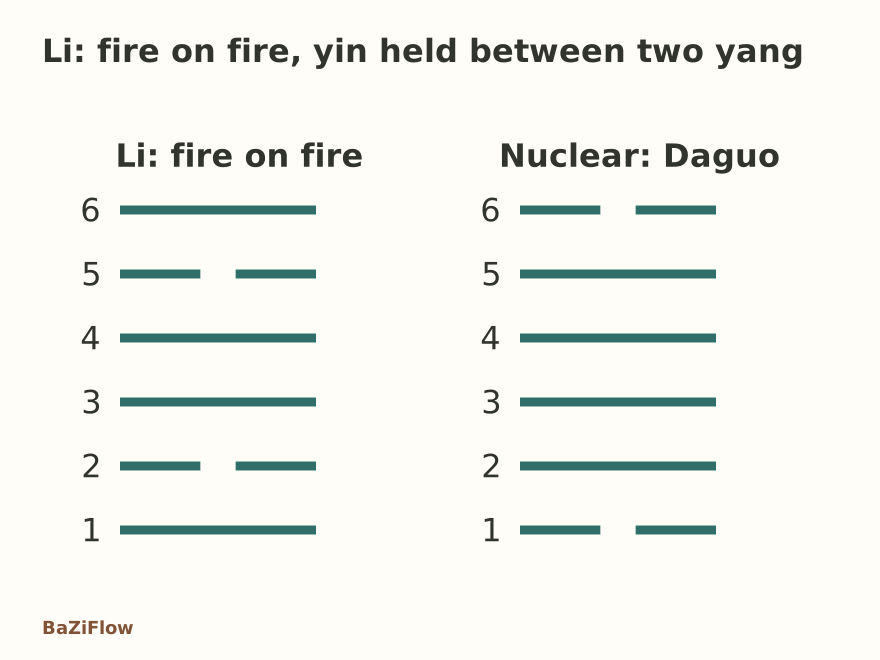 HEX-030 / Shared methods
Li: to cling, from tangled steps to the slanting sun, and a run of "likes"
Li is the 30th hexagram: fire on fire. The Commentary on the Judgments explains the name as cling: sun and moon cling to heaven, grain and trees to earth. Line 4 gives four clauses ending in "like" and no verdict.
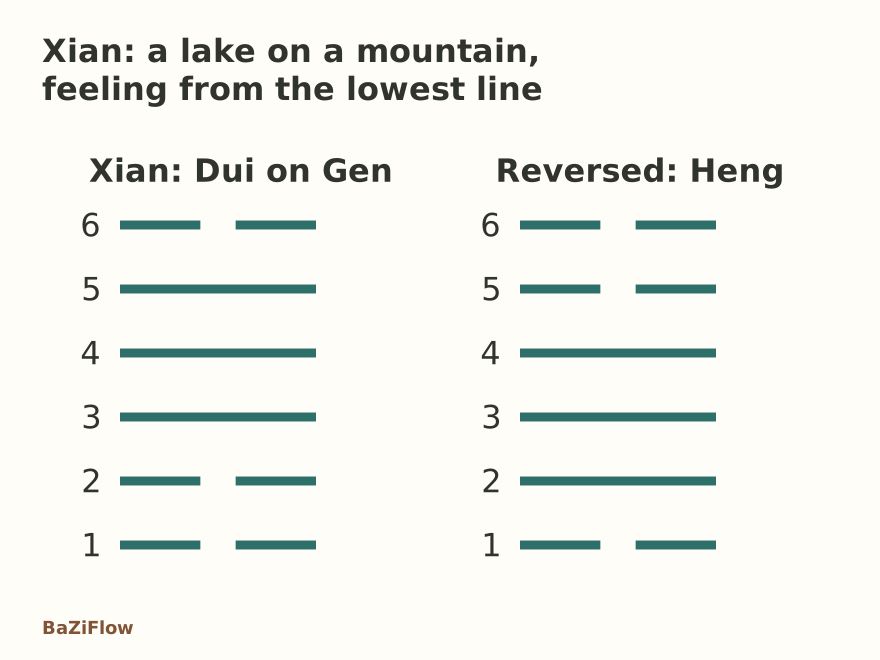 HEX-031 / Shared methods
Xian: a lake on a mountain, and feeling that climbs from the big toe to the tongue
Xian opens the lower part of the Zhouyi: Gen below, Dui above, a lake on a mountain. The Commentary says Xian means to feel; the statements list body parts upward, pause at line 4 for a thought, and end on the tongue.
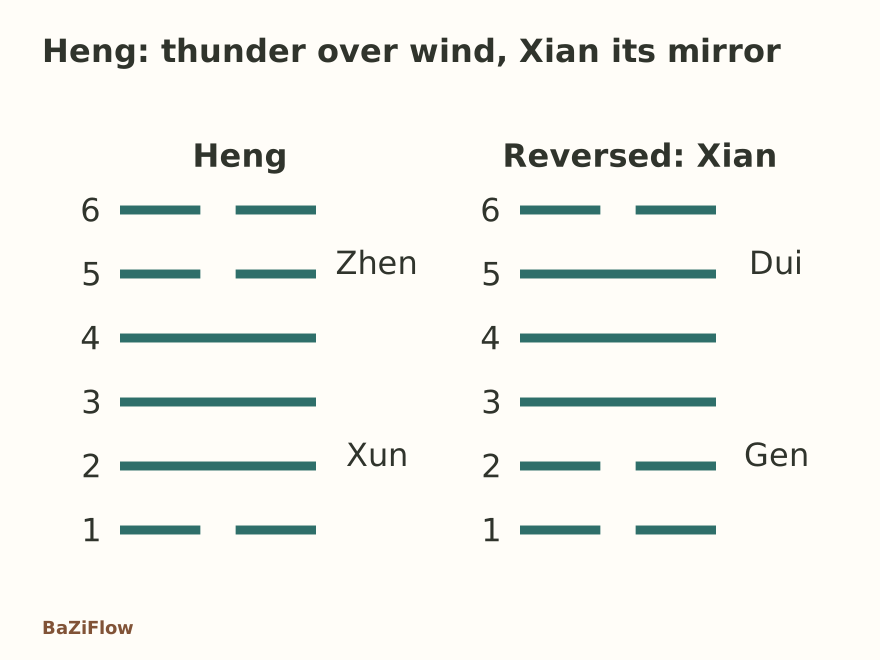 HEX-032 / Shared methods
Heng: thunder and wind, and why lasting is not standing still
Heng is the 32nd hexagram: Zhen (thunder) above Xun (wind). Read how its Commentary ties lasting to change, how the Great Image fixes a direction rather than a posture, and how its six lines show lasting going wrong.
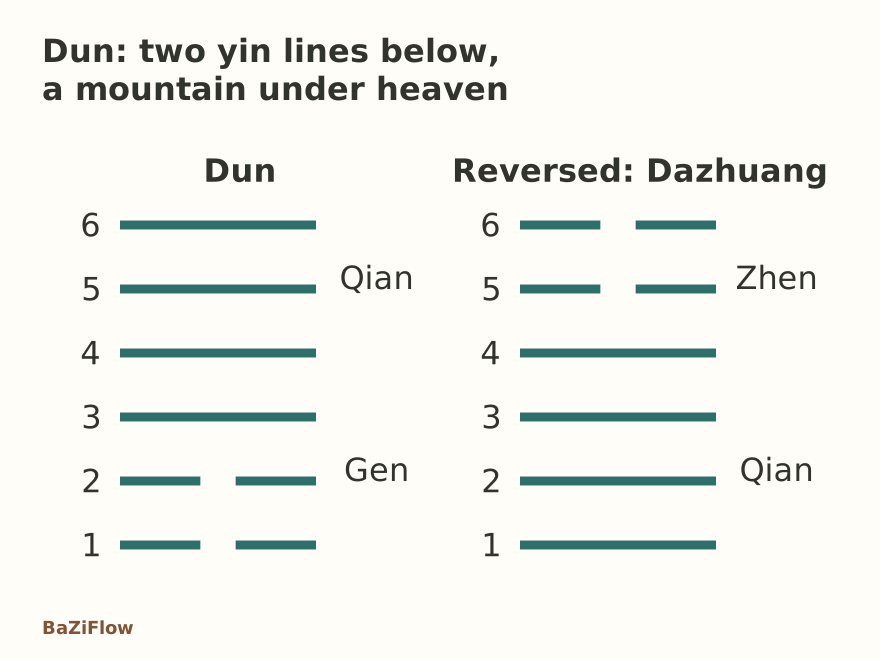 HEX-033 / Shared methods
Dun: a mountain under heaven, from the tail of the retreat to the ample one
Dun is the 33rd hexagram: Qian (heaven) above Gen (mountain), two yin lines growing from the bottom. Read “moving with the time”, the Great Image on distance, and the changing wording of “retreat” in its six lines.
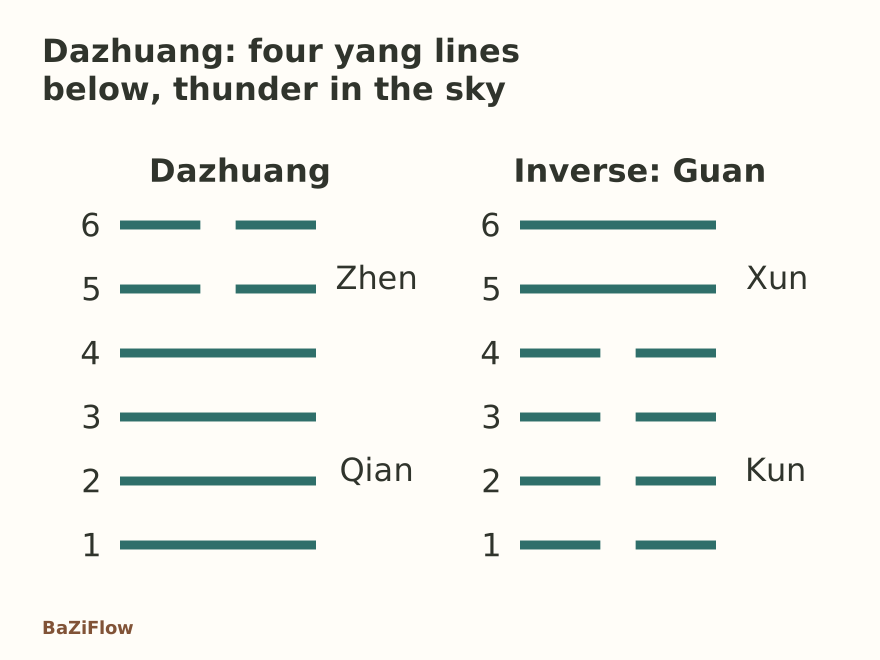 HEX-034 / Shared methods
Dazhuang: thunder in the sky, and where strength is meant to stop
Dazhuang is the 34th hexagram: Zhen (thunder) above Qian (heaven), four yang lines rising from the bottom. See how the judgment keeps one phrase, how the Commentary adds “upright”, and how a ram meets one hedge twice.
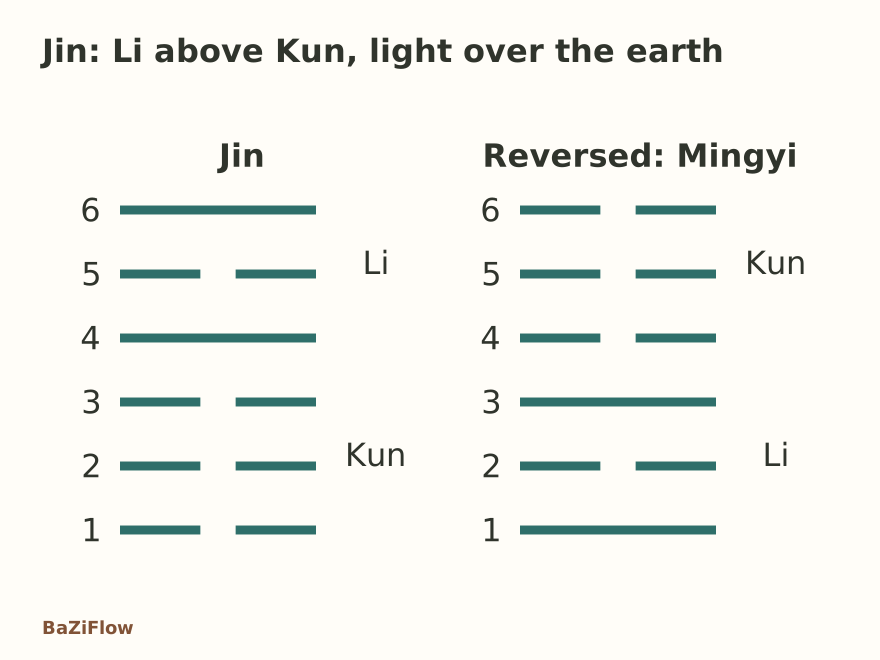 HEX-035 / Shared methods
Jin: light over the earth, from three audiences to the horns
Jin is the 35th hexagram: Li (fire, the sun) above Kun (earth), light rising over the ground. Read the judgment’s gifts and audiences, the Image’s “shine your own virtue”, and the flavors of “advancing” in its lines.
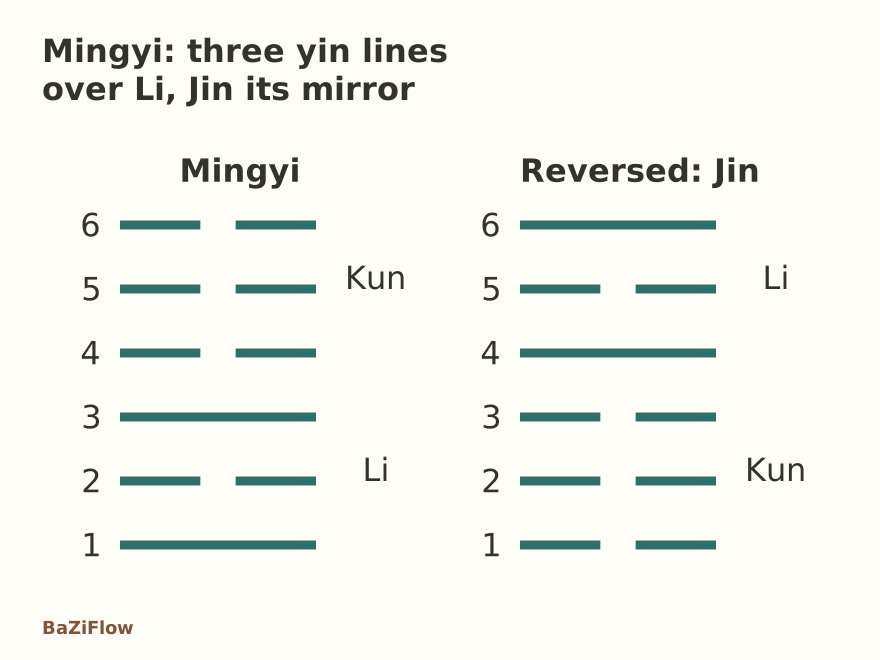 HEX-036 / Shared methods
Mingyi: light goes into the earth, from the drooping wing to the entering earth
Mingyi is the 36th hexagram: Kun (earth) above Li (fire, the sun), light going into the ground. See the two people in the Commentary, the Image’s “use dimness”, and a wound traveling from wing to heart.
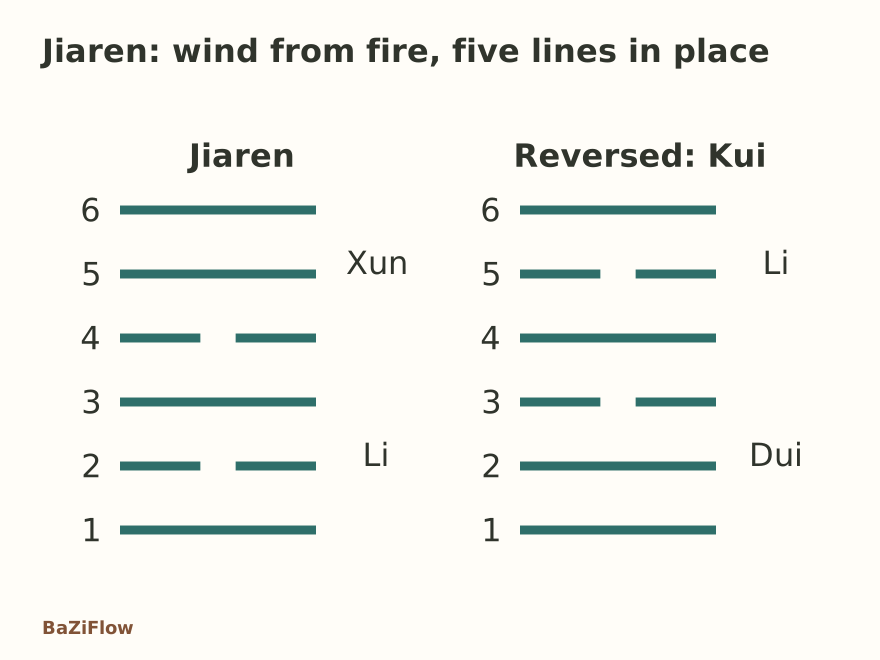 HEX-037 / Shared methods
Jiaren: wind from fire, from “set a guard” to “turning back to oneself”
Jiaren is the 37th hexagram: Xun (wind) above Li (fire). Read the Commentary on places and names, the Image’s “words with substance, conduct with constancy”, and six lines running from a guard to self-examination.
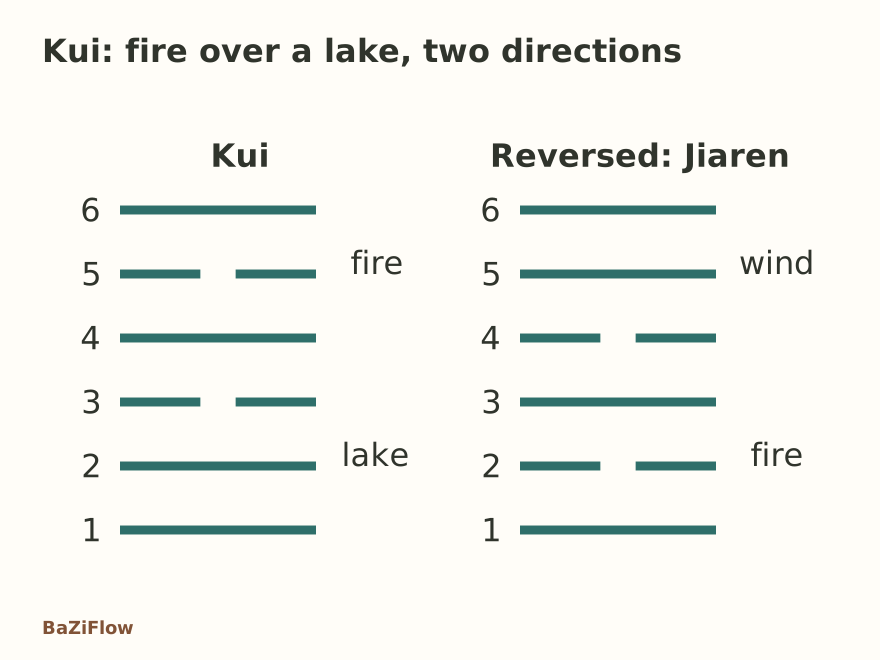 HEX-038 / Shared methods
Kui: fire over a lake, and five of its six lines are about seeing or meeting
Kui is the 38th hexagram: Li (fire) above Dui (lake), one moving up and one moving down. Read the Commentary on the Judgments, the Great Image on being alike yet different, and the verbs “see” and “meet” in its lines.
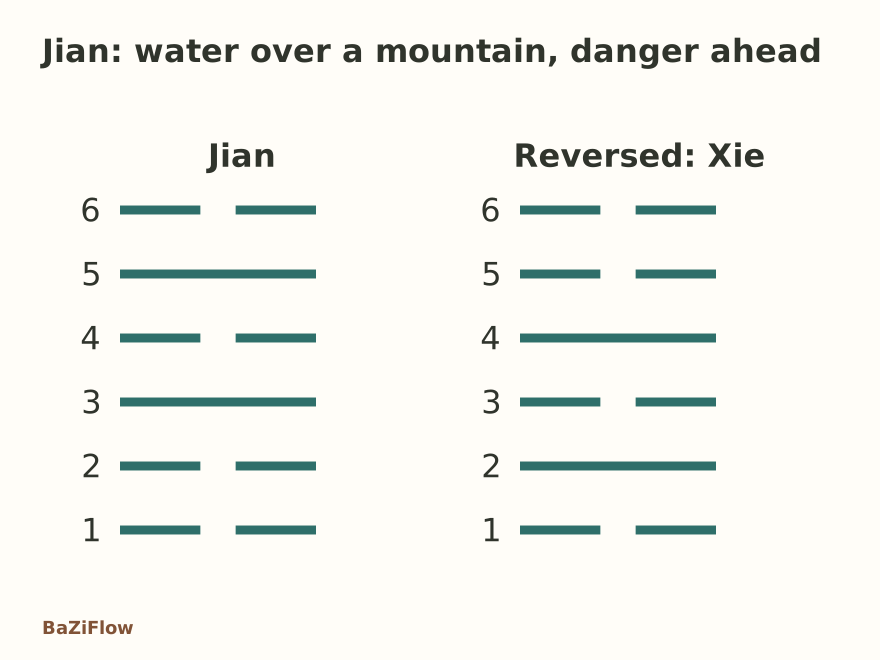 HEX-039 / Shared methods
Jian (蹇): water over a mountain, and four ways of coming after “going is blocked”
Jian (蹇) is the 39th hexagram: Kan (water) above Gen (mountain). Read “seeing danger and stopping”, the Great Image on turning back to the self, and four lines where “going” is blocked but each “coming” differs.
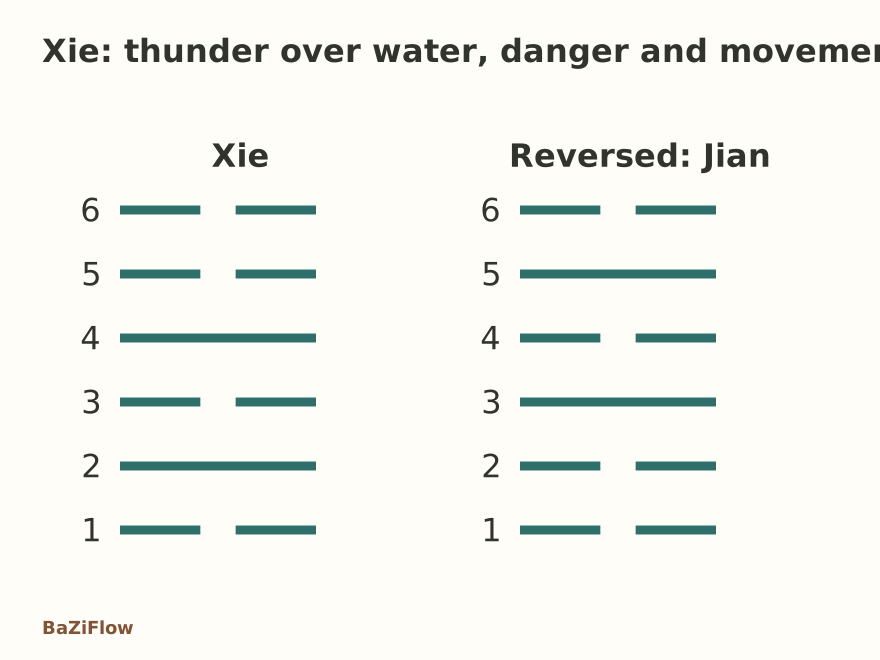 HEX-040 / Shared methods
Xie: thunder and rain arise, from “coming back is fortunate” to “the duke shoots a hawk”
Xie (解) is the 40th hexagram: Zhen (thunder) above Kan (water). Read the judgment that forks into “nowhere to go” and “somewhere to go”, the thunder and rain of the Commentary, and a hunt at both ends of the lines.
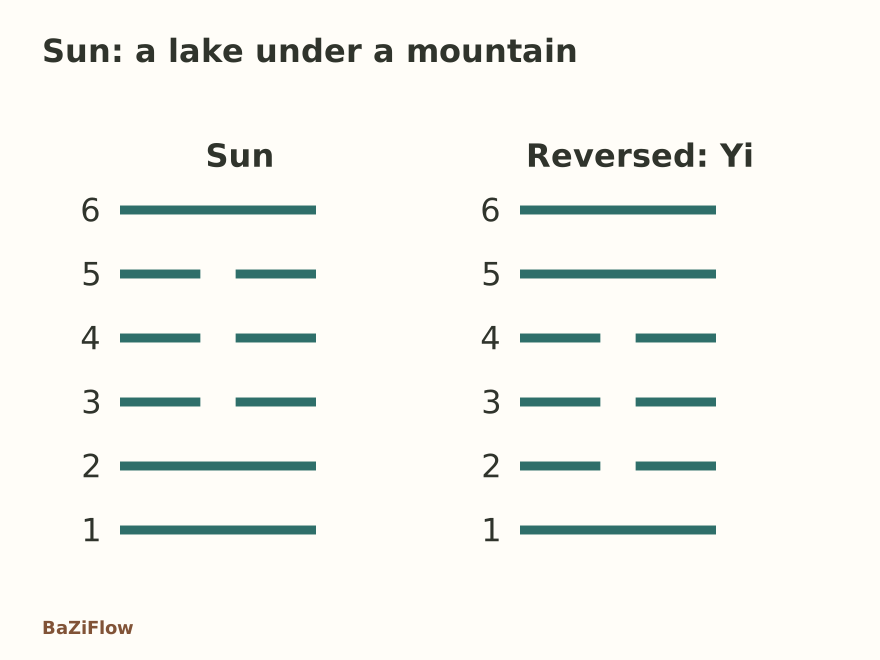 HEX-041 / Shared methods
Sun: a lake under a mountain, from “two bowls may be used” to “without reducing, he adds”
Sun (損) is the 41st hexagram: Gen (mountain) above Dui (lake). Read the judgment’s two bowls, “reduce the lower, add to the upper”, the counting in its lines, and the three lines that say “add”.
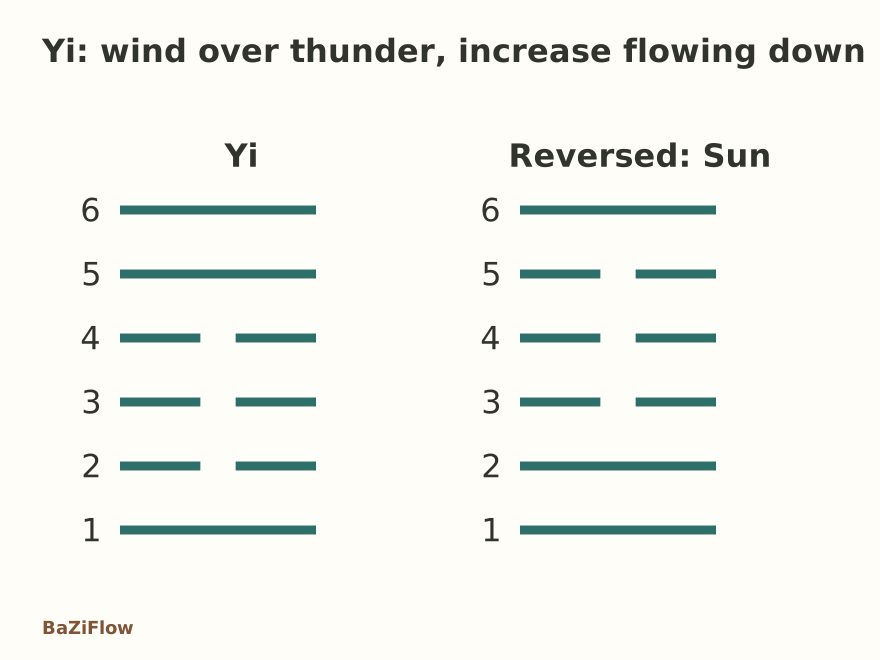 HEX-042 / Shared methods
Yi (益): wind over thunder, from “from above to below” to “no one adds; someone strikes”
Yi (益) is the 42nd hexagram: Xun (wind) above Zhen (thunder). Read “reduce the above, add to the below”, the Great Image on moving toward good and mending faults, and a Small Image that says “from outside” twice.
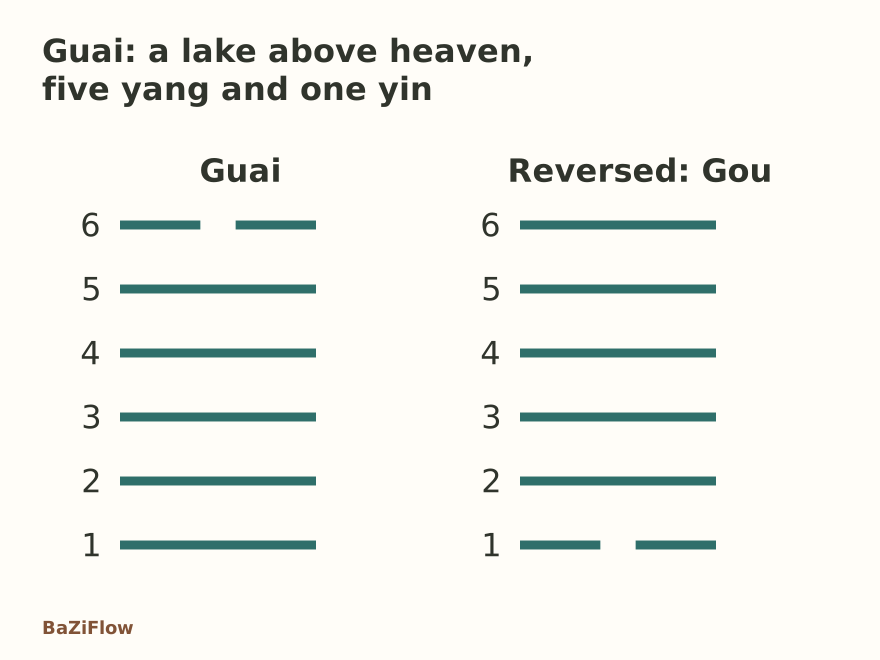 HEX-043 / Shared methods
Guai: a lake above heaven, from “proclaim in the court” to “no call”
Guai (夬) is the 43rd hexagram: Dui (lake) above Qian (heaven), five yang lines and one yin. Read the spoken acts of the judgment, “deciding yet harmonious”, and the toes, cheekbone and “call” of the lines.
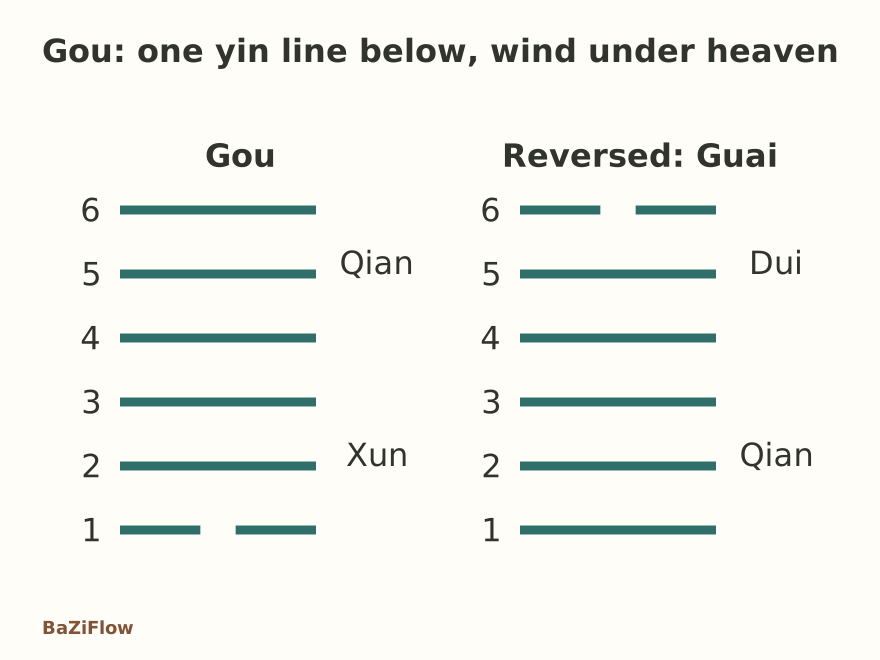 HEX-044 / Shared methods
Gou: one yin line meets five yang, from “tied” and “wrapped” to “horns”
Gou is the 44th hexagram: Qian (heaven) above Xun (wind), with one yin line at the foot. Read the judgment “the woman is strong”, the narrow and wide readings of “meeting”, and its verbs of holding.
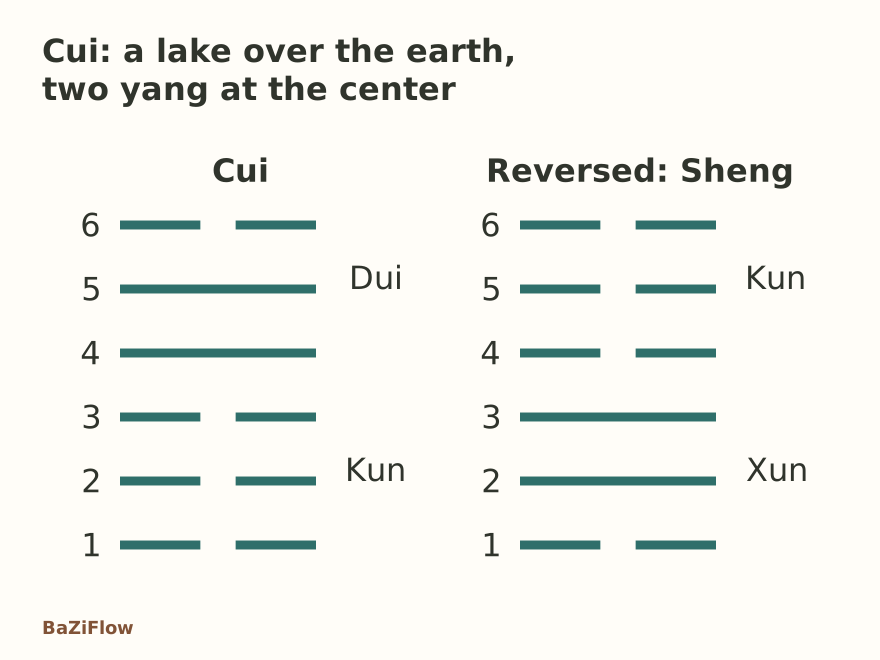 HEX-045 / Shared methods
Cui: a lake above the earth, from confusion to guarding against the unforeseen
Cui is the 45th hexagram: Dui (lake) above Kun (earth), two yang lines in the middle. Read “look at what they gather around”, the Great Image on guarding, and the moods and reservations of its six lines.
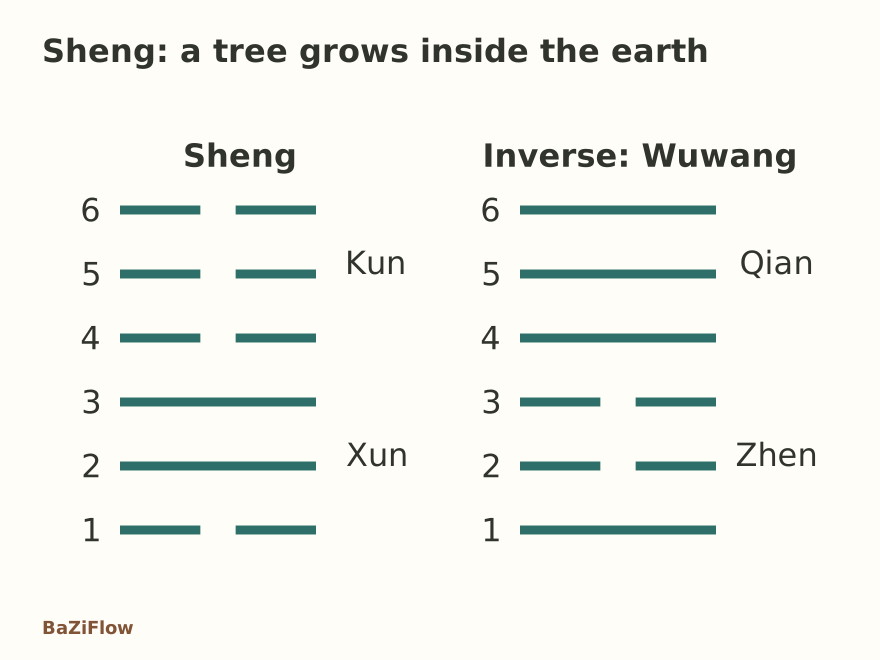 HEX-046 / Shared methods
Sheng: a tree grows in the earth, rising and offering by turns to “rising in darkness”
Sheng is the 46th hexagram: Kun (earth) above Xun (wind, wood). Read the Commentary’s soft words, the Image’s “pile up the small”, and six lines where rising and offering take turns up to “rising in darkness”.
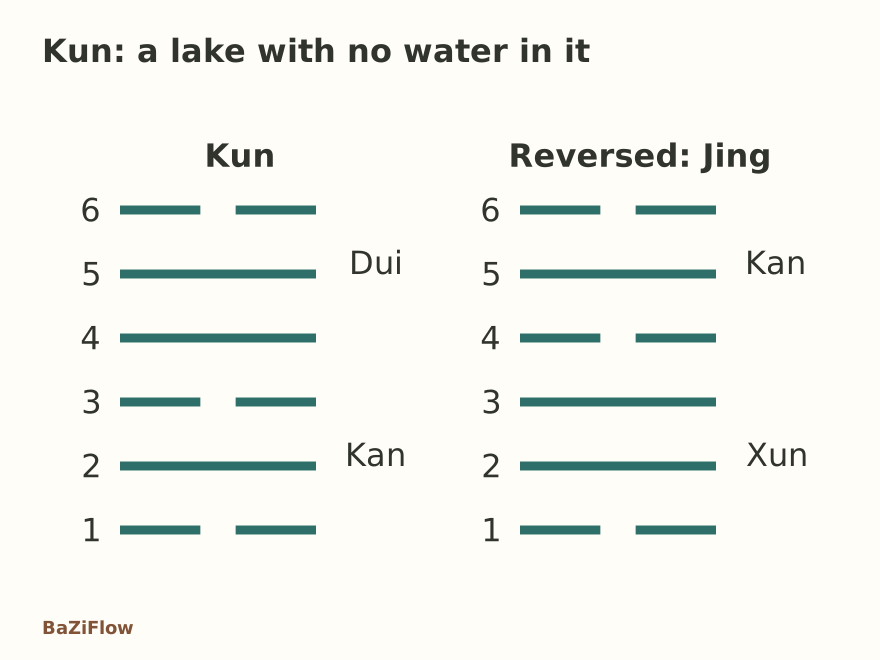 HEX-047 / Shared methods
Kun (困): a lake with no water, from “stuck on a stump” to “stuck in vines”
Kun (困) is the 47th hexagram: Dui (lake) above Kan (water), the water sunk below. Read the Commentary’s “the firm is covered” and “words are not believed”, the Image’s “stake one’s life”, and what each line is stuck on.
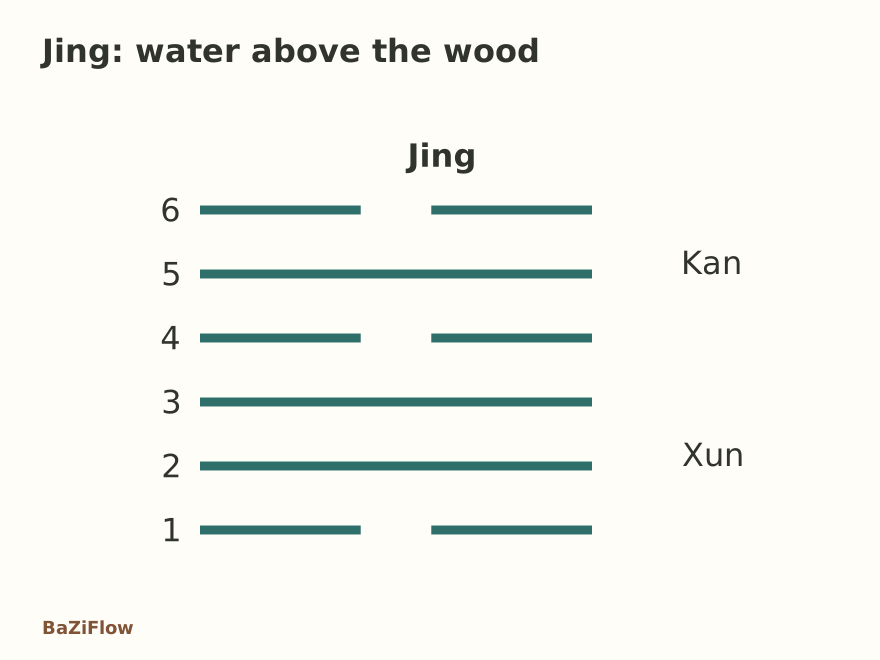 HEX-048 / Shared methods
Jing: water above the wood, from “mud in the well” to “do not cover the well”
Jing is the 48th hexagram: Kan (water) above Xun (wood). Read “change the town, not the well”, “nourishes and is never exhausted”, and six lines from mud to lined wall, cold spring and an uncovered mouth.
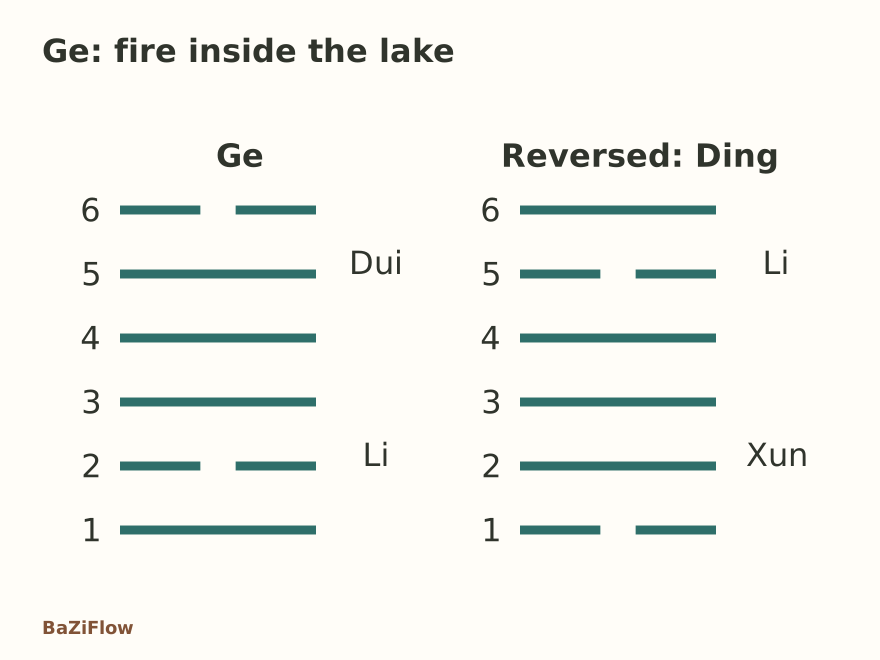 HEX-049 / Shared methods
Ge: fire inside the lake, from “the hide of a yellow ox” to the tiger’s change
Ge is the 49th hexagram: Dui (lake) above Li (fire). Read the name explained by two daughters whose wills differ, “the day has come, then trust”, the Image’s calendar, and change from ox hide to tiger stripes.
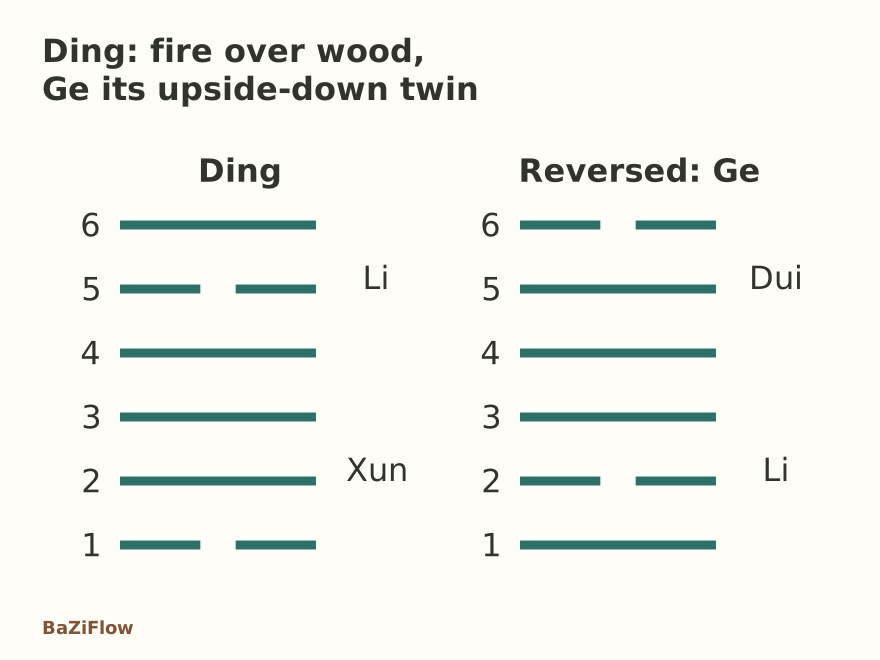 HEX-050 / Shared methods
Ding: fire over wood, read from the upturned feet to the jade carrying bar
Ding is the 50th hexagram: Li (fire) above Xun (wood). Read the Commentary on cooking and nourishing, the Great Image on setting one’s place right, and six lines that run from a cauldron’s feet to its carrying bar.
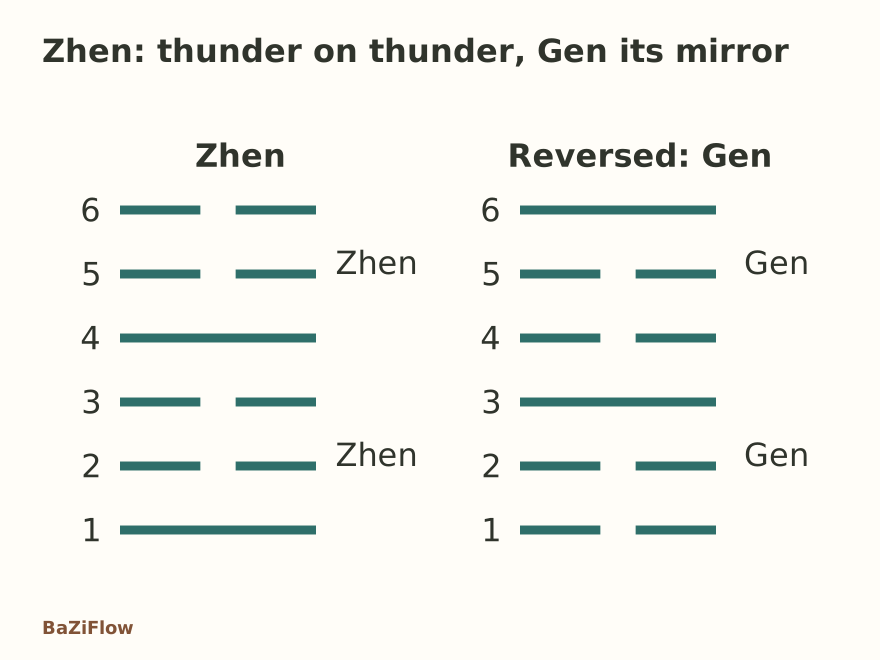 HEX-051 / Shared methods
Zhen: how near the thunder falls, and what stays in the hand
Zhen is the 51st hexagram, thunder doubled. Read the judgment’s dread followed by laughter, the Commentary’s “startles the far, frightens the near”, and six lines that set the thunder at different distances.
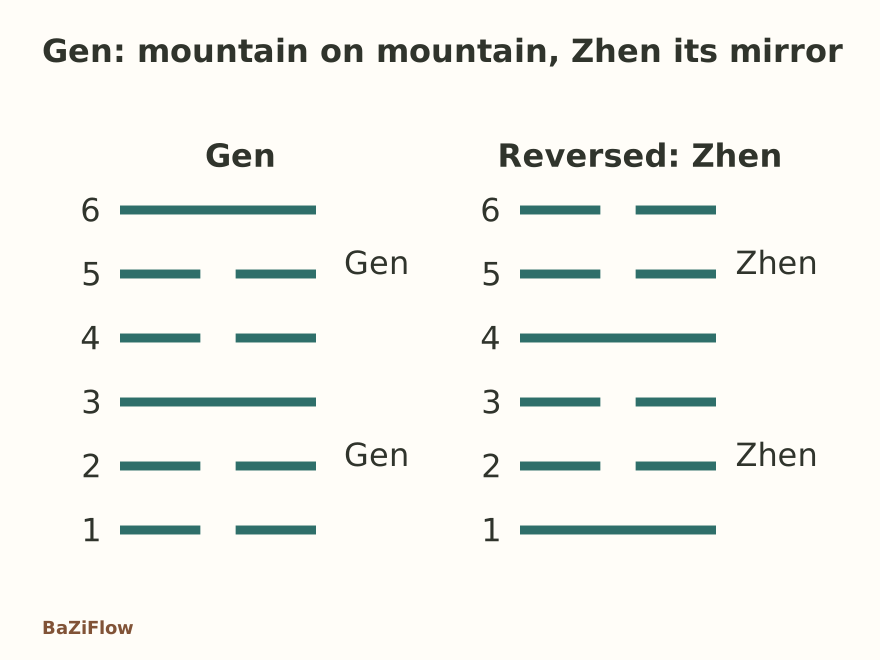 HEX-052 / Shared methods
Gen: where in the body the stopping happens, from the toes to the jaw
Gen is the 52nd hexagram, mountain on mountain. Read the judgment’s still back, the Commentary’s “stop when it is time to stop, go when it is time to go”, and six lines that ask where stillness falls, from toes to jaw.
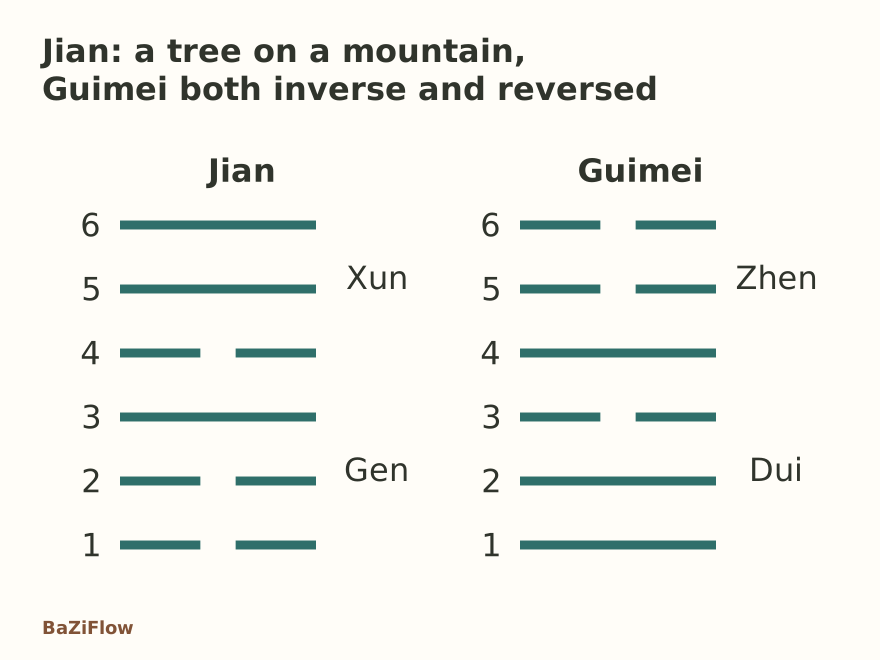 HEX-053 / Shared methods
Jian (漸): one wild goose, six landings, and what each stop brings
Jian is the 53rd hexagram: Gen (mountain) below Xun (wood). Read the Commentary’s three “advances”, the Great Image on a tree on a mountain, and six lines that follow one wild goose from the shore to the hill.
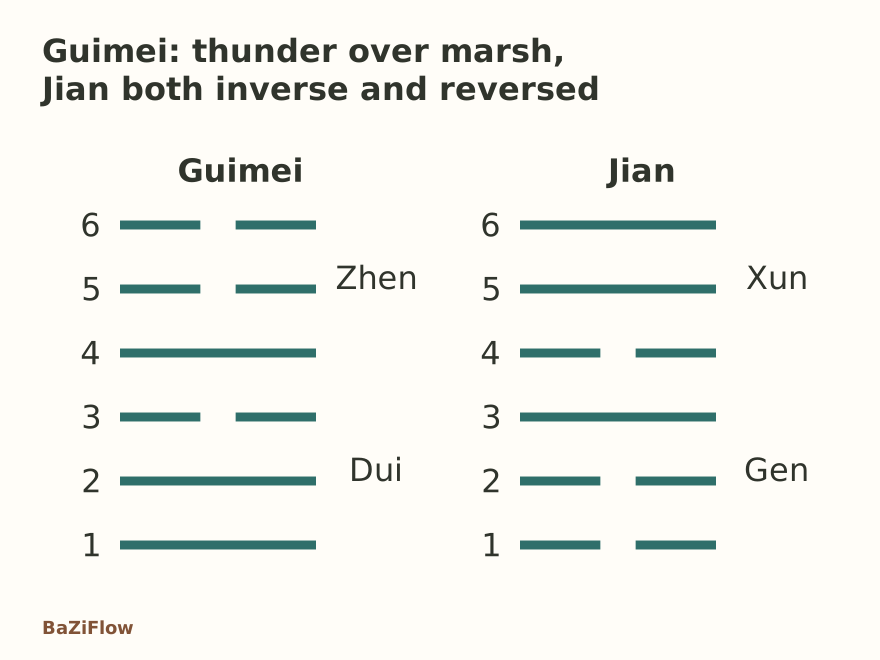 HEX-054 / Shared methods
Guimei: from the junior sister to the empty basket
Guimei is the 54th hexagram: Dui (marsh) below Zhen (thunder). Read a Commentary that praises first and warns after, and six lines that run from the junior sister who goes with the bride to the empty basket.
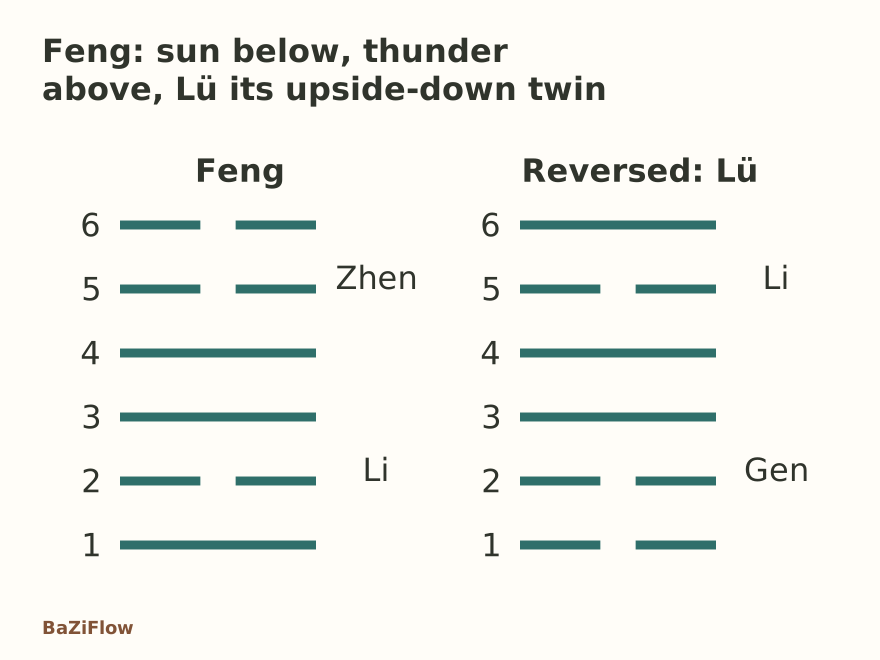 HEX-055 / Shared methods
Feng: the Dipper at midday, and why what grows “great” is a covering
Feng is the 55th hexagram: Li (brightness) below Zhen (movement). Read the Commentary’s “fitting to be at midday” followed by “midday then tilts”, and six lines in which what is made great is a screen, a curtain, a roof.
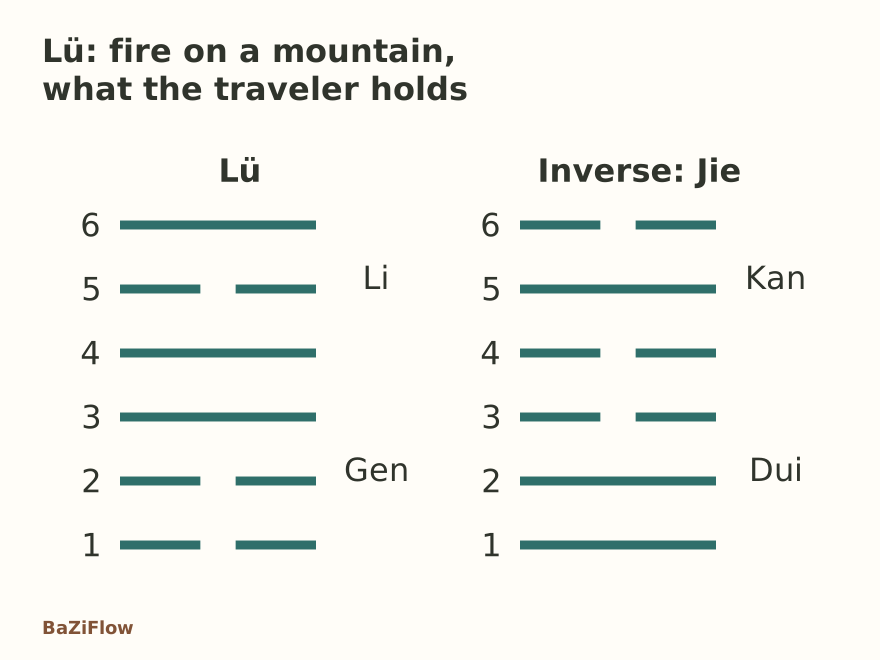 HEX-056 / Shared methods
Lü (旅): fire on a mountain, from “petty and fussy” to the burned nest
Lü (旅) is the 56th hexagram: Li (fire) above Gen (mountain). Read the judgment “small success”, the Great Image on careful punishment, and six lines that keep a traveler’s inventory: lodging, funds, a servant.
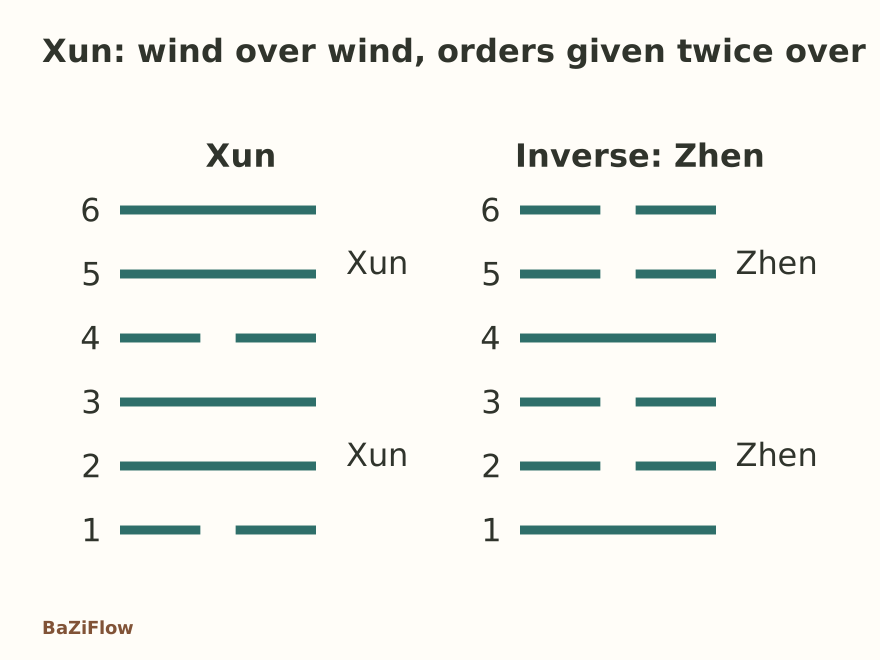 HEX-057 / Shared methods
Xun: wind over wind, and “beneath the bed” written twice
Xun (巽) is the 57th hexagram, wind over wind. Read “with Xun doubled, orders are repeated”, the Great Image on repeating orders, and one sentence, “beneath the bed”, on line 2 and line 6 with opposite results.
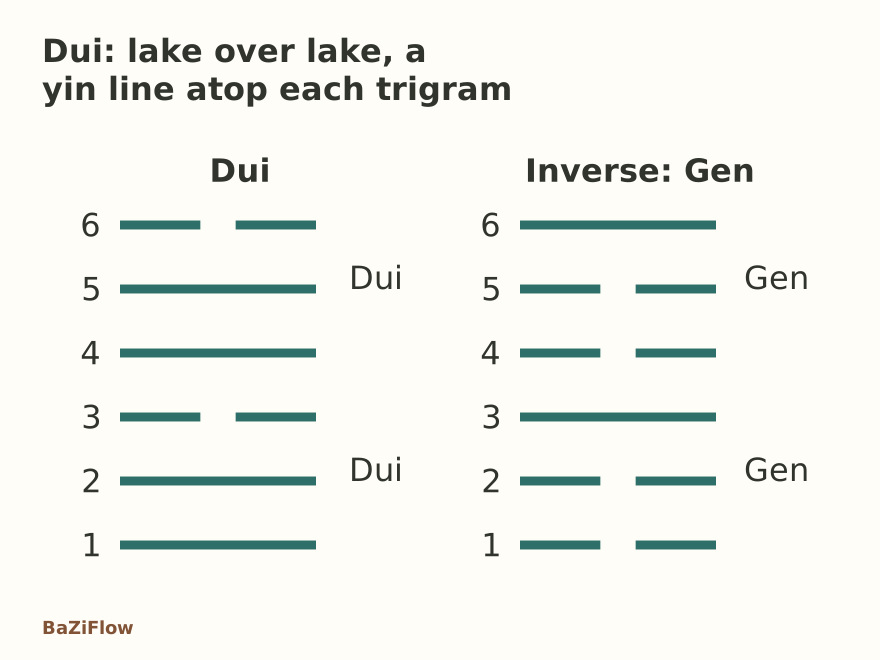 HEX-058 / Shared methods
Dui: lake over lake, from “harmonious delight” to “delight that draws”
Dui (兌) is the 58th hexagram, lake over lake. Read “firm in the center, yielding outside”, the Great Image of friends at study, and six lines that pair up by place within the trigram.
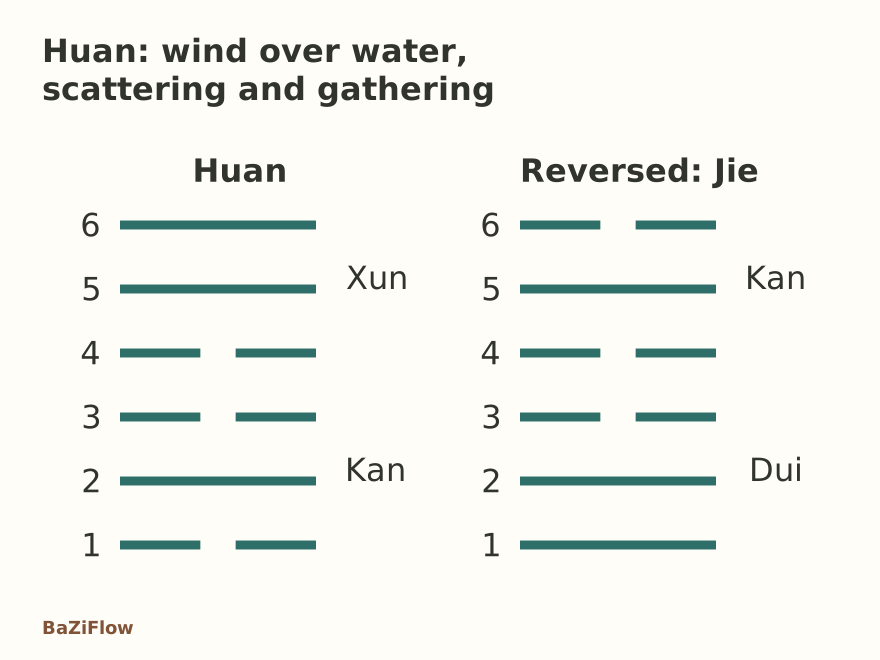 HEX-059 / Shared methods
Huan: wind over water, and what “scatter” takes as its object
Huan (渙) is the 59th hexagram: Xun (wind) above Kan (water). Read “the king comes to the temple”, the Great Image of temples, and six lines in which “scatter” takes a new object each time.
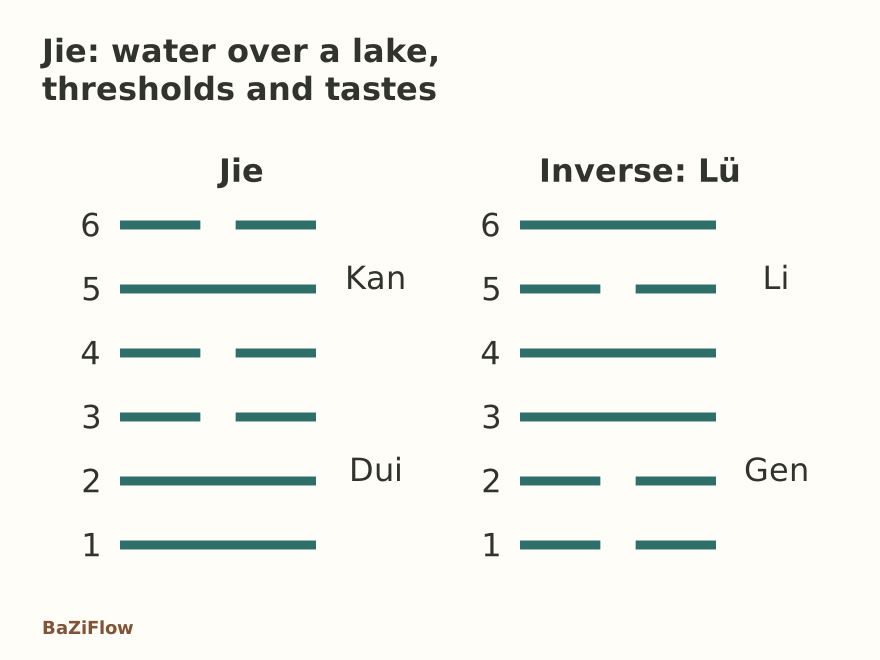 HEX-060 / Shared methods
Jie: water over a lake, from “does not go out” to the bitter limit
Jie (節) is the 60th hexagram: Kan (water) above Dui (lake). Read “fixing numbers and measures” and six lines that run from staying in the courtyard to easy, sweet and bitter limits.
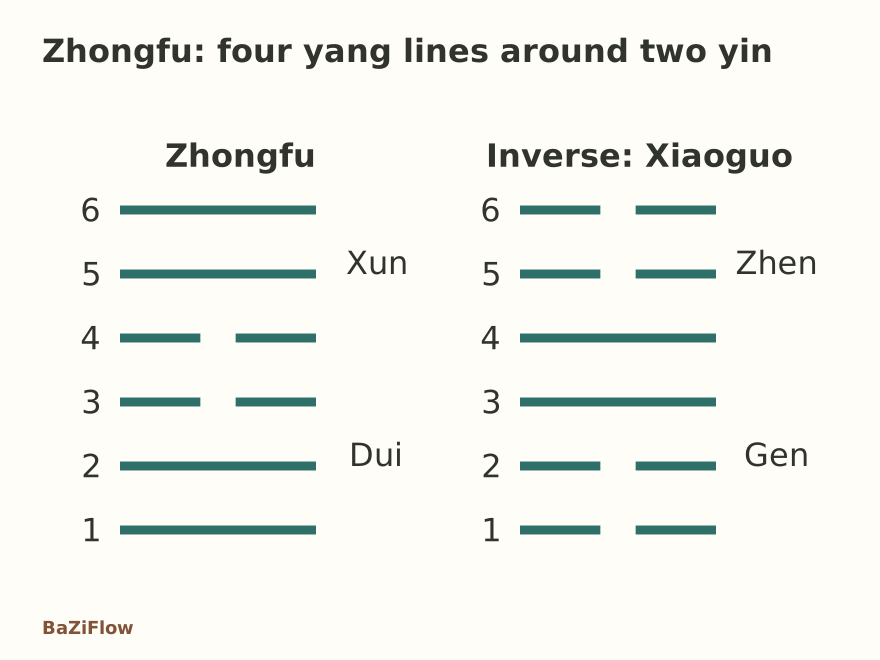 HEX-061 / Shared methods
Zhongfu: solid outside, hollow within, from the calling crane to the feathered voice
Zhongfu (中孚) is the 61st hexagram: Xun (wind) over Dui (lake). Read “the yielding is inside”, the hollow boat, the Great Image on deliberating cases, and six lines of voices from a crane to a feathered voice.
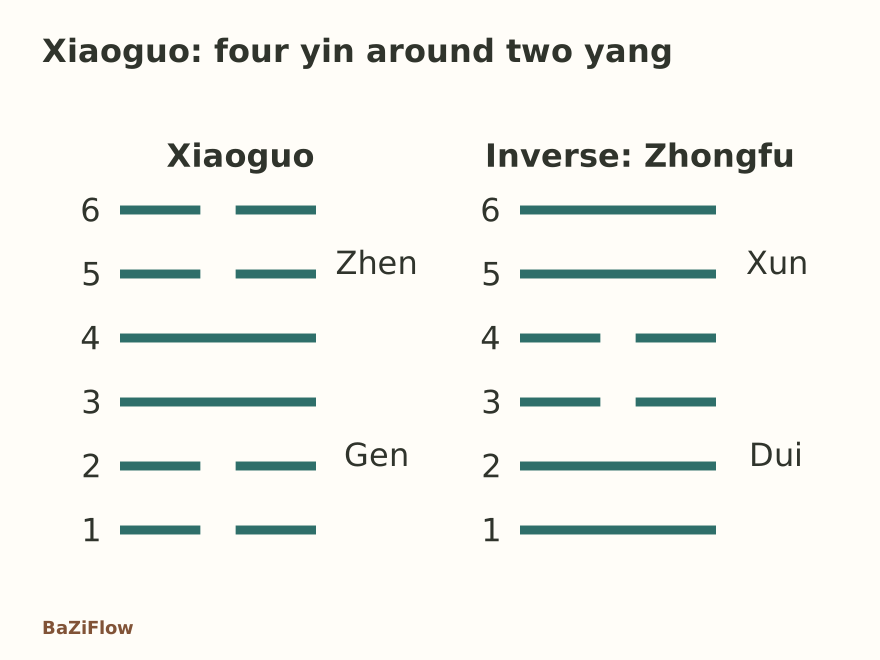 HEX-062 / Shared methods
Xiaoguo: thunder above the mountain, and passing and meeting trade places
Xiaoguo is the 62nd hexagram: thunder over mountain, four yin lines around two yang, likened to a bird. Read the Judgment on going down, the Image on courtesy, grief and thrift, and the swap of "pass" and "meet".
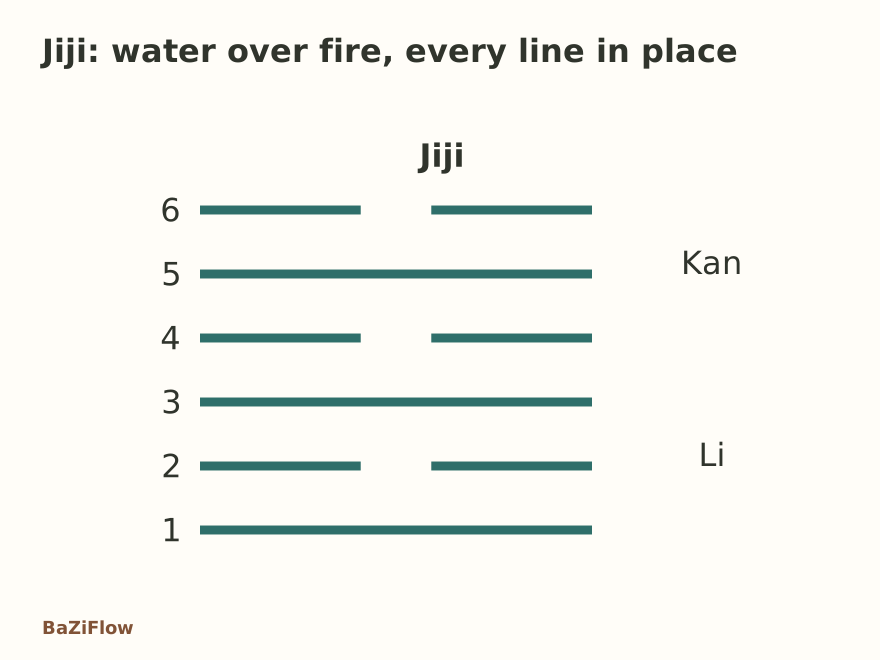 HEX-063 / Shared methods
Jiji: water above fire, after every line has found its place
Jiji is the 63rd hexagram: Kan (water) above Li (fire), all six lines in their own places. Read "good at the start, disorder at the end", the Image on guarding ahead, and water rising from the tail to the head.
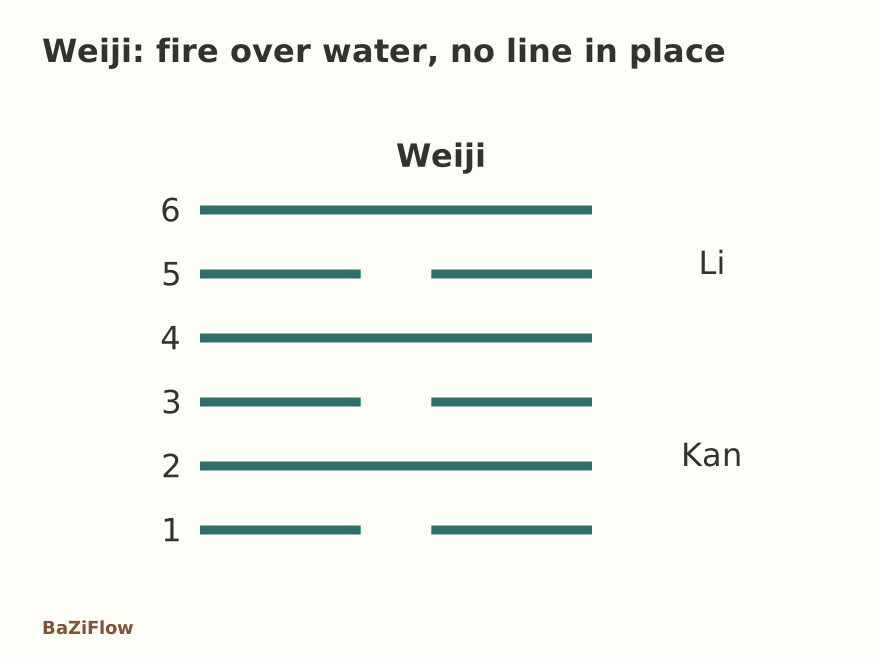 HEX-064 / Shared methods
Weiji: fire above water, no line in place, and yet each answers another
Weiji is the 64th and last hexagram: fire over water, every line out of place yet answering another. Read the little fox, "settle each in its quarter", the twin "also does not know", and the Xu Gua ending.
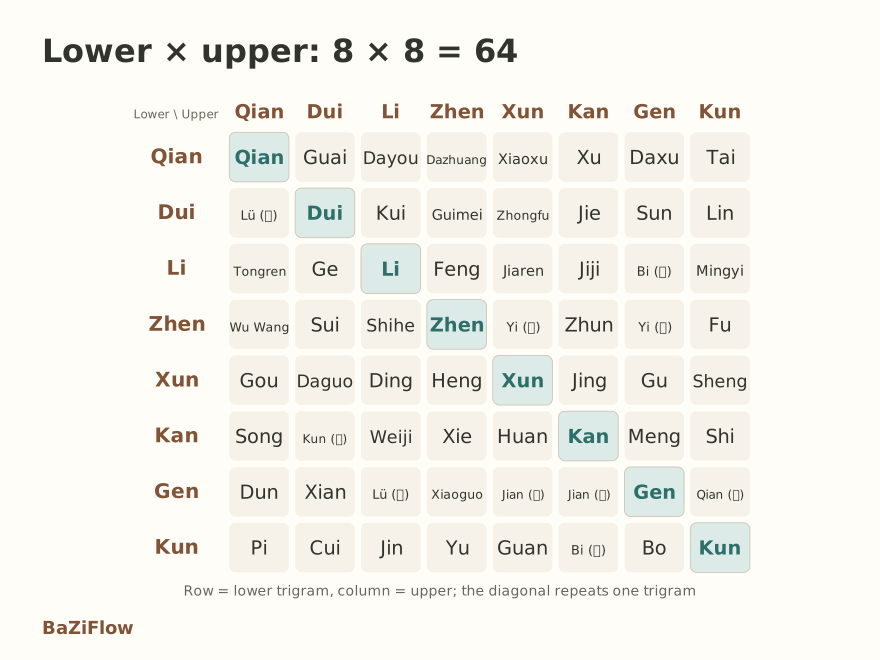 YJ-006 / Yijing
The Sixty-Four Hexagrams: How Upper and Lower Trigrams Form One Figure
The sixty-four hexagrams are an 8 × 8 set of combinations, one trigram stacked on another. A lookup table, a Zhun, Jie and Meng comparison and two exercises show how to count lines, split them and find the name.
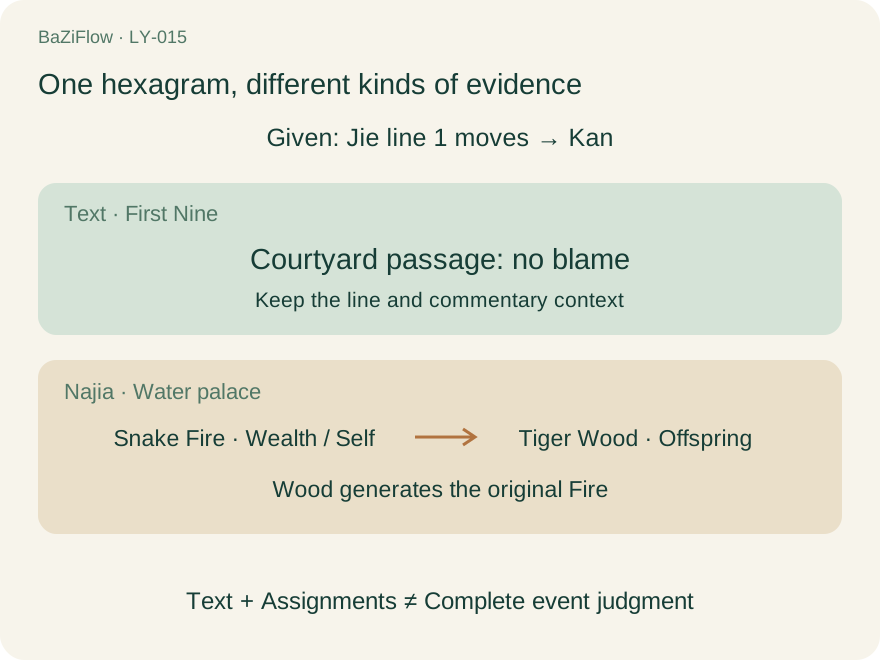 LY-015 / Liu Yao
Hexagram texts and Najia Liuyao use different evidence
Distinguish canonical line names from casting values, then compare Jie’s First Nine passage with its Water-palace assignments and a local return-generation relation.
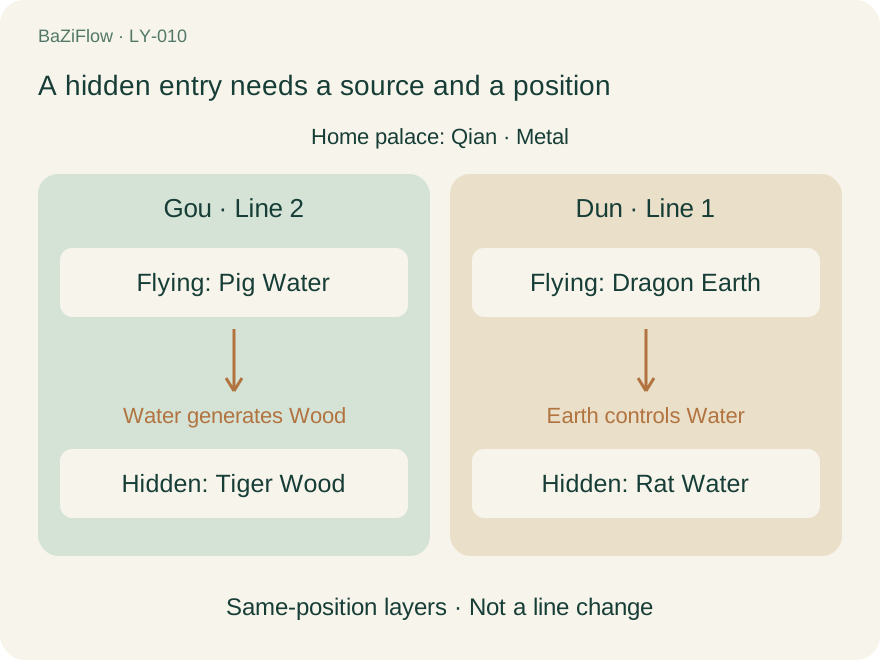 LY-010 / Liu Yao
Hidden and flying spirits: trace the palace and position
Use Gou and Dun in the Qian palace to locate two hidden entries, compare generating and controlling pairs, and preserve the texts’ different methods.
BZ-010 / BaZiHidden stems: separate the branch list, visible expression and seasonal rulership
List the conventional contents of all twelve branches, use Tiger to explain why expansion adds no visible stems, and separate lookup, expression, rulership and Day Master relations.
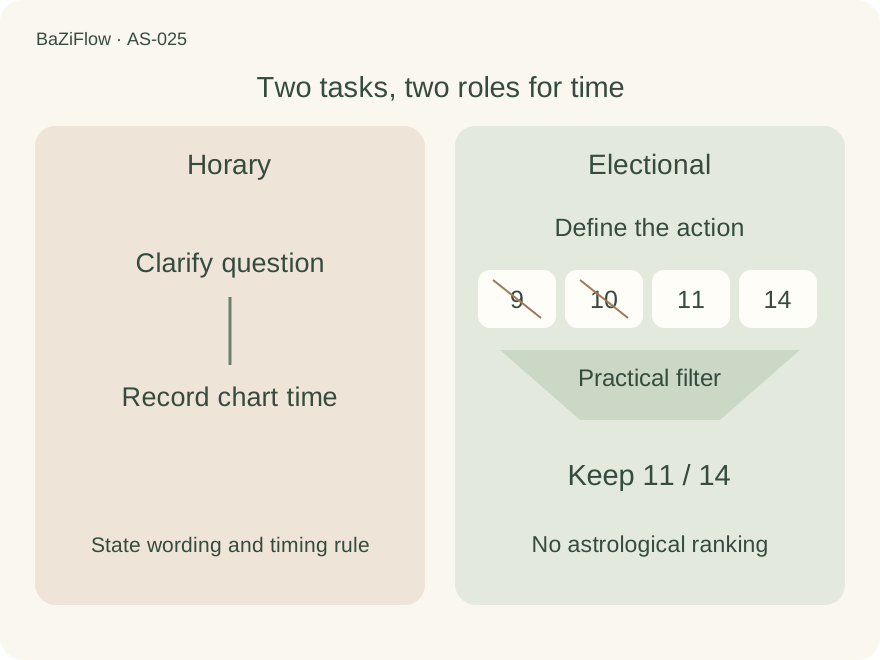 AS-025 / Western astrology
Horary or electional astrology? Define what the time belongs to
Separate a question chart from candidate action times and the eventual event record. A repair-session example shows why scope and practical constraints come before chart interpretation.
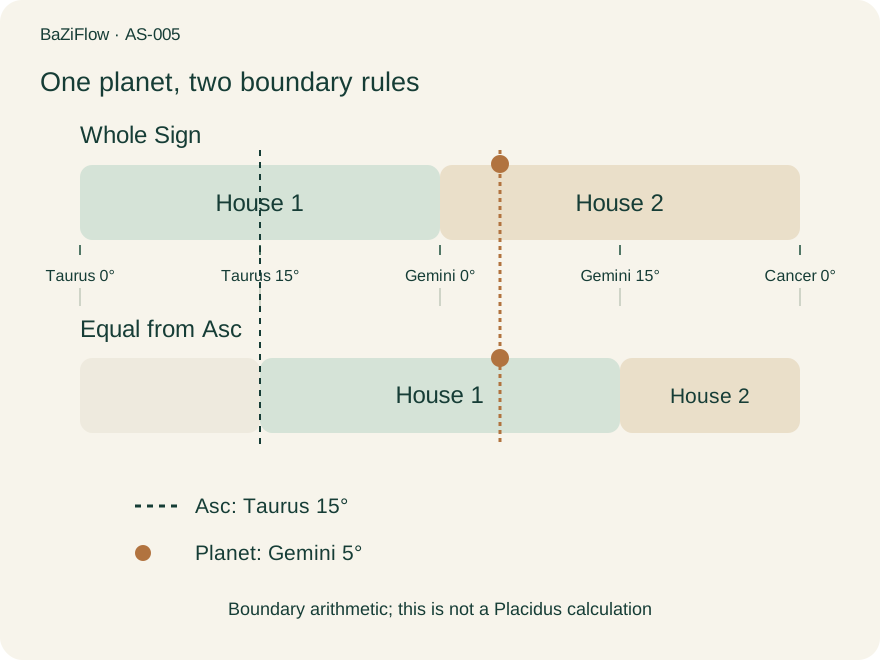 AS-005 / Western astrology
House Systems: Why One Planet Can Receive a Different House
Compare whole-sign, Ascendant-based equal and Placidus boundaries, then locate an invented planet at Gemini 5° with Taurus 15° rising and keep polar limitations visible.
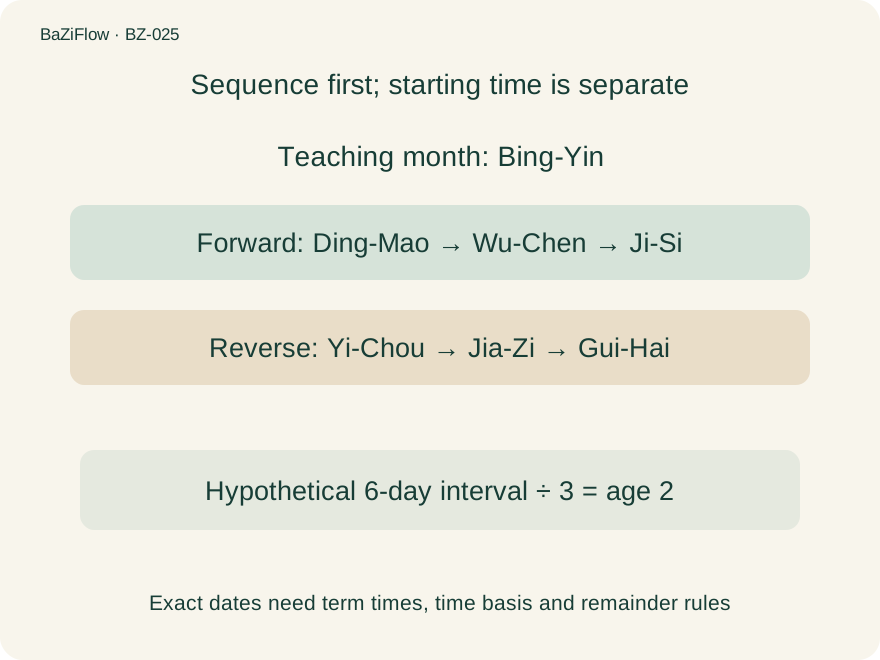 BZ-025 / BaZi
How luck pillars are derived: separate the sequence from its starting time
Use a Yang Fire Tiger month and a six-day interval to separate pillar order from starting age, then check direction, the twelve jie boundaries, units and remainders.
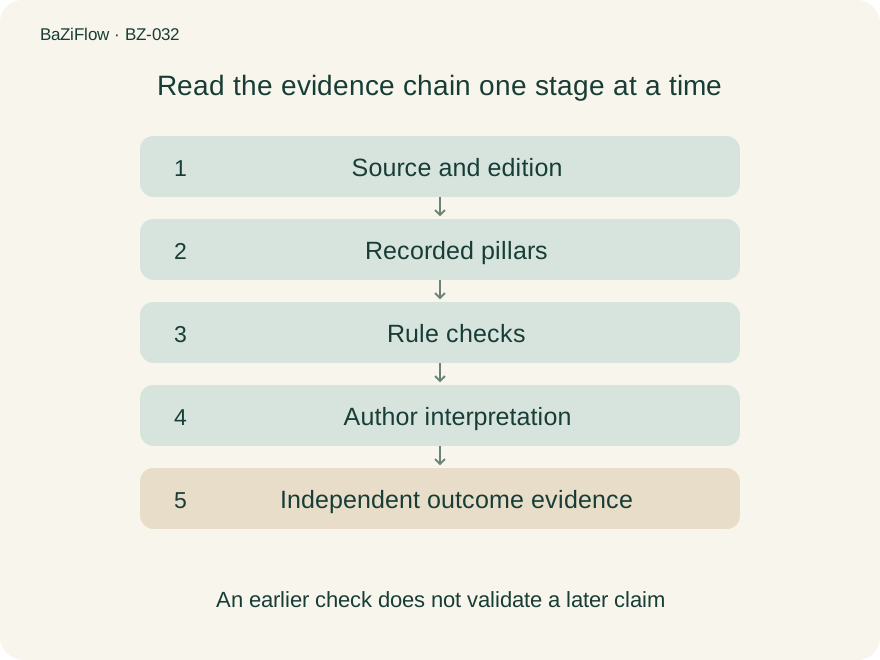 BZ-032 / BaZi
How to read a BaZi case: separate records, rules, interpretation and outcomes
Work through two examples from Ziping Zhenquan by separating recorded pillars, rule checks, interpretation and outcome evidence. A consistent chart fragment does not verify a biography.
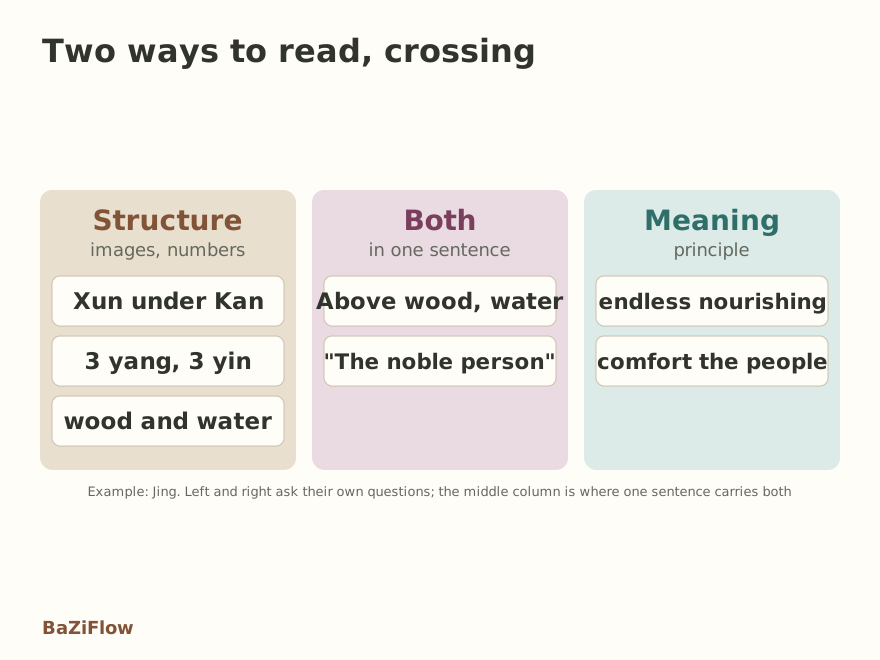 YJ-011 / Yijing
Images, Numbers and Meaning: Two Ways of Reading the Zhou Yi, and Where They Cross
Readers of the Zhou Yi ask about structure or about principle. A Commentary on the Images sentence on Jing, two passages by Kong Yingda and Wang Bi's "Ming Xiang" show the two directions crossing, not competing.
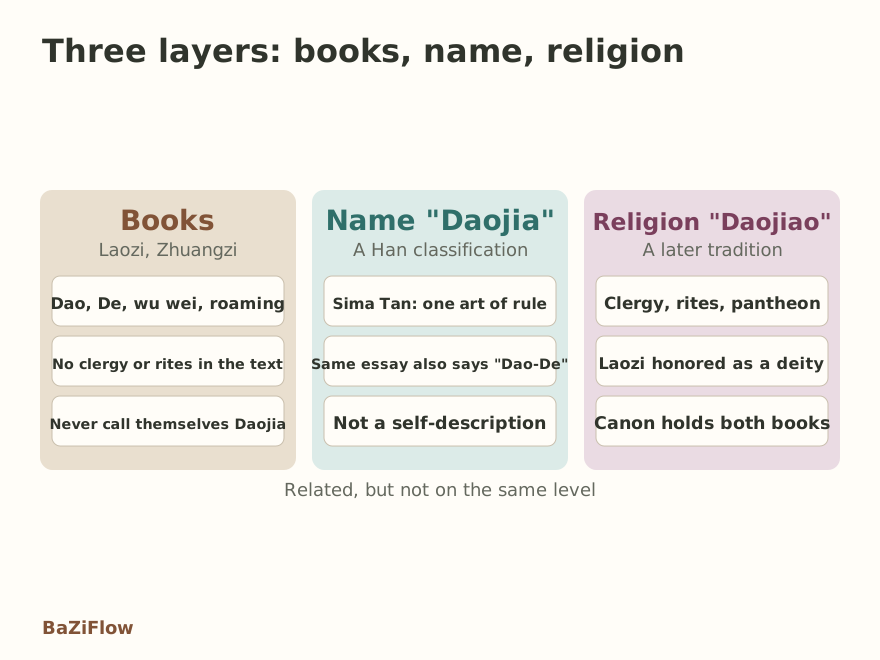 DA-001 / Daoist thought
Daoist Thought and Religious Daoism: Sorting the Books, the Name and the Religion
A three-column comparison separates the Laozi and Zhuangzi (two books), the label "Daojia" (a Han classification) and the religion "Daojiao"; Sima Tan’s essay and a Zhuangzi chapter show where the name comes from.
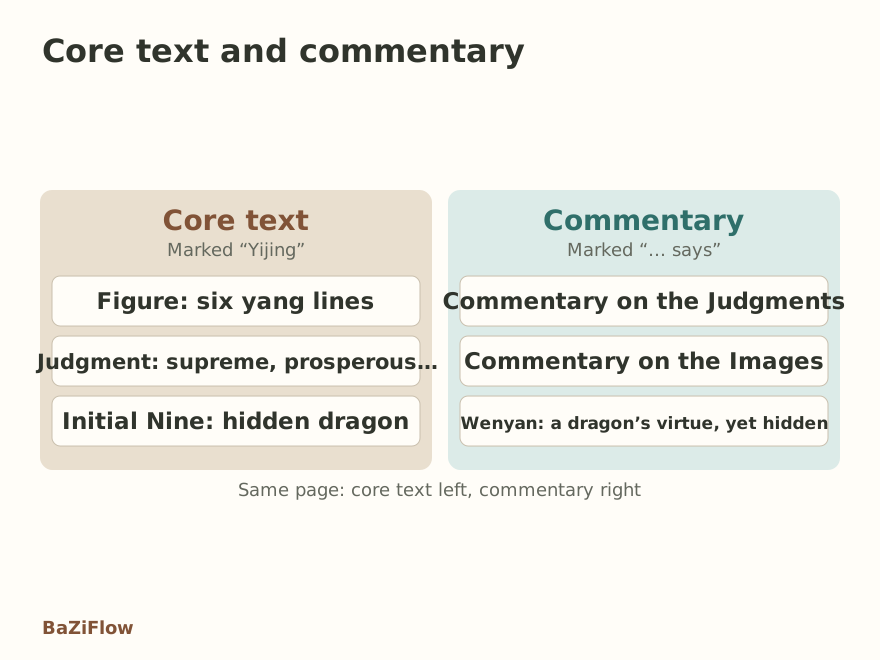 YJ-002 / Yijing
Core Text and Commentaries: Telling the Zhou Yi from What Explains It
On one page of hexagram Qian, tell the core text (figure, Judgment, line statements) from the commentaries (the Ten Wings). Label each sentence, then sum up each Wing in a line.
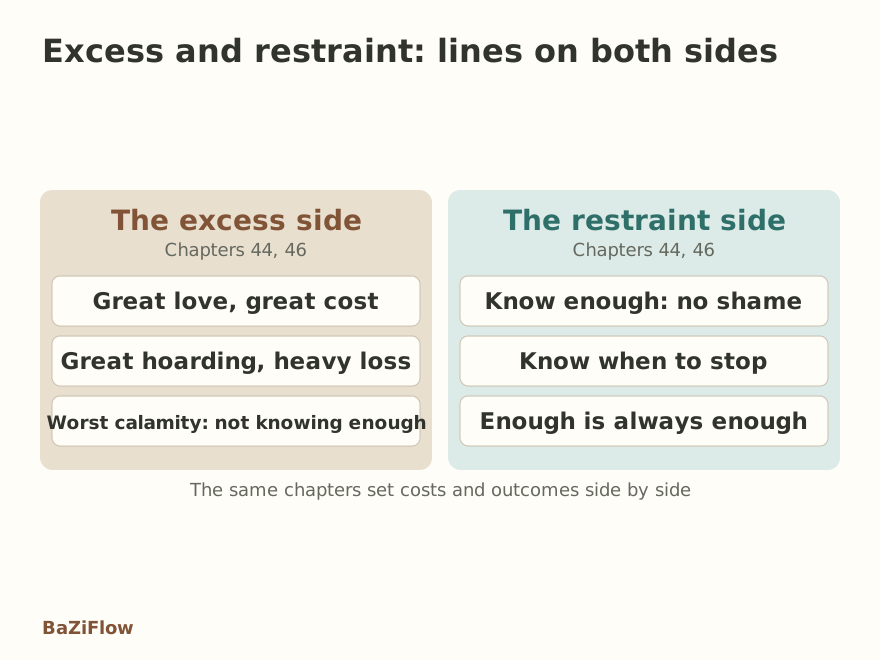 DA-006 / Daoist thought
Knowing Enough and Knowing When to Stop: "How Much" Versus "Where", Then Desire and Limits
Chapters 44, 46, 33, 9 and 12 of the Laozi show that knowing enough asks "how much is enough" and knowing when to stop asks "where to halt". Side by side, the lines separate moderation, stopping and passive restraint.
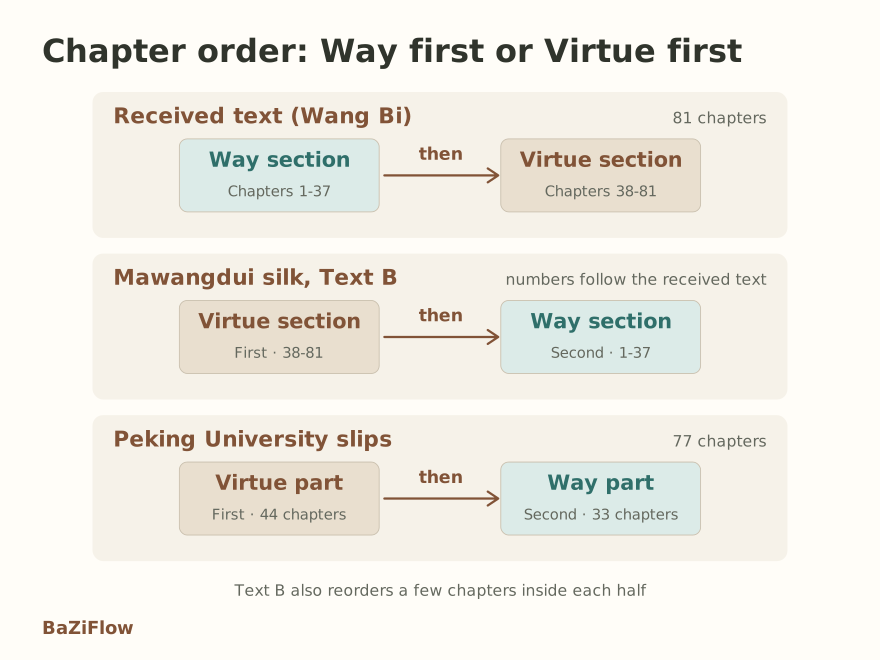 DA-011 / Daoist thought
Laozi Editions: Chapter Order and Wording in the Received Text, Silk and Bamboo
The Laozi survives as a received text, Mawangdui silk and bamboo slips. A chapter-order table, chapter 38 side by side, a few disputed lines and a timeline of copying against finding show where they differ.
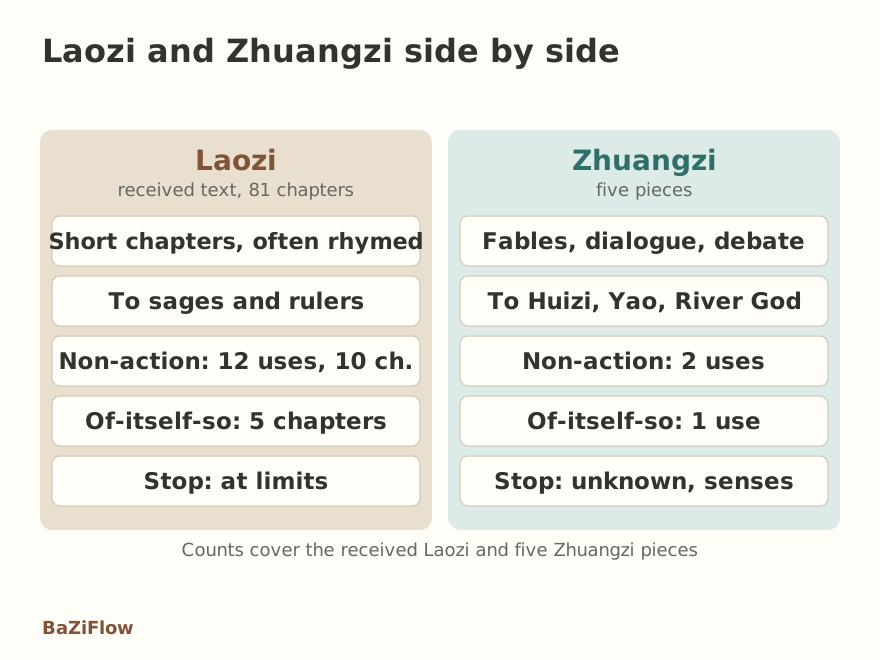 DA-012 / Daoist thought
Laozi and Zhuangzi: Reading Them Side by Side by Genre, Audience and Word Use
The Laozi and the Zhuangzi are both called Daoist yet write and use words differently. A style table, whom each addresses, three shared words and three uses of know-when-to-stop show how to read them together.
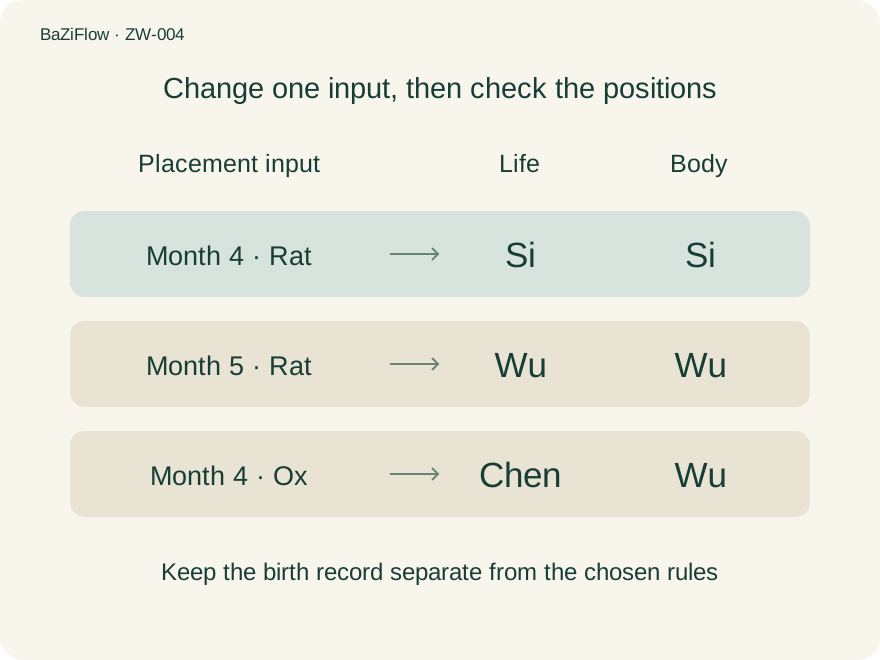 ZW-004 / Zi Wei Dou Shu
Why leap-month and midnight settings change a Zi Wei chart
Compare two Zi Wei charts by separating the recorded lunar date, the month used for palace placement, the selected hour and the late-Rat day rule.
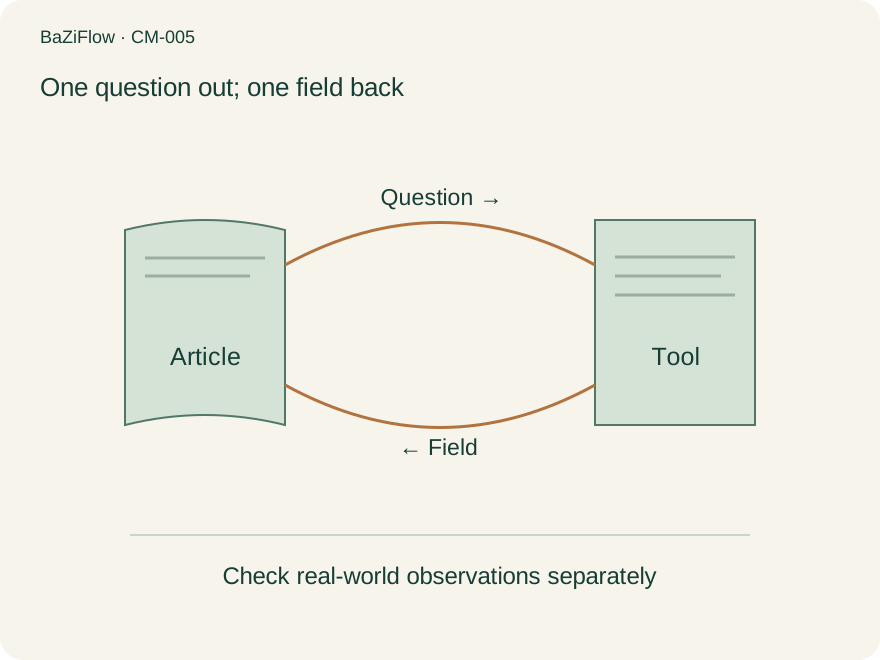 CM-005 / Shared methods
Use an Article to Ask a Better Question of a Tool
Turn a concept into one inspectable question, then bring a specific field back to the explanation. Keep instructional examples, calculated outputs and personal conclusions in their proper roles.
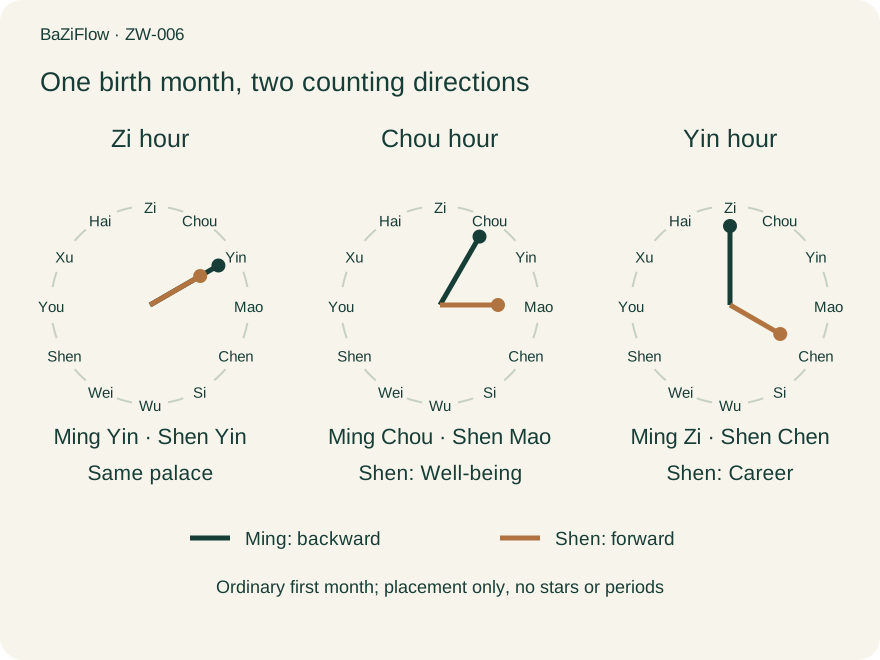 ZW-006 / Zi Wei Dou Shu
Life and Body palaces: two placements, not two lives
Learn why Shen Gong sits inside an existing palace, how its placement differs from Ming Gong, and why an age slogan cannot replace a method.
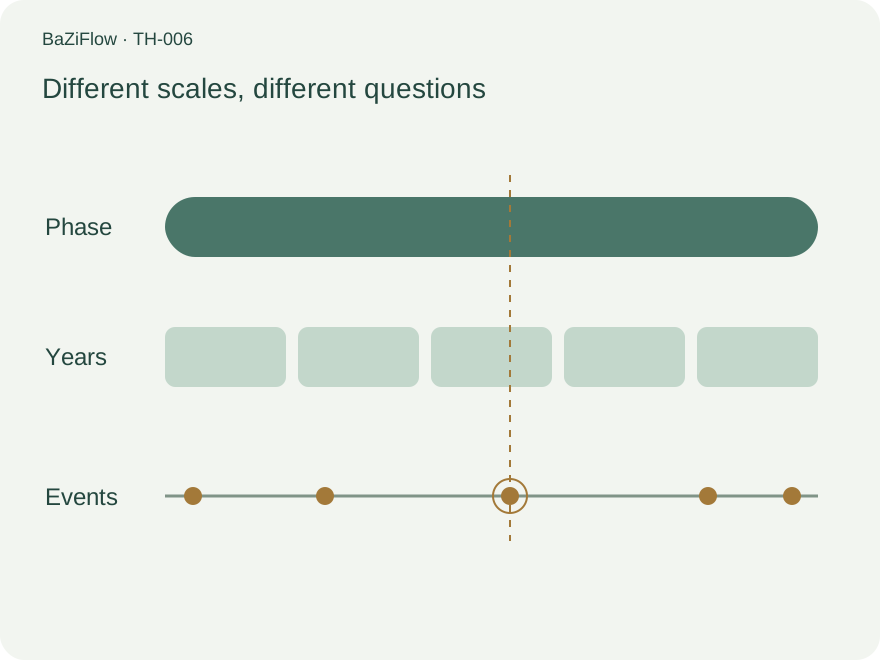 TH-006 / Read by theme
Life stages: keep the time scale attached to the claim
Compare long periods, annual layers and dated events without treating them as interchangeable. Learn where BaZi and Ziwei timing methods fit, and what a retrospective record can establish.
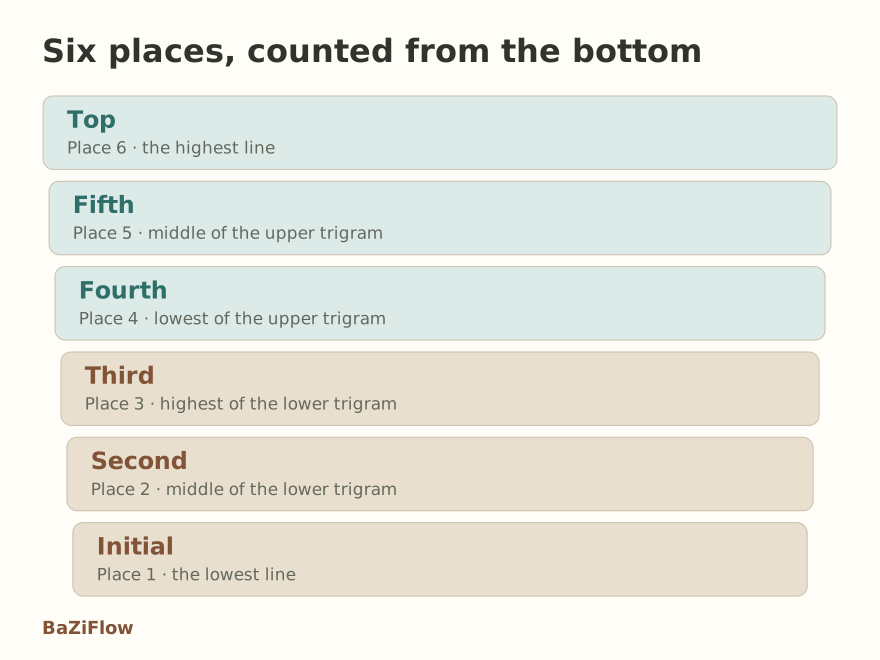 YJ-008 / Yijing
Line positions: the six places, Nine and Six, and the sayings about them
Six places run from Initial to Top; a yang line is Nine, a yin line Six. Build line names on Qian and Xu, then put "two is praised" and the later terms central place and correspondence in their own layers.
 MH-010 / Meihua Yishu
Line texts and external signs: preserve the evidence layers
Locate Qian’s first line precisely, separate an observation from its symbolism, and retain the source’s different emphases on text and external responses.
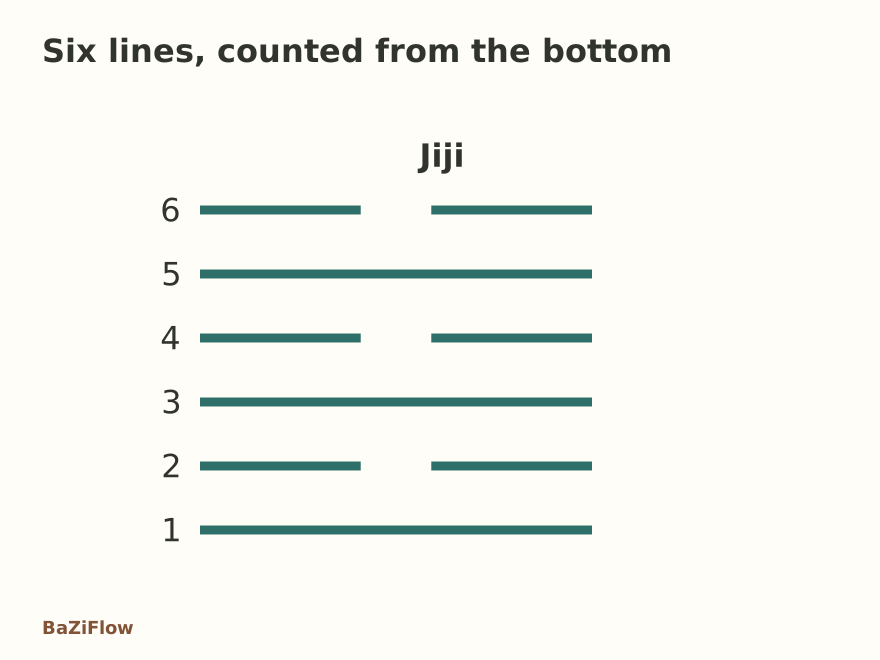 YJ-004 / Yijing
Yin and Yang Lines: Two Strokes, Six Places, Read from the Bottom
A yang line is unbroken and a yin line is broken in the middle. Six lines stack from the bottom into one hexagram, giving 2 × 2 × 2 × 2 × 2 × 2 = 64 patterns. Jiji and Weiji show why order matters.
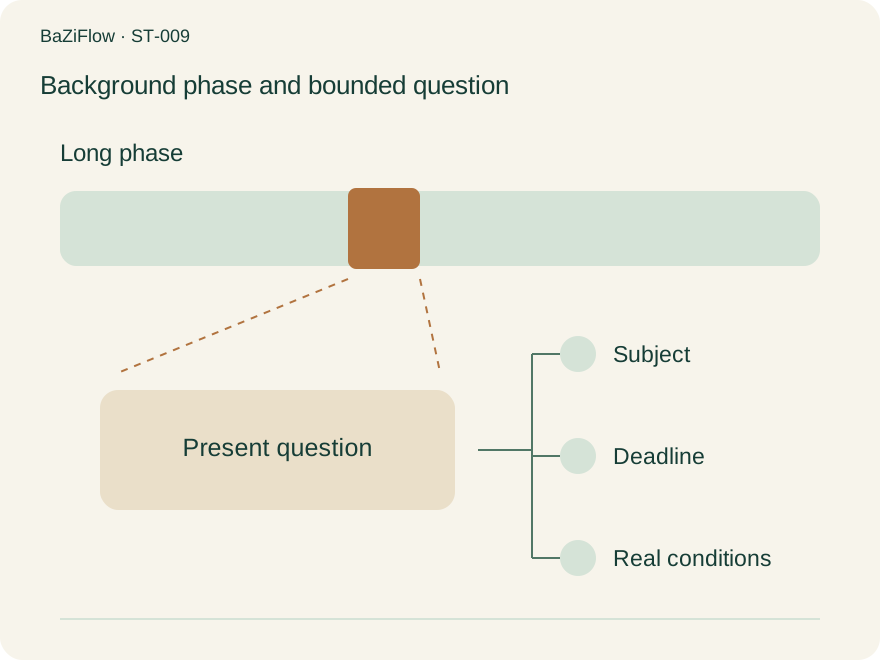 ST-009 / Cross-system studies
A Ten-Year Theme Cannot Answer a One-Week Decision
Separate a background phase from a bounded question. A course-choice example shows why real constraints, question scope and review dates must survive a symbolic reading.
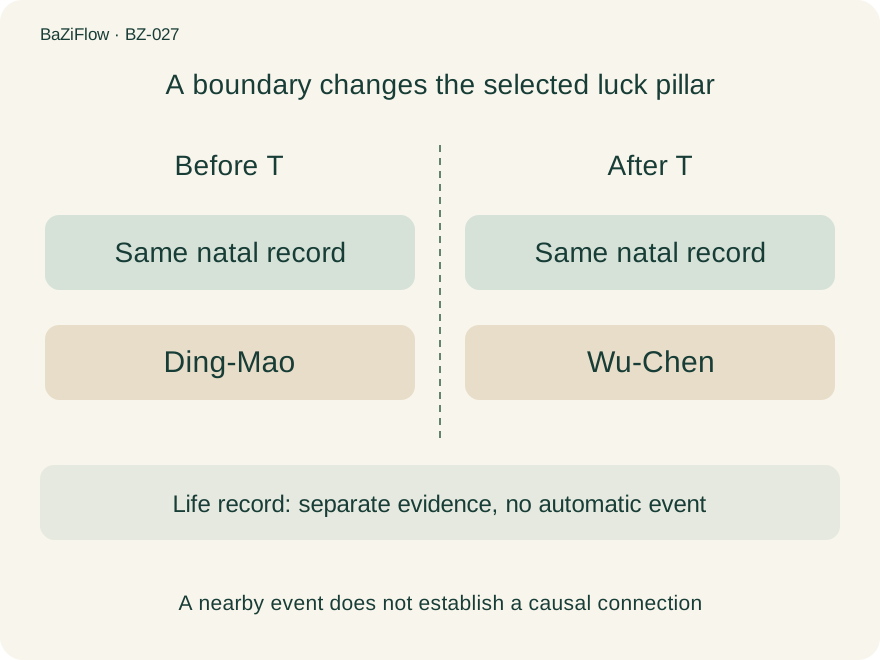 BZ-027 / BaZi
Luck-pillar transitions: separate a calculated boundary from life events
A calculated boundary changes the selected luck pillar, not the natal record or reality by itself. Compare before-and-after snapshots and keep life events as separate evidence.
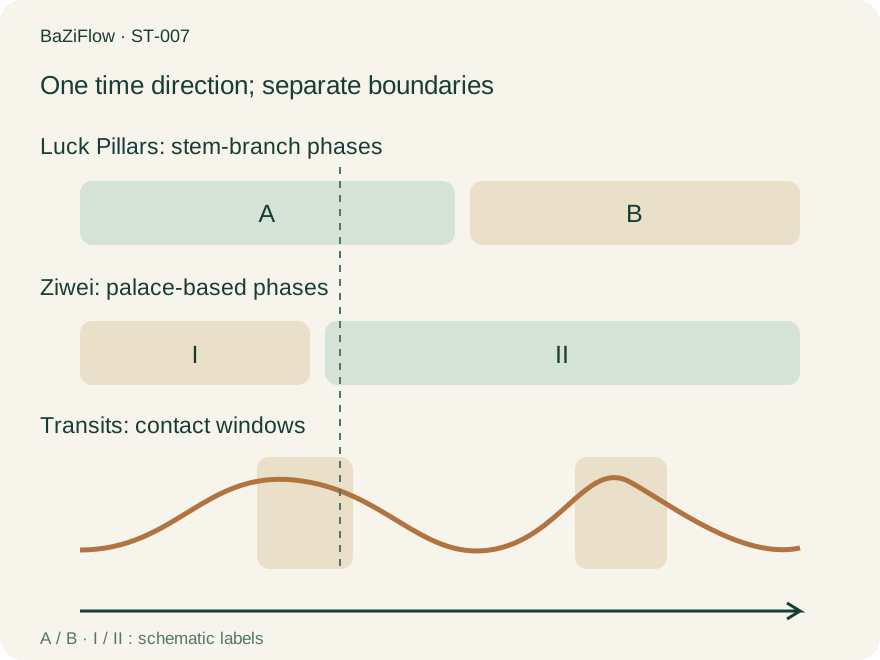 ST-007 / Cross-system studies
Luck Pillars, Ziwei Decades and Transits: Three Clocks
Compare what actually changes in three timing methods: a Bazi pillar, a Ziwei palace perspective, or a planetary relationship. Keep dates and interpretive claims separate.
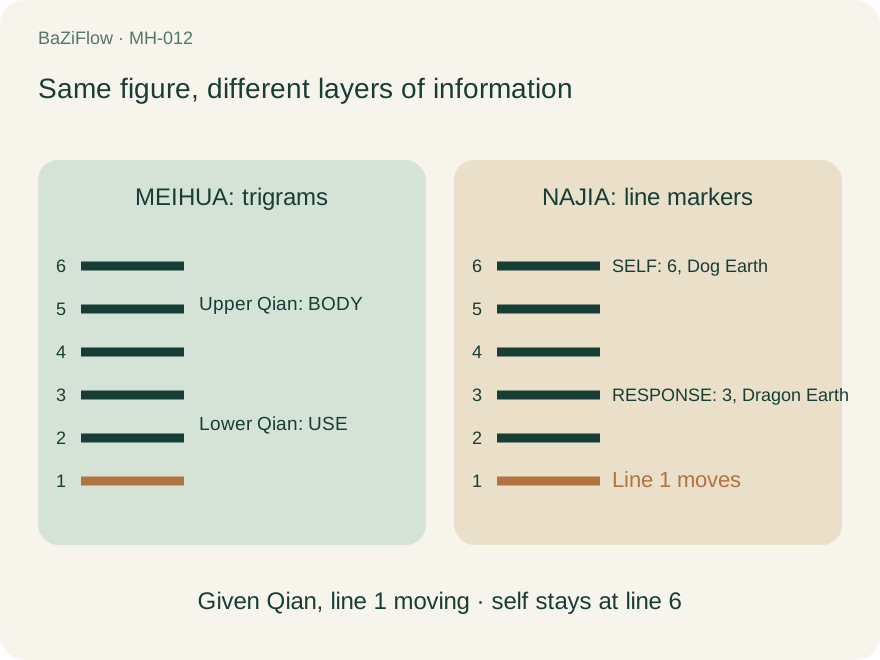 MH-012 / Meihua Yishu
Meihua and Liuyao: the same figure, different records
Compare a supplied Qian bottom-line change across trigram roles and Najia line markers, preserving the differences in inputs, phases and focus selection.
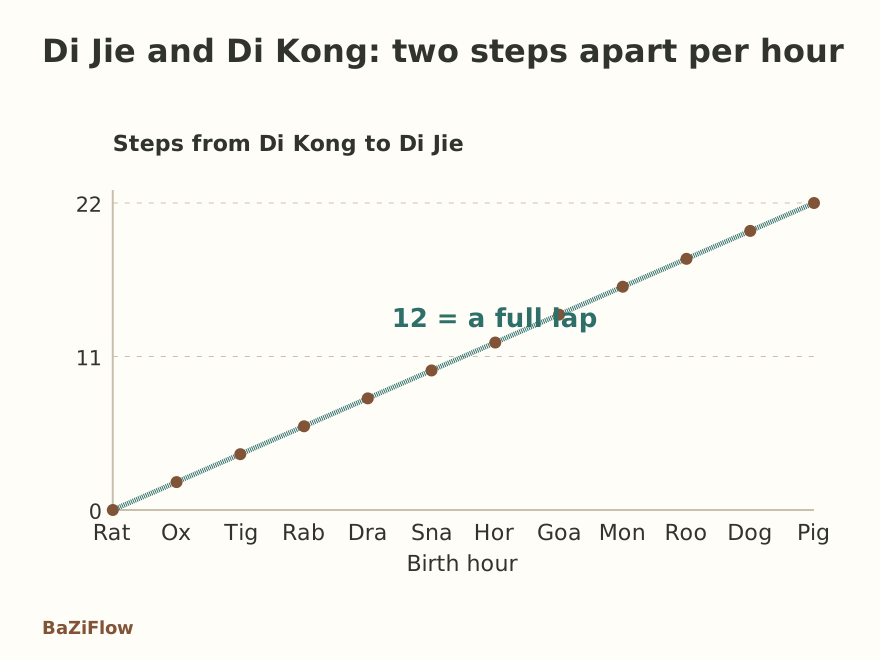 ZW-AUX-14 / Zi Wei Dou Shu
Di Jie (地劫): Starting from the Pig Palace Like Di Kong, but Walking Forward
Di Jie and Di Kong start from the same Pig palace and look only at the birth hour, yet walk in opposite directions. The twelve landings, their mirror relation, and why Di Jie jumps two palaces per hour against Life.
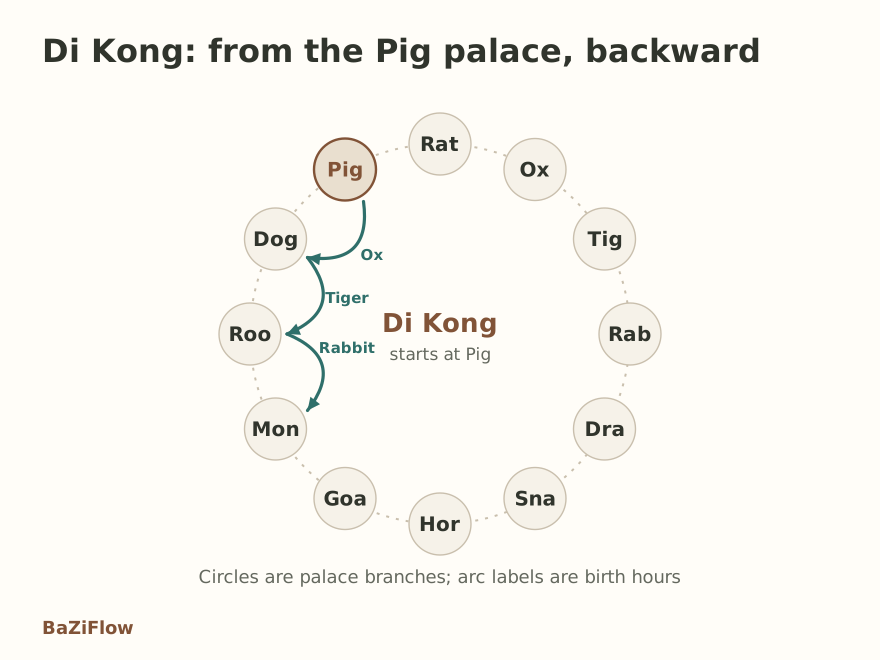 ZW-AUX-13 / Zi Wei Dou Shu
Di Kong (地空): Counting Back from the Pig Palace, the Star the Book Calls Tian Kong
Di Kong is placed by birth hour alone: the Rat hour sits on the Pig palace and each later hour steps one palace back. The twelve landings, the two Tian Kongs, and why its gap to the Life palace depends only on the month.
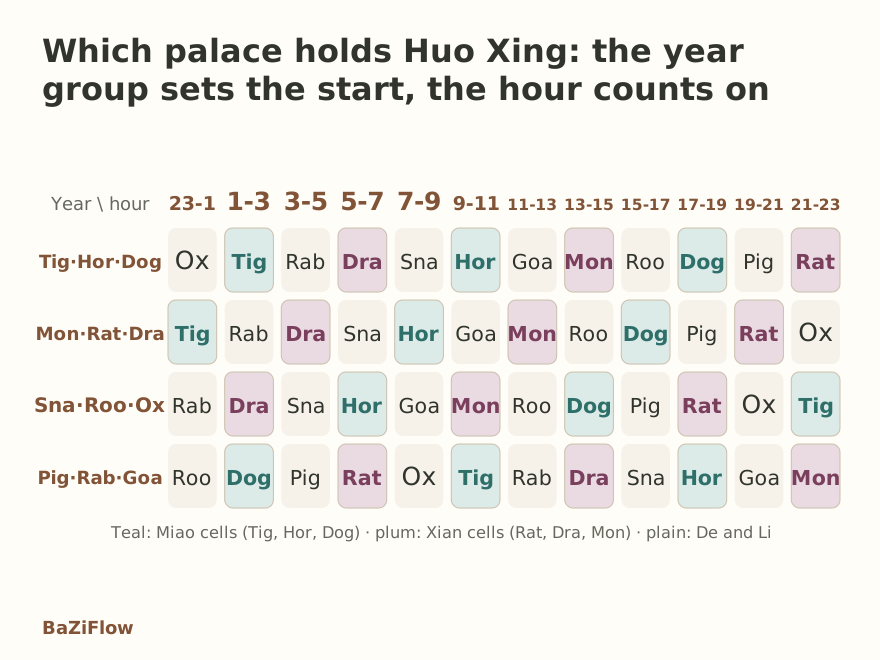 ZW-AUX-09 / Zi Wei Dou Shu
Huo Xing (火星): Year Group Sets the Start, the Birth Hour Counts the Steps
Huo Xing needs two inputs: the year-branch group fixes the start palace, the birth hour sets the count. A 4x12 table, the Miao/Xian pairing, the hour it meets Qing Yang and the Body Ruler homonym show how to read it.
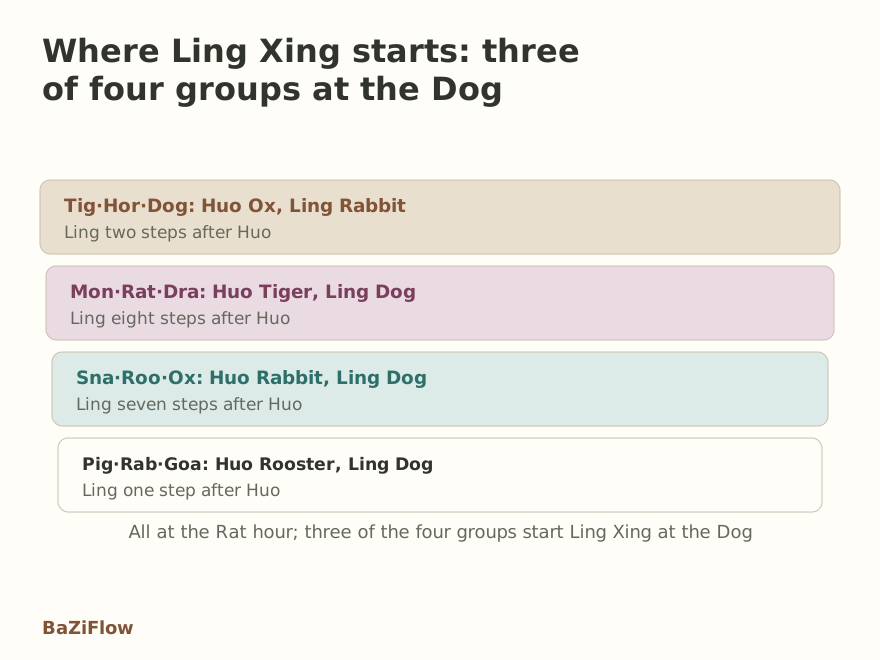 ZW-AUX-10 / Zi Wei Dou Shu
Ling Xing (铃星): Three Groups Start at the Dog, and the Gap to Huo Xing Varies
Ling Xing uses the verse of Huo Xing, yet three groups start it at the Dog. A ring, a placement table, the four Huo-Ling gaps and the flank conditions explain its pattern and how the book names the pair.
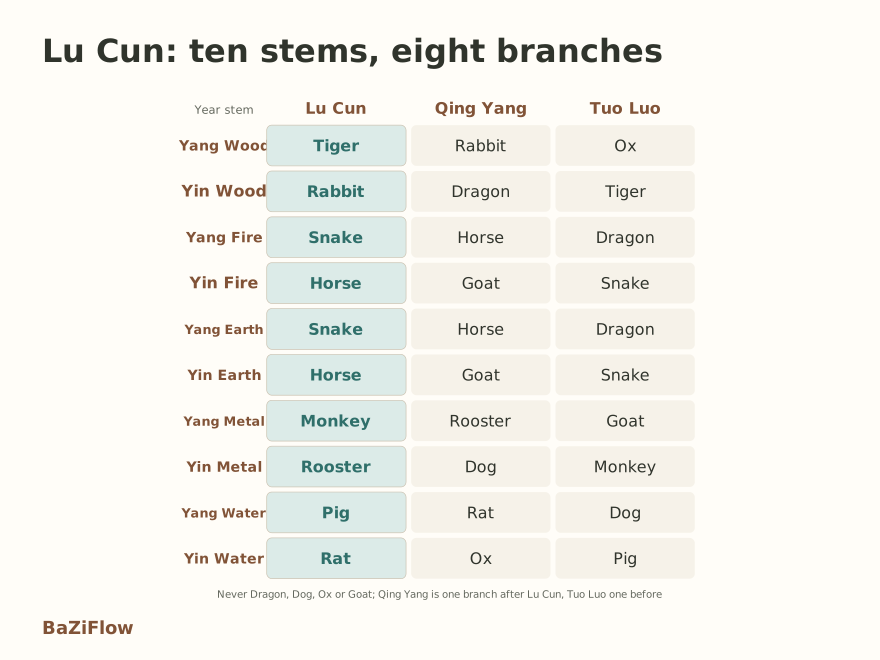 ZW-AUX-05 / Zi Wei Dou Shu
Lu Cun (禄存): Ten Year Stems on Eight Branches, With Qing Yang and Tuo Luo Beside It
Lu Cun follows the birth-year stem: ten stems land on eight branches, never Dragon, Dog, Ox or Goat. A ten-row table, its Qing Yang and Tuo Luo neighbors, the BaZi Emolument Star it matches, the year boundary and Boshi.
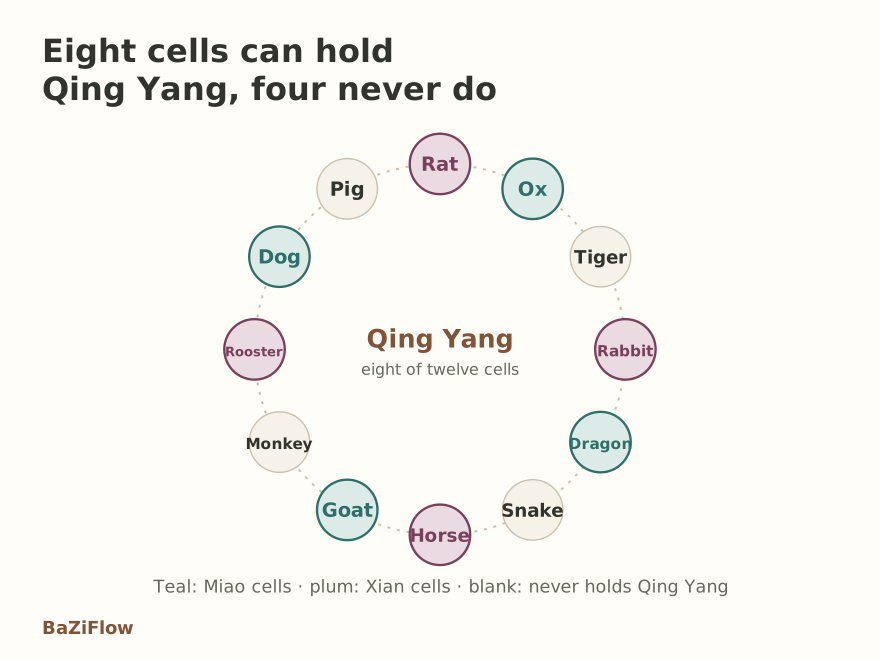 ZW-AUX-07 / Zi Wei Dou Shu
Qing Yang (擎羊): The Star One Step After Lu Cun, With Only Eight Landing Points
Qing Yang is placed by the birth-year stem alone: find Lu Cun, then step one branch on. A ring, an eight-row table, the Miao/Xian pairing and the Yang-Tuo flanking example show where it can and cannot land.
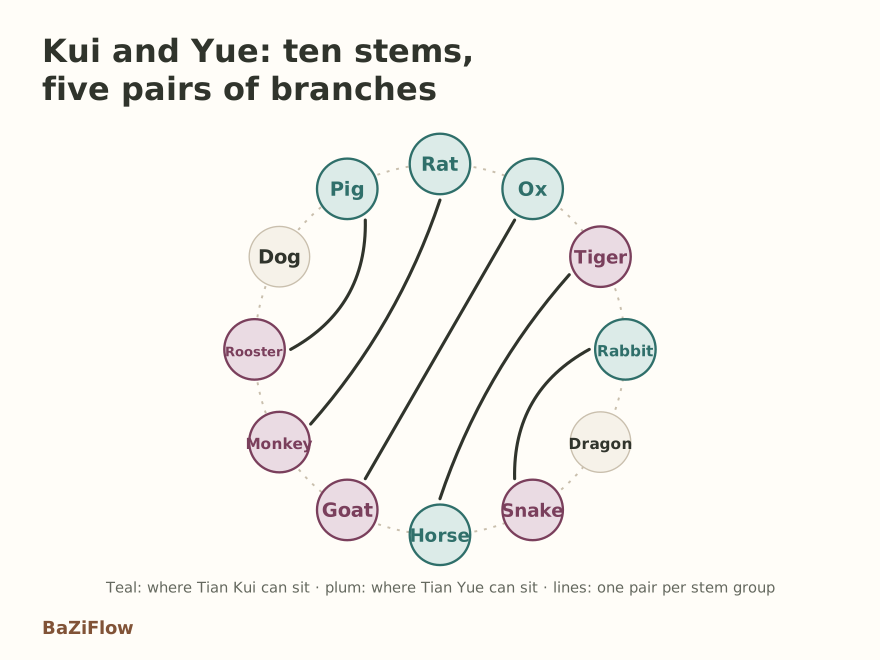 ZW-AUX-11 / Zi Wei Dou Shu
Tian Kui (天魁): A Pair From the Birth-Year Stem, and Which Life Palaces See Both
Tian Kui and Tian Yue are placed as a pair from the birth-year stem, ten stems giving five pairs. A ring, the verse against the assignment, who sees both and the yearly pair show the pattern.
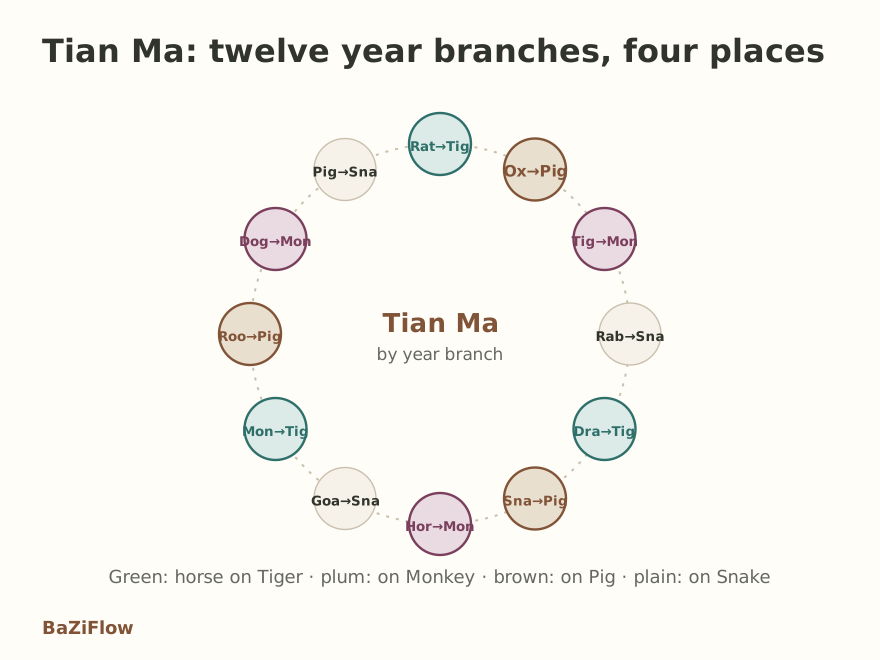 ZW-AUX-06 / Zi Wei Dou Shu
Tian Ma (天马): Four Palaces by Year Branch, With Its Shared-Palace Names
Tian Ma follows the birth-year branch: twelve branches land on only Tiger, Monkey, Snake and Pig, opposite each trine's first. A branch ring, the book's shared-palace names, and the Lu Cun and Tuo Luo years.
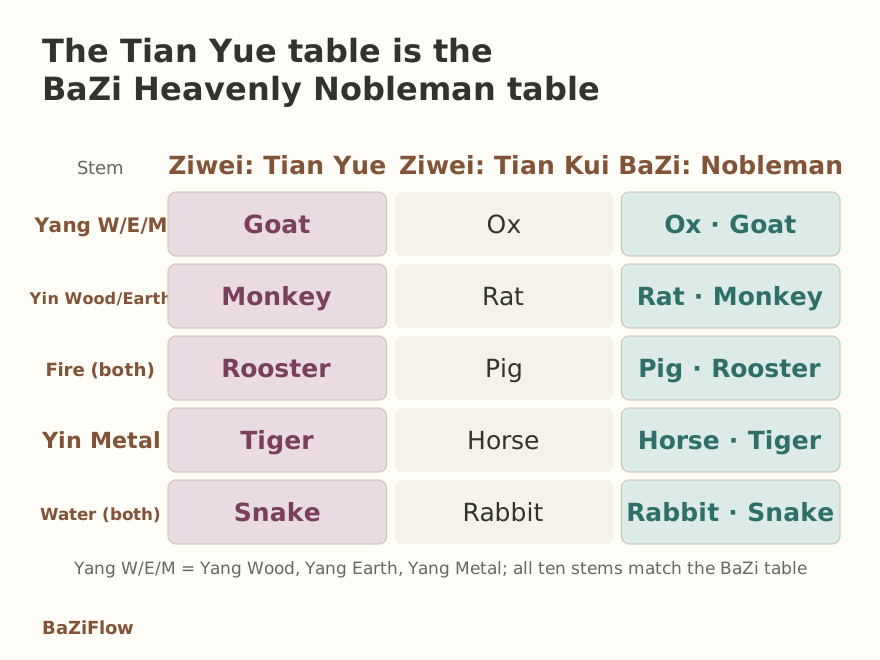 ZW-AUX-12 / Zi Wei Dou Shu
Tian Yue (天钺): The Heavenly Nobleman Table, and Two Versions of the Fire Line
The Tian Yue table is exactly the BaZi Heavenly Nobleman table, read by year stem in Ziwei and day stem in BaZi. A comparison, the two stems, the Fire-line variants and the flank of Life show how to read it.
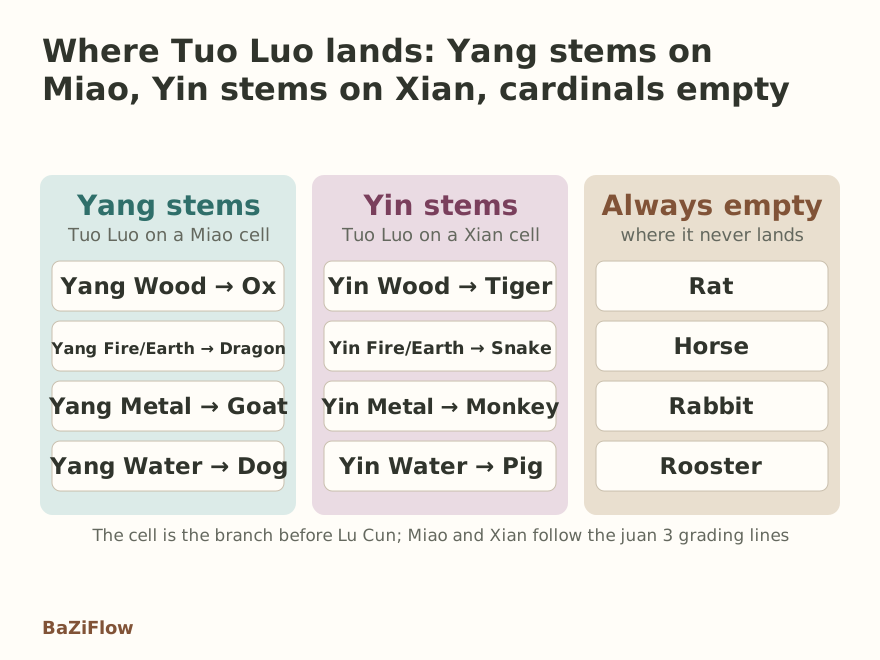 ZW-AUX-08 / Zi Wei Dou Shu
Tuo Luo (陀罗): The Star Before Lu Cun, and Why a Natal and a Yearly One Can Overlap
Tuo Luo goes on the branch before Lu Cun, never on Rat, Horse, Rabbit or Rooster. A comparison, the "Ji" naming puzzle, the Tuo-Lu-Yang triple and the juan 3 overlap example explain its pattern and the yearly overlap.
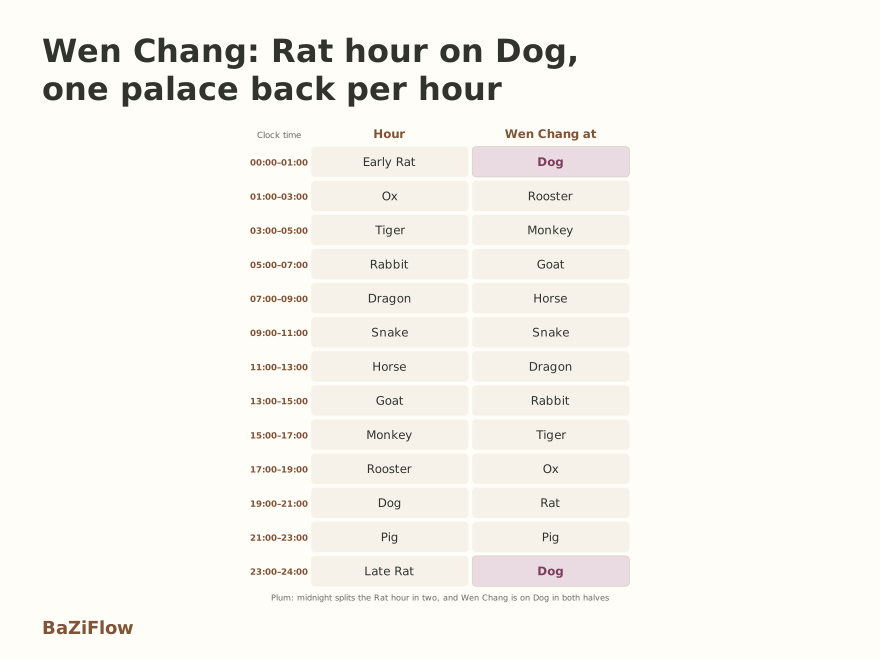 ZW-AUX-03 / Zi Wei Dou Shu
Wen Chang (文昌): Placed by Birth Hour From the Dog Position, and the Late Rat Hour
Wen Chang follows the birth hour: the Rat hour goes on Dog and each later hour steps one palace back. An hour table, the late Rat hour and its day count, the Body Ruler table, and the track shared with You Bi.
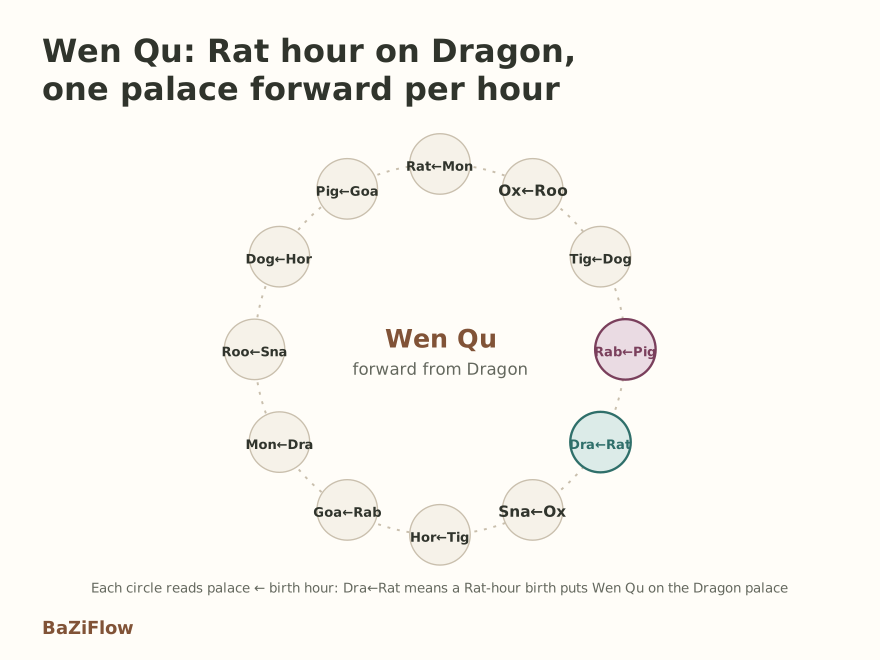 ZW-AUX-04 / Zi Wei Dou Shu
Wen Qu (文曲): Placed by Birth Hour From the Dragon Position, With Its Twelve-Palace Grades
Wen Qu uses the same birth hour as Wen Chang but starts at the Dragon branch and moves forward. A twelve-palace grade ring checked against the book table, how the pair relate, its Life Ruler role and the Ji and Ke years.
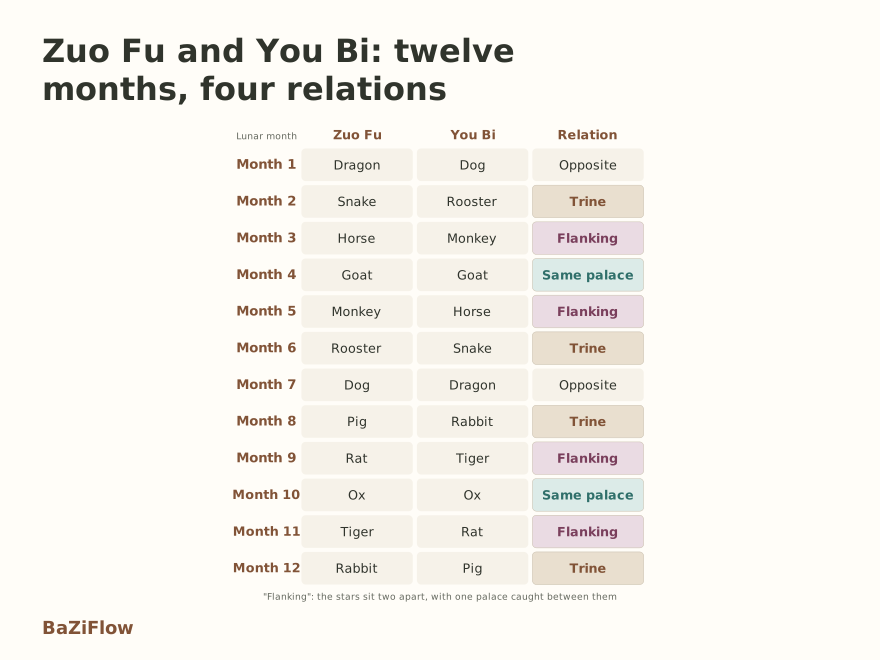 ZW-AUX-02 / Zi Wei Dou Shu
You Bi (右弼): Counted Back From the Dog Position, and Its Four Relations to Zuo Fu
You Bi uses the same lunar month as Zuo Fu, but starts at the Dog branch and counts the other way. A twelve-month table of the pair, a check of the Quan Shu example on flanking the Life palace, and one chart written up.
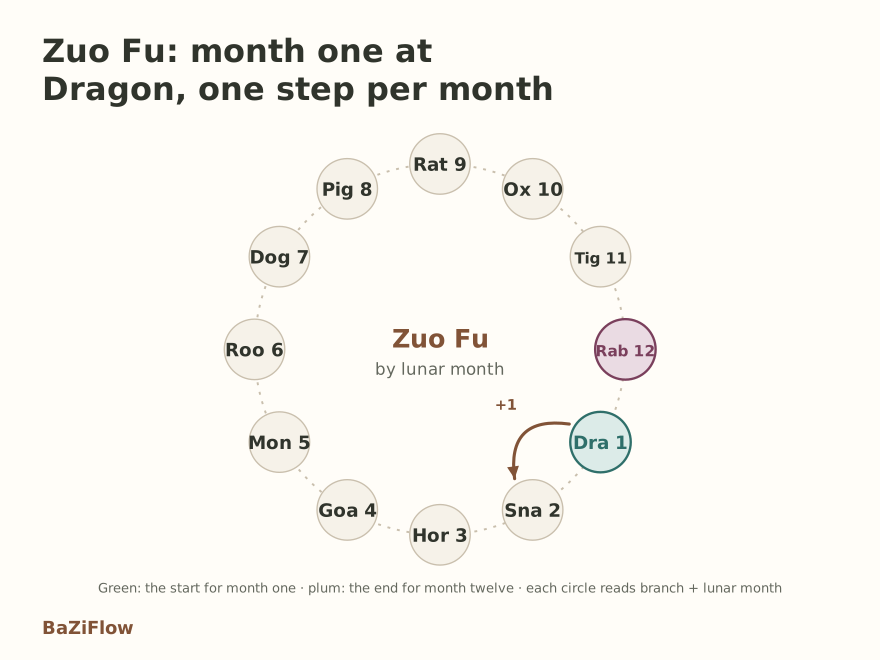 ZW-AUX-01 / Zi Wei Dou Shu
Zuo Fu (左辅): Placed by Lunar Birth Month, From the Dragon Position
Zuo Fu depends on one input, the lunar birth month: month one goes on the Dragon branch and each later month moves one step. A twelve-month map, palace names, the leap-month cutoff and the Santai count.
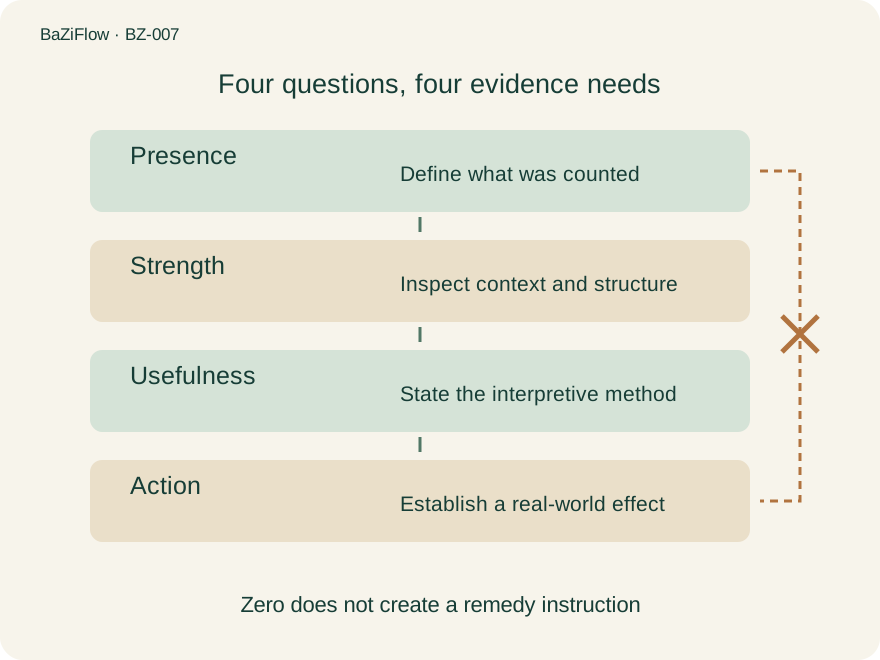 BZ-007 / BaZi
Missing element in BaZi: does it need a remedy? Four questions after a zero
What a missing element in BaZi means: use a chart fragment with no visible Fire but Yang Fire inside Tiger to separate presence, strength, usefulness and action, and check what an element chart actually counts.
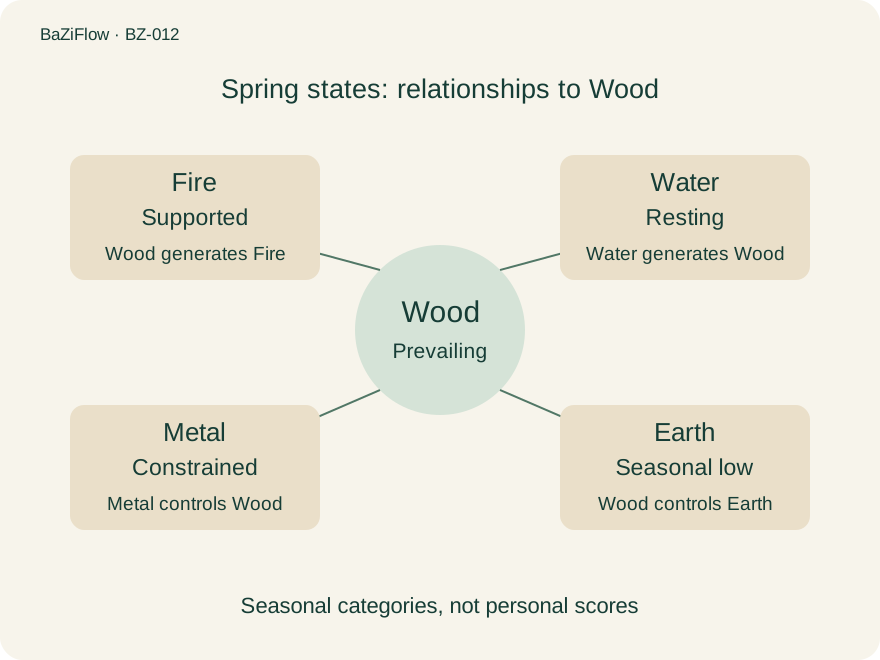 BZ-012 / BaZi
Month command and element strength: season is a condition, not another count
Keep Yang Wood fixed while changing the Tiger month to the Monkey month, then derive the five spring states and distinguish solar-term position, local weather and whole-chart strength.
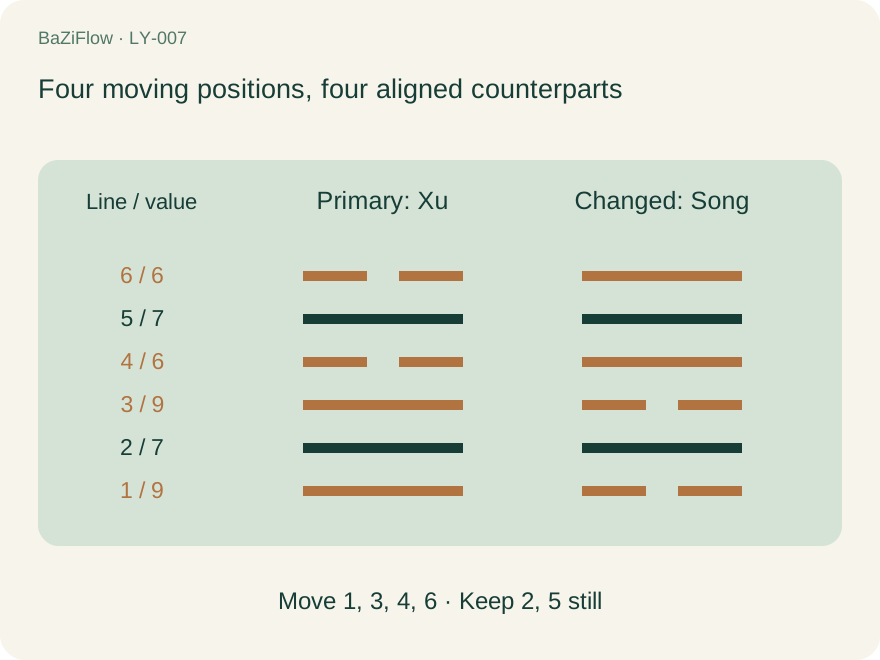 LY-007 / Liu Yao
Moving lines and changed counterparts: auditing Xu to Song
Encode the source diagram as 9, 7, 9, 6, 7, 6, align its four moving positions, and separate changed branch assignments from the original movement record.
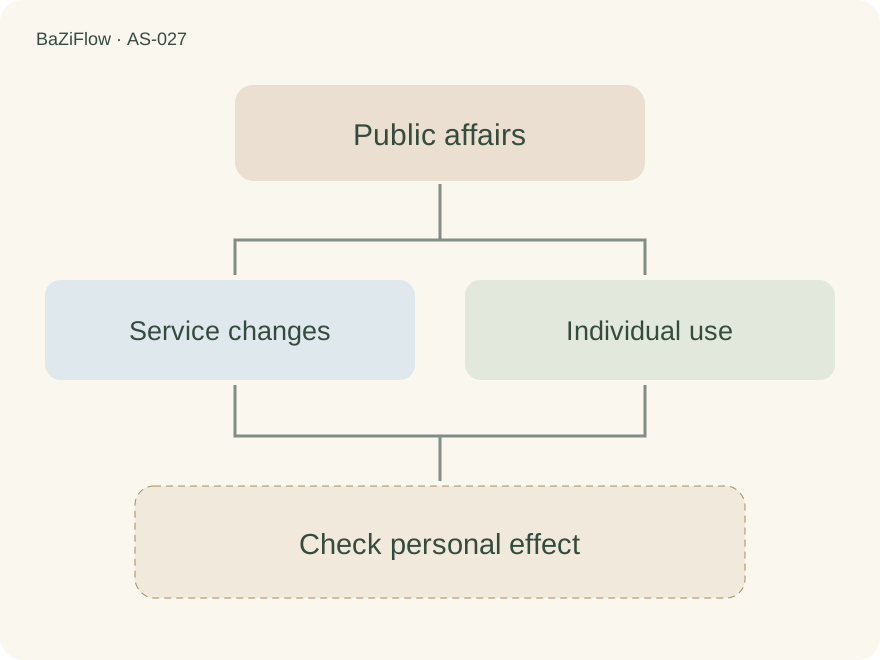 AS-027 / Western astrology
Mundane astrology: public events and personal claims
A reading-room example separates institutional records, personal experience and astrological interpretation, with a method for preserving forecasts before comparing news.
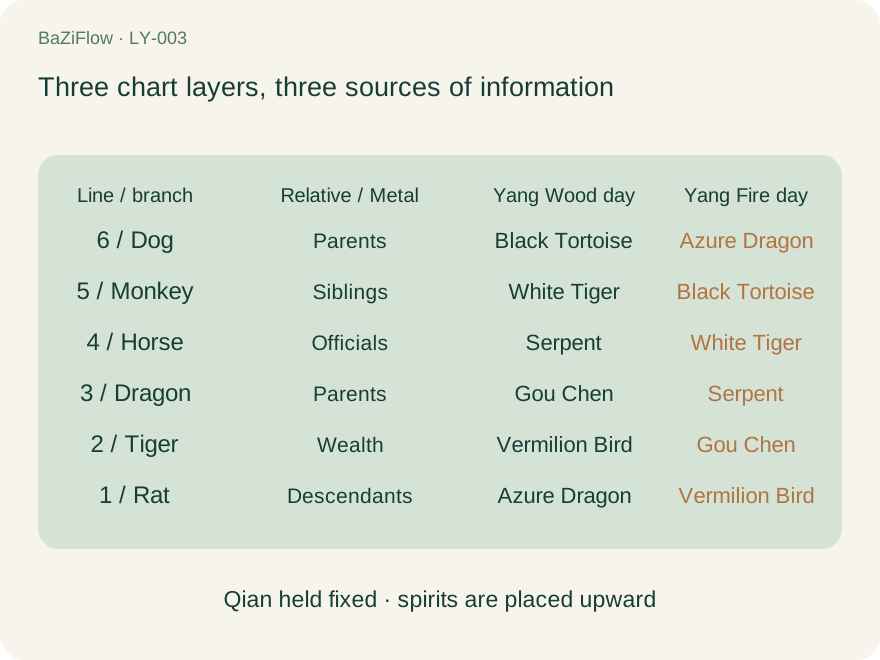 LY-003 / Liu Yao
Najia, Six Relatives, and Six Spirits: three chart layers
Build the annotations of a supplied Qian hexagram, trace relatives to palace Metal, and compare Yang Wood and Yang Fire day stems without confusing the columns.
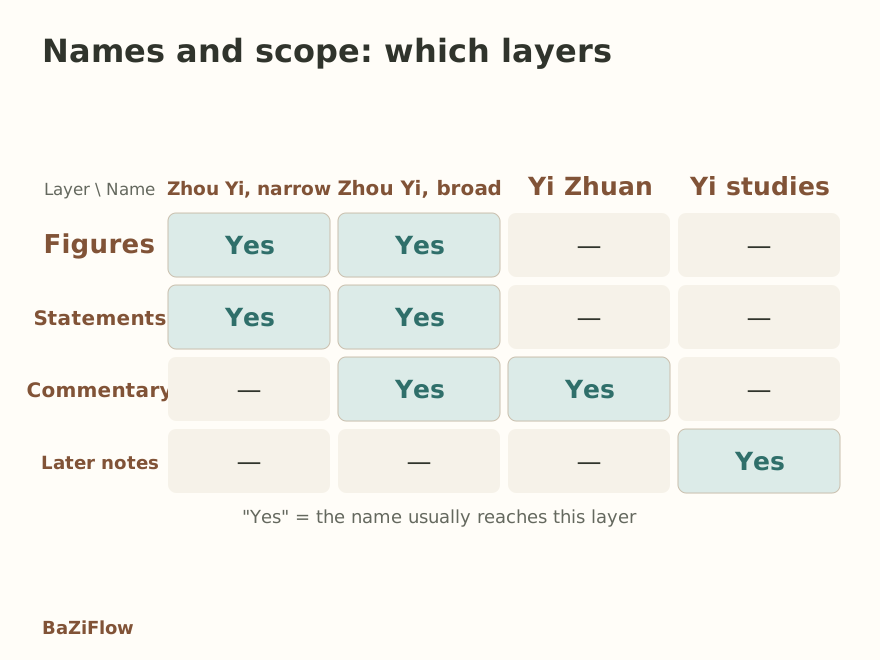 YJ-001 / Yijing
Yijing and Zhou Yi: Sorting the Names and Their Scope
A comparison table separates Yi, Zhou Yi, Yijing, Yi Zhuan and Yi studies by how much each covers, then checks how the Rites of Zhou, the Zuo Zhuan, the Book of Han and the Book of Sui use the names.
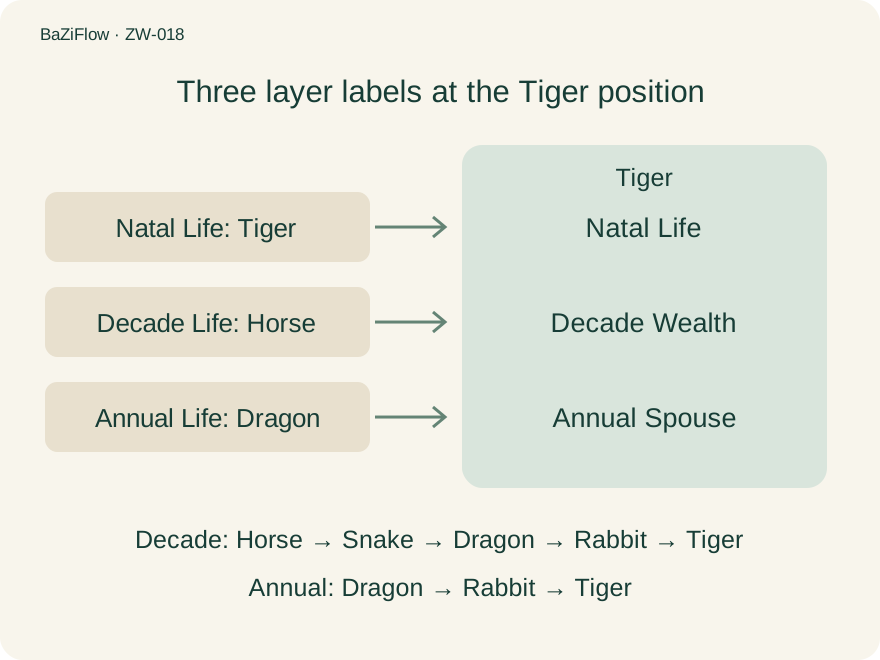 ZW-018 / Zi Wei Dou Shu
Natal, Decade and Annual Layers: Keep the Labels Separate
Work through one fixed branch position with three palace labels. Learn how natal, ten-year and annual scopes differ, and why a shared location does not by itself establish a life event.
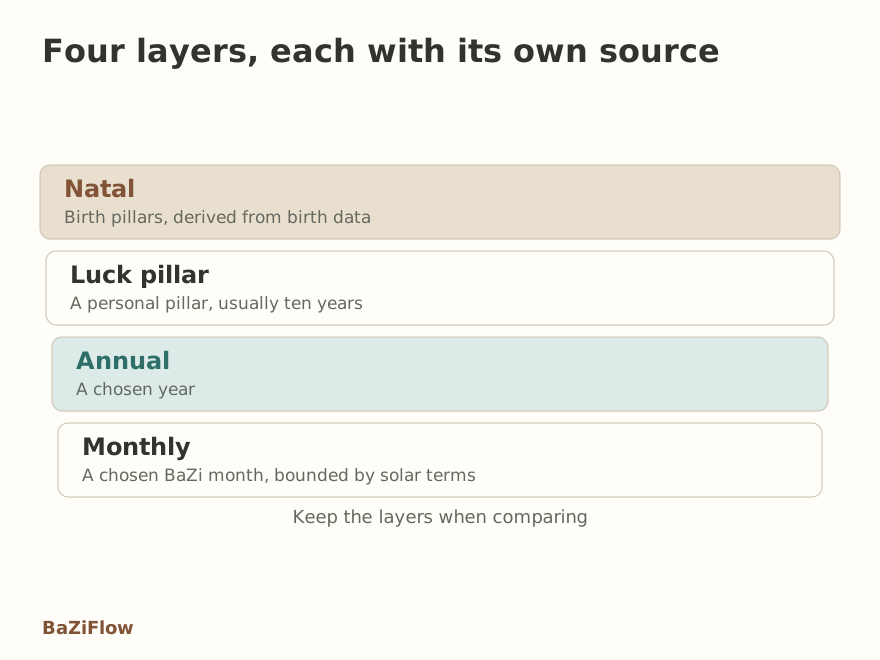 BZ-026 / BaZi
Natal, Luck, Annual and Monthly Layers: How to Read Them Together
Natal chart, luck pillar, year and month are four records with their own sources. A four-layer comparison, the year-to-month stem table and a Horse-year example keep comparison conditions apart from birth facts.
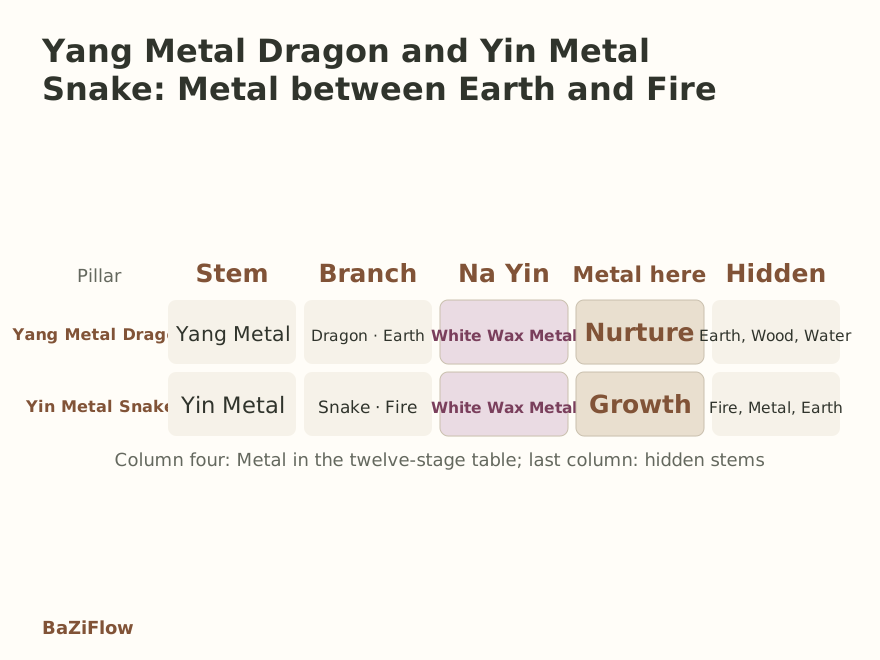 BZ-NY-09 / BaZi
White Wax Metal (白蜡金): Why Yang Metal Dragon and Yin Metal Snake Carry This Na Yin Name
Yang Metal Dragon and Yin Metal Snake share White Wax Metal. The Sanming Tonghui naming is set on Metal's stage circle, where six Metal names fill all twelve stages; then its smelting and official-star lines are checked.
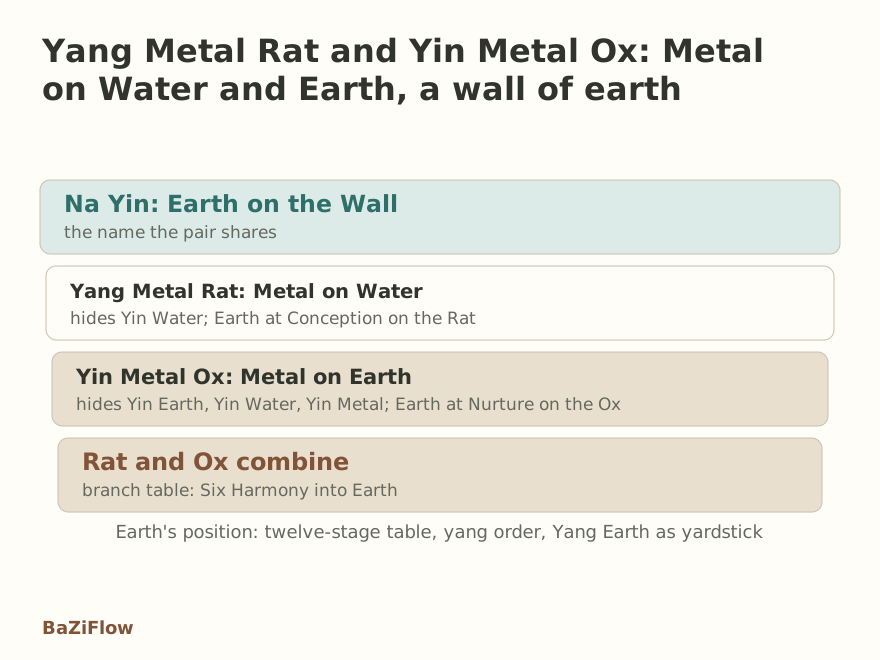 BZ-NY-19 / BaZi
Earth on the Wall (壁上土): Why Yang Metal Rat and Yin Metal Ox Carry This Na Yin Name
Yang Metal Rat and Yin Metal Ox share the nineteenth Na Yin name. The mud-wall reason, the Rat and Ox combining into Earth, the contrast with Earth by the Road, pairings checked, and the Start of Spring in 1960 and 2020.
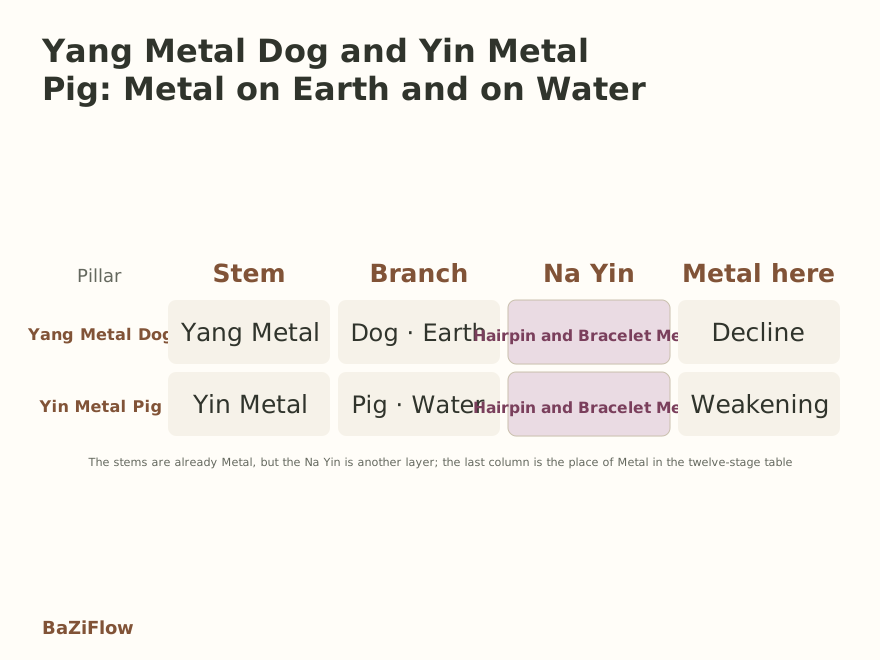 BZ-NY-24 / BaZi
Hairpin and Bracelet Metal (钗钏金): Yang Metal Dog, Yin Metal Pig, Last of Six Metals
The twenty-fourth Na Yin name goes to Yang Metal Dog and Yin Metal Pig. The Sanming Tonghui reads it as finished jewelry put away; the calendar specialists put Metal at Decline and Weakening. Year conversion checked.
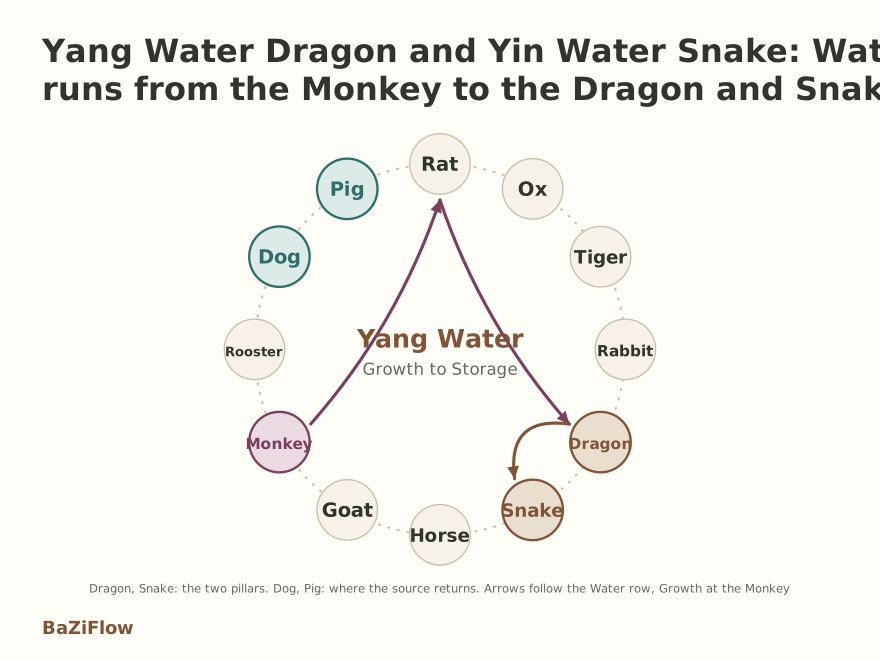 BZ-NY-15 / BaZi
Long Flowing Water (长流水): Yang Water Dragon, Yin Water Snake and Newborn Metal
Yang Water Dragon and Yin Water Snake share Long Flowing Water: Water stored on the Dragon, Metal born on the Snake. Then Storage against Severance, and a table check of Earths, combinations and the dragon line.
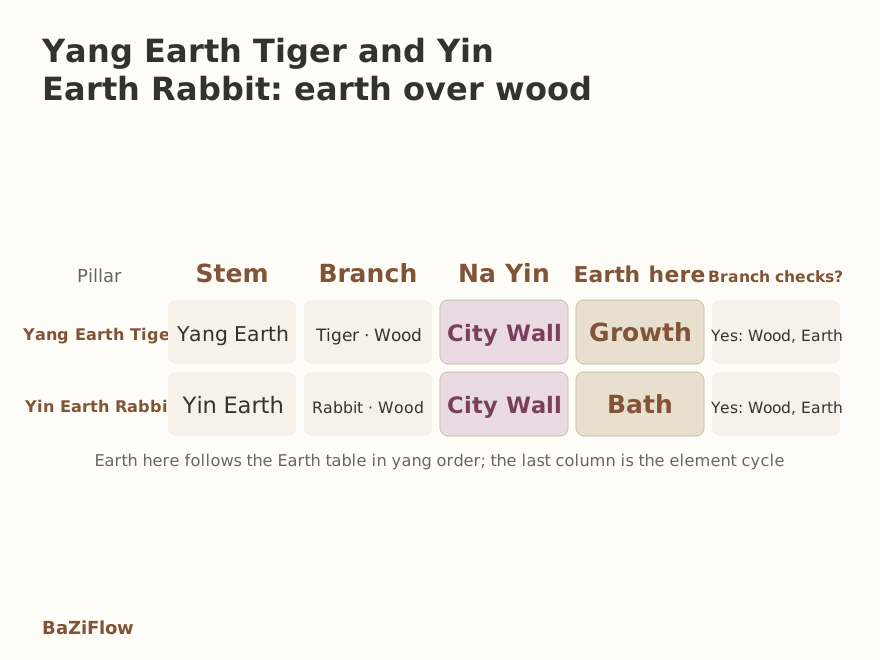 BZ-NY-08 / BaZi
Earth on the City Wall (城头土): Why Yang Earth Tiger and Yin Earth Rabbit Share This Name
Yang Earth Tiger and Yin Earth Rabbit share Earth on the City Wall. Read the naming from the Tiger as a mountain, the contrast with post-road earth and the "made or unmade" rule, then check the wood it names.
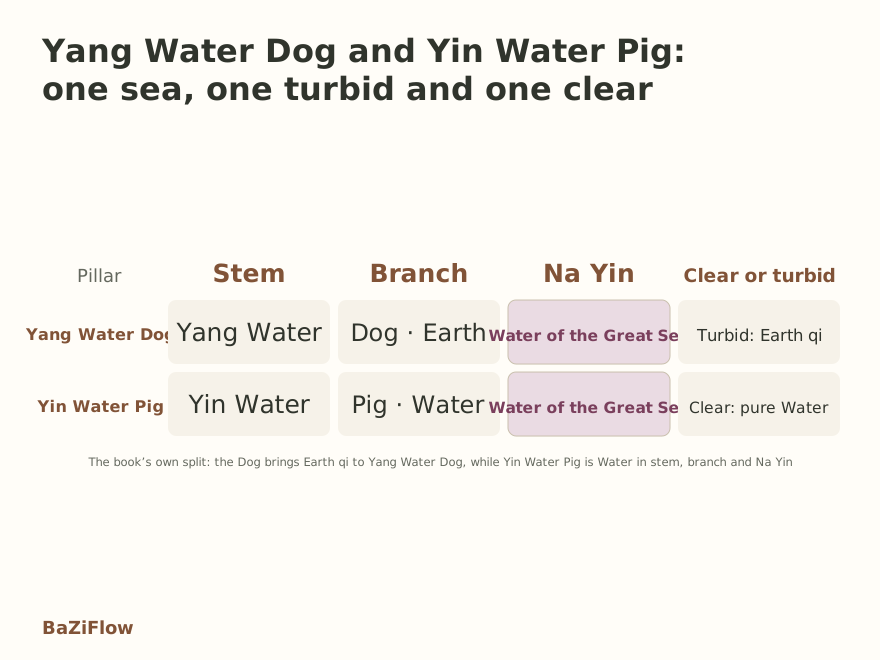 BZ-NY-30 / BaZi
Water of the Great Sea (大海水): Yang Water Dog, Yin Water Pig and the Cycle Restarting
The thirtieth Na Yin name goes to the cycle's last pair: the gate of heaven and returning rivers in the Sanming Tonghui, Yang Water Dog turbid and Yin Water Pig clear, named pairings, and the loop back to Yang Wood Rat.
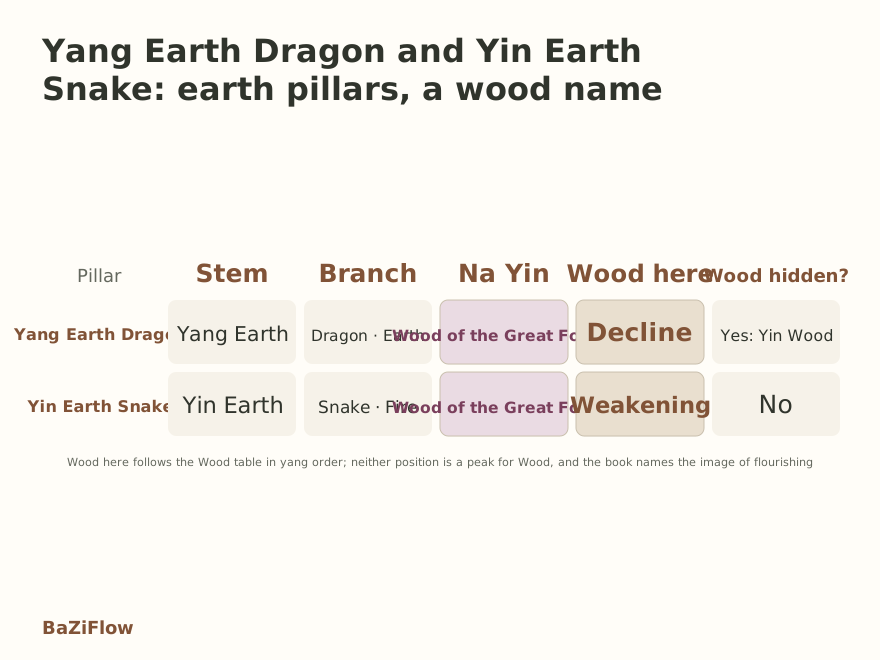 BZ-NY-03 / BaZi
Wood of the Great Forest (大林木): Why Yang Earth Dragon and Yin Earth Snake Share This Name
Yang Earth Dragon and Yin Earth Snake share Wood of the Great Forest. Set the Sanming Tonghui's two images of flourishing against Decline and Weakening on the twelve-stage table, then check the pairings it names.
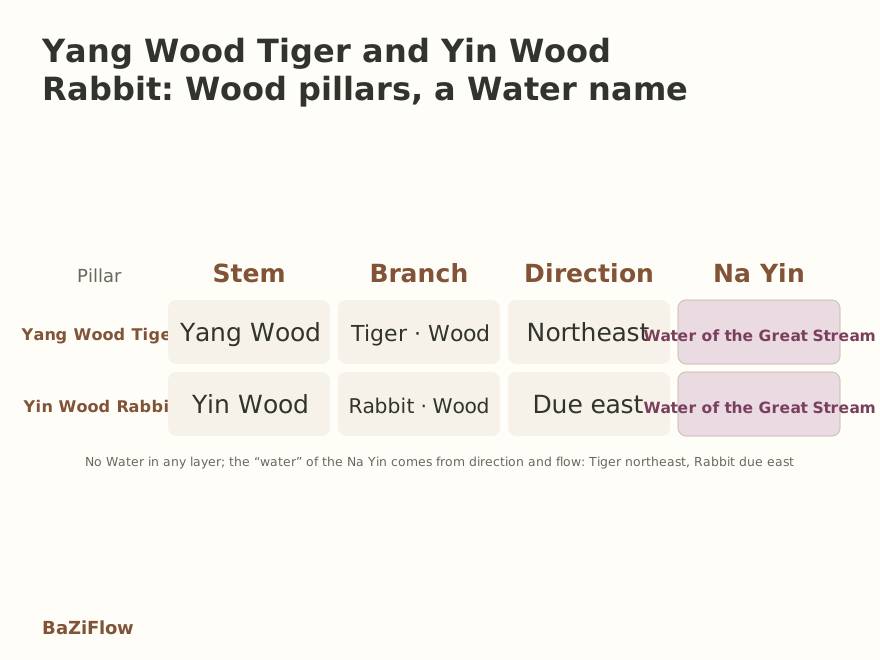 BZ-NY-26 / BaZi
Water of the Great Stream (大溪水): Why Yang Wood Tiger and Yin Wood Rabbit Take This Name
Two pillars of pure Wood share the twenty-sixth Na Yin name. The Sanming Tonghui’s two compass-based lines, the entry’s “return and feed” test, its named clashes, and a year pillar worked out by remainders.
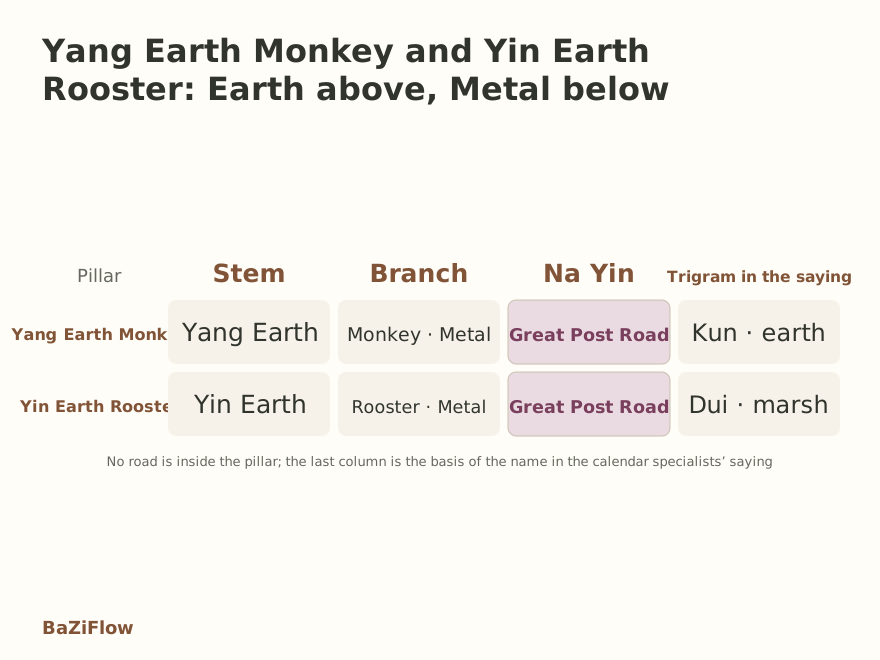 BZ-NY-23 / BaZi
Earth of the Great Post Road (大驿土): Kun and Dui, and the Phrase “Earth at Growth”
Yang Earth Monkey and Yin Earth Rooster share the twenty-third Na Yin name. The Sanming Tonghui reads Monkey as Kun and Rooster as Dui, then calls Yang Earth Monkey “earth at Growth”; two stage tables, pairings, years.
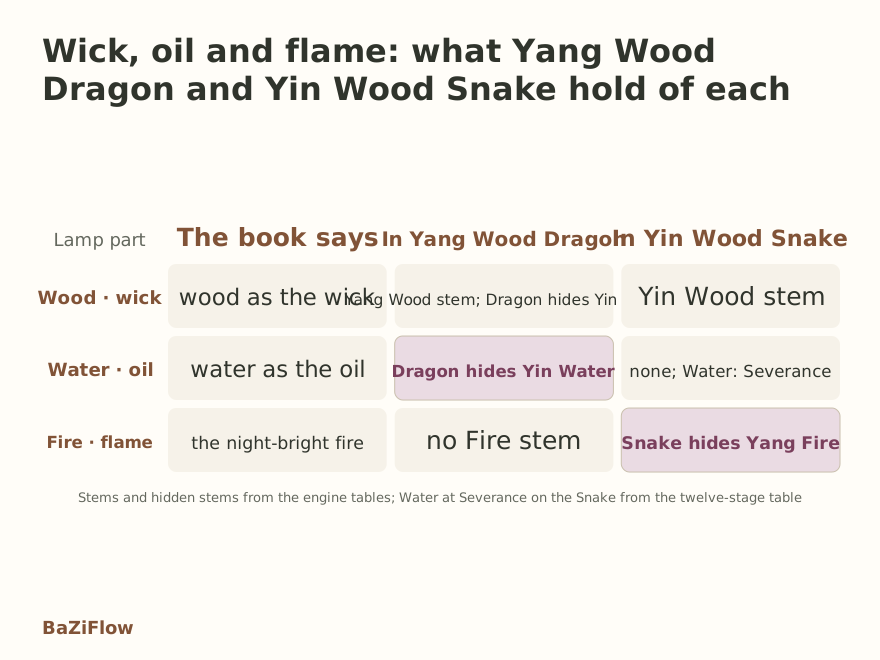 BZ-NY-21 / BaZi
Lamp Cover Fire (覆灯火): Why Yang Wood Dragon and Yin Wood Snake Carry This Na Yin Name
Yang Wood Dragon and Yin Wood Snake share the twenty-first Na Yin name: where a lamp's wick, oil and flame sit in the two pillars, two opposite pictures, the wind of Dragon and Snake, named pairings, and their years.
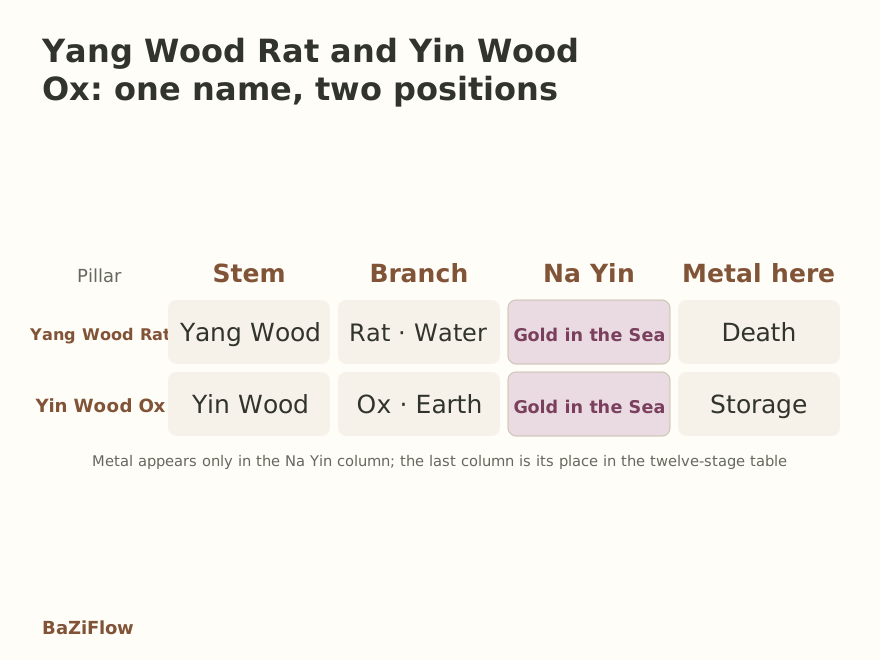 BZ-NY-01 / BaZi
Gold in the Sea (海中金): Why Yang Wood Rat and Yin Wood Ox Carry This Na Yin Name
The first of thirty Na Yin names is shared by Yang Wood Rat and Yin Wood Ox. A table, two reasons for the name, the Sanming Tonghui reading and a year-pillar conversion keep Na Yin, stems and hidden stems apart.
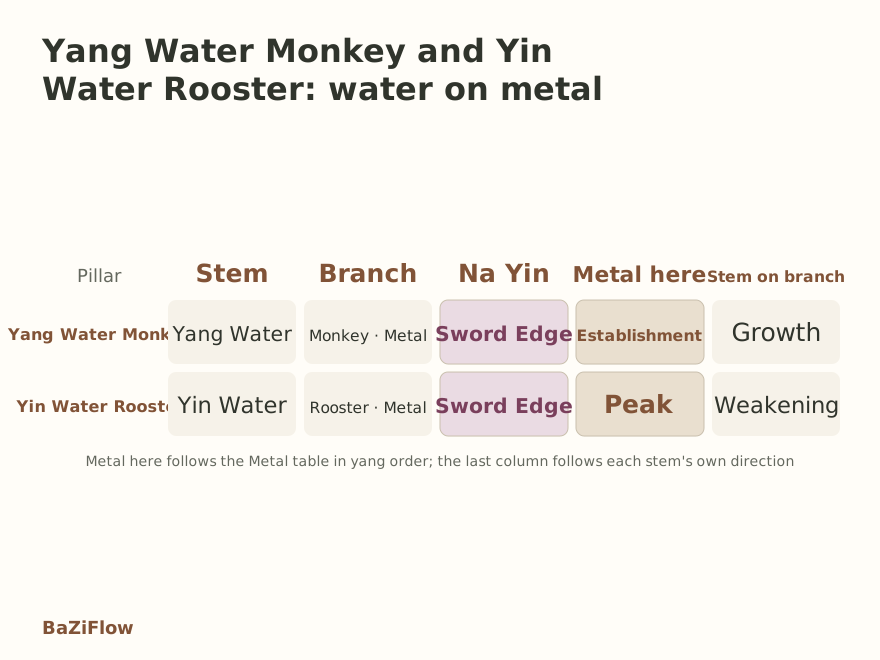 BZ-NY-05 / BaZi
Sword Edge Metal (剑锋金): Why Yang Water Monkey and Yin Water Rooster Carry This Na Yin Name
Yang Water Monkey and Yin Water Rooster share Sword Edge Metal. Check "Establishment on the Monkey, Peak on the Rooster" on the stage table, read the quenching image and its water-not-fire terms, and test the pairings.
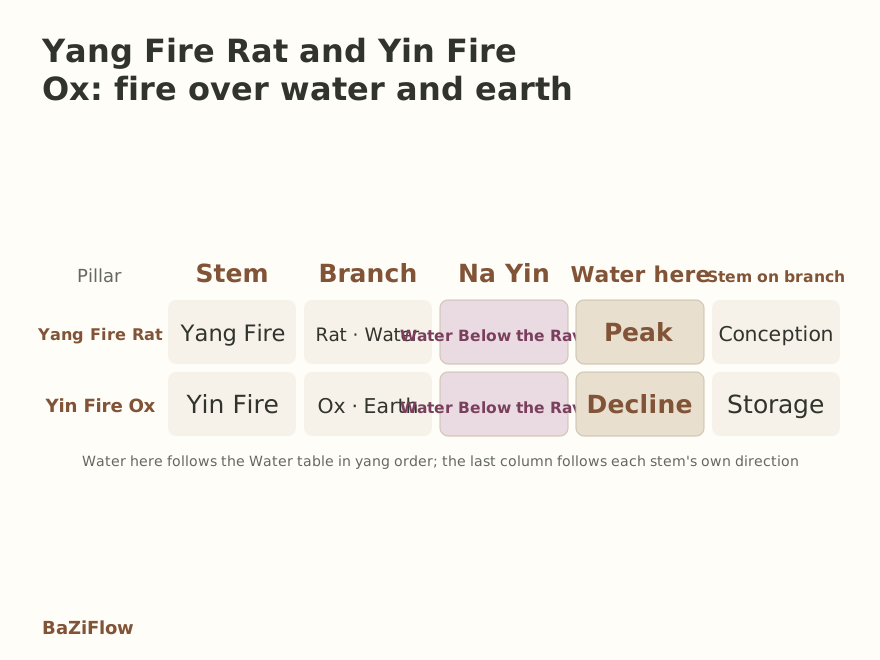 BZ-NY-07 / BaZi
Water Below the Ravine (涧下水): Why Yang Fire Rat and Yin Fire Ox Carry This Na Yin Name
Yang Fire Rat and Yin Fire Ox share Water Below the Ravine. Check "Water peaks at the Rat and fades at the Ox" on the stage table, set it beside the long-flowing and great-sea waters, then test the named pairings.
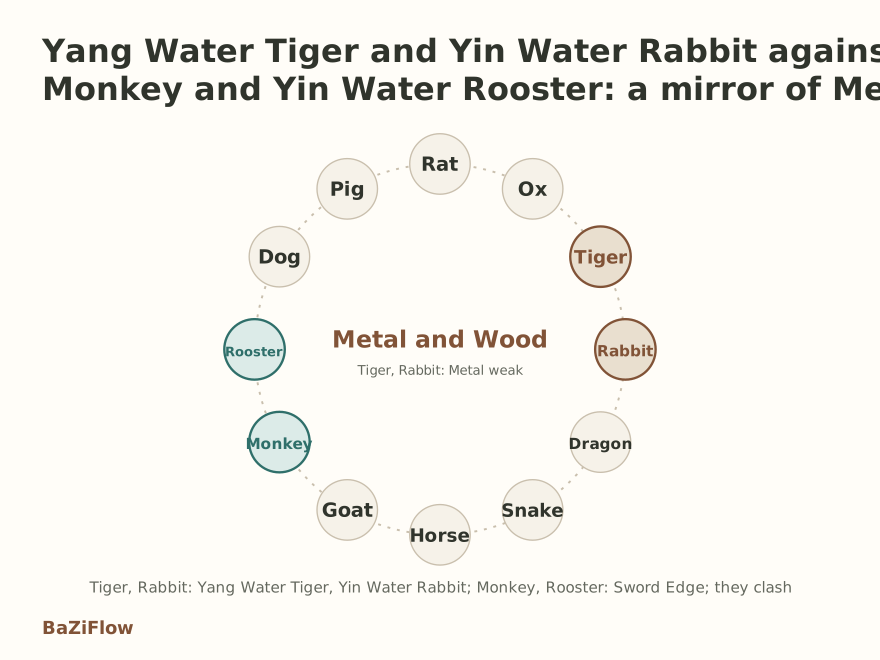 BZ-NY-20 / BaZi
Gold Foil Metal (金箔金): Why Yang Water Tiger and Yin Water Rabbit Carry This Na Yin Name
Yang Water Tiger and Yin Water Rabbit share the twentieth Na Yin name: Wood at its height with Metal cut off, the mirror of Sword Edge Metal, two spellings, pairings checked, and the yearly drift of the Start of Spring.
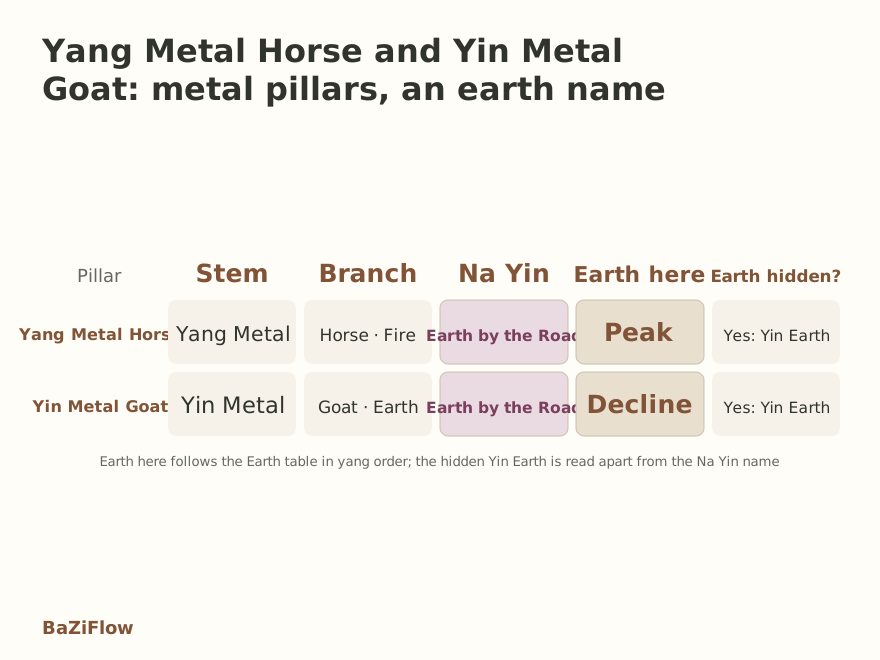 BZ-NY-04 / BaZi
Earth by the Road (路旁土): Why Yang Metal Horse and Yin Metal Goat Carry This Na Yin Name
Yang Metal Horse and Yin Metal Goat share Earth by the Road. Follow the Sanming Tonghui's two images of a road that shows the land, why it asks for water first and metal second, and check its named pairings.
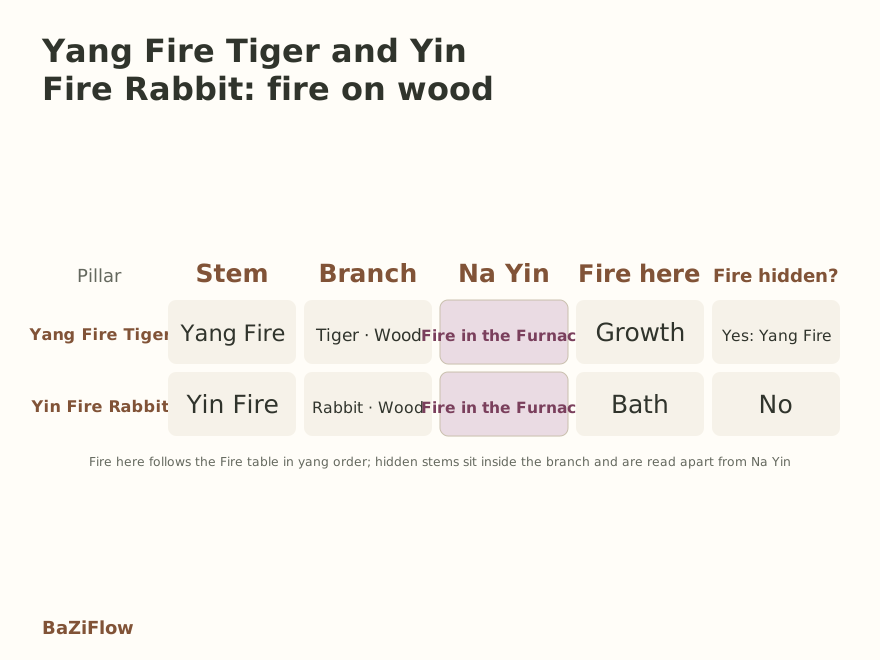 BZ-NY-02 / BaZi
Fire in the Furnace (炉中火): Why Yang Fire Tiger and Yin Fire Rabbit Carry This Na Yin Name
Yang Fire Tiger and Yin Fire Rabbit share Fire in the Furnace. Check the book's "self-born" and "self-defeated" against the twelve-stage table, test its named pairings, and place the year pillar by the Start of Spring.
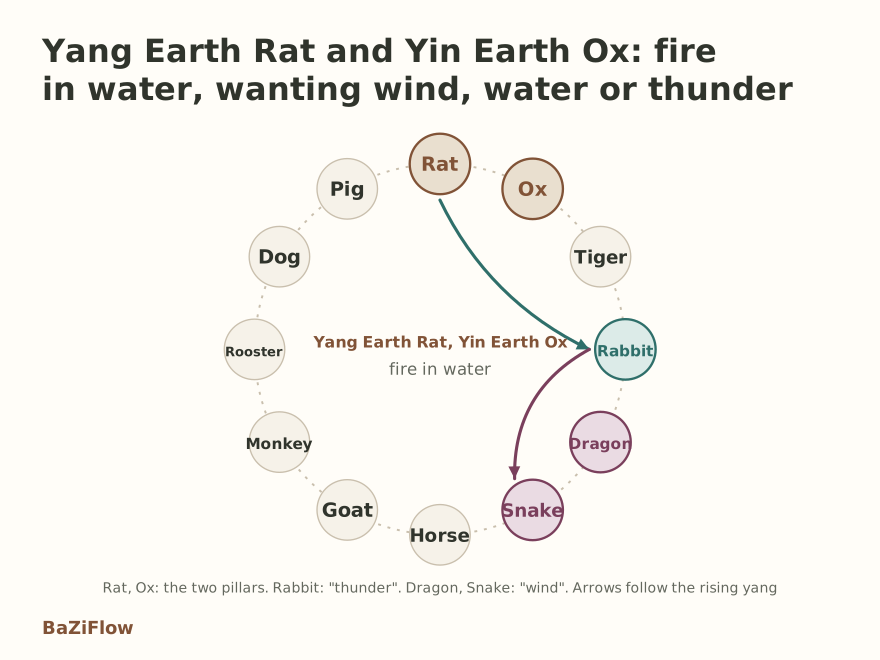 BZ-NY-13 / BaZi
Thunderbolt Fire (霹雳火): Yang Earth Rat, Yin Earth Ox and Fire Inside Water
Yang Earth Rat and Yin Earth Ox share Thunderbolt Fire. Neither pillar holds fire; the book says fire in water needs a divine dragon, adds wind, water and thunder as helpers, and rates the two pillars unevenly.
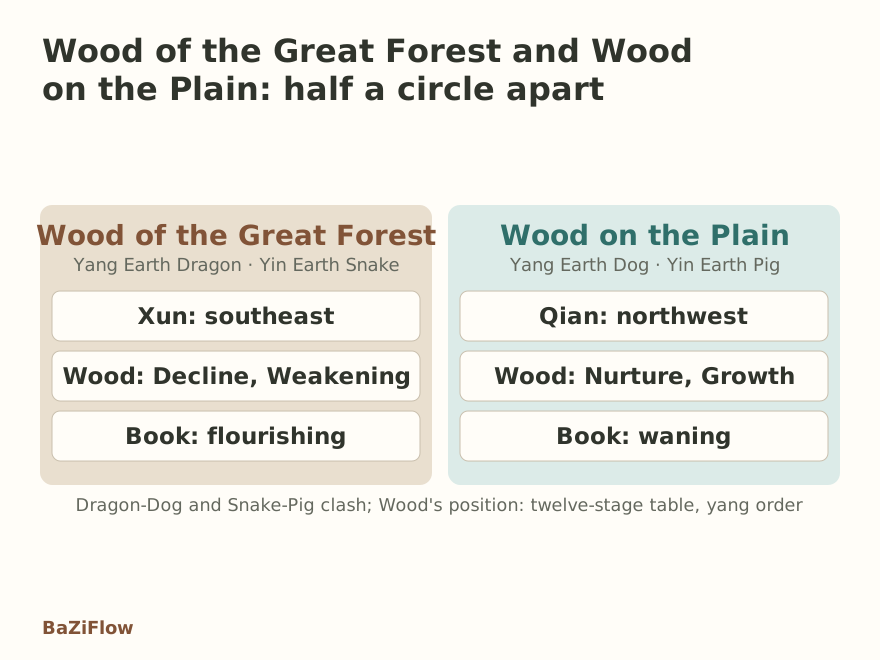 BZ-NY-18 / BaZi
Wood on the Plain (平地木): Why Yang Earth Dog and Yin Earth Pig Carry This Na Yin Name
Yang Earth Dog and Yin Earth Pig share the eighteenth Na Yin name: the open field and Wood's birthplace, the mirror of the Great Forest, ridgepole and beam, a garden example, pairings, and the 1960 Start of Spring.
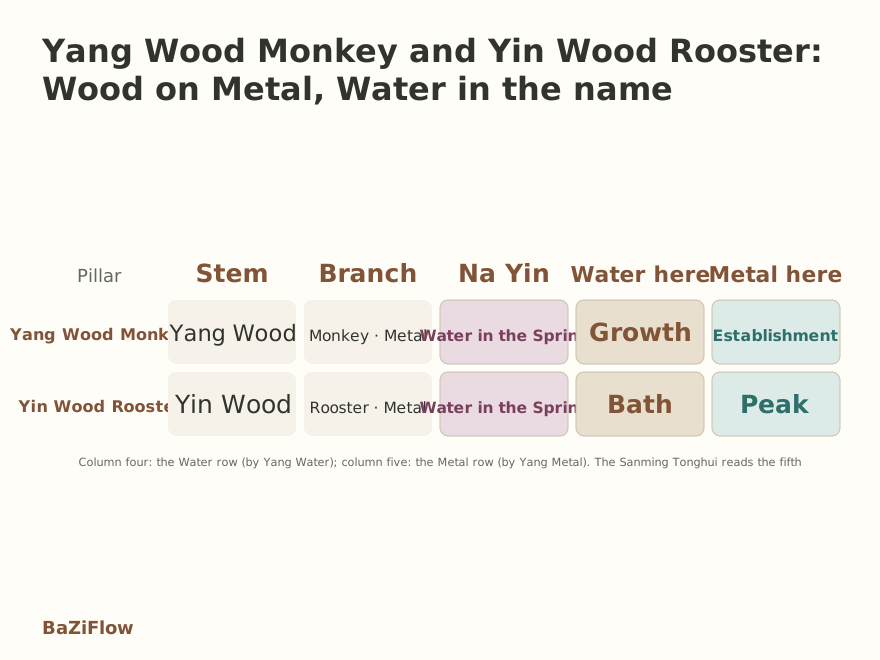 BZ-NY-11 / BaZi
Water in the Spring (泉中水), or Well-Spring Water: Yang Wood Monkey and Yin Wood Rooster
Yang Wood Monkey and Yin Wood Rooster share Water in the Spring, which the Sanming Tonghui writes Well-Spring Water: Metal birthing Water, a well as picture, two patterns, and the digit-sum method that counts Water out.
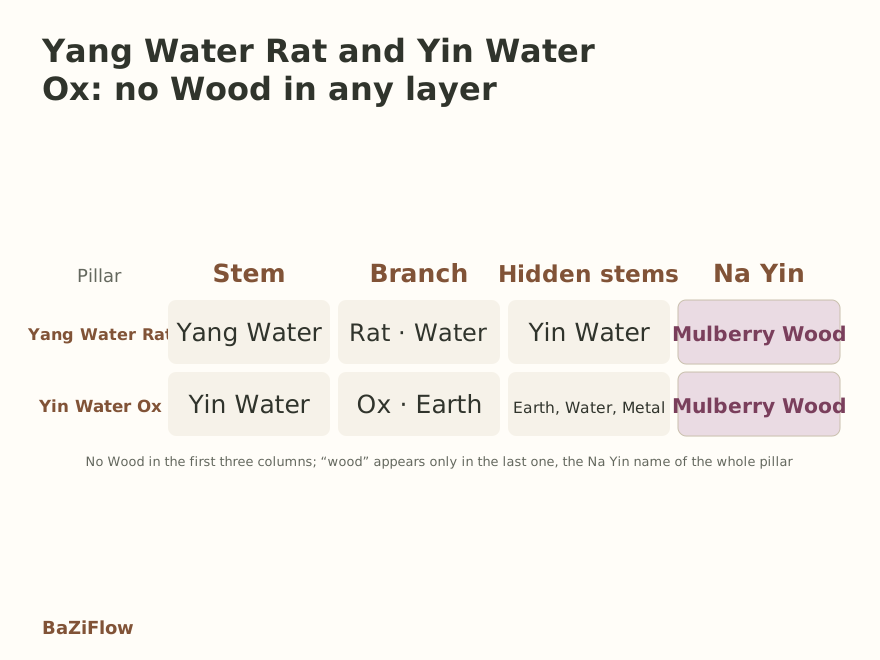 BZ-NY-25 / BaZi
Mulberry Wood (桑柘木): No Wood in Yang Water Rat or Yin Water Ox, So Why This Name
Yang Water Rat and Yin Water Ox share the twenty-fifth Na Yin name with no Wood in any layer: the Sanming Tonghui’s two lines of imagery, the Ox as Metal, silkworm pasture on Dragon and Snake, January births.
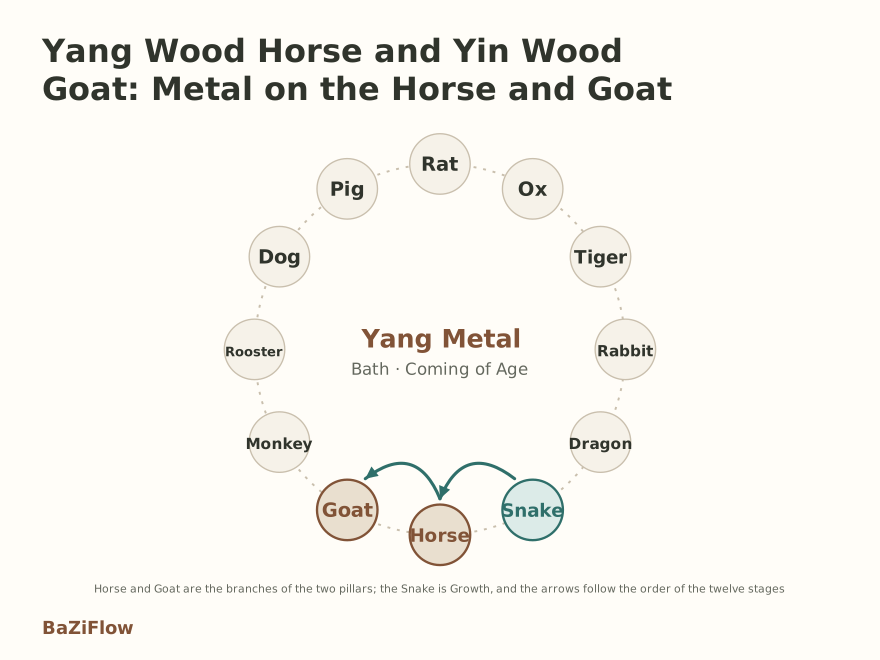 BZ-NY-16 / BaZi
Sandstone Metal (沙中金): Why Yang Wood Horse and Yin Wood Goat Carry This Na Yin Name
Yang Wood Horse and Yin Wood Goat share the sixteenth Na Yin name: four spellings, the Xieji Bianfang Shu's five-tone derivation, why Horse is "defeat" and Goat "coming of age", and the named pairings checked.
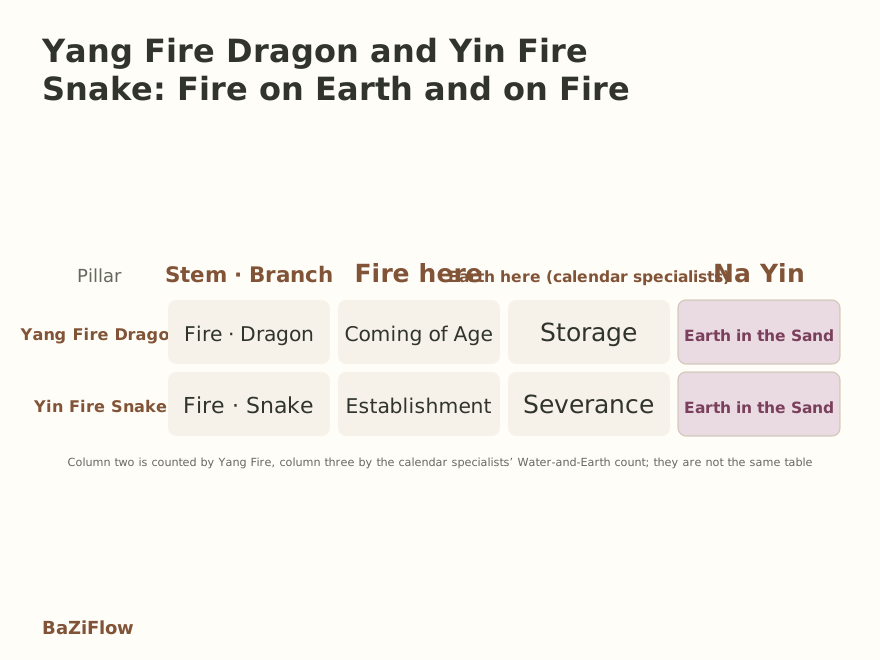 BZ-NY-27 / BaZi
Earth in the Sand (沙中土): Yang Fire Dragon, Yin Fire Snake and Two Stage Tables
Yang Fire Dragon and Yin Fire Snake share the twenty-seventh Na Yin name: the Sanming Tonghui's dragon-and-snake imagery, one sentence counting Earth and Fire on different tables, the word “Yang Fire”, two sample charts.
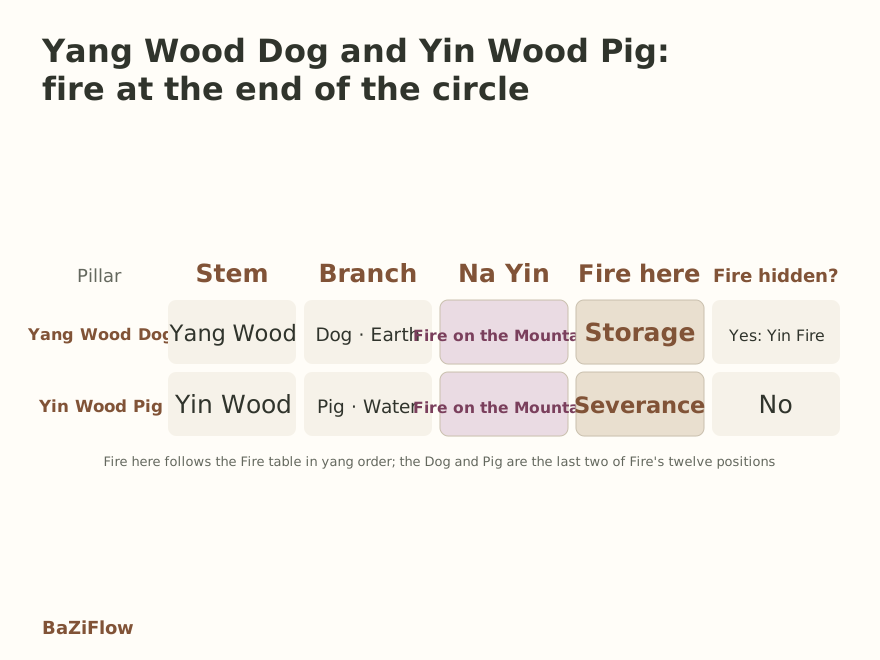 BZ-NY-06 / BaZi
Fire on the Mountain (山头火): Why Yang Wood Dog and Yin Wood Pig Carry This Na Yin Name
Yang Wood Dog and Yin Wood Pig share Fire on the Mountain. The Sanming Tonghui gives one name three pictures; set them beside Storage and Severance on the stage table, check its pairings and place the year pillar.
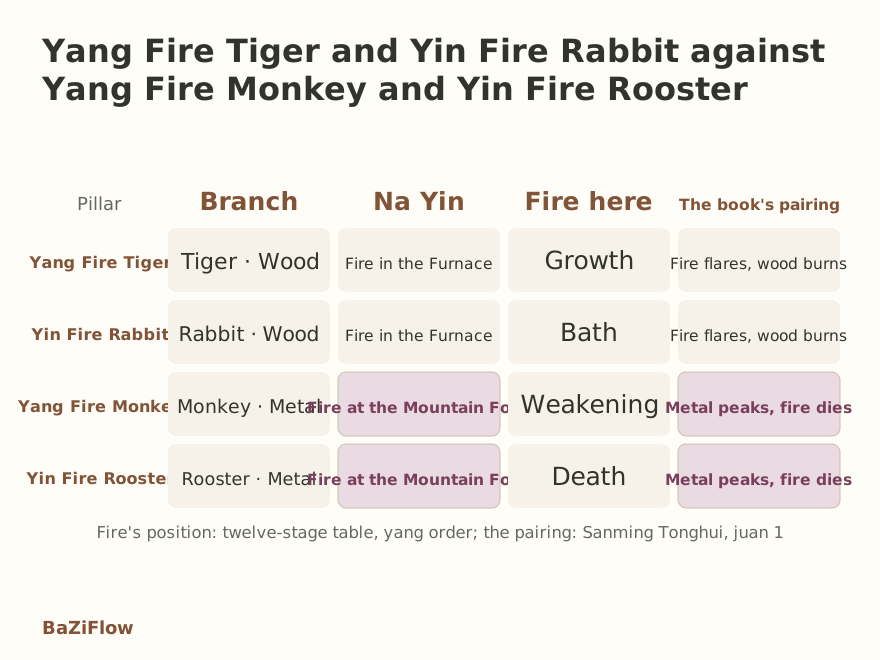 BZ-NY-17 / BaZi
Fire at the Mountain Foot (山下火): The Na Yin of Yang Fire Monkey and Yin Fire Rooster
Yang Fire Monkey and Yin Fire Rooster share the seventeenth Na Yin name. Sanming Tonghui sunset images, Weakening and Death on the table, two readings of the fire, pairings checked, two Starts of Spring off the 4th.
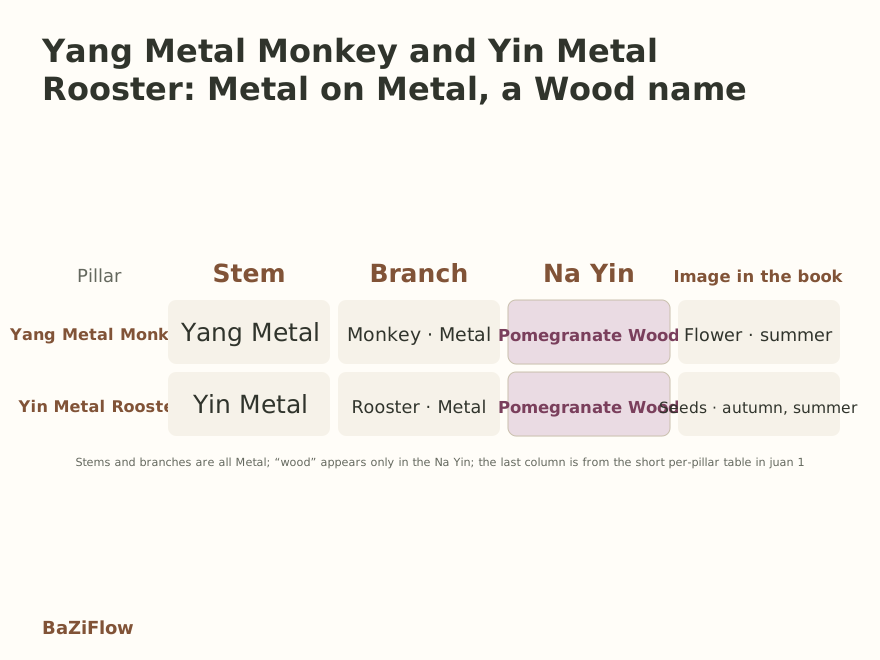 BZ-NY-29 / BaZi
Pomegranate Wood (石榴木): A Wood Name on All-Metal Yang Metal Monkey and Yin Metal Rooster
Yang Metal Monkey and Yin Metal Rooster are Metal through and through, yet share a Wood name: the Sanming Tonghui's two lines of imagery, the rule that Metal stems may serve as Wood, a Wood–Metal swap, pairings, years.
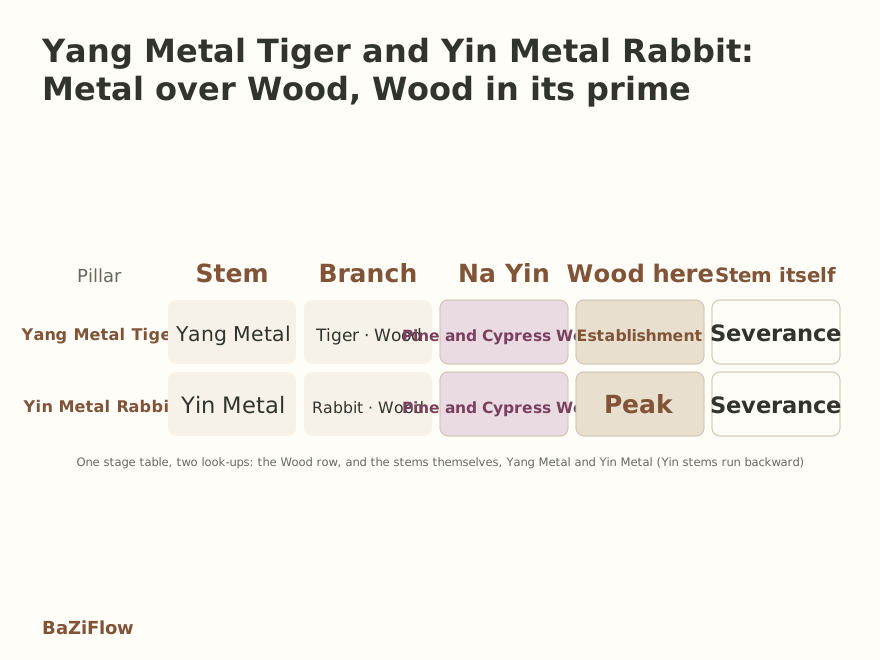 BZ-NY-14 / BaZi
Pine and Cypress Wood (松柏木): Metal Over Wood, Read as Firm in the Cold
Yang Metal Tiger and Yin Metal Rabbit share Pine and Cypress Wood. Metal sits over Wood, yet the book reads it as firm in the cold; then Wood at Establishment and Peak, the pair against Pomegranate, and four pairings.
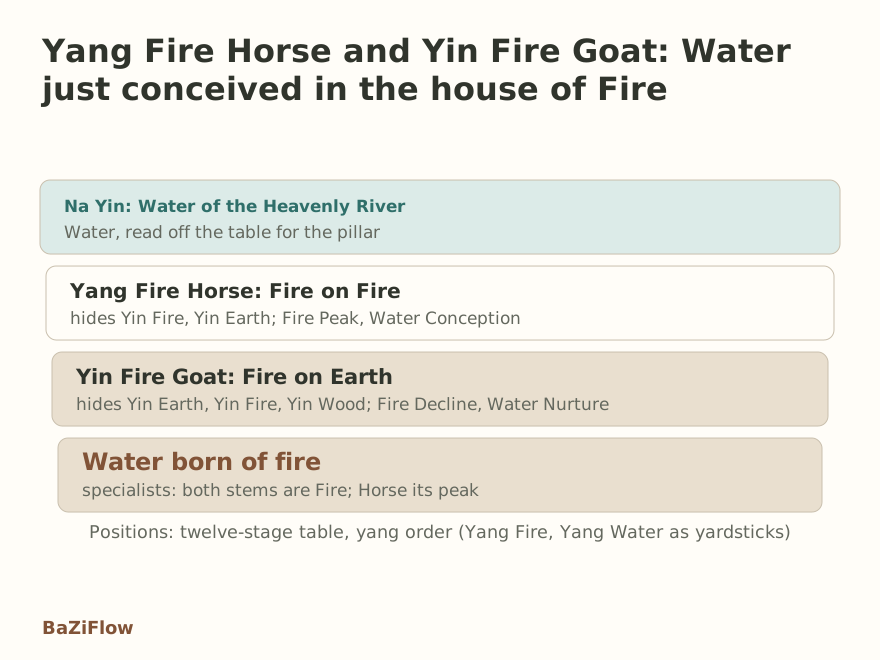 BZ-NY-22 / BaZi
Water of the Heavenly River (天河水): Why Yang Fire Horse and Yin Fire Goat Carry This Name
Yang Fire Horse and Yin Fire Goat share the twenty-second Na Yin name: Water born of fire, at Conception and Nurture on Horse and Goat, the Thunderbolt Fire mirror, a raft into the river, and the 2026 Start of Spring.
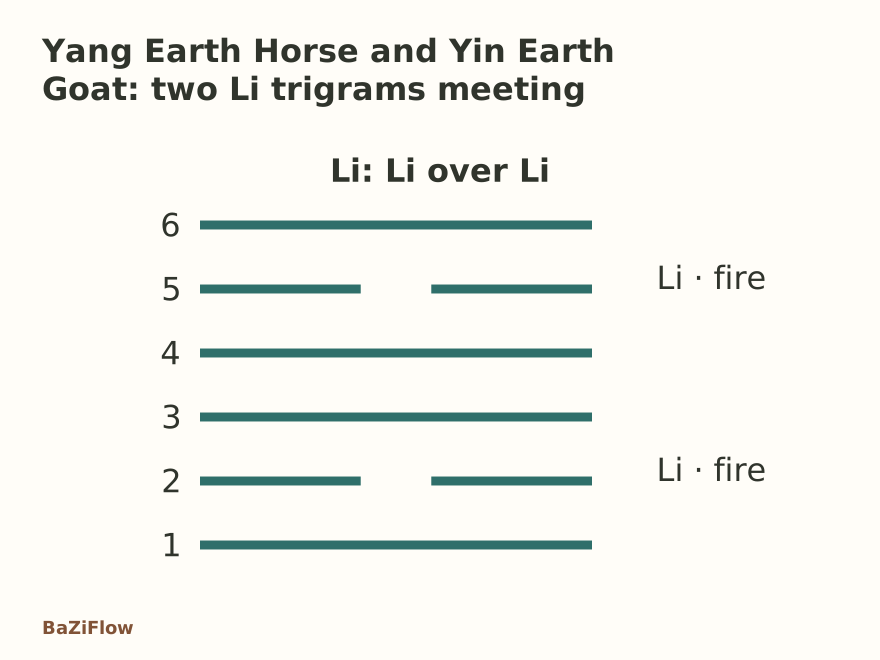 BZ-NY-28 / BaZi
Fire in the Sky (天上火): Yang Earth Horse, Yin Earth Goat and the Sun-and-Moon Patterns
Yang Earth Horse and Yin Earth Goat share the twenty-eighth Na Yin name: the Sanming Tonghui’s “two Li meeting”, the Horse as peak fire fed by the Goat's Wood, the sun-and-moon patterns, pairings and the year pillar.
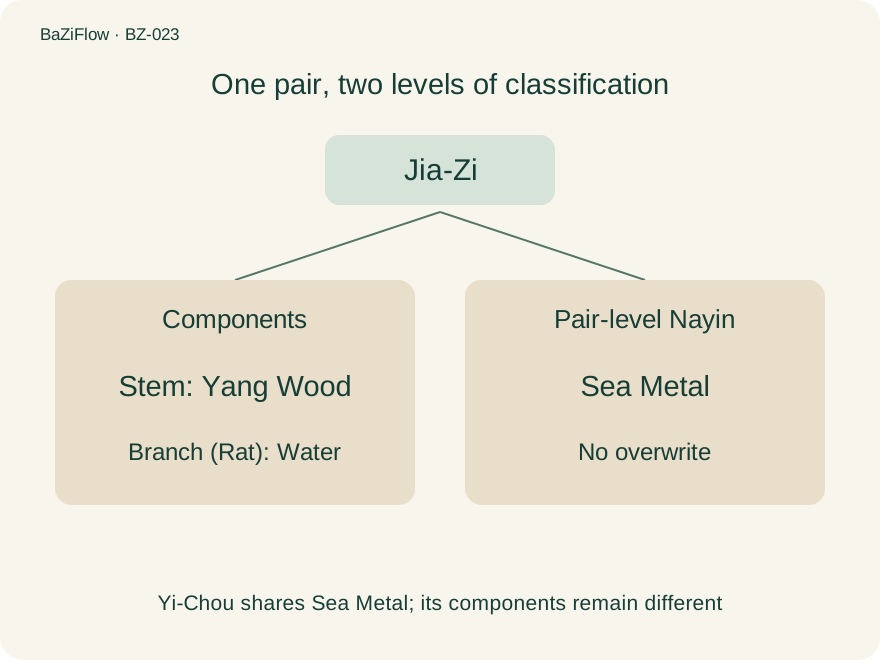 BZ-023 / BaZi
What is Na Yin in BaZi? Why Yang Wood Rat Gold in the Sea does not replace Yang Wood
How Na Yin differs from ordinary elements: separate stem, branch, hidden-stem and whole-pillar classifications through Yang Wood Rat and Yin Wood Ox, then tell Na Yin Metal from a Metal Day Master or missing Metal.
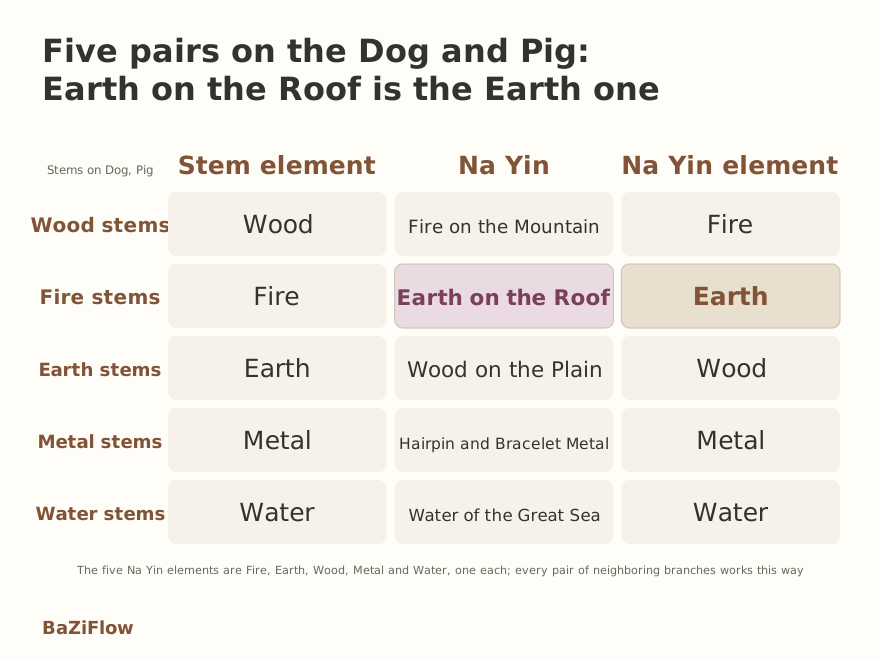 BZ-NY-12 / BaZi
Earth on the Roof: Why Yang Fire Dog and Yin Fire Pig Carry This Name, "Finished Earth"
Yang Fire Dog and Yin Fire Pig share Earth on the Roof. Five pairs sit on the Dog and Pig, one per element; then fire rising, the fired tile, "finished" against "unfinished" Earth, and the combination patterns.
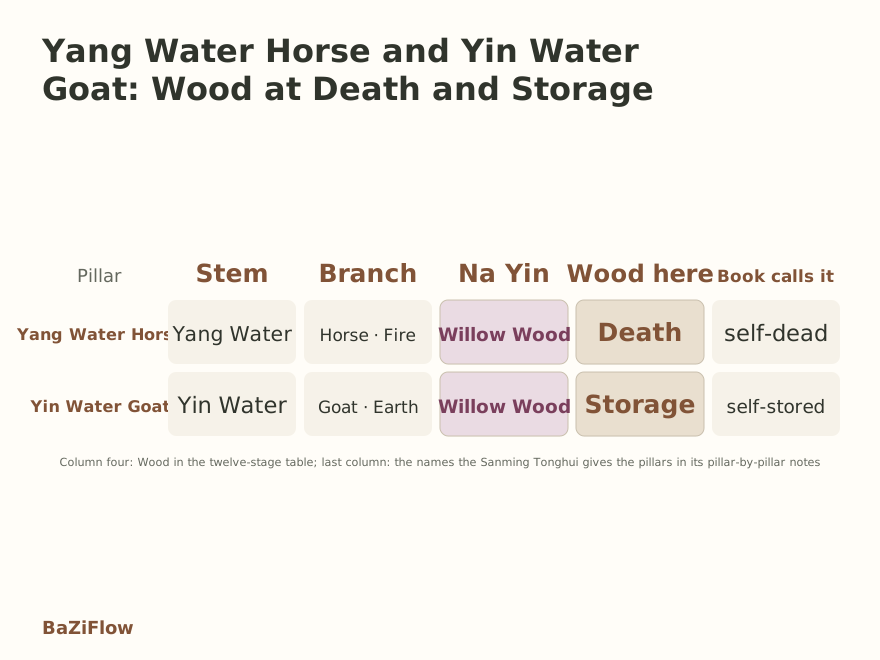 BZ-NY-10 / BaZi
Willow Wood (杨柳木): Why Yang Water Horse and Yin Water Goat Carry This Na Yin Name
Yang Water Horse and Yin Water Goat share Willow Wood: Wood at Death and Storage, two opposite leaves in one book, the rule letting another pillar overrule "small and weak", and four Willow-trailing-gold pillars checked.
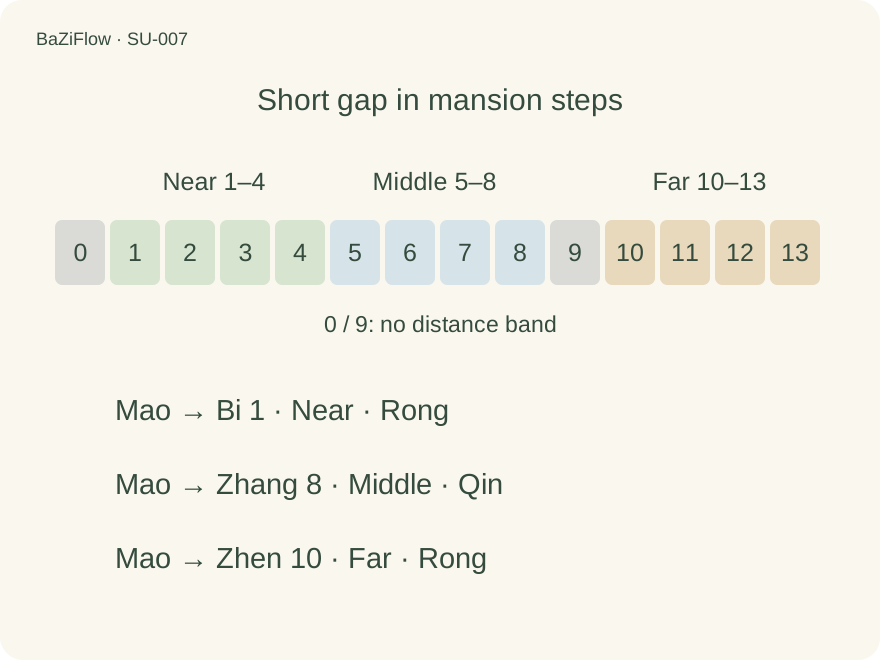 SU-007 / Sukuyō astrology
Sukuyō distance: separate short gap from direction
Apply a named practitioner convention to 27-position offsets, test the excluded gaps and keep distance bands distinct from roles, addresses and relationship evidence.
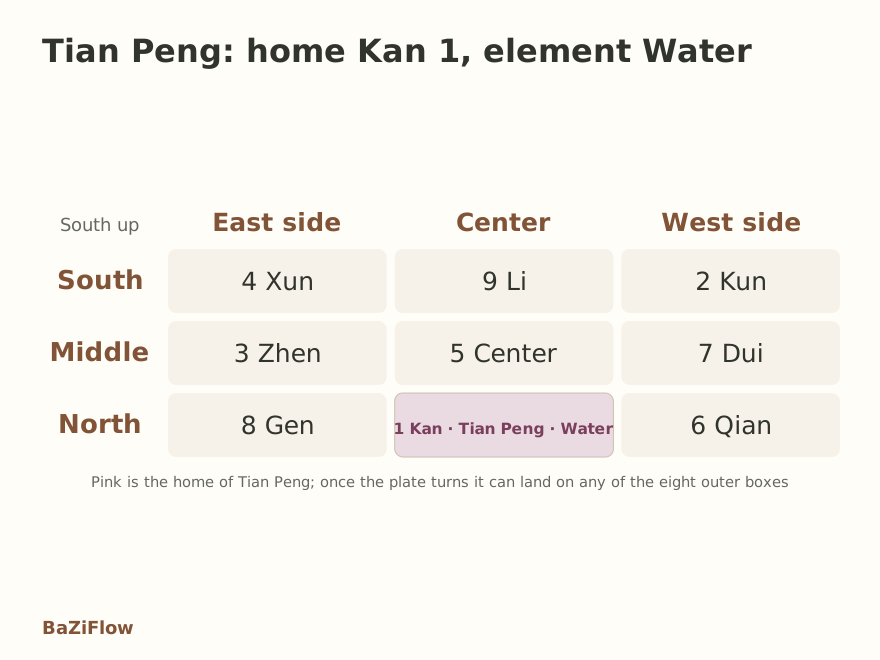 QM-STAR-01 / Qimen Dunjia
Tian Peng: Water in Kan One, Its Name, Fu Yin, Fan Yin and Three Rankings
Tian Peng is the star whose home is Kan One, element Water. The book's "courtesy name", star-level Fu Yin and Fan Yin, the Water-star month table and three rankings keep the home position apart from where it lands.
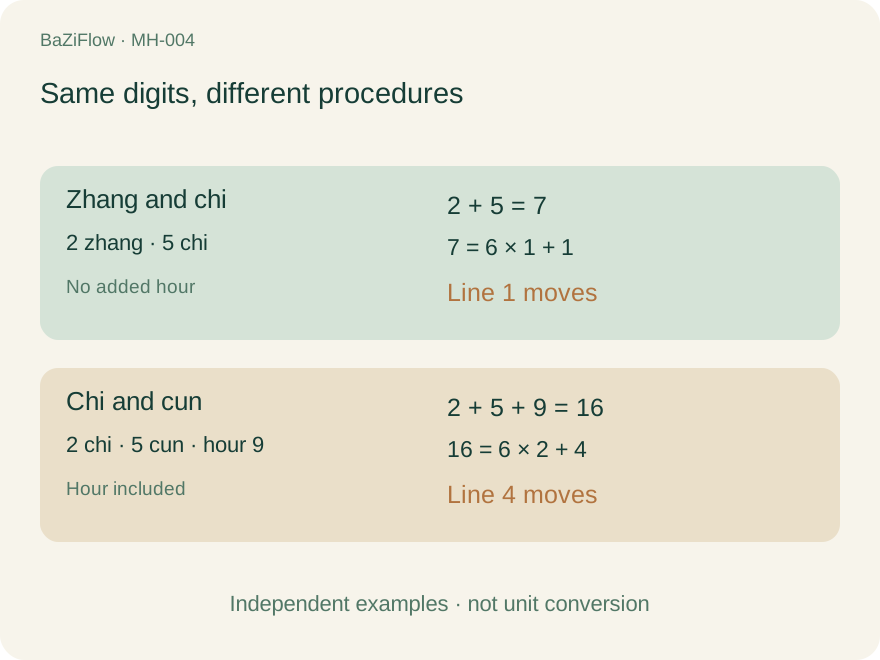 MH-004 / Meihua Yishu
Number casting: why the source matters as much as the digits
Compare two classical measurement procedures using the same pair of values, and learn why units, original numbers and grouping must survive in a casting record.
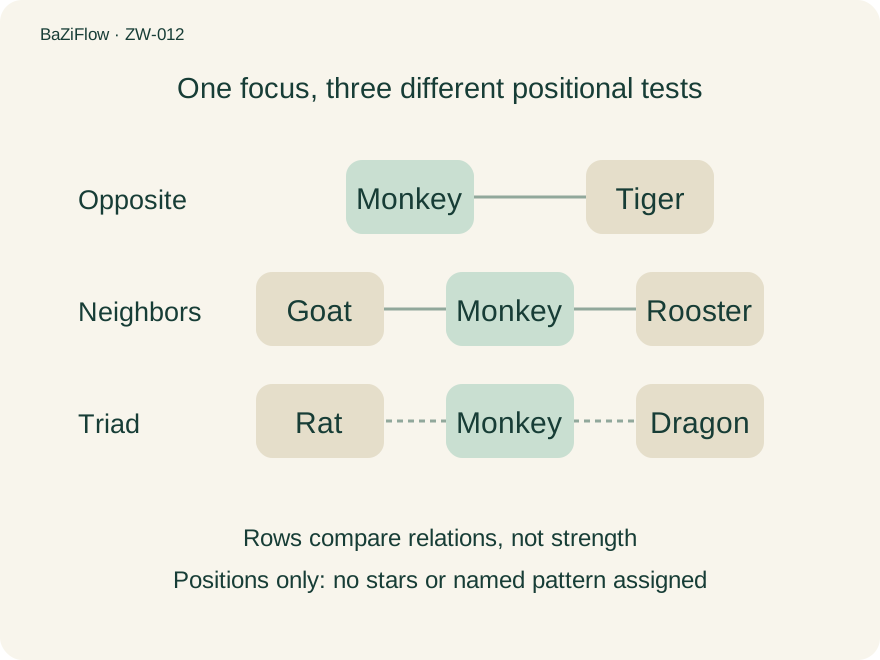 ZW-012 / Zi Wei Dou Shu
Opposite, flanking and converging palaces are different relations
Use Monkey as a focus to distinguish its opposite, its immediate neighbors and its triad partners. Keep relationship words tied to checkable chart positions.
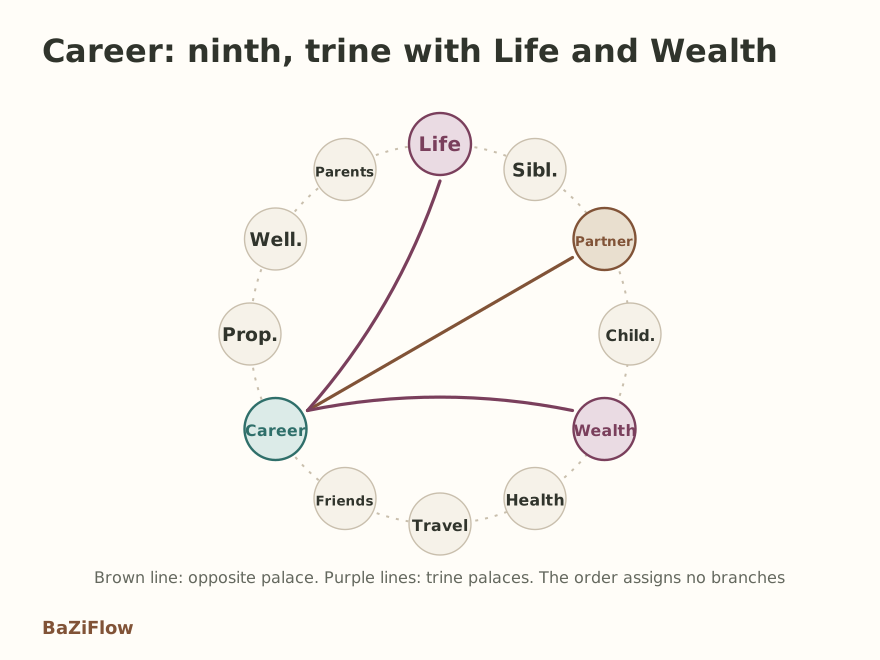 ZW-PAL-09 / Zi Wei Dou Shu
The Career Palace in Zi Wei Dou Shu: What "Office" Meant in the Book, and Today
The Career palace is the ninth of twelve, trine with Life and Wealth. Read the office words of juan 2, five verses that sort officials by type and the four stars called masters of Career, then translate for today.
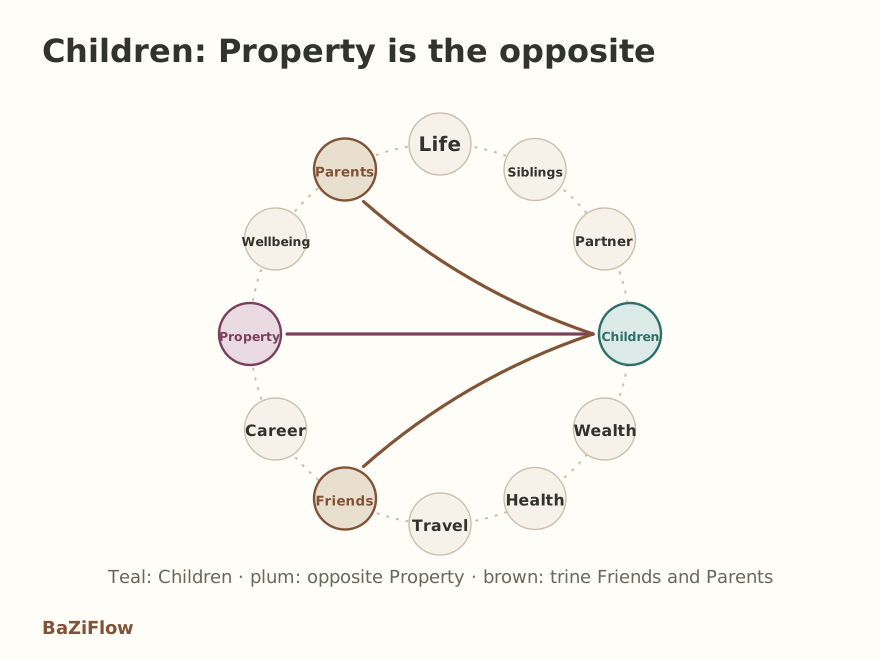 ZW-PAL-04 / Zi Wei Dou Shu
The Children Palace (子女宫): Own Palace, Then the Opposite, and Where to Look If It Is Empty
The Children palace is the fourth box in the order. See its opposite, Property, read the order juan 2 gives for it, find where to look when the own palace holds no stars, and see its place in the strong and weak grading.
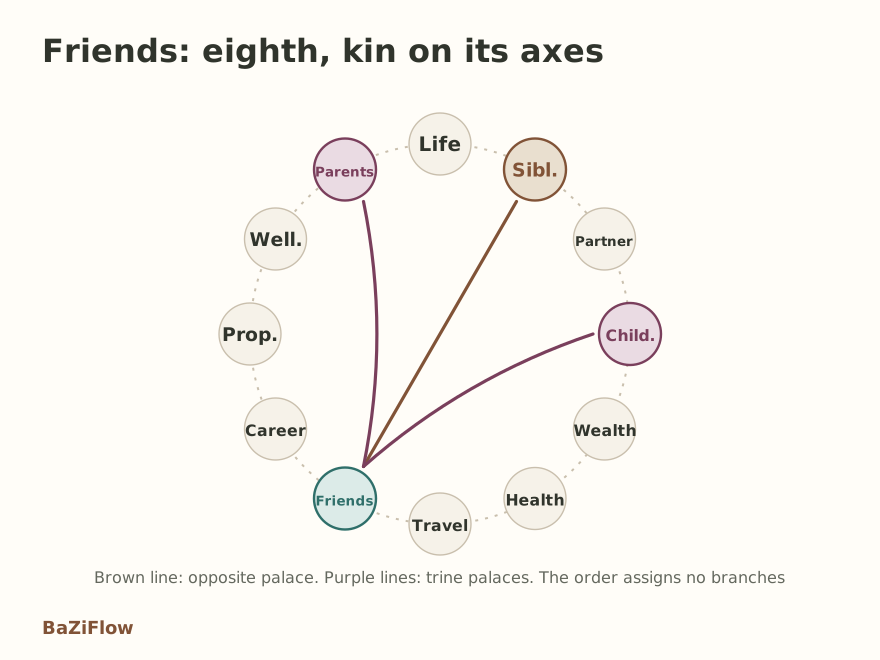 ZW-PAL-08 / Zi Wei Dou Shu
The Friends Palace in Zi Wei Dou Shu: Three Names and the Kin Palaces on Its Axes
The Friends palace is the eighth of twelve, the servants palace in the old book. Work out its opposite and trine palaces, weigh the book's wording, and place it with the rule "six from Life is Tian Shang."
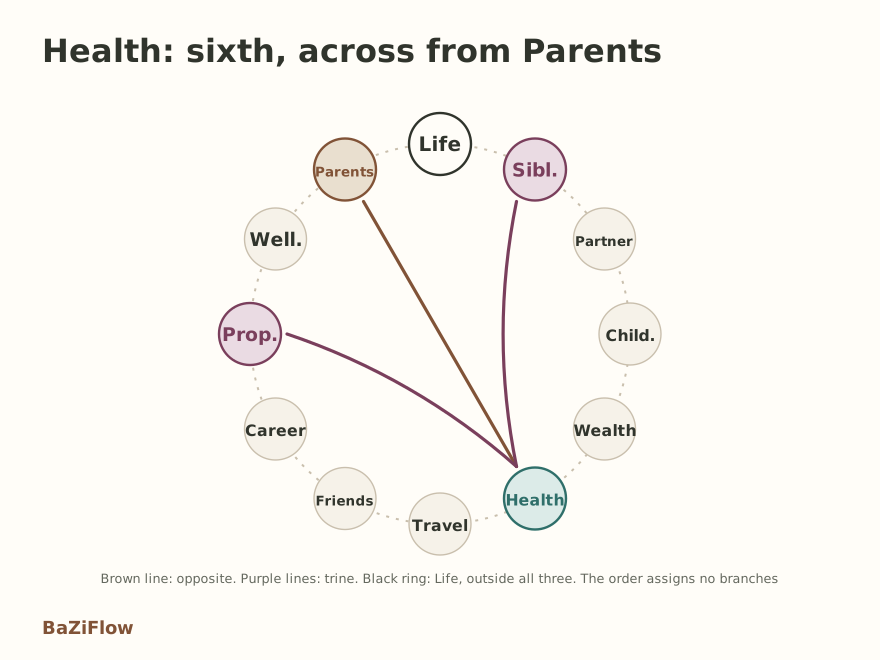 ZW-PAL-06 / Zi Wei Dou Shu
The Health Palace (疾厄宫): The Second Look After Life, and the Words Its Entries Use
The Health palace is the sixth box, opposite Parents and outside Life's four directions. Follow the order juan 2 gives, count the words its entries use, and see their three-slot pattern. No symptom lines are quoted.
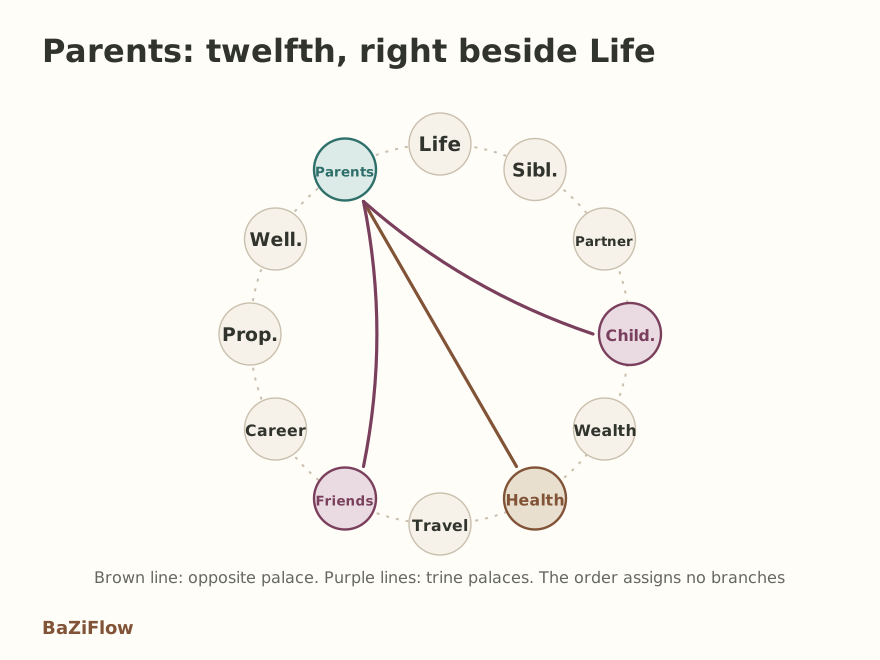 ZW-PAL-12 / Zi Wei Dou Shu
The Parents Palace in Zi Wei Dou Shu: The Last Palace, and the Sun-and-Moon Index
The Parents palace is the twelfth and last, right beside Life. Read how juan 2 indexes it with the Sun as father and the Moon as mother, check both stars in the grade table, and take the book's own closing line.
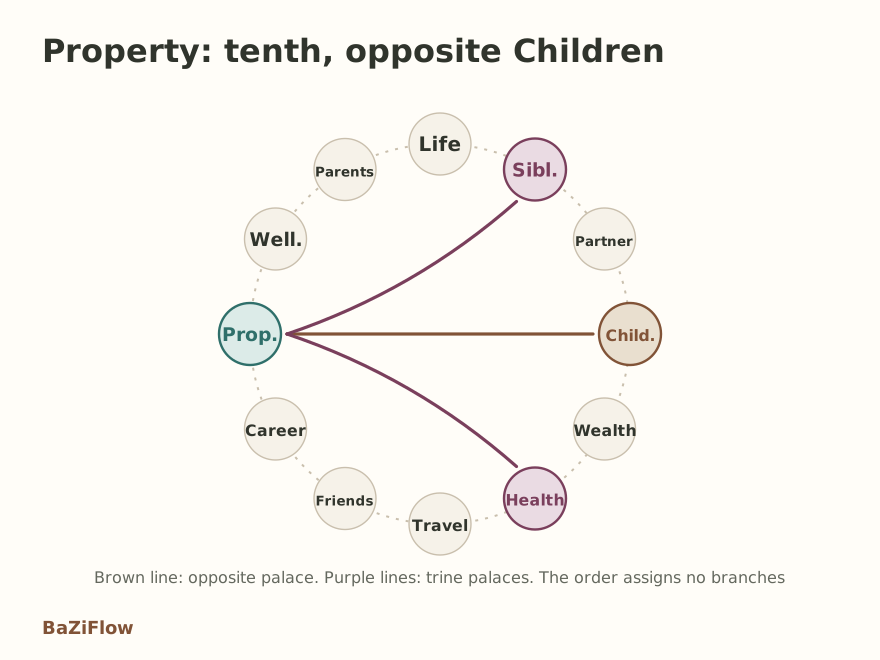 ZW-PAL-10 / Zi Wei Dou Shu
The Property Palace in Zi Wei Dou Shu: Inherited vs Self-Made, and Four Patterns Naming It
The Property palace is the tenth of twelve, opposite Children. Count the inherited and self-made words in juan 2, read the four patterns that name it, and check Sun and Moon grades at the four storehouse branches.
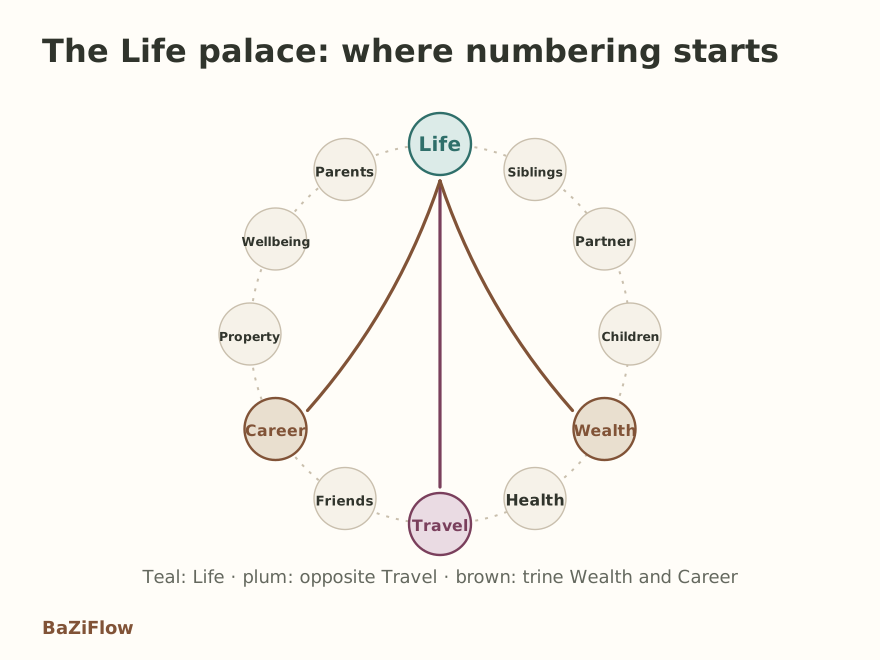 ZW-PAL-01 / Zi Wei Dou Shu
The Life Palace (命宫): Where the Twelve Palaces Start Counting
The Life palace is the box from which the other palace names are counted. A ring diagram, the book's own reading order, a Life Ruler lookup and a Tai Sui year conversion show its position, neighbors and time layer.
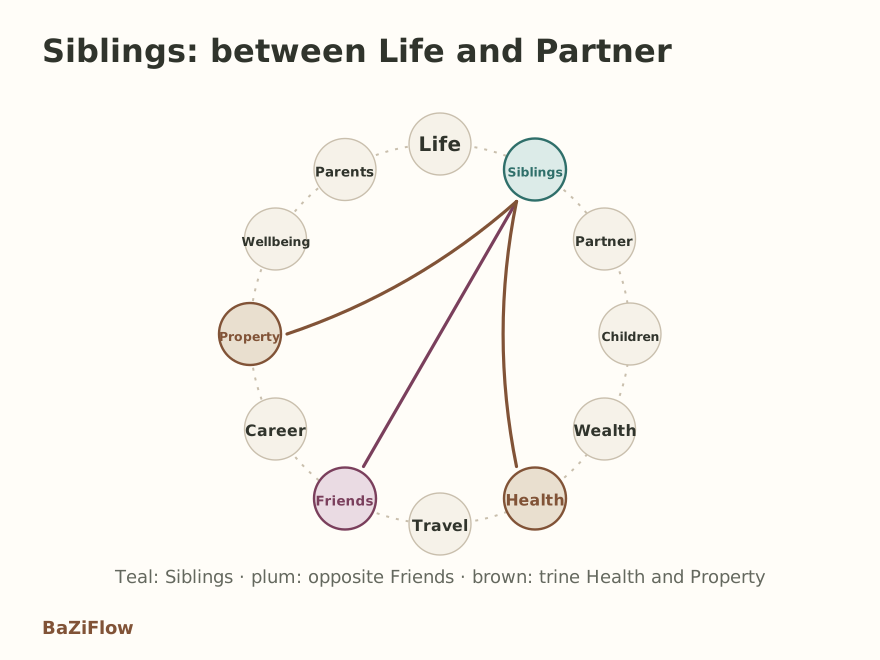 ZW-PAL-02 / Zi Wei Dou Shu
The Siblings Palace (兄弟宫): Second Box, the Quan Shu Entry and the Decade Path
The Siblings palace follows Life in the order. A ring diagram shows its neighbors, one line of the juan 2 entry is taken apart, and the second decade of yin-male and yang-female charts is traced into this box.
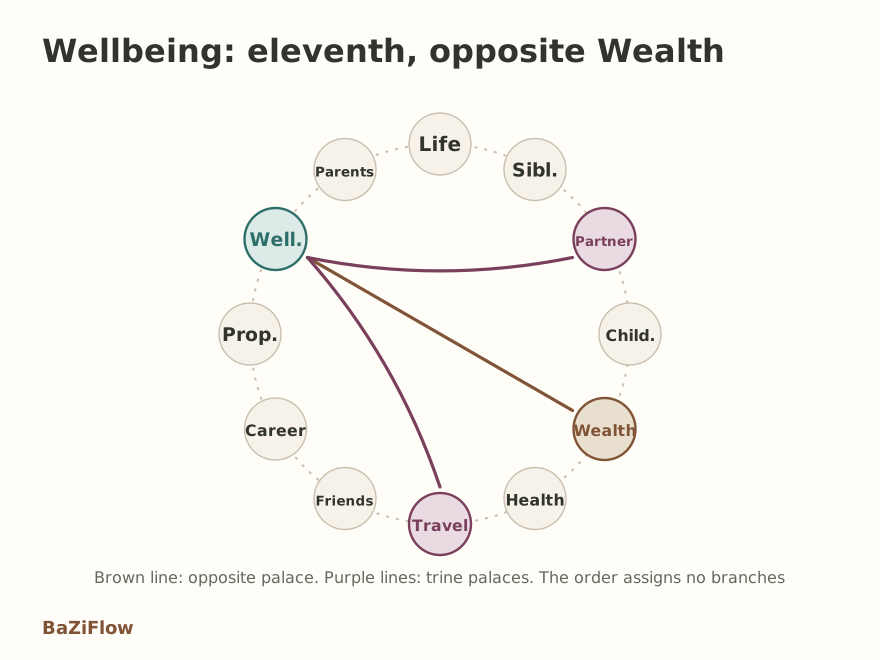 ZW-PAL-11 / Zi Wei Dou Shu
The Wellbeing Palace in Zi Wei Dou Shu: Toil, Ease, and Five "Look First" Lists
The Wellbeing palace is the eleventh of twelve, and the book itself says Wealth is opposite. Count the toil and ease words in juan 2, compare five lists that rank it first to fourth, and chart Tian Tong by branch.
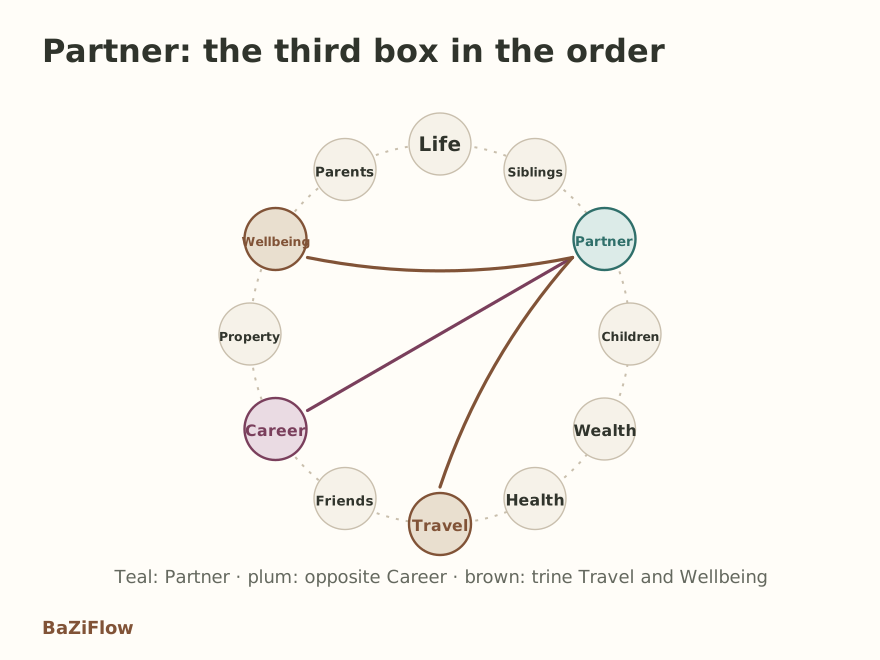 ZW-PAL-03 / Zi Wei Dou Shu
The Partner Palace (夫妻宫): Three Names, One Box, and the Years Tian Ma Lands in It
The Partner palace was once "wife and concubine", "husband" for women, and is now just Partner. See what juan 2 asks of it, work the Tian Ma rule tied to the birth year, and find its place in the male and female orders.
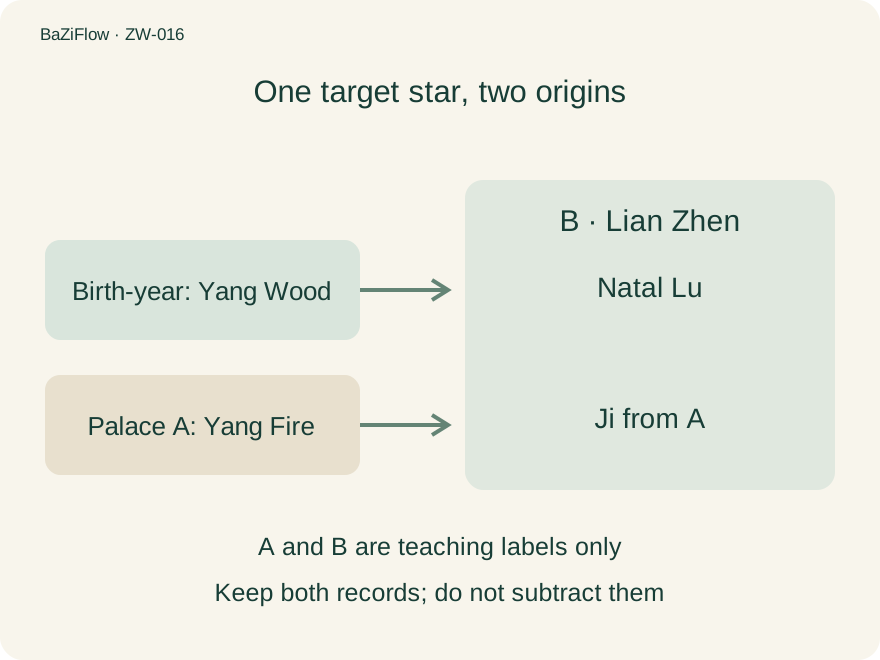 ZW-016 / Zi Wei Dou Shu
Palace-Stem and Birth-Year Transformations Compared
Track two transformation sources to one star without losing their origins. A Yang Wood birth-year stem and a Yang Fire palace stem illustrate why an arrow is not merely a label on its destination.
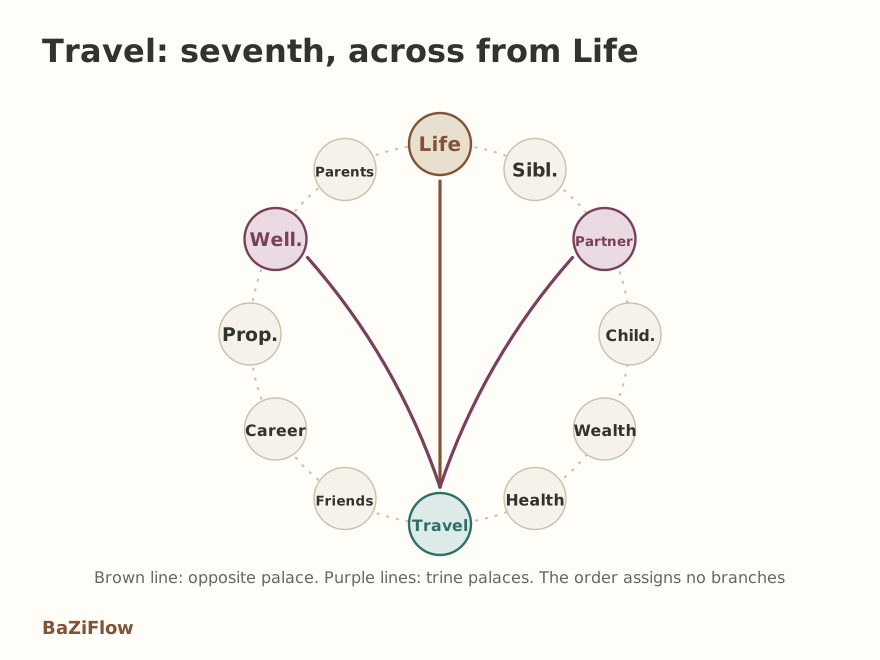 ZW-PAL-07 / Zi Wei Dou Shu
The Travel Palace in Zi Wei Dou Shu: Across from Life, and the Book's "Going Out"
The Travel palace is the seventh of twelve, six places from Life. Work out its opposite and trine palaces, then read juan 2's word choices, the Tian Shi and Tian Shang flanking rule, and the strong and weak palace table.
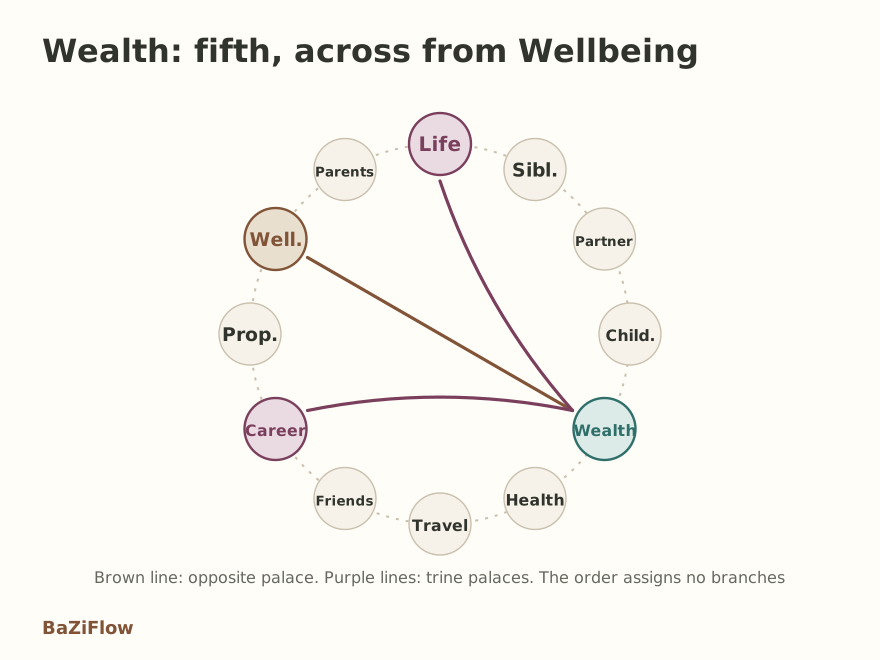 ZW-PAL-05 / Zi Wei Dou Shu
The Wealth Palace (财帛宫): Four Kinds of Money Words, and the Sun-and-Moon Flank
The Wealth palace is the fifth box, opposite Wellbeing. Sort the words juan 2 uses for it, see how Bright and Fallen change a star's line, take one entry apart, and find the two palaces a sun-moon flank pair occupies.
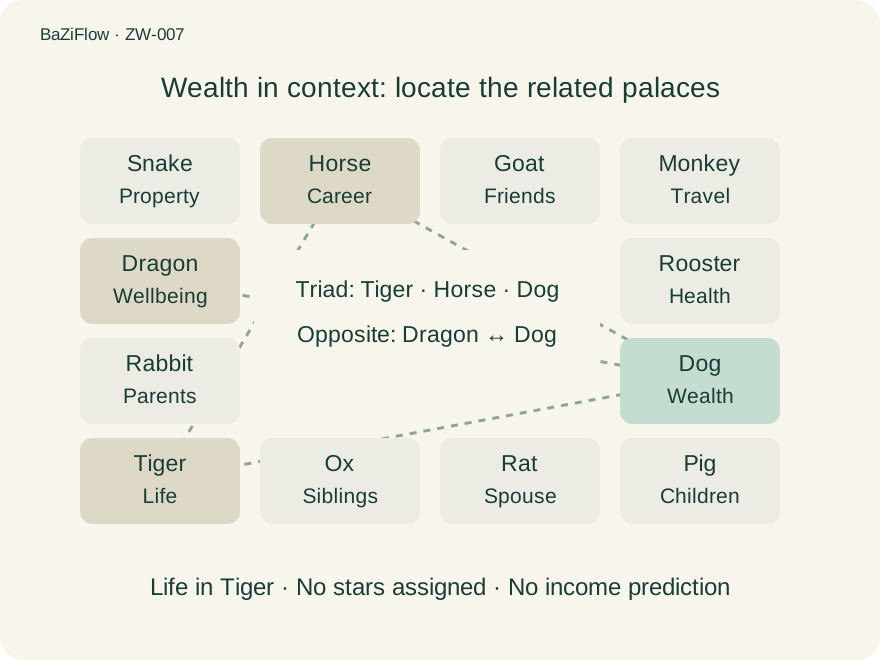 ZW-007 / Zi Wei Dou Shu
Why one Zi Wei palace cannot stand in for the whole chart
A cropped palace can show a star name while hiding its context. Learn to track palace coordinates, related positions and timing layers before interpreting it.
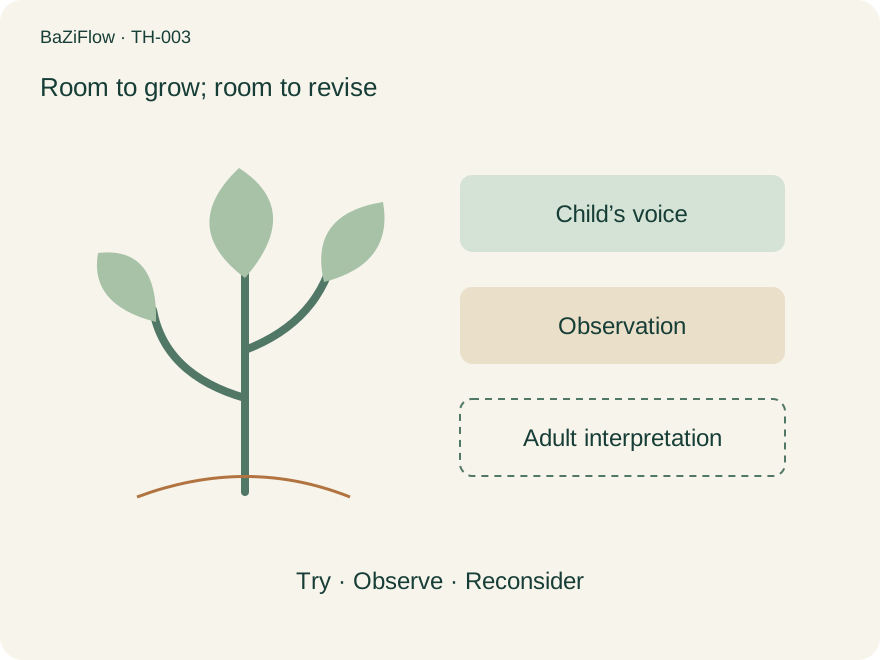 TH-003 / Read by theme
Read for a Child Without Writing Their Future for Them
Separate the child’s words, observed behavior and an adult’s interpretation. Preserve privacy and opportunities to try things; a more detailed chart does not authorize a verdict on ability or identity.
 BZ-021 / BaZi
BaZi patterns explained: how formation, disruption and assistance work
What a BaZi pattern is and when it counts as formed: separate a pattern name from its formation, trace Eating God, Resource and a stem combination, then change the goal to see why assistance depends on the configuration.
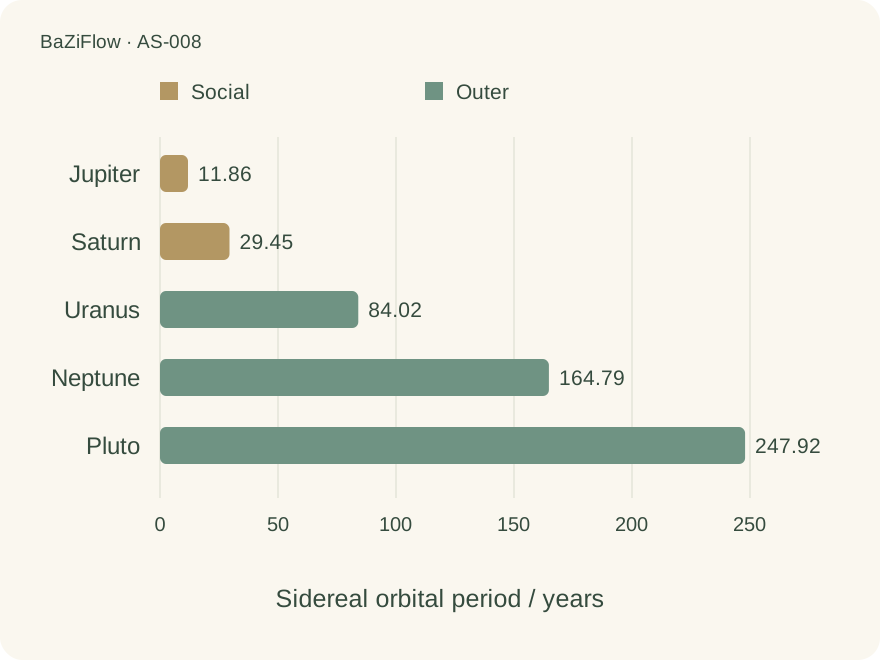 AS-008 / Western astrology
Personal, Social and Outer Planets: Use Groups as a Directory
List the modern astrological groups, compare JPL orbital periods, then use one shared outer-planet position with different angular partners to recover chart-specific context.
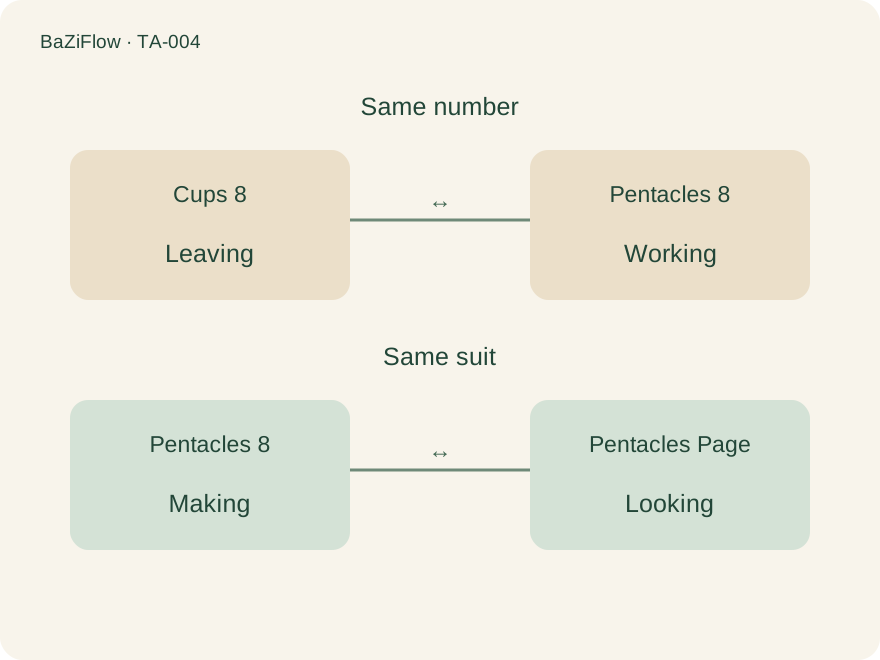 TA-004 / Tarot
Numbered scenes and court figures: compare what the cards actually do
Use two Eights and two other Pentacles cards to separate number, suit, action and role. A court title does not identify a real person, and a shared number does not erase a different scene.
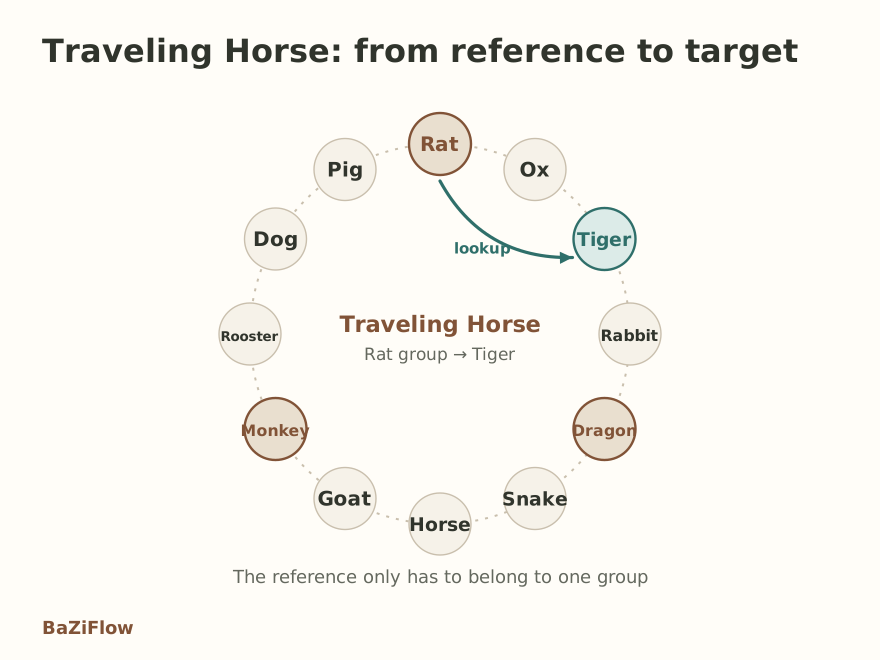 BZ-022 / BaZi
Symbolic Stars in BaZi: Check the Reference and Rule Before the Meaning
Symbolic stars are marks looked up by fixed rules, not stars in the sky. Four Traveling Horse pairings, three layers of checking and a six-item record separate reference, rule and real-life inference.
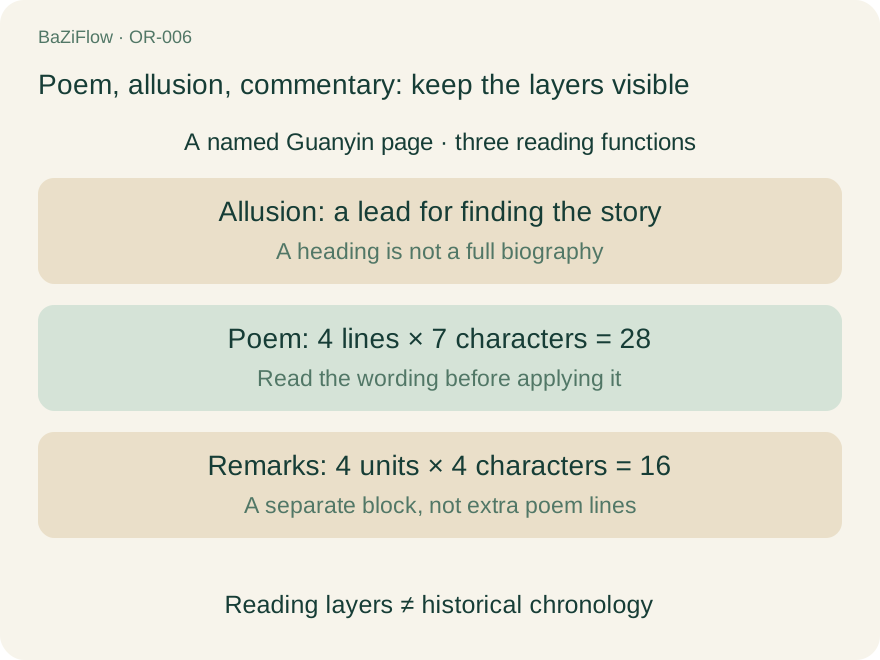 OR-006 / Oracle lots
Read the poem, allusion, and commentary as distinct layers
Use a named Guanyin lot page to separate the poem, story heading, and remarks, while keeping editorial choices and personal interpretations visible.
MH-007 / Meihua YishuPrimary, nuclear and changed hexagrams: trace each operation
Audit two independent operations on Jiji: extract its inner trigrams to form Weiji, or change line three to form Zhun, while preserving the Qian–Kun textual caveat.
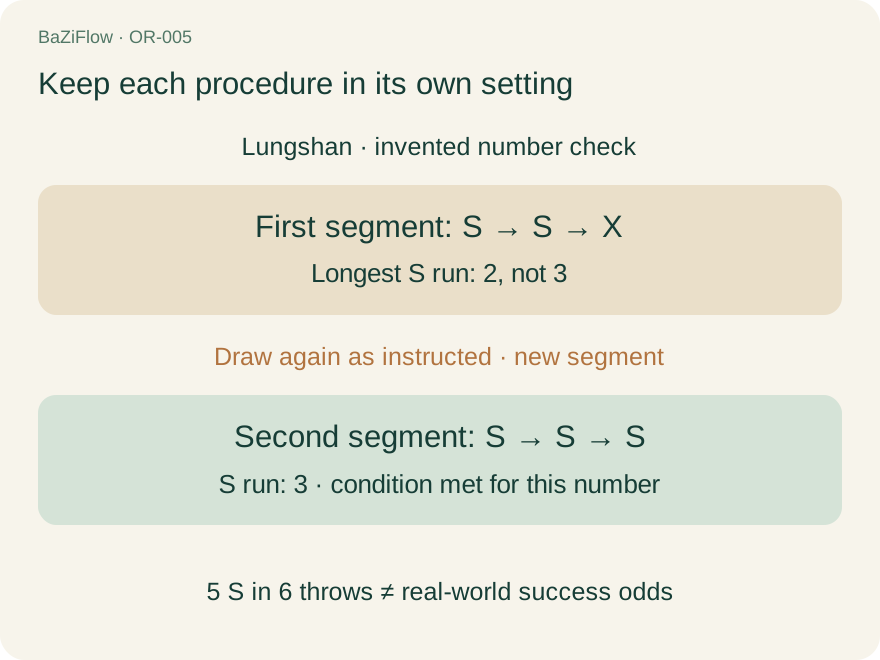 OR-005 / Oracle lots
Oracle-lot procedures and local customs: keep the setting
Compare named temple guidance without filling missing details from another site; distinguish stages, consecutive checks, sticks, and paper slips.
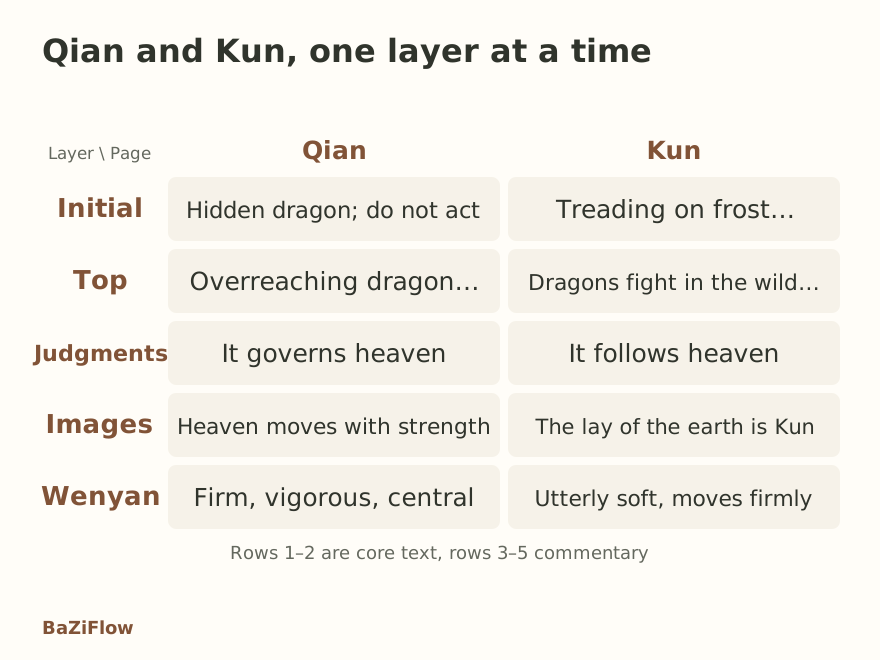 YJ-010 / Yijing
Reading Qian and Kun Together: From the Core Text to Different Explanations
Set the core text of Qian (乾) and Kun (坤) side by side, then the three commentaries, and only then later explanations. Two places, Initial and Top, show how each layer words the same line. No personality labels.
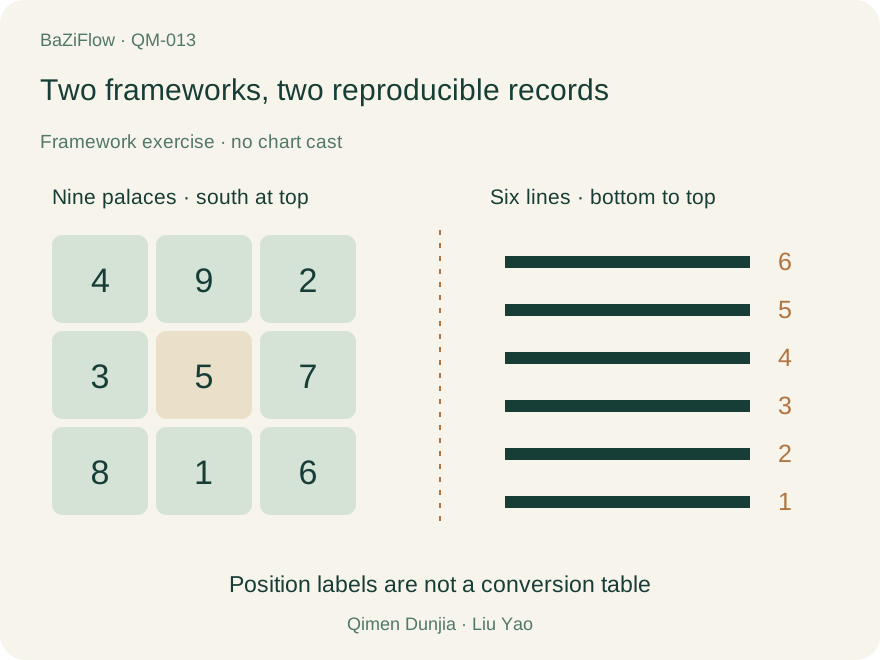 QM-013 / Qimen Dunjia
Qimen and Liu Yao: compare the records before the answers
Compare hourly Qimen with coin-cast Najia Liu Yao through their inputs, position frameworks and reading records, without treating shared terms as interchangeable rules.
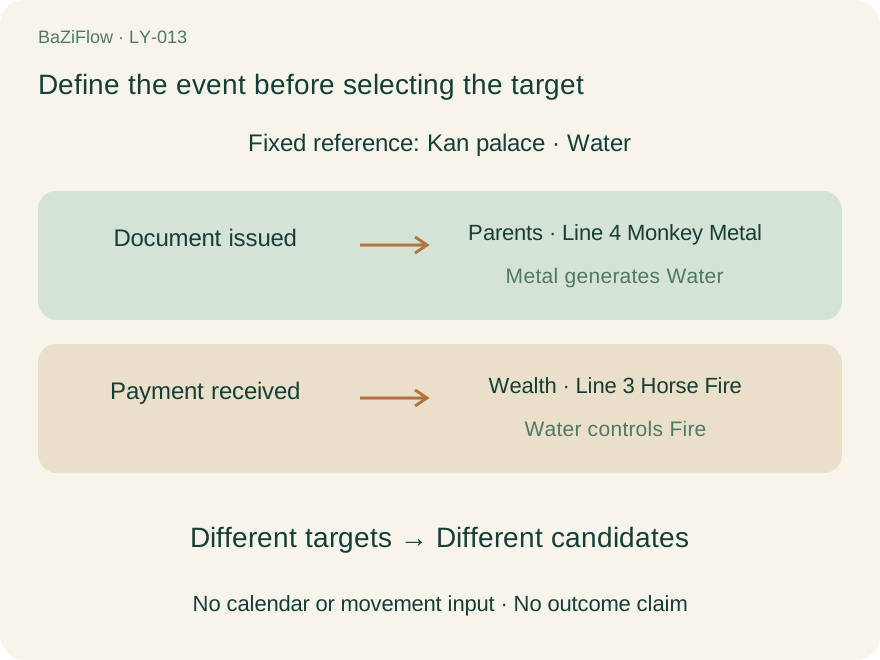 LY-013 / Liu Yao
Define a Liuyao question before selecting its target
Compare document and payment targets in doubled Kan, distinguish proxy subjects and role labels, and keep alternatives within a common observation scope.
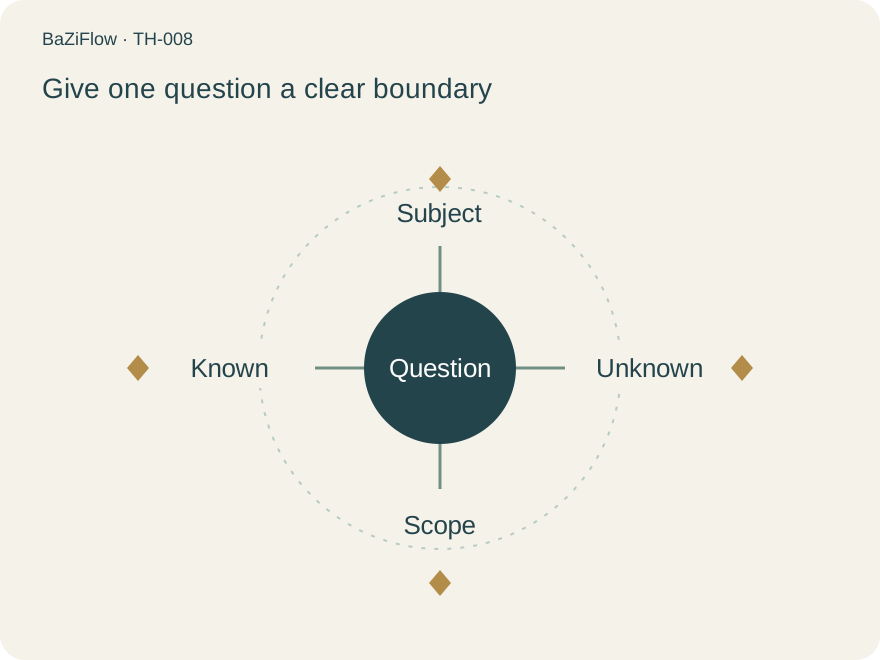 TH-008 / Read by theme
Asking a question: separate what happened from what you assume
Build a question from its subject, scope, known facts and unknowns, then choose a route through Tarot, Liuyao or Qimen without changing the question to fit an answer.
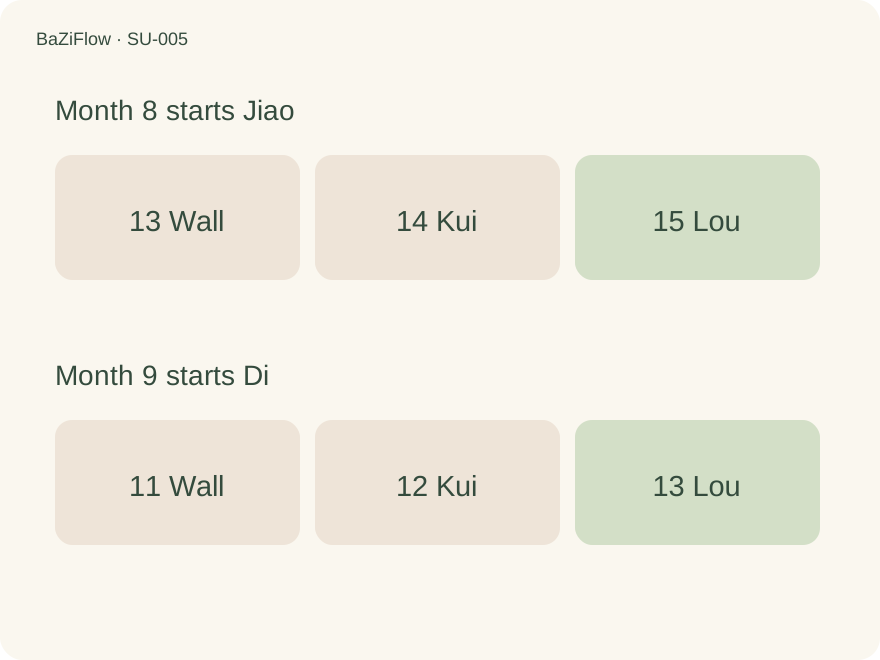 SU-005 / Sukuyō astrology
Reading a Sukuyō calendar: keep the lookup record
Reconstruct two date-table entries ending in Bond, distinguish day numbers from advances, and keep weekday, date system and personal fields separate.
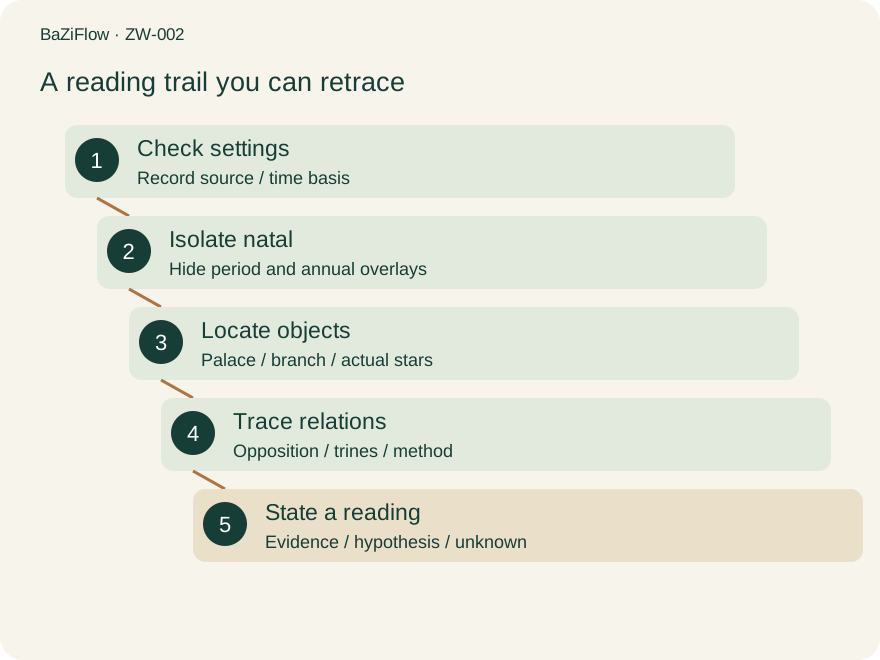 ZW-002 / Zi Wei Dou Shu
Your first Zi Wei chart: make a map before a reading
A practical sequence for identifying settings, natal placements and palace relationships without turning a star name into a personality verdict.
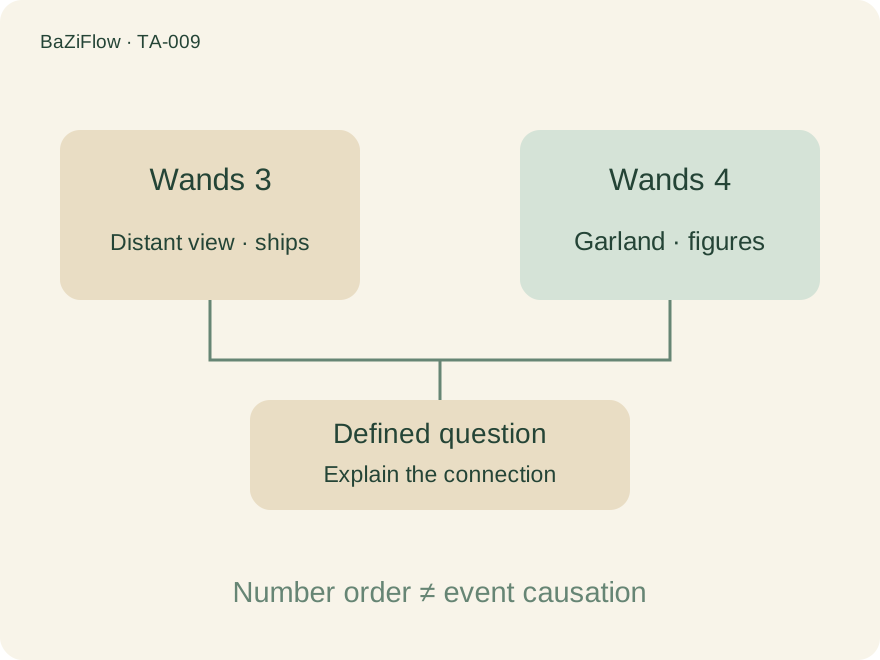 TA-009 / Tarot
A card relationship needs more than “and then”
Use the Three and Four of Wands to separate adjacent numbers from a supported connection. A touring-display example and a position-swap test keep the reading tied to specific material.
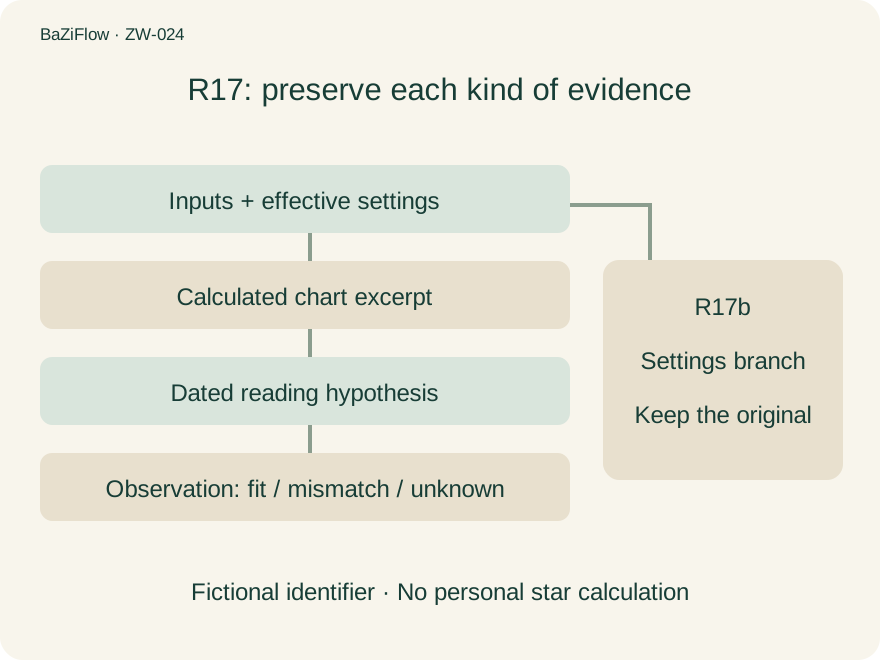 ZW-024 / Zi Wei Dou Shu
Keep a Zi Wei Case Record Someone Else Can Recheck
Preserve inputs, effective settings, chart excerpts and dated interpretations. A fictional late-night boundary comparison shows how to add a revision without rewriting the original evidence.
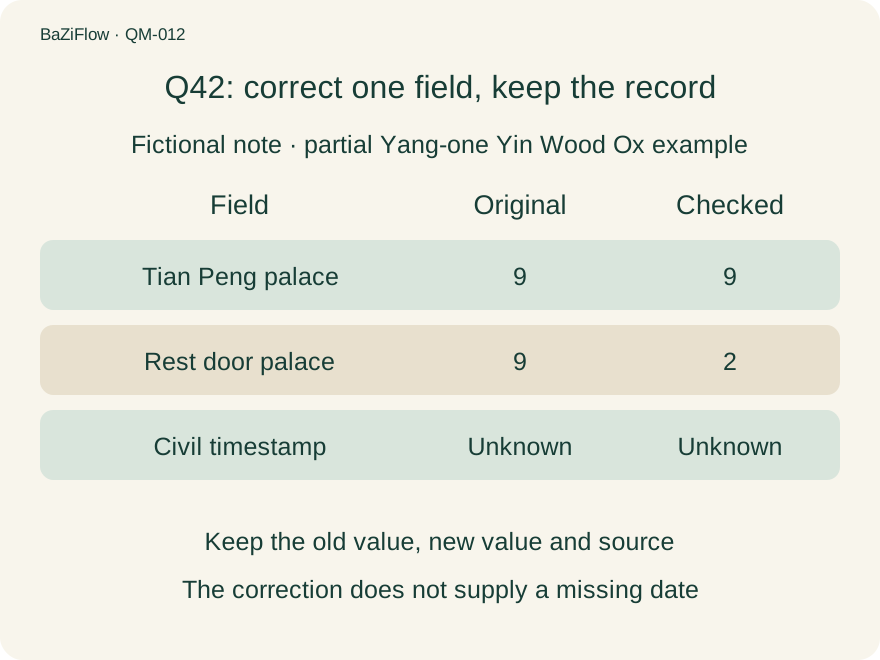 QM-012 / Qimen Dunjia
Record a Qimen chart so that a later correction can be traced
A fictional transcription error shows why the original chart, interpretation and later outcome need separate records. Correct one door position without rewriting the history or treating every conclusion as verified.
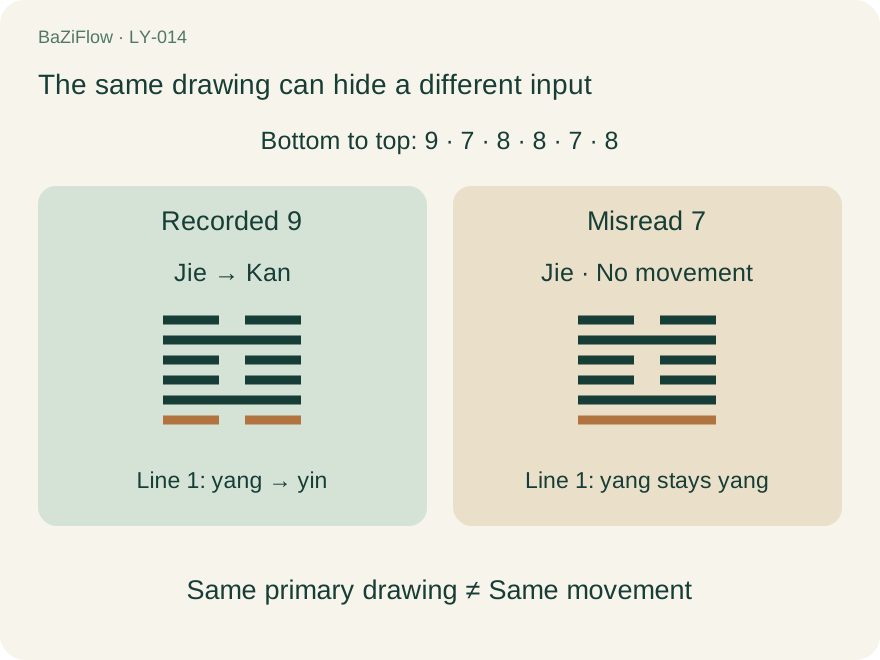 LY-014 / Liu Yao
Recording Liuyao cases: separate inputs, claims, and outcomes
Rebuild Jie changing to Kan from a six-value record, detect a hidden transcription error, and keep repeat castings, revisions, and missing follow-up distinct.
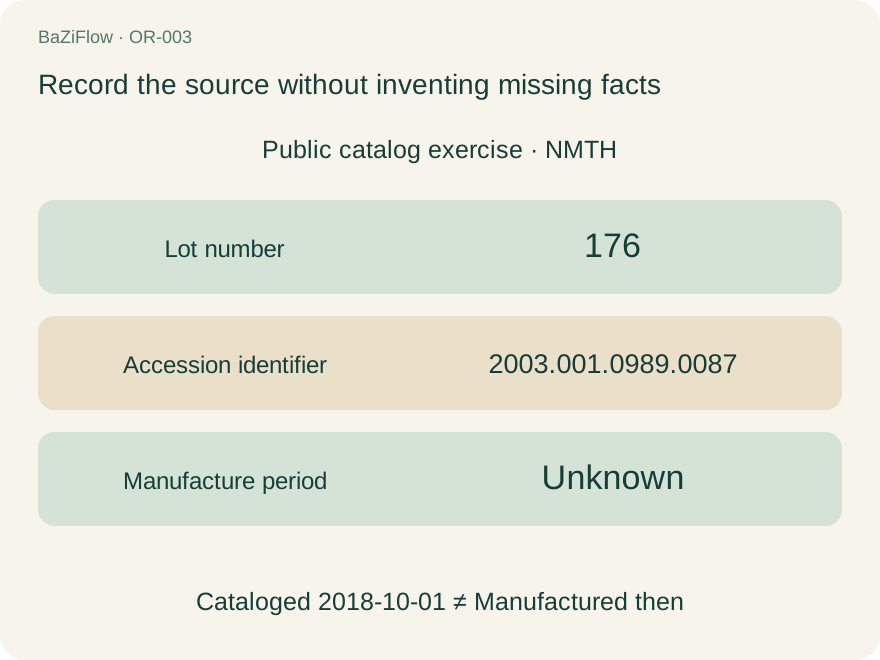 OR-003 / Oracle lots
Recording an oracle-lot source: identifiers, dates, and gaps
Use museum catalog examples to separate lot numbers from accession identifiers, preserve originals and transcriptions, and record unknown provenance honestly.
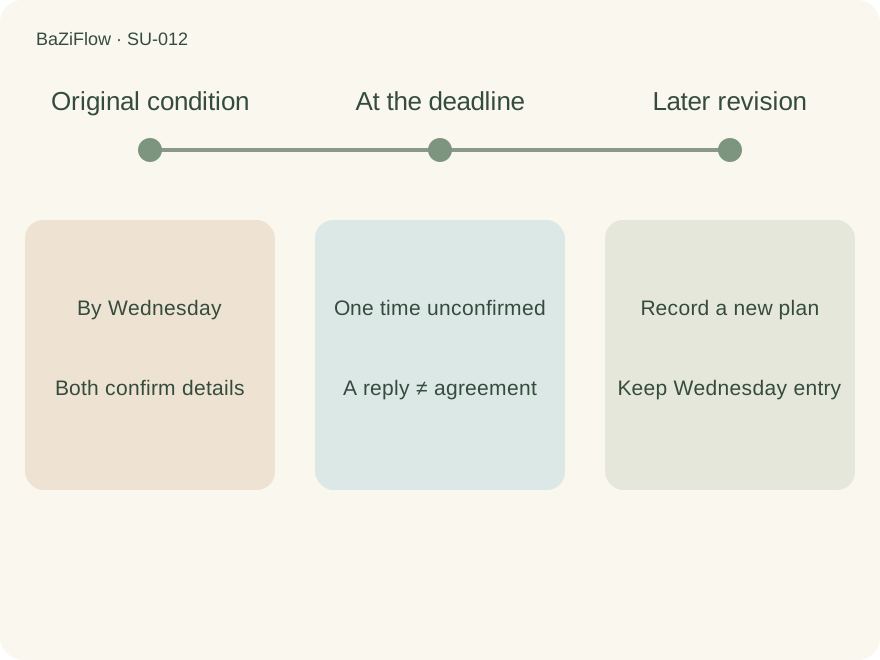 SU-012 / Sukuyō astrology
Recording Sukuyō cases without rewriting the claim
Follow a walk invitation through a Wednesday deadline, distinguish partial confirmation from the original condition, and preserve actions and revisions.
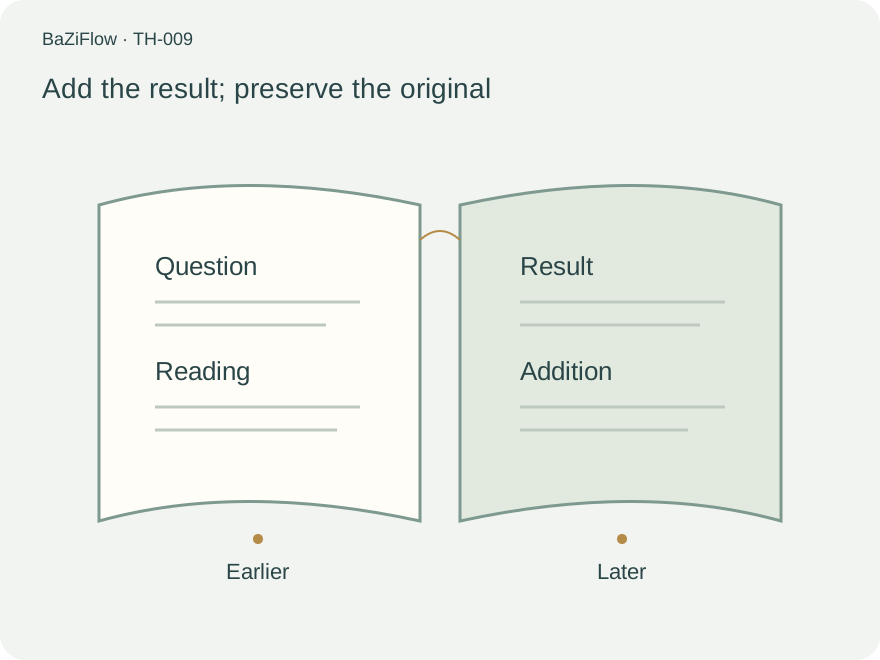 TH-009 / Read by theme
Reflection: preserve the reading before judging the result
Review Tarot and Meihua records with the original wording, later evidence and corrections kept separate. Include misses and unresolved cases rather than rebuilding a successful story.
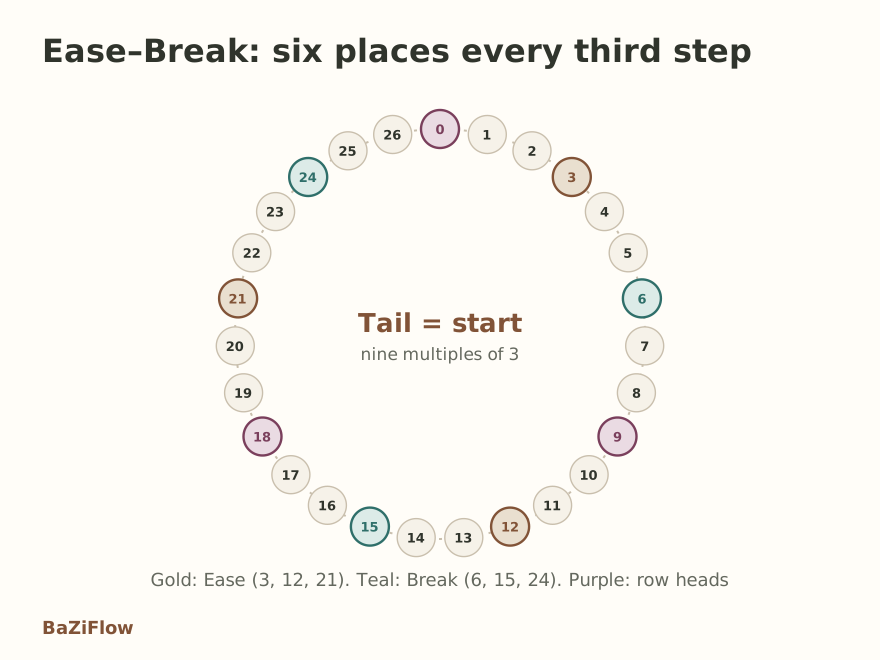 SU-REL-05 / Sukuyō astrology
Ease–Break (安壊): six places every third step, and opposite verdicts on Ease and Break days
Ease lands on offsets 3, 12 and 21 and Break on 6, 15 and 24, multiples of 3 that are not multiples of 9. A ring, a chain of three-step jumps, three pairs of examples and the book's Ease-day and Break-day statements.
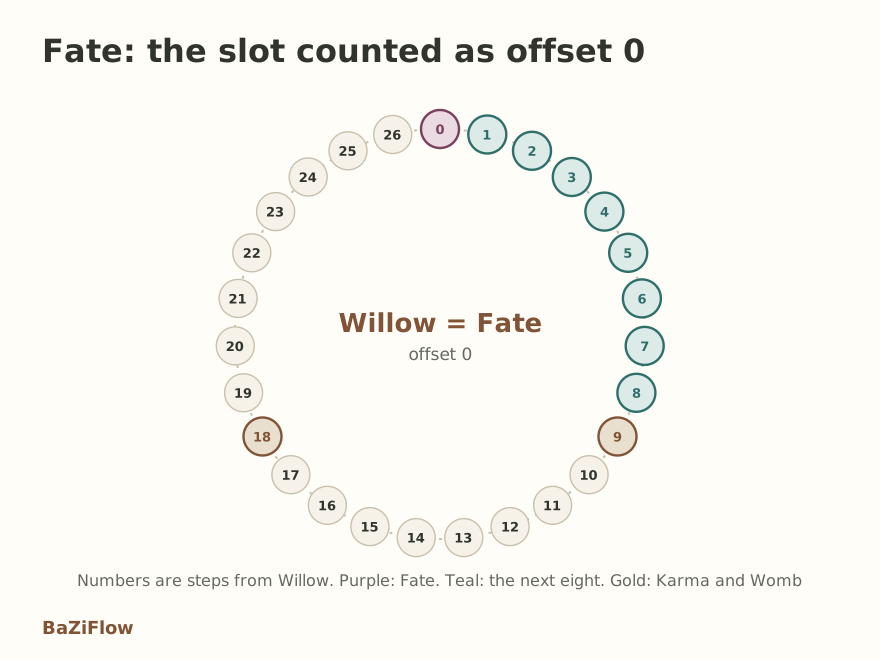 SU-REL-01 / Sukuyō astrology
Fate (命): the zero-offset slot the Sukuyō Sutra counts from
Fate is the zero-offset slot of the three-nine count: your own birth mansion is the start and is called Fate. A ring, a nine-by-three table, a same-mansion check and the six palaces show how the word is used.
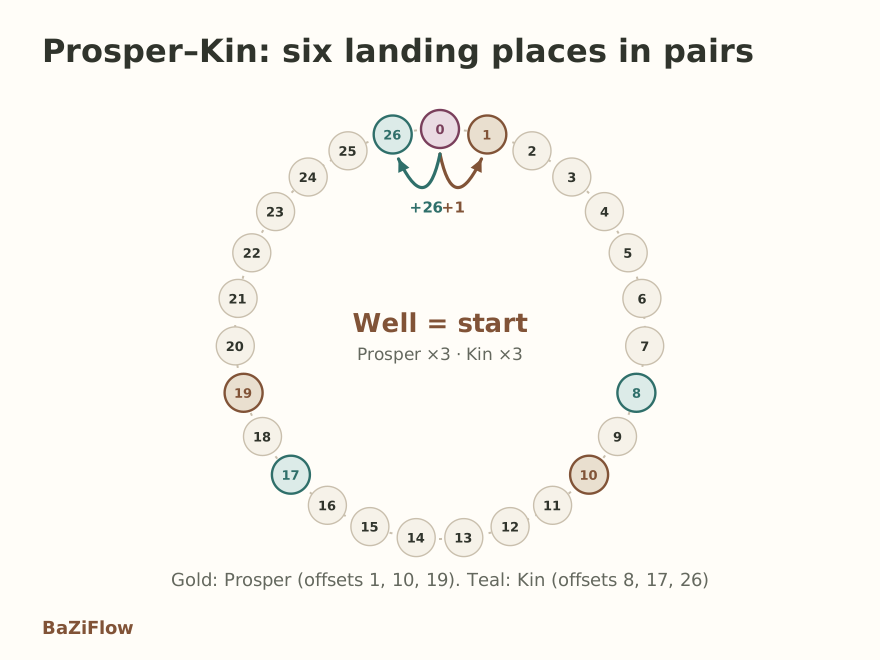 SU-REL-02 / Sukuyō astrology
Prosper–Kin (栄親): six landing offsets and how they pair up
Prosper lands on offsets 1, 10 and 19, Kin on 8, 17 and 26. A ring, a six-place table, a mirror diagram and the book's own uses of the two names show how they pair into one group.
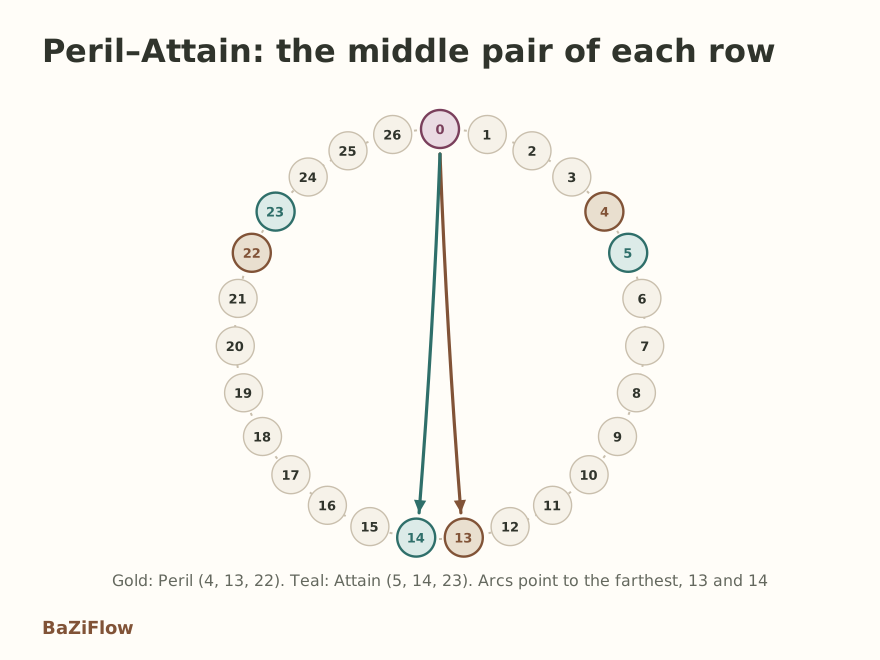 SU-REL-06 / Sukuyō astrology
Peril–Attain (危成): the mid-row couple, the farthest pair and Peril-day readings
Peril lands on offsets 4, 13 and 22 and Attain on 5, 14 and 23, side by side mid-row; 13 and 14 are the farthest places from the start. A ring, three couples, an angle diagram and two readings of Peril days.
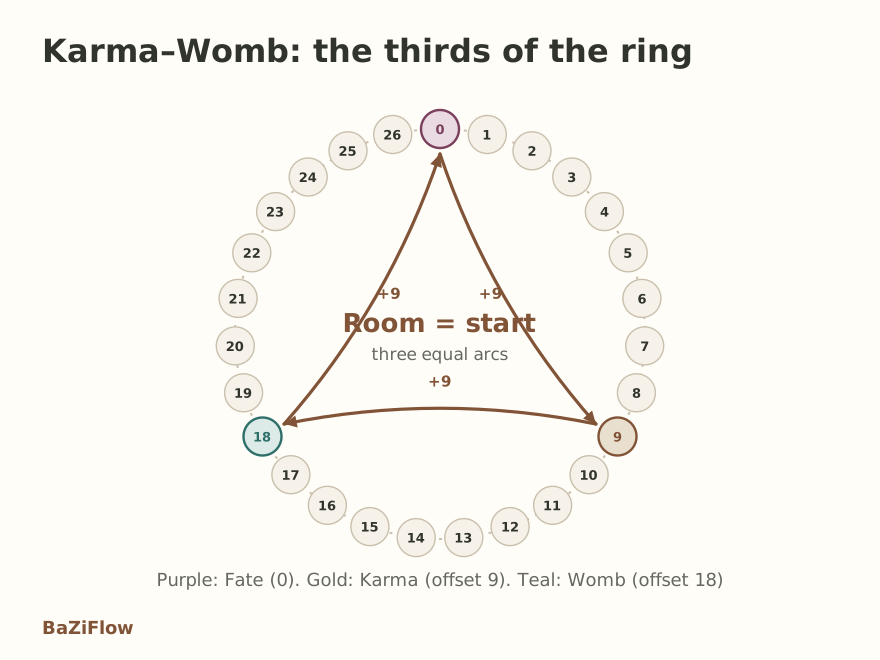 SU-REL-03 / Sukuyō astrology
Karma–Womb (業胎): offsets 9 and 18, the thirds of the ring, and how the book treats the two
Karma and Womb sit at places 10 and 19 of the three-nine count and cut the ring of 27 into thirds, nine steps each way. A ring, a three-mansion table, the row structure and the book's two statements on Karma days.
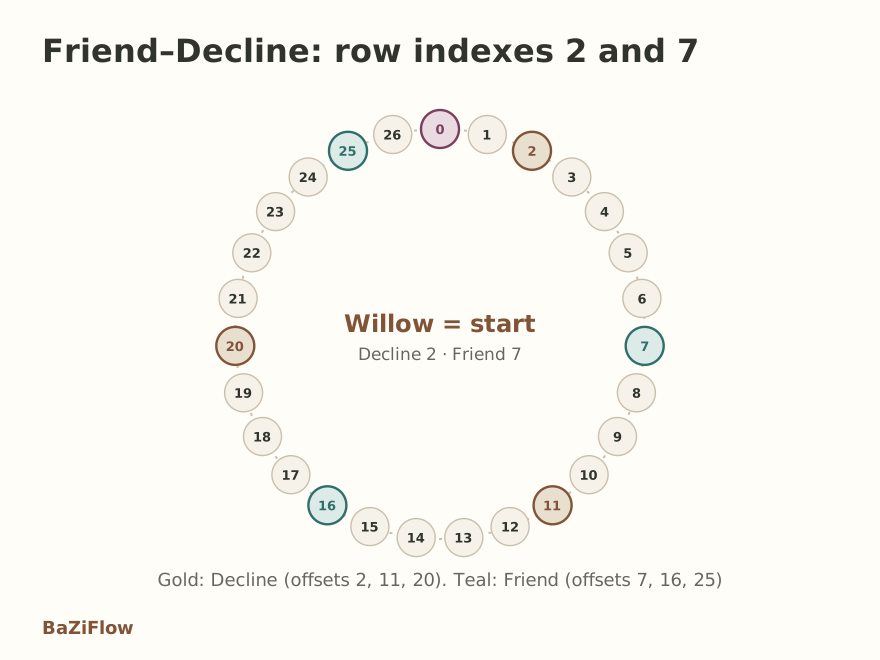 SU-REL-04 / Sukuyō astrology
Friend–Decline (友衰): why the indexes add up to 9, and how the book groups the two names
Friend lands on offsets 7, 16 and 25, Decline on 2, 11 and 20. A ring, an in-row index table, a scatter of reversed offsets and the book's own grouping of the two names show why the pair is always k and 9−k.
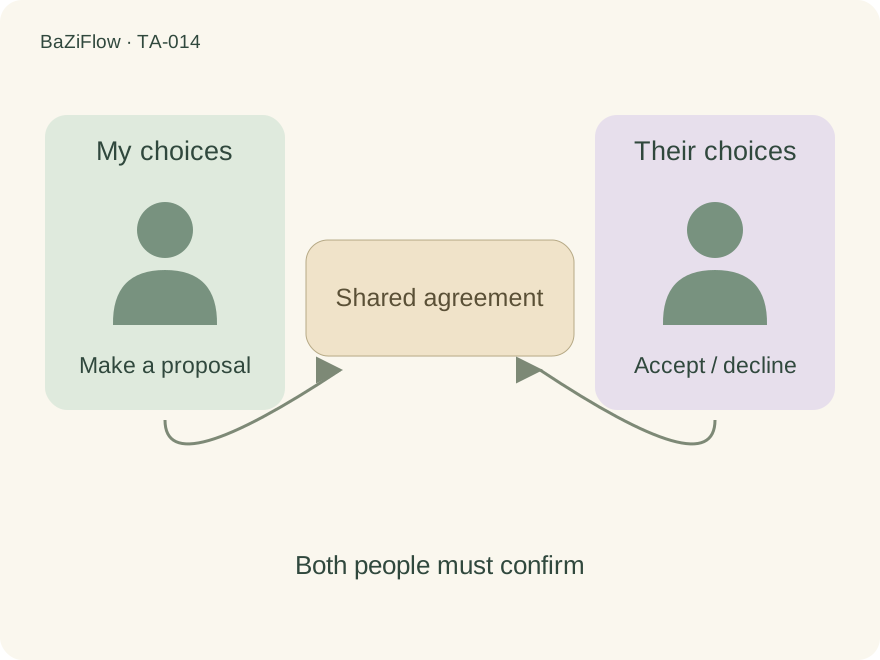 TA-014 / Tarot
Relationship readings without speaking for the other person
Use a shared-house planning example to separate your choices, another person’s response and decisions that require both people. Read relational imagery as a prompt, not as evidence of someone else’s consent.
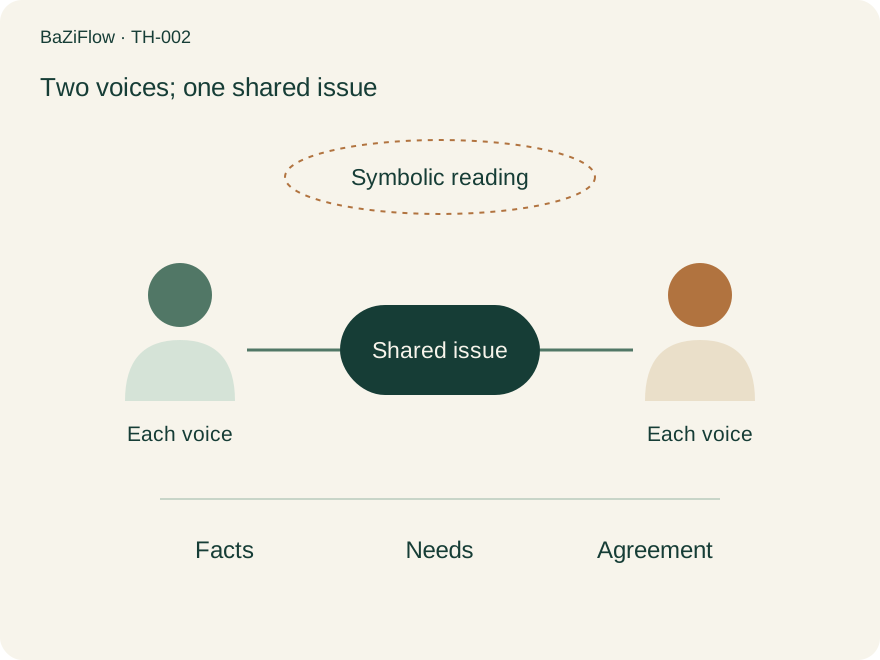 TH-002 / Read by theme
Turn Compatibility Labels into Questions Two People Can Answer
Use relationship readings without letting a score or symbol speak for either partner. Separate one chart, a comparison of two charts and the agreements people actually make.
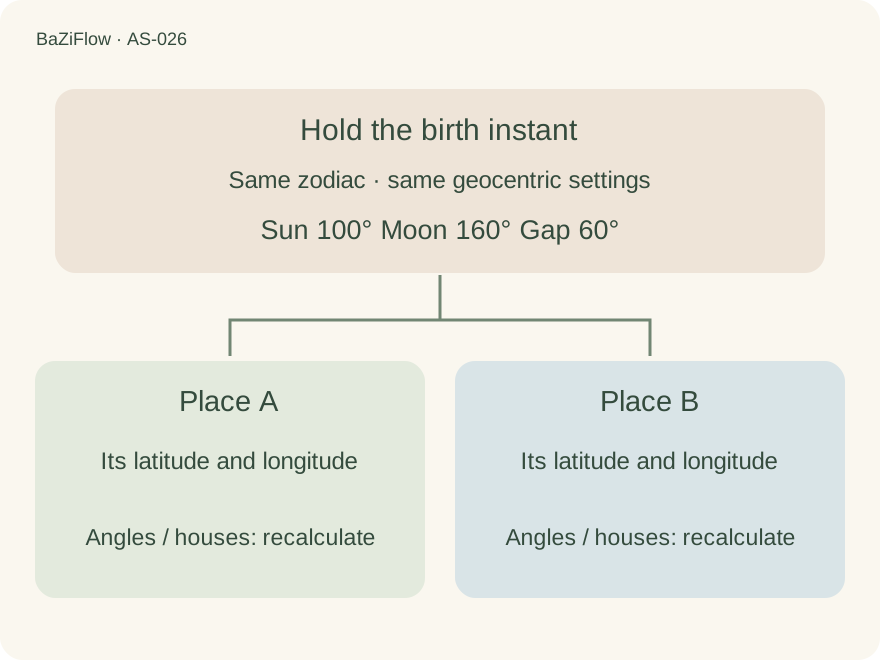 AS-026 / Western astrology
Relocation astrology: hold the instant, inspect the place
Audit the unchanged geocentric positions before reading local angles. A clock-offset example and location checklist distinguish a true relocation comparison from changed inputs.
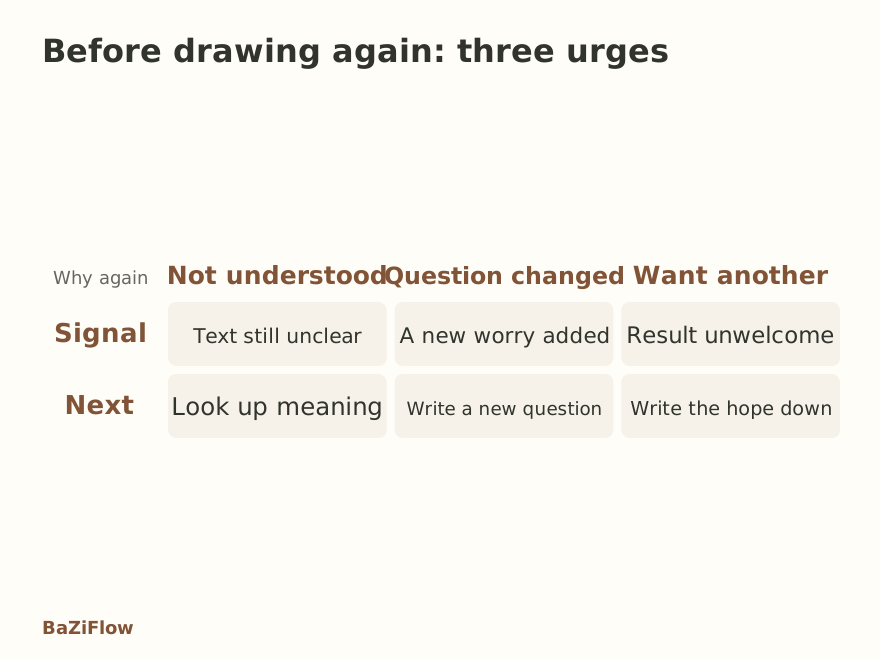 OR-012 / Oracle lots
Drawing lots again: tell "ask again" from "want another answer"
The urge to draw once more usually has one of three causes: the text was not understood, the question has changed, or another answer is wanted. A three-column record shows which one it is.
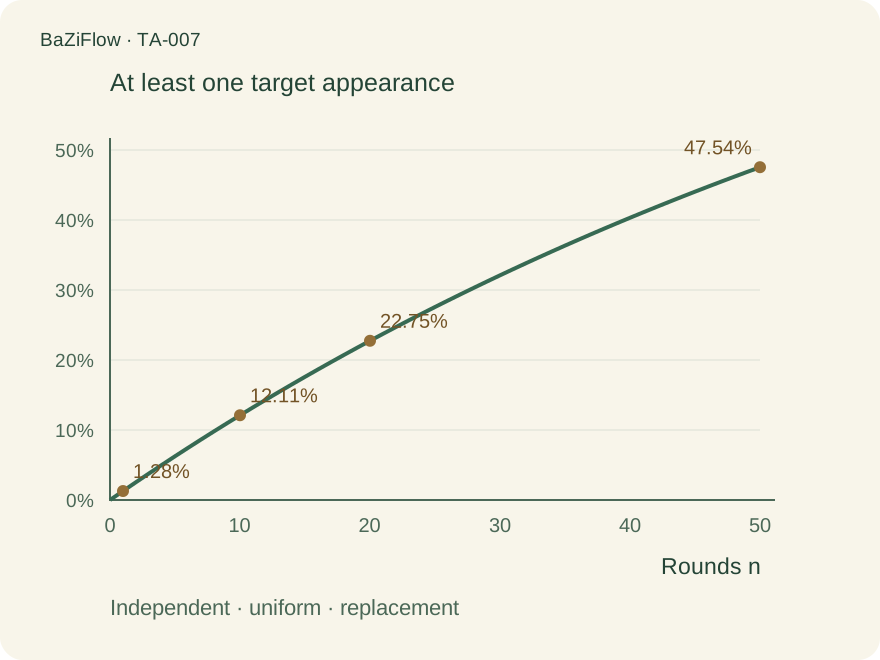 TA-007 / Tarot
Repeated tarot questions change what you end up selecting
Distinguish a new question from a search for a preferred result. A tightly defined 78-card probability example shows why many opportunities cannot be presented as one unselected draw.
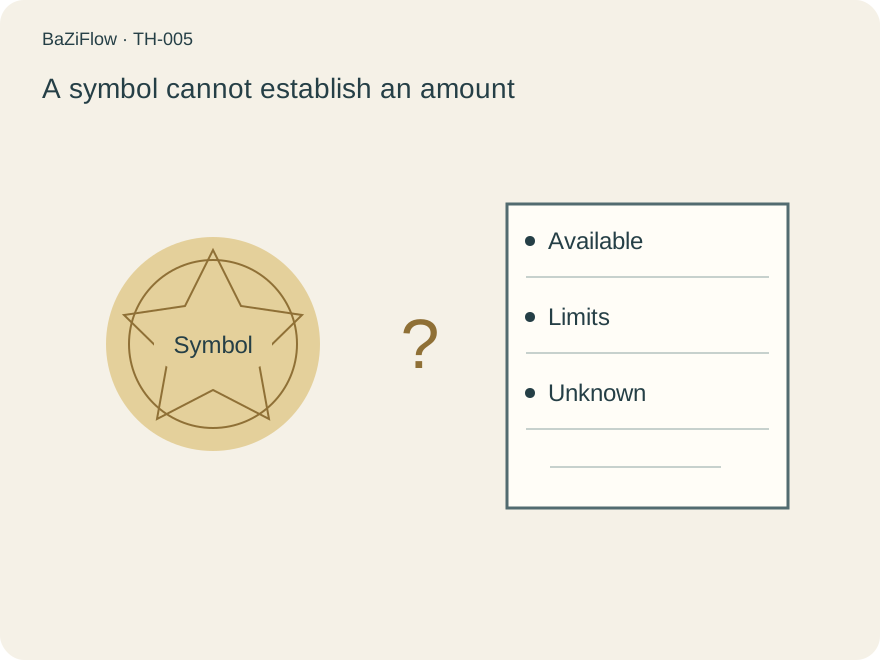 TH-005 / Read by theme
Resources and wealth: what would count as evidence?
Start with a claim about resources, identify what would verify it, then explore Wealth stars and symbolic abundance without turning them into balances or investment promises.
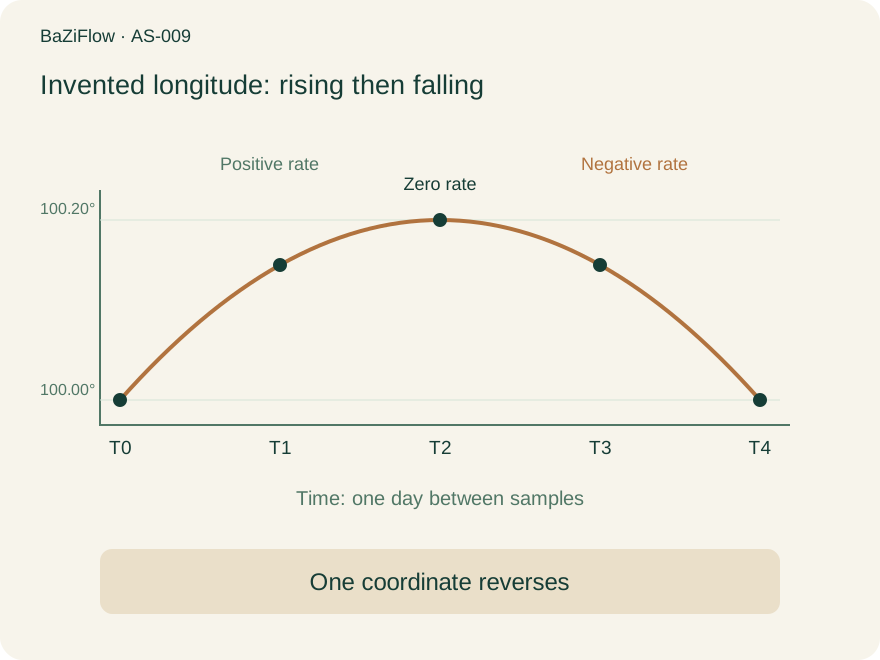 AS-009 / Western astrology
Retrograde motion: identify the coordinate that reverses
Use an invented position-and-speed series to read direct motion, a station and retrograde motion. Separate a coordinate change from orbital reversal, chart layers and causal claims.
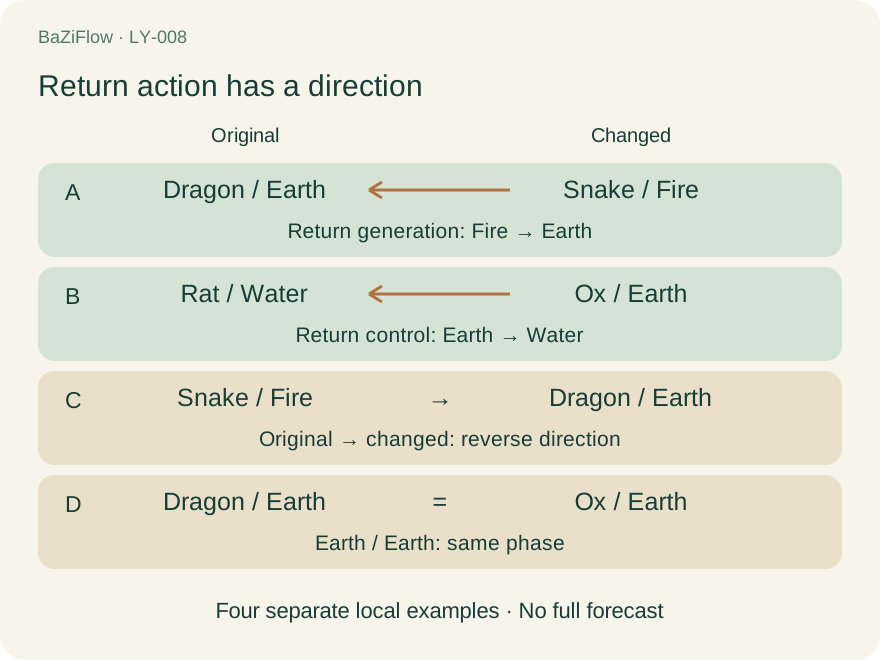 LY-008 / Liu Yao
Return generation and control: direction before interpretation
Recalculate four local trigram changes to distinguish return action, reversed generation, and a shared phase before assessing strength or the selected object.
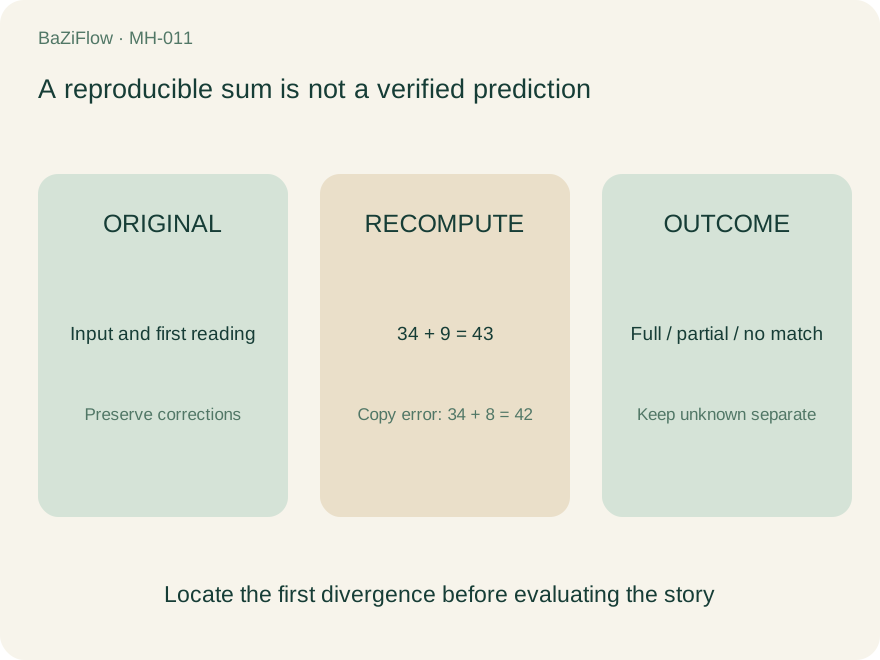 MH-011 / Meihua Yishu
Reviewing Meihua cases: preserve inputs and outcomes
Audit a hypothetical copied-hour error, freeze the original matching criterion, and keep partial and unresolved cases visible without inventing an accuracy claim.
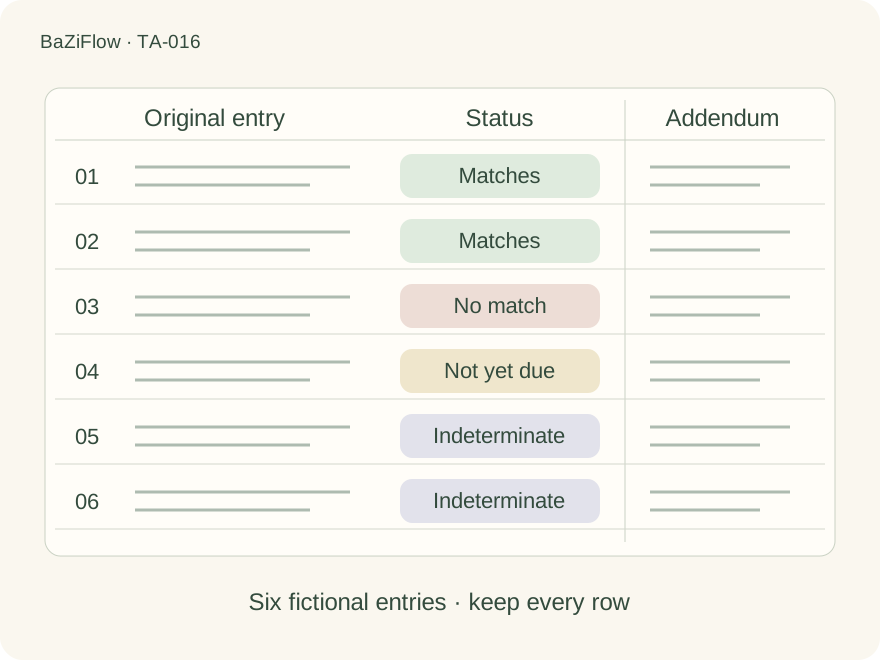 TA-016 / Tarot
Review the whole tarot journal, not just the memorable matches
A six-entry fictional ledger shows why changing the denominator, extending deadlines or replacing an event claim with a feeling can make a journal look more accurate without adding evidence.
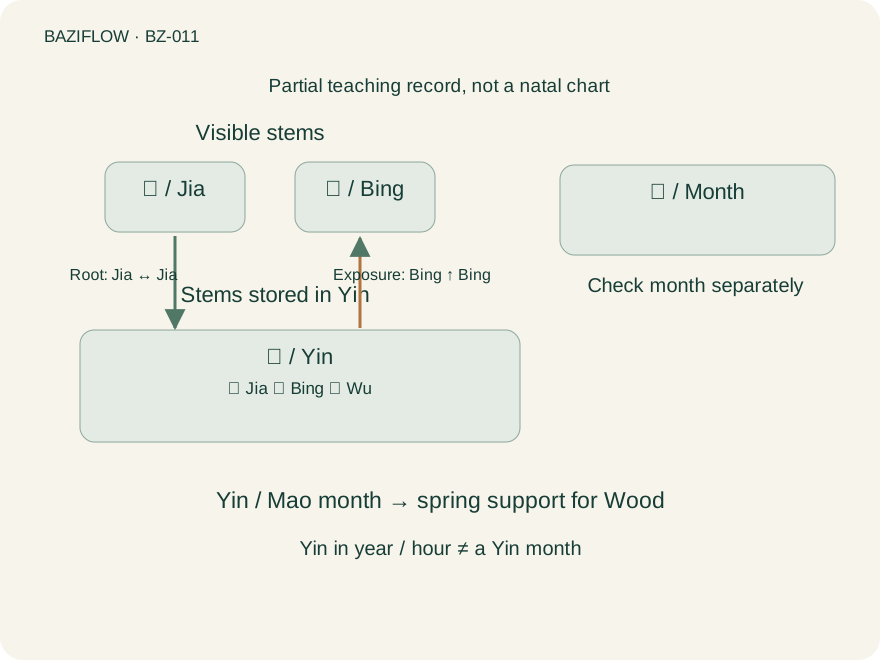 BZ-011 / BaZi
Roots, expression and seasonal support: three different checks
Compare Yang Wood with the Tiger, Rabbit and Rat branches, check whether hidden Yang Fire appears among the stems, and keep seasonal support tied to the actual month pillar.
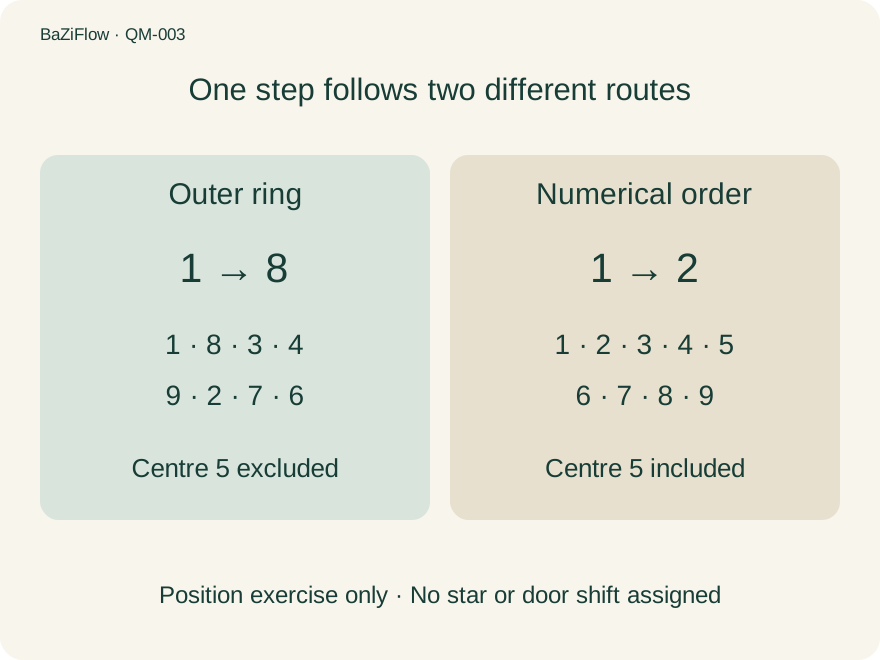 QM-003 / Qimen Dunjia
Rotating and Flying Qimen Plates: Check the Placement Rules
Compare an eight-position outer ring with numerical movement through nine palaces. A named implementation and a classical lodging variant show why chart style is only part of the setup.
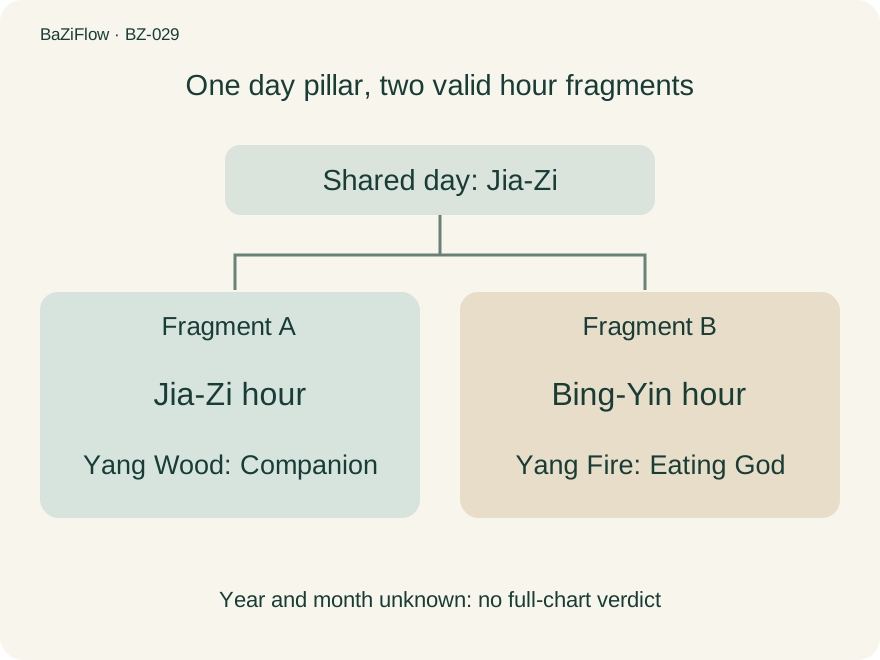 BZ-029 / BaZi
Same day pillar in BaZi: why two shared characters still give different readings
What does sharing a day pillar mean? Hold Yang Wood Rat day fixed and compare legal Yang Wood Rat and Yang Fire Tiger hours, then separate verified relationships, seasonal conditions, positions and personal conclusions.
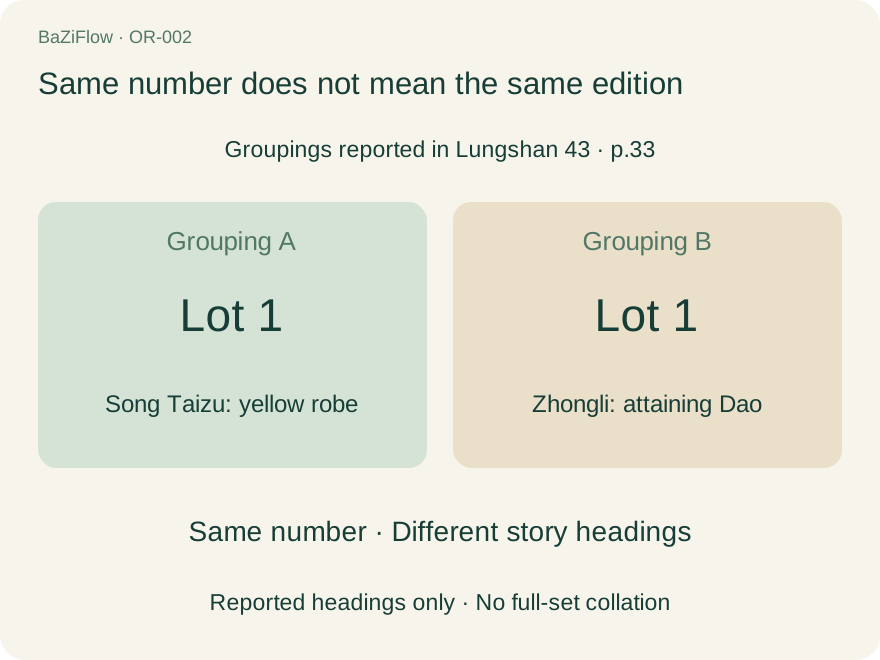 OR-002 / Oracle lots
Why the same oracle-lot number can have different versions
Compare source-bound first-lot headings, distinguish character forms from content changes, and avoid merging several editions into an entry no source contains.
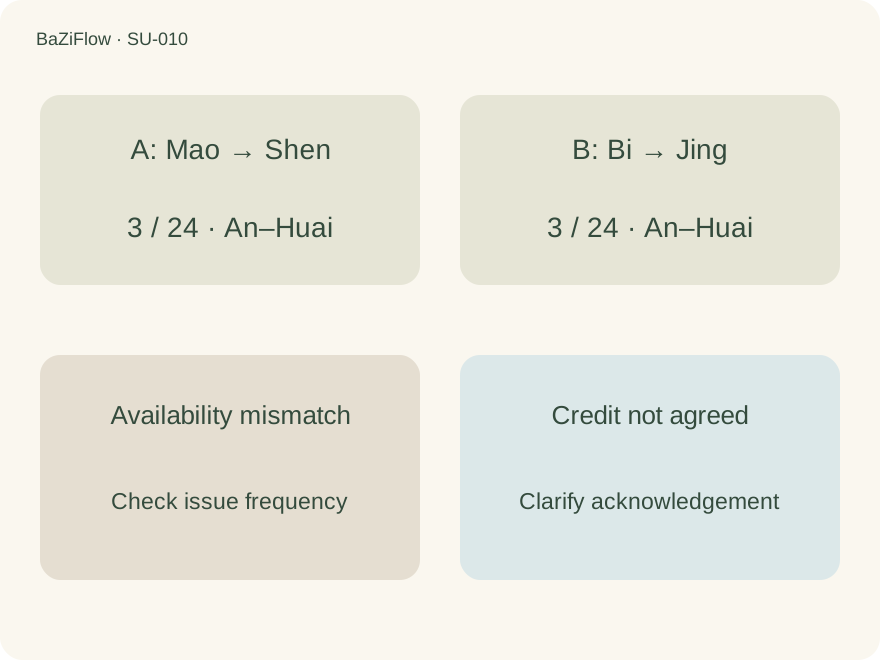 SU-010 / Sukuyō astrology
Same Sukuyō group, different practical evidence
Count the ordered pairs compressed into six groups, then compare two newsletter projects with matching positions but different schedule and attribution problems.
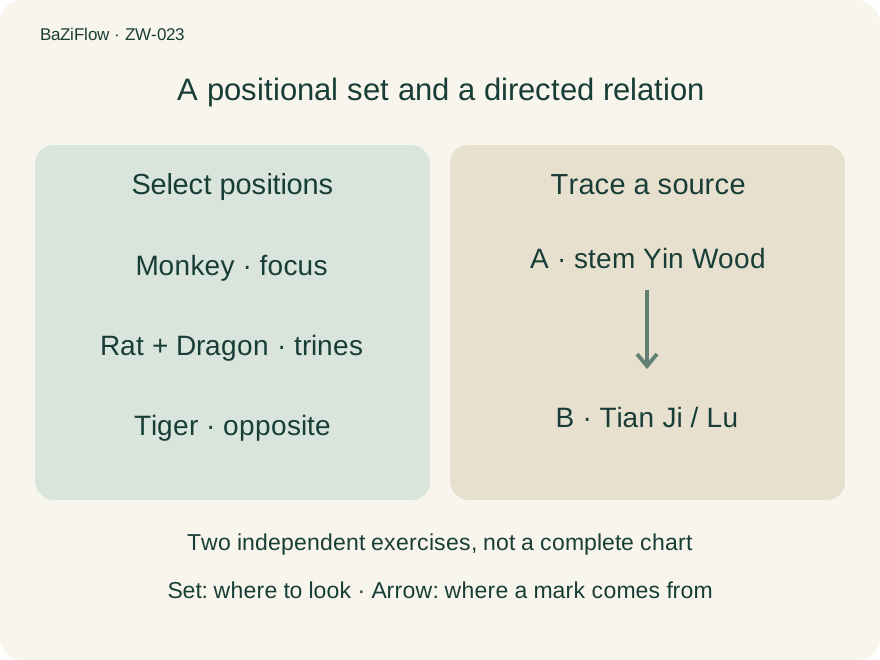 ZW-023 / Zi Wei Dou Shu
San He and Flying Stars: Compare the Operations First
A four-position set and a palace-stem transformation arrow encode different information. Learn how to compare these reading frameworks without inventing uniform school rules or accuracy rankings.
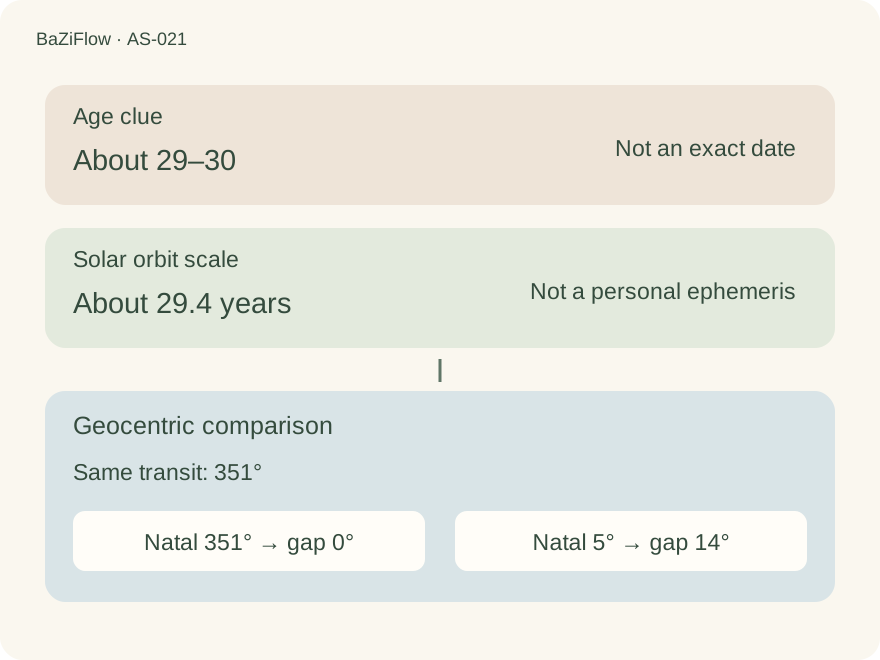 AS-021 / Western astrology
Saturn return: test the position before telling the life story
A worked comparison separates a natal Saturn conjunction from an age label, an orbital period and an orb window. Use it to audit return dates without prescribing a crisis.
 CM-007 / Shared methods
Save the Card, Keep the Route Back to the Article
A share card and an article link preserve different things. Save the image for a concise reminder, keep the link for context, and check language and version before passing either on.
 CM-003 / Shared methods
Keep an Evidence Trail That Can Survive a Correction
Organize a reading around recoverable claims, source locations, processing choices and unresolved questions. Preserve the old version when new evidence changes a field or interpretation.
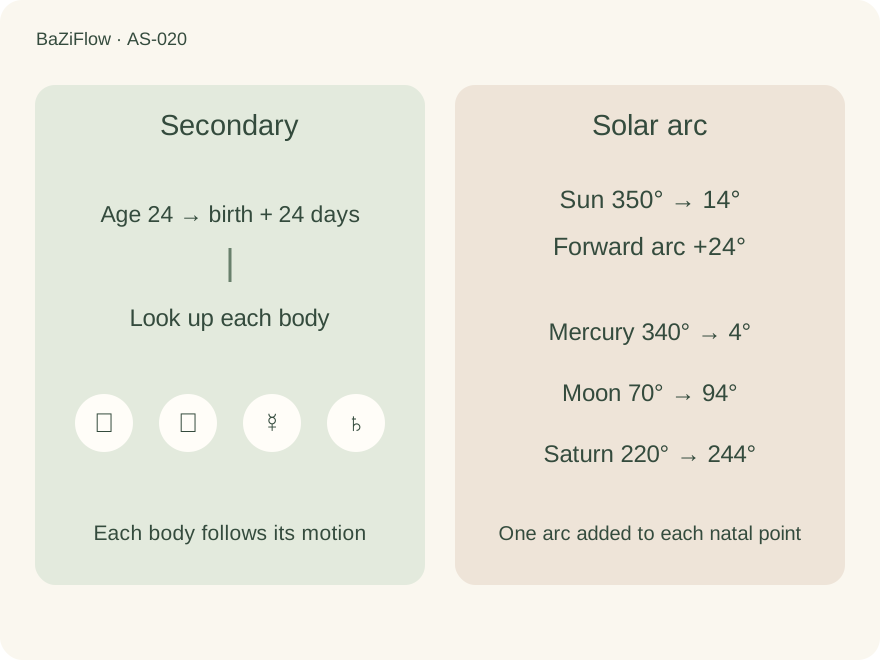 AS-020 / Western astrology
Secondary progressions and solar arc: different operations
Test what stays invariant when every natal point receives one solar arc, then contrast that operation with day-for-year positions. Check wraparound, mean arcs and angle methods before comparing software.
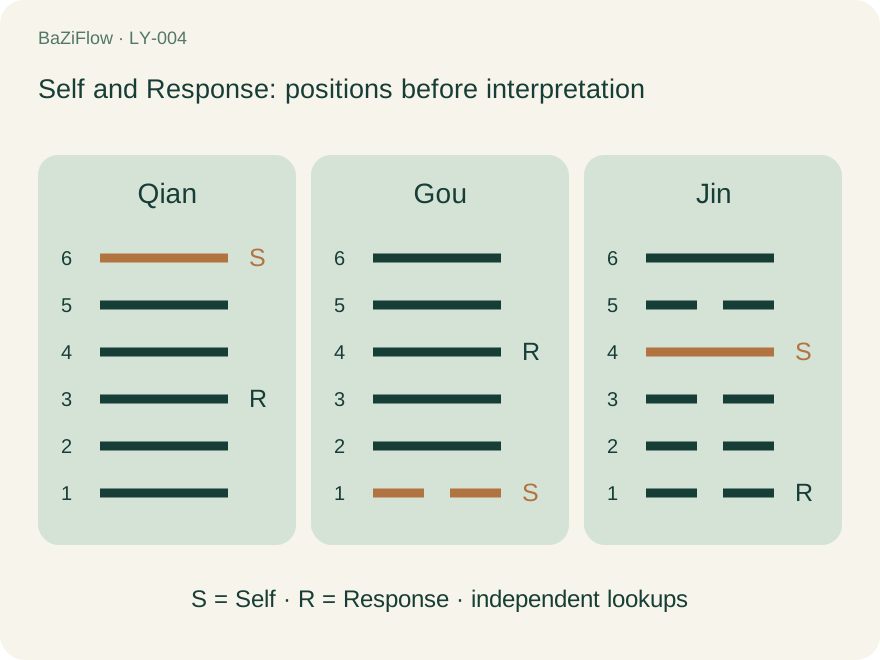 LY-004 / Liu Yao
Locating Self and Response without confusing moving lines
Check the Qian palace sequence and the three-position gap, then distinguish a primary hexagram’s Self from movement, changed charts, and assigned roles.
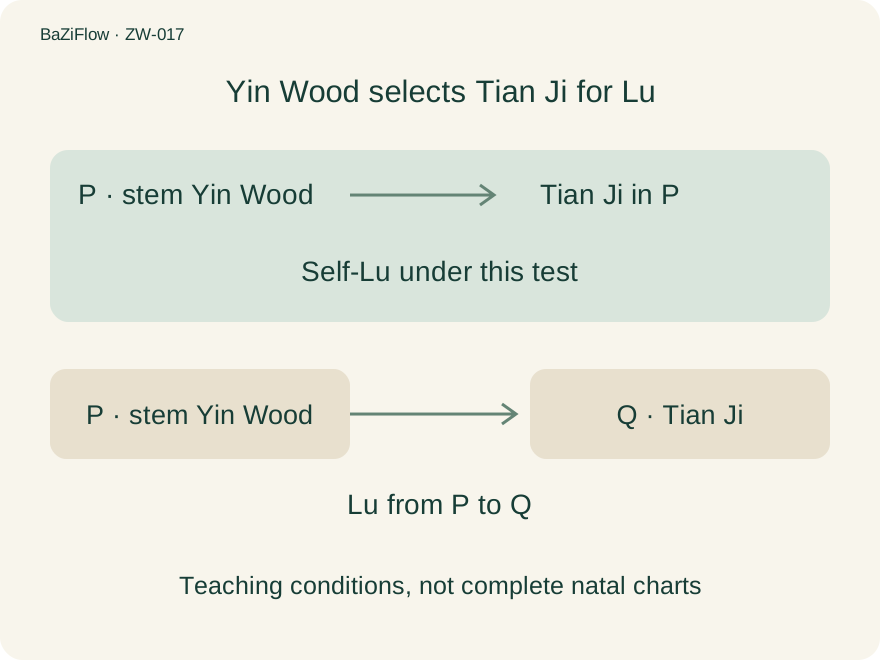 ZW-017 / Zi Wei Dou Shu
Self-Transformation: Define the Test Before the Meaning
Use a positive and a negative palace example to understand one documented self-transformation test. Separate the palace stem from natal labels and avoid assuming all schools use identical terminology.
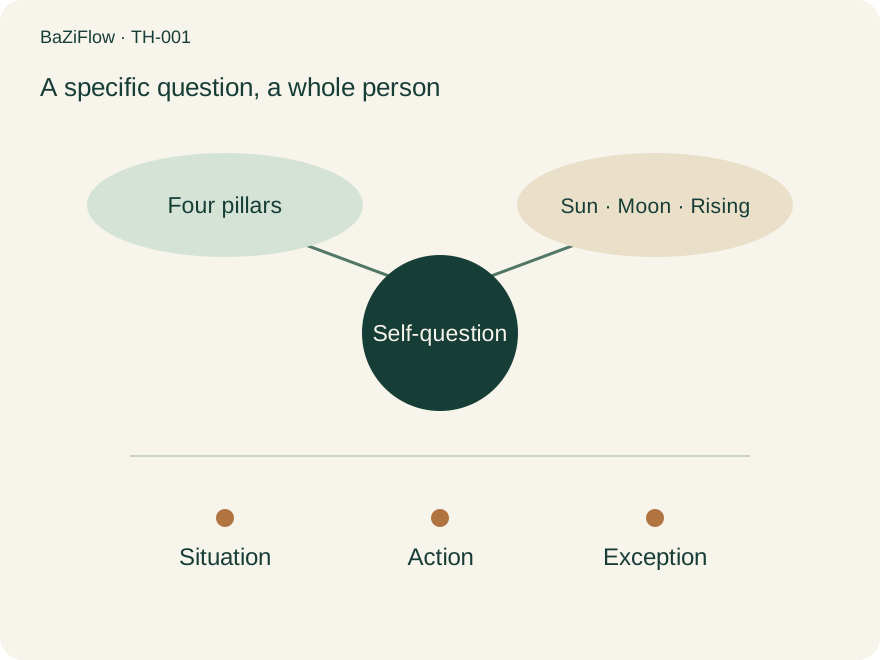 TH-001 / Read by theme
Choose a Starting Point for Understanding Yourself
Begin with a question you can observe, then choose a route through the four pillars, Sun–Moon–rising symbolism or the evidence behind a personal reading. Keep the person larger than any label.
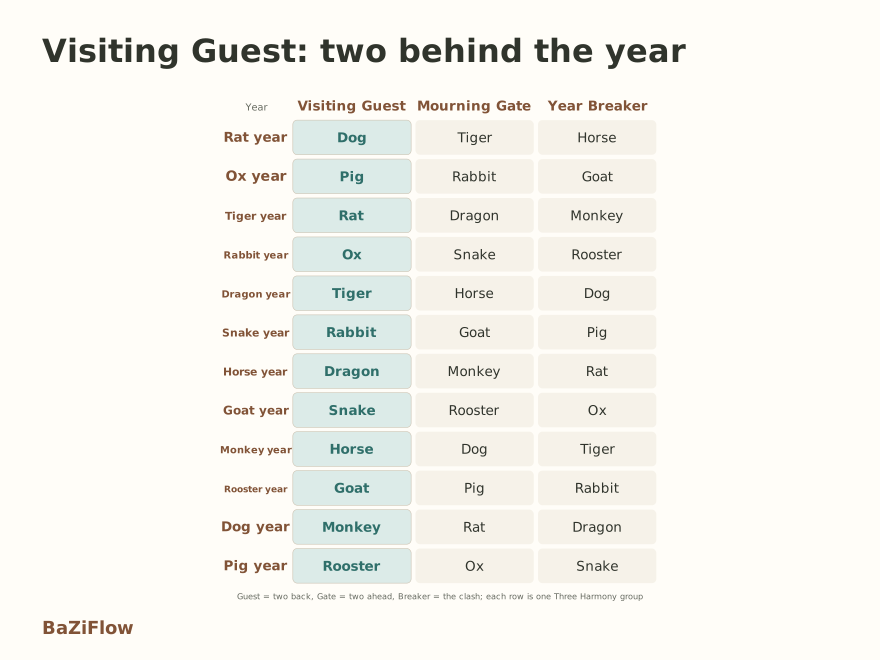 BZ-SS-29 / BaZi
Visiting Guest (吊客): Two Places Behind the Year Branch, Across from the Official Talisman
The Visiting Guest starts from the year branch and takes the second branch behind it, read in the month, day and hour pillars. A table, two charts, "a guest comes from elsewhere", and a Yin Earth Pig (己亥) case.
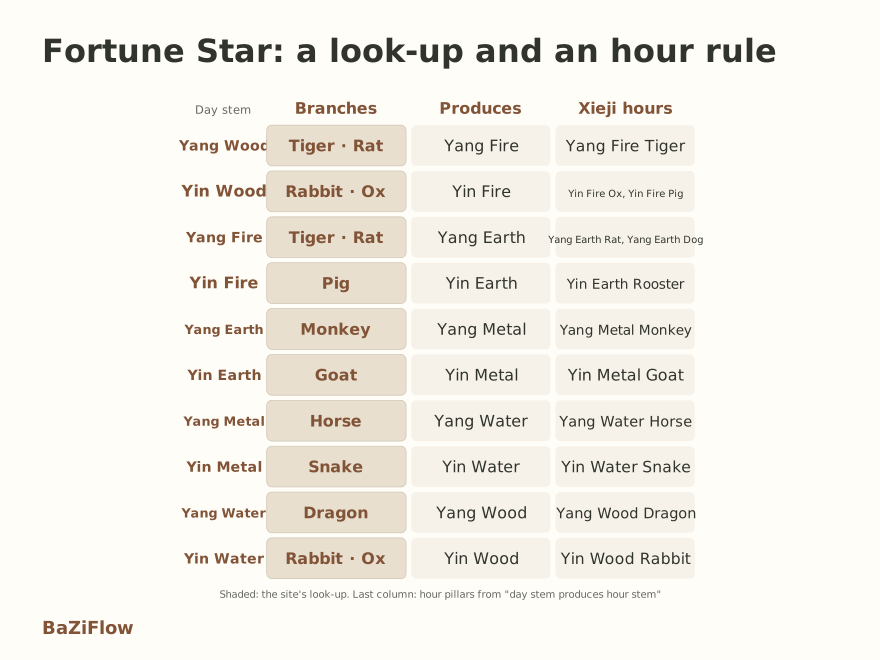 BZ-SS-16 / BaZi
Fortune Star Nobleman (福星贵人): A Look-up by Day Stem, and the Xieji Rule by Hour
Fortune Star starts from the day stem. A table, the Xieji rule "day stem produces hour stem" and a chart from the Sanming Tonghui that the site does not hit show where two look-ups agree and part.
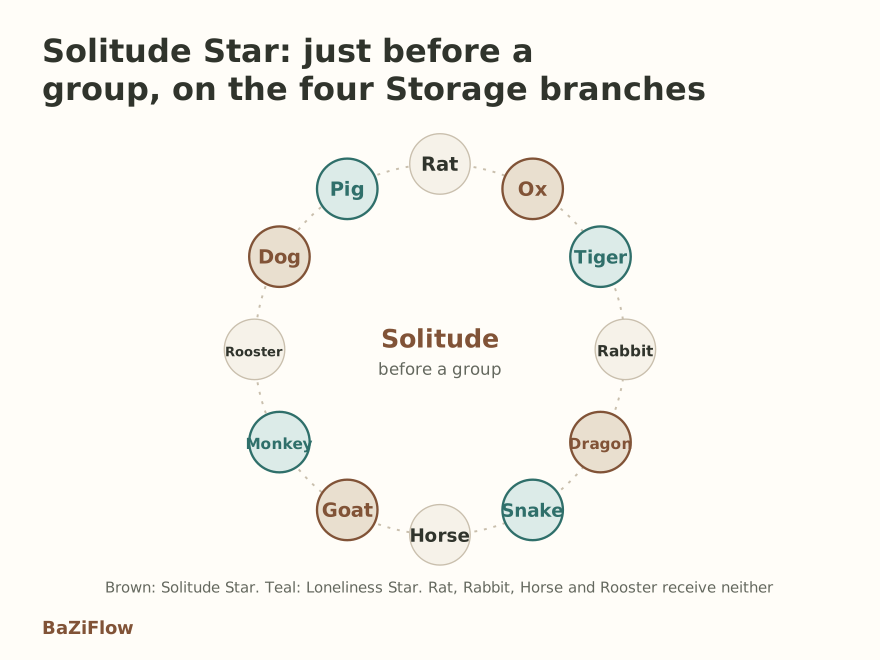 BZ-SS-10 / BaZi
Solitude Star (寡宿): One Before the Year Branch's Group, on the Four Storage Branches
The Solitude Star takes the branch before the year branch's direction group: always Ox, Dragon, Goat or Dog. A ring, the tomb of a husband or wife, two charts, and the condition that a single one is not counted.
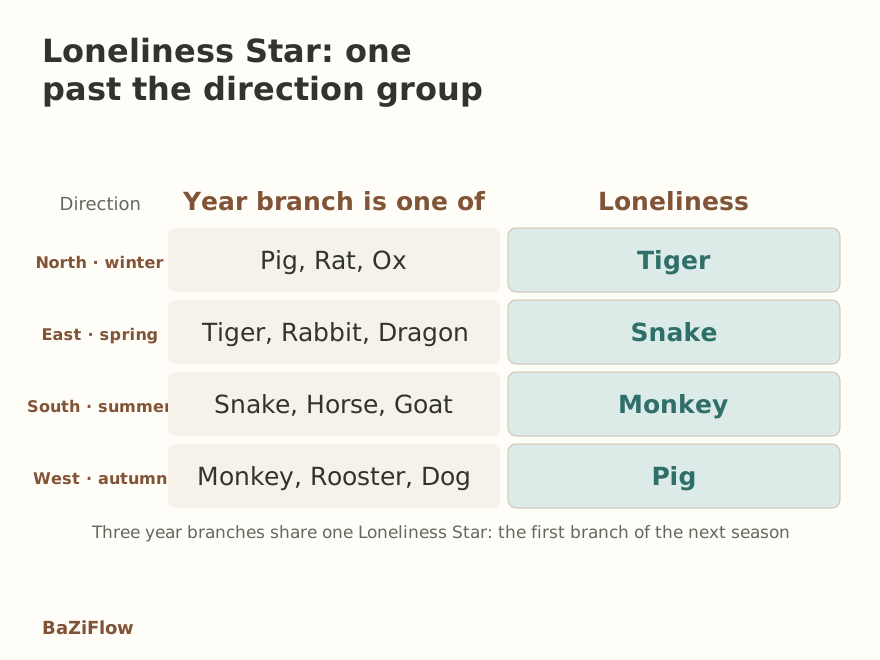 BZ-SS-09 / BaZi
Loneliness Star (孤辰): One Branch Past the Year Branch's Direction Group
The Loneliness Star starts from the year branch and takes the branch after its direction group: always Tiger, Snake, Monkey or Pig. A table, two charts, the Sanming Tonghui count and its "mother cut off" reasoning.
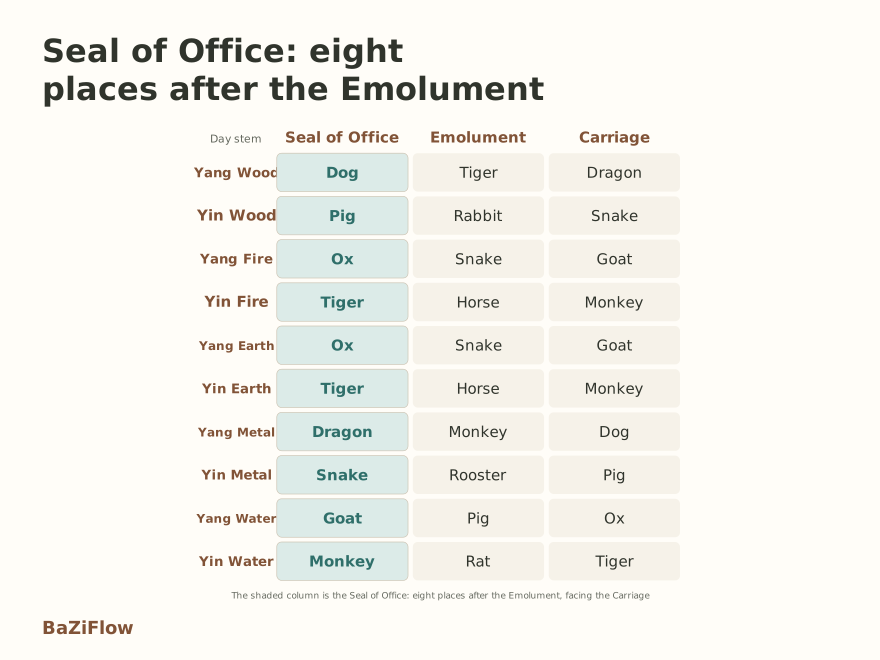 BZ-SS-13 / BaZi
Seal of Office (国印贵人): One Branch per Day Stem, Eight Places After the Emolument
The Seal of Office is a ten-row look-up keyed to the day stem; the branch it returns is searched in all four pillars, day pillar included. A table, two charts, an arithmetic pattern, a look-alike classic table.
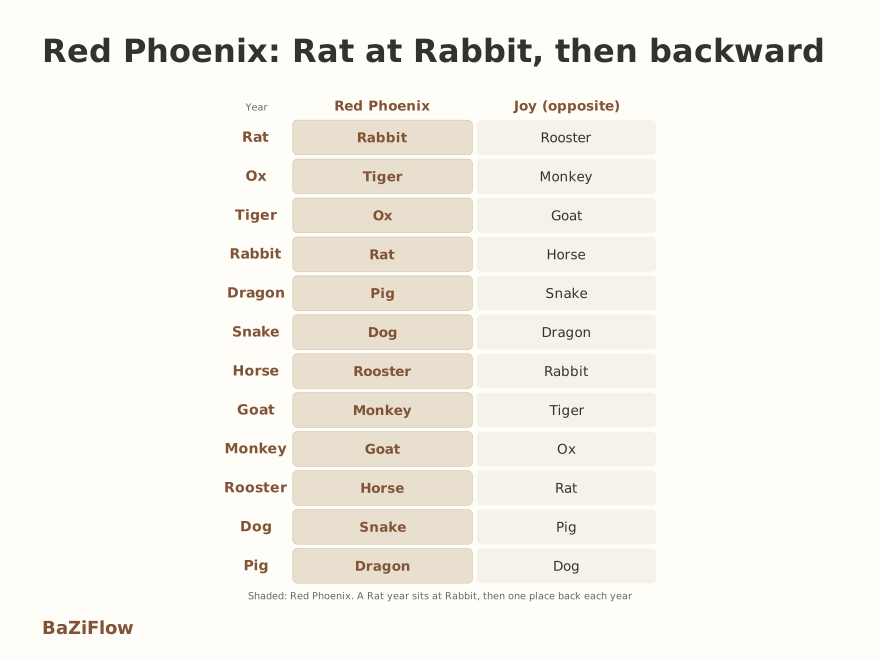 BZ-SS-23 / BaZi
Red Phoenix (红鸾): Counted Back from Rabbit to the Year Branch
Red Phoenix starts from the year branch, counted back from Rabbit. A twelve-year table, the Ziwei verse, three other things of this name and a comparison with Peach Blossom and Red Charm set it apart.
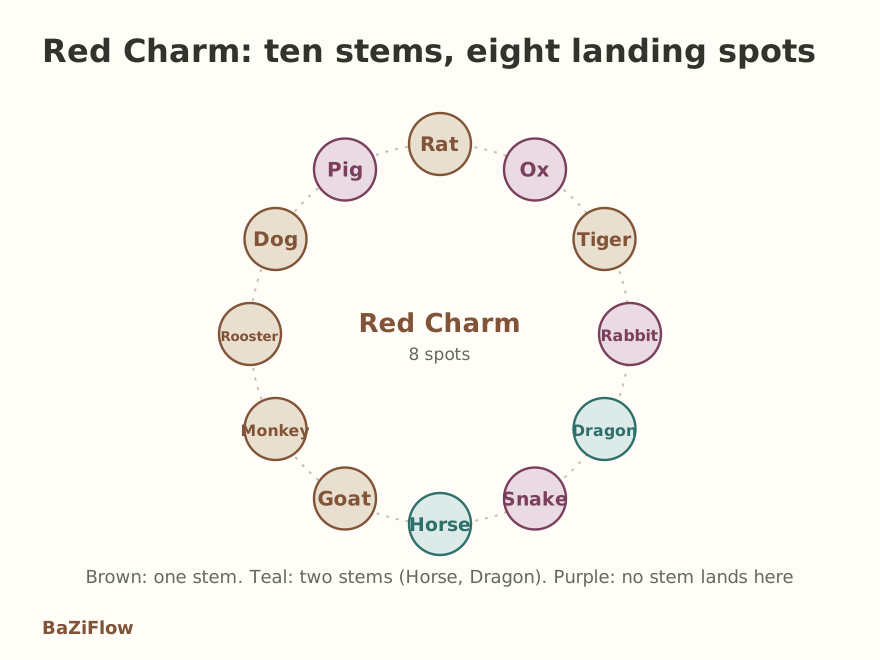 BZ-SS-08 / BaZi
Red Charm (红艳): Ten Day Stems on Eight Branches, and Two Cells That Differ From the Book
The Red Charm starts from the day stem, and ten stems land on only eight branches. A ring, a comparison table, two charts and the Sanming Tonghui entry that pairs it with Peach Blossom, with the two cells that differ.
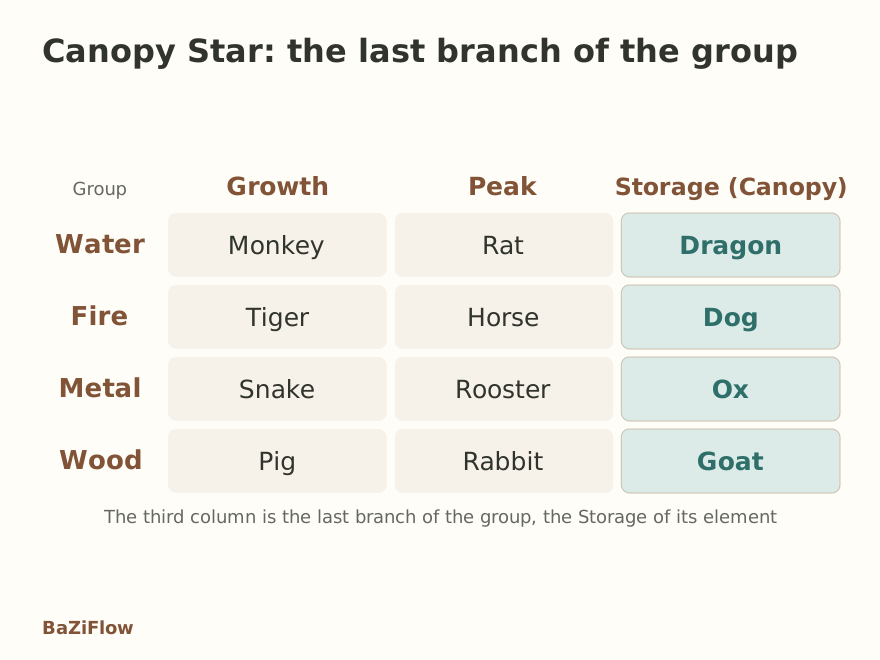 BZ-SS-05 / BaZi
Canopy Star: the Last Branch of a Three Harmony Group, the Storage of Its Element
The Canopy Star starts from the day branch and takes the last branch of its Three Harmony group, the Storage of that element. A table, three chart types, and the old text's "jeweled canopy" and "art star".
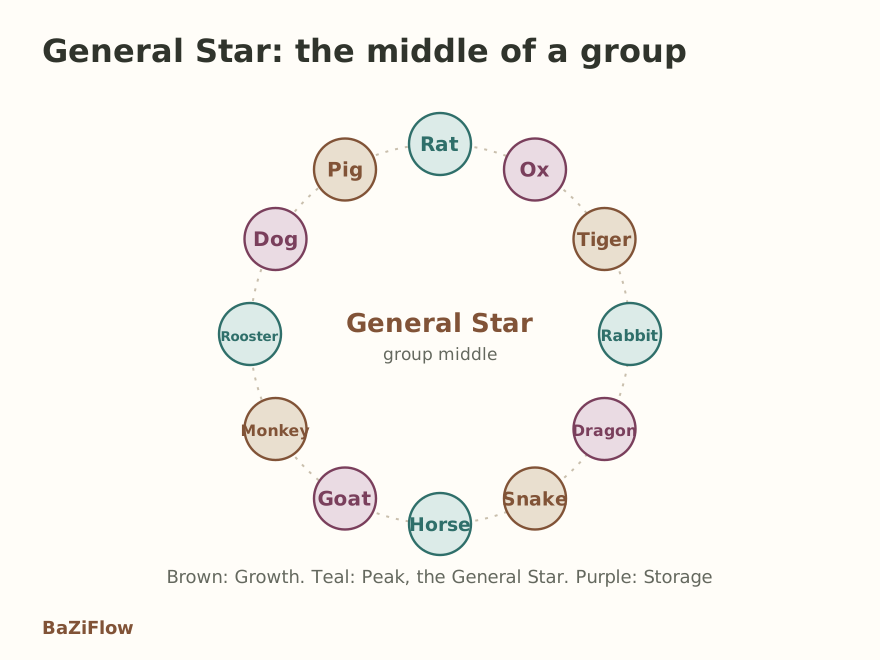 BZ-SS-06 / BaZi
General Star: the Middle Branch of a Three Harmony Group
The General Star starts from the day branch and takes the middle branch of its Three Harmony group, the Peak spot: always Rat, Horse, Rabbit or Rooster. A ring, two charts and the book's "central army".
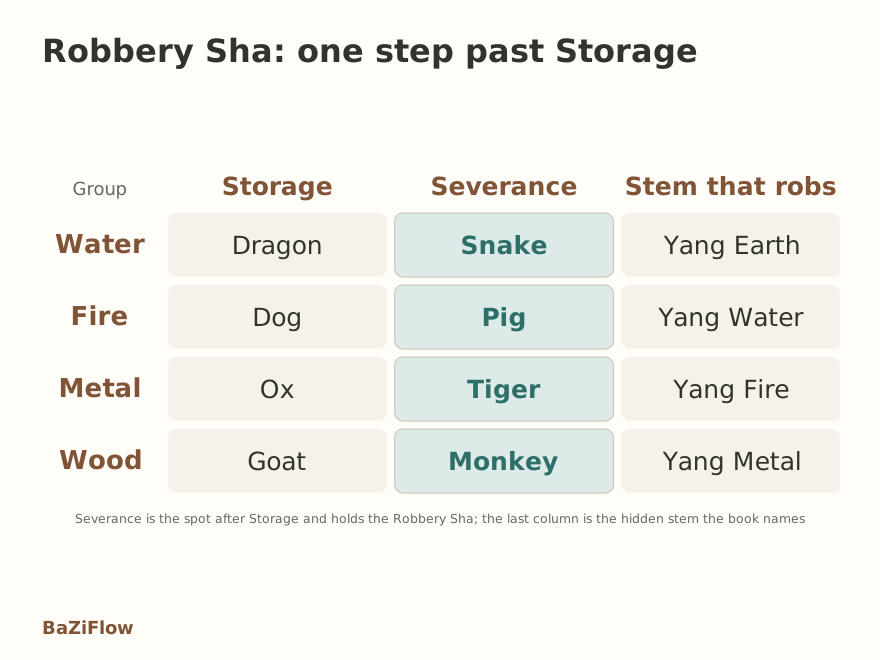 BZ-SS-25 / BaZi
Robbery Sha (劫煞): the Severance Spot of the Day Branch's Three Harmony Group
The Robbery Sha starts from the day branch and takes the spot right after Storage in its Three Harmony group, the Severance stage: always Tiger, Monkey, Snake or Pig. A table, two charts, two classical readings.
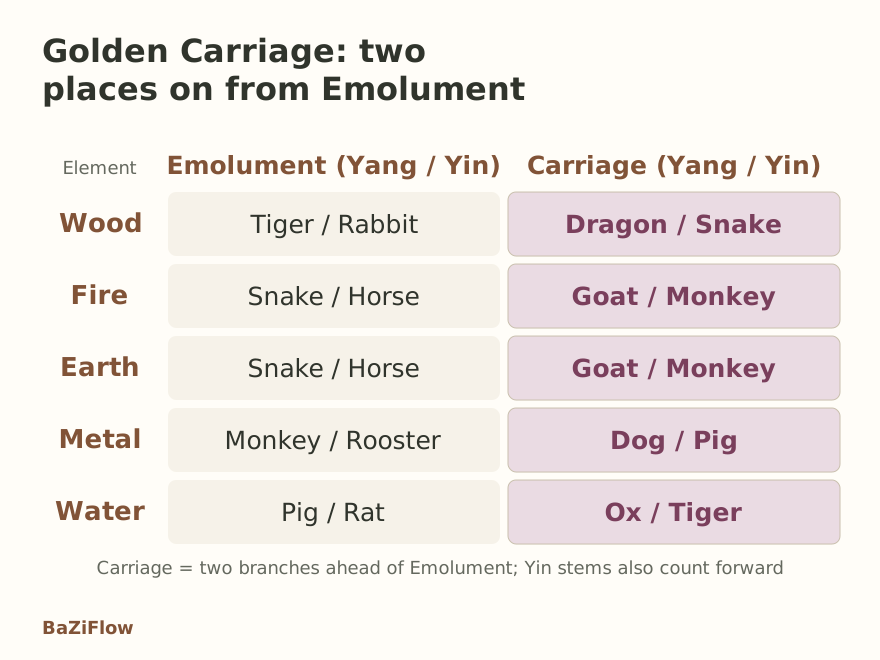 BZ-SS-12 / BaZi
Golden Carriage (金舆): Two Branches Ahead of Emolument, Yin Stems Included
The Golden Carriage starts from the day stem and sits two branches ahead of its Emolument. A look-up table, the Sanming Tonghui image, why Yin stems count forward, the book's second count from the Horse, and two charts.
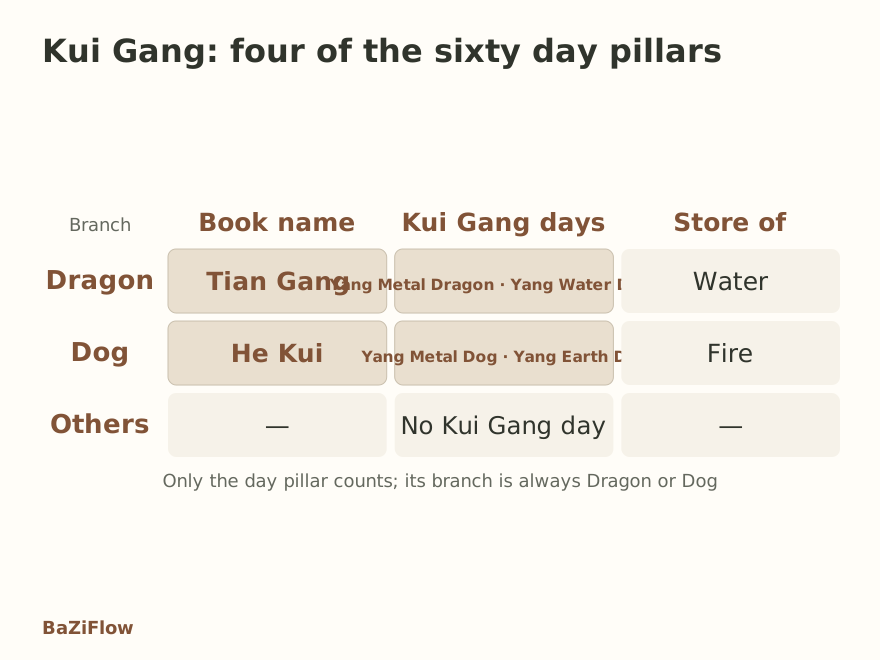 BZ-SS-20 / BaZi
Kui Gang (魁罡): Four Day Pillars, Read from the Day Pillar Alone
Kui Gang is not looked up from a month or year branch; the day pillar itself must be one of four. A table, Sanming Tonghui on the Dragon and Dog, and two charts from the book show how to spot it and where the site stops.
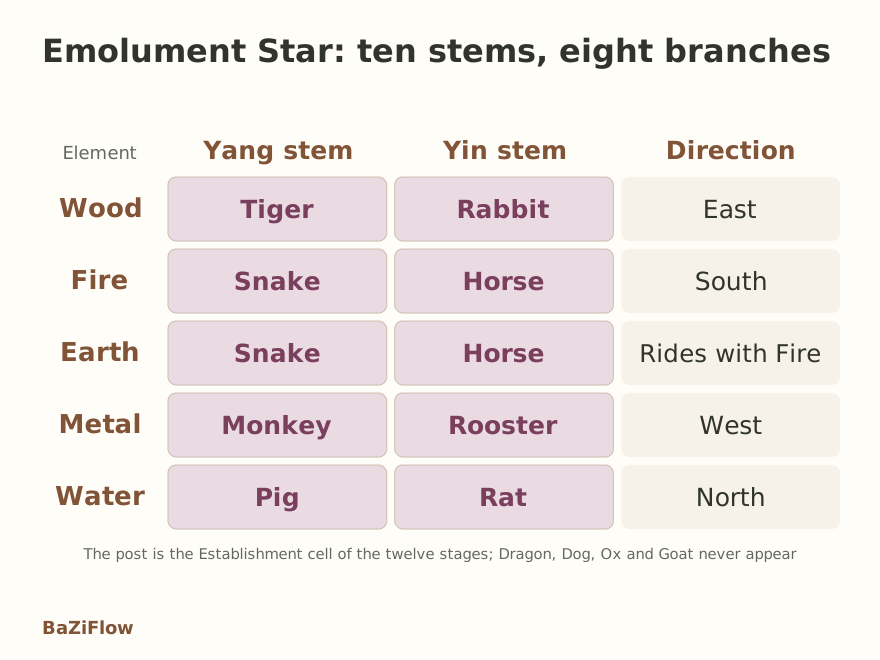 BZ-SS-11 / BaZi
Emolument Star (禄神): The Day Stem's Own Post, and Why It Never Sits on a Storehouse
The Emolument Star starts from the day stem and lands on eight branches, the Establishment cell of the twelve stages. A look-up table, the Sanming Tonghui reasoning, two charts, and names for clashed or void Emolument.
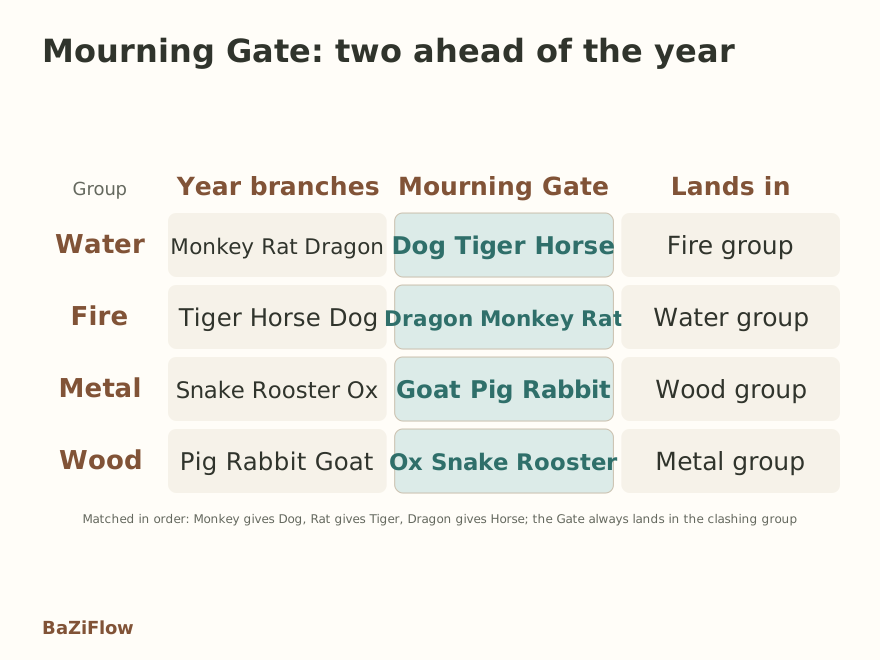 BZ-SS-28 / BaZi
Mourning Gate (丧门): Two Places Ahead of the Year Branch, the Third of the Twelve
The Mourning Gate starts from the year branch and takes the second branch ahead of it, read in the month, day and hour pillars. A table, two charts, and the old books on its name and the White Tiger.
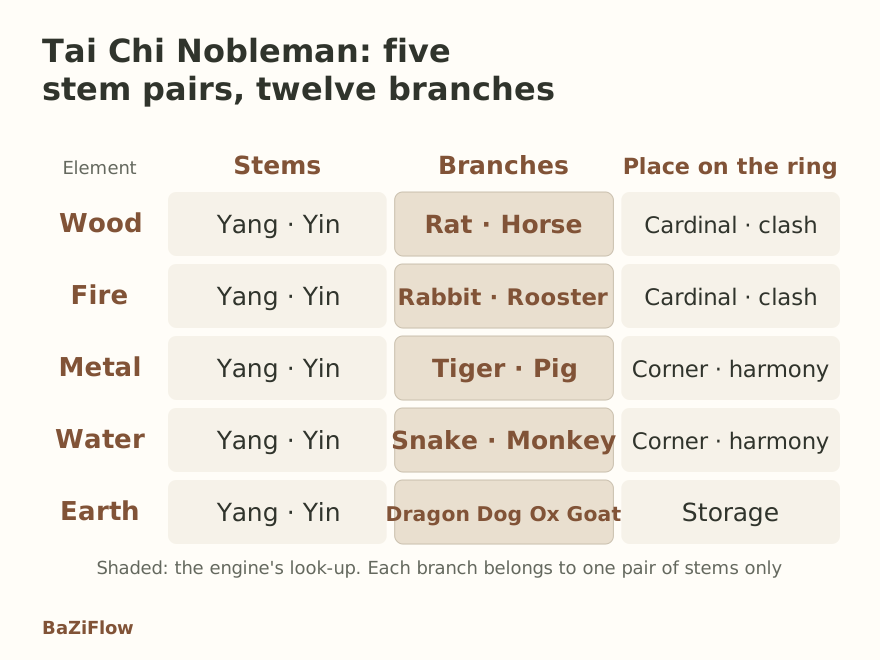 BZ-SS-17 / BaZi
Tai Chi Nobleman (太极贵人): Five Stem Pairs Share Twelve Branches
Tai Chi Nobleman is looked up by day stem and year stem, and five stem pairs share all twelve branches. A table, the Sanming Tonghui juan 3 reading of the name and two sample charts show the look-up and its limits.
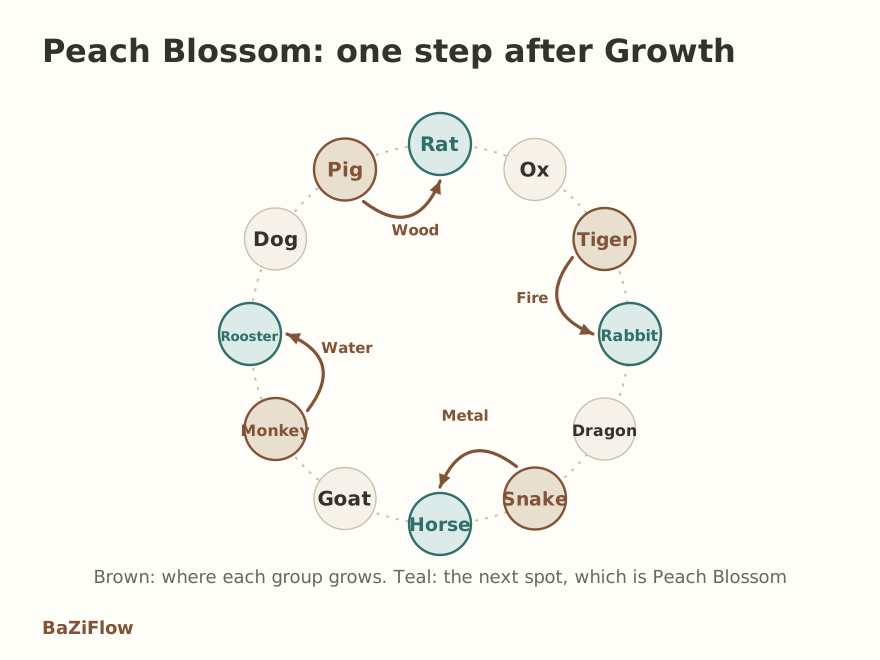 BZ-SS-04 / BaZi
Peach Blossom: Count One Step Past Growth to Bath, Which the Book Calls Xian Chi
Peach Blossom starts from the day branch: take the Growth spot of its Three Harmony group and count one on; the book calls it Xian Chi. A ring, two charts, blossom over the fields and reversed blossom.
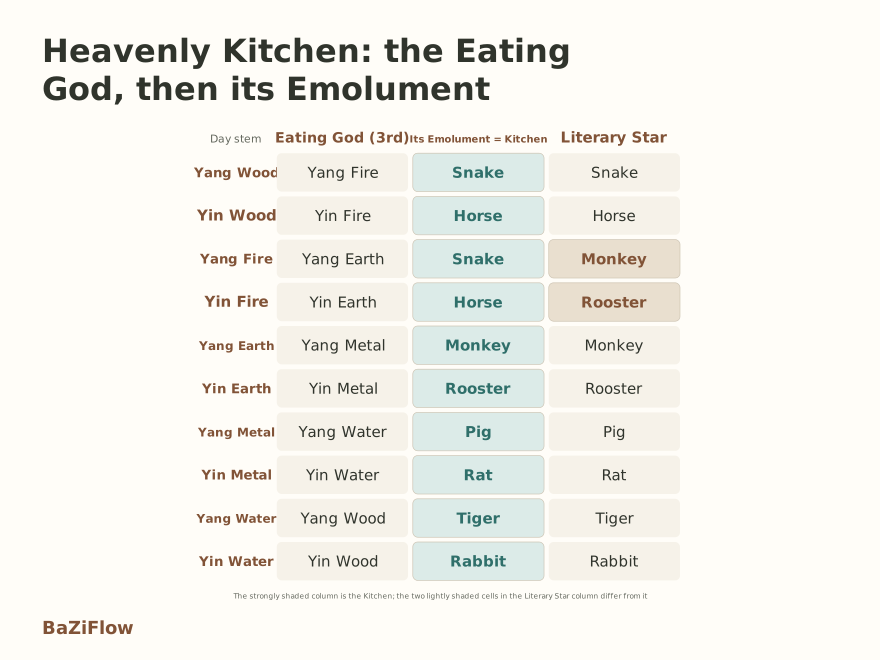 BZ-SS-15 / BaZi
Heavenly Kitchen (天厨贵人): Count the Eating God, Then Find Its Emolument
The Heavenly Kitchen is keyed to the day stem: count to its Eating God, take that stem's Emolument branch, then look for it in the pillars. A table, two sample charts and what the Yuanhai and Sanming Tonghui say.
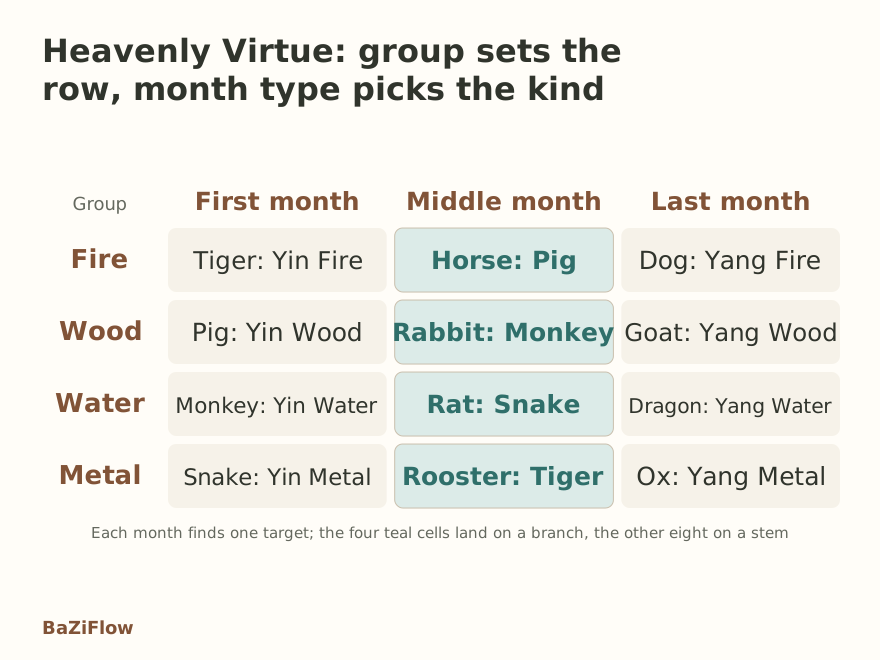 BZ-SS-18 / BaZi
Heavenly Virtue (天德贵人): One Character from the Month Branch
Heavenly Virtue starts from the month branch, and twelve months find one character each, eight on a stem and four on a branch. A table, two almanac readings and a rival month list sort stems from branches.
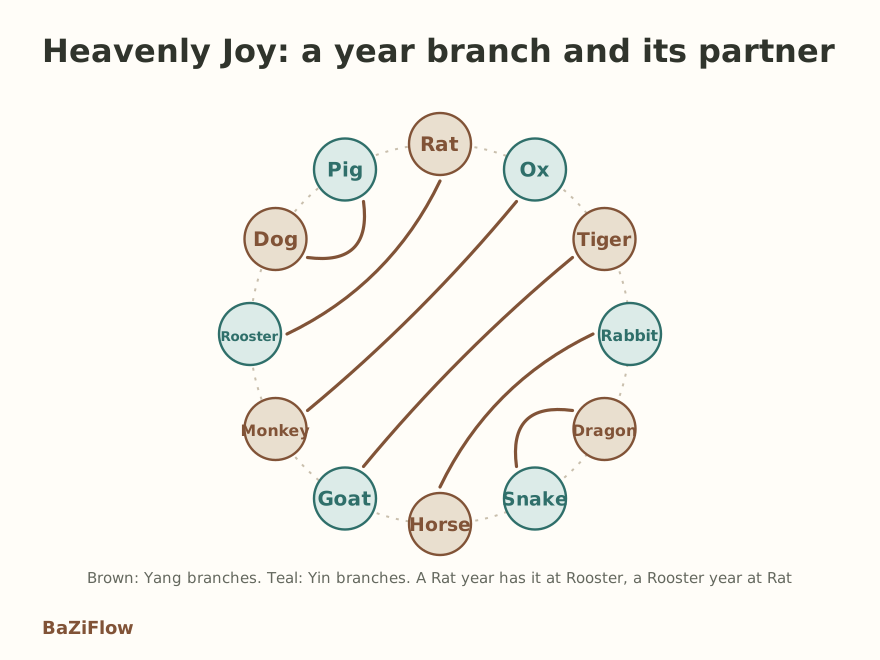 BZ-SS-22 / BaZi
Heavenly Joy (天喜): The Branch Opposite Red Phoenix, and Other Tables of That Name
Heavenly Joy starts from the year branch and takes the branch opposite Red Phoenix. A ring chart, the Ziwei Doushu Quanshu verse and three same-name tables from the Xieji Bianfang Shu show the look-up and its sources.
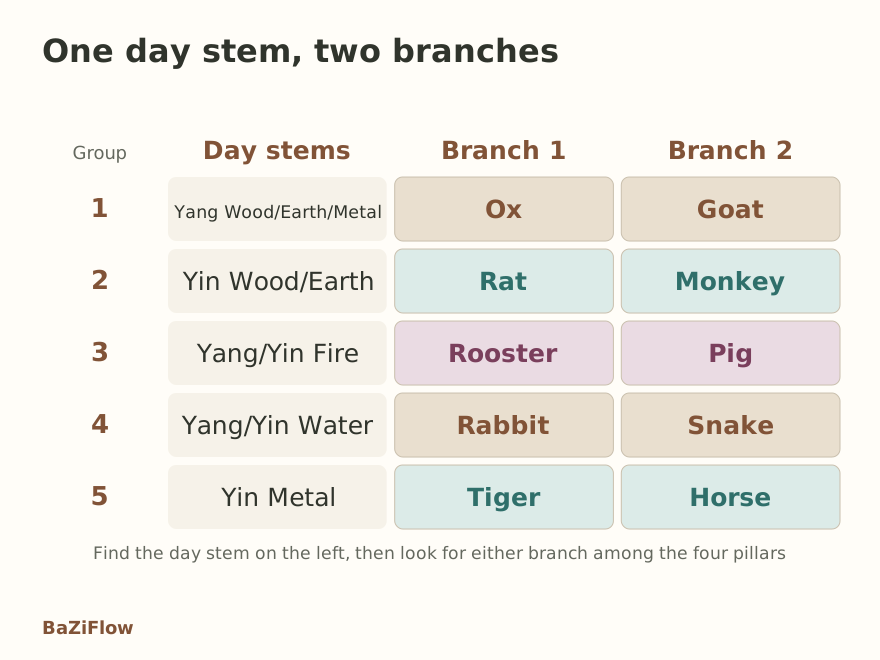 BZ-SS-01 / BaZi
Heavenly Nobleman: Which Two Branches Your Day Stem Looks Up
The Heavenly Nobleman looks only at the Day Master stem. Each stem maps to two branches, searched in the four pillars. A table, two worked charts and three set-ups from the Sanming Tonghui, juan 3.
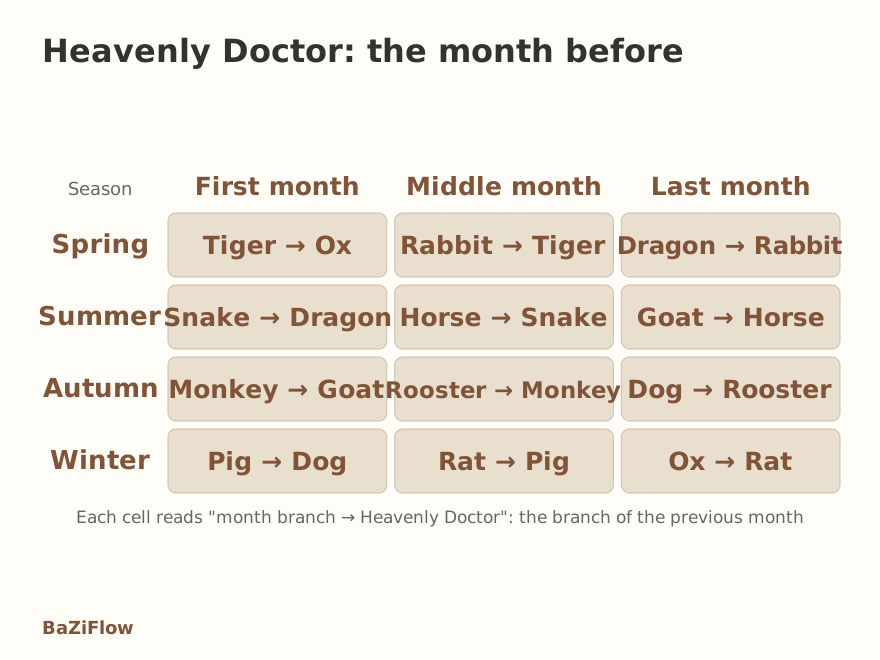 BZ-SS-24 / BaZi
Heavenly Doctor (天医): The Branch Before the Month, and Tables Sharing the Name
The Heavenly Doctor starts from the month branch and takes the branch just before it. Two sample charts, the almanac rule "start at Dog in the first month", and the other tables that share the name.
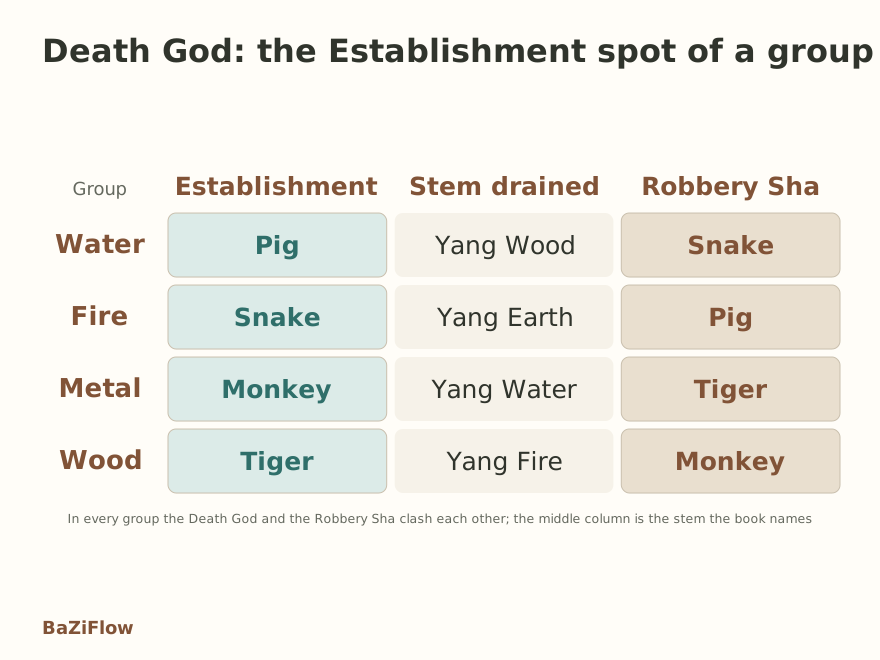 BZ-SS-27 / BaZi
Death God (亡神): the Establishment Spot of a Group, Opposite the Robbery Sha
The Death God starts from the day branch and takes the Establishment spot of its Three Harmony group, just before Peak: Tiger, Monkey, Snake or Pig. A table, the banner-and-pennant case and two sample charts.
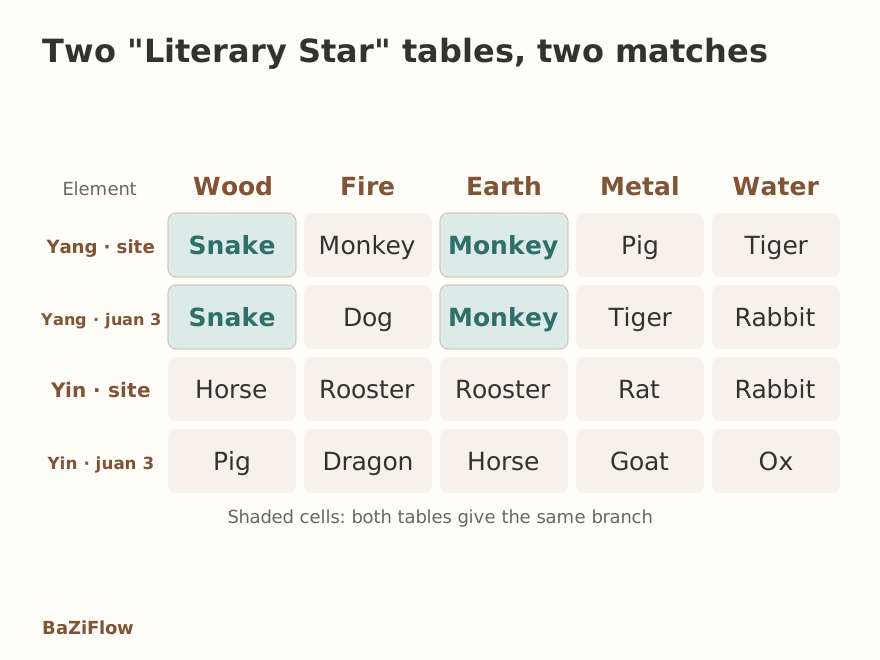 BZ-SS-02 / BaZi
Literary Star: One Branch per Day Stem, and a Different Table in the Sanming Tonghui
The Literary Star maps the Day Master stem to one branch. Two charts and a comparison table set the site table against the Sanming Tonghui juan 3 list, which agrees on two stems, and trace the site table to its source.
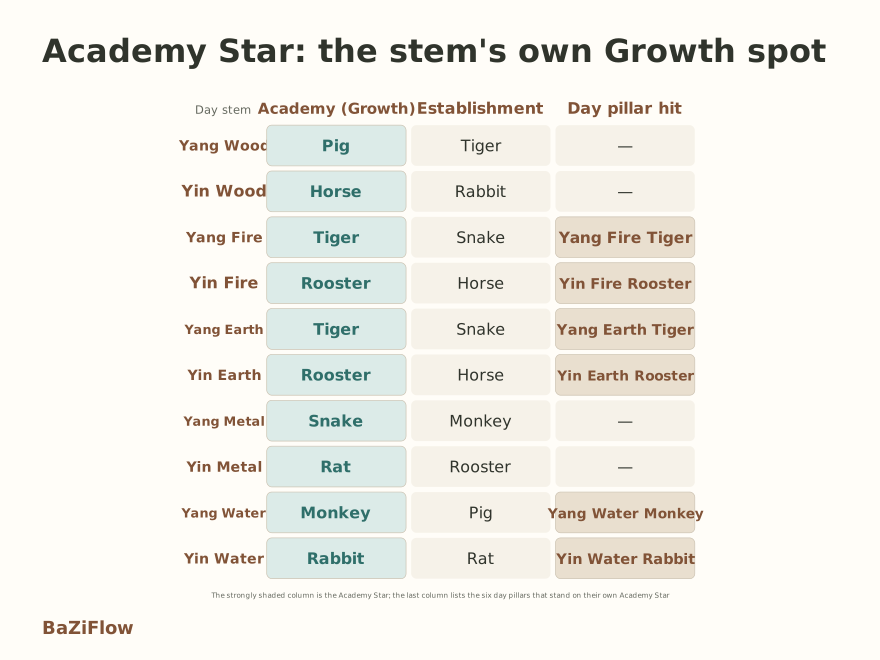 BZ-SS-14 / BaZi
Academy Star (学堂): The Day Stem's Own Growth Spot, and How the Sanming Tonghui Reads It
The Academy Star keys on the day stem: take the branch where that stem sits at Growth in the twelve life stages and look for it in the pillars. A table, a Yin Fire day example, other readings, the classic's conditions.
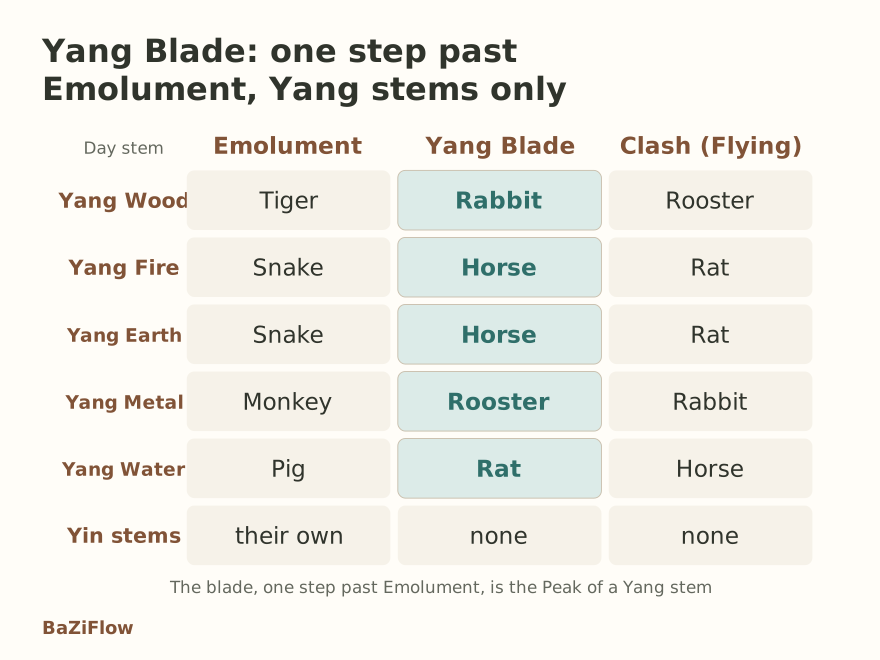 BZ-SS-07 / BaZi
Yang Blade (阳刃): One Step Past Emolument, Only for the Five Yang Stems
The Yang Blade starts from the day stem and exists only for the five Yang stems, on the branch right after Emolument. A table, two charts and the Sanming Tonghui on the blade, the Yin stems and the Day Blade.
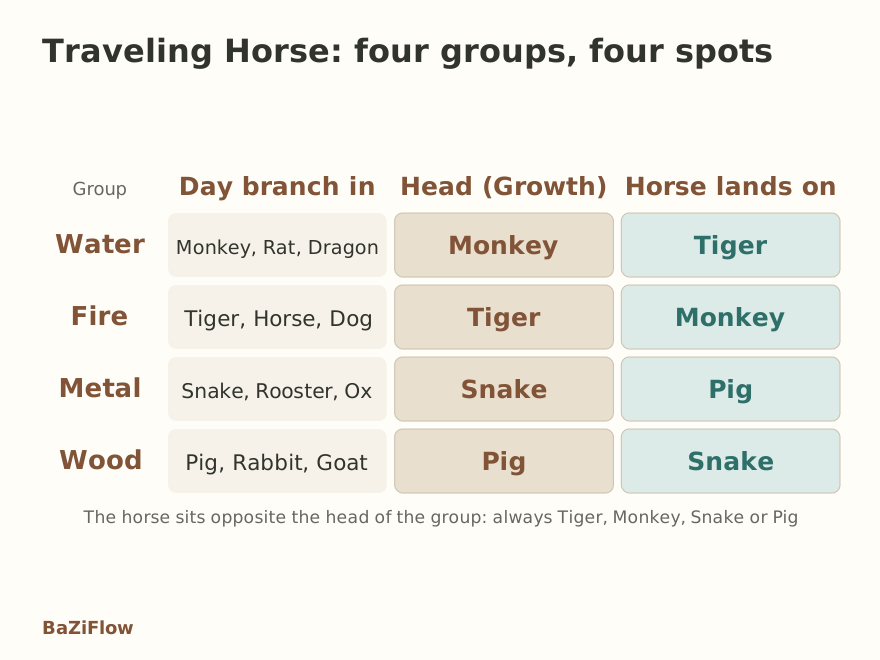 BZ-SS-03 / BaZi
Traveling Horse: Find the Head of the Three Harmony Group, Then Its Clash
The Traveling Horse starts from the day branch: find its Three Harmony group, take the head, then the clashing branch. It lands only on Tiger, Monkey, Snake or Pig. Set against the twelve horses of the Sanming Tonghui.
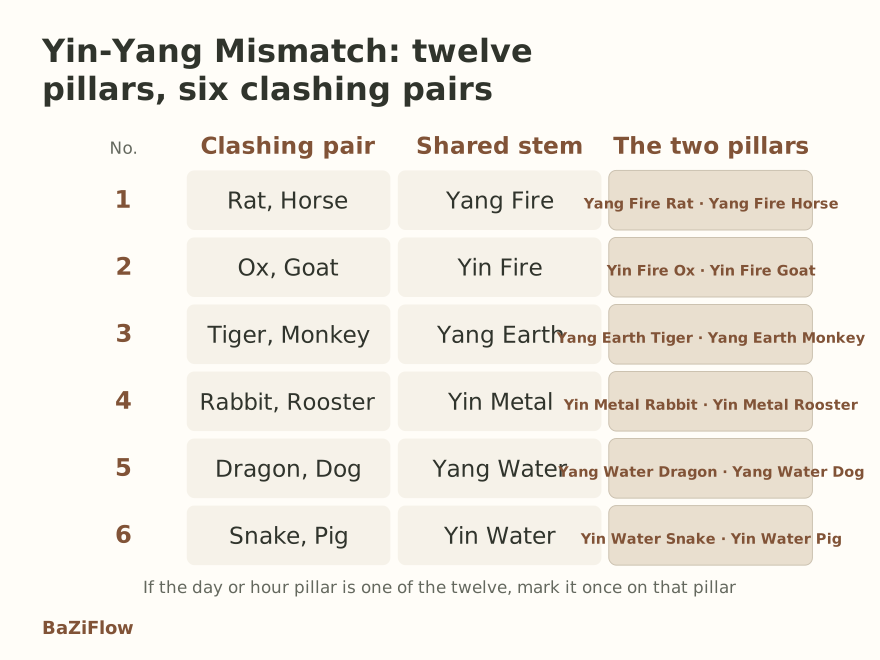 BZ-SS-21 / BaZi
Yin-Yang Mismatch (阴阳差错): Twelve Fixed Pillars, Checked on the Day and Hour
Yin-Yang Mismatch needs no conversion: the day or hour pillar itself must be one of twelve fixed pillars. A table, the Sanming Tonghui entry and three demonstration charts show how to spot it and where the site differs.
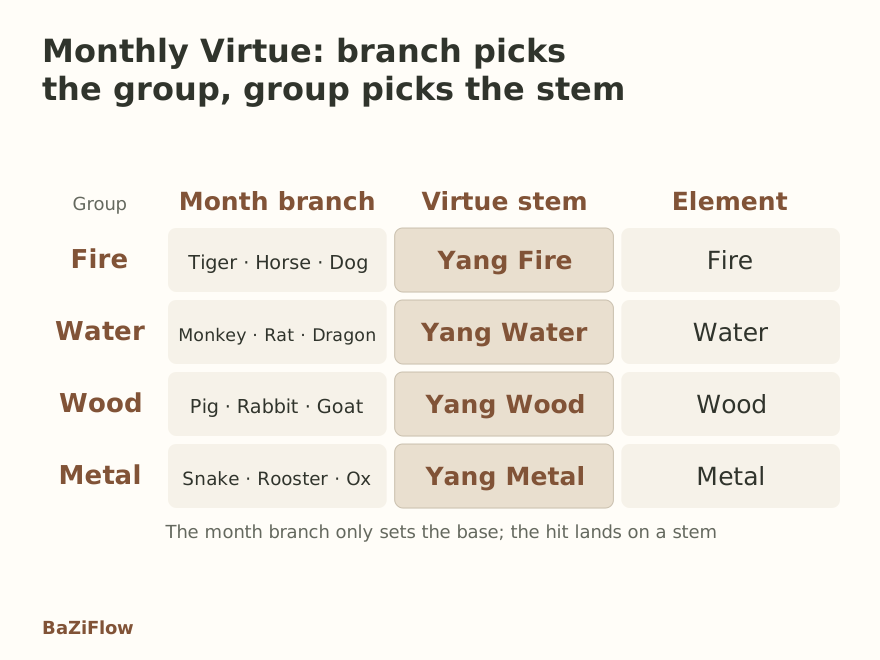 BZ-SS-19 / BaZi
Monthly Virtue (月德贵人): Four Yang Stems Found from the Month Branch
Monthly Virtue starts from the month branch, takes the Yang stem of its Three Harmony group and looks for it among the four stems. A table, two classical explanations and the book's own two charts add its conditions.
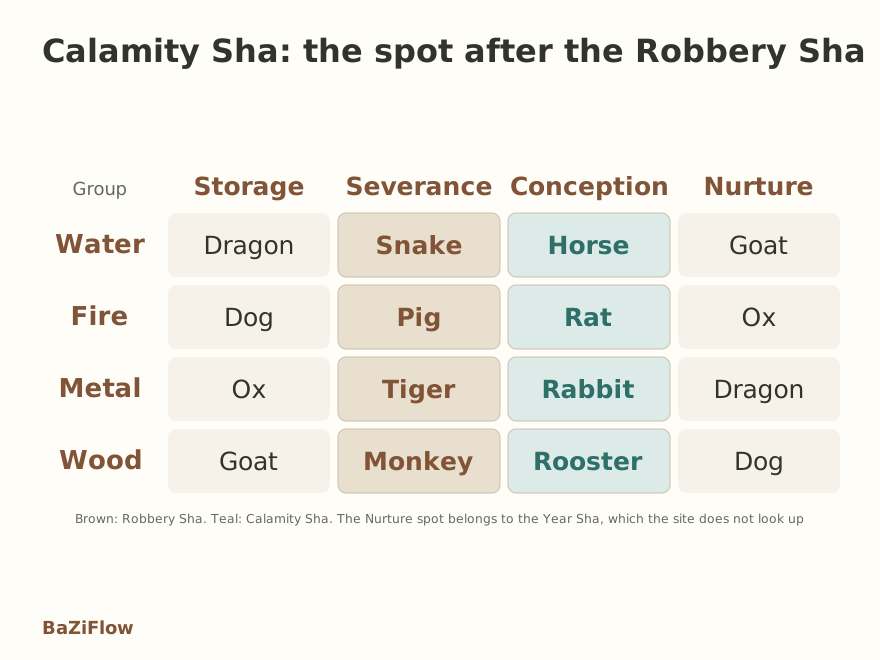 BZ-SS-26 / BaZi
Calamity Sha (灾煞): One Spot After the Robbery Sha, Opposite the General Star
The Calamity Sha starts from the day branch and sits one spot after the Robbery Sha in its Three Harmony group, at Conception and across from the General Star: Rat, Horse, Rabbit or Rooster. Table, ring, two readings.
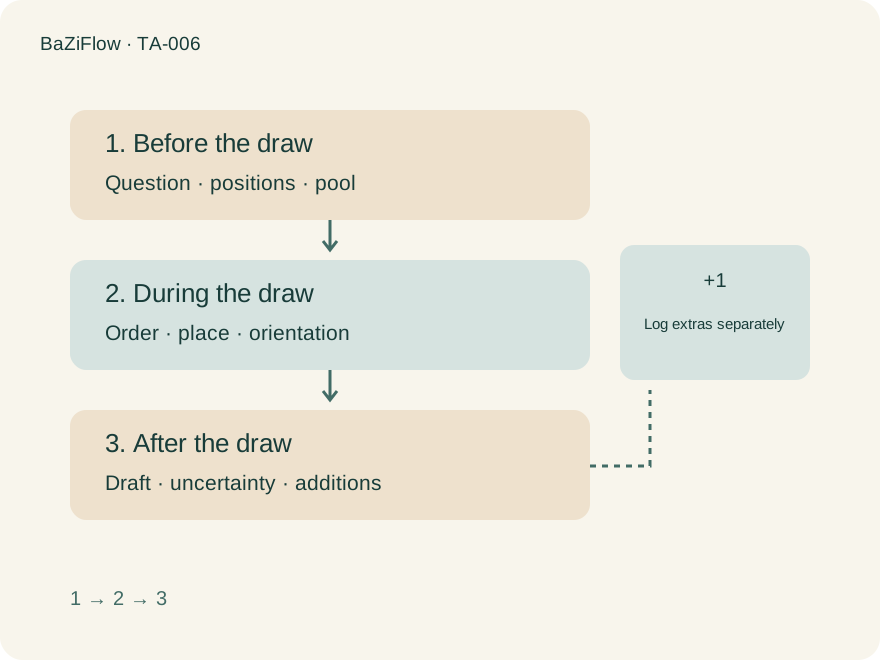 TA-006 / Tarot
A tarot draw needs a record, not just a photograph
Build a readable record of deck selection, orientation, dealing order and later additions. Two procedures in Waite’s 1911 manual show why a named method matters more than an invented universal ritual.
 AS-016 / Western astrology
House ruler, occupant and dispositor: keep the roles distinct
Trace a fifth-house ruler through a constructed Libra-rising chart. Separate the sign used to assign rulership, the planet’s actual location and the next dispositor link without inventing missing data.
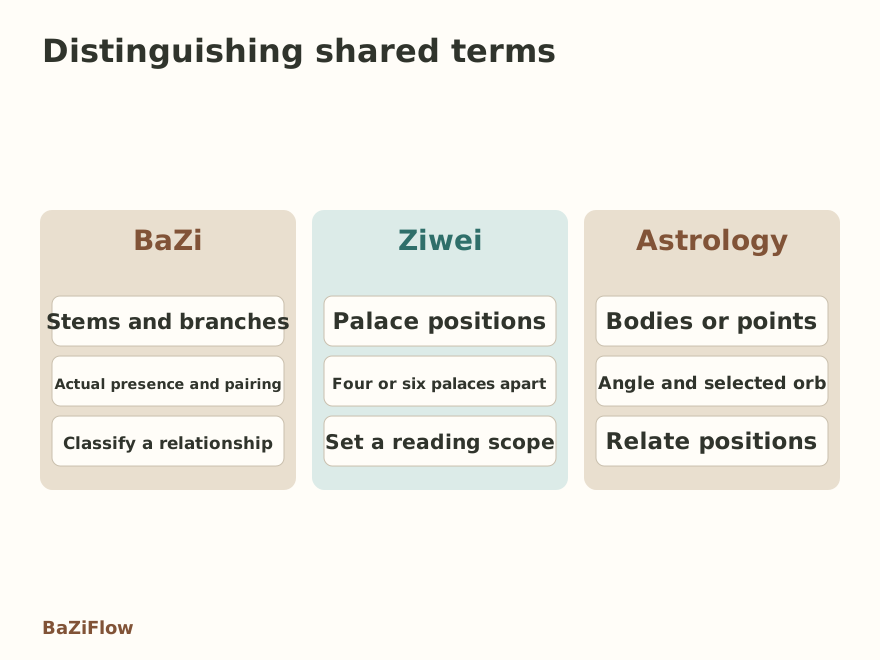 ST-003 / Cross-system studies
Combination, clash and star in BaZi, Ziwei and astrology: different rules
What combination, clash and star mean in each system: compare BaZi pairing, Ziwei palace spacing and astrological longitude through unequal combination gaps, a cross-sign conjunction and a 177° opposition candidate.
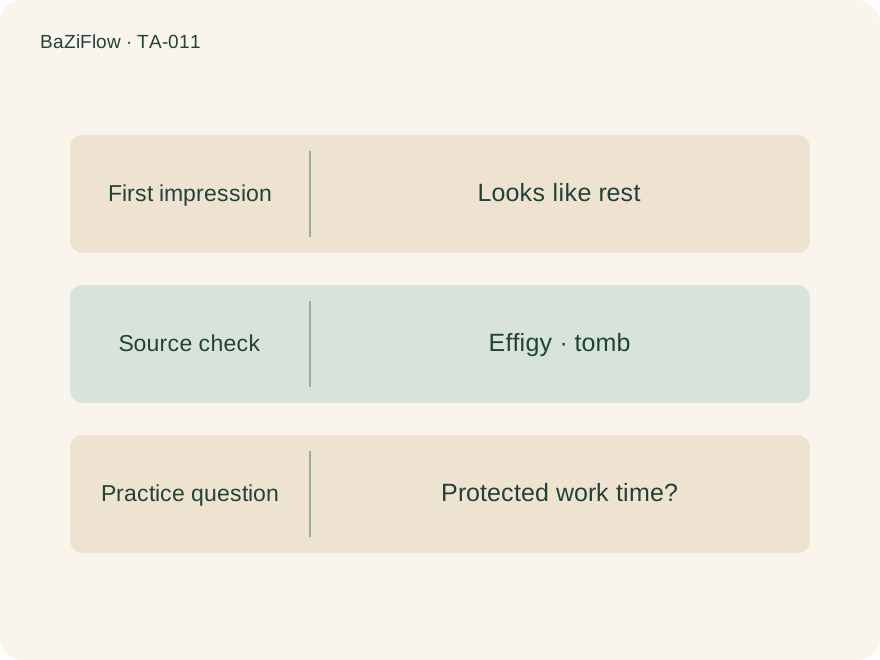 TA-011 / Tarot
A single-card practice can record a correction
Use the Four of Swords to distinguish a first impression from a source description and a practical question. The aim is a traceable learning note, not a prediction that must fit the day.
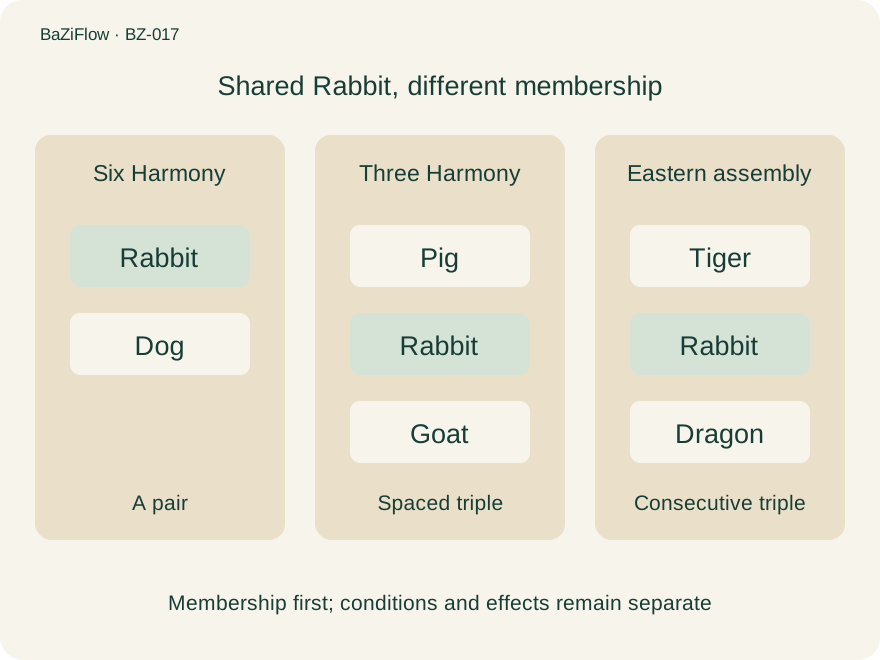 BZ-017 / BaZi
Six Harmony, Three Harmony and Directional Assemblies
Rabbit–Dog, Pig–Rabbit–Goat and Tiger–Rabbit–Dragon share a branch but belong to different structures. Compare their membership rules before asking whether a combination forms or transforms.
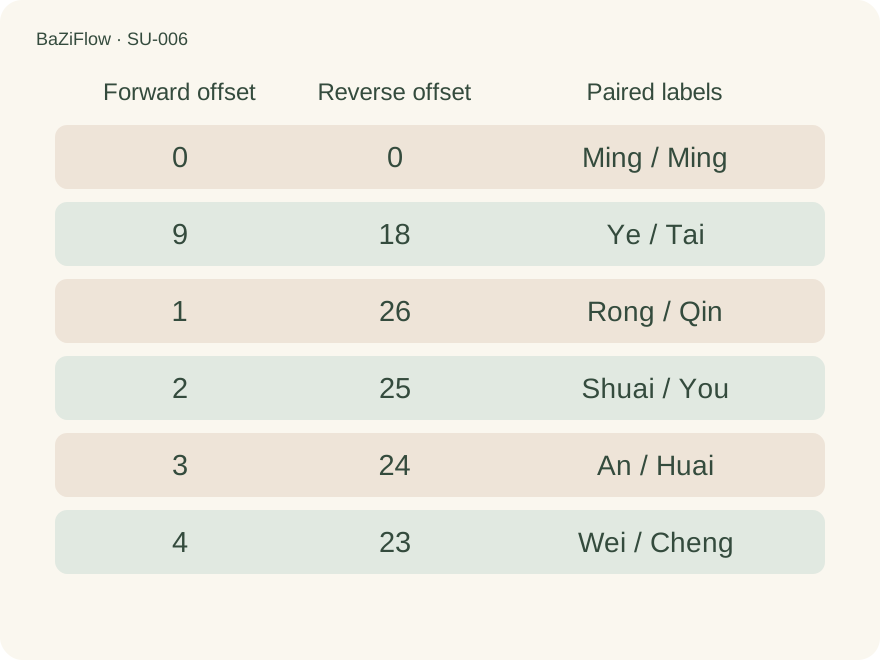 SU-006 / Sukuyō astrology
Six Sukuyō groups: derive both directional labels
Derive six reciprocal pairs from the three-nine ordering using modular offsets, while keeping reference ownership and interpretive limits explicit.
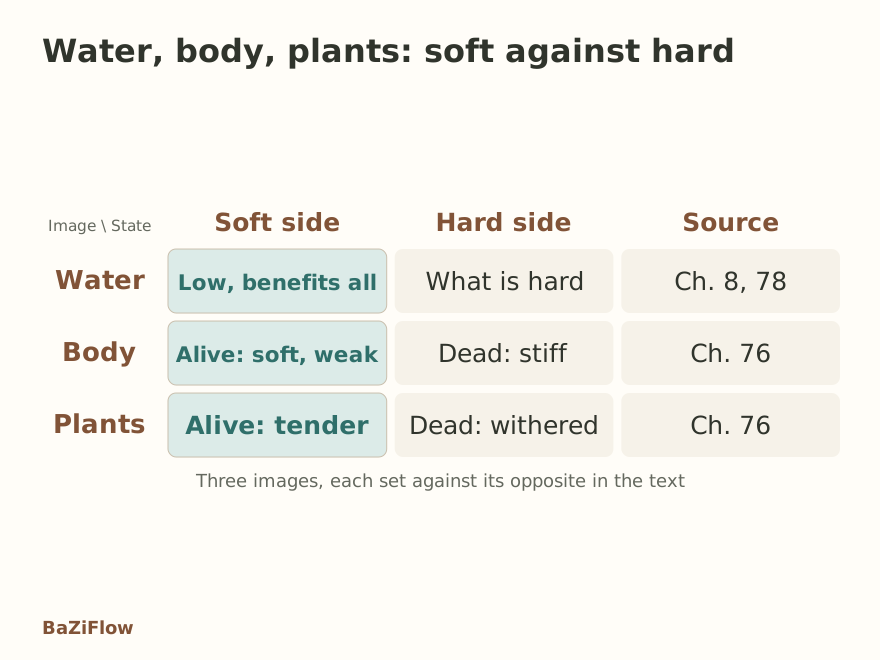 DA-005 / Daoist thought
Softness and Non-Contention: Read the Images First, Then Talk About Strength and Yielding
Water, life and death, plants and the sea show what softness (柔弱) and non-contention (不争) mean in the Laozi. Chapter 78 itself adds "none can practice it", which sets the text apart from later "yield and win" readings.
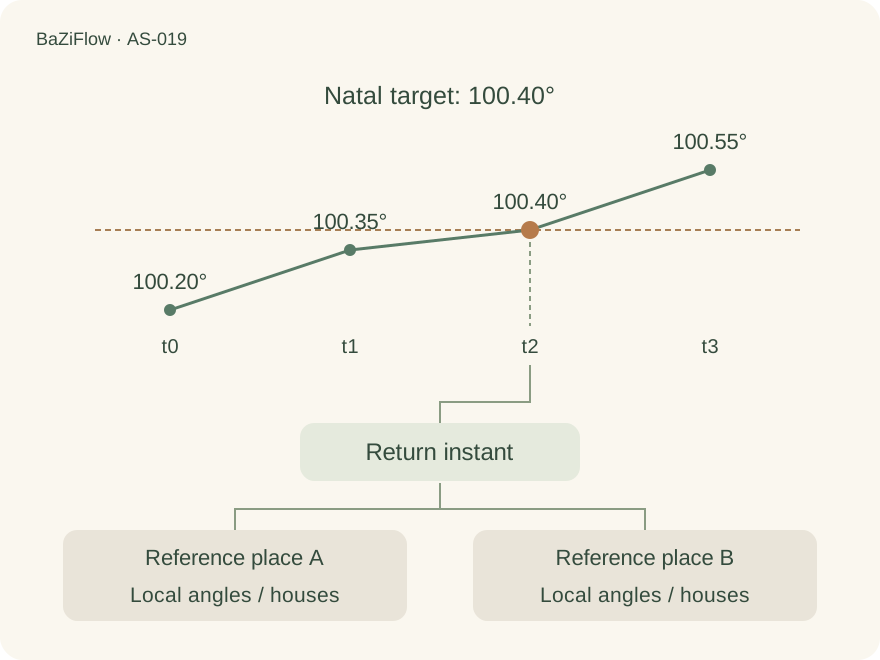 AS-019 / Western astrology
Solar returns: solve the time, then choose the chart location
Distinguish the Sun’s return to natal longitude from a birthday clock time. Audit the target units, zodiac, reference place and aspect layers before comparing annual charts.
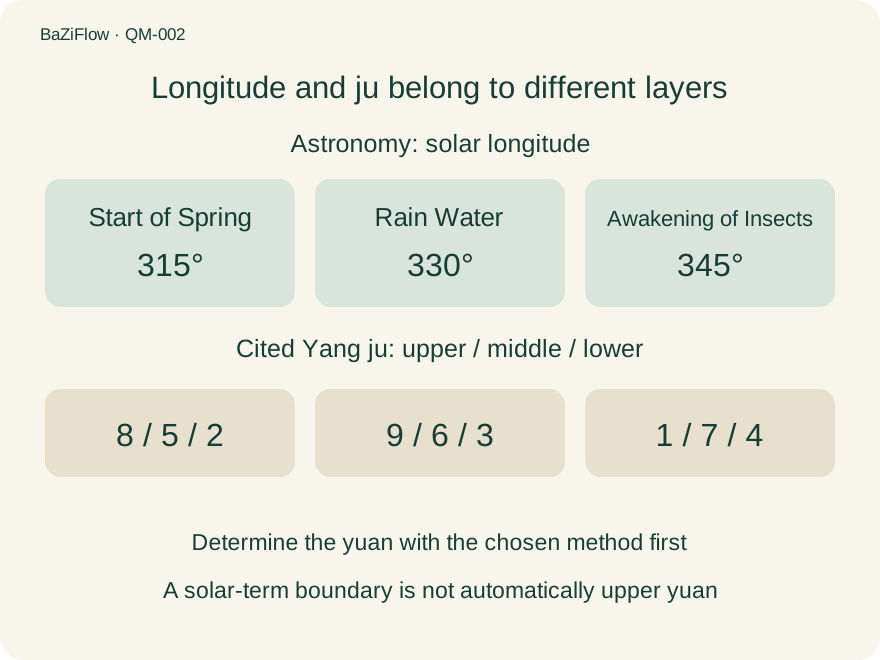 QM-002 / Qimen Dunjia
Solar Terms and Qimen Ju Numbers Are Different Layers
Solar longitude identifies a seasonal reference, while a chosen Qimen method supplies cycle and ju rules. Three named classical examples show why a solar-term label is not a complete setup.
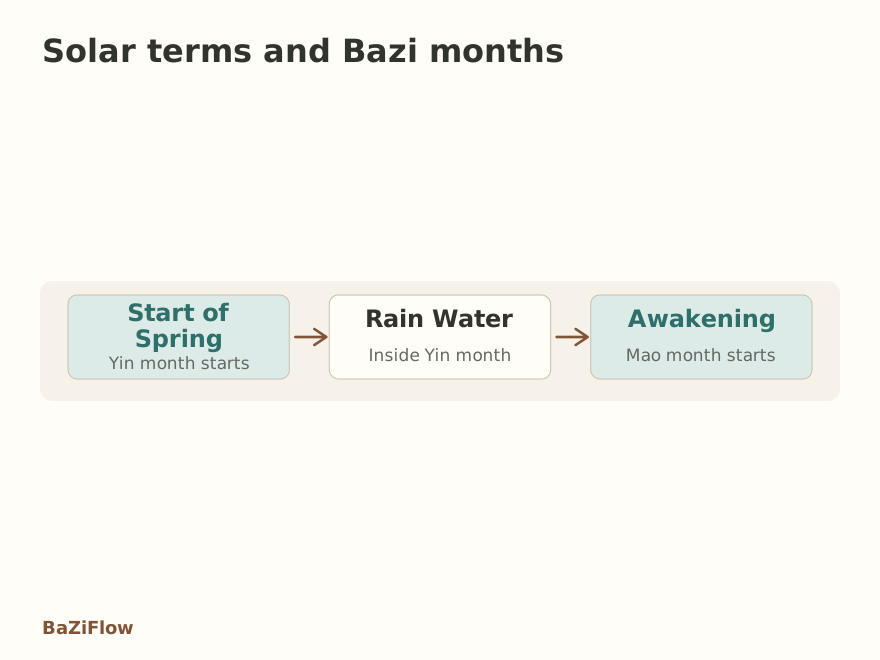 BZ-003 / BaZi
Why BaZi months follow solar-term boundaries
Separate a civil month, a lunar-calendar month and a BaZi solar month, then learn how to handle an uncertain birth near a boundary.
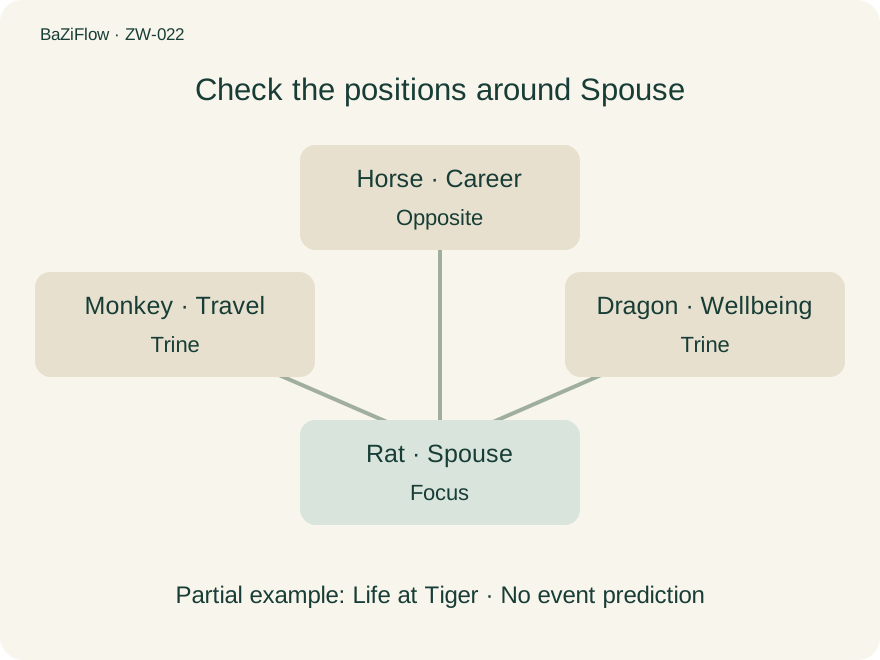 ZW-022 / Zi Wei Dou Shu
What a Spouse Palace Can—and Cannot—Tell You
Separate a chart location from a relationship prediction. A worked palace map shows the surrounding positions, while examples explain empty palaces, transformation labels and missing evidence.
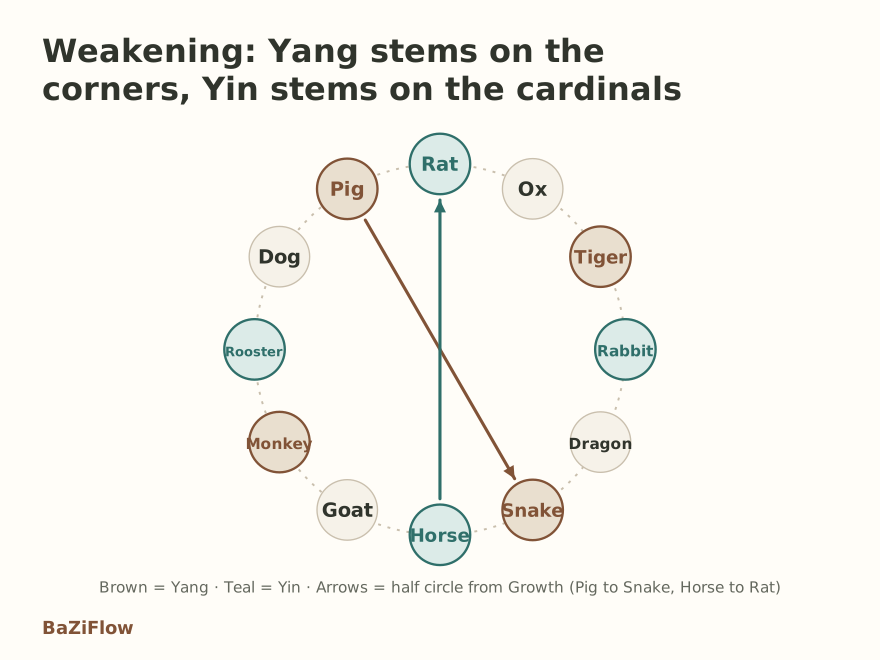 BZ-CS-07 / BaZi
Weakening (病): The Seventh Cell, and Two Other Uses of the Word in the Books
Weakening is the seventh cell of the twelve life stages, directly across from Growth. An eight-spot table, a lookup from the Yuanhai Ziping and a three-way comparison separate the stage, the pattern flaw and Na Yin.
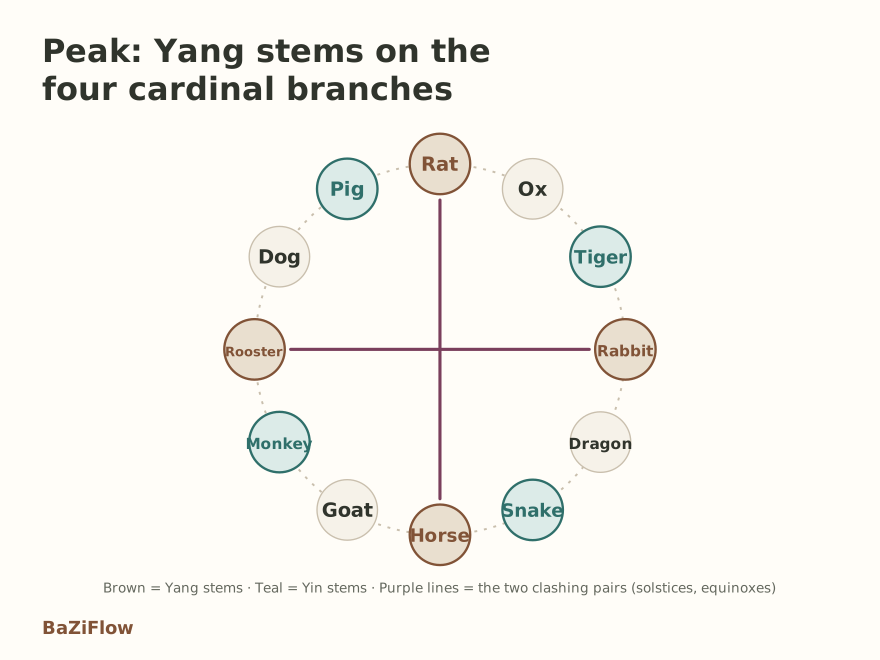 BZ-CS-05 / BaZi
Peak (帝旺): The Solstice and Equinox Months, and "Full Means Falling"
Peak is the fifth cell of the twelve life stages. A map of the ten stems, a table setting Peak beside the Yang Blade, the "sun at noon" passage and the two meanings of "strong" show where it sits and what it covers.
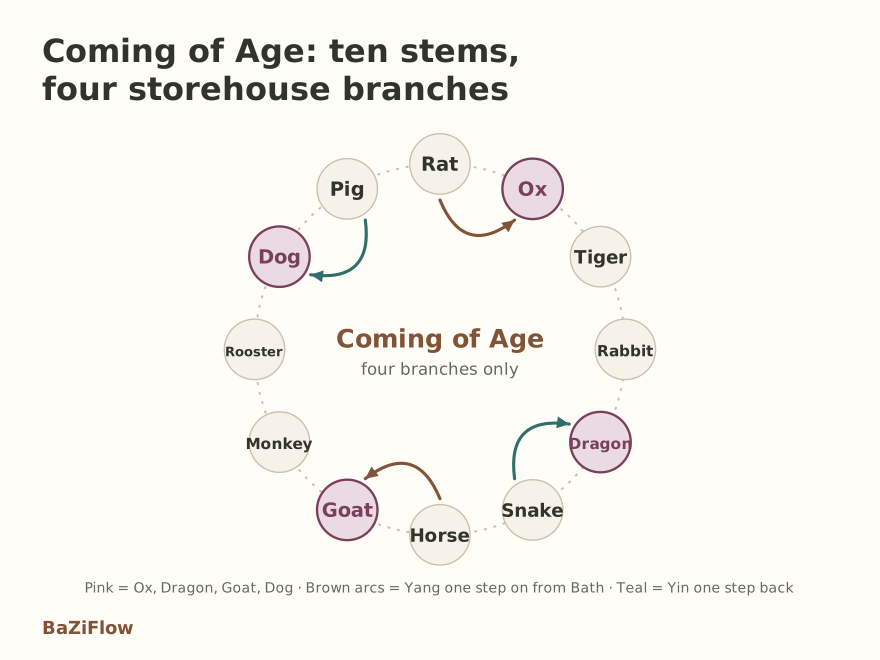 BZ-CS-03 / BaZi
Coming of Age (冠带): Ten Stems on Four Storehouse Branches, and How Three Books Read It
Coming of Age is the third cell of the twelve life stages; all ten Day Masters land on Ox, Dragon, Goat and Dog. A reverse table, stage versus hidden stems, three books and a five-year handover window explain it.
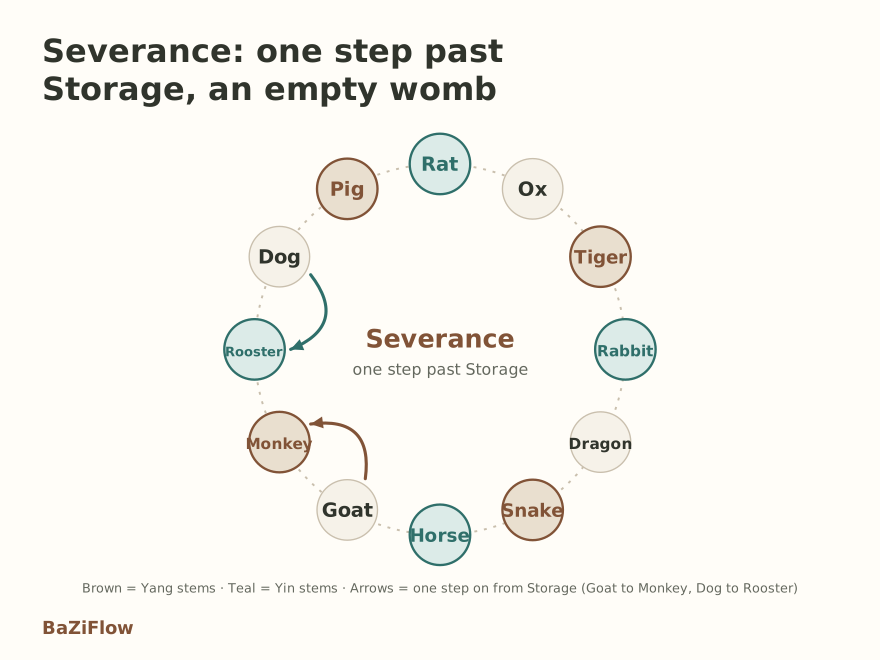 BZ-CS-10 / BaZi
Severance (绝): The Cell Where the Womb Is Still Empty, and Its Other Names
Severance is the tenth cell of the twelve life stages, right after Storage. Eight landing spots, the Sanming Tiyao list counted from "receiving qi", two senses of the conception origin and ten qi-receiving days.
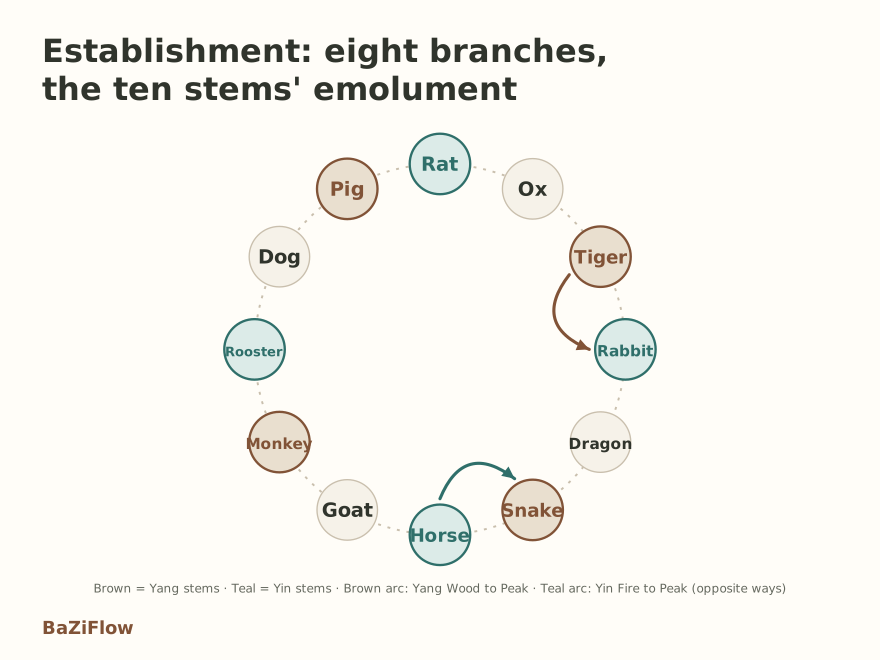 BZ-CS-04 / BaZi
Establishment (临官): Eight Branches, Each One Stem's Emolument, and What the Books Say
Establishment, the fourth of the twelve life stages, is also called the emolument. A ten-stem table, the Sanming Tonghui entries, a hidden-stems check and the swap with Peak set it apart from Build Emolument.
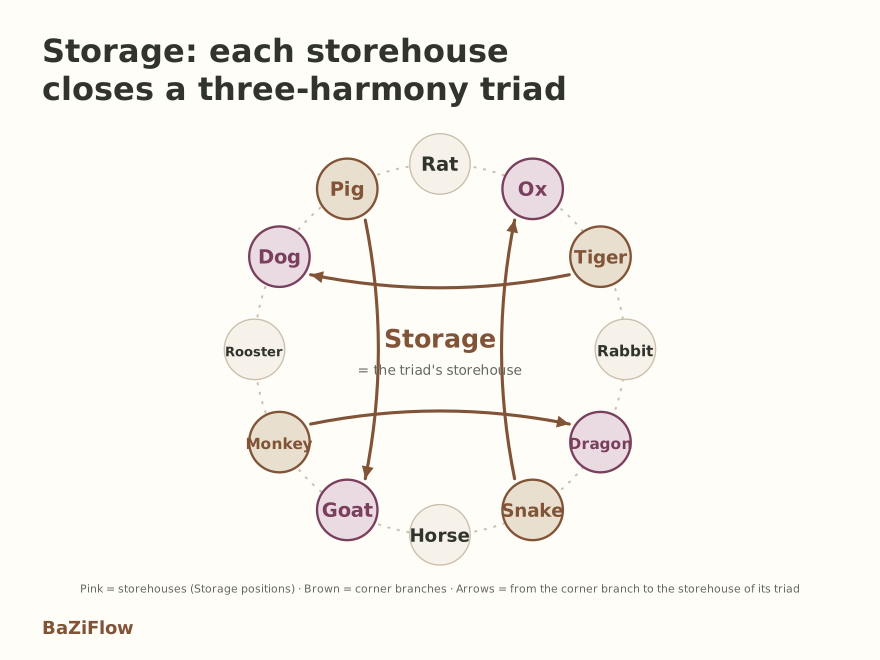 BZ-CS-09 / BaZi
Storage (墓): Which Day Masters Each Storehouse Holds, and How Three Harmony Fixes It
Storage is also called the storehouse, and all ten Day Masters land on Dragon, Dog, Ox and Goat. Three-harmony triads, the Sanming Tonghui on each storehouse, a Di Tian Sui line and Na Yin names explain the cell.
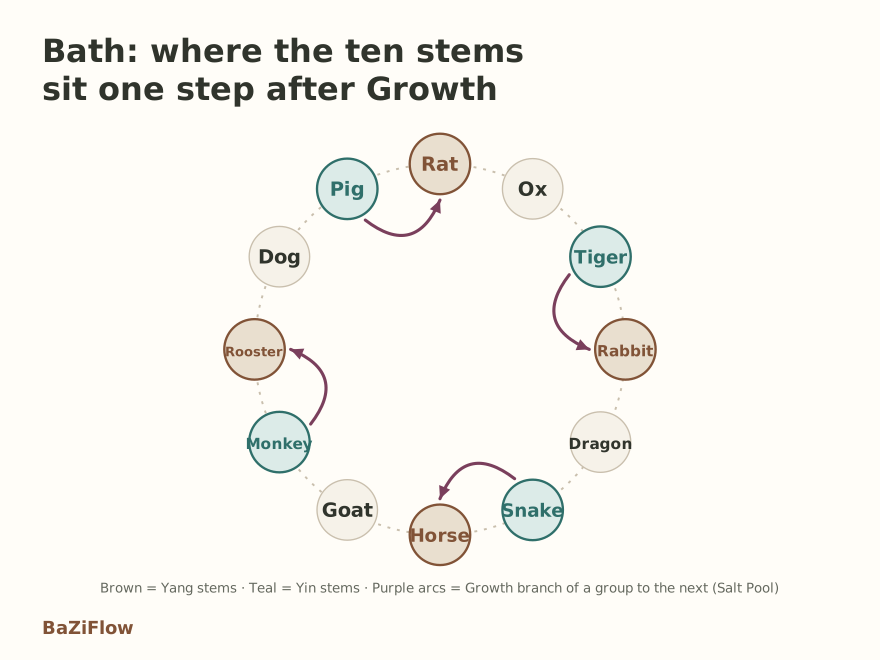 BZ-CS-02 / BaZi
Bath (沐浴): One Step After Growth, and Why It Is Also Called Ruin and the Salt Pool
Bath is the second cell of the twelve life stages. A map of the ten stems, the one-step-after-Growth rule and a Salt Pool comparison table show which table each of the three names, Bath, Ruin and Salt Pool, is read from.
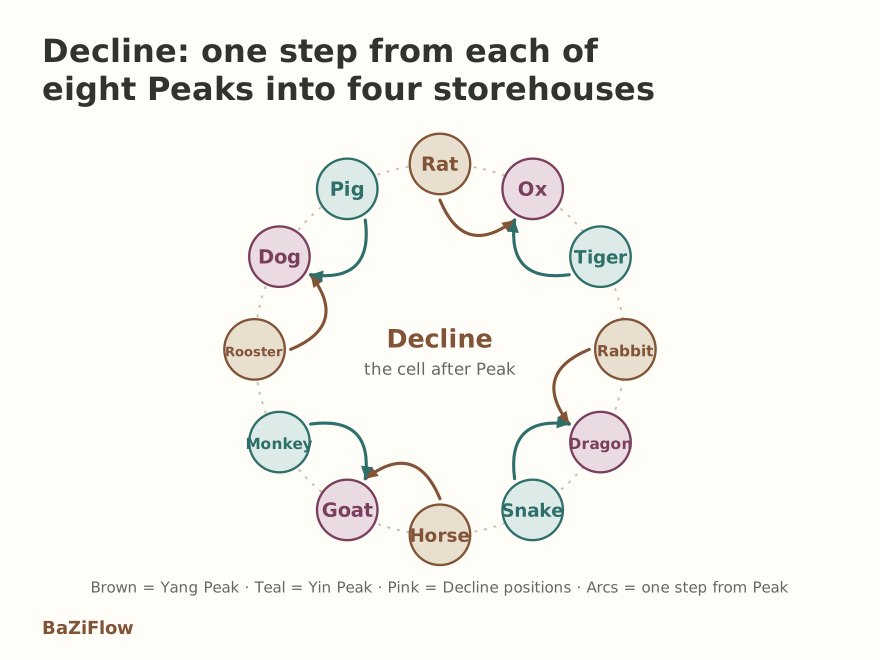 BZ-CS-06 / BaZi
Decline (衰): The Step After Peak, and Why All Ten Stems Land in a Storehouse
Decline is the sixth cell of the twelve life stages, right after Peak; all ten Day Masters land on Dragon, Dog, Ox and Goat. A ring of eight Peaks, a before-and-after table and a loose old usage explain it.
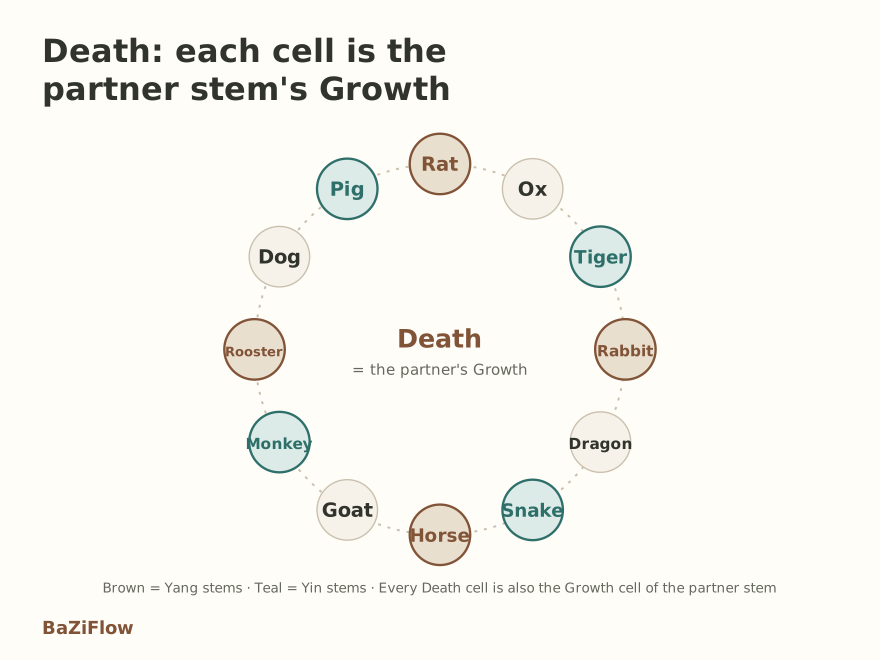 BZ-CS-08 / BaZi
Death (死): Ten Day Masters, and the Picture the Classics Attach to Each Position
Death is the eighth cell of the twelve life stages, and each stem dies exactly where its partner is born. Five pairs, ten sayings from the Sanming Tonghui, the luck bands and the book's own caveat explain the cell.
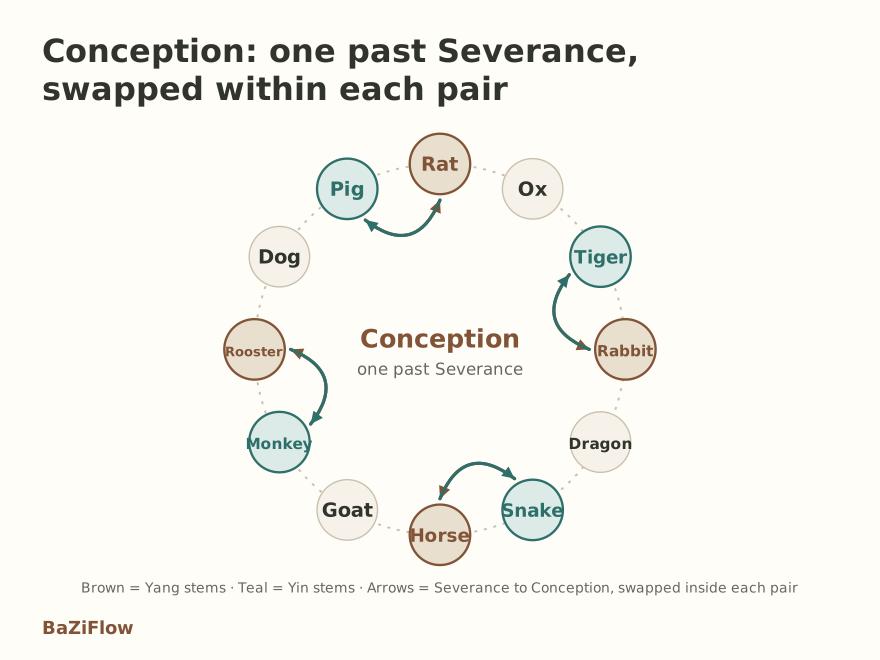 BZ-CS-11 / BaZi
Conception (胎): One Step After Severance, and the Stage Versus the Conception Origin
Conception is the eleventh cell of the twelve life stages, after Severance. Where the ten Day Masters land, the five stem pairs that swap Severance and Conception, the conception origin and "self-conceived gold".
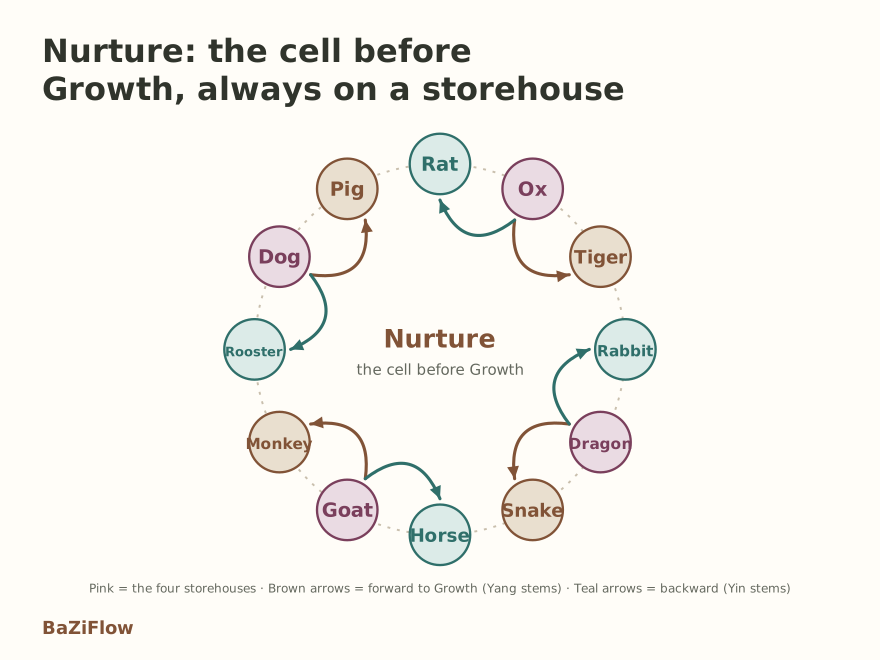 BZ-CS-12 / BaZi
Nurture (养): Ten Day Masters on Four Storehouses, and the Book's "Taking Shape"
Nurture is the twelfth cell of the twelve life stages, between Conception and Growth. Where the ten Day Masters land, four shared storehouses, three passages on Conception and Nurture, and the book's luck-by-age scheme.
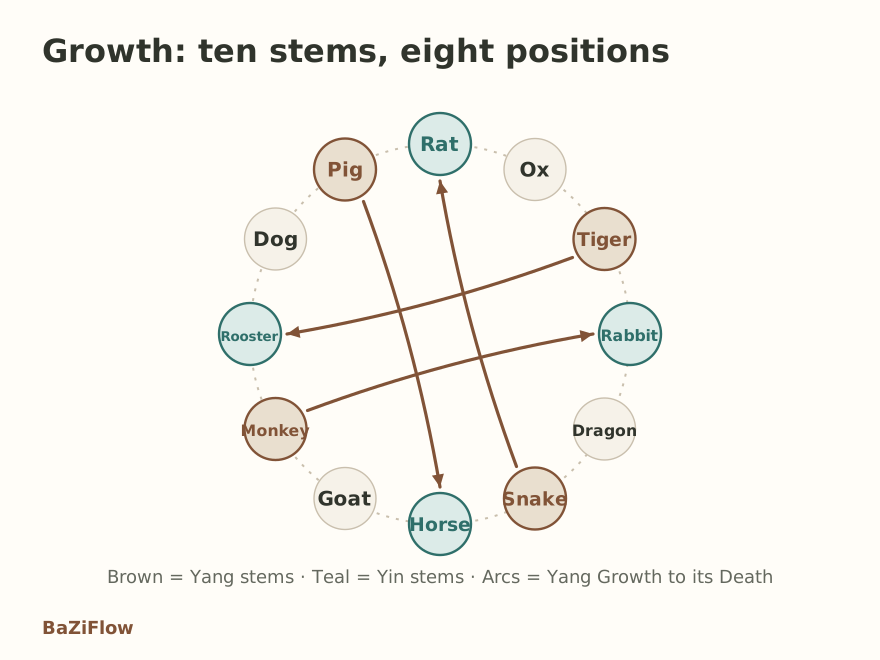 BZ-CS-01 / BaZi
Growth (长生): Where Each Day Master Lands, and How the Sanming Tonghui Records It
Growth is the first cell of the twelve life stages table. A map of the ten stems, the Yang-forward Yin-reverse rule, the Sanming Tonghui entries stem by stem and two ways to place Earth show where each Day Master lands.
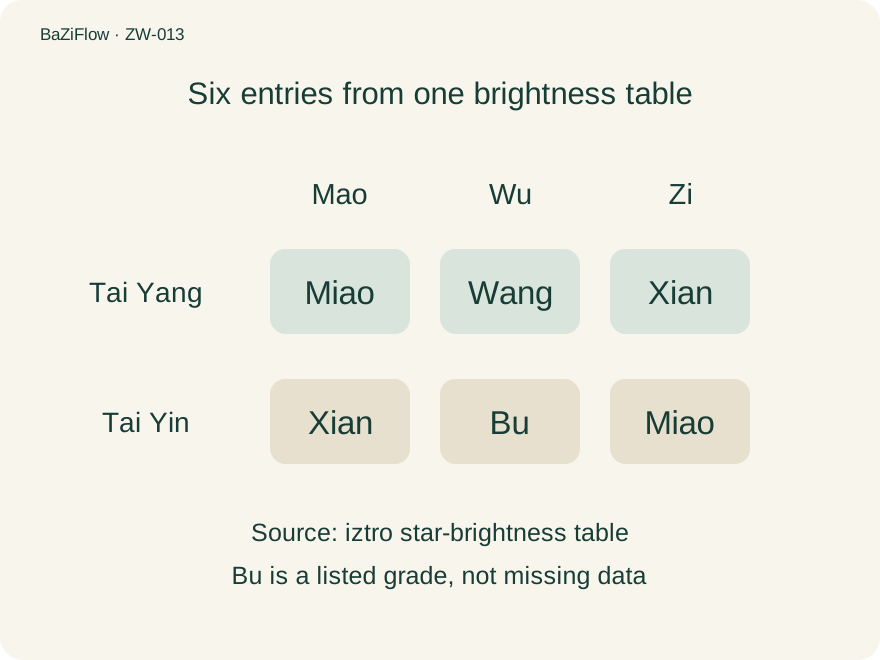 ZW-013 / Zi Wei Dou Shu
Zi Wei brightness levels are table entries, not life scores
Check six Sun and Moon entries in a named brightness table. Learn why the star, branch position, grading system and source version must be kept together.
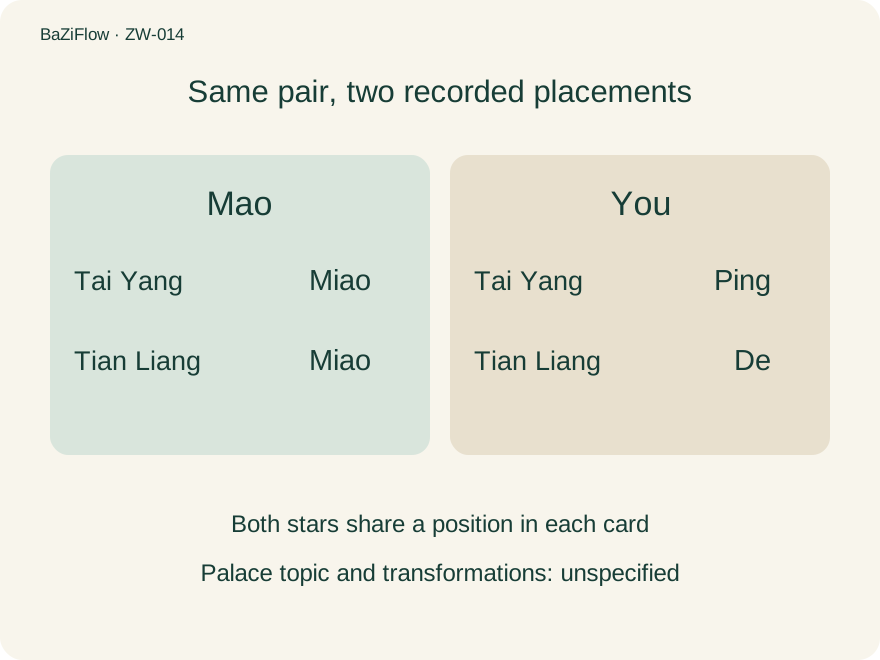 ZW-014 / Zi Wei Dou Shu
Reading Ziwei Star Combinations as Relationships
Compare two Tai Yang–Tian Liang placements and learn why a pair of star names is not a complete reading. Track location, scope and missing context before interpreting a combination.
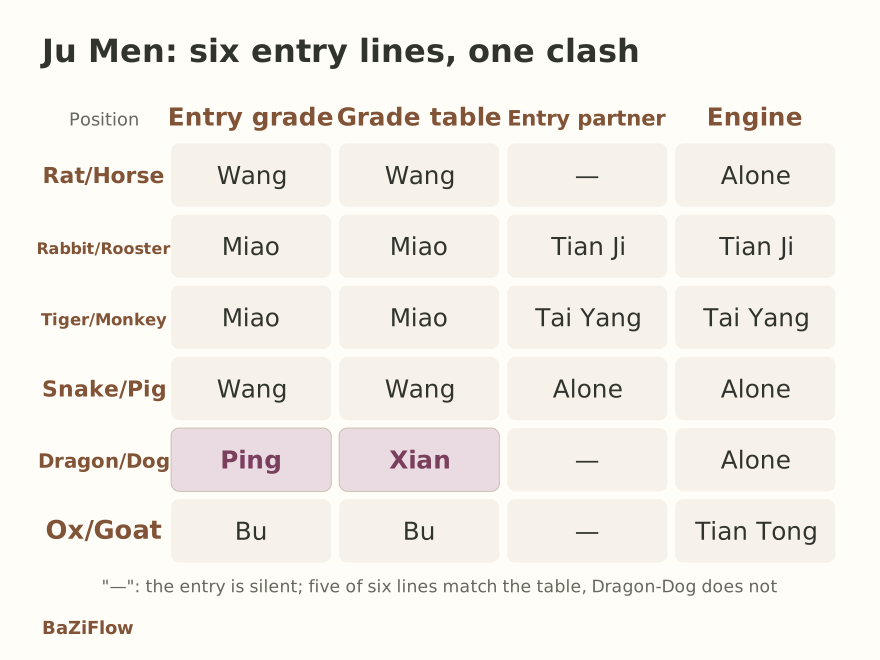 ZW-STAR-10 / Zi Wei Dou Shu
Ju Men (巨门): Six Entry Lines Audited, the Dragon-Dog Clash and a Fixed Chart
Ju Men is fourth in the Tian Fu group and Yin. Its six entry lines checked against the grade table, why Dragon and Dog disagree, one fixed chart for "stone hiding jade", and which named partners can meet it.
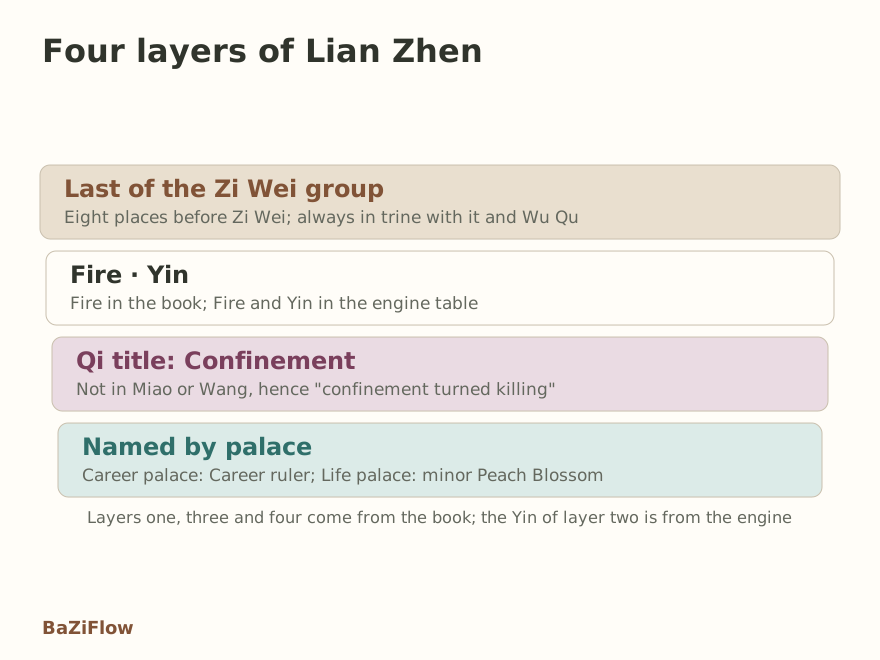 ZW-STAR-06 / Zi Wei Dou Shu
Lian Zhen (廉貞): Two Titles by Palace, and Three Records Kept Apart
Lian Zhen is Fire and the last star of the Zi Wei verse, which loops back after three skipped spots. The book names it by palace; its table has four grades, no Wang. Co-residents and the element example are checked.
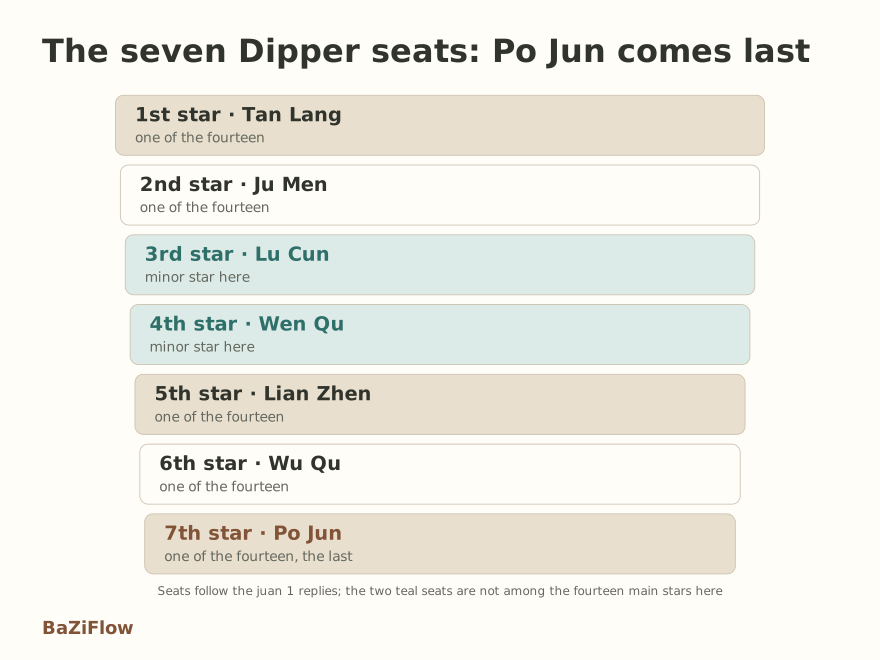 ZW-STAR-14 / Zi Wei Dou Shu
Po Jun (破军): The Last Dipper Star, Jia and Gui, and a Snake-Pig Line with No Grade
Po Jun is the seventh Northern Dipper star, the Waste. Its seat and three palaces on a ring, the entry against the grade table, "Gui and Jia" against the Hua verse, and the Snake-Pig line with a partner but no grade.
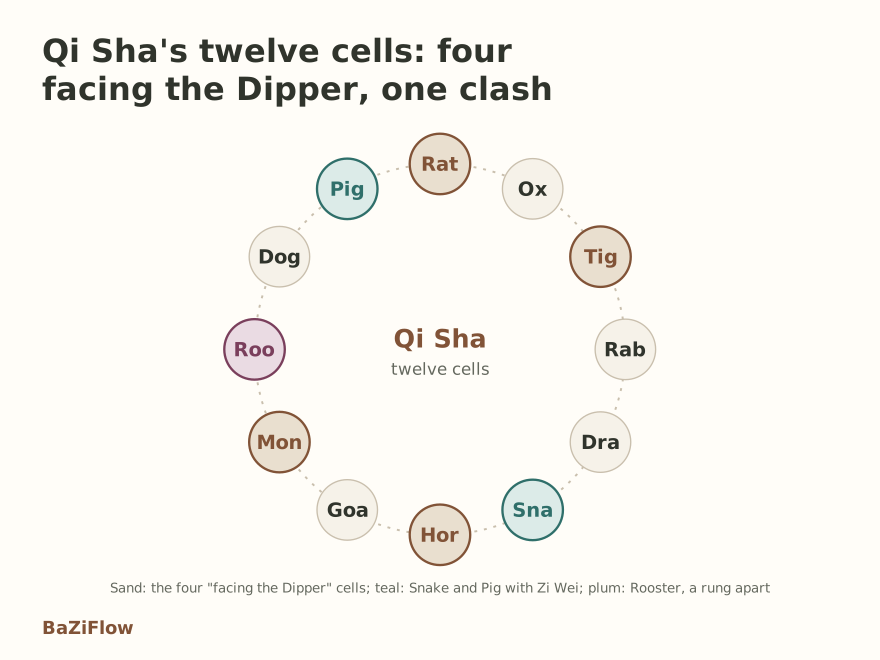 ZW-STAR-13 / Zi Wei Dou Shu
Qi Sha (七杀): Four Dipper Cells, the Rooster Clash, and Eight Meeting Charts
Qi Sha is Fire and Metal, sixth in the Southern Dipper. The pattern "facing the Dipper" as four Zi Wei landings, the entry against the table, the juan 3 list and the engine, the Rooster clash, and eight meeting charts.
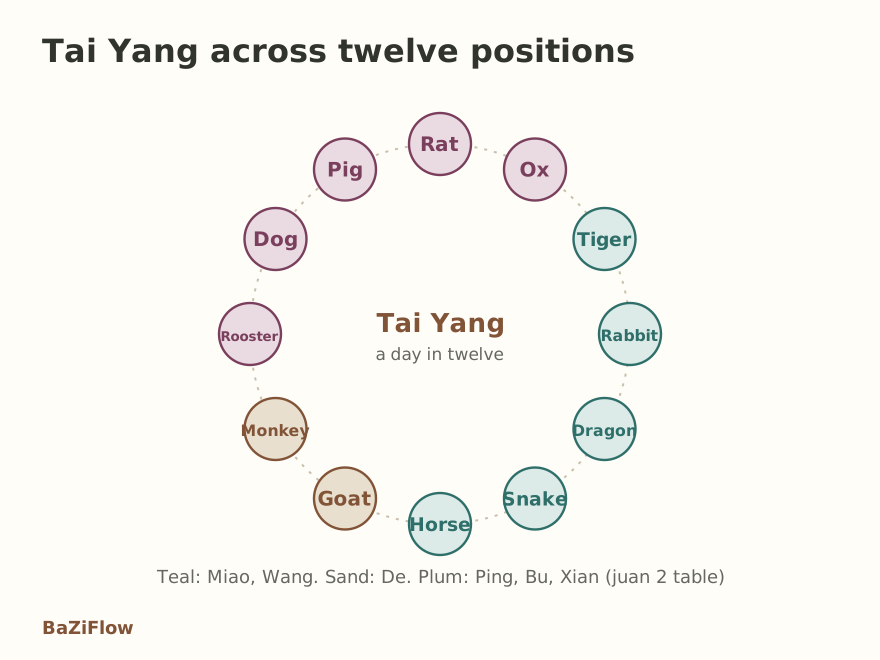 ZW-STAR-03 / Zi Wei Dou Shu
Tai Yang (太陽): Twelve Positions as One Day, Beside the Grade Table
Master Yuchan likens Tai Yang's twelve positions to a day; juan 2 adds a grade table and a day/night clause. Side by side they differ at Ox, Horse and Rooster. Plus co-residents and the father-star habit.
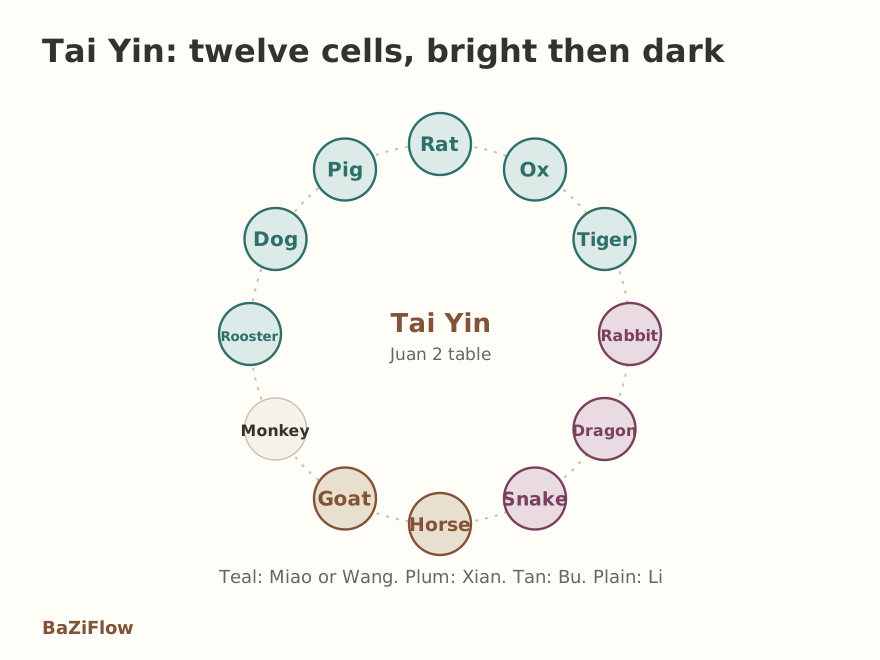 ZW-STAR-08 / Zi Wei Dou Shu
Tai Yin (太陰): The Moon's Twelve Cells, Sun-Moon Pairing and Four Records Compared
Tai Yin is Water and comes right after Tian Fu in its group; the book calls it the Sun's mate. Its twelve cells in a ring, the four ways Sun and Moon can meet, and four grade records checked cell by cell.
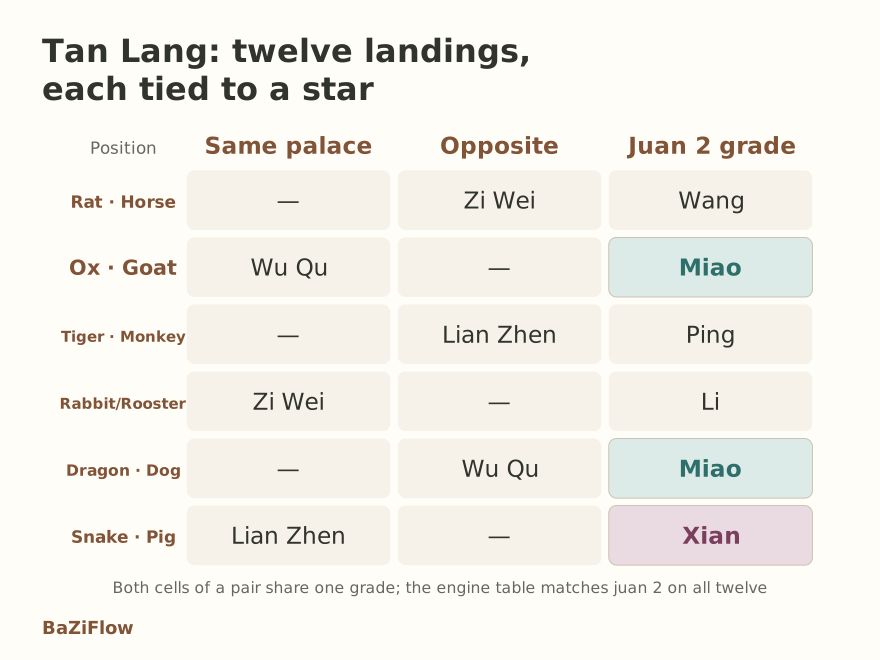 ZW-STAR-09 / Zi Wei Dou Shu
Tan Lang (贪狼): Landings Tied to Zi Wei, Wu Qu or Lian Zhen, Water or Wood, Life Ruler
Tan Lang is third in the Tian Fu group and mirrors Zi Wei across the Rabbit-Rooster axis. Its six pairs of landings and partners, five element records, why the four tomb cells are all Miao, and the Life Ruler at Rat.
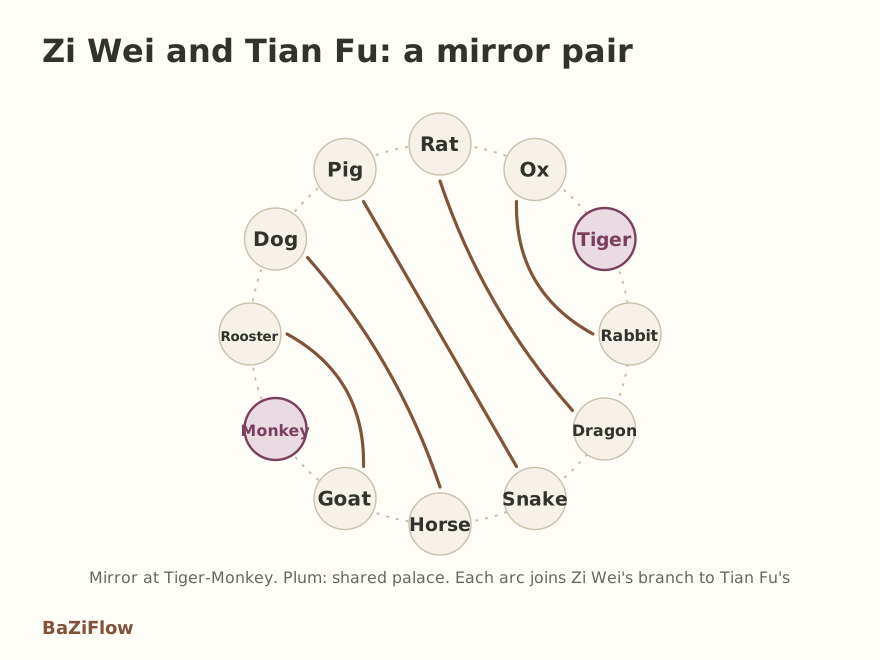 ZW-STAR-07 / Zi Wei Dou Shu
Tian Fu (天府): Zi Wei's Mirror and "Deputy", Read by Position and Two Gradings
Tian Fu is Earth and heads the eight-star Tian Fu group, mirroring Zi Wei across the Tiger-Monkey axis. How to derive it from Zi Wei, count its eight stars, why Qi Sha is opposite, and why its table stops at De.
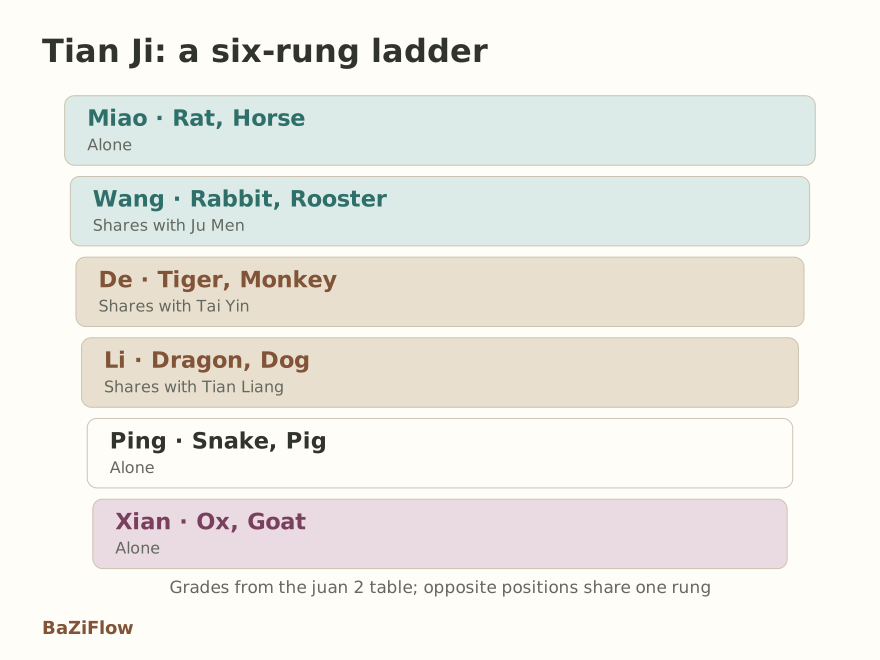 ZW-STAR-02 / Zi Wei Dou Shu
Tian Ji (天機): A Six-Rung Grade Ladder and the Co-residents Behind It
Tian Ji is Wood and always sits one step before Zi Wei. Its grades in the Quan Shu table form six rungs, opposite palaces sharing one; with Tai Yin, Ju Men and Tian Liang as co-residents, here is how to read it.
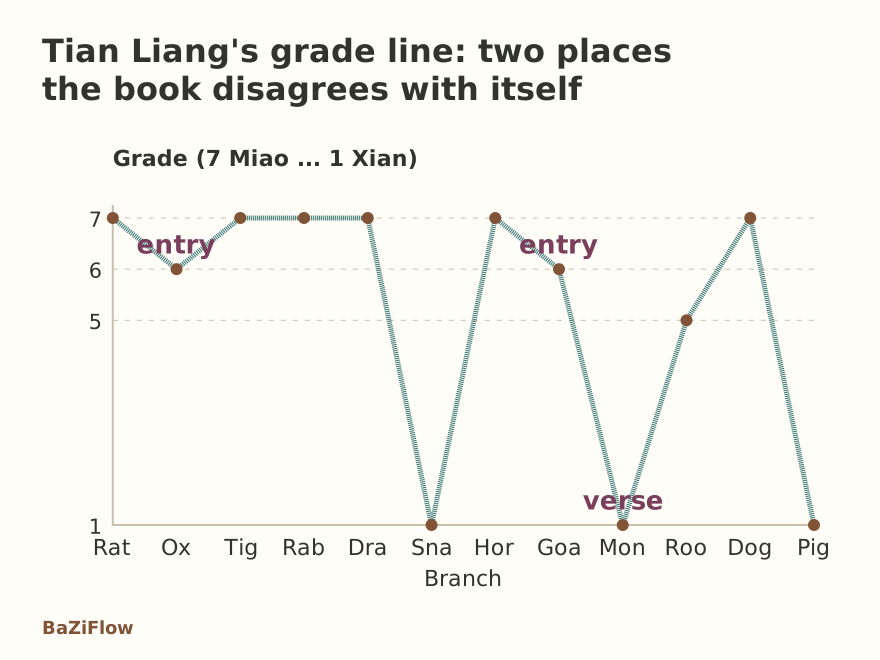 ZW-STAR-12 / Zi Wei Dou Shu
Tian Liang (天梁): Dipper Seat Two, Placement Six, and Two Places the Book Disagrees
Tian Liang is Earth, called the Shade. Dipper seat versus placement rank, a grade line over twelve cells, the entry on Ox-Goat and a verse on Monkey against the table, and "Life or opposite" as two of twelve.
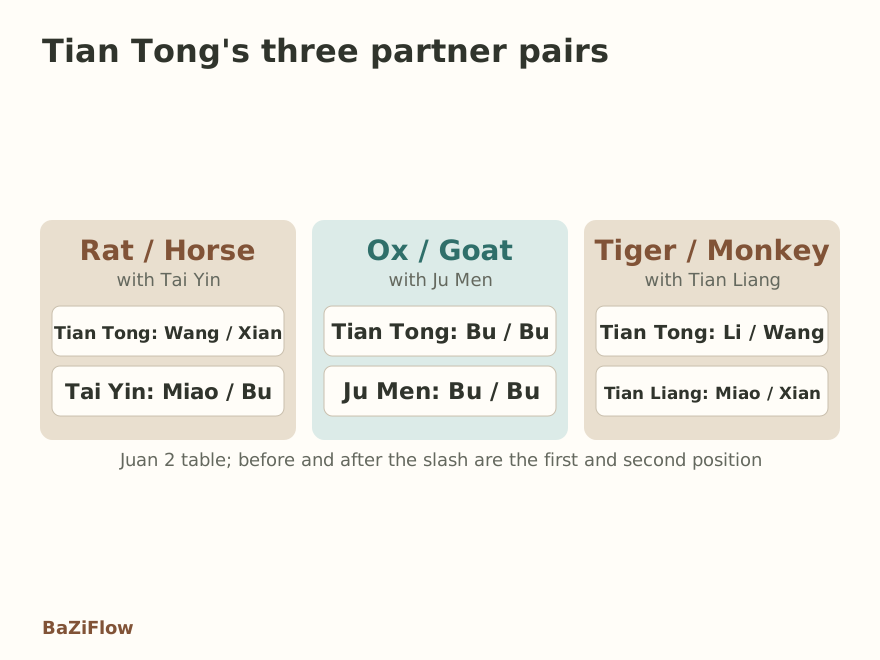 ZW-STAR-05 / Zi Wei Dou Shu
Tian Tong (天同): Reading "Blessed in All Twelve Palaces" Beside a Table with a Xian Cell
Tian Tong is Water. The book calls it a blessing in all twelve palaces, yet its table has a Xian cell and a clause demotes Snake and Pig. The records sit together, with its Wellbeing pairing worked out by position.
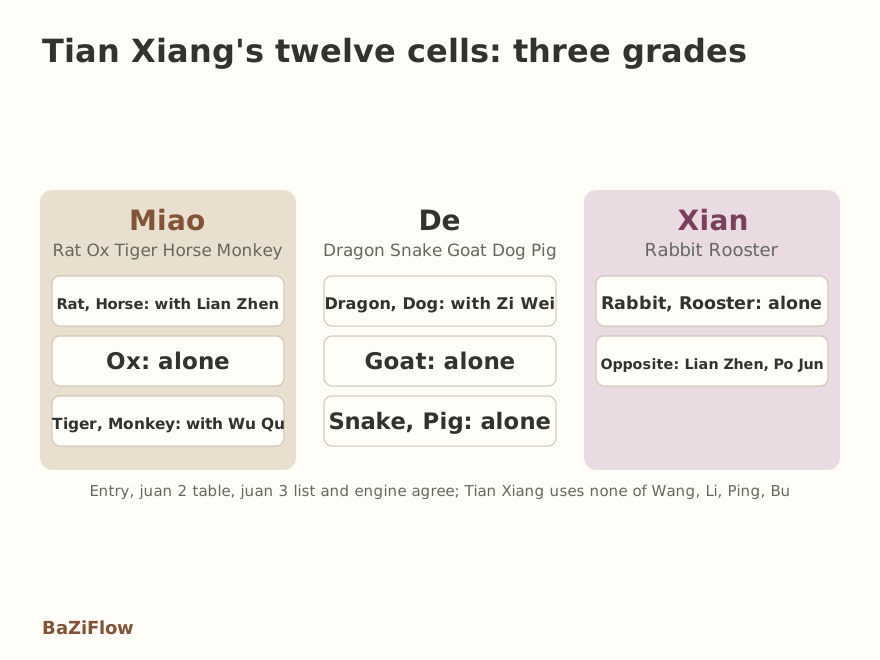 ZW-STAR-11 / Zi Wei Dou Shu
Tian Xiang (天相): Two Kinds of "Fifth", Who Faces Sunken Cells, and a Missing Hua
Tian Xiang is Water and the book calls it the Seal. Seven entry lines checked against the grade table, the juan 3 list and the engine, why Ox and Goat are split, who faces a sunken cell, and why the Hua verse skips it.
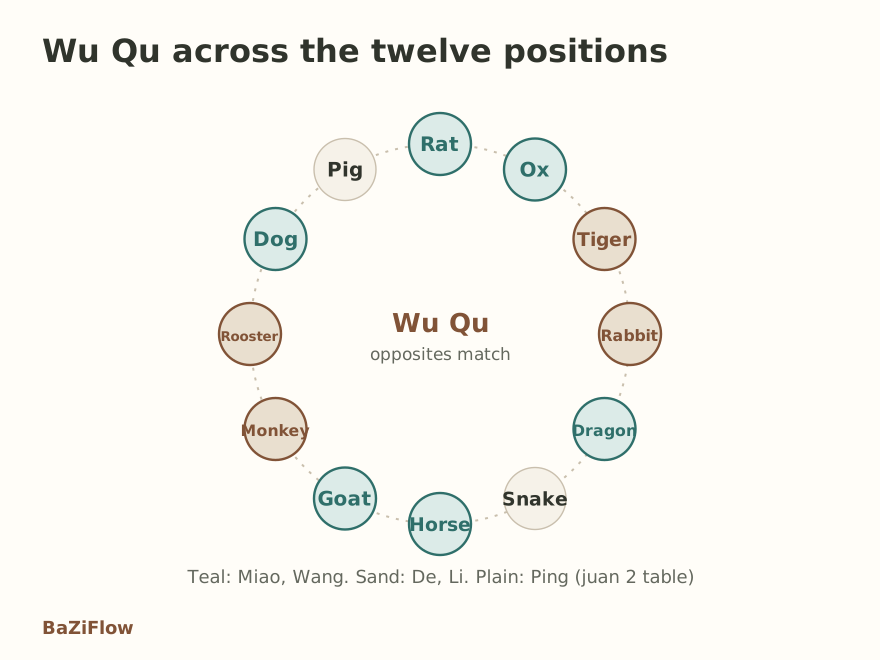 ZW-STAR-04 / Zi Wei Dou Shu
Wu Qu (武曲): Three Lines Tying It to Wealth, and Which Can Be Checked by Position
Wu Qu is Metal, fourth star of the Zi Wei sequence. The Quan Shu ties it to wealth by palace, deputies and trading authority; grades and positions test each line, and Wu Qu with Lian Zhen is read as restraint.
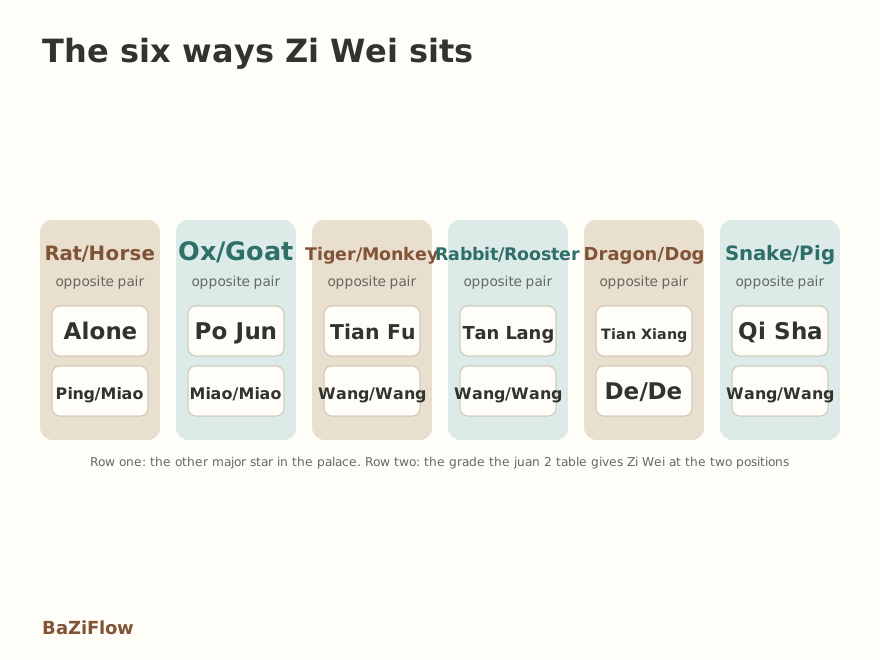 ZW-STAR-01 / Zi Wei Dou Shu
Zi Wei (紫微): Twelve Landing Points, Six Co-residents, and How to Read "Meeting Po Jun"
Zi Wei is Earth and heads the six-star Zi Wei sequence. With juan 1 and 2 of the Quan Shu and an engine-checked table: its six co-residents, whether "meeting Po Jun" is same or opposite palace, and the Miao/Wang table.
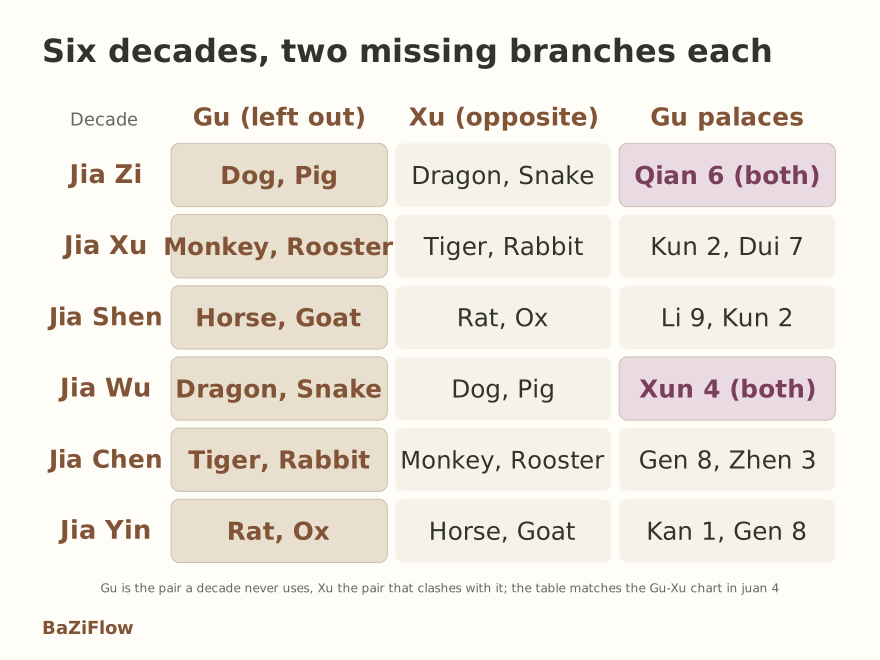 QM-STATE-06 / Qimen Dunjia
Void Branches of a Decade (旬空): Find the Decade, Split Day from Hour, Then Map to a Palace
A void pair is the two branches a decade leaves out: find the decade, name the gap, then map it to palaces. The Gu-Xu chart of juan 4 is checked, and one day of twelve hours shows why day decade and hour decade differ.
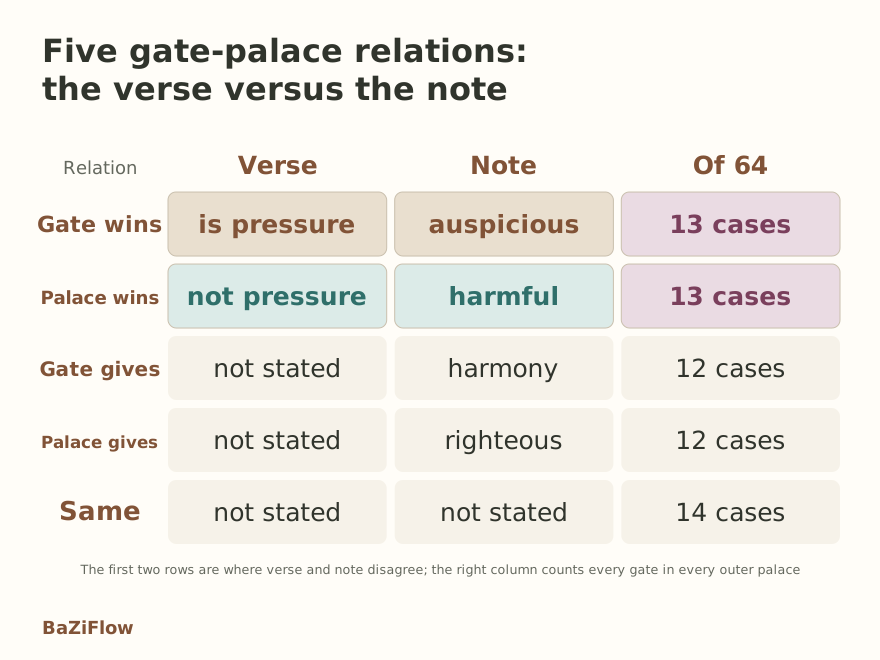 QM-STATE-01 / Qimen Dunjia
Gate Pressure (门迫): What to Check Before Calling It: Palace, Two Elements, One Arrow
The look-up behind gate pressure: where the gate stands now, the elements of gate and palace, and who controls whom. The verse and note of Dun Jia Yan Yi disagree, and 13 of 64 cases are gate-controls-palace.
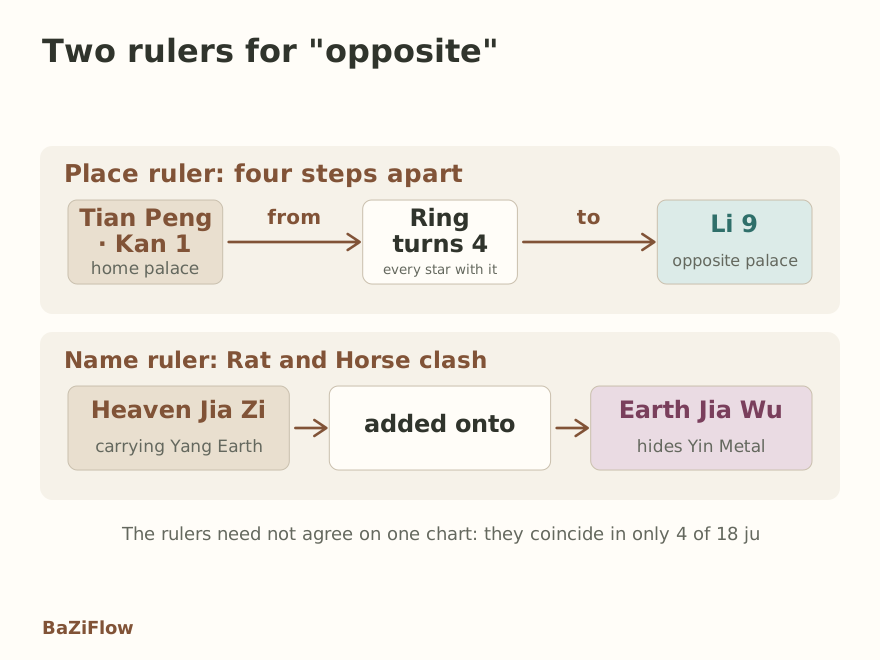 QM-STATE-05 / Qimen Dunjia
Fan Yin (反吟): A Four-Step Position, or Yang Wood Rat Against Yang Wood Horse
Fan Yin has two rulers for "opposite": four palaces apart in position, a Rat-and-Horse or Dog-and-Dragon clash in name. A worked Yin-mode ju 3 board, its share of 1080 charts, and the book's two lines on wonders.
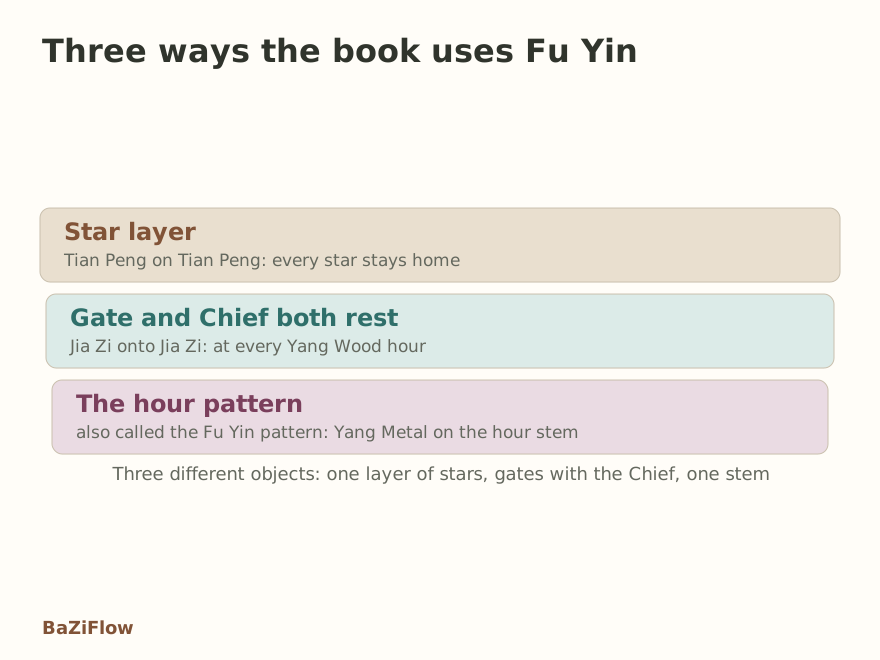 QM-STATE-04 / Qimen Dunjia
Fu Yin (伏吟): Star Layer, Gate and Chief, and the "Hour Pattern" Are Three Different Things
Dun Jia Yan Yi uses Fu Yin in three senses: Peng on Peng at the star layer, gate and Chief at rest on every Yang Wood hour, and the Yang Metal-on-hour-stem pattern. Recomputing each decade counts them over 1080 charts.
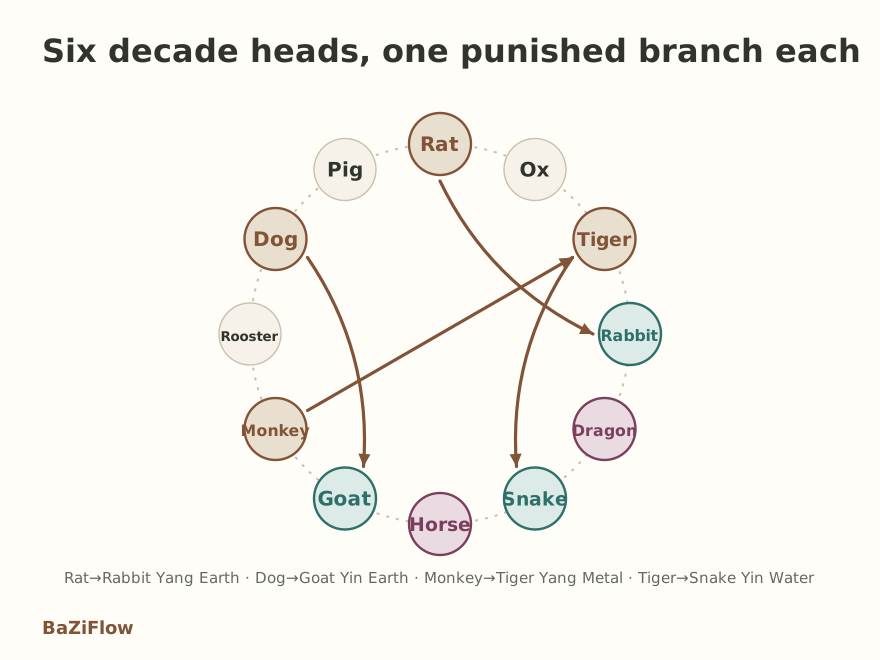 QM-STATE-02 / Qimen Dunjia
Strike Punishment (六仪击刑): Which Instrument, Which Branch, Which Palace
Strike punishment needs three look-ups: the instrument the Chief carries, the punished branch of its decade head, and the palace of that branch. Dun Jia Yan Yi gives six pairs, a worked hour and two board counts.
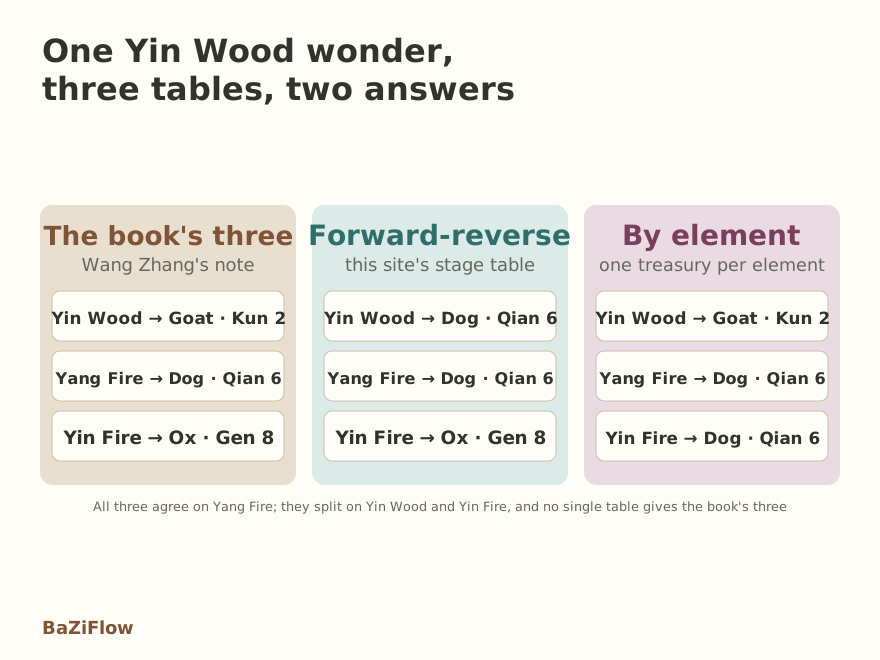 QM-STATE-03 / Qimen Dunjia
Three Wonders in the Tomb (三奇入墓): Choose the Tomb Table, Then See Where the Wonder Lands
Before checking a palace, choose the tomb table: the book gives Yin Wood at Kun Two, Yang Fire at Qian Six and Yin Fire at Gen Eight, and two other tables disagree. Then the six hour tombs and one worked case.
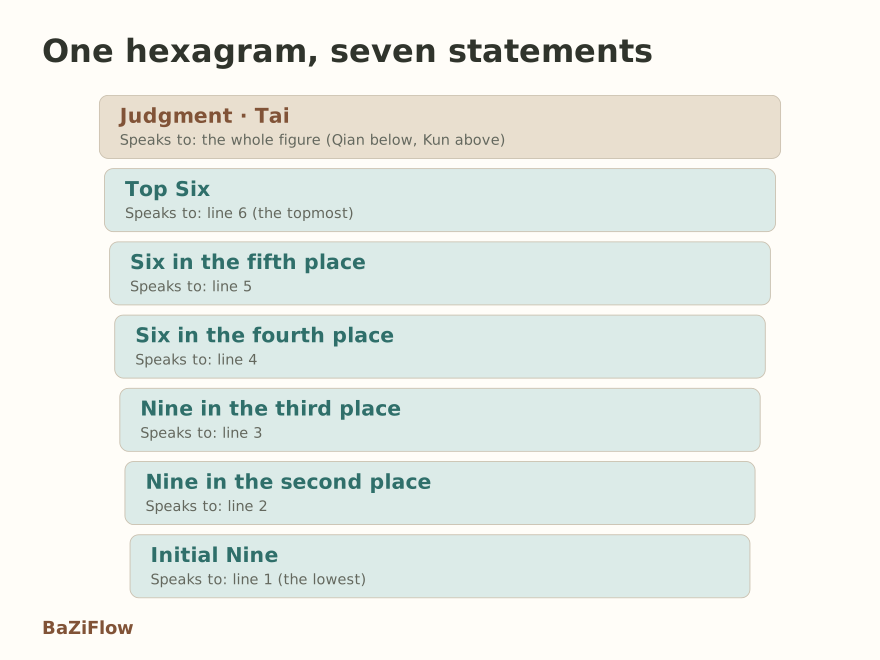 YJ-007 / Yijing
Judgment and Line Statements: Whole Hexagram or Single Line?
Using hexagram Tai, separate the one Judgment that speaks to the whole figure from the six line statements that speak to single lines, then set the later commentaries in their own layer.
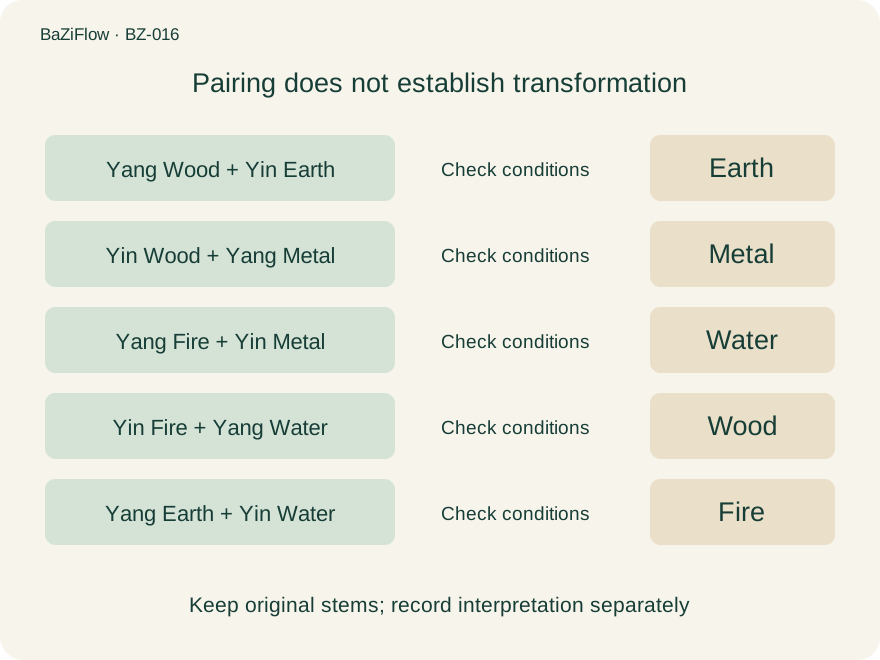 BZ-016 / BaZi
Stem Combinations: A Pair Is Not Yet a Transformation
The five stem pairs are easy to identify; transformation is a separate conditional claim. Check the pairing table, preserve the original stems, and state which chart layer and rules are involved.
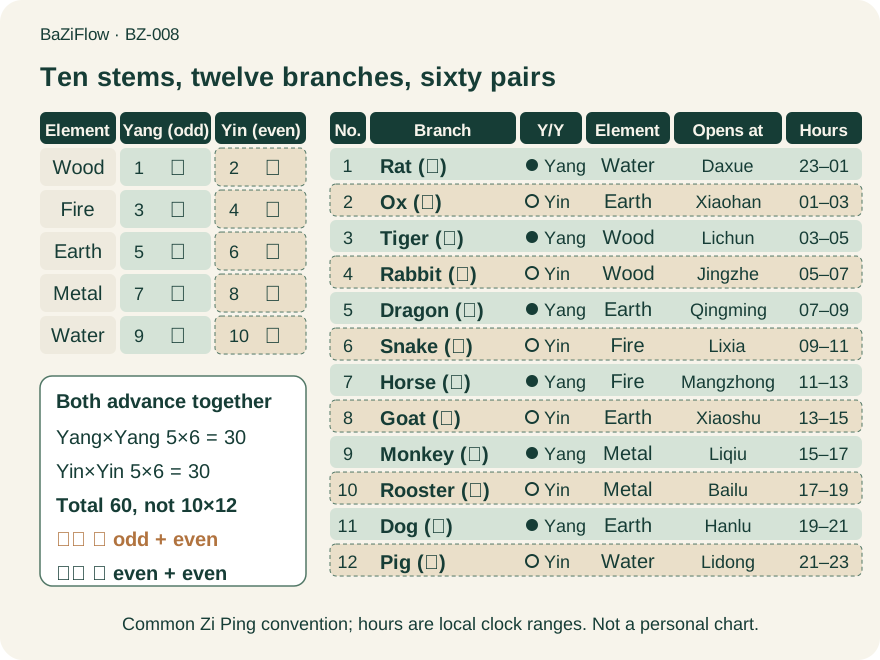 BZ-008 / BaZi
What the ten stems and twelve branches each do
Separate the jobs of Heavenly Stems and Earthly Branches—element, polarity, month and hour—then see why parity limits the cycle to sixty pairs.
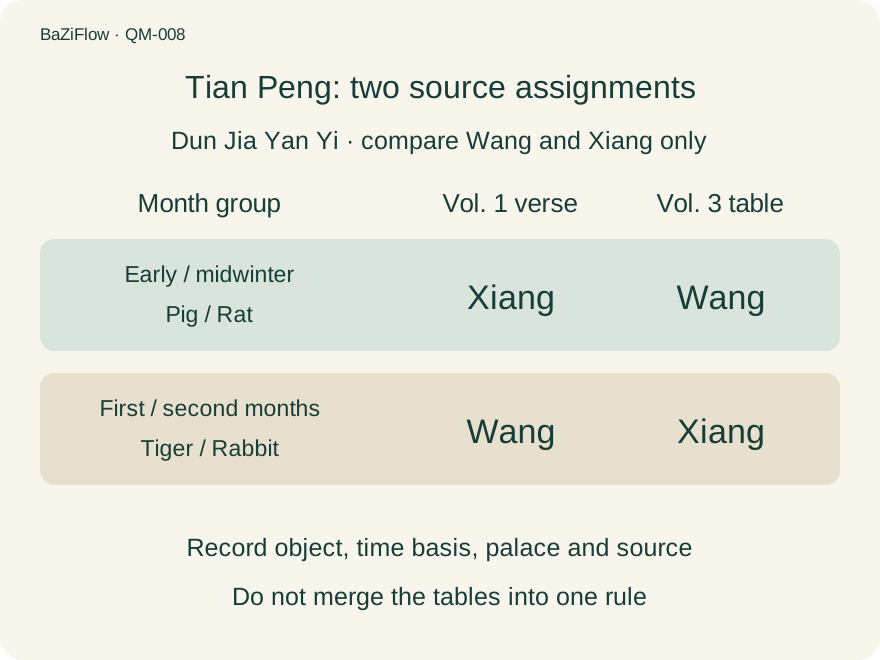 QM-008 / Qimen Dunjia
Before calling a Qimen symbol strong, identify the rule
Two passages in the same classical work give Tian Peng different flourishing and supporting labels. Learn to retain the source, object, time convention and palace condition instead of blending incompatible tables.
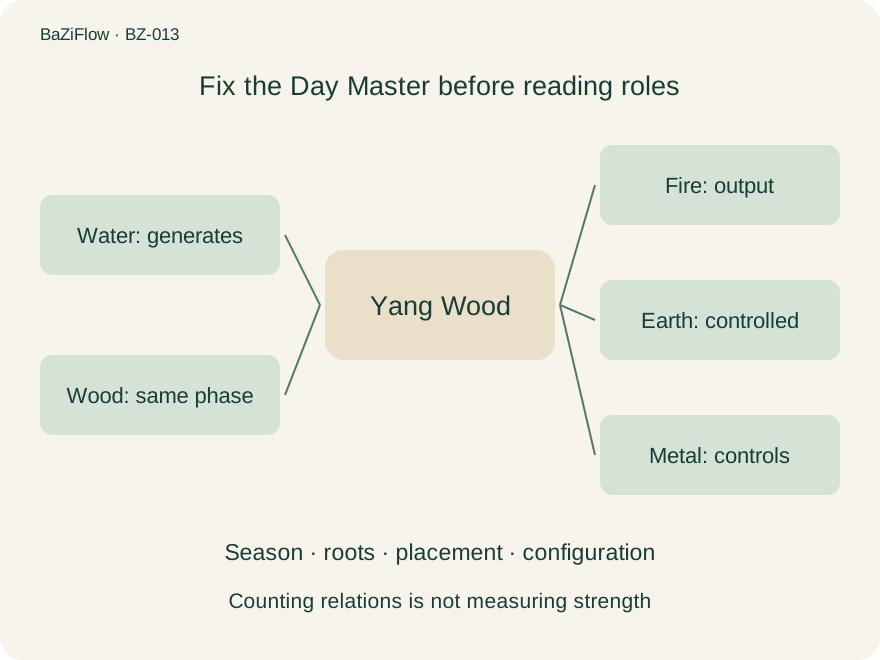 BZ-013 / BaZi
Strong and weak Day Masters: references, relationship directions and evidence
Use Yang Water to separate support, output and control, then update a judgment with seasonal and root evidence while keeping chart strength distinct from health or personal worth.
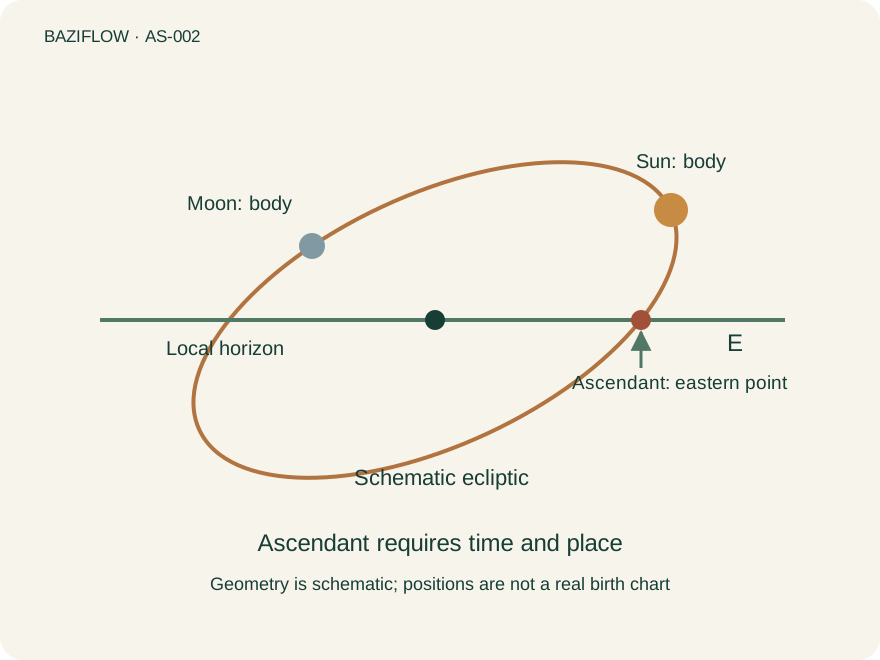 AS-002 / Western astrology
Sun, Moon and Rising: Two Luminaries and One Intersection
Separate two celestial bodies from a horizon point, then practice reading three information situations: an unknown time, a lunar boundary and a reliable birth record.
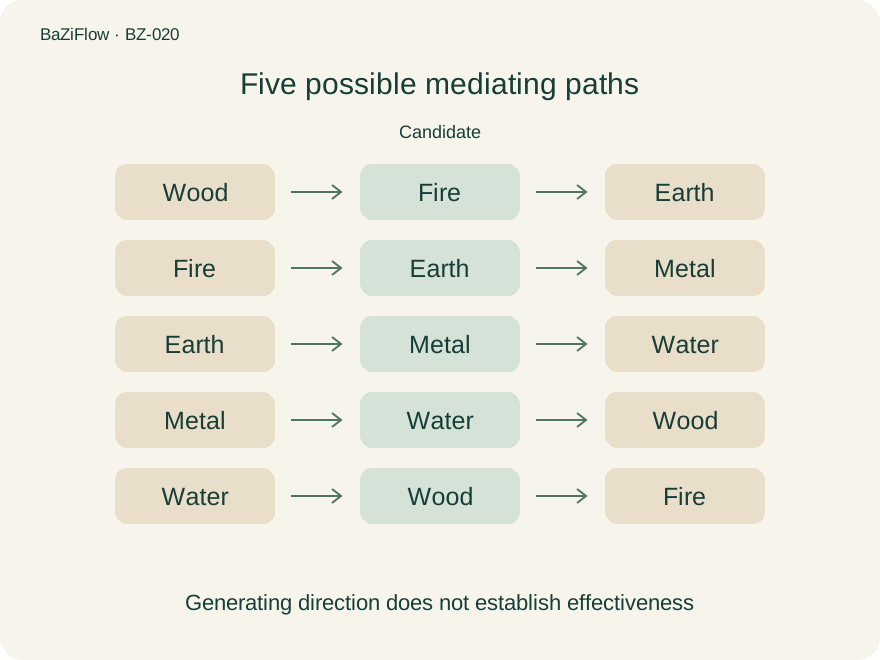 BZ-020 / BaZi
Support, climate and mediation ask different BaZi questions
A phase chosen for support need not be chosen for seasonal adjustment or mediation. Compare the questions, then test five generating paths without turning them into remedies.
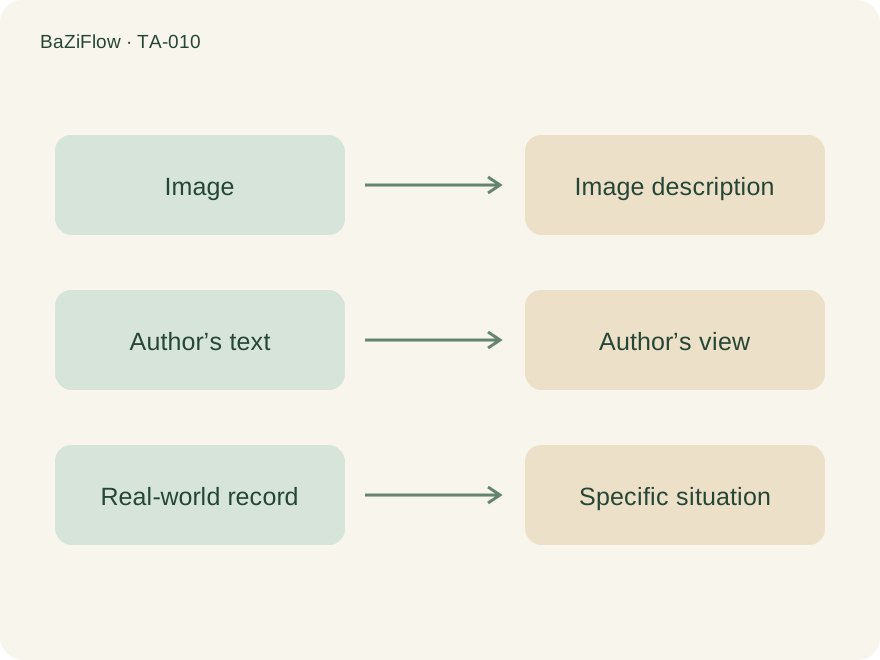 TA-010 / Tarot
A symbol and a fact need different kinds of evidence
Use the Tower to distinguish a recorded card, an author’s interpretation and a claim about a real project. A prototype-review example shows how an association can become a check without becoming a prediction.
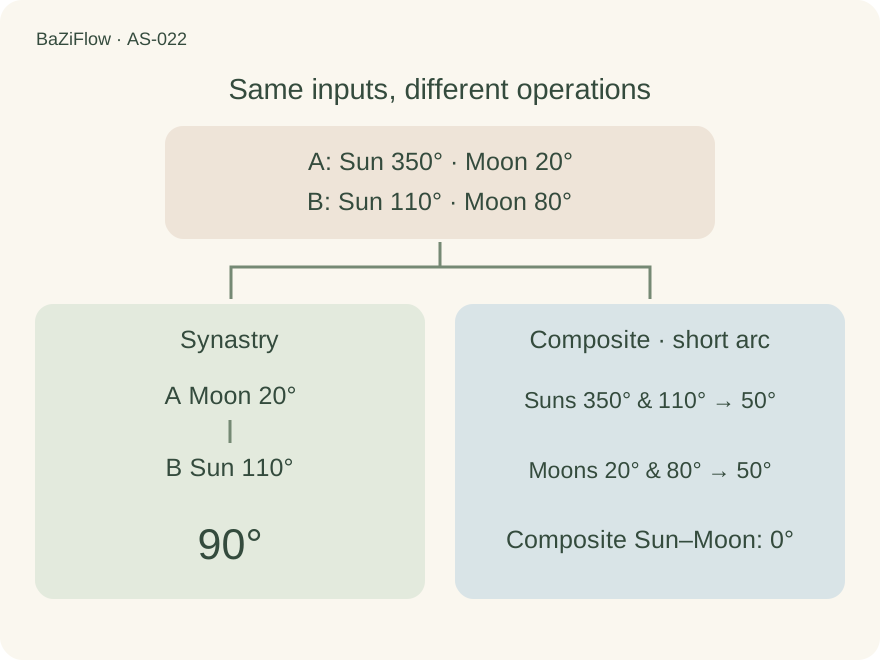 AS-022 / Western astrology
Synastry and composite charts: why two correct calculations can differ
Audit a square in synastry and a conjunction in a midpoint composite using the same four invented longitudes. Learn which labels and settings make the comparison meaningful.
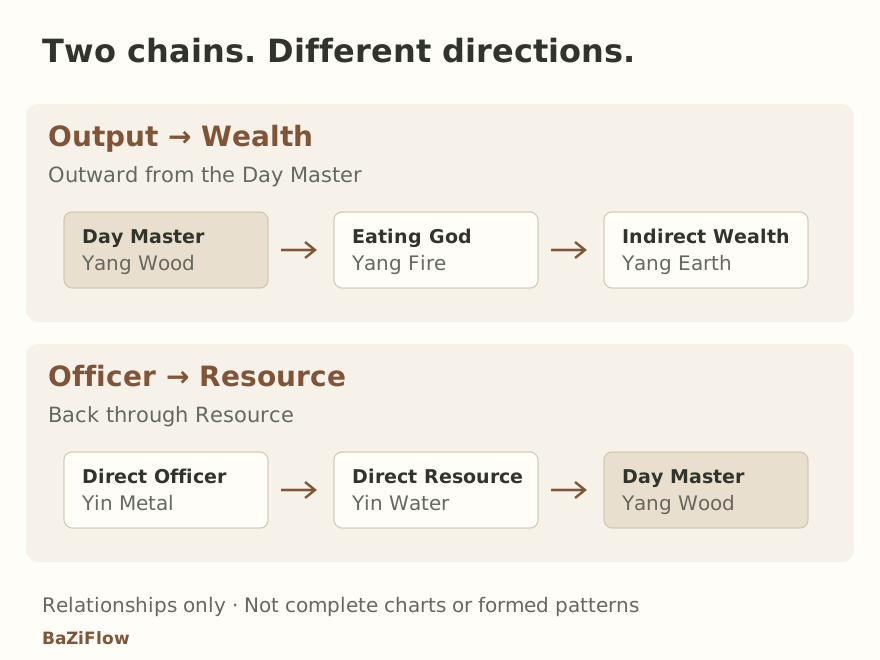 BZ-015 / BaZi
Output Generates Wealth and Officer Generates Resource: Chains and Conditions
See where each generating chain begins and ends, then compare strength, position and interference. A Ten God label identifies a relationship; it does not establish a successful pattern.
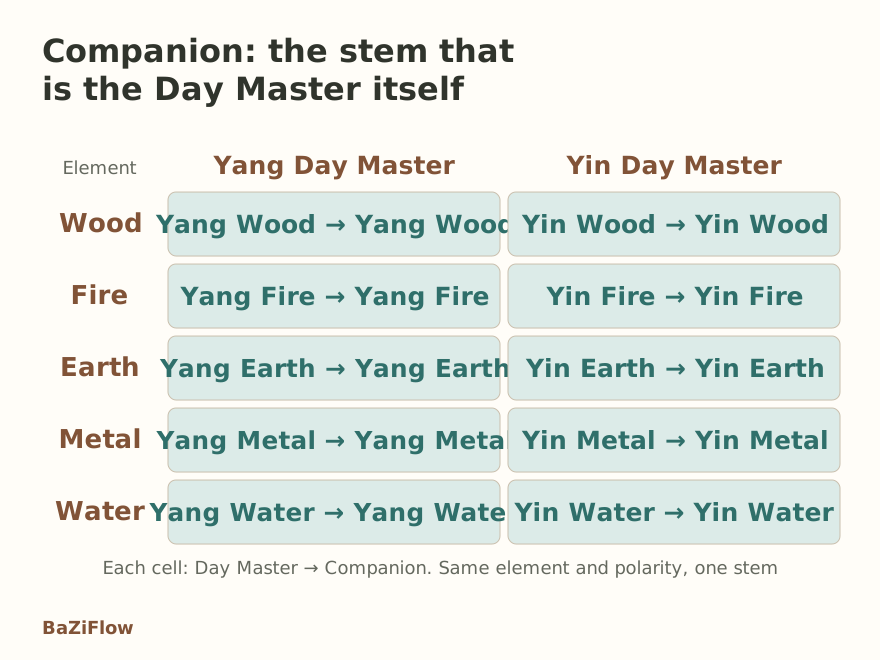 BZ-TG-01 / BaZi
Companion (比肩): The Ten God That Is Your Own Stem, and How to Count It in a Chart
Companion is the only Ten God that maps a Day Master to itself. A ten-stem table, a practice chart and short passages from three classical texts show how to look it up, count it and read it.
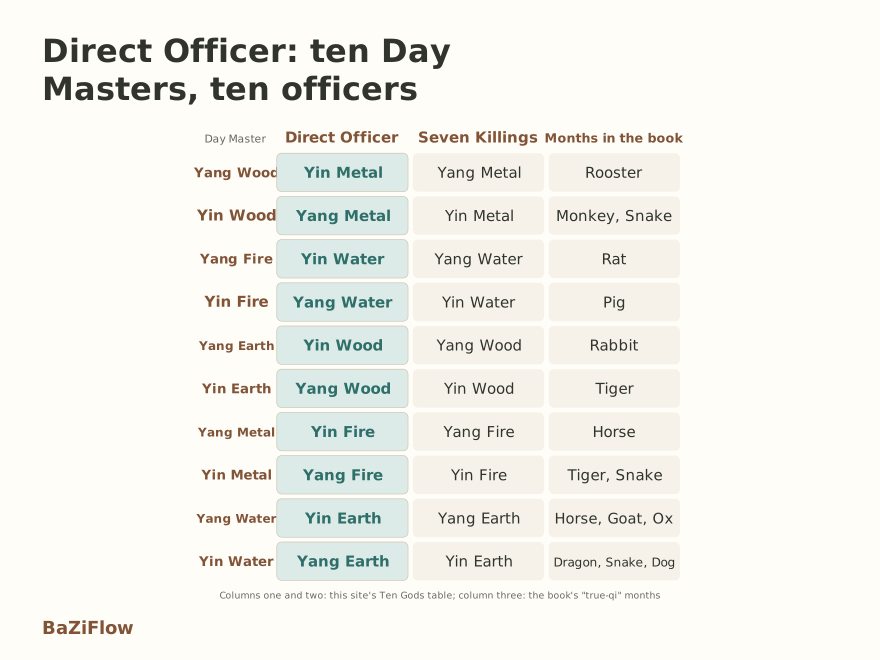 BZ-TG-08 / BaZi
Direct Officer (正官): Why the Sanming Tonghui Allows Only One
The Direct Officer controls the Day Master with the opposite polarity. A ten-row table of officers and months, the named months checked against hidden stems, many versus mixed, the four "looks" and one chart taken apart.
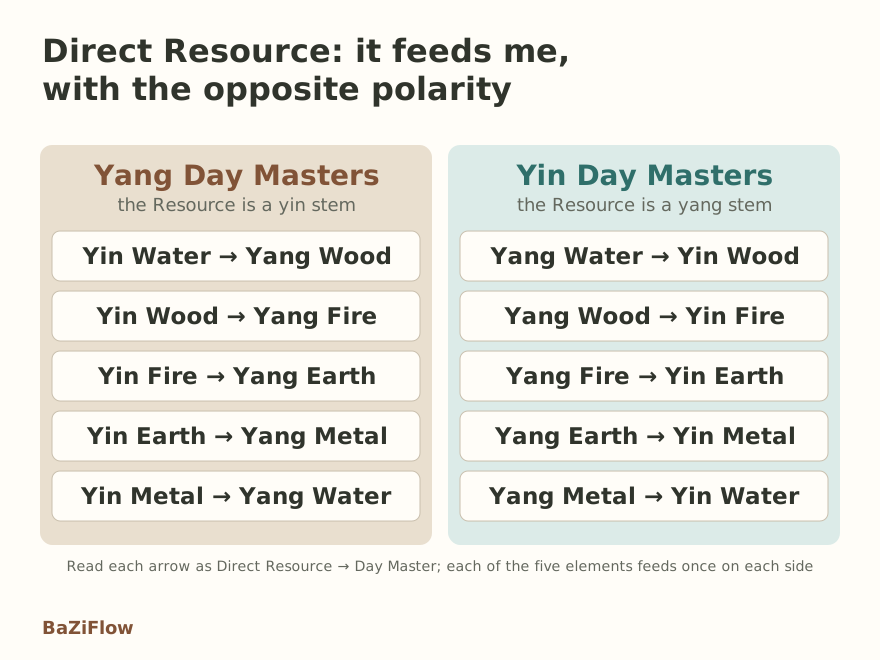 BZ-TG-10 / BaZi
Direct Resource (正印): What "the Resource Leans on the Officer" Means
The Direct Resource feeds the Day Master with the opposite polarity. A yang-yin table, the five month groups against hidden stems, officer feeding Resource, Wealth breaking it, one chart and a same-named term.
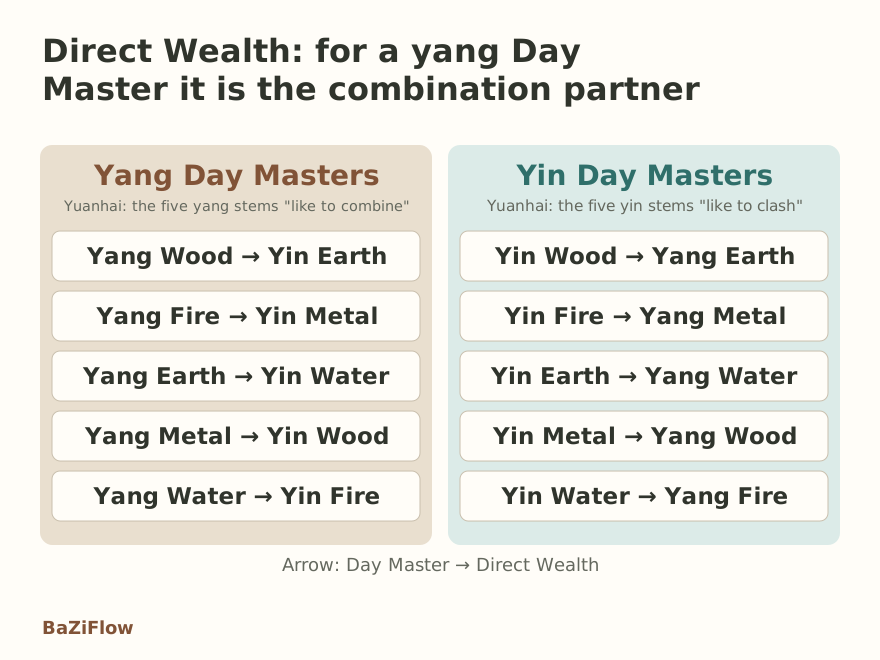 BZ-TG-06 / BaZi
Direct Wealth (正财): The Stem the Day Master Controls With Opposite Polarity
Direct Wealth is the stem the Day Master controls with opposite polarity. A yang-and-yin table, the like-and-dislike lists of two old books, Direct Wealth in the day branch, and a book chart taken apart.
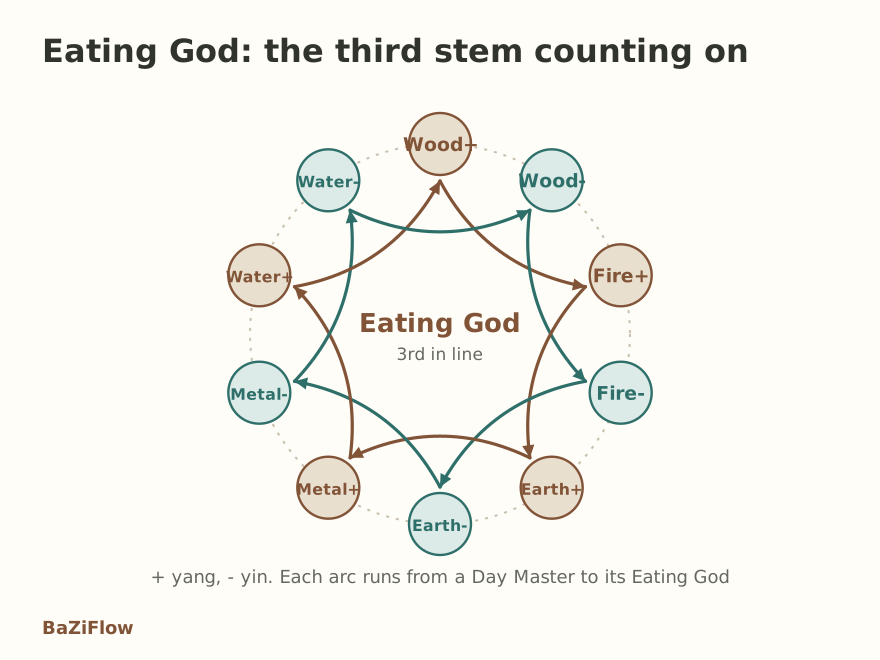 BZ-TG-03 / BaZi
Eating God (食神): The Third Stem From the Day Master and Its Three Neighbors
Eating God is the stem the Day Master generates with the same polarity, the third stem counting on from it. A circle gives the look-up, then two images in the word "eating" and the three neighbors the book assigns.
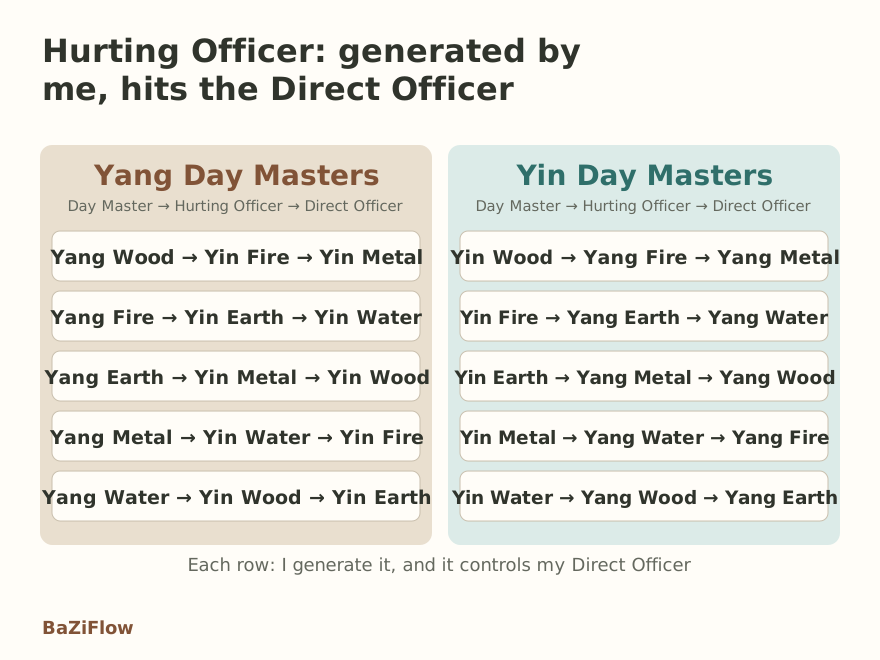 BZ-TG-04 / BaZi
Hurting Officer (伤官): The Stem It Generates, and Which Officer the Name Hurts
Hurting Officer is the stem the Day Master generates with the opposite polarity; for all ten Day Masters it controls their Direct Officer. Then the seven "meeting the officer" cases and a chain through wealth.
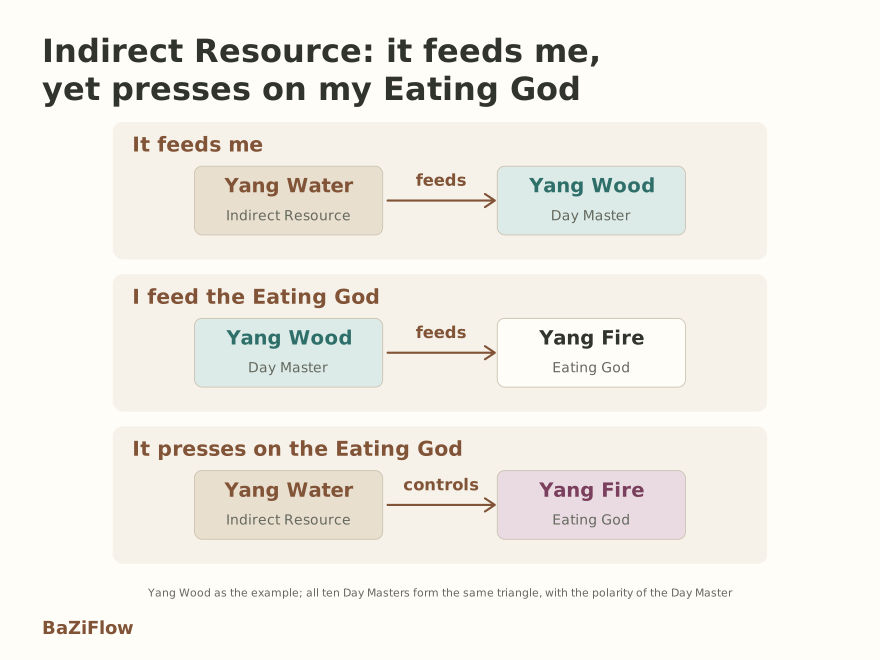 BZ-TG-09 / BaZi
Indirect Resource (偏印): The Overturned Food and the Owl Star of the Old Books
The Indirect Resource feeds the Day Master with the same polarity. A triangle, the fact that it is the Eating God's own Seven Killings, the book's nineteen checked pillars, three Wood-day charts, and how it meets Wealth.
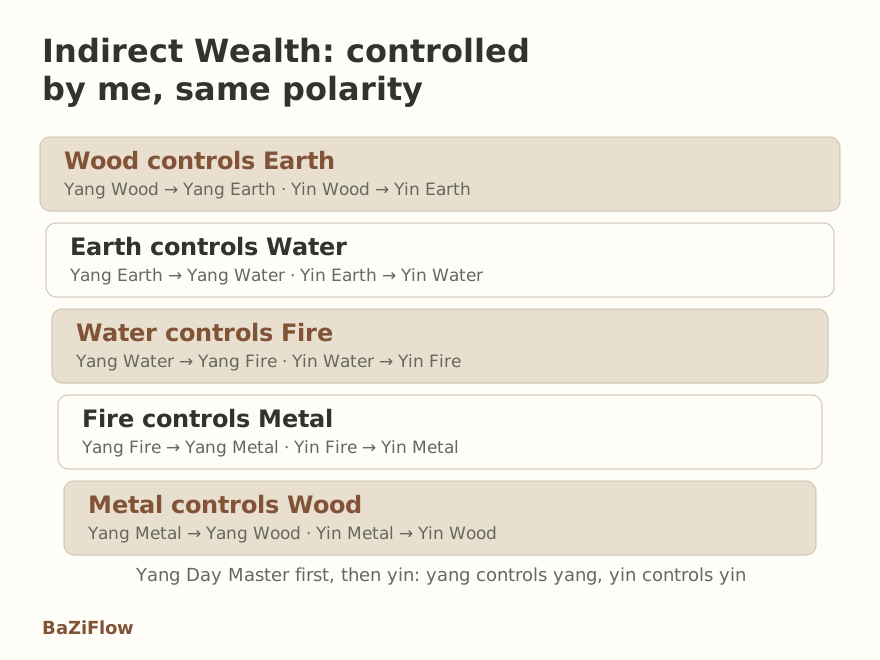 BZ-TG-05 / BaZi
Indirect Wealth (偏财): The Stem the Day Master Controls With the Same Polarity
Indirect Wealth is the stem the Day Master controls with the same polarity; the Yuanhai Ziping defines it as "yang meeting yang wealth, yin meeting yin wealth". Then two lines in the old books and a reverse look-up.
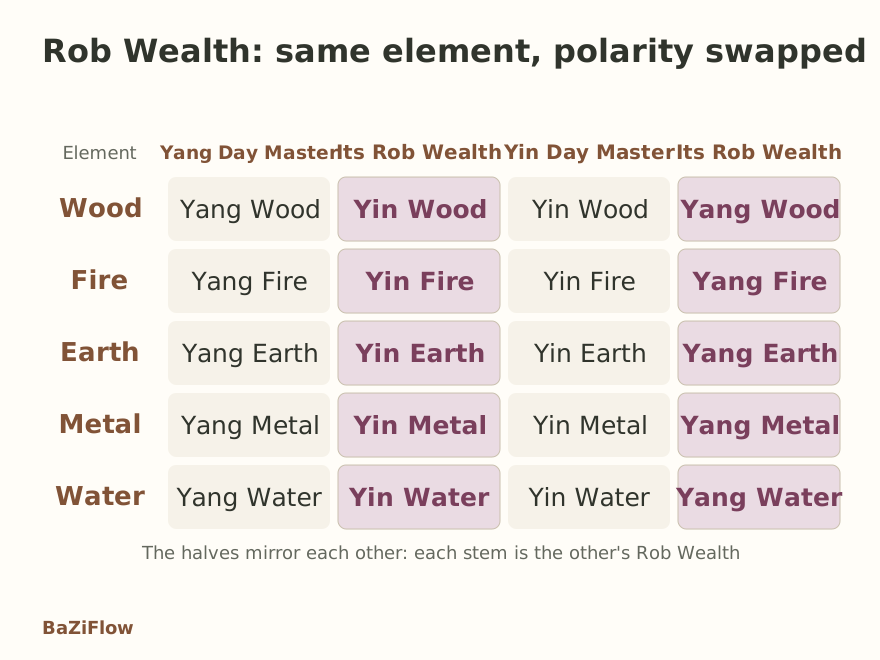 BZ-TG-02 / BaZi
Rob Wealth (劫财): Same Element, Opposite Polarity, and Why It Is Not the Robbery Sha
Rob Wealth is the stem of the same element and opposite polarity as the Day Master, so the ten stems form five mutual pairs. A table, the source of "wealth fears being robbed", and how it differs from the Robbery Sha.
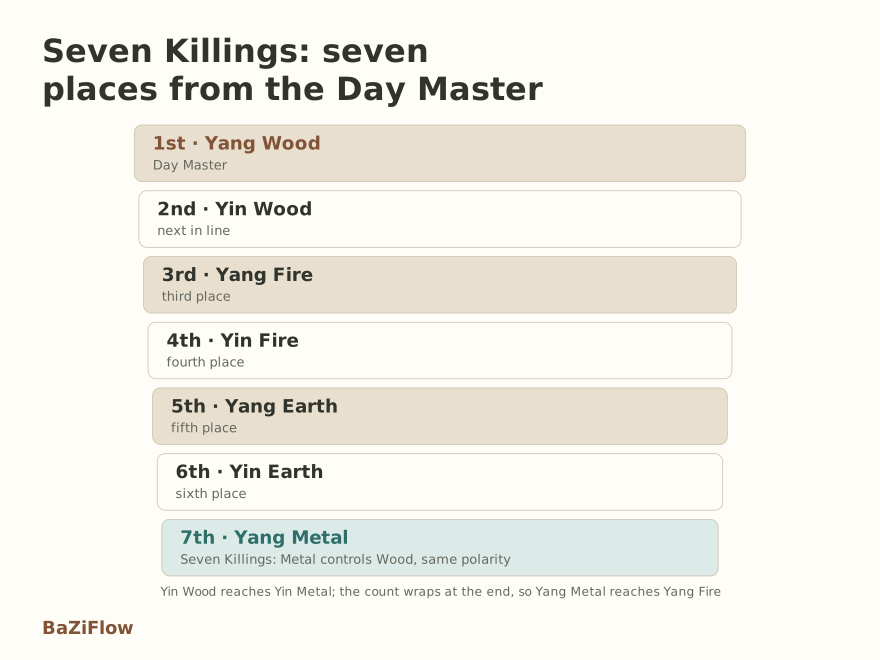 BZ-TG-07 / BaZi
Seven Killings (七杀): The Stem Seven Places from the Day Master
The Seven Killings is the stem seven places on from the Day Master, controlling it with the same polarity. A counting ladder, a ten-line check of the Sanming Tonghui, three routes and one Yuanhai Ziping chart.
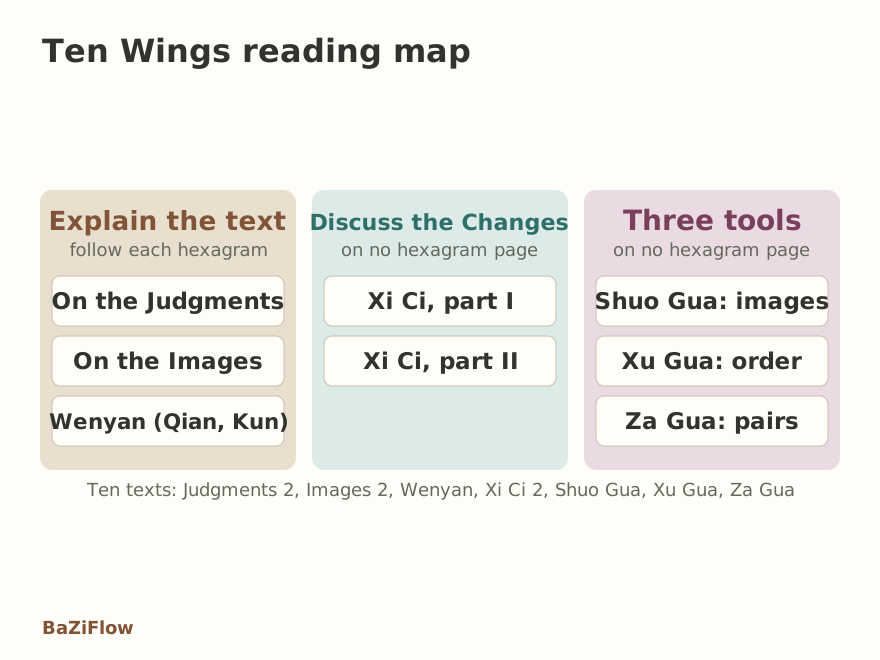 YJ-009 / Yijing
Reading the Ten Wings
On hexagram Fu, see what each of the Ten Wings asks: the Commentary on the Judgments explains, the Great Commentary (Xi Ci) discusses, three texts are lookup tools. Tradition and modern debate stay apart.
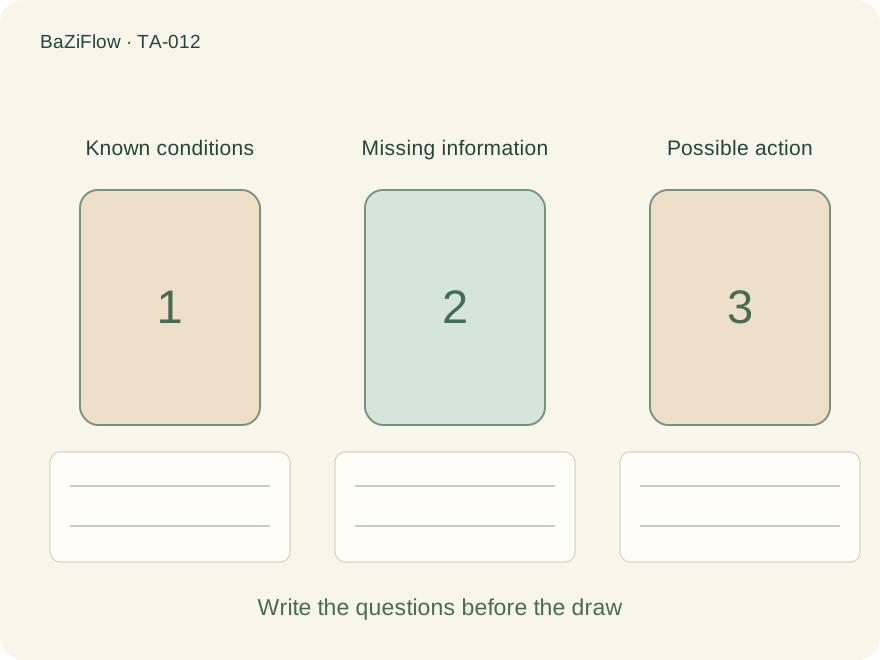 TA-012 / Tarot
Give three cards three different jobs
Design a small spread around known conditions, missing information and a possible action. A repair-event example shows why positions need to be defined before the cards and checked against external evidence.
ZW-011 / Zi Wei Dou ShuThree sides, four directions: the four palaces read together
Anchor, opposite and two trine palaces: compute the set for any Zi Wei palace as i, i+4, i+6, i+8, and keep branches, palace names and school methods apart.
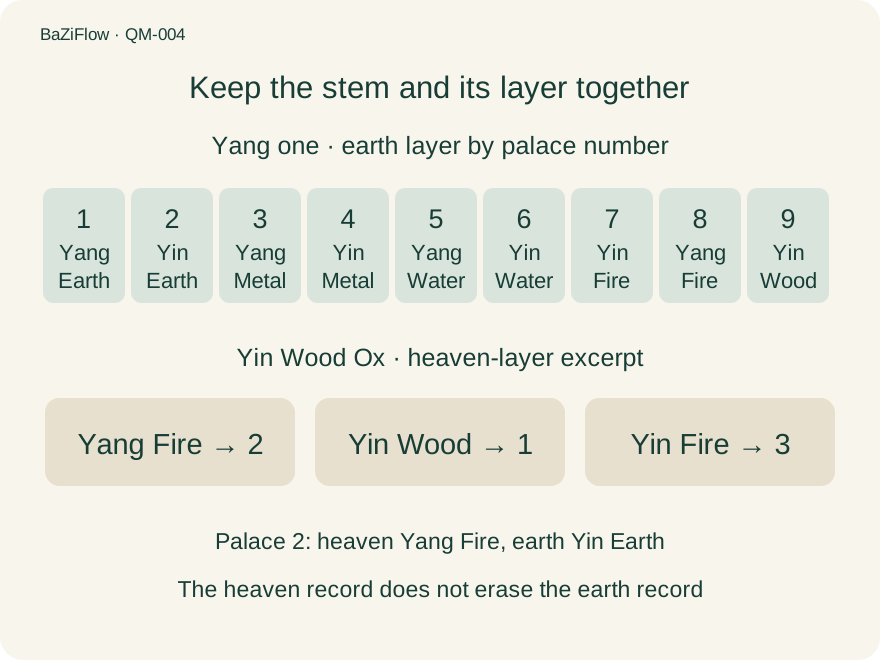 QM-004 / Qimen Dunjia
Three Wonders, Six Instruments and Two Stem Layers
Learn the nine Qimen stem symbols and the six Yang Wood correspondences. A Yang-one example separates the earth arrangement from heaven-layer placements without turning a partial chart into a prediction.
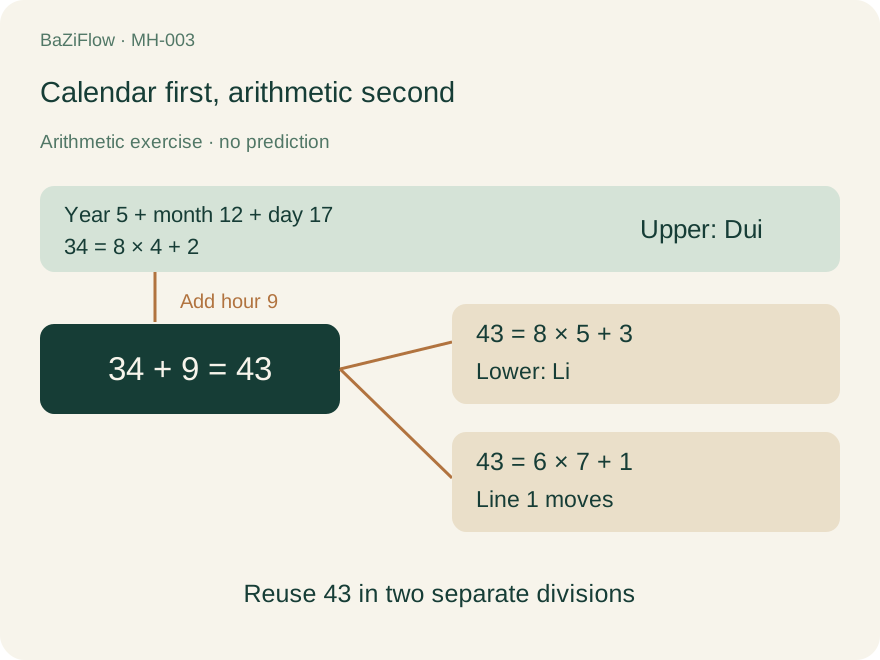 MH-003 / Meihua Yishu
Time-based Meihua casting: record the calendar before the sum
Recalculate the classical 34-and-43 example while separating the original moment, calendar conversion, branch values and boundary conventions in a reproducible record.
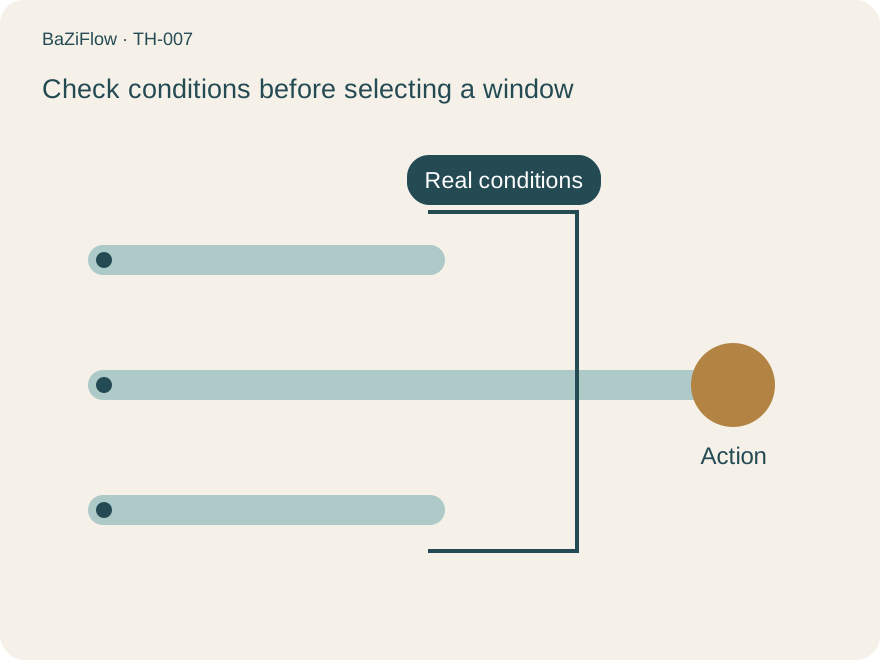 TH-007 / Read by theme
Timing and action: define the start before choosing a moment
Distinguish asking a horary question from selecting an electional time, then connect practical constraints with Qimen timing and direction. A candidate window is not a success guarantee.
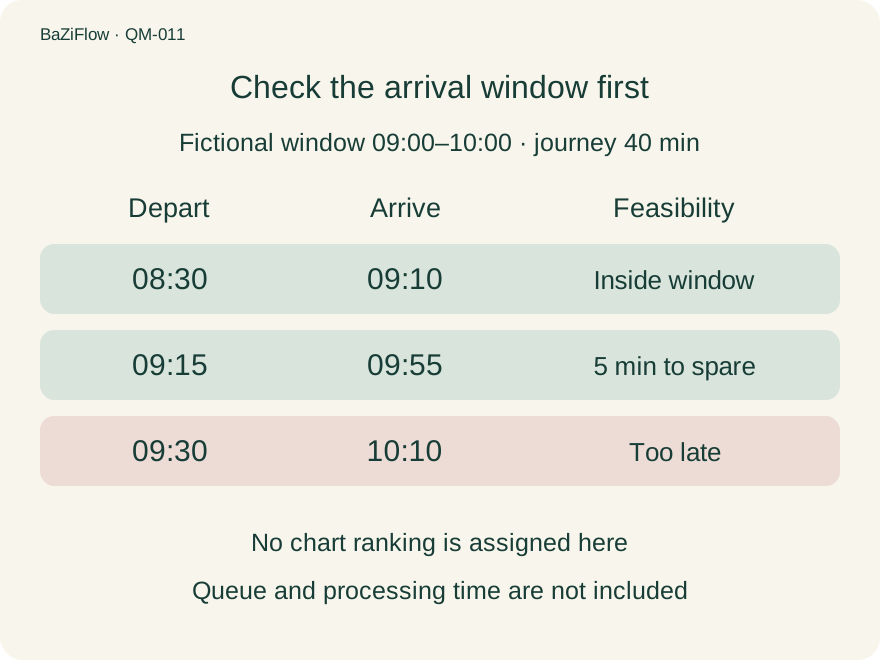 QM-011 / Qimen Dunjia
Choosing a Qimen time or direction starts with real constraints
A fictional appointment window shows why departure, arrival and submission are separate events. Define the action, time zone, direction origin and feasible options before comparing traditional timing preferences.
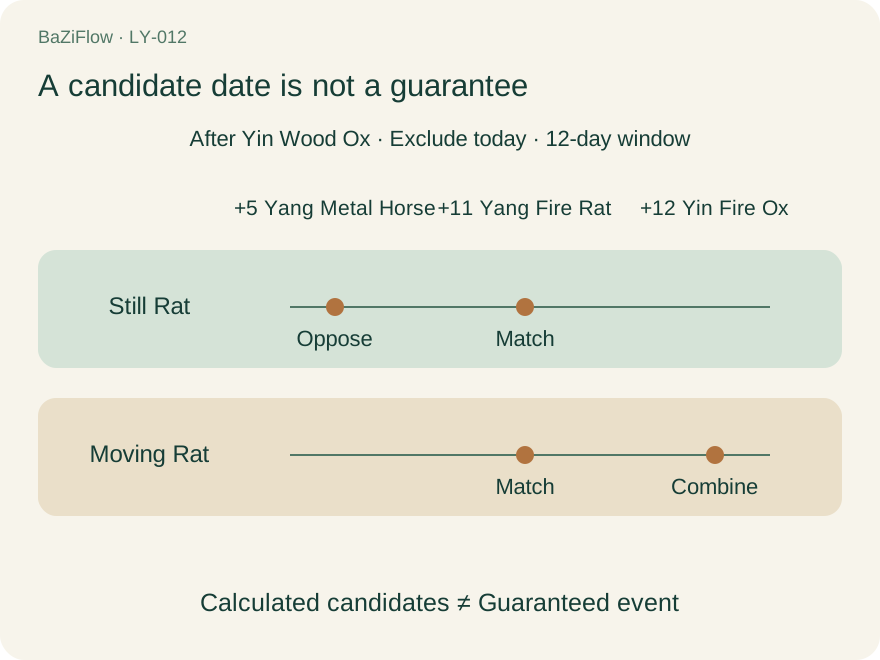 LY-012 / Liu Yao
Timing judgments need uncertainty: candidates are not guarantees
Compute still-Rat and moving-Rat candidates within a fixed twelve-day window, then separate calendar arithmetic, event definitions, and observed outcomes.
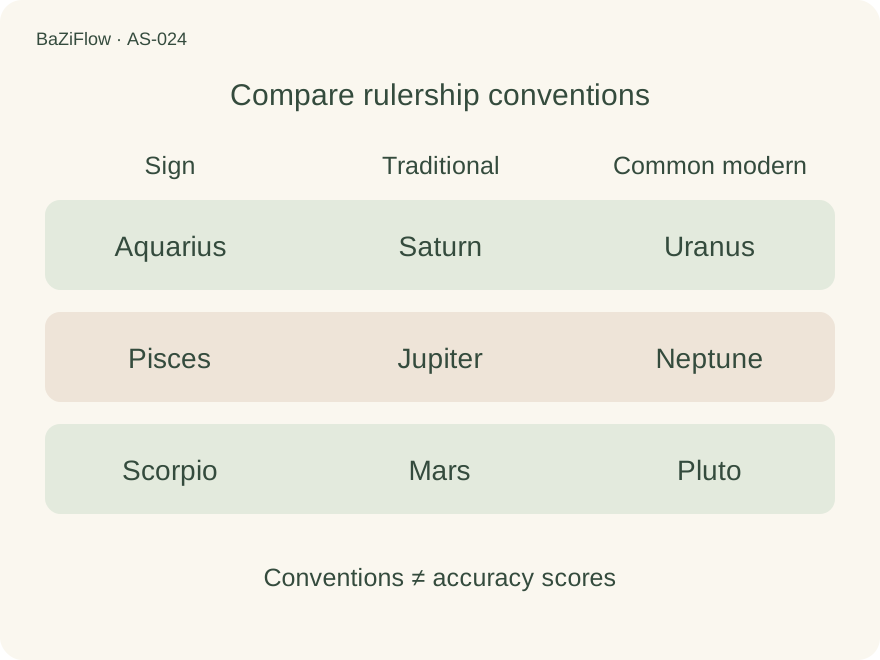 AS-024 / Western astrology
Traditional and modern astrology: compare the rules, not the labels
Use a limited Mercury-in-Aquarius example to separate rulership choices, historical terminology and interpretive aims without turning two broad traditions into a single contest.
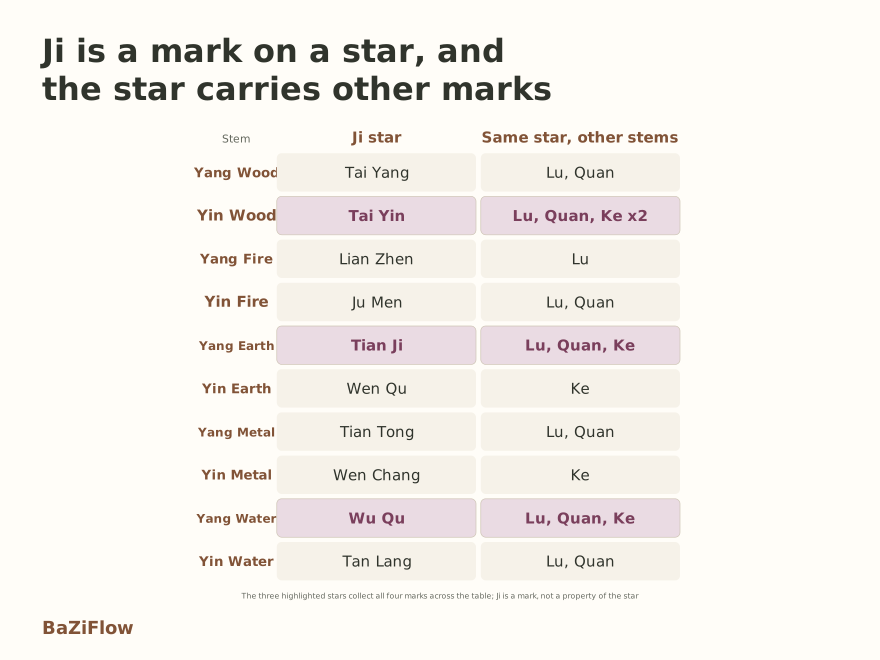 ZW-HUA-04 / Zi Wei Dou Shu
Why Hua Ji (化忌) Is Not Simply Bad News: Ask the Star, Place and Source First
Hua Ji is a mark on a star; Wu Qu, Tian Ji and Tai Yin collect all four marks. Two Yang Wood year charts and the conditions in the Quan Shu's Ji entry show how star, place, brightness and source shape a record.
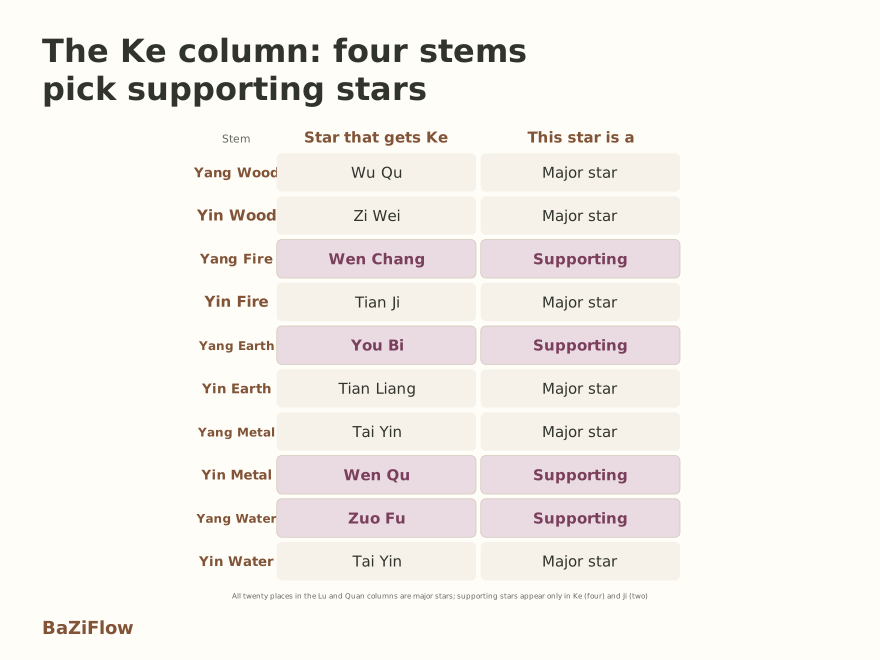 ZW-HUA-03 / Zi Wei Dou Shu
Hua Ke (化科): Four Stems Pick Supporting Stars, and the Three Sources
Four stems hand Hua Ke to Wen Chang, You Bi, Wen Qu or Zuo Fu. An engine-computed sample chart shows how supporting stars are placed by month and hour, and keeps birth-year, palace-stem and self Ke apart.
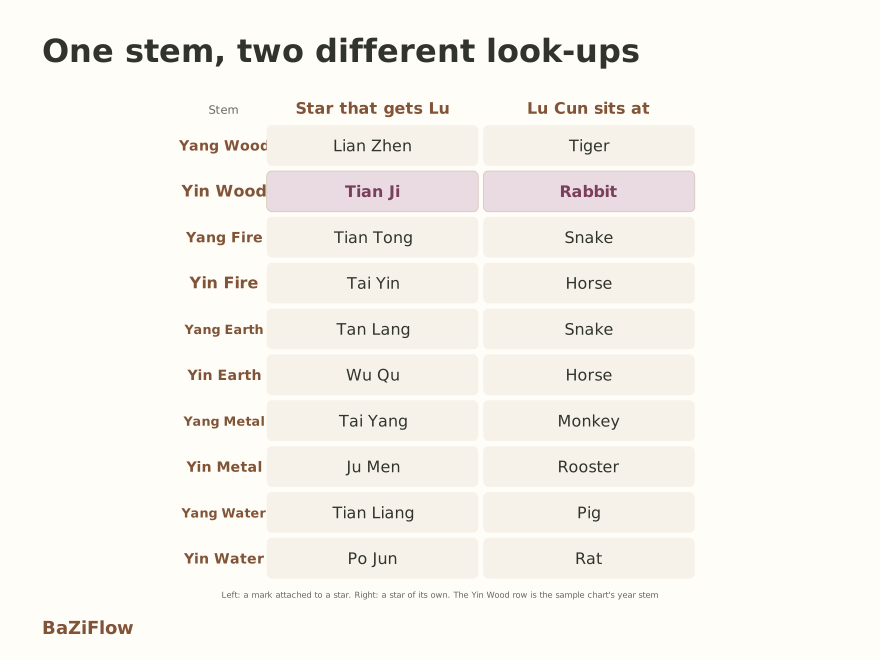 ZW-HUA-01 / Zi Wei Dou Shu
Hua Lu (化禄): How It Differs From Lu Cun, and Its Three Sources
A sample chart worked step by step shows the three sources of Hua Lu (birth-year stem, palace stem, self-transformation) and keeps it apart from Lu Cun, which also comes from the year stem.
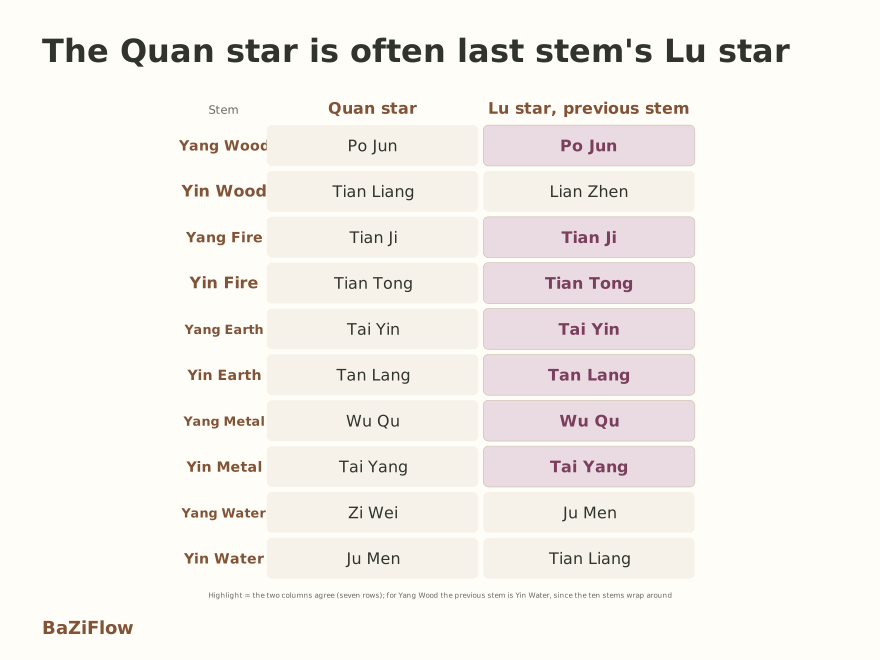 ZW-HUA-02 / Zi Wei Dou Shu
Hua Quan (化权): Why Its Star Often Repeats the Previous Stem's Lu, and Three Sources
Read the Quan column against the previous stem's Lu column, then use an engine-computed sample chart for birth-year, palace-stem and self Quan, and separate the book's "meets Ju Men and Wu Qu" from the table look-up.
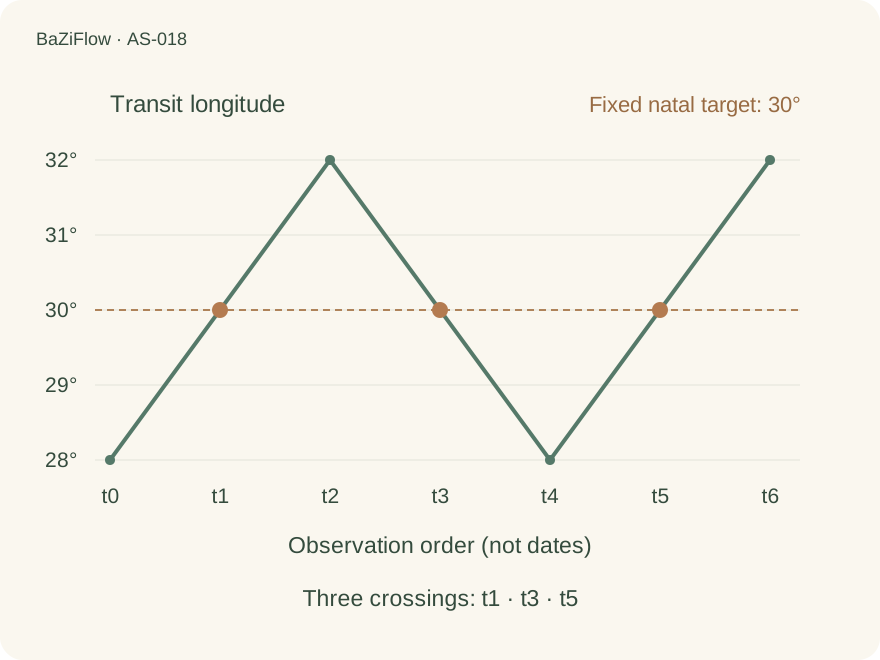 AS-018 / Western astrology
One sky, different natal targets: how transits are compared
Compare one moving position with two natal records, then separate exact contacts, orb windows, repeat passes and daily-horoscope display choices. Keep the moving and fixed sides explicitly labelled.
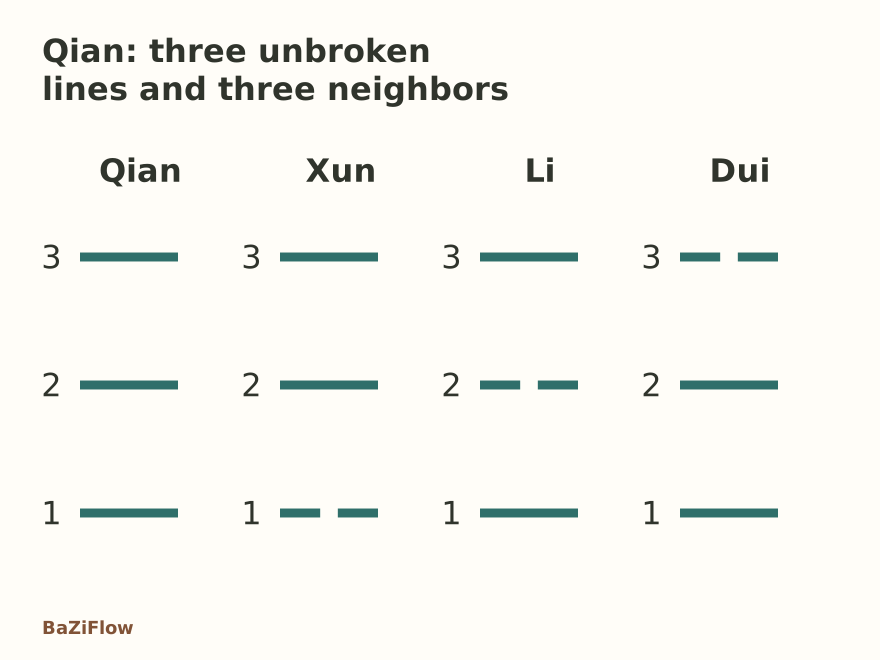 TRIGRAM-01 / Shared methods
Qian (乾): three unbroken lines and the fourteen images the Shuo Gua lists for it
Qian is the trigram whose three lines are all yang. Read it in layers: its figure, the fourteen images of Shuo Gua chapter 11, its two positions on the later diagrams, and the fifteen six-line hexagrams it enters.
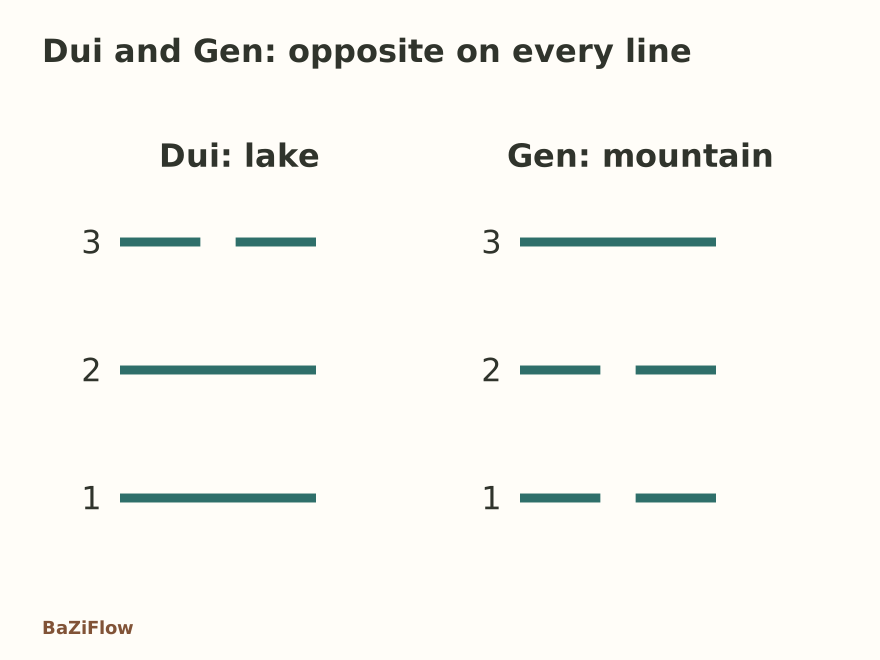 TRIGRAM-02 / Shared methods
Dui (兑): a gap at the top, and the word "delight" seven times in the Shuo Gua
Dui has two yang lines under a broken top line and is the inverse of Gen. Follow the word delight through seven appearances in the Shuo Gua, then its season, position, images, and the double lake of hexagram 58.
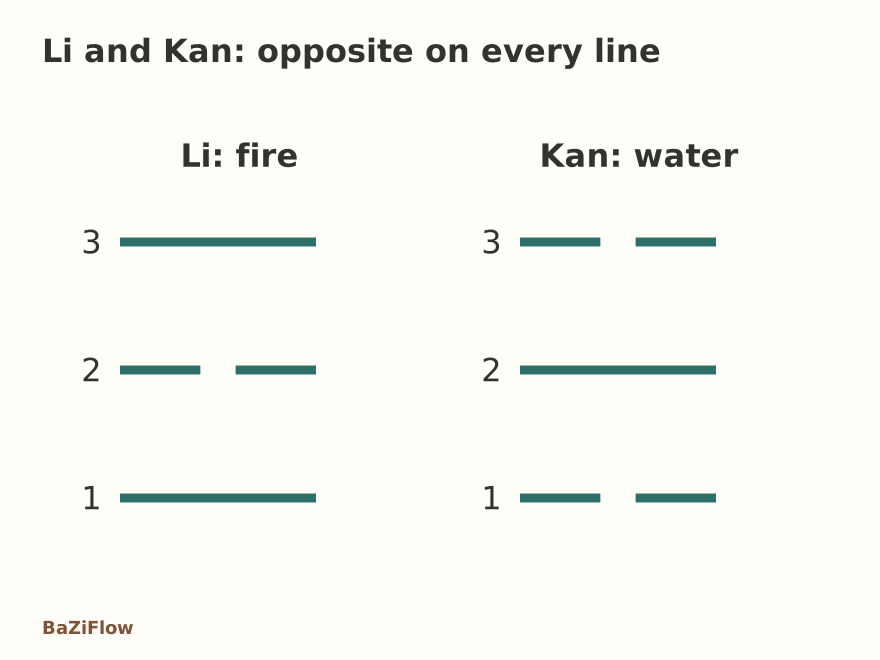 TRIGRAM-03 / Shared methods
Li (离): a broken line in the middle, the word "clinging" and facing the light
Li has two yang lines around a broken yin line. Follow its word, clinging, through three Ten Wings texts, then chapter 5 on facing the light, the shelled creatures of chapter 11, and the pheasant versus the cow.
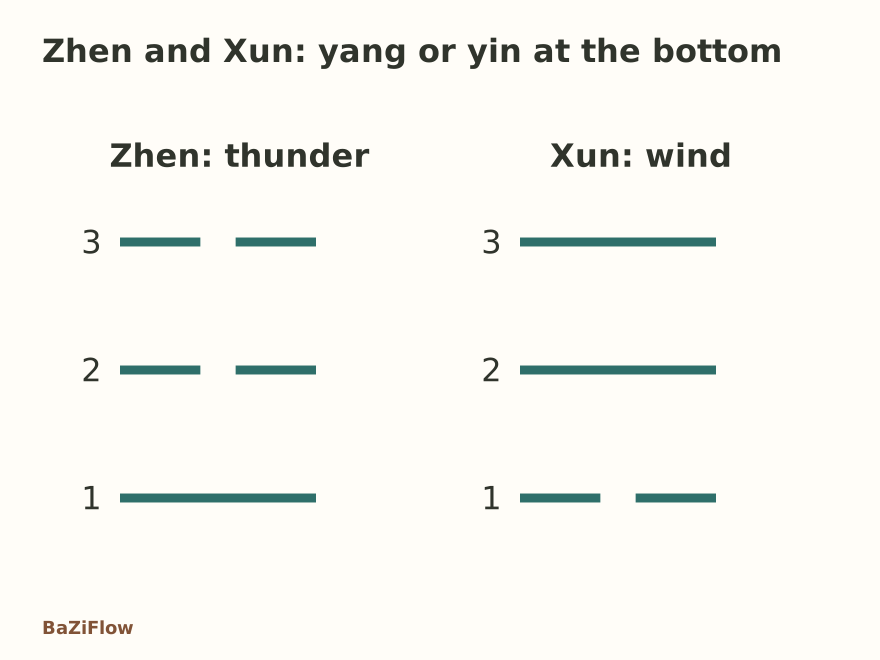 TRIGRAM-04 / Shared methods
Zhen (震): yang at the bottom, and the first stop of "the sovereign emerges in Zhen"
Zhen has a yang line at the bottom under two yin lines. See where that line sits among the one-yang trigrams, the chapter 5 journey that starts here, two wordings for thunder and wind, and how the chapter 11 list ends.
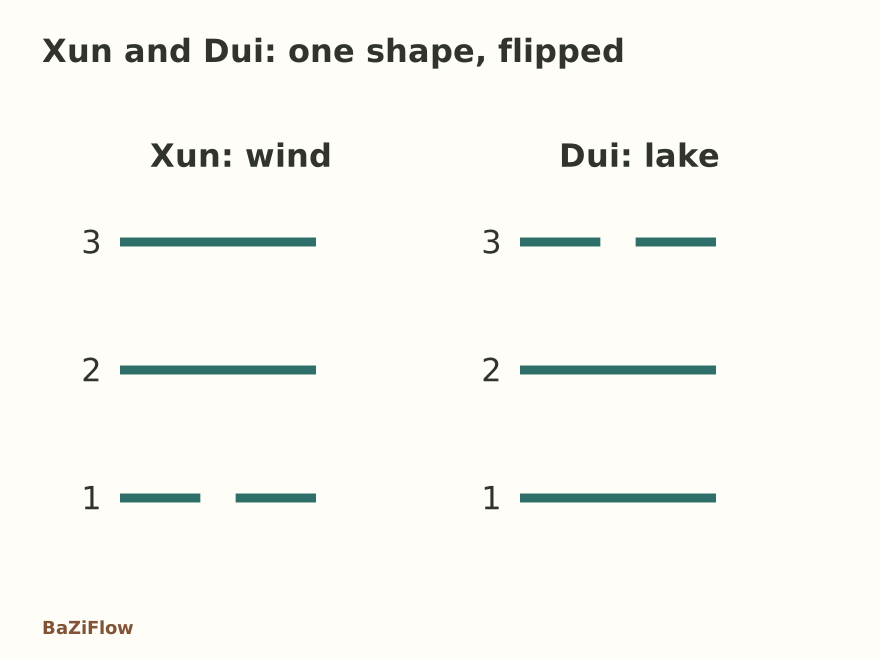 TRIGRAM-05 / Shared methods
Xun (巽): yin at the bottom, wind and wood, and "set even in Xun"
Xun has a yin line at the bottom under two yang lines and is Dui turned over. Read its two images, wind and wood, "set even in Xun" in chapter 5, the indecisive items on its list, and hexagram 57.
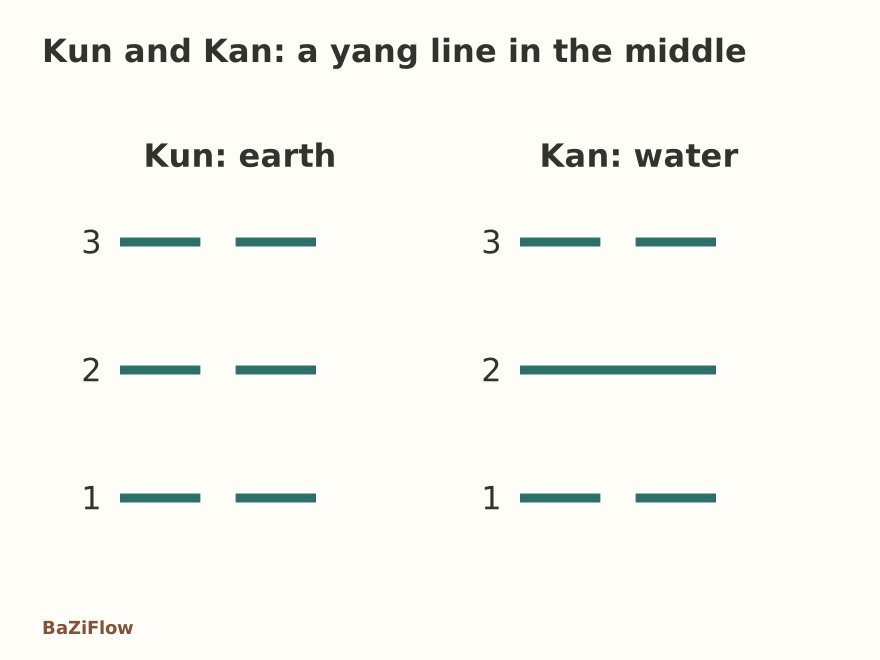 TRIGRAM-06 / Shared methods
Kan (坎): a yang line held in the middle, and the words sinking, toil and return
Kan has a yang line held between two yin lines. Read its three words, sinking, toil and return, the two places in chapter 5 that say "due", the twenty-item chapter 11 list, and the repeated Kan of hexagram 29.
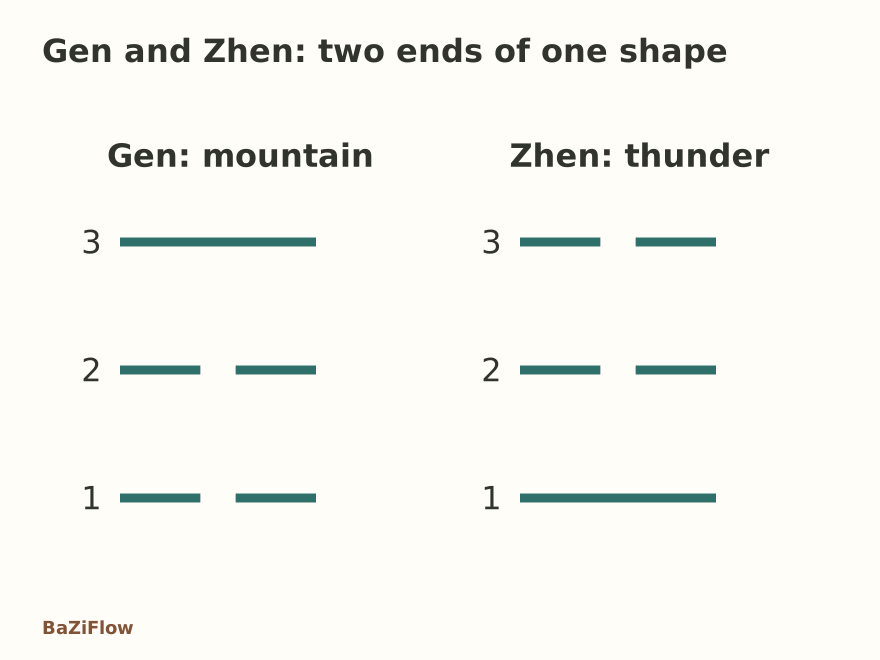 TRIGRAM-07 / Shared methods
Gen (艮): yang pressed on top, and the last stop that is also the first
Gen has a yang line on top over two yin lines and is Zhen upside down. Read the last stop of the chapter 5 journey, an ending that becomes a beginning, the two verbs of chapter 6, the Xu Gua link and hexagram 52.
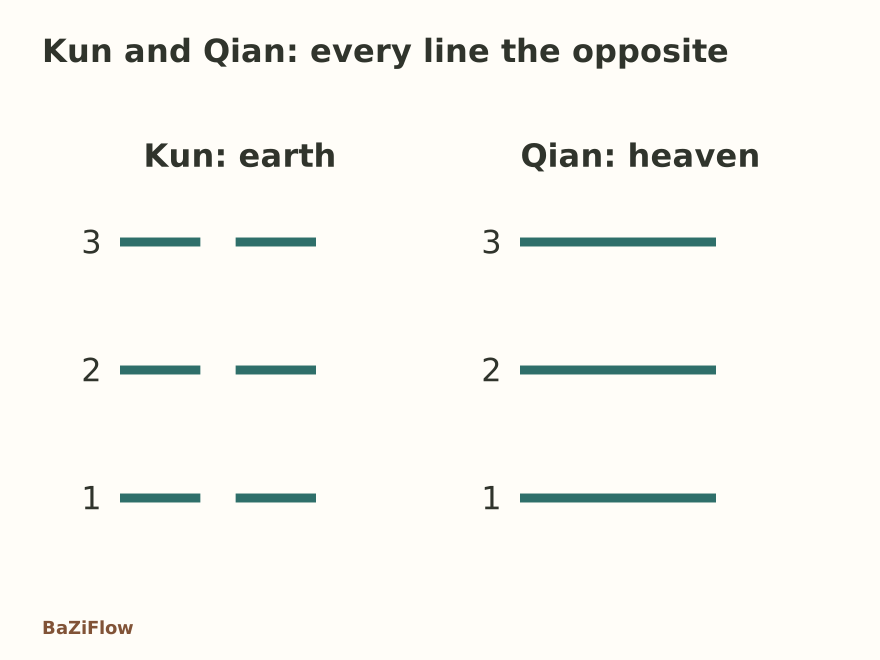 TRIGRAM-08 / Shared methods
Kun (坤): three yin lines, Qian’s counterpart, and two sets of images for the earth
Kun is the trigram of three yin lines, the inverse of Qian. Read the seven Shuo Gua chapters where it stands with Qian, the southwest in the Judgment, the list of chapter 11, and two sets of images, black and yellow.
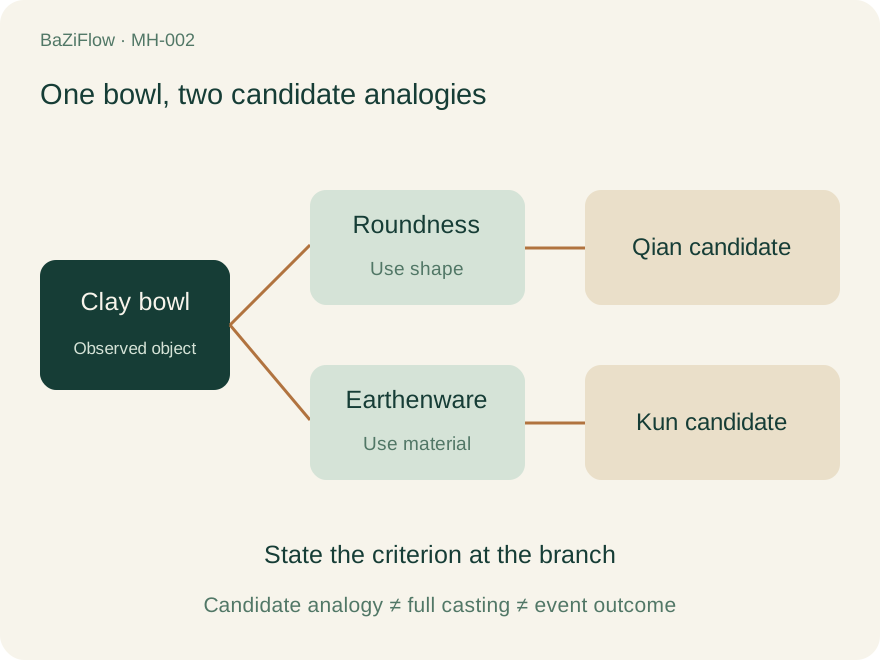 MH-002 / Meihua Yishu
Trigram imagery: why a round clay bowl has two possible routes
Use a round earthenware bowl to separate observation, selection criteria and trigram analogy, then examine how context can help—or invite hindsight.
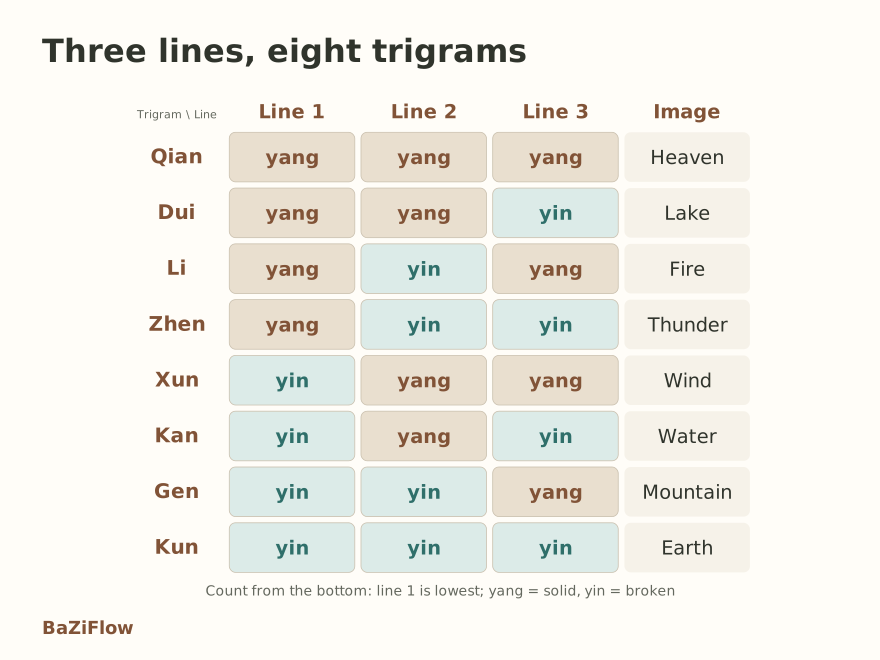 YJ-005 / Yijing
Eight Trigrams: Three-Line Structure and Basic Images, Read Through the Shuo Gua
The eight trigrams are the small figures built from three lines. An eight-row table, a 1-3-3-1 grouping and Shuo Gua chapter 7 separate structure, names, natures and images, and show which chapter each entry comes from.
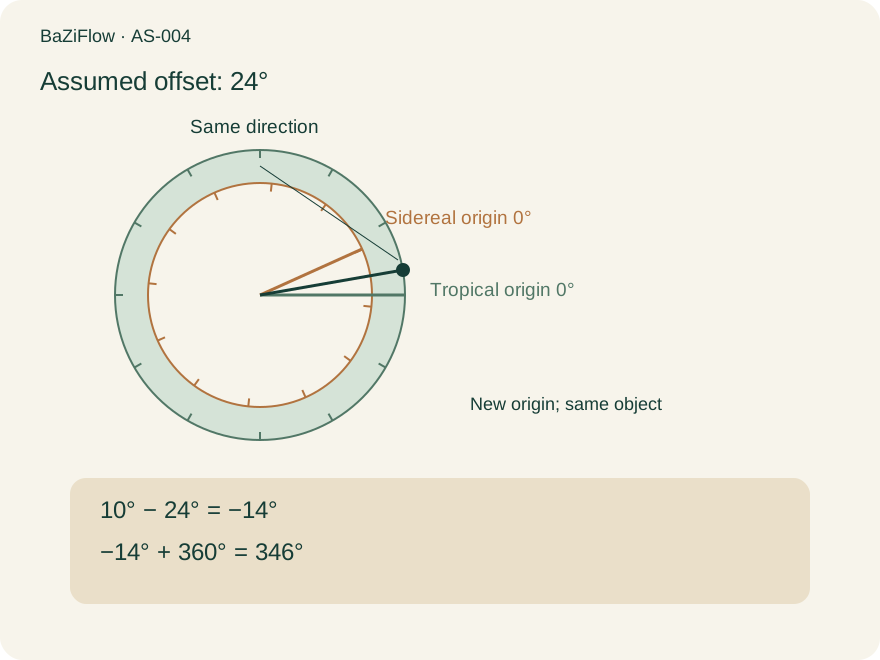 AS-004 / Western astrology
Tropical vs sidereal zodiac: what is the difference between the two readings?
Tropical vs sidereal zodiac explained: understand reference points and ayanamsha through an invented 24-degree offset, then test what changes sign and what preserves its angular separation.
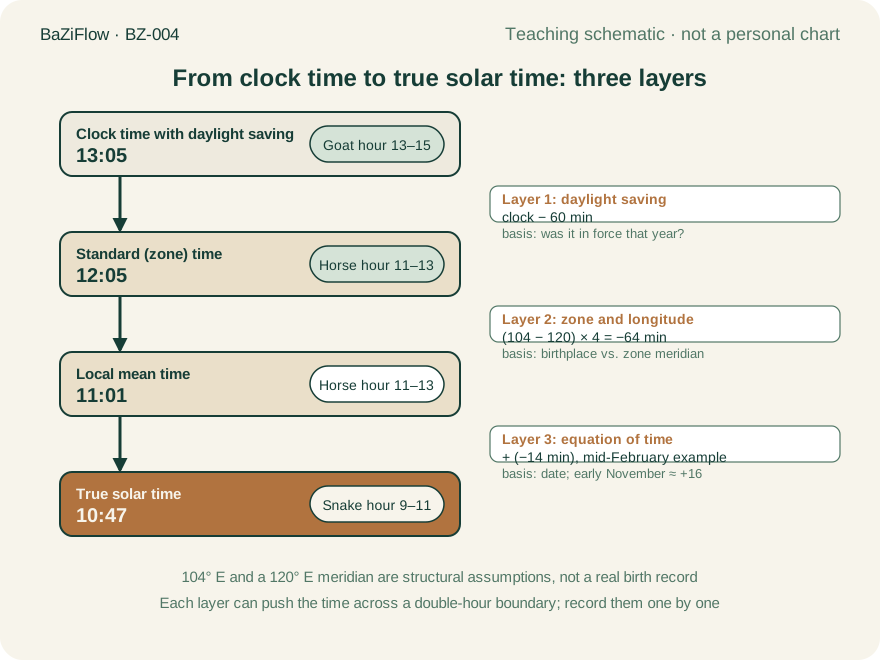 BZ-004 / BaZi
True solar time: separate civil offsets, longitude and the equation of time
Follow a reproducible conversion through historical civil time, longitude and the equation of time, then check whether uncertainty crosses an hour-branch boundary.
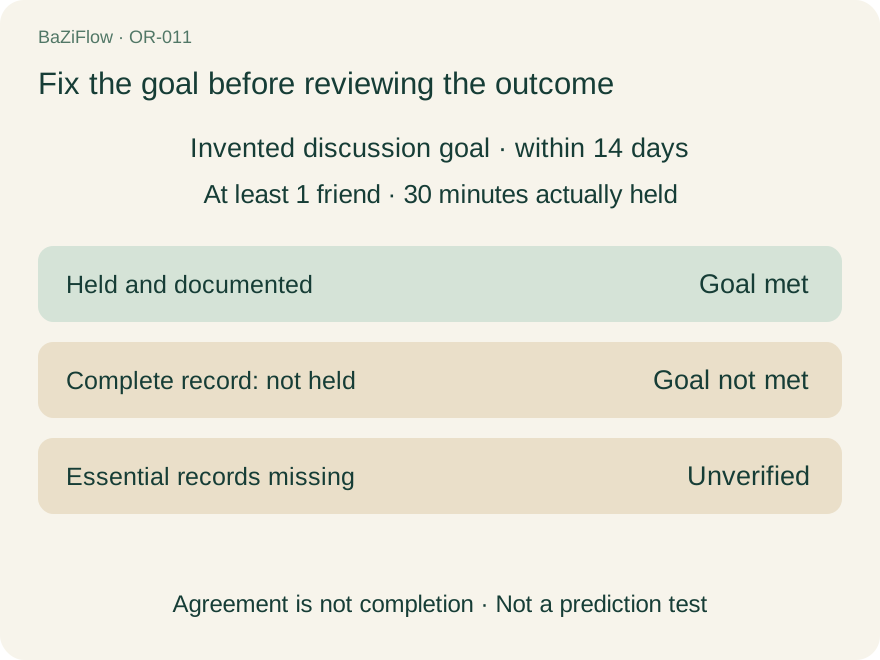 OR-011 / Oracle lots
Turn a lot reading into checkable reflection without moving the goal
Use an invented fourteen-day discussion plan to separate interpretation, action, and evidence, while distinguishing practical benefit from prediction testing.
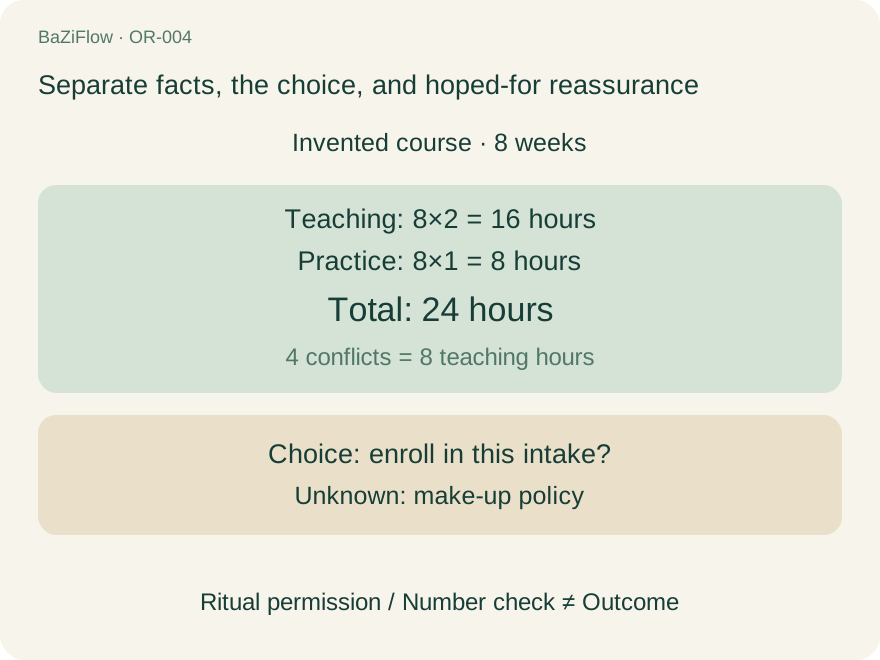 OR-004 / Oracle lots
Turn a vague oracle-lot concern into one focused question
Separate facts, choices, missing information, and hopes through an eight-week course example, while distinguishing ritual permission from an event outcome.
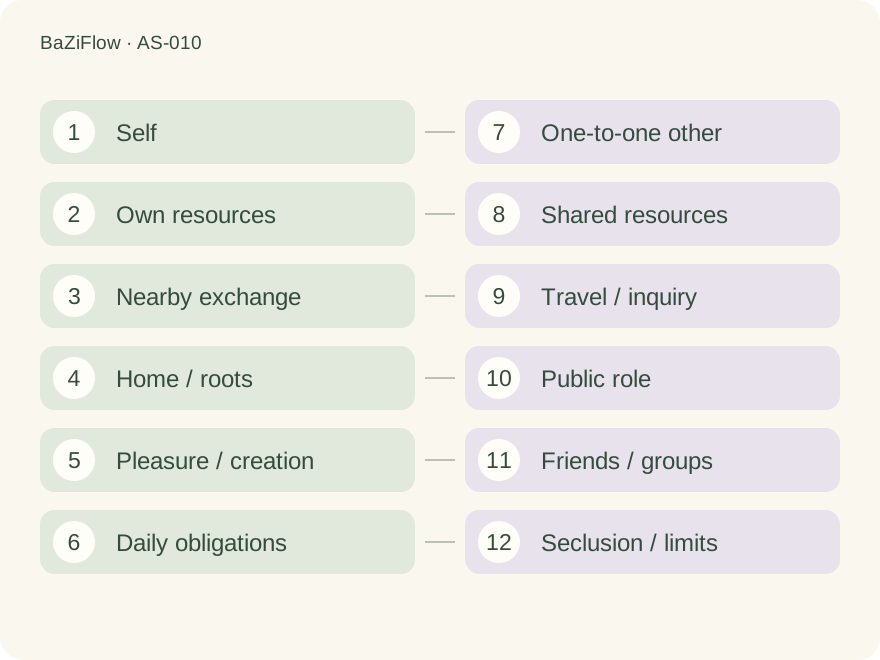 AS-010 / Western astrology
The twelve houses as topics, not twelve verdicts
Distinguish the twelve house topics through six paired contrasts, while separating meanings from signs, calculated placements and real-world evidence.
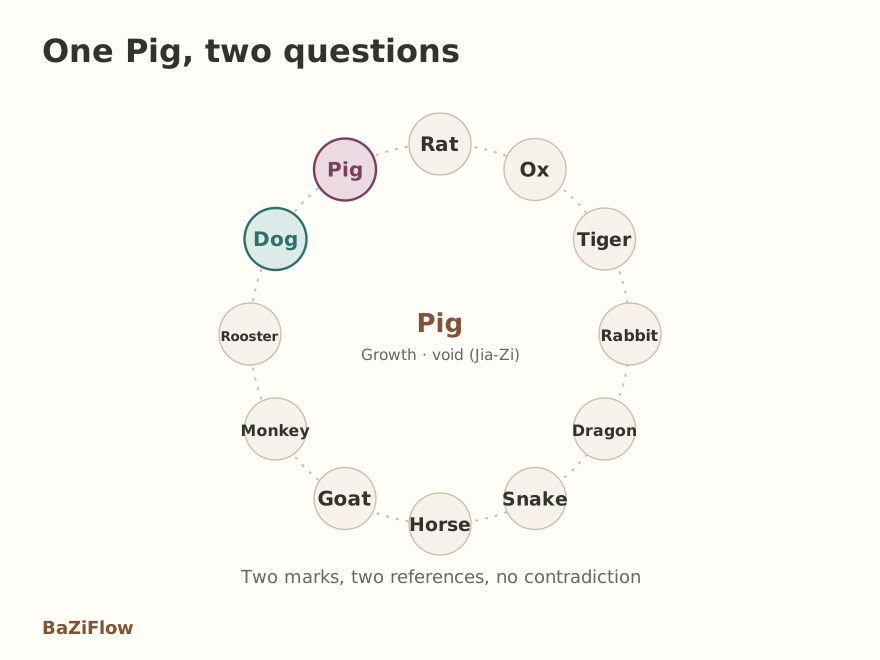 BZ-024 / BaZi
Twelve Life Stages and Void Branches: Two Tables, Two References
The twelve life stages ask where a stem falls on a branch; void branches ask which two branches are left when ten stems meet twelve. A Yang Wood circuit, the six blocks and a Yang Metal Horse example separate them.
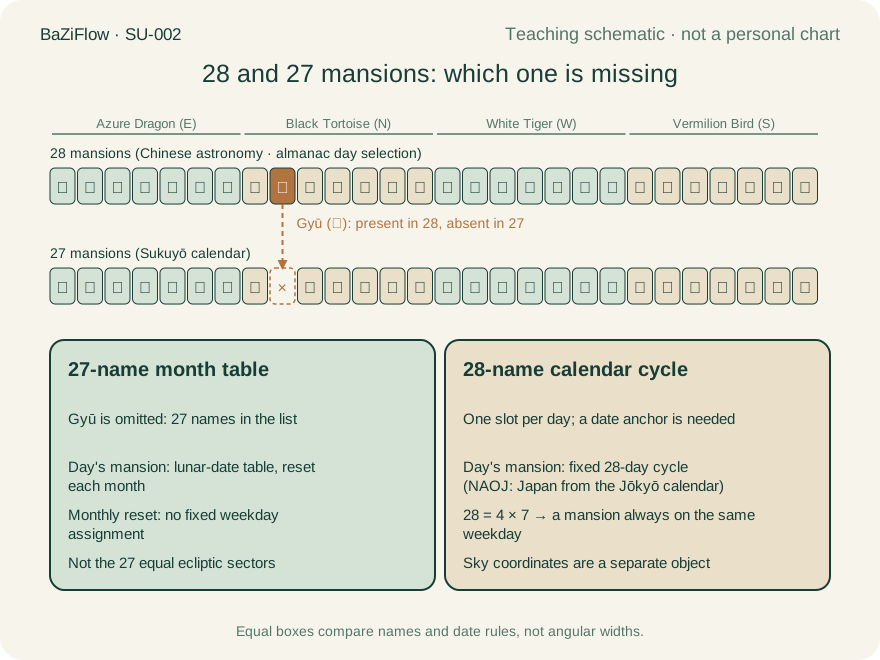 SU-002 / Sukuyō astrology
Sukuyō 27 mansions vs the 28 lunar mansions: what is the difference?
27 Sukuyō mansions vs the 28 lunar mansions: separate sky positions, month-table assignments and continuous calendar annotations. Compare the name lists, a 28-day counter and the missing anchor needed for a real date.
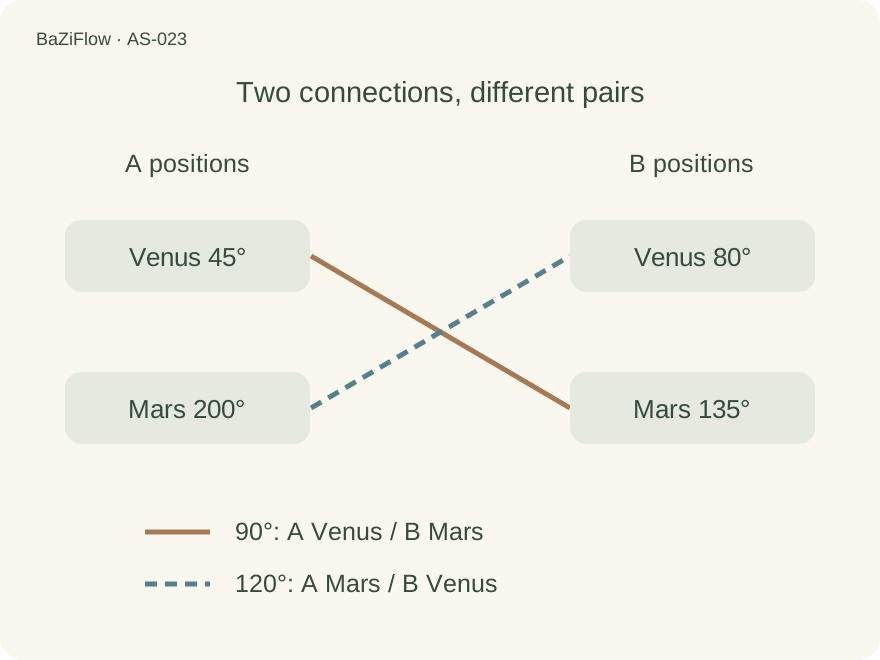 AS-023 / Western astrology
Two people, four planet labels: keeping synastry ownership clear
Distinguish reversing a pair from replacing its members, then apply the same discipline to statements, guesses and shared agreements in relationship readings.
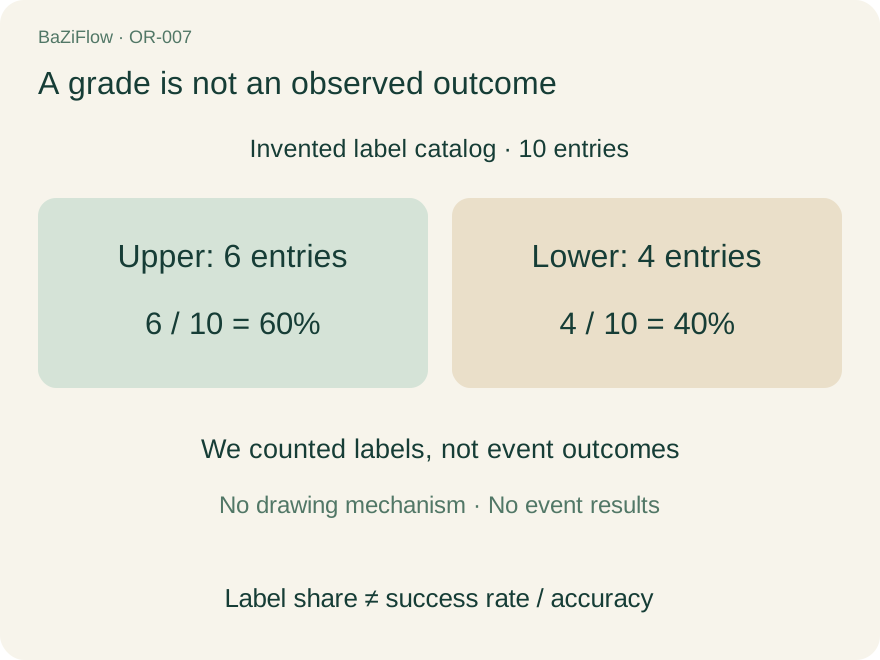 OR-007 / Oracle lots
Upper and lower oracle lots are labels, not event outcomes
Separate grades, textual conditions, and observed results through a ten-entry exercise, without turning religious exhortation into a personal verdict.
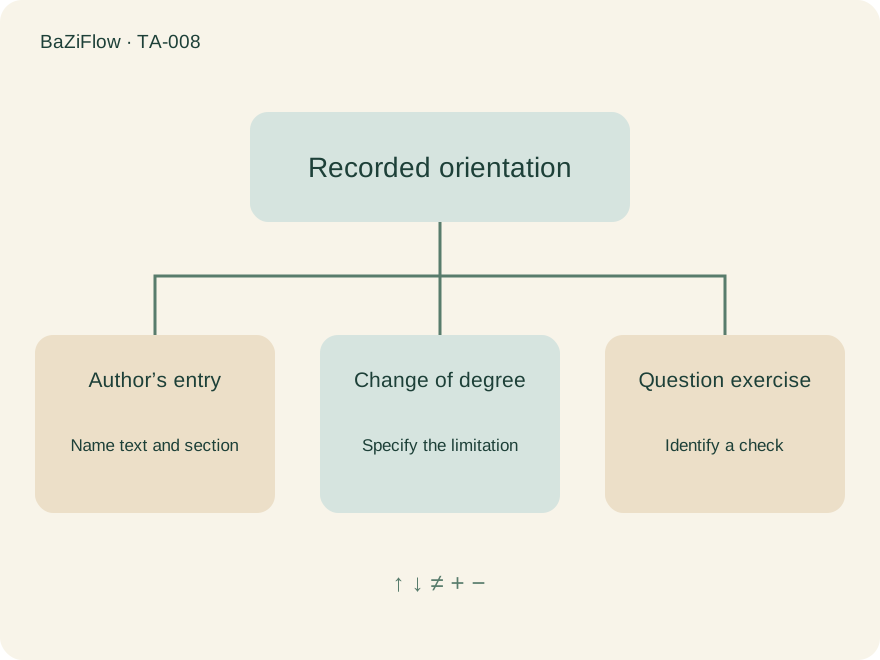 TA-008 / Tarot
Reversals are not a universal minus sign
Compare three different reversal patterns in Waite’s text, then test an interpretation against a concrete question. Keep a recorded orientation separate from the rule used to interpret it.
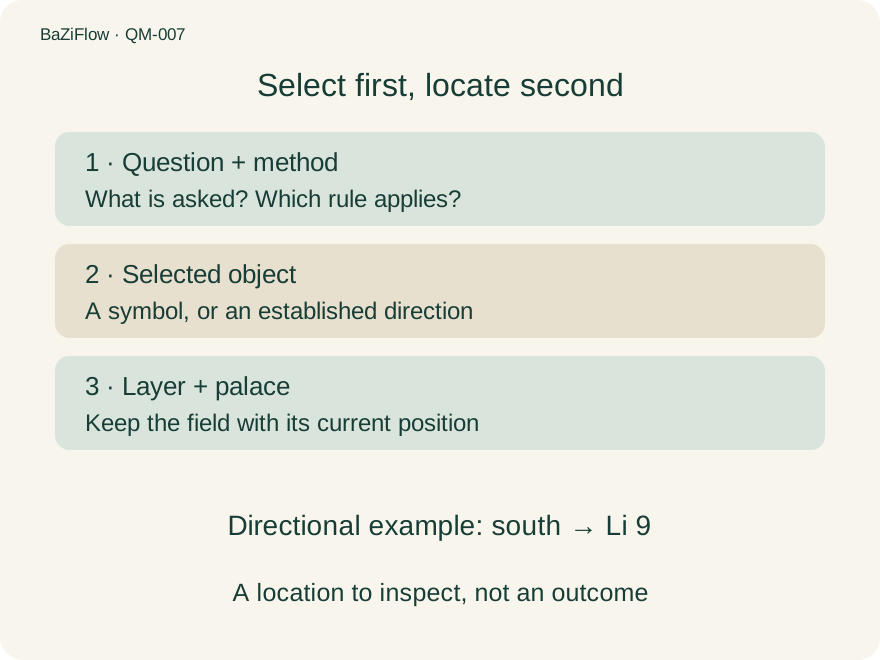 QM-007 / Qimen Dunjia
Choosing a Qimen significator before looking for its palace
A significator is a selected object of attention, not an answer hidden in a palace. Compare symbol-first and direction-first approaches, using a limited south-to-Li example with explicit source and scope.
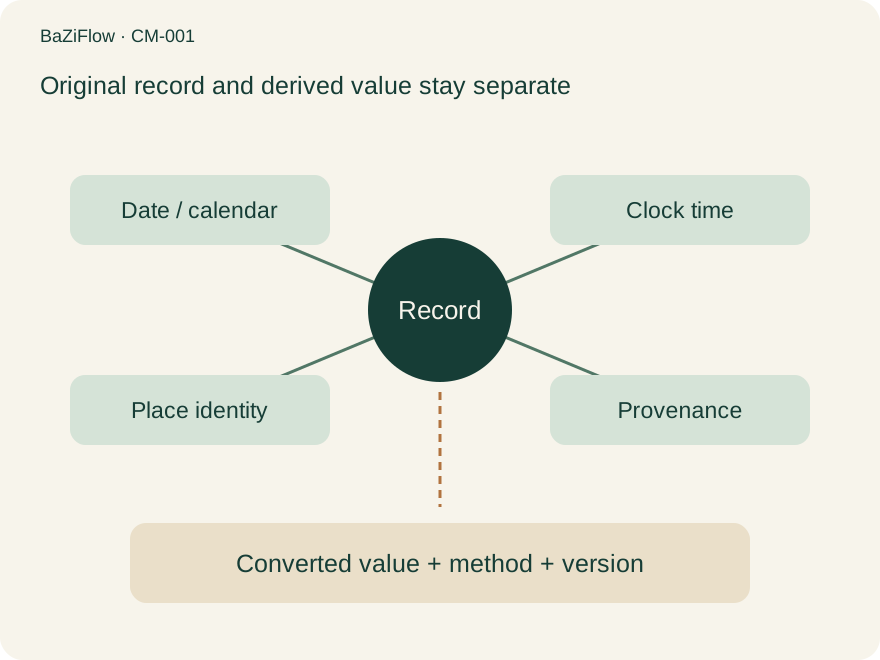 CM-001 / Shared methods
Verify Birth Data Without Overwriting the Original Record
Keep civil-time notation, calendar, location and provenance distinct from later conversions. Preserve uncertainty and revision history instead of filling gaps with precise-looking defaults.
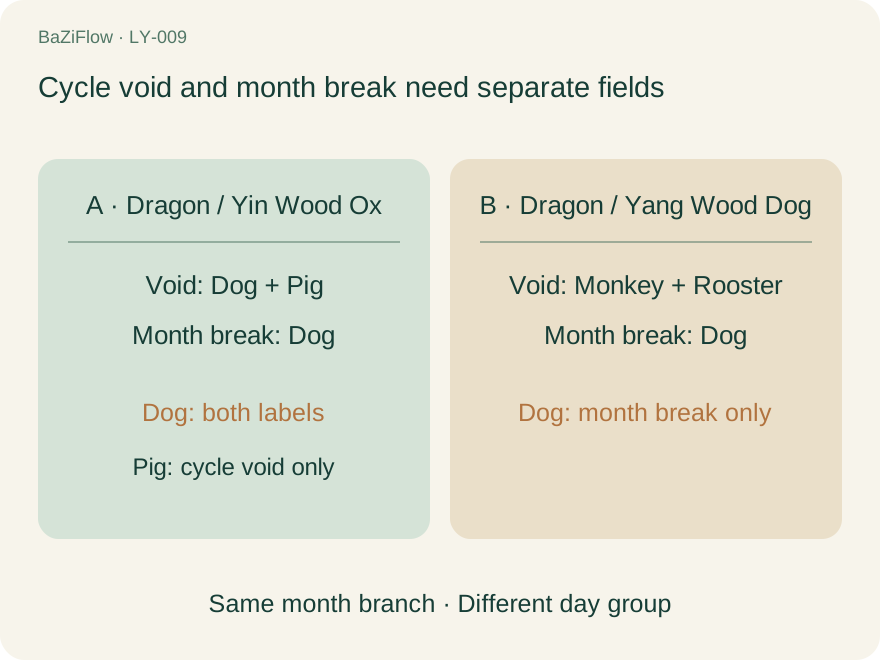 LY-009 / Liu Yao
Cycle void versus month break: two independent calendar tests
Compare supplied Dragon-month inputs on Yin Wood Ox and Yang Wood Dog days to separate the day-group void pair from month clash without inventing an outcome.
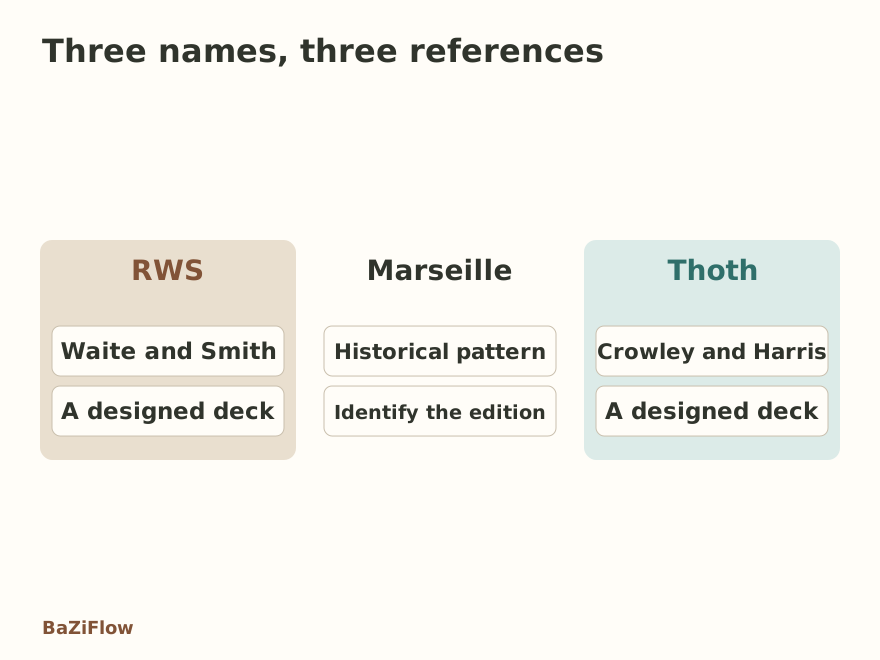 TA-002 / Tarot
Waite, Marseille and Thoth: Sort Three Things Out Before You Switch Decks
The same card number can be a different card in another deck. A side-by-side table, an edition record and a three-column note separate RWS, Marseille and Thoth, and show what to rewrite when you switch.
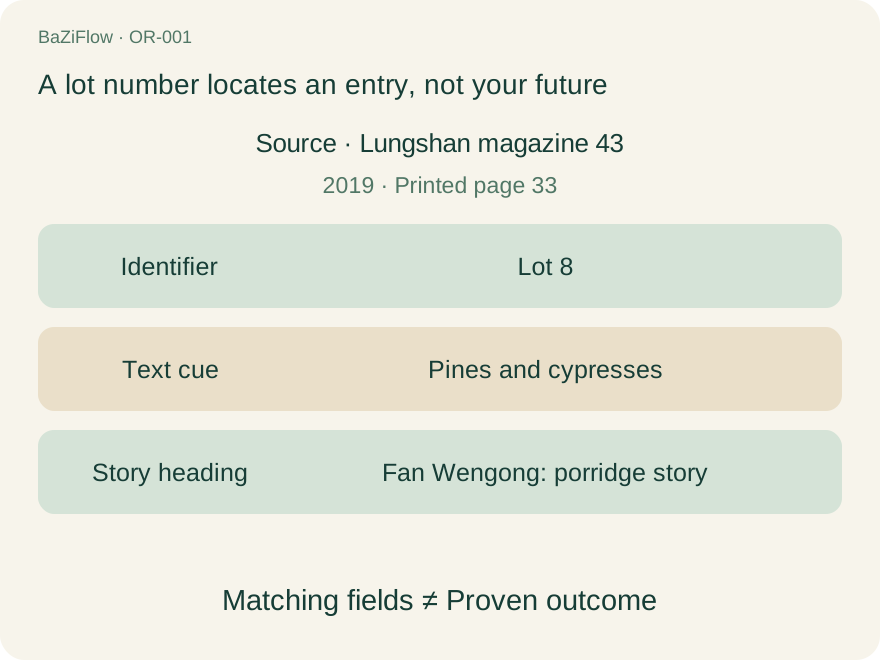 OR-001 / Oracle lots
What are oracle lots? Numbers, poems, and narrative references
Learn to identify a lot within its source, distinguish verse from story headings and commentary, and avoid treating a number as a universal fortune ranking.
BZ-014 / BaZiHow the Ten Gods are derived: five relationships and two polarities
Fix the Day Master, identify the elemental direction and compare polarity. Use a complete Yang Wood table and Yin Metal examples to distinguish relationship names from life interpretations.
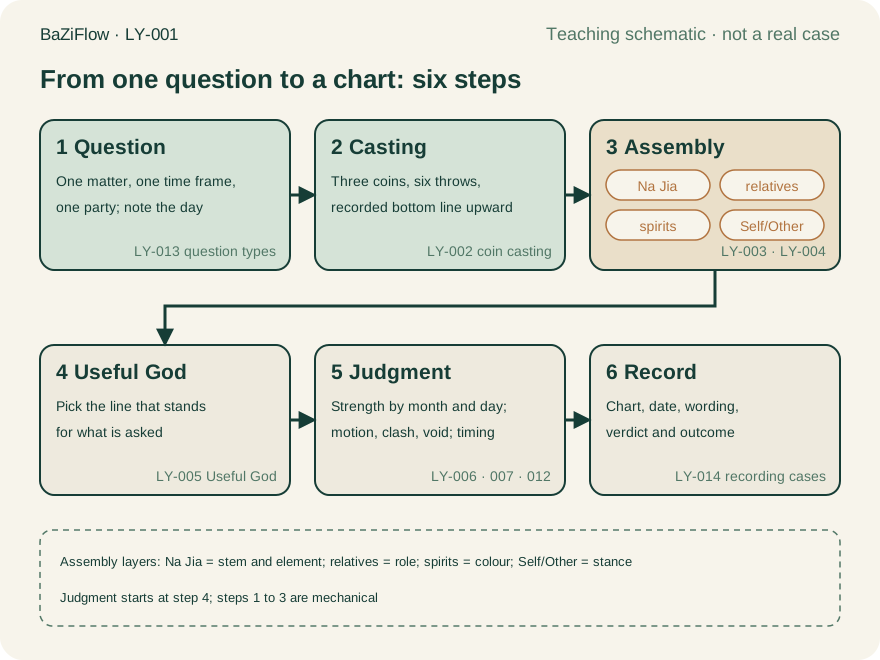 LY-001 / Liu Yao
What is Liu Yao? From a single question to an assembled hexagram chart
Separate original casting results, chart labels and interpretation. Use named chapters of Zeng Shan Bu Yi to trace each label and preserve a question whose outcome can be checked.
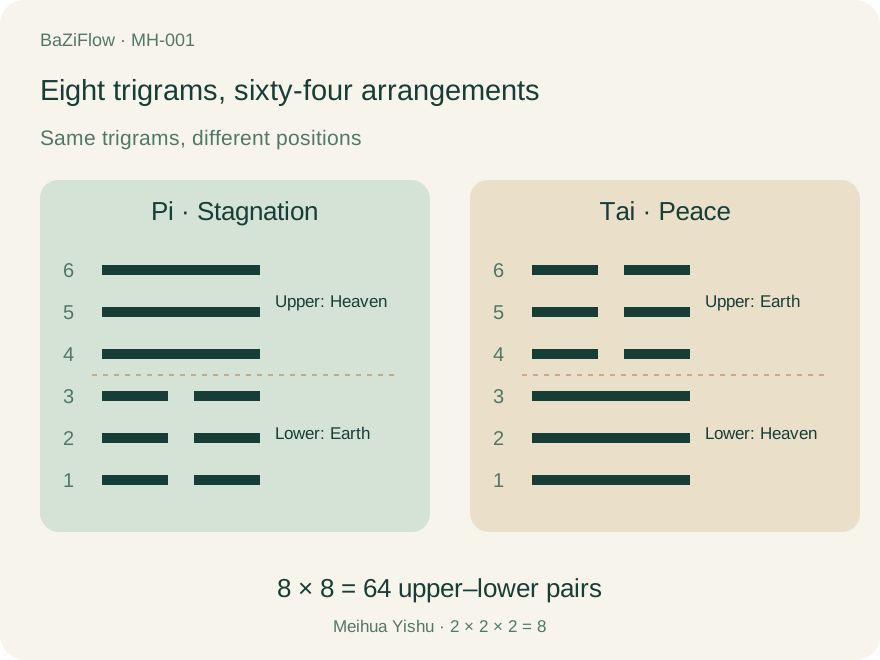 MH-001 / Meihua Yishu
Meihua Yishu: from eight trigrams to sixty-four hexagrams
Build the eight trigrams and compare Pi with Tai, then distinguish Meihua casting numbers, line changes and interpretation from the structure of a figure itself.
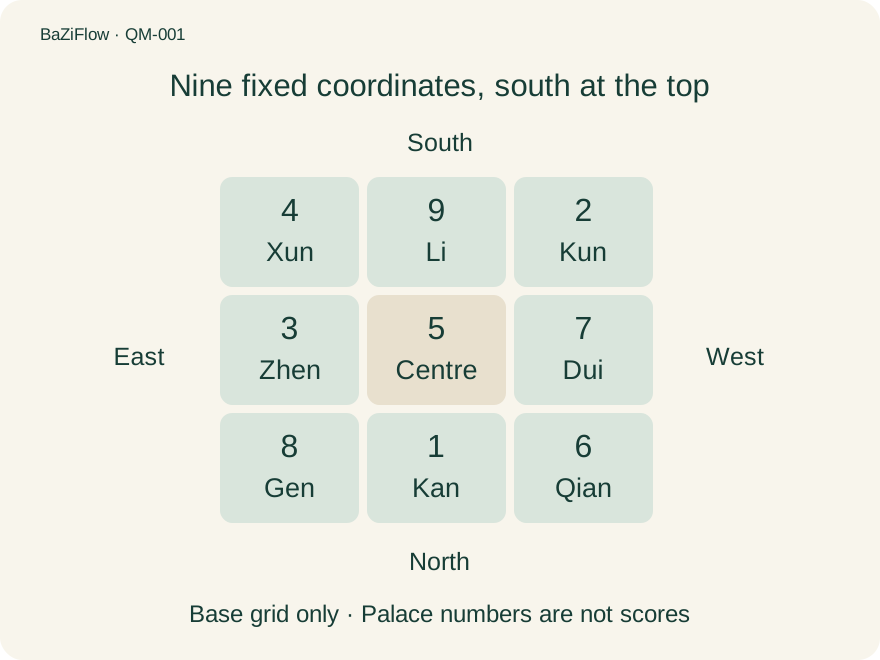 QM-001 / Qimen Dunjia
Meet the Nine Palaces Before Reading a Qimen Chart
Learn the numbered grid, its south-up orientation and the distinction between a palace and the symbols placed there. Named classical examples show why the time label alone is not a complete chart.
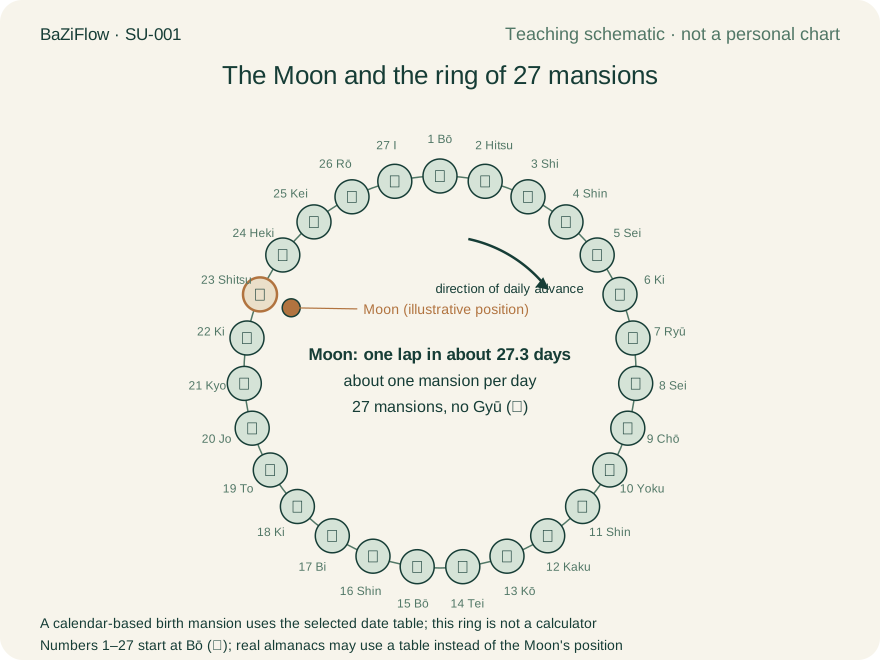 SU-001 / Sukuyō astrology
What is Sukuyō astrology? How a birth mansion is found
What Sukuyō astrology is and how a birth mansion is found: distinguish a measured Moon position from a calendar-assigned mansion. Compare sources, a month-table example and the settings needed to reproduce a result.
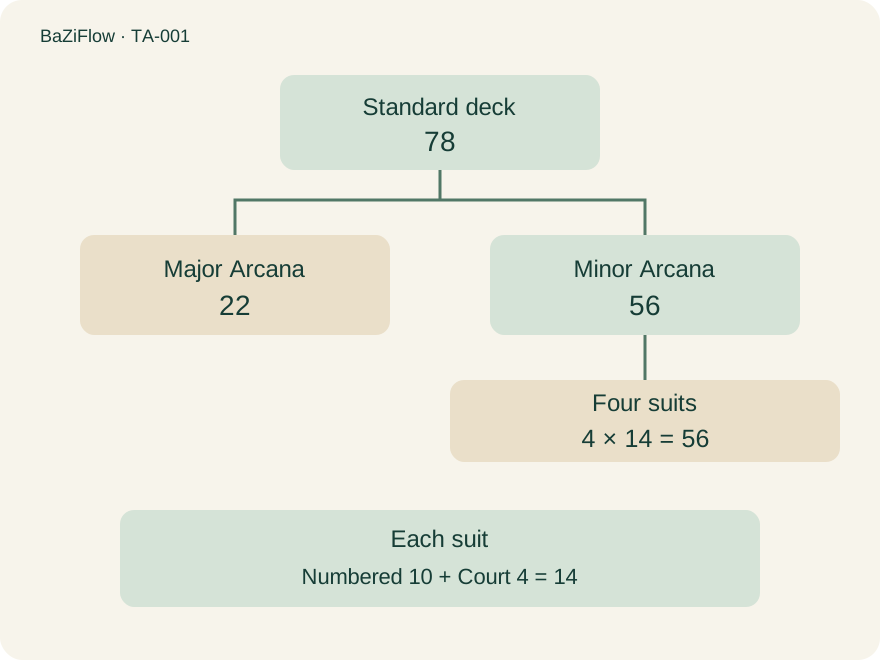 TA-001 / Tarot
The structure of a tarot deck: 22 cards and four suits
Map a standard 78-card deck before memorising meanings. Separate Major and Minor Arcana, court ranks, historical evidence and the conventions of a particular reading method.
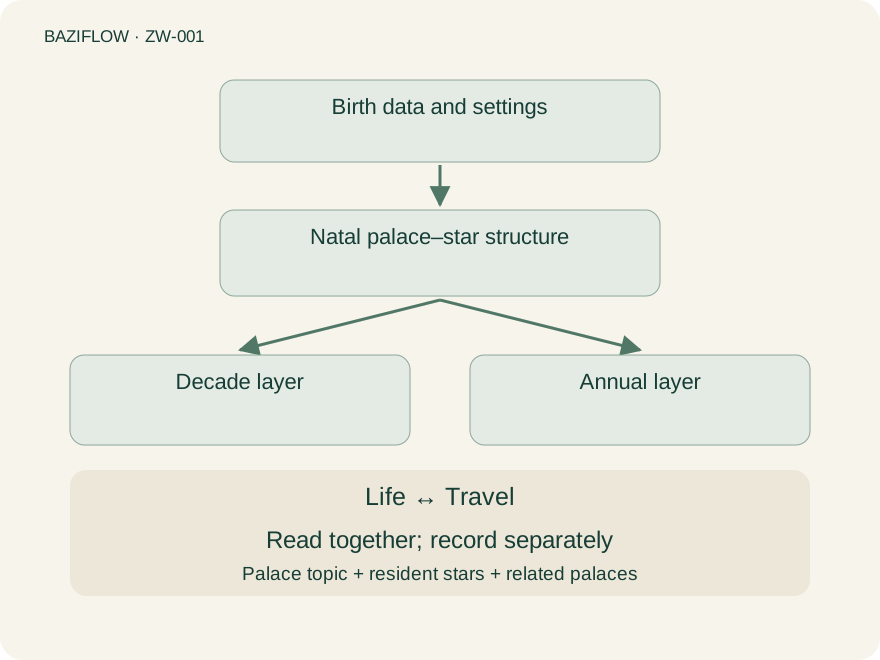 ZW-001 / Zi Wei Dou Shu
What is Zi Wei Dou Shu? Read the palaces, stars and timing layers
Understand the structure of a Zi Wei chart before looking up star descriptions: inputs, palaces, symbolic stars and timing layers.
 ZW-019 / Zi Wei Dou Shu
What a Monthly Ziwei Chart Can—and Cannot—Tell You
Define the month before reading its chart. A verified 2026 calendar example shows why lunar and Gregorian boundaries differ, followed by a practical way to compare observations without hindsight.
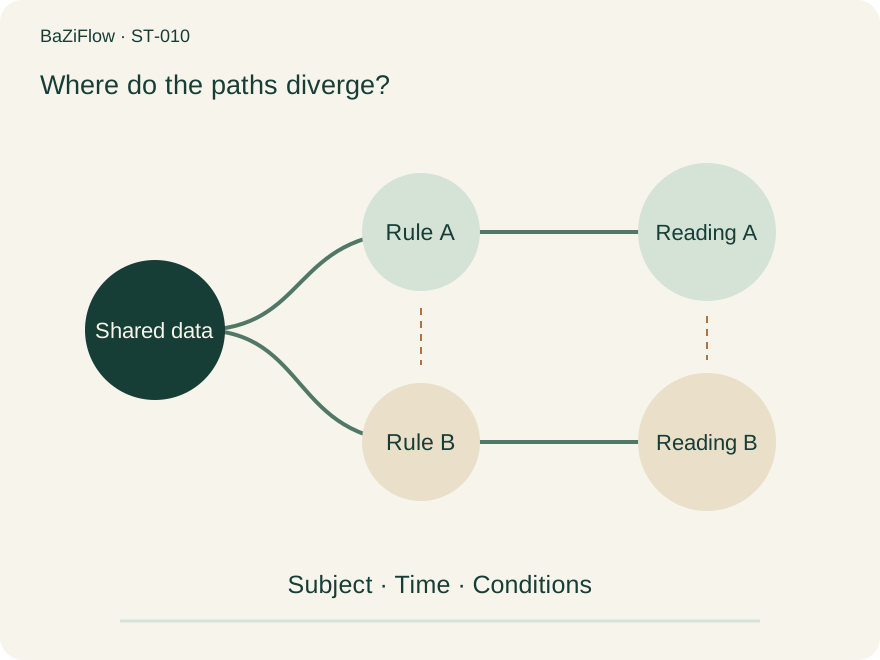 ST-010 / Cross-system studies
When Readings Disagree, Locate the First Divergence
Treat a disagreement as a traceable comparison: align the subject and interval, then inspect inputs, rules, fields and interpretation before trying to reconcile the final sentence.
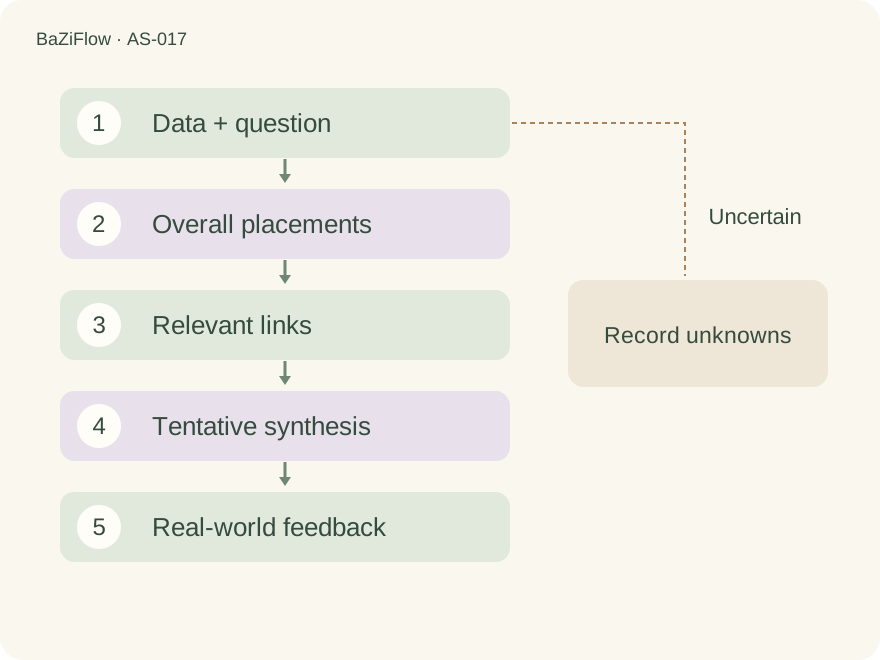 AS-017 / Western astrology
A whole-chart reading needs an evidence trail
Organise a reading around a question, a reliable chart inventory and a small set of relevant relationships. Use a partial worked record to distinguish synthesis from repeated labels and unverified biography.
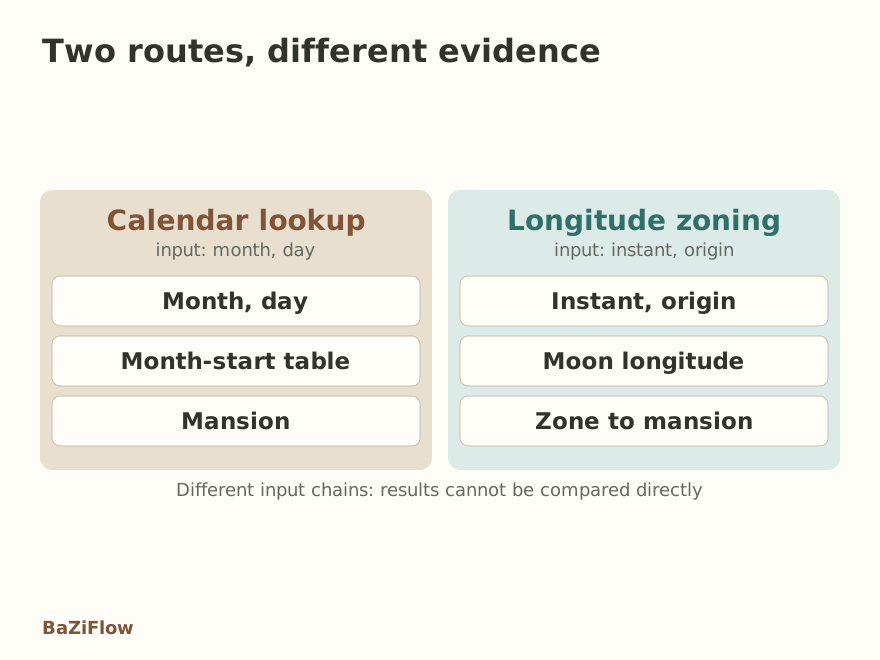 SU-003 / Sukuyō astrology
Why do Sukuyō Natal Mansion results differ? Tell lookup from zoning, then check the rule
Why two websites give different natal mansions: first see whether each uses a month-and-day table or Moon-longitude zones. A 799/800 arcminute exercise, two sources and a check sheet find the first step that differs.
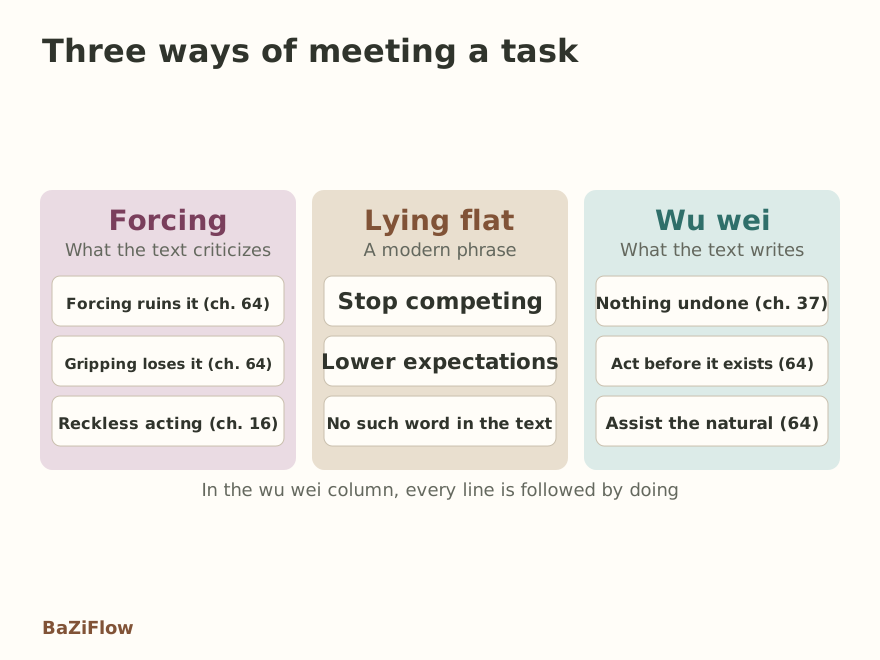 DA-003 / Daoist thought
Wu Wei: Why It Is Not Doing Nothing, Read Through Chapters 2, 48, 57 and 64
A three-column comparison, the "loss on loss" chain of chapter 48 and the three moves of chapter 64 read wu wei: the text writes "nothing left undone", and "lying flat" is a modern borrowing.
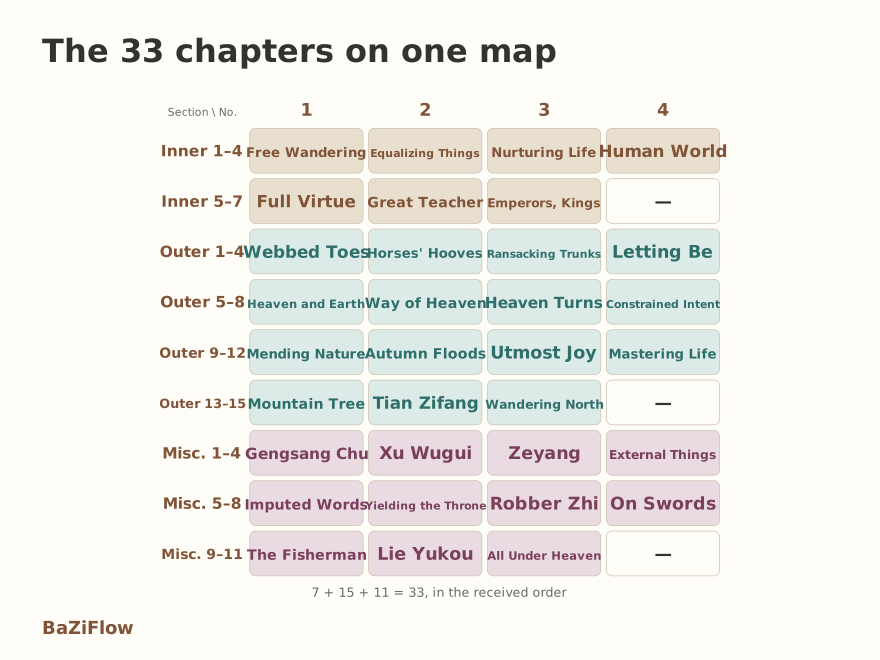 DA-007 / Daoist thought
The Zhuangzi: Inner, Outer and Miscellaneous Chapters, Mapped
A map of the 33 received chapters separates the inner, outer and miscellaneous sections, then uses "Autumn Floods" and "All Under Heaven" to show how the book speaks of Zhuang Zhou.
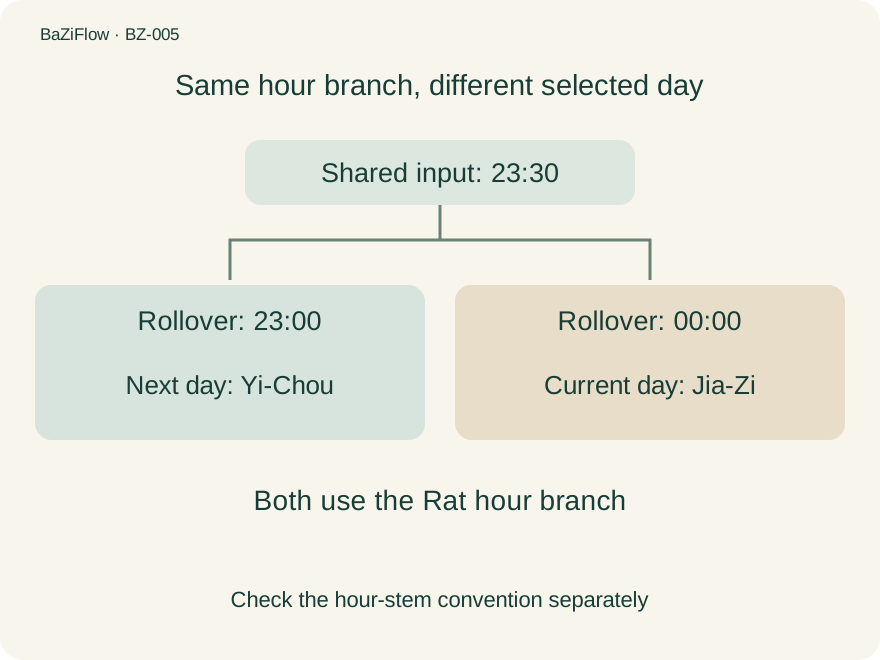 BZ-005 / BaZi
Zi-hour day boundaries: decide the hour branch, day pillar and hour stem separately
Compare 23:00 and midnight day boundaries on one timeline, then use Yang Wood and Yin Wood days to explain why late-Zi hour stems need a separate convention.
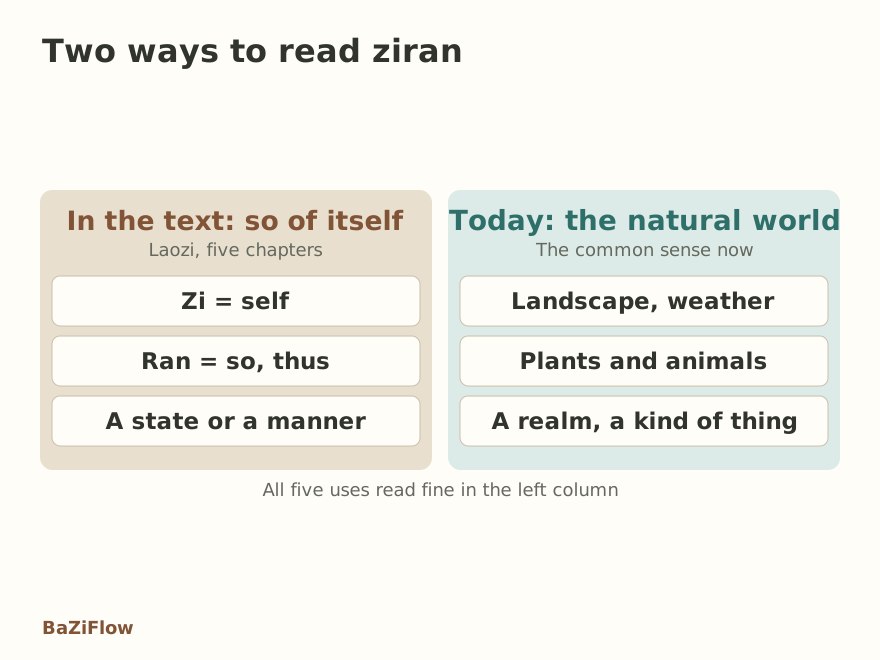 DA-004 / Daoist thought
Ziran: Read It as "So of Itself" First, Then Talk About Landscape
Five passages in the Laozi use ziran. Substituting "so of itself" and "the natural world" into each line, then comparing the Zhuangzi, separates what the text says, how tradition reads it and what modern speech borrows.
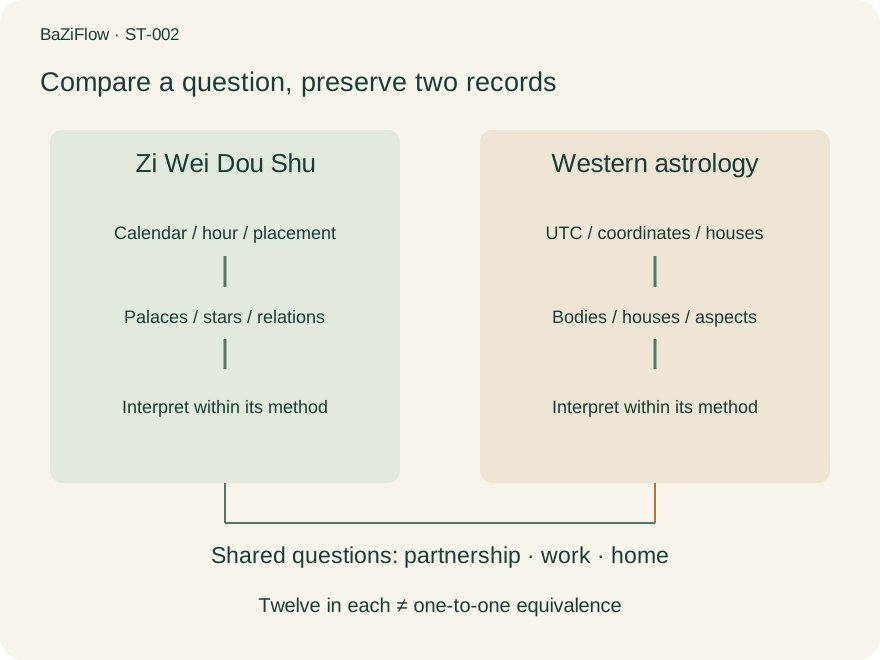 ST-002 / Cross-system studies
Ziwei Palaces and Astrological Houses: Twelve Regions, Different Methods
Distinguish rule-based palace placement from local-sky divisions, then align relationship, work and home questions without converting names or chart objects.
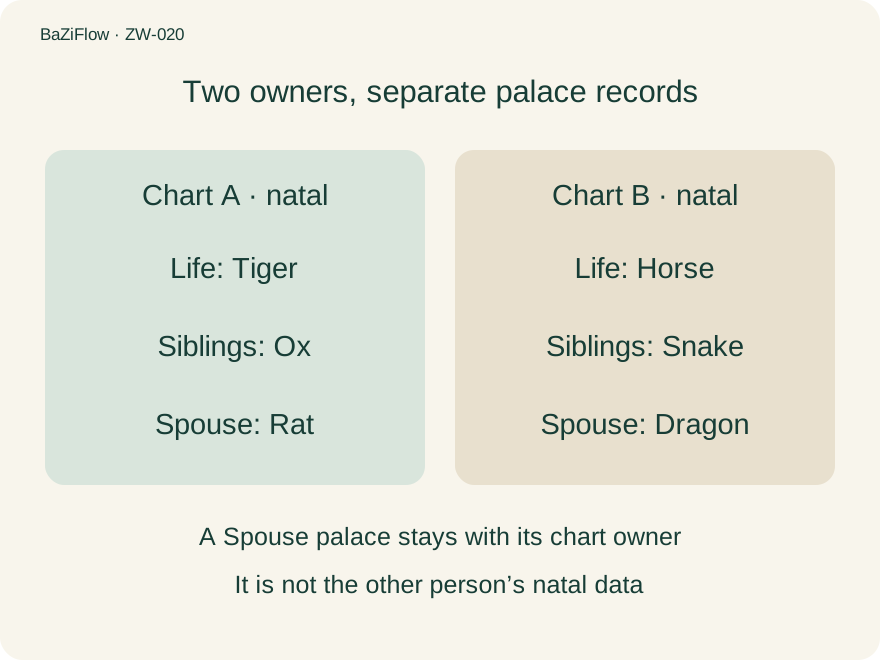 ZW-020 / Zi Wei Dou Shu
Ziwei Compatibility Beyond Matching Two Major Stars
Keep two people and two charts distinct when exploring compatibility. A palace-order example shows why one person’s Spouse palace is not the other person’s natal data.
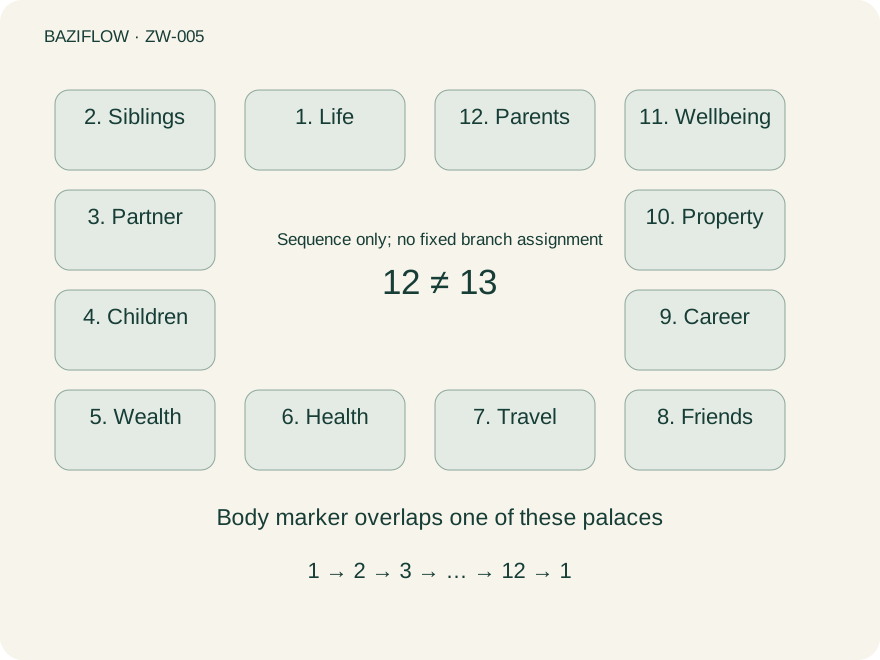 ZW-005 / Zi Wei Dou Shu
The twelve Zi Wei palaces: a map of questions
Learn the twelve palace names, their scope and how to turn a broad life question into a disciplined chart-reading exercise.
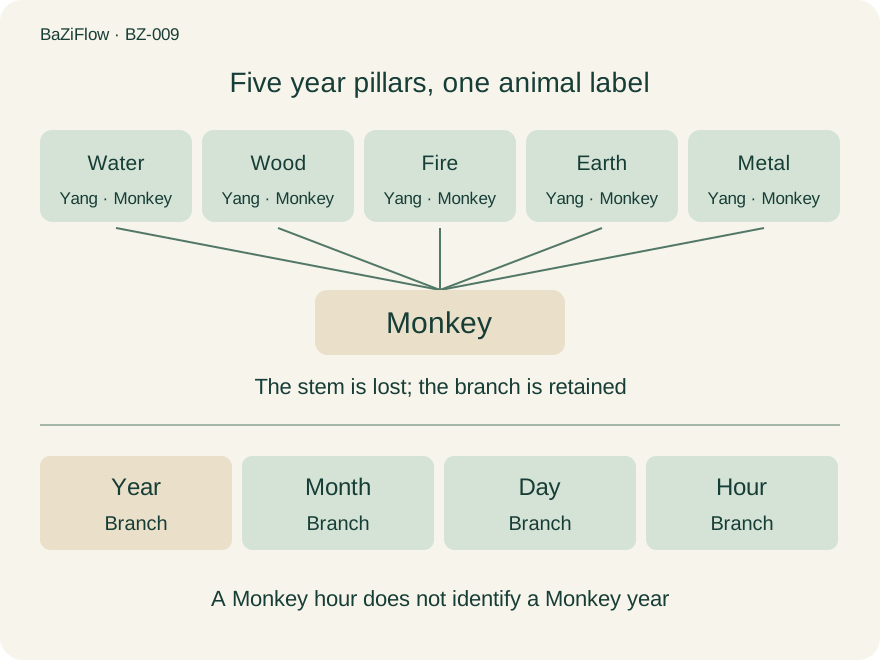 BZ-009 / BaZi
Zodiac animals and branches: what one animal label leaves out
Use the twelve-animal ring and five Monkey-year pillars to understand a compressed label, distinguish pillar positions and separate twelve- and sixty-step cycles.