

Monthly Virtue: a stem found from the month branch
Content version · · Sources & references
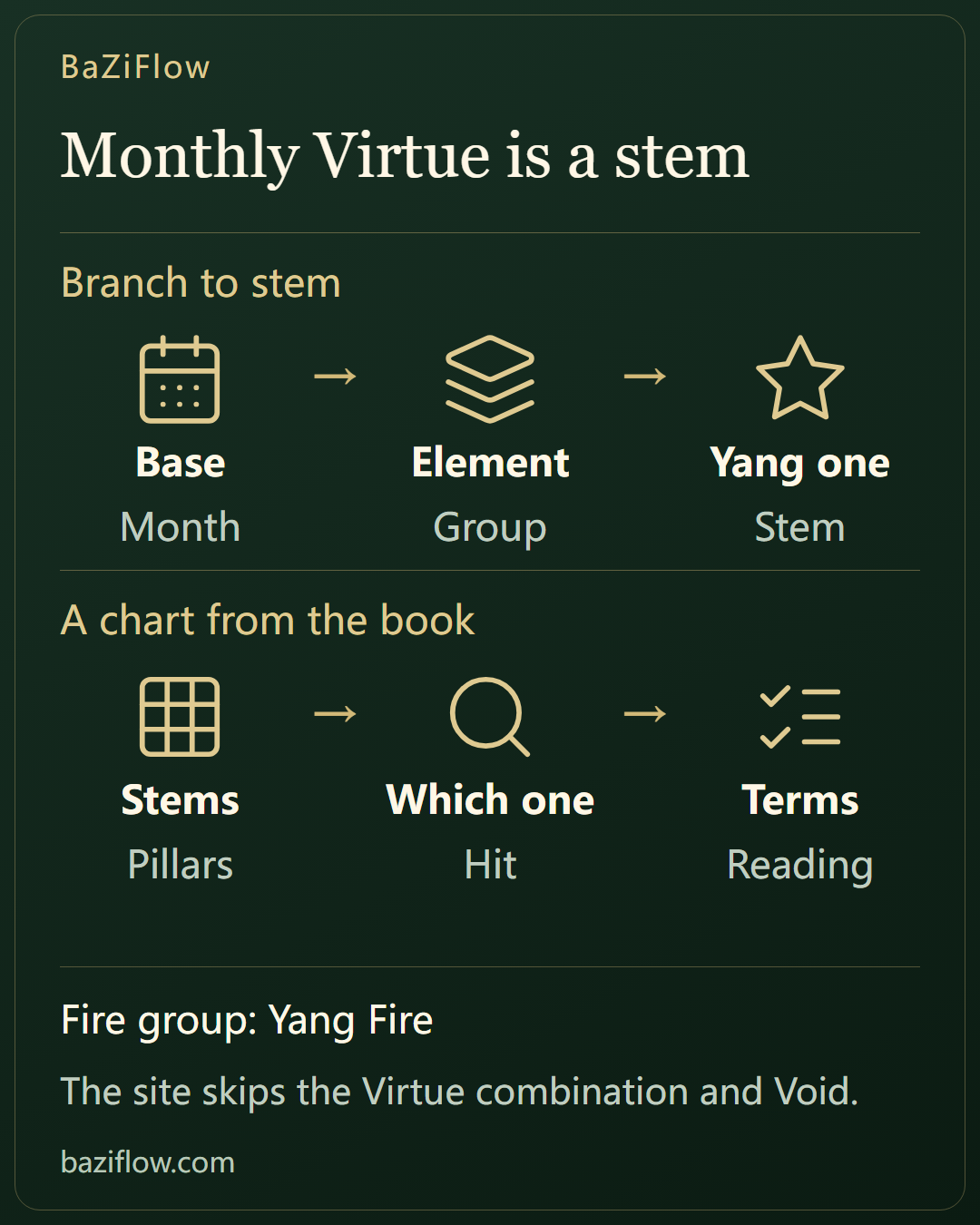
Monthly Virtue starts from the month branch, takes the Yang stem of its Three Harmony group and looks for it among the four stems. A table, two classical explanations and the book's own two charts add its conditions.
The short version9 min read
Monthly Virtue only ever lands on a stem. The month branch fixes a Three Harmony group, the group's element gives one Yang stem out of four, and that stem is searched for among the stems of the year, month, day and hour pillars.
- Tiger, Horse and Dog months take Yang Fire; Monkey, Rat and Dragon months take Yang Water; Pig, Rabbit and Goat months take Yang Wood; Snake, Rooster and Ox months take Yang Metal.
- The books give two routes: the Sanming Tonghui speaks of where sun and moon meet and enter, and the Xieji Bianfang Shu quotes Cao Zhengui, who says each group takes the Yang stem of its own element. Both end at the same table.
- The month pillar's own stem can hit only in six months, the Yang branches Tiger, Dragon, Horse, Monkey, Dog and Rat, and each of those has just two possible year stems. Every other hit has to come from the year, day or hour stem.
Read first
Symbolic Stars in BaZi: Check the Reference and Rule Before the Meaning ↗
Start with the month branch, end on a stem
Monthly Virtue (月德贵人) is looked up in two steps. First see which Three Harmony group the month branch belongs to, then take the Yang stem of that group's element: Yang Fire for the Fire group, Yang Water for Water, Yang Wood for Wood, Yang Metal for Metal. After that, look for that stem among the stems of the four pillars.
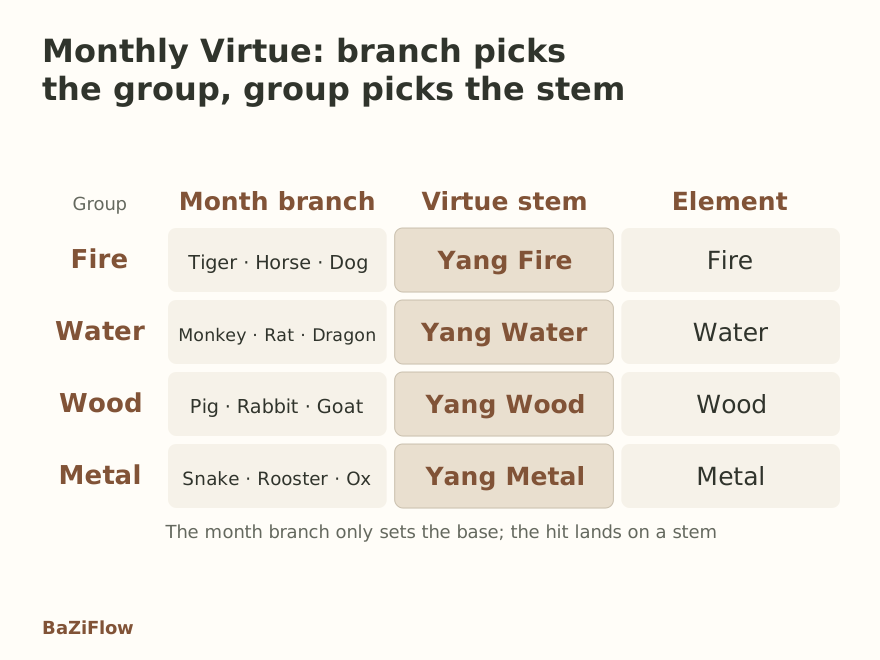
Look-up table: each of the four Three Harmony groups takes the Yang stem of its own element. The values were checked against the site's Monthly Virtue table; the hit is a stem and the month branch only sets the group.
The four rows are the four groups, and the three month branches in a row share one stem. A Tiger, Horse or Dog month looks for Yang Fire (丙); Monkey, Rat or Dragon looks for Yang Water (壬); Pig, Rabbit or Goat looks for Yang Wood (甲); Snake, Rooster or Ox looks for Yang Metal (庚). The search covers the stems of the year, month, day and hour pillars, and the site's engine counts the day pillar's own stem too.
Where Yang Fire, Water, Wood and Metal come from
Juan 3 of the Sanming Tonghui (三命通会), under the heading "On the Heavenly and Monthly Virtues", first says what a virtue is and then explains the monthly one:
The Monthly Virtue is the direction a Three Harmony group shines on, the spot where sun and moon meet. For Monkey, Rat and Dragon they meet at Rooster, come out at Yang Metal and enter their dwelling at Yang Water... so Yang Water, Yang Wood, Yang Fire and Yang Metal are called the Monthly Virtue.
The book treats a Three Harmony group as a bearing at which sun and moon meet: where they meet, which point they come out of, and which dwelling they enter. The stem of the dwelling entered is the Monthly Virtue. Laid out for all four groups:
Enlarge diagram · scroll sideways to read
The last column is exactly the four stems in the engine table. The Xieji Bianfang Shu (协纪辨方书), a Qing court handbook for choosing dates, approaches it differently in juan 5, quoting Cao Zhengui:
The Monthly Virtue is the Yang virtue within the month, which is why the stem is honored and the branch is lowly: a subject seeking the ruler's virtue. Take the Yang stem of the Three Harmony element as the virtue. Tiger, Horse and Dog make Fire, so Yang Fire is the virtue.
Two things are said here. The virtue sits on a stem because "the stem is honored and the branch is lowly", and each group takes the Yang stem of its own element. In the same juan the compilers add a note: the month is Yin and Yin has no virtue of its own, so it borrows the virtue of the Yang stems, which is why only the four Yang stems are used and the four Yin stems are not. One argument comes from the sky, the other from Yin and Yang, and they arrive at the same table.
Two charts from the book, checked with the engine
In juan 5 of the Sanming Tonghui, in the section on the Resource star, the author prints two charts to show a Resource sharing a position with the Heavenly and Monthly Virtues. They make good exercises. Chart one is Jia Yin, Bing Yin, Bing Yin, Ding You (甲寅 丙寅 丙寅 丁酉), and chart two is Geng Shen, Geng Chen, Geng Zi, Ren Wu (庚申 庚辰 庚子 壬午), each listed from the year pillar to the hour pillar.
Enlarge diagram · scroll sideways to read
For chart one the book says "Heavenly Virtue at Yin Fire, Monthly Virtue at Yang Fire", meaning the stems Yin Fire and Yang Fire. The Tiger month is in the Fire group, so the target is Yang Fire, and among the four stems (one Yang Wood, two Yang Fire and one Yin Fire) the month pillar and the day pillar each carry one.
For chart two the book says "Heavenly and Monthly Virtue both at Yang Water". The Dragon month is in the Water group, the target is Yang Water, and of the four stems (three Yang Metal, then Yang Water) only the hour stem is Yang Water. The engine returns the same results. The Yin Fire in chart one is the Heavenly Virtue, a different shensha.
One more detail can be read off the table. For the month pillar's own stem to hit, the month branch has to be one of the six Yang branches, because the month stem of a Yin branch is always a Yin stem, while all four Virtue stems are Yang. With the usual rule for month stems, each of those six months can produce a hit from only two year stems:
The six month pillars whose own stem is the Virtue
Bing Yin, in Yang Wood or Yin Earth years
The Virtue is Yang Fire. Chart one in the book is of this kind.
Ren Chen in Yang Fire or Yin Metal years; Ren Shen in Yang Wood or Yin Earth years
The Virtue is Yang Water in both, each with two possible year stems.
Bing Wu in Yin Fire or Yang Water years; Bing Xu in Yin Wood or Yang Metal years; Ren Zi in Yin Fire or Yang Water years
In the six Yin-branch months the month stem is a Yin stem and never hits, so any hit must come from the year, day or hour stem.
One name in three places
The Sanming Tonghui puts "the Heavenly and Monthly Virtues" in a single entry, and both start from the month branch, so they are easy to mix up. The Xieji Bianfang Shu also has a Monthly Virtue of the same name, used for choosing dates.
Enlarge diagram · scroll sideways to read
The almanac writes it as "months 1, 5 and 9 at Yang Fire, months 2, 6 and 10 at Yang Wood, months 3, 7 and 11 at Yang Water, months 4, 8 and 12 at Yang Metal". Month 1 is the Tiger month, so this is the same table as the picture above. Heavenly Virtue is covered in its own article. It is used for choosing days, and the text says such days suit digging earth and building, feasting, and taking office. A chart reading uses the same table to ask a different question: do these four stems appear among the chart owner's four stems?
What the book requires, and two neighbors the site does not check
In the book, Monthly Virtue is not "present means done". The same entry sets conditions:
Where a chart carries ill-omened sha and gets these two virtues to support and dissolve them, the ill is not severe. It must be seen on the day, with the hour free of control, clash, punishment and destruction; then it is good.
The "two virtues" are the Heavenly and the Monthly. The book describes their role as supporting and dissolving the ill-omened sha in a chart, and hopes to see them on the day pillar, with the hour pillar not hit by control, clash, punishment or destruction. The site's table answers only whether it is there and on which pillar; "seen on the day" and "the hour not hit" are left to the chart as a whole. The site's word "buffer" is a modern shorthand for "the ill is not severe".
Both books also list two neighbors of the Monthly Virtue that the engine does not check. The Monthly Virtue combination pairs each virtue stem with its Five Combination partner: Yang Fire with Yin Metal in month 1, Yang Wood with Yin Earth in month 2, Yang Water with Yin Fire in month 3, Yang Metal with Yin Wood in month 4. The Monthly Void is the stem that clashes with the virtue: Yang Water for the Tiger-Horse-Dog months, Yang Metal for Pig-Rabbit-Goat, Yang Fire for Monkey-Rat-Dragon, Yang Wood for Snake-Rooster-Ox.
Enlarge diagram · scroll sideways to read
If another program marks a "Virtue combination" or a "Monthly Void", the first question is which book and which table it follows. The Five Combinations themselves are explained in stem combinations, the origin of the Three Harmony groups in Six Harmony, Three Harmony and Directional, and the place of shensha in a whole chart in where shensha belong in a reading.
Questions readers ask next
My month branch is Pig and no other pillar has a Pig. Does that mean no Monthly Virtue?
The branch itself is never the target. Pig belongs to the Wood group, so the stem to find is Yang Wood. If one of the four stems is Yang Wood there is a hit; if none is, there is none, whatever the branches show.
Monthly Virtue and Heavenly Virtue both start from the month branch. What separates them?
Monthly Virtue lands only on one of four stems. Heavenly Virtue lands on a stem in some months and on a branch in others, one place for each of the twelve months. The book lists them in one entry and gives them similar reading conditions, but each has its own table.
If my chart has Monthly Virtue, will people help me and will trouble stop short of the worst?
The site describes it as a "buffer", which echoes the book's wording that it helps defuse trouble. The same passage attaches conditions: it should be seen on the day pillar, with the hour pillar free of clash and punishment. It is a supporting clue to read with the whole chart, not a guarantee.
Was this article helpful?
Sources & references
Continue reading
Heavenly Virtue (天德贵人): One Character from the Month Branch ↗