

The Property palace: inherited, self-made, four patterns
Content version · · Sources & references
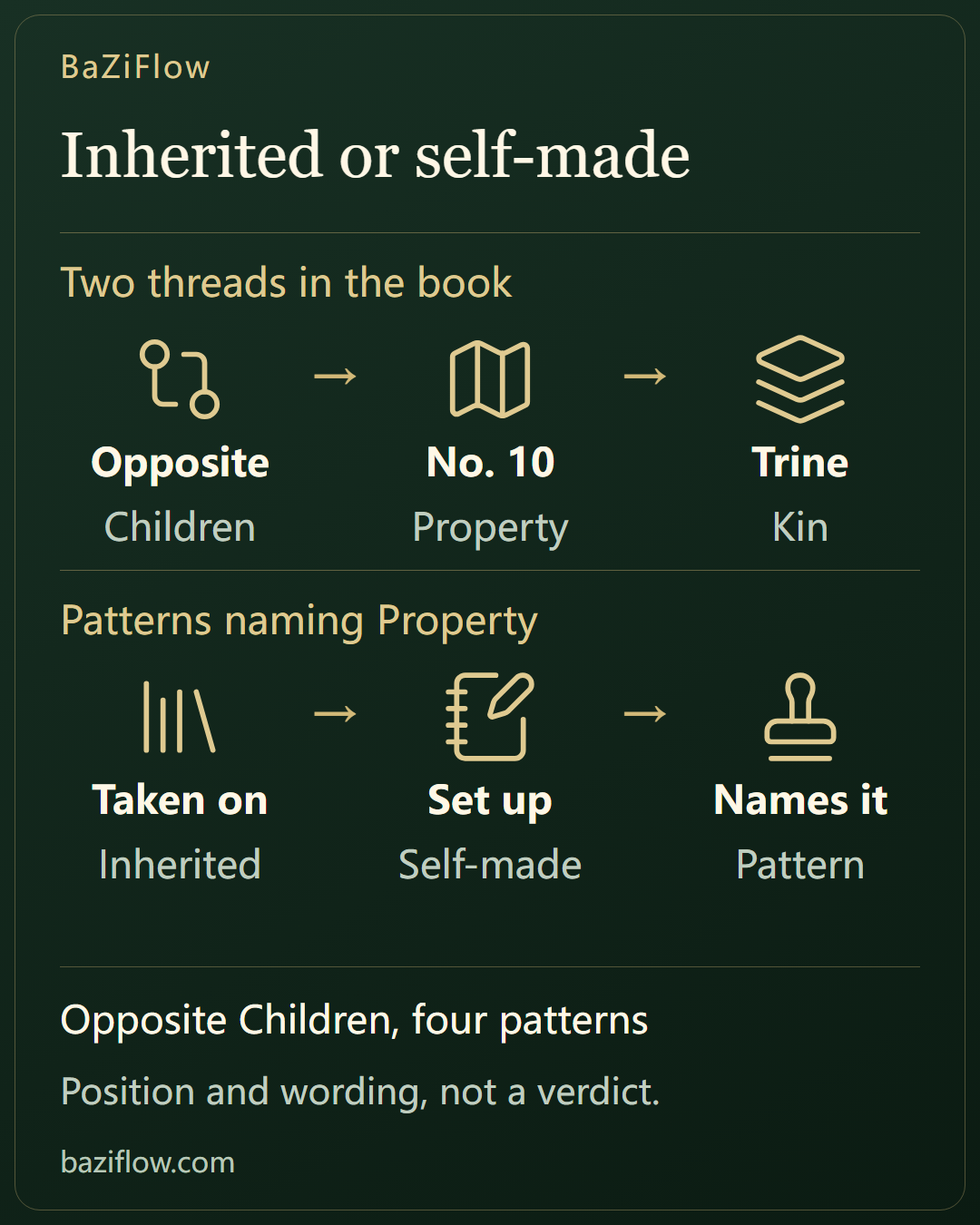
The Property palace is the tenth of twelve, opposite Children. Count the inherited and self-made words in juan 2, read the four patterns that name it, and check Sun and Moon grades at the four storehouse branches.
The short version7 min read
The Property palace (田宅宫) is the tenth of the twelve, with the Children palace opposite; juan 2 of the Zi Wei Dou Shu Quan Shu writes it in two threads, the ancestral estate and what a person sets up alone, and juan 1 has four named patterns that mention this palace.
- Property is no. 10, its opposite is Children (no. 4), its trine palaces are Siblings (no. 2) and Health (no. 6), and its neighbors are Career and Wellbeing.
- In the 21 star entries of the juan 2 Property section, "ancestral estate" occurs 15 times, "gives up the estate" 10, "self-made" 9 and "none at all" 8: the main line is where holdings come from, inherited or acquired by oneself.
- Of the six "wealth patterns" in juan 1, three name the Property palace, and the "noble patterns" add one more. "Sun and Moon Shine on the Jade" wants both in Property at a storehouse branch, so the Miao-Wang table can check the four positions.
Read first
Field and house, tenth place
Take the name apart first: "field" is farmland and "house" is a dwelling. The palace stands tenth in the twelve, and this site reads it as home, residence and the property setting.
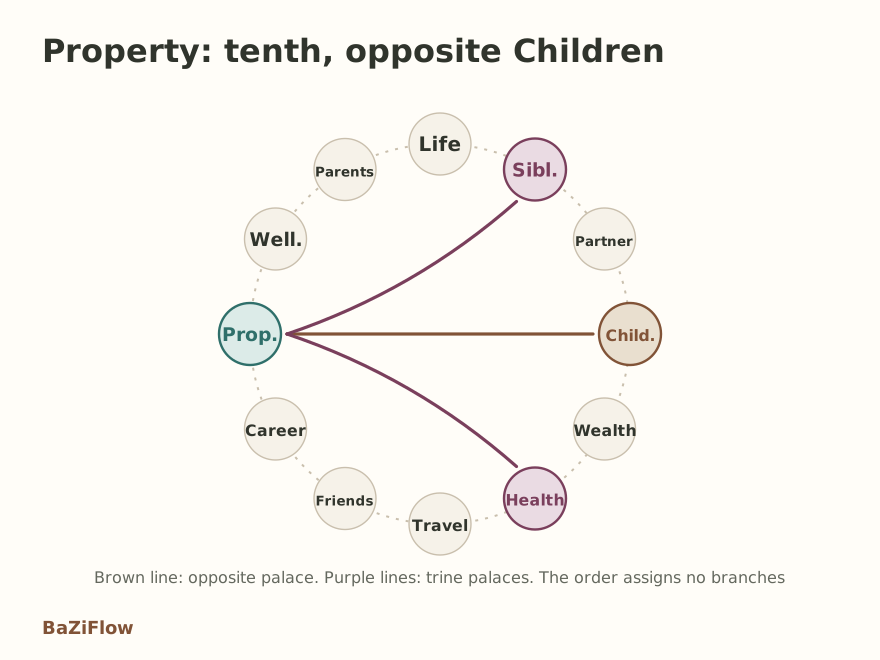
Property, tenth (green), faces Children (brown) and has its trine on Siblings and Health (purple); Career and Wellbeing on either side are where "flanking" looks.
Tenth on the ring, the Property palace faces the Children palace (no. 4) across the circle, and the Siblings palace (no. 2) and the Health palace (no. 6) sit four steps off on either hand. Those four make its set of four directions. Right beside it are Career (no. 9) and Wellbeing (no. 11), which matter once flanking comes up.
Inherited, or made alone
The Property section of juan 2 has 23 paragraphs covering 21 stars (Wu Qu takes two) and closing on the Dou Jun (斗君); each star entry says whether holdings come down from the ancestors or are set up by the person once this star sits in the palace. Here are counts of several words side by side:
Enlarge diagram · scroll sideways to read
The main line of the section is origin: some stars take on the ancestral estate, some leave it and set up anew, and some in a fall with malefics yield none at all. A single entry often runs several together, as Tian Ji's "gives up the estate, sets up anew" and Tian Tong's "few first, many later, self-made" both show a sequence. Reading this palace begins with telling which thread the book is writing, then looking at the other stars in the palace.
Four patterns that name Property
Besides the star-by-star entries of juan 2, juan 1 keeps a list of patterns sorted into "wealth patterns" and "noble patterns." Four of them name the Property palace:
Enlarge diagram · scroll sideways to read
Of the six "wealth patterns," three bear on the Property palace, and another, "Sun and Moon Flank Wealth," names the Wealth palace. In other words, half of the wealth patterns hang directly on Property. Juan 1 has a general line too:
Among the twelve palaces only Life and Body, Property and Wealth are the essential ones, bringing wealth.
The book here sets Property beside Life and Wealth as three "essential palaces." But it sits under the entry for the star Lu Cun and speaks of what happens when Lu Cun guards those palaces, so it cannot be taken as a rule for every chart.
Flanked into place: Wealth and Shelter Flank the Seal
The original line for this pattern reads:
Xiang guards Life, with Wu and Liang coming to flank it; Property likewise.
That is: Tian Xiang (天相) guards the Life palace with Wu Qu (武曲) and Tian Liang (天梁) sitting on either side to flank it, which makes Wealth and Shelter Flank the Seal; "likewise" for Property means putting Property in place of Life, so the flanking palaces become Career and Wellbeing. Worked through the placement rules, though, this layout never appears: Tian Liang is always one branch after Tian Xiang, so with Tian Xiang in Property it is fixed in Career, and Wu Qu always sits an even number of places from Tian Xiang, so it cannot reach Wellbeing. Across 1,296 iztro charts, Wu Qu and Tian Liang never flank Tian Xiang. The book does not explain how the line is meant to be met, so cite it together with that fact.
Enlarge diagram · scroll sideways to read
Flanking is a relation of adjacent positions, a different angle from opposite and trine; the differences are in opposite, flanking and converging palaces. Another wealth pattern, Shelter and Seal Arch the Body, uses a different relation: the body palace is in Property, and Tian Liang and Tian Xiang shine in from the trine and opposite positions. By the same geometry the two stars are always adjacent, so they cannot both stand on the trine and opposite positions of one palace either.
Sun and Moon on the Jade: at a storehouse branch
Of the four, the one best tested against a table is "Sun and Moon Shine on the Jade":
Sun and Moon on the Jade: the Sun and Moon stand in the Property palace, and prefer a storehouse position.
In Zi Wei Dou Shu the "storehouse" positions are usually the Dragon, Dog, Ox and Goat branches. Juan 2 has a Miao-Wang table of each star's grade on the twelve branches; here are Tai Yang and Tai Yin at those four:
Enlarge diagram · scroll sideways to read
The table shows that "prefer a storehouse position" does not mean the Sun and Moon are bright at all four. The Sun is strongest on Dragon and not at ease on Ox and Dog; the Moon is brightest on Ox and fallen on Dragon. The book says only "prefer a storehouse"; it does not say the four storehouses are equally bright, so the position condition has to be checked against the brightness table.
Find Property, then count its four directions
Property is no. 10, its opposite is Children, its trine palaces are Siblings and Health, and its neighbors are Career and Wellbeing.
Tell inherited from self-made
The main line is the source of holdings; note which word each entry uses, then the stars and malefics that share the palace.
Check position conditions before citing a pattern
Flanking needs adjacency, arching needs trine, opposing needs the opposite palace, a storehouse needs a branch. If the condition fails, do not cite it.
Work it out, look it up
Tai Yang and the Property palace both fall on Dragon. What grade does the table give, and where is Life then?
The table gives Tai Yang on Dragon as strong. Property is on Dragon, so Life is nine places on from it, on Ox.
Moon Born from the Sea needs the Moon on Rat guarding Property. Where is Life then?
Life is on Rooster. Property is on Rat and the palaces run backward along the branches, so Life lies nine places on from Property. In the table Tai Yin on Rat is exactly bright.
Each neighbor has its own article: Career and Wellbeing. How the four directions are taken is set out in the three sides and four directions.
Questions readers ask next
Does the Property palace say whether I will own a house?
It is not a count of houses. "Field" in the name means farmland and "house" means a dwelling; this site reads the palace as home, residence and the property setting, which is wider than owning. The book's main line is "ancestral" and "self-made," asking where holdings come from and go, and no sentence counts houses for anyone.
Does "gives up the ancestral estate" mean the family fortune is sure to fail?
No. It is the book's wording; literally it means leaving the ancestral holdings and not keeping them, opposite to "keeping" or "receiving" them, and it often appears next to "self-made" or "newly set up." It describes the arrangement of the star in that entry and needs the co-resident stars and malefics to be read; it is not a verdict on a person.
Why are Property and Children opposite palaces?
In the palace order they are six places apart: Property is no. 10 and Children is no. 4. Opposition is a relation of position, and the book does not merge the two palaces for it; it only means that Children also stands within the same four directions when Property is read.
Was this article helpful?
Sources & references
Continue reading
The Career Palace in Zi Wei Dou Shu: What "Office" Meant in the Book, and Today ↗
The Wellbeing Palace in Zi Wei Dou Shu: Toil, Ease, and Five "Look First" Lists ↗