

Extended Net: two stars and a Vajra Peak day
Content version · · Sources & references
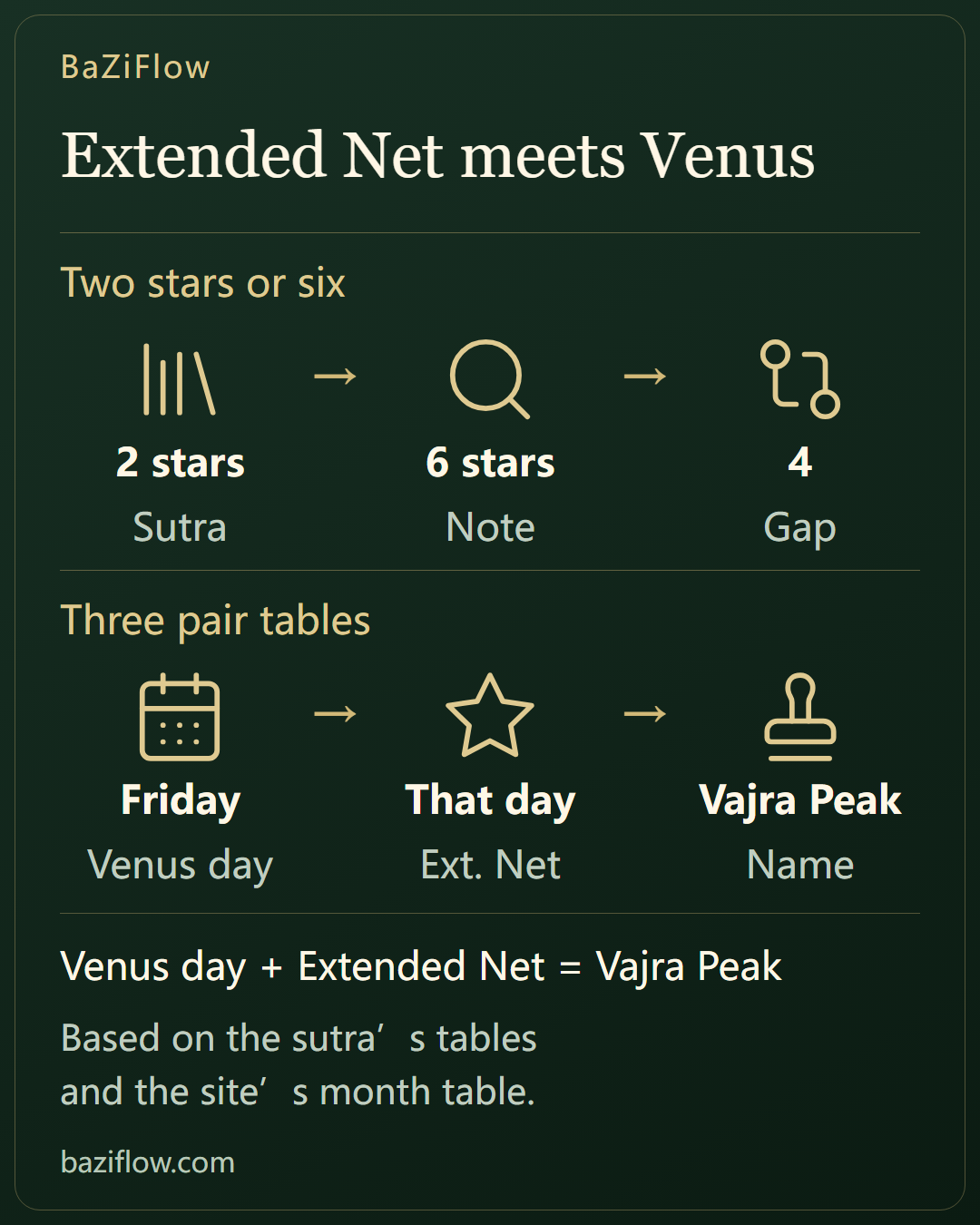
Extended Net (张) is position 9 on the site’s 27-mansion ring. Its two-star picture against the note’s six, its place in the sutra’s three weekday tables, and which 2026 days fall on both it and a Friday.
The short version8 min read
Extended Net (张) is position 9 on the site’s 27-mansion ring, between Star and Wings. The Sukuyō Sutra draws it with two stars and pairs it with the Venus day as a Vajra Peak day.
- Extended Net is the first-day mansion of month 7 in the Japanese old calendar (new moon fixed by Tokyo time), so days 1 and 28 both fall on it. On the ring it is 9th, and in the house table it takes four whole feet in the middle of the Lion house.
- The sutra’s picture gives it two stars and the commentator’s note gives six, a gap of 4. Set beside the seven mansions from Star to Root, only Horn and Root have matching counts.
- Three tables of luminary and mansion pairs hold 21 pairs and use only 18 mansions. Extended Net appears once, with the Venus day, as a Vajra Peak day; the site’s month table matches it only on July 17 in 2026.
Read first
What is Sukuyō astrology? How a birth mansion is found ↗
Sukuyō 27 mansions vs the 28 lunar mansions: what is the difference? ↗
Position 9 on the ring, and the first day of month 7
When Venus rules the day and the day’s mansion is Extended Net (张), the Sukuyō Sutra gives that day a name of its own: a Vajra Peak day. The mansion itself is position 9 on the site’s ring of 27, with Star (星) before it and Wings (翼) after it.
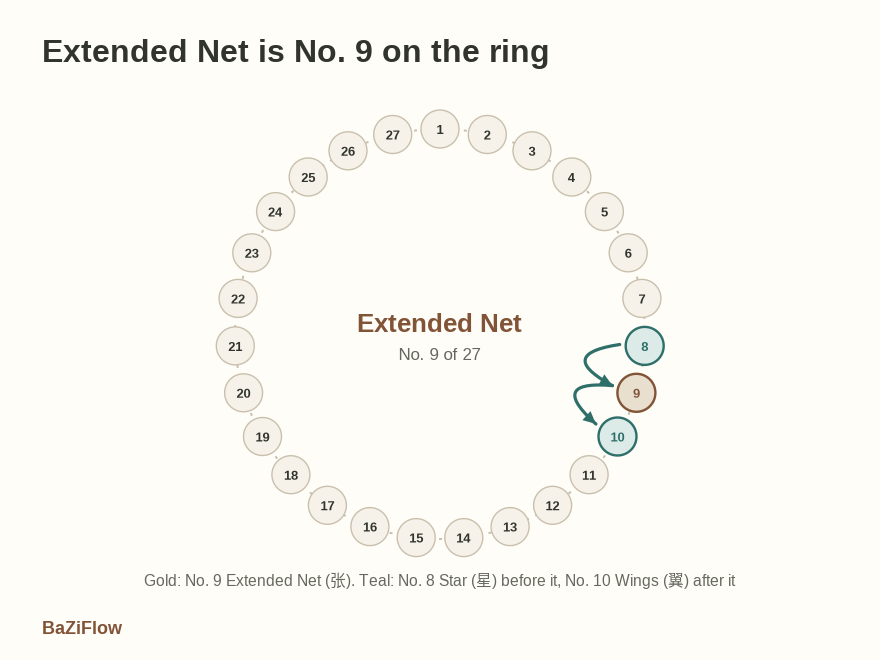
Gold Extended Net at position 9, flanked by Star and Wings; in the site’s month table it is the first-day mansion of month 7.
Gold marks Extended Net and teal its neighbors, Star and Wings. Behind the picture the commentator Yang Jingfeng marks it a “mansion of the south”, one of a group of seven in which it ranks fifth.
The site finds mansions with the NAOJ month-start table, and Extended Net happens to be the first-day mansion of old-calendar month 7. Day 1 is Extended Net, and after 27 steps the count comes back to it, so day 28 is Extended Net as well. A month of 29 or 30 days is longer than the 27-place ring, so the mansion that opens a month has two or three days left over to come round again at the end.
Enlarge diagram · scroll sideways to read
Two stars or six: the second-widest gap among the nearby seven
Every mansion gets a short “picture” entry in the sutra’s chapter on day-mansions. The Extended Net entry opens with:
Extended Net has two stars, shaped like a pestle. It is the god Vasu (婆薮).
A pestle is the wooden club used to pound grain, and the sutra uses it as a likeness of shape. After the picture comes a sentence added by Yang Jingfeng:
In Chinese astronomy, Extended Net has six stars; it belongs to the south.
Two layers of text on one page, one saying two and the other six. Put the two numbers of the seven mansions from Star to Root side by side and you can see where Extended Net stands.
Enlarge diagram · scroll sideways to read
Of the seven rows only Horn (角) and Root (氐) agree. Extended Net differs by 4, second only to Wings with 20, and Chariot is the one row where the sutra text counts more than the note. At the Hairy Head entry Jingfeng explained that the sutra often gives star numbers Chinese astronomy does not, and he set the two beside each other (see Hairy Head); the gaps are not copying slips. This article does not judge which number is right.
Three tables pairing a luminary with a mansion
The sutra’s seven luminaries are the Sun, Moon, Mars, Mercury, Jupiter, Venus and Saturn, which take turns governing days in a seven-day week. At the end of the fifth chapter in fascicle 1 it lists three tables of seven pairs each: on a day governed by one luminary, the day’s mansion happens to be a particular mansion. The tables have names: Sweet Dew days, Vajra Peak days and Rakshasa days. Extended Net is in the Vajra Peak table:
… Well on a Jupiter day, Extended Net on a Venus day, Neck on a Saturn day. These seven days are called the Vajra Peak days.
“On a Venus day” means the Venus day governs. Fascicle 2, in its chapter on the luminaries’ days, copies the three tables out again, and the 21 pairs agree between the two places apart from a few miswritten characters.
Enlarge diagram · scroll sideways to read
The 21 pairs use only 18 mansions. Tail (尾), Willow and Ghost each appear twice, while Turtle Beak (觜), Horn, Winnowing Basket (箕), Dipper (斗), Girl (女), Emptiness (虚), Rooftop (危), Encampment (室) and Bond (娄) never appear. Extended Net appears once, as the Venus pair. After each table the sutra adds text on what the seven days suit; this article does not repeat it.
On the site’s month table, 2026 has only one such day
There are 14 days in 2026 that fall on Extended Net. Listing their weekdays, only one is a Venus day, a Friday:
| Gregorian date | Old calendar | Weekday |
|---|---|---|
| Jan 6 | Month 11, day 18 | Tue |
| Feb 3 | Month 12, day 16 | Tue |
| Mar 2 | Month 1, day 14 | Mon |
| Mar 30 | Month 2, day 12 | Mon |
| Apr 26 | Month 3, day 10 | Sun |
| May 24 | Month 4, day 8 | Sun |
| Jun 20 | Month 5, day 6 | Sat |
| Jul 17 | Month 6, day 4 | Fri |
| Aug 13 | Month 7, day 1 | Thu |
| Sep 9 | Month 7, day 28 | Wed |
| Oct 5 | Month 8, day 25 | Mon |
| Nov 2 | Month 9, day 23 | Mon |
| Nov 29 | Month 10, day 21 | Sun |
| Dec 26 | Month 11, day 18 | Sat |
Look twice at the 2 November row. Month 9, day 23 is 2 November in the Japanese calendar but 1 November (a Sunday) in the Chinese lunar one, since the two places put that autumn’s new moon on either side of midnight; the story is in the Star article. Applied to Chinese dates, the same table would put the Extended Net day on 1 November. The other thirteen days are the same under both.
The weekday steps back one place at a time. When Extended Net returns after 27 days, and 27 = 3 × 7 + 6, the weekday moves back one; after 28 days it stays; after 26 days it moves back two. A mansion therefore seldom stays on one weekday.
Enlarge diagram · scroll sideways to read
The count varies from year to year. On the same month table, 2025 has only September 19, while 2027 has March 19, April 16 and October 22. Counting all 21 pairs together, 2026 has 49 days that fall on one of the three kinds: 16 Sweet Dew days, 16 Vajra Peak days and 17 Rakshasa days.
Three small exercises
Which mansion is day 1 of old-calendar month 7?
The first-day mansion of month 7 is Extended Net, so it is Extended Net; one lap on, day 28 is again Extended Net.
July 17, 2026 is a Friday and old-calendar month 6, day 4. Which mansion?
Month 6 starts at Ghost; three steps on are Ghost, Willow, Star, Extended Net, so it is Extended Net. The Venus day meets it: a Vajra Peak day.
In “Extended Net on the Venus day”, which day does Venus mean?
The Venus day, the luminary that governs Fridays in the sutra’s week, and not the Metal of the five elements.
Before it is Star and after it Wings. For the difference between birth and daily mansions, see birth mansion versus daily mansion.
Questions readers ask next
What does “Extended Net on the Venus day” mean?
In the sutra the seven luminaries (Sun, Moon, Mars, Mercury, Jupiter, Venus, Saturn) take turns governing days in a seven-day week. This line says that when Venus governs the day and the day’s mansion is Extended Net, the day has a name of its own, a Vajra Peak day. The Venus day is the Friday of the week.
I was born on day 1 of old-calendar month 7. Is my birth mansion necessarily Extended Net?
In the NAOJ month-start table the site uses, yes, since month 7 begins at Extended Net. A different table, or a different way of fixing the new moon, may give another mansion for the same day. Record which table was used before discussing the result.
Is the site’s “Extended Net meets Friday” the same thing as the sutra’s?
Not exactly. The sutra fixes the day’s mansion by where the Moon stands, while the site’s mansion is a name worked out from the month-start table and the old-calendar day. So the site’s match is a date correspondence on that table and says nothing about the Moon’s actual position.
Was this article helpful?
Sources & references
Continue reading
Star (星): Where the Twelve-House Table Begins, and the Sutra’s Six Stars ↗
Wings (翼): Two Stars or Twenty-Two, Among the Side-by-Side Mansions ↗