
Five Elements cycles: learn the relationships, not just the order
Content version · · Sources & references
Rebuild the generating and controlling cycles from one diagram, read them as directions rather than verdicts, and practise the five positions relative to a reference element.
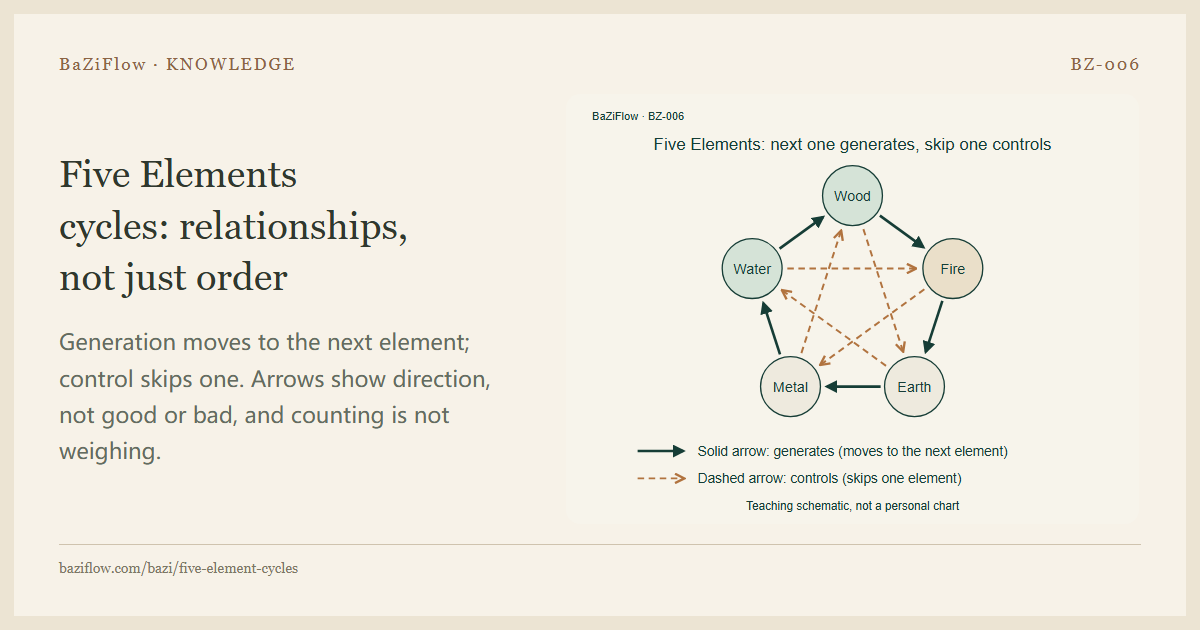
Generation moves to the next element; control skips one. Arrows show direction, not good or bad, and counting is not weighing.
Try the five-dot test
Put five dots on a circle and label them, clockwise, Wood, Fire, Earth, Metal and Water. Join each dot to its neighbour with a solid arrow: that is the generating cycle (相生), in which Wood generates Fire, Fire generates Earth, Earth generates Metal, Metal generates Water and Water generates Wood. Now skip one neighbour and draw a dashed arrow to the dot after it. That is the controlling cycle (相克): Wood controls Earth, Earth controls Water, Water controls Fire, Fire controls Metal and Metal controls Wood.
The rule fits in one line: generation moves to the next element; control skips one. Rebuild the circle and you never need to memorise ten sentences.
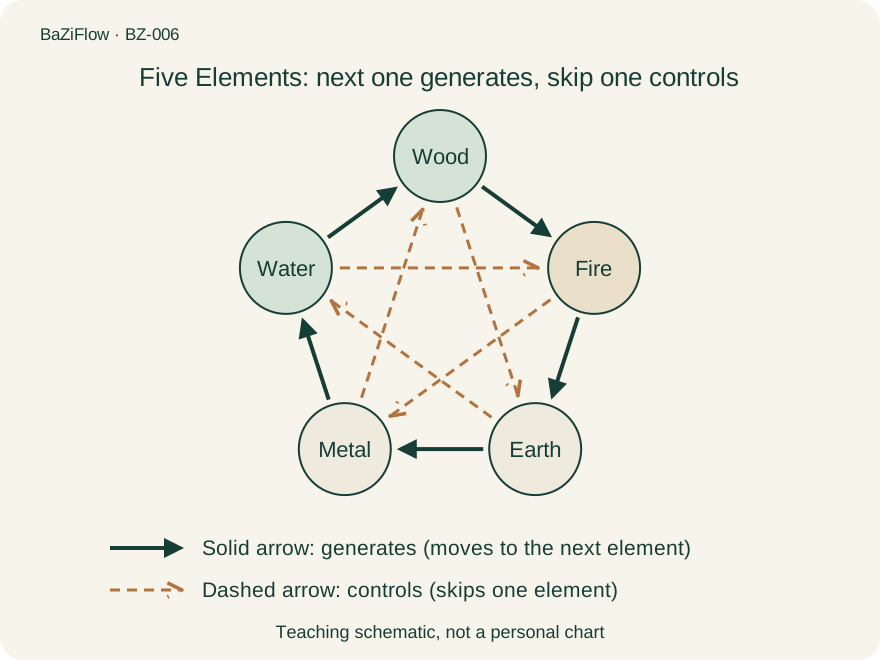
Original BaZiFlow teaching diagram; a schematic of relationships, not a personal chart.
The figure checks itself, too. Each element generates one, is generated by one, controls one and is controlled by one. If your notes show an element controlling two others, something was copied wrong.
Arrows have direction, not moral value
"Generates" means one element supports another; "controls" means one restrains another. "Water controls Fire" is not the same statement as "Fire controls Water", so always write the subject and the object.
Neither arrow is a grade. The generated element receives support while the generating element spends something; the controlled element is restrained, yet traditional texts also treat restraint as a check on excess. The Ming-era Sanming Tonghui (San Ming Tong Hui) presents the two cycles as two ways of moving through one loop. Whether a relationship helps or hinders in a chart depends on the whole structure; the diagram only shows which element acts on which.
Practice: take Fire as the reference point
No birth data is needed. Make one element "self" and the other four fall into four distinct positions. With Fire as self:
- produces self: Wood
- produced by self: Earth
- controls self: Water
- controlled by self: Metal
- same as self: Fire
Try Metal as self; in the same order you should get Earth, Water, Fire, Wood and Metal.
In BaZi, "self" is the Day Master, and adding yin and yang splits these positions into the Ten Gods (十神), a topic for its own article. They name relationships, not personality types: "controls self" does not mean someone is working against you.
Draining, exhausting, overacting, insulting
Texts often contrast support with three pressures: control from the element that controls self; draining (泄), the outflow when self generates another; and exhausting (耗), usually the effort self spends controlling another. Definitions of exhausting vary, so check your author's.
Overacting (乘) and insulting (侮) come mainly from classical medicine. A Suwen chapter in the Yellow Emperor's Inner Classic says an element in excess over-restrains what it normally controls and turns back to insult what normally controls it, while a deficient element is insulted in turn. That belongs to Five Movements and Six Qi theory, about climate, organs and illness. BaZi books discuss reversed restraint in their own way—the same Sanming Tonghui chapter mentions Water turning back on Earth—so read each in context rather than matching terms one to one.
Counting is not weighing
Three Fire characters and one Water do not prove that Fire overpowers Water. That treats frequency as strength. Traditional reading also weighs the season of the month, roots, stem or branch position, hidden stems and combinations; see roots, exposed stems and seasonal support and solar terms and the month pillar.
Count only stems and branches from the chart calculation; words in a question or a generated explanation are not chart data. Nor do the cycles tell you to "add" a missing element—that is a separate claim needing its own scrutiny.
Where to go next
With the arrows clear, read what the ten stems and twelve branches do. This article explains traditional terminology only; it does not judge health, relationships or finances.
Part of a learning path
BaZi: from the four pillars to time layers · Step 1 of 2 available
Sources & references
Continue reading
What the ten stems and twelve branches each do ↗