

The Devil: two chains before the altar
Content version · · Sources & references
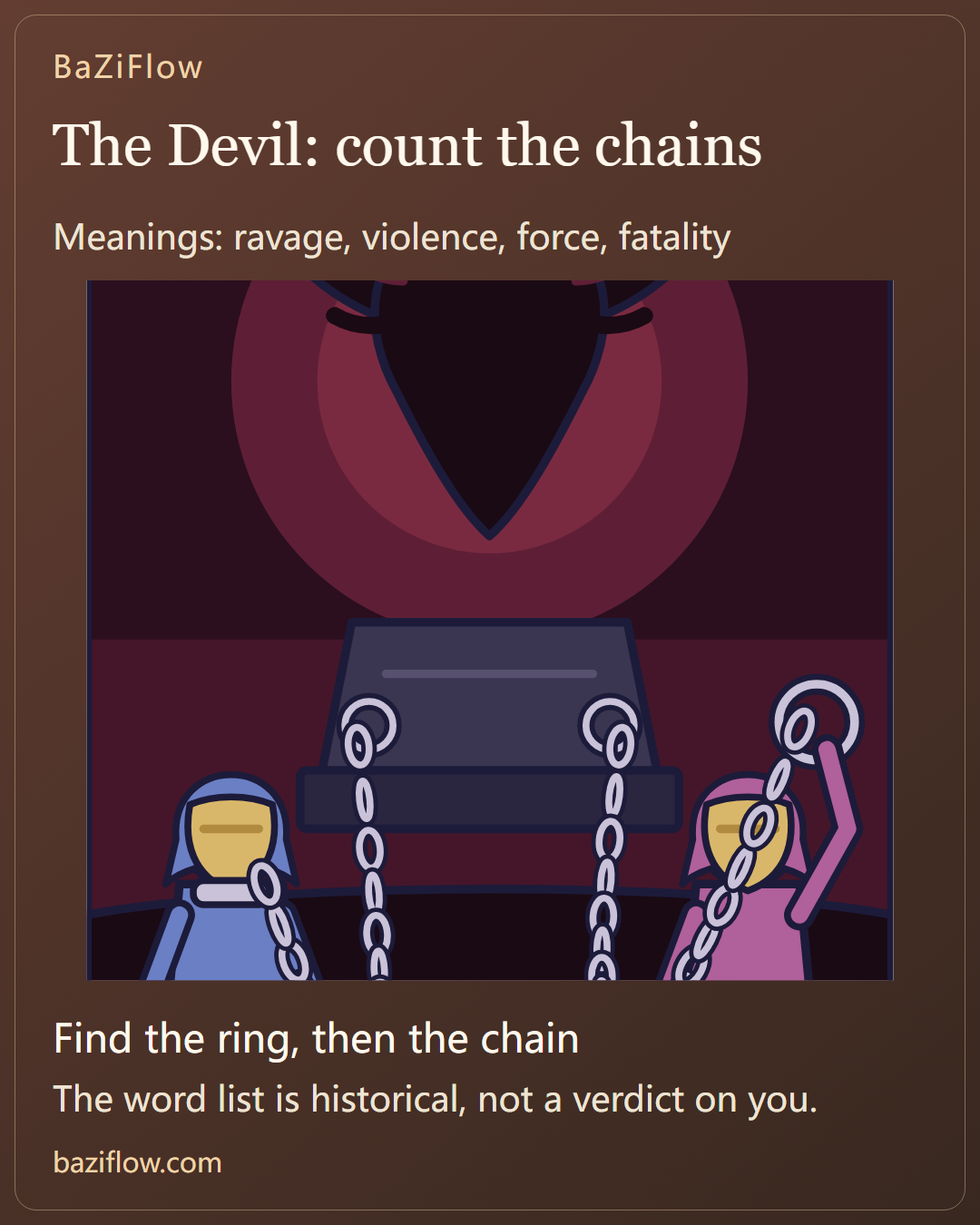
The Devil shows a winged, horned figure on an altar with two chained figures before it. Separate Waite's picture, his word list and his own conclusion, then use "find the ring" to sort an interview-prep list.
The short version8 min read
The Devil shows a figure on an altar and two chained figures in front. Waite's list circles force and fatality and adds that what is predestined is not for this reason evil, so first sort what is force from what is chain.
- Waite writes a bat-winged goat figure standing on an altar, right hand raised, left hand holding a torch inverted toward the earth, a reversed pentagram on the forehead, and a ring before the altar with two chains running to a male and a female figure.
- The divinatory list is made of words of force and fatality and closes on "that which is predestined but is not for this reason evil". Reversed: evil fatality, weakness, pettiness, blindness.
- He adds that the exalted figure is "not to be their master for ever" and is himself a bondsman, blind to the liberty of service. The practice: count the chains, find the ring, sort what is fixed from what was put on.
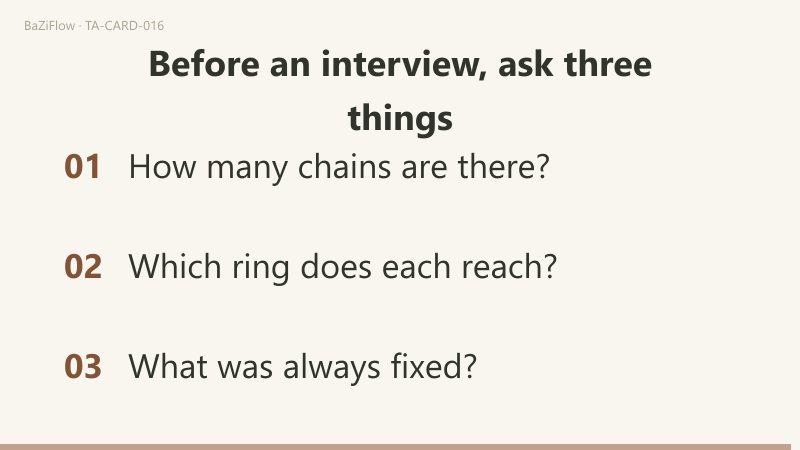
Read first
The picture: a figure on an altar, two chains before it
Waite first says what kind of design this is: an accommodation, a mean or harmony, between several motives mentioned in his first part. Then the picture: the Horned Goat of Mendes, with wings like those of a bat, stands on an altar. At the pit of the stomach is the sign of Mercury. The right hand is upraised and extended, the reverse of the benediction given by the Hierophant in the fifth card; in the left is a great flaming torch, inverted towards the earth; a reversed pentagram is on the forehead.
In front of the altar there is a ring, and from it two chains are carried to the necks of two figures, male and female. These are analogous with those of the fifth card, he says, "as if Adam and Eve after the Fall", and then writes a line: here is the chain and fatality of the material life.
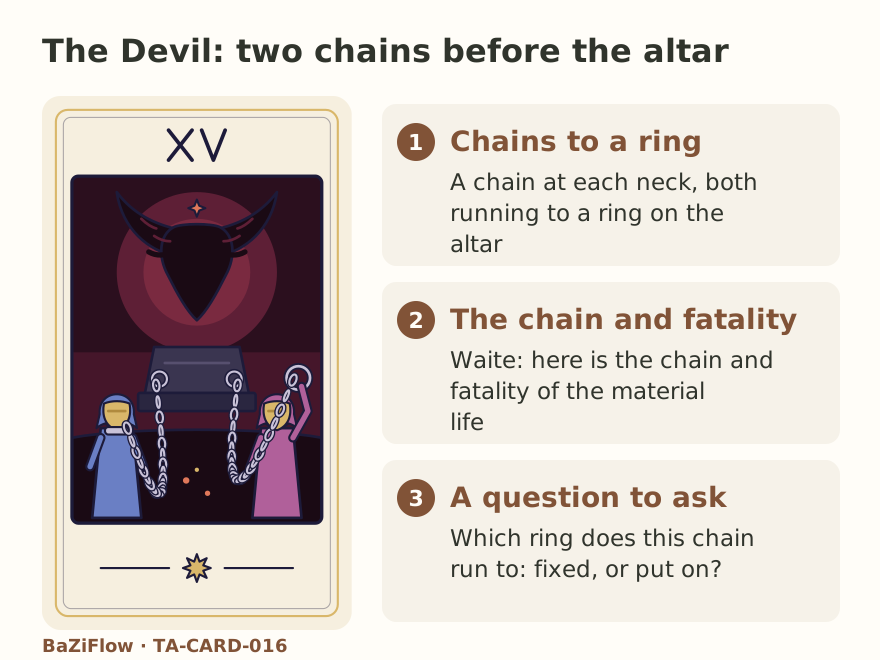
BaZiFlow's original Devil with three ways to read it
The opening figure is a BaZiFlow redrawing, not a copy of the RWS card: a horned black silhouette, a dark altar below it, and two hooded figures whose chains run to a ring on the altar.
On the RWS card itself: a horned, bat-winged figure crouches on a black square altar with a reversed pentagram on the forehead, its right hand raised and its left holding a torch pointed down; a ring stands before the altar; a woman and a man stand bare at the sides, chain loops at their necks hanging down to the ring, the man's tail ending in flame and the woman's tail with a cluster of grapes.
Read it from the top down: the figure, the ring, the people.
Enlarge diagram · scroll sideways to read
What Waite lists: ravage, violence, vehemence, force, fatality, and "not for this reason evil"
Waite's divinatory meaning is:
Ravage, violence, vehemence ... force, fatality; that which is predestined but is not for this reason evil.
The first six words all speak of onset and strength: ravage, violence, vehemence, then extraordinary efforts, force, and finally fatality. "Temptation" is not in the list, and neither is "dependence". The last clause is a limit: what is predestined is not for that reason evil.
Enlarge diagram · scroll sideways to read
Chain, ring and tail: what he wrote, what he answered, what he concluded
Waite's description of the symbols is concrete, and he gives a meaning for only a few. Three are worth reading apart: the reversed pentagram and the raised hand, the ring with its two chains, the tails and the faces.
Three symbols and the words Waite gave them
- Pentagram, raised hand
- Waite: a reversed pentagram on the forehead; the right hand raised, the reverse of the Hierophant's benediction; in the left a torch inverted towards the earth. He gives looks and a contrast, and does not explain each.
- Ring, two chains
- Waite: a ring before the altar with two chains to the necks of a male and a female figure, "as if Adam and Eve after the Fall"; here is the chain and fatality of the material life.
- Tails, faces
- Waite: the figures are tailed, to signify the animal nature, but there is human intelligence in the faces; he who is exalted above them is not to be their master for ever.
Enlarge diagram · scroll sideways to read
He is not persuaded by two other accounts. Of Éliphas Lévi, he says that with more than his usual derision for the arts which he pretended to respect, he affirms that the Baphometic figure is occult science and magic. Of another commentator, who says that in the Divine world it signifies predestination, Waite says there is no correspondence in that world with the things which below are of the brute.
His own conclusion is that what it does signify is the Dweller on the Threshold without the Mystical Garden, when those are driven forth therefrom who have eaten the forbidden fruit.
How to read it: count the chains, find the ring, sort what is set from what was added
The clearest line in the picture runs from the ring before the altar, out along each chain to a neck. Follow that line and interview prep has three steps. The line comes from the picture, the list is ours, and the original has no such use.
Count the chains: one "must" per chain
Write down every "must" in your head before the interview: must memorize the whole question bank, must not feel nervous at all. One line, one chain, with no verdict yet.
Find the ring: where does each chain run?
Ask what each "must" is attached to: a specific requirement in the job description, or only a fear of being outdone. A chain that reaches the job description has found its ring.
Sort: what is set, what was put on
Borrow the list's clause "predestined but not for this reason evil" as a sorting rule: the interview time and the job's requirements are set, and neither good nor bad. A "must" that reaches no ring was put on, and you can ask: if I loosened it one notch, what would happen?
Say an interview is next Wednesday and the job description lists three abilities. Put your "musts" down and look for each ring:
Enlarge diagram · scroll sideways to read
What the chain chart can hold
Fits on the chart
- The "must" as you said it
- The ring it runs to
Does not fit
- A verdict on yourself
- What others will think
One more question
- What if I loosened it
- What was always fixed
Reversed and neighboring cards: evil fatality, weakness, blindness, and three cards on chains and collapse
Waite's reversed list has four words:
Evil fatality, weakness, pettiness, blindness.
In the upright list the clause "predestined but not for this reason evil" turns, in the reversed one, into plainly "evil fatality"; the other three words, weakness, pettiness, blindness, speak of lacking strength or lacking sight. "Blindness" can be set beside Part II's "blind to the liberty of service", and that pairing is the reader's, not something the text draws.
Enlarge diagram · scroll sideways to read
Three cards on chains and collapse
The fifth card, a blessing reversed
Waite says the Devil's raised right hand is the reverse of the Hierophant's benediction, and the chained pair echo the figures before him. The Hierophant's list includes marriage, alliance, captivity, servitude; by another account, mercy and goodness.
Another man and woman
Waite likens the Lovers' pair to Adam and Eve newly in the earthly paradise, love not yet contaminated by gross material desire; under the Devil a pair of the same kind stands after the Fall.
The next card, a reflection of this one
Under the Tower Waite says its disaster mirrors this card in a way: the Devil is about sinking into a material, animal state, the Tower about ruin on the side of the intellect.
Enlarge diagram · scroll sideways to read
Questions readers ask next
Is the Devil card about temptation or addiction?
Neither word is in Waite's list. His words are about force and fatality, with a limit added: what is predestined is not for this reason evil. Reading the chain as temptation or dependence is a later teaching borrowing, and should be labeled as one.
Who are the two chained figures?
Waite says they are analogous to the figures of the fifth card, the Hierophant, "as if Adam and Eve after the Fall". They are tailed, signifying the animal nature, but there is human intelligence in their faces.
What does the Devil mean reversed?
Waite's reversed list is evil fatality, weakness, pettiness, blindness. Set beside the upright list, fatality "not for this reason evil" becomes plainly "evil fatality"; the other three words he does not expand on.
Was this article helpful?
Sources & references
Continue reading
The Emperor: a staff and a globe on a stone seat, and a description made of objects ↗