

Choose the feature before the analogy
Content version · · Sources & references
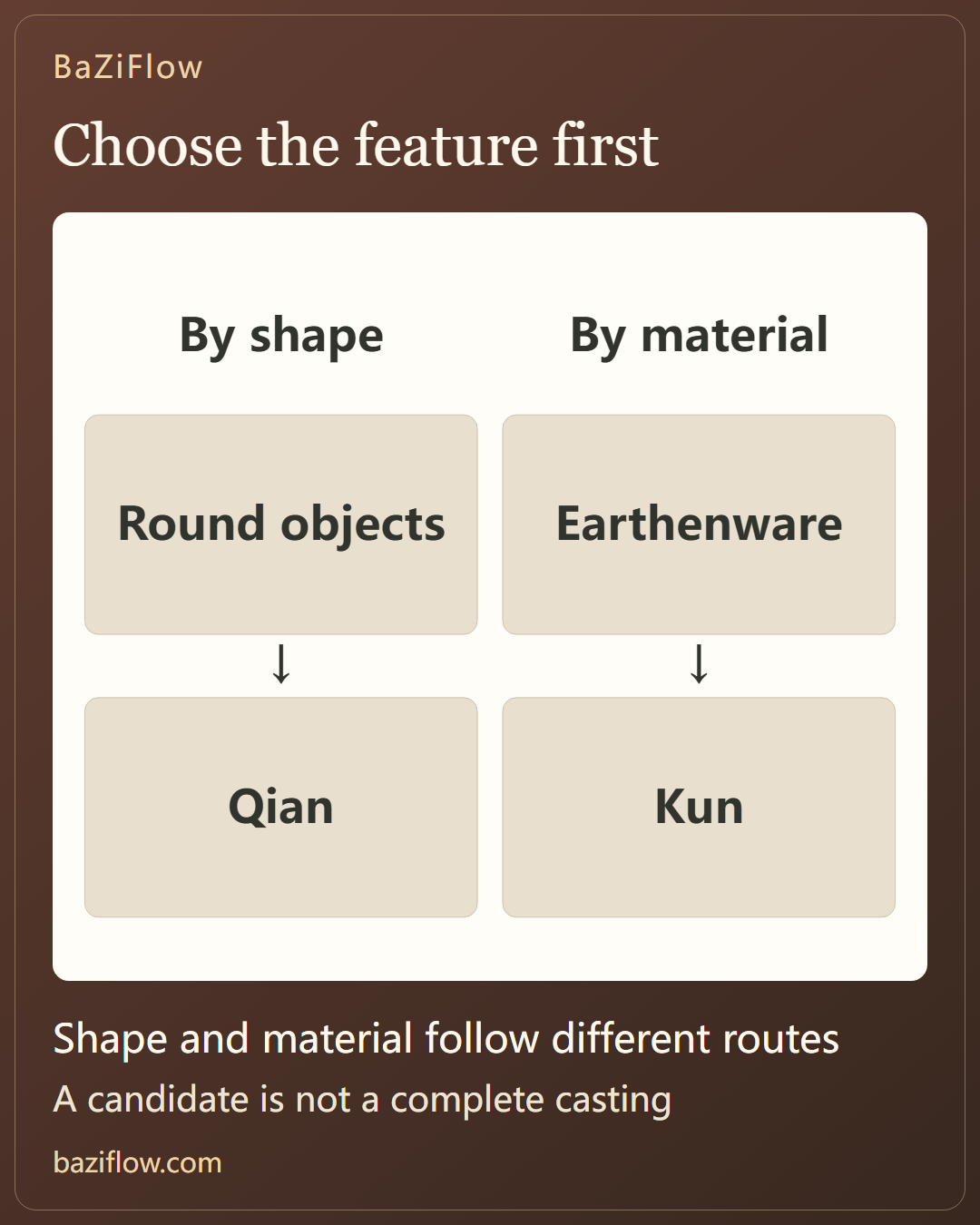
Use a round earthenware bowl to separate observation, selection criteria and trigram analogy, then examine how context can help—or invite hindsight.
The short version6 min read
Taking an image links a selected feature of an object to a traditional trigram category. A round clay bowl can suggest Qian through shape or Kun through earthenware. Replacing it with a square clay tile makes the distinction testable: shape changes while material stays the same, so the two classification routes respond differently.
- Qian’s roundness in Shuo Gua and Kun’s earthenware in Meihua Yi Shu support different feature-based analogies, without choosing the governing criterion for an object.
- Replace the round bowl with a square clay tile: the shape route changes from Qian to Kun, while the earthenware route retains Kun. The criterion determines the difference.
- A candidate analogy is not a completed casting. The object-based procedure also specifies direction and hour information; two features alone cannot supply the whole procedure.
Read first
A round earthenware bowl has more than one feature
Place a round clay bowl on a table. Should it suggest Qian because it is round, or Kun because it is earthenware? Both routes have textual support: the Shuo Gua associates Qian with roundness, while volume 1 of Meihua Yi Shu includes earthenware in Kun's categories. The sources offer possible analogies. They do not automatically decide which feature should govern this particular exercise.
This is the central difficulty in taking images, the practice of linking observed features with trigram categories. An object does not come with one uniquely discoverable trigram label. The choice depends on a stated procedure and on which feature is being considered. If that choice is concealed, an interpretation can switch from shape to material to function whenever the result becomes inconvenient.
Keep observation separate from the words used to describe it
The bowl's round rim and clay material are observations in this example. Calling it a “golden opportunity” adds a metaphor, not a metallic property. Extracting Metal from that phrase would turn a figure of speech into a fact about the object. The same mistake occurs when a short technical token is found inside an ordinary word and promoted into evidence.
| What is recorded | Evidence in the example | Permitted use |
|---|---|---|
| Round shape | The rim has been observed | Candidate for a shape-based analogy |
| Earthenware material | The bowl is made of clay | Candidate for a material-based analogy |
| A phrase involving gold | Someone's description | No evidence that the object is metallic |
Chapter 7 of the Shuo Gua discusses qualities such as Qian's vigour and Kun's receptivity; chapter 11 lists natural features, animals and objects. These categories operate at different descriptive levels. Meihua Yi Shu expands the lists and gives object-based examples, including round things and earthenware. Neither text should be treated as a search dictionary in which every matching word triggers a fact.
Observed material: clay
- Usable in the material route
Metaphor involving gold
- No evidence of metal
The branching point belongs in the record
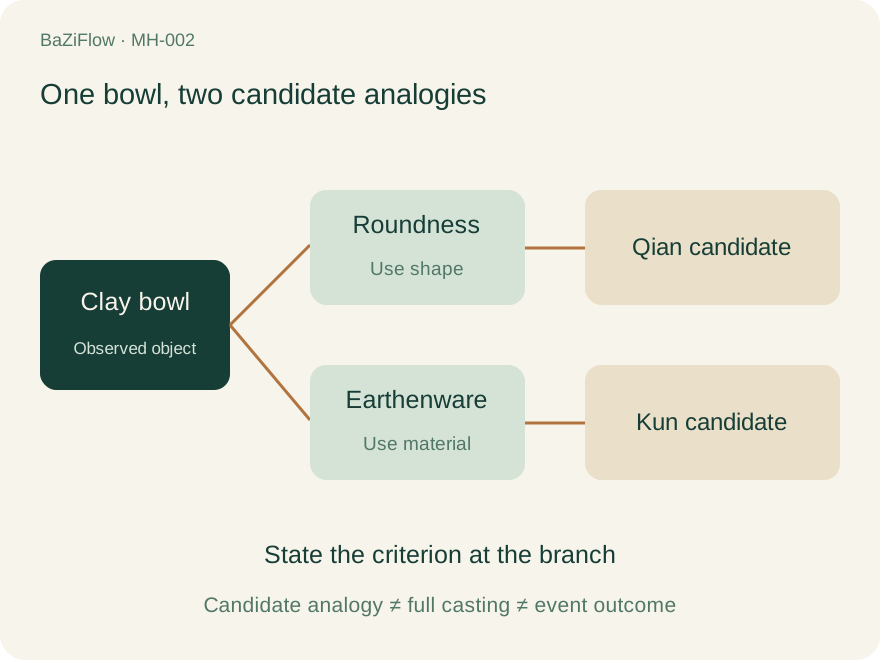
Original BaZiFlow teaching diagram of alternative image-selection routes; no hexagram is cast and no event is predicted.
Read the diagram in three stages: an observed feature, a declared selection criterion and a text-supported analogy. Writing only “Qian” collapses those stages and hides the decision. Choosing Qian first and then searching for roundness is not the same evidential process as declaring a shape-based exercise before choosing a candidate, even when the final label happens to match.
For a reproducible classroom exercise, specify in advance that material alone will be used. The clay bowl then supplies a Kun candidate. Roundness stays in the observation log but is marked as unused by this exercise. A separate shape-only exercise can yield a Qian candidate. The point is to compare classification rules, not to discover which label produces the more pleasing prediction.
If the actual casting procedure has not supplied a way to choose between equally plausible features, preserve the ambiguity. Two candidates do not by themselves form upper and lower trigrams. The object-based procedure in Meihua Yi Shu also specifies the use of direction and hour information. Conditions for casting from observed signs keeps those additional steps distinct.
Replace the round clay bowl with a square clay tile, deliberately keeping the earthenware material constant. The object-selection passage in Meihua Yi Shu associates round objects with Qian and earthenware or square objects with Kun. If shape was selected beforehand, the candidate changes from Qian to Kun. If material was selected, both remain Kun candidates. Changing one observed feature reveals which rule controls the classification; it does not test which label better fits a later outcome.
Round clay bowl
- Shape only
- Qian candidate
- Earthenware only
- Kun candidate
Square clay tile
- Shape only
- Kun candidate
- Earthenware only
- Kun candidate
A classical borrowing story acknowledges alternatives
The night-time borrowing story in volume 1 of Meihua Yi Shu considers tools through a Metal-and-Wood relationship. The narrative distinguishes a hoe from an axe by appealing to the evening setting and the proposed practical use. Whatever one makes of its reported success, the argument does not amount to a universal equation saying that Metal plus Wood always means an axe.
The story is useful here because it makes an additional source of selection visible: context. Symbolic categories alone leave more than one candidate. Yet context can also become a source of hindsight if details learned after the event are silently introduced into an earlier reading. A modern record should therefore distinguish what was known before the outcome from what was learned later.
That recording practice is an editorial proposal for examining reasoning, not an assertion that the historical narrative was a controlled experiment. A surviving success story cannot supply an accuracy rate, and its conclusion should not be converted into a rule that rules out every other Metal-and-Wood object.
Symbolic candidates
- Short Metal, long Wood
- Hoe or axe
Evening context
- Narrative adds practical use
- Selects an axe for firewood
New analogies require a declared scope
Tables in different teaching traditions vary in their entries and extensions. Modern objects may not have a direct entry in a classical list. A phone can be considered through communication, sound or light, but choosing one of those features is a modern interpretive step. Without an actual passage, it should not be presented as the ancient text's unique instruction.
An evocative analogy is not stronger merely because it is vivid. The useful questions are which feature was observed, when the criterion was chosen and what would count against the choice. If those questions cannot be answered, “not determined” is more informative than an elaborate chain of associations.
Image selection can organise observations without settling a complete reading. It does not on its own specify a moving line, Body and Use or an outcome. Continue with reviewing Meihua cases to see how the selected route can be preserved before later events make other routes tempting.
An item in the text
- Round objects, earthenware
- Return to its passage
A modern analogy
- A phone’s sound or light
- Explain the selected feature
Questions readers ask next
Does taking an image mean finding one hidden trigram in an object?
It means relating a selected observed feature to a traditional category. A round clay bowl has both shape and material properties. The actual procedure and declared criterion determine which route is used; the object does not automatically select one unique label.
What changes when the bowl becomes a square clay tile?
With shape fixed as the criterion, round objects suggest Qian and square objects suggest Kun. With earthenware fixed as the criterion, both suggest Kun. This comparison changes one feature and demonstrates classification, without supplying a complete casting.
Can a phrase involving gold establish a Metal observation?
No. A metaphor does not change the bowl’s clay material or establish the presence of metal. Verify the observed feature and the source for its use before making an analogy; a matching word is not a material fact about the object.
Was this article helpful?