

Rong–Qin and actual teamwork
Content version · · Sources & references
Credit the actions that make a workshop succeed, then audit unassigned roles and distinguish a practitioner’s positive interpretation from individual commitments.
The short version6 min read
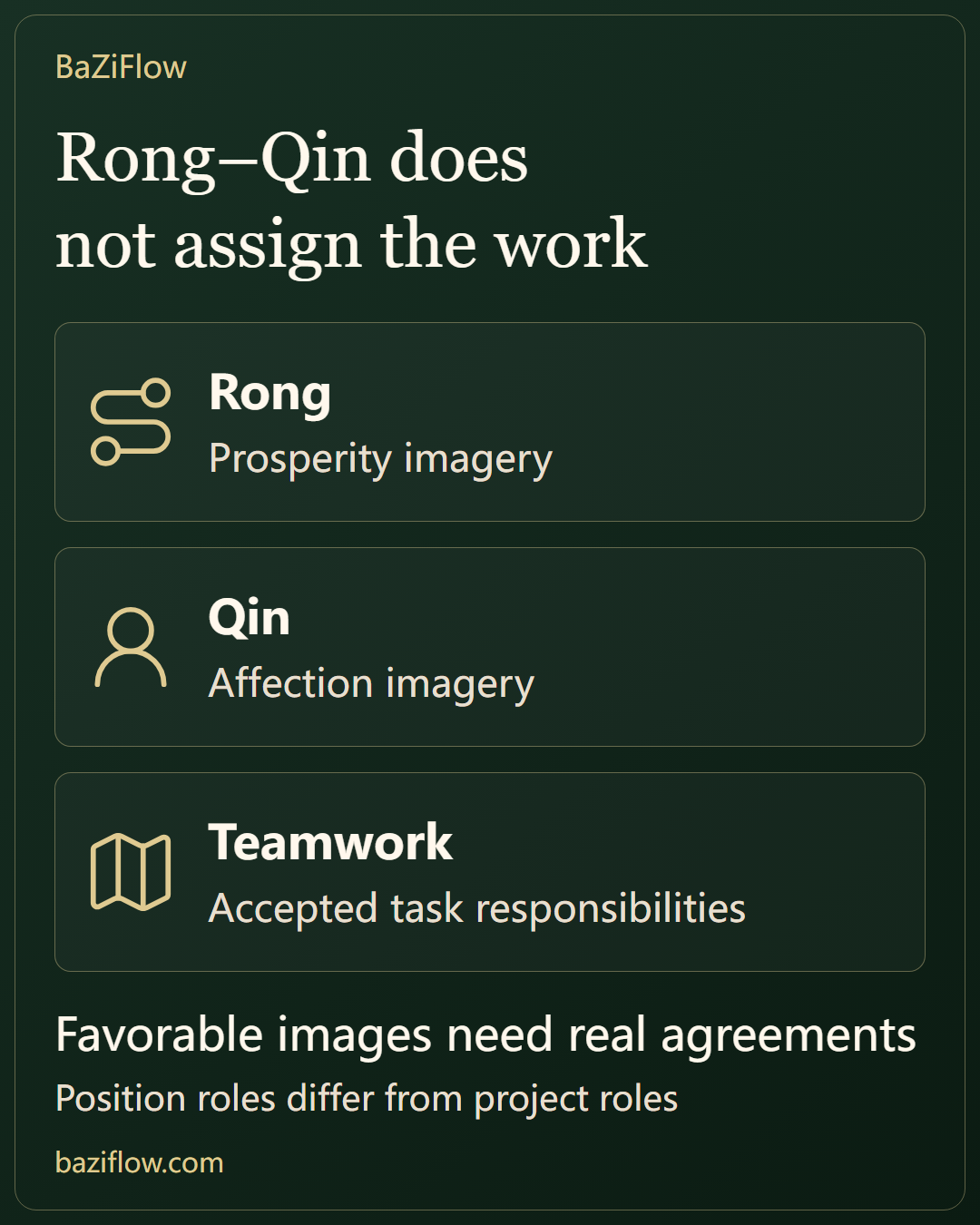
Rong–Qin (榮親) combines two directed positions; modern readings add favorable images of prosperity and affection. From Mao (昴), Bi (畢) occupies Rong, while Mao occupies Qin from Bi. Those names do not assign room access, materials or welcome duties. The workshop example separates the encouraging interpretation from the agreements that make collaboration work.
- Mao to Bi has offset one, Rong, while Bi to Mao has offset twenty-six, Qin. The pair retains direction but does not assign permanent work roles.
- Koseido interprets Rong–Qin through prosperity and affection. That practitioner’s evaluation does not measure either person’s availability, ability or agreement.
- Willingness to attend, acceptance of a specific duty and completion are different states. Favorable labels do not automatically advance one to the next.
Read first
What a favorable interpretation actually tells you
Check the names before applying the interpretation. Assume A is Mao and B is Bi in the 27-mansion three-nine sequence without Niu. The forward offset is one, placing B at Rong; the reverse is twenty-six, placing A at Qin. If the target is Zhang instead, Mao to Zhang has offset eight, Qin, with reverse nineteen, Rong. Both pairs belong to Rong–Qin, but the forward word differs.
The group therefore preserves a pair of labels without allocating resources or care duties to the participants. Position follows the mansion references; a project role follows the present agreement. Changing the workshop host does not automatically change Rong into Qin. Koseido’s prosperity and affection imagery can remain an attributed cultural interpretation, while the plan separately records who has accepted which task.
Rong and Qin occur as position labels in the three-nine ordering of T1299. Their reciprocal grouping is explained in six relationship groups. Koseido's modern account interprets the pair through ideas of prosperity and affection and gives it a strongly positive evaluation. This identifies the practitioner's interpretation; it does not establish the organizers' availability, skill or agreement.
A source may describe mutual help with great confidence. Readers should still distinguish that description from an observed act of help. “The guide praises this category” can be checked against the guide. “My collaborator has agreed to collect the materials” requires the collaborator's actual response. The first claim cannot fill the evidence field for the second.
Nor should a directional position become a permanent division of labor. The person imagined to provide support is not thereby obliged to do invisible preparation indefinitely. Current roles can be negotiated, exchanged or declined. A traditional name supplies no consent on the person's behalf.
The same applies to future outcomes. A successfully organized afternoon does not establish a general predictive rule about every pair in that category. A missed task does not prove that the people are fundamentally incompatible. Both conclusions would extend beyond the evidence from the event.
1 step: B is Rong
26 steps: A is Qin
Appreciation does not assign a role
Imagine two organizers preparing a fictional workshop.
An organizer can sincerely appreciate the partnership while noticing that preparation time was uneven. Those observations need not cancel each other. A useful review might say that the welcome went well, collection took longer than expected, and the next event needs an earlier material deadline. The review describes a particular arrangement rather than retelling a universal story of effortless harmony.
Positive expectations become less useful when they pressure someone to accept more work. “But we are supposed to be the ideal team” is not a reason to disregard a refusal. If a person cannot take a role this time, ask what arrangement is actually feasible rather than treating the boundary as disloyalty to the label.
Position role
- Birth references and direction
Project role
- Ability, time and acceptance
Audit the unassigned tasks
Before the event, imagine that both organizers said, “Let's do this together.” One assumed that the other would collect materials; the other assumed the person who proposed the workshop had already done so. Both may be enthusiastic. The task remains unassigned.
| Task | What a usable agreement would identify | What enthusiasm alone leaves open |
|---|---|---|
| Room access | Who confirms entry and departure times | Whether either organizer has checked |
| Materials | Who obtains the listed items and by when | Whether “helping” includes collection |
| Welcome | Who meets participants at the start | Whether the role has been accepted |
| Clean-up | Who can stay and what must be restored | Whether both people assumed the other would do it |
The table does not assign the work to a supposedly nurturing or resource-giving side of Rong–Qin. No such personal information has been supplied. The participants must choose and confirm the roles. Filling every blank with a name merely to make the example look complete would repeat the original mistake.
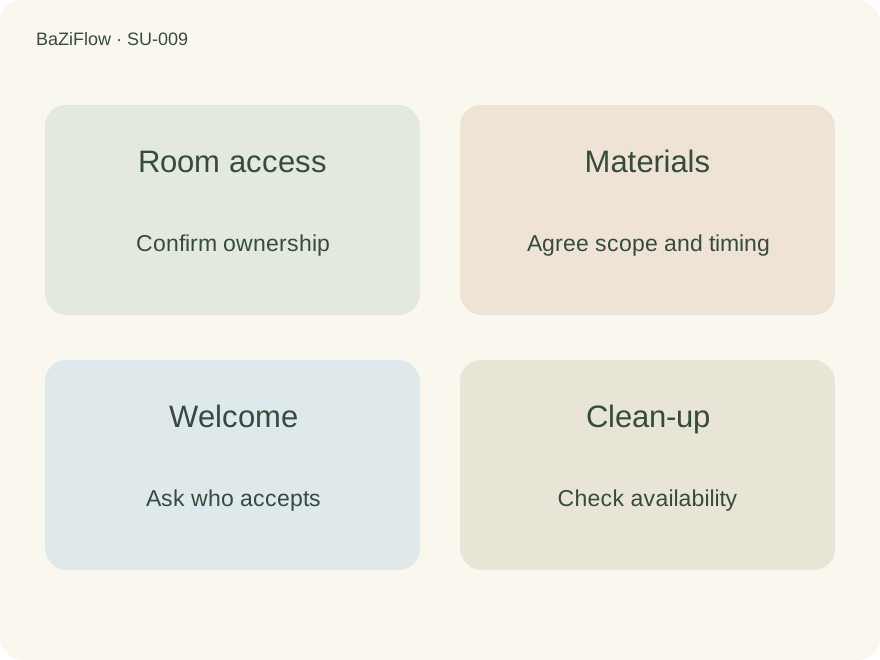
Original workshop agreement board; separate roles require actual acceptance.
Each task remains a separate agreement. Agreeing to help with a workshop does not automatically mean agreeing to every preparation and follow-up duty. Someone may accept the welcome role while being unable to stay afterwards. That is a constraint to plan around, not evidence of a failed astrological promise.
Will attend
Participation
Accepts a duty
Defined scope
Completes it
Checked result
Give the work credit before giving the category credit
A small workshop runs smoothly: materials arrive, somebody welcomes participants, and the room is cleared on time. If its two organizers have read that they form a favorable Rong–Qin pairing, it may be tempting to credit the result entirely to compatibility. That explanation can hide the planning that actually made the workshop possible.
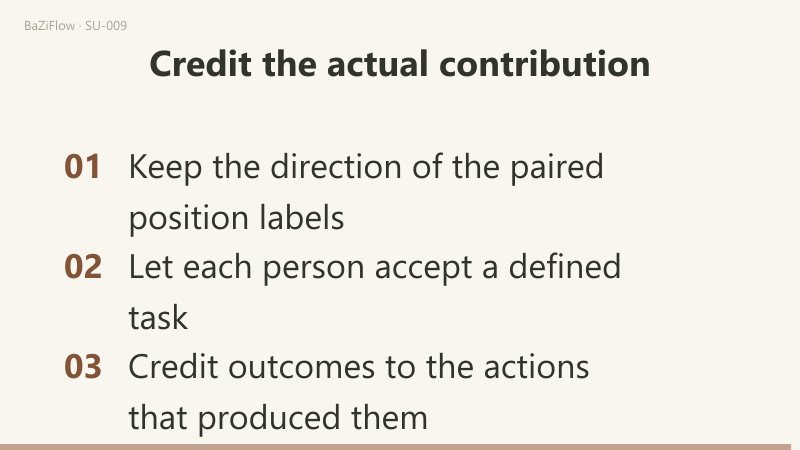
Keep the useful details. One person confirmed the room's access time, another checked the material list, and both agreed who would stay for the final clear-up. Those actions can inform the next event. “We are naturally supportive” may express a pleasant feeling, but it does not preserve the working arrangement.
The workshop is an invented example, not a recorded test of a mansion pairing. Its purpose is to show why a positive label should not absorb the evidence of individual contributions. An encouraging story can obscure practical gaps just as easily as an alarming one can exaggerate them.
Confirm room access
- In the stated completed example
Prepare materials
- In the stated completed example
Complete the workshop
- In the stated completed example
Different projects need different observations
Compare several projects if you keep a personal reading log. The same two people may work comfortably on one task and struggle with another because the time, resources or responsibilities differ. Reusing the same paragraph about mutual growth while changing only the project name loses those differences.
For this fictional workshop, a final note could distinguish the original expectation, the confirmed roles, the completed tasks and anything still undecided. Preserve the contributors' choices and actions as the evidence of what happened. Recording Sukuyō cases explains how to keep that record without turning selected successes into proof of an astrological claim.
Questions readers ask next
How do Rong and Qin become a paired category?
In the declared three-nine sequence, Mao to Bi is offset one, Rong; the reverse is twenty-six, Qin. Changing the target from Bi to Zhang gives offset eight, Qin, and reverse nineteen, Rong. The group remains Rong–Qin while the directed words switch.
Must Rong supply resources while Qin provides care?
Those work roles cannot be assigned from the positions alone. Position depends on the birth references and direction, whereas current responsibilities depend on ability, time and actual acceptance. Roles can rotate without changing the positional calculation.
Why distinguish attendance, task acceptance and completion?
Agreeing to attend does not automatically include obtaining materials, welcoming participants or clearing the room. Each responsibility needs an accepted scope, and its completion needs a result. A favorable relationship label cannot fill all three states at once.
Was this article helpful?
Sources & references
Continue reading
An–Huai readings: keep labels separate from behavior ↗