

Two of Wands: a globe on the battlement
Content version · · Sources & references
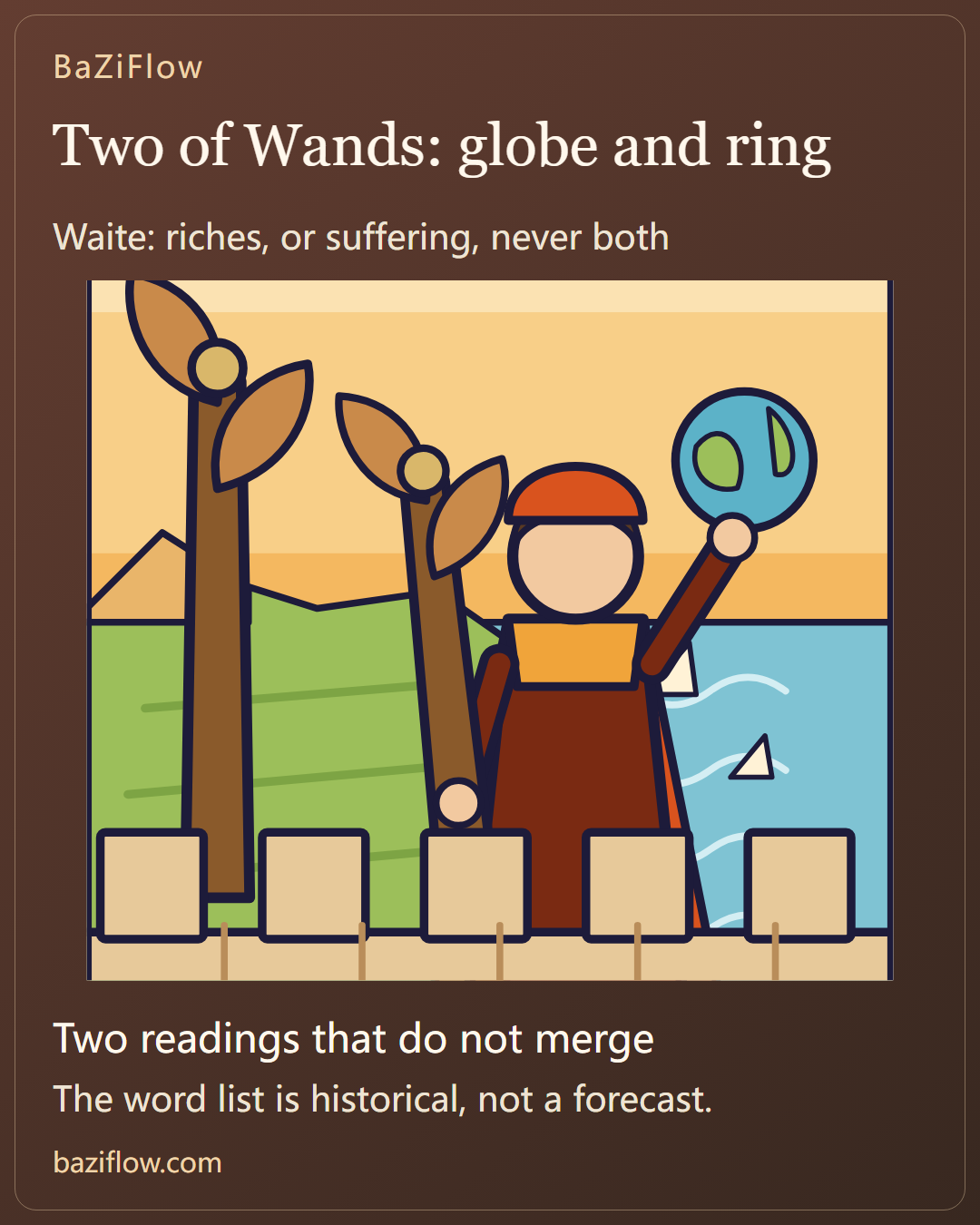
The Two of Wands shows a figure on a height holding a globe, one staff in hand and another fixed in a ring. Separate the picture, the two readings and the reversed list, then sort a race entry by globe, hand and ring.
The short version7 min read
In the Two of Wands a figure stands on a battlement holding a globe, one staff in hand and another fixed in a ring. Waite gives two incompatible readings, so ask first which one you are reading.
- Waite's picture: a tall man on a battlemented roof looks over sea and shore, a globe in his right hand, a staff in his left resting on the battlement, another fixed in a ring; he asks the reader to notice the Rose and Cross and Lily on the left.
- The list is two readings with "no marriage possible" between them: riches, fortune, magnificence on one side, and physical suffering, disease, chagrin, sadness, mortification on the other. Waite adds a reading of the design itself.
- The reversed list is surprise, wonder, enchantment, emotion, trouble, fear. The extras have one line: a young lady may expect trivial disappointments.
Read first
The man on the battlement: a globe in the palm, two staves
Waite draws the card in one sentence: a tall man looks from a battlemented roof over sea and shore; he holds a globe in his right hand, while a staff in his left rests on the battlement, and another is fixed in a ring. He adds that the Rose and Cross and Lily on the left side should be noticed.
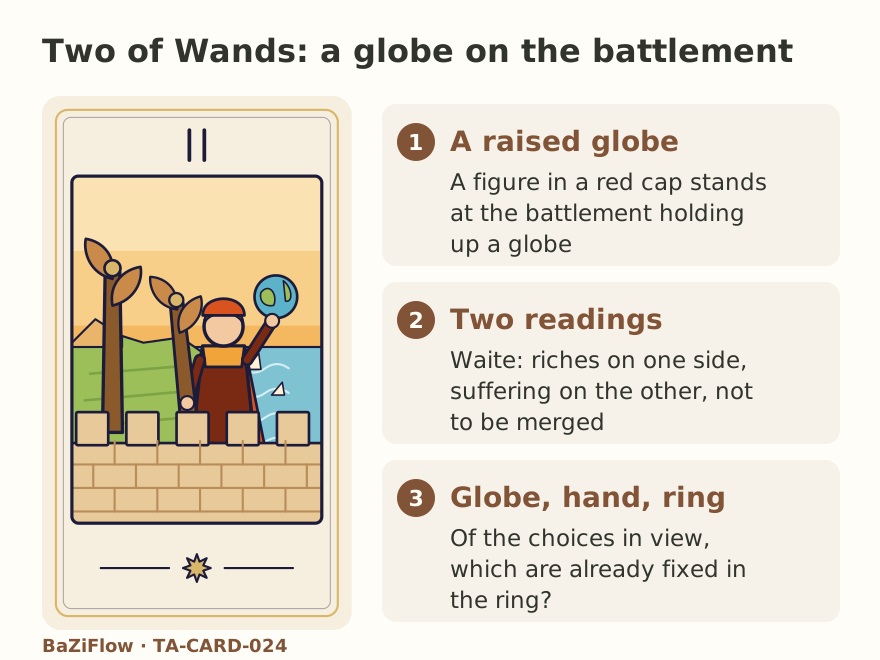
BaZiFlow's own Two of Wands, with three ways in.
On the Rider-Waite-Smith card the man stands in profile facing left, in a red cap and a long red robe, looking out from behind the battlement. To the left is a stretch of water; to the right are green slopes, a small red-roofed house and distant mountains. One hand holds up the globe, the other grips the staff at left; the staff at right stands on the parapet with its base in a ring. On the stone block at lower left are red roses and white lilies.
From far to near the picture has three layers: water and land before him, a globe and a staff in his hands, the battlement under his feet.
Enlarge diagram · scroll sideways to read
What Waite lists: two readings that "cannot be married"
Waite's divinatory meanings open with a caution: between the alternative readings there is no marriage possible. Then he gives the two: on the one hand riches, fortune, magnificence; on the other, physical suffering, disease, chagrin, sadness, mortification.
Between the alternative readings there is no marriage possible; on the one hand, riches, fortune, magnificence; on the other, physical suffering, disease, chagrin, sadness, mortification.
Next comes his own reading of the design: it gives one suggestion, a lord overlooking his dominion and alternately contemplating a globe, and it looks like the malady, the mortification, the sadness of Alexander amid the grandeur of this world's wealth. He does not say which Alexander.
Enlarge diagram · scroll sideways to read
The third layer deserves a second look. His reading of the picture puts grandeur and sadness into the same man. It sits in the same entry as "no marriage possible", and Waite does not reconcile the two.
Globe, two staves, rose and lily: who pointed out what
Waite points to four things on the card: the globe, the staff in hand, the staff in the ring and the Rose and Cross and Lily on the left. He gives their positions, and says very little about the globe or the flowers.
Globe, staves, flowers: whose statement is each?
- Globe
- Waite writes a globe in his right hand, and says he alternately contemplates it. What the globe stands for he does not say separately; his reading is that the whole design looks like a lord and his dominion.
- Two staves
- One in the left hand, resting on the battlement; another fixed in a ring. Waite gives only the positions, not why one is held and one is fixed.
- Rose and Cross and Lily
- Waite says they "should be noticed" on the left and does not explain them. On the Rider-Waite-Smith card the stone block at lower left shows red roses and white lilies.
Enlarge diagram · scroll sideways to read
How to read it: narrow the globe down to one staff in the ring
The objects in the picture come in an order from large to small: the globe is the whole world, the staff in hand is what is being weighed, the staff in the ring is already fixed. Borrow that order to sort out an everyday matter: a running group's chat has five or six race sign-up links pasted in and nobody is sure which race to enter. The mapping is a teaching borrowing, not Waite's words.
Enlarge diagram · scroll sideways to read
Whatever is on the globe waits
The five or six links in the chat count only as "looking" until you decide. Give yourself a date: no payment before it, and on that day put the globe down and add no new links.
No more than two in hand
Write "what I get" and "what it costs" separately for each of the one or two races. Waite says no marriage is possible between the two readings, so do not stitch race A's upside onto race B's cost to build one ideal race.
Look at what the ring already holds
Fixed things are like the staff in the ring: work schedule, fees already paid, a trip already booked. List them first; the race you shortlist has to fit around them.
Here is one example, a sheet for each of two shortlisted races:
Two shortlisted races, one sheet each
What I get / what it costs
Get: about six weeks of build-up, easy weekends. Cost: the entry fee, and the second weekend of October.
What I get / what it costs
Get: a longer goal, and three others in the group are already entering. Cost: one more long run a week, and the entry is due before the end of October.
With both sheets written, look at the ring: is anything already fixed on the second weekend of October? The race that fits is the one that goes forward as a candidate.
Reversed and neighboring cards: wonder beside fear, and two more cards of "two"
Waite's reversed list is a single string: surprise, wonder, enchantment, emotion, trouble, fear. The first four are about being moved by something, the last two are trouble and fear, and nothing separates them. The two-reading structure of the upright entry does not appear here.
Surprise, wonder, enchantment, emotion, trouble, fear.
The additional meanings are one line with no reversed entry: a young lady may expect trivial disappointments, period wording from other readers.
Enlarge diagram · scroll sideways to read
Three cards, and how each places its "two" or "three"
One person, two pentacles
A young man dances with a pentacle in each hand, joined by a cord in the shape of an 8. That list also has two sides: gaiety and recreation on one, news, obstacles and agitation on the other.
One person, two swords
A hoodwinked woman balances two swords on her shoulders. The list: conformity and the equipoise it suggests, courage, friendship, concord in a state of arms. Here the "two" lands on balance, not on two readings.
The next card: watching ships from a cliff
A figure with his back turned stands at a cliff edge watching ships on the sea, three staves planted in the ground. The list turns to established strength, enterprise, trade and co-operation: from weighing to ships already at sea.
Questions readers ask next
Does the Two of Wands mean "you must make a choice"?
Waite does not write that. He gives two sets of words, riches and suffering, and says no marriage is possible between them; the man holds a globe and looks into the distance. Reading it as "weigh two options" is a later teaching borrowing, so say so when you use it.
What does the Two of Wands mean reversed?
Waite's reversed list is surprise, wonder, enchantment, emotion, trouble, fear: some words about being moved, some about unease, with no single direction. The extras add one line, a young lady meeting trivial disappointments, in period wording.
Why does the Two of Wands list include disease?
That is the 1910 list as written: for the other reading he lists physical suffering, disease, chagrin, sadness, mortification, and says the design looks like Alexander's malady and sadness amid the grandeur of worldly wealth. In teaching it is safer to read it as unease inside splendor.
Was this article helpful?
Sources & references
Continue reading
Ace of Wands: a hand grips a staff in leaf, and Waite's list looks back to origins ↗