

Check settings when results differ
Content version · · Sources & references
Build a controlled comparison of calendar, time conversion, location and system rules. Change one relevant condition at a time and separate field differences from interpretation differences.
The short version5 min read
Matching clock digits do not guarantee a matching instant. Retain both inputs and their settings, identify a single evidenced difference, and separate calculation fields from interpretive wording.
- Matching strings can still carry different calendar, time-type or geographic meanings.
- Change one evidenced setting while recording what remains fixed and which fields respond.
- A fresh draw changes input; matching fields do not validate every interpretation or forecast.
Read first
Build a comparison that changes one thing at a time
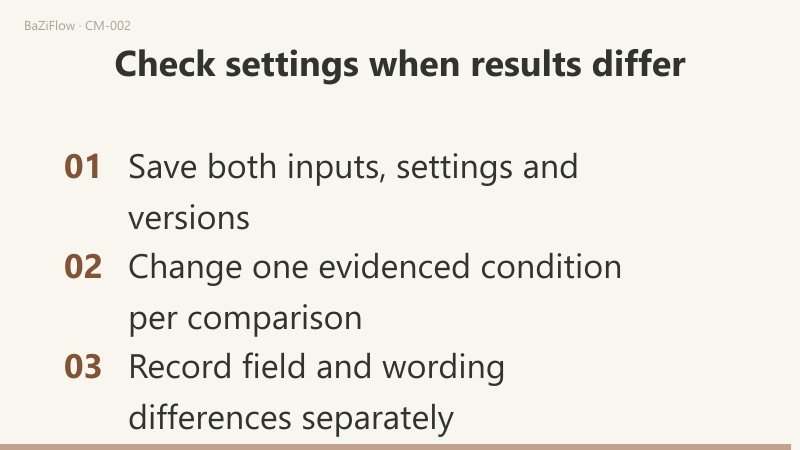
Keep the original data fixed and preserve both outputs before experimenting. Write down the settings visible in each tool and the versions or comparison date. Then select one evidenced difference to investigate. If time, place and method are changed together, a matching result will not reveal which change mattered.
The goal is not to make two systems agree at any cost. It is to discover whether a difference comes from input meaning, conversion, a method convention, a calculated field or later interpretation. Different definitions may legitimately remain different after the investigation.
| Comparison stage | Hold fixed | Investigate |
|---|---|---|
| Input meaning | Original record | Calendar, leap-month notation and time format |
| Conversion | Confirmed notation | Zone, daylight-saving handling and location |
| Method | Matched common conditions | Relevant system-specific rules |
| Explanation | Matched fields | Selection, weighting and language |
These are inspection categories, not a promise that every interface exposes the same controls. Check only what is relevant, but do not declare unchecked fields equivalent.
First comparison
- Fixed
- Source and place
- Changed
- Offset +09 to +08
- Observed
- UTC 01 to 02
Next comparison
- Fixed
- Aligned time basis
- Changed
- One evidenced rule
- Observed
- Affected fields only
Two terms used below
- Fixed condition
- An explicitly retained part of this comparison, not a remembered assumption.
- Candidate cause
- An evidenced discrepancy that still needs a controlled comparison.
Confirm that the displayed text has the same meaning
Identical date numerals can be treated as different calendars. A time can be local civil time in one interface and an already adjusted value in another. A familiar place label can resolve to a different location. The strings can match while the calculation inputs do not.
Start from verified birth data, including the original notation and uncertainty. Do not quietly alter the record while testing settings. Otherwise the exercise stops being a comparison of processing conditions and becomes a comparison of new inputs.
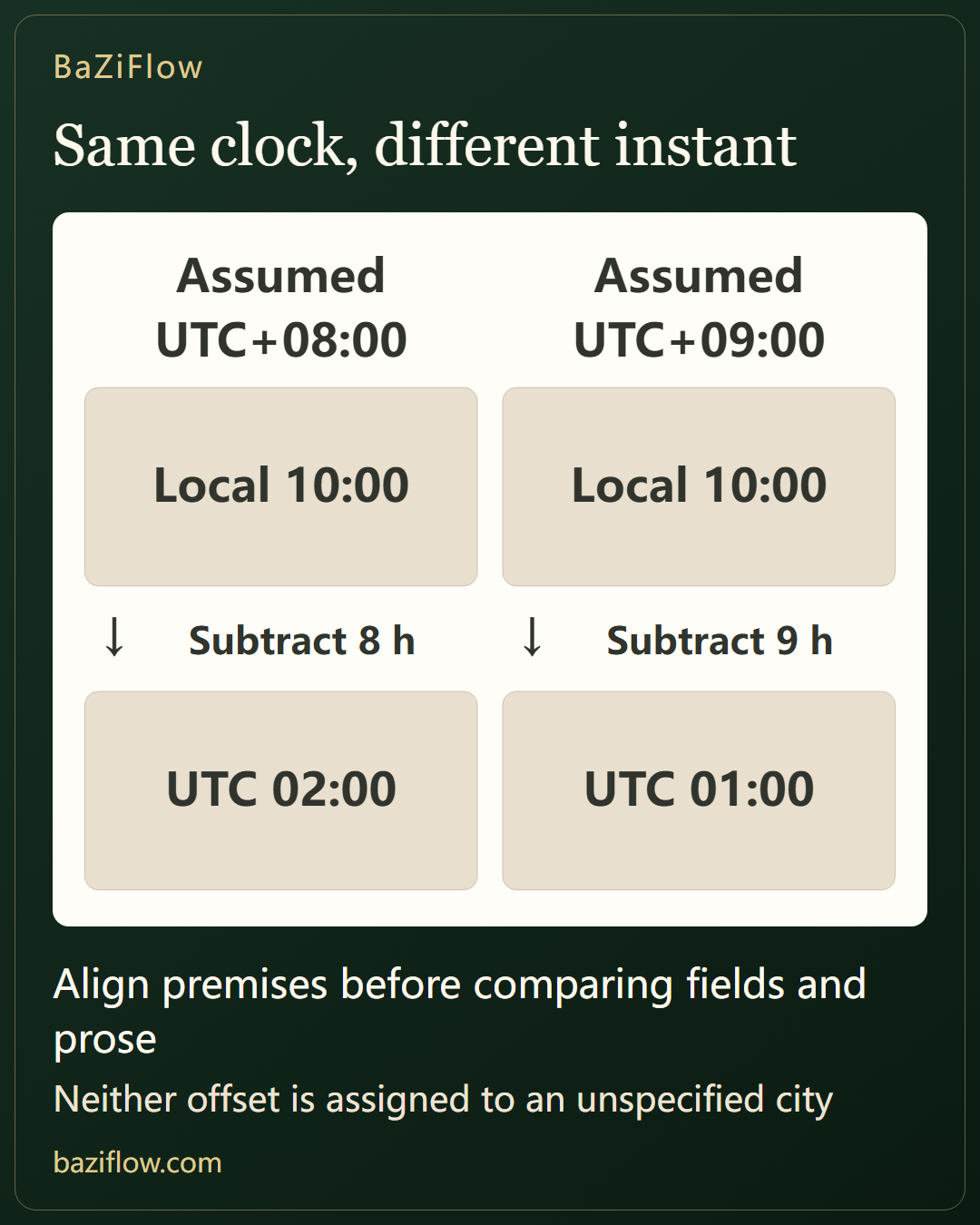
A simple arithmetic example illustrates the issue without a birth date. A 10:00 clock reading under a verified UTC+08:00 offset corresponds to 02:00 UTC. Under UTC+09:00 it corresponds to 01:00 UTC. Both subtractions follow their premises, but the premises identify instants an hour apart. The example does not assign either offset to an unspecified city.
Using the converted 02:00 as though it were still the original local time could cause a second adjustment. Read what the field requests and what the tool already does. Do not add or subtract time merely because a different output looks more familiar.
Assumed UTC+08:00
Assumed UTC+09:00
Check the rules that are actually in use
IANA's time-zone documentation describes historical local-time rules and their updates. This is a reason to retain the applicable date, zone and data version rather than applying today's offset indiscriminately. Missing historical information should remain an identified gap.
For a technical astrology example, Swiss Ephemeris house calculations explicitly take time, geographic coordinates and a house-system choice. Extended interfaces also distinguish calculation flags. Those parameters show why settings belong to the calculation; they do not show which personal interpretation is more accurate.
Other relevant categories may include a Bazi day-boundary convention, solar-time handling, zodiac choice or a Ziwei placement convention. The list is not an assertion that every tool implements each option. If a necessary setting is undocumented, mark it unknown instead of inventing a default on the tool's behalf.
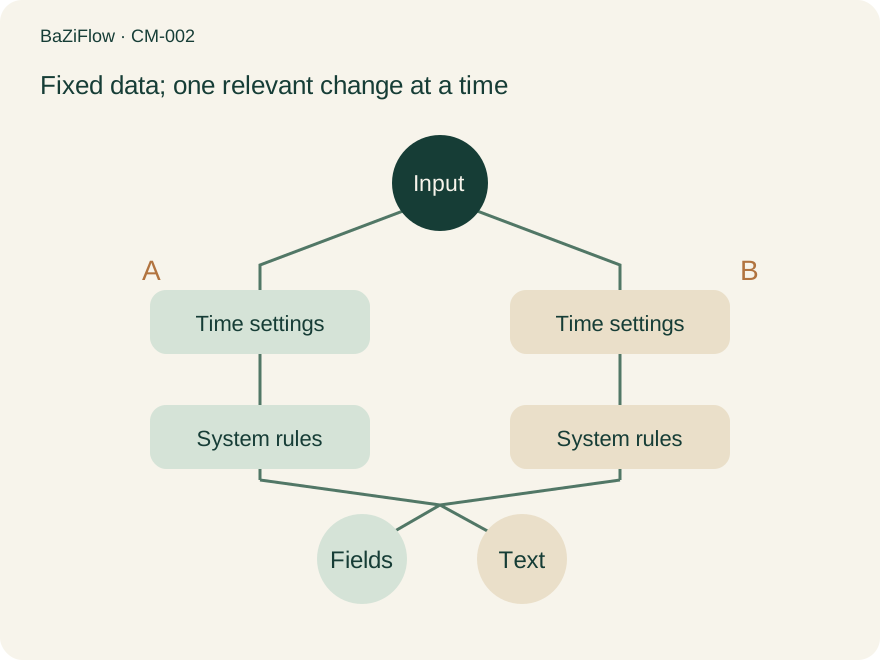
Original BaZiFlow settings diagram. The paths locate differences and do not rank particular tools.
The final split matters: a field comparison and a wording comparison are different tests. Their results should be recorded separately.
Same date digits
- Meaning to check
- Same calendar?
Same time digits
- Meaning to check
- Civil or converted?
Same place name
- Meaning to check
- Same geographic object?
Preserve the difference between a new draw and a new explanation
In a method with an extraction or drawing step, repeating the same question can produce a different input. A fresh tarot draw is not a rerun of the same recorded spread. To compare interpretations, retain the actual cards, positions and upright or reversed handling under discussion.
Similarly, two methods can intentionally define their frames differently. Keep both conventions visible rather than tuning settings until the diagrams look alike. If a tool claims the same data and convention but produces different fields, then examine its data or implementation version. Calling a discrepancy a “school difference” should not conceal a demonstrable processing error.
After aligning a condition, record which fields changed and which did not. A small, reasoned comparison is more informative than a large collection of screenshots without fixed premises. There is no need to rerun unrelated fields merely to make the record look extensive.
Same question
- A new draw changes input
Same recorded spread
- Interpretation can be compared
Stop changing the input when the fields already match
If the underlying numbers and symbols agree but the prose differs, examine the interpretive selection, weighting and wording. Further edits to birth data are unlikely to explain that particular discrepancy. Locating conflicting conclusions addresses the next layer.
State the result narrowly: the inspected fields match under these settings, or this remaining difference follows from these conventions. Neither sentence establishes that all fields match or that a forecast has been validated. Unchecked auxiliary fields and time layers remain unchecked.
When an actual error is corrected, retain the previous value, the reason and the affected explanations. A reusable comparison needs only clear fixed conditions, a named change and an observed result. Those details make the next investigation easier after a software update or a move to another device.
Fields match
- Compare explanations
Fields differ
- Inspect calculation inputs
Keep the original pair
Both clocks show 10:00: A uses +08 and produces 02, while B uses +09 and produces 01.
Change only B’s offset
Suppose documentation establishes +08 for B. Keep its clock and place fixed; its UTC result becomes 02.
Limit the finding
This locates the UTC discrepancy only. House method, other fields and explanatory language remain separate checks.
Questions readers ask next
Do matching digits establish matching input?
Not until their calendar, time type and location identity are checked. Identical characters can feed different processing paths.
Does an output match prove the settings are correct?
It establishes agreement only in the inspected fields. Several simultaneous changes prevent attribution, and no forecast is validated by a settings match.
Can a fresh draw test the old explanation?
A new draw supplies different cards. Retain the original spread, positions and orientation rules when the question concerns interpretive differences.
Was this article helpful?
Sources & references
Continue reading
Birth-Time Uncertainty: Boundaries, Ranges and Stable Fields ↗