

Solar-return time and place
Content version · · Sources & references
Distinguish the Sun’s return to natal longitude from a birthday clock time. Audit the target units, zodiac, reference place and aspect layers before comparing annual charts.
The short version7 min read
A solar return first finds when the Sun reaches its natal longitude again, then calculates houses for a reference place. Birthday clock time, display time zone and local house boundaries have different roles in comparing annual charts.
- The return condition is equality with the natal solar longitude, not midnight on the birthday or a copied birth clock time.
- Under the geocentric convention, place changes local angles and houses, while a time zone changes only the clock representation.
- 100°24′ equals 100.40°. Angle units, zodiac settings and both endpoints of an aspect table must remain consistent.
Read first
One sky, different natal targets: how transits are compared ↗
What makes the timestamp a solar return?
A solar return chart is erected for the moment the Sun reaches its natal position again. In the common geocentric tropical calculation considered first here, the target is the natal Sun's ecliptic longitude. Find the corresponding instant around the birthday in the selected year, then calculate the chart for a declared reference place.
Astrodienst's chart-type documentation defines the chart through that return and notes that its date need not coincide with the calendar birthday. Copying the birth clock time onto this year's birthday, or choosing midnight because the date has begun, does not solve the positional condition.
The order matters. An attractively drawn chart for an arbitrarily selected birthday hour is still a chart for that hour; it is not thereby an exact solar return. Equally, calculating an instant precisely does not prove that a life event can be predicted with the same precision.
Fix the natal target
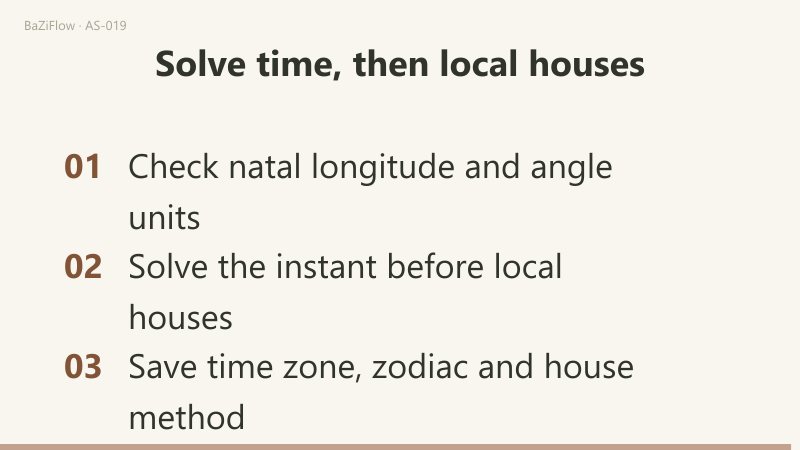
Keep solar longitude, units, zodiac and birth data.
Solve the return instant
Find matching longitude under the same convention near the selected year’s birthday.
Calculate the local chart
Combine that instant with reference coordinates and house method, then display its time zone.
Audit the target before searching for the instant
Suppose the natal longitude is 100°24′. In decimal degrees that is 100.40°, because 24 arcminutes divided by 60 equals 0.40°. It is not 100.24°. Confusing these representations changes the target before any annual search begins.
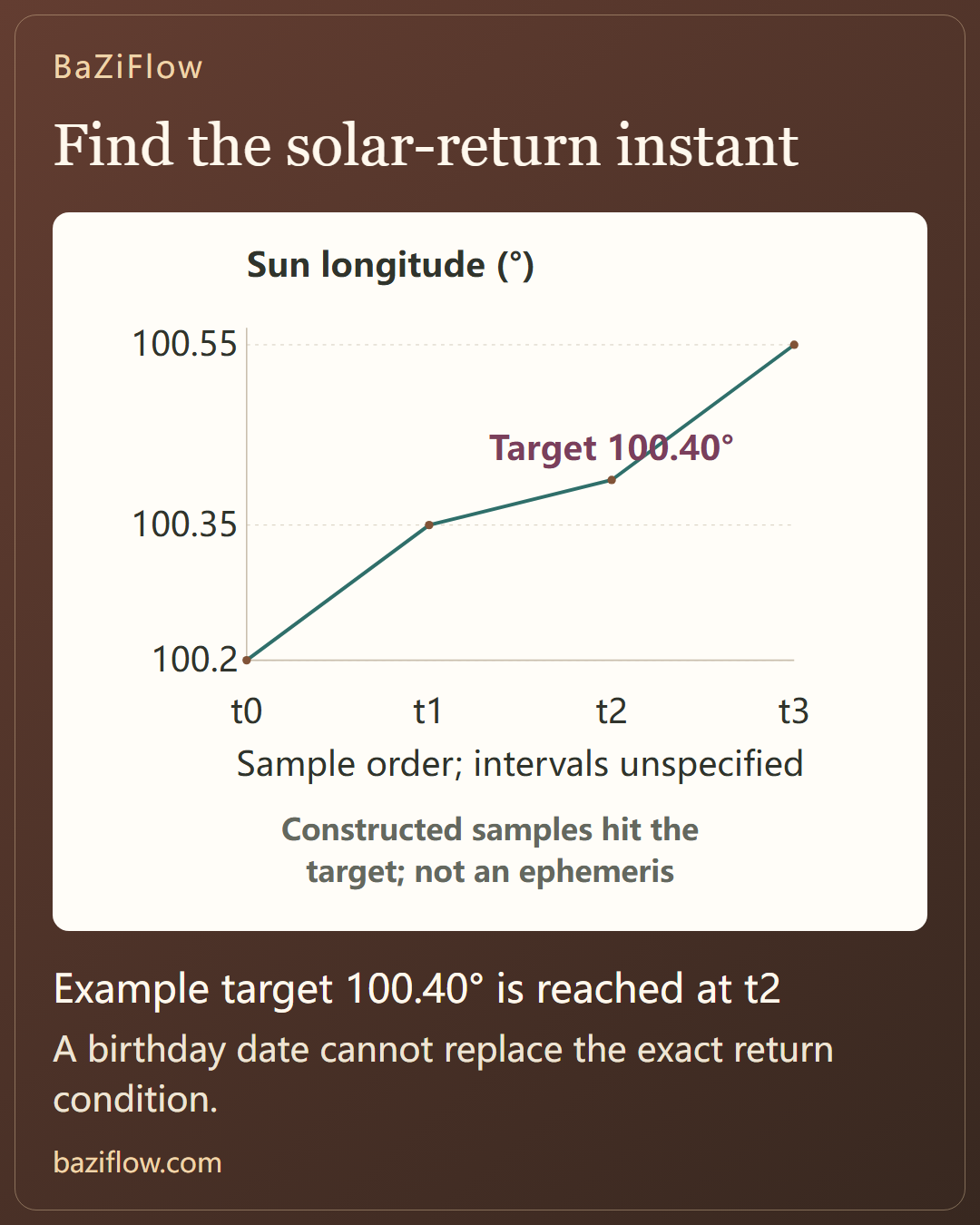
Now construct four ordered samples: 100.20°, 100.35°, 100.40° and 100.55°. The third equals the target. The second is 0.05° short, while the fourth is 0.15° beyond it. This exercise deliberately supplies an exact sample; an actual calculation may need to refine a bracket until the required precision is reached.
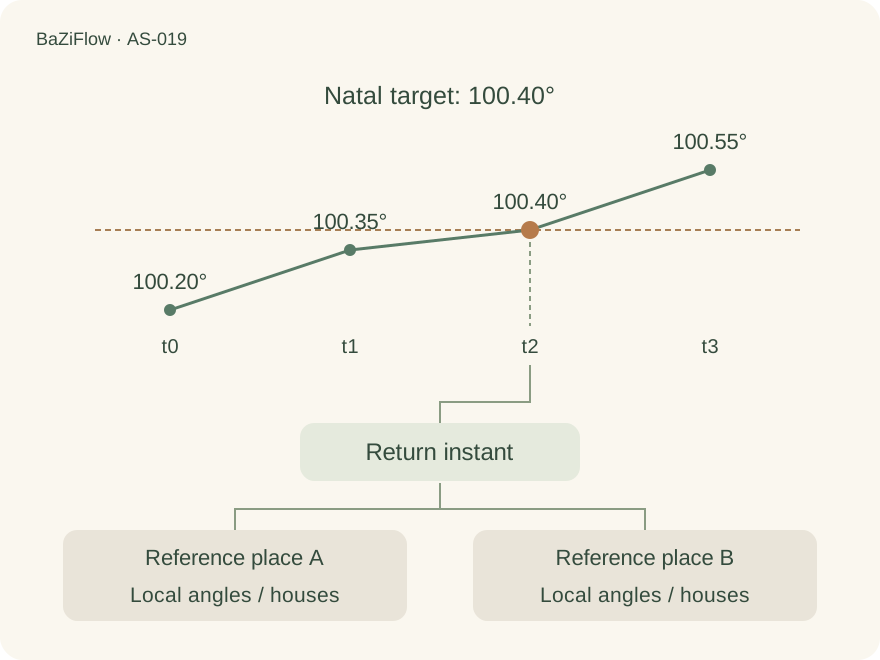
Original calculation schematic, not an actual ephemeris. Sample labels specify order, not equal intervals or calendar dates.
The labels t0 through t3 are not dates, and the intervals have no assigned length. The connecting line is not a measured solar velocity curve. Do not read a duration from its slope or assume that a simple midpoint between adjacent samples gives the exact answer. Position, speed and coordinate settings must remain consistent through the calculation; Swiss Ephemeris documents them as distinct parts of the computation.
Input precision also limits what can be claimed. An uncertain birth time may leave the natal target uncertain. A program printing seconds does not establish that the original data justify seconds. Keep the uncertainty attached to the result rather than hiding it behind a detailed timestamp.
Separate the instant, the clock label and the reference place
Under the geocentric convention used here, changing the city does not change the Sun's longitude at a given instant. The same solved return instant can therefore be used to erect charts for two reference places. Their local angles and houses depend on the geographic inputs. A topocentric or otherwise different convention would need its own explicit treatment.
A time zone changes the clock representation. For example, add nine hours to 23:30 UTC: the clock becomes 08:30 on the next calendar date at UTC+9. That conversion has changed the label, not created another return. A reference-place menu may also select a time zone, but that interface convenience does not merge the two roles.
| Layer | Example of what belongs there | Common comparison error |
|---|---|---|
| Return condition | Sun reaches the specified natal longitude | Using a chosen birthday hour instead |
| Clock display | Timestamp with its UTC offset | Counting a date change as a new instant |
| Local chart | Geographic coordinates and house system | Treating every changed house as a changed return time |
Astrodienst's return-chart FAQ allows the reference place to be changed and warns that the setting can persist into other charts. Record it with the output. An old travel location silently retained by software can explain a difference that otherwise looks mysterious.
None of this establishes that travelling to a place with a preferred chart changes the year's outcome. It establishes which inputs change the drawing. A calculation choice and a claim about control over life are separate propositions.
One geocentric return instant
Local houses calculated separately
Match the zodiac convention before solving the instant
Choose the zodiac before solving the return. Astrodienst notes that a sidereal solar return is computed using the corresponding sidereal position and can occur at a different time from the tropical return. It is not necessarily the same instant with different sign labels. See tropical and sidereal zodiacs for the reference distinction.
Do not take a natal target from one coordinate convention and compare it with a current Sun value from another. A matching number is meaningful only within the stated method. The year, natal target, zodiac, reference place, house system and display time zone should travel together in the record.
Tropical
- Tropical natal target
- Tropical current Sun
Sidereal
- Sidereal natal target
- Sidereal current Sun
Distinguish the endpoints of the aspect table
When reading the result, distinguish return-to-return aspects from return-to-natal aspects. Return Sun to return Moon describes a relationship within the annual snapshot. Return Saturn to natal Moon compares two epochs. Omitting those prefixes can make a list of technically correct angles refer to the wrong objects.
The conjunction of return Sun and natal Sun is the defining condition of the chart. It is not an additional, independently discovered piece of evidence that makes this year special. The natal record is not erased or restarted when the return chart is made.
Astrological interpretation may use the snapshot as a framework for annual themes, but it does not provide a guaranteed calendar of events. Keep the selected symbolism, the natal context and the person's actual circumstances distinguishable. A house placement alone cannot establish a particular relationship, career or health outcome.
Within return
- R Sun / R Moon
- One instant
Return to natal
- R Saturn / N Moon
- Two epochs
Compare the settings before comparing the years
Imagine opening two saved solar-return charts. The newer file uses another city and another house system, as well as another year. A changed house placement now has more than one possible source. The comparison cannot tell you which change came from the year alone.
Make a small comparison ledger before interpreting either drawing. Hold the year and zodiac fixed while comparing reference places; hold the place and house system fixed when examining year-to-year differences. These are controlled comparisons of chart inputs, not experiments proving that moving to a city changes someone's life.
| Difference in the saved files | First question to resolve |
|---|---|
| Different calendar dates | Different return instants, or one instant shown in different time zones? |
| Different Ascendants | Same reference coordinates and house calculation? |
| Different solar targets | Same zodiac, angle units and natal data? |
| Different aspect lists | Return-to-return or return-to-natal endpoints? |
An image without its settings cannot settle these questions. Recover the missing fields before treating the visual differences as an annual theme. The first two steps below change one variable at a time.
Hold place fixed across years
Keep zodiac and house method aligned to identify changes due to the annual positions.
Hold the instant fixed across places
Record coordinates and house method to isolate the geographical change.
Save both endpoint labels
Distinguish within-return, return-to-natal and within-natal aspect tables.
For moving positions on any selected day, use the separate comparison described in transits and the natal chart. A solar return selects a particular instant by a return condition; it does not compress every day of the year into one event timetable.
Questions readers ask next
Is the return instant my original birth time on each birthday?
No. Solve for the Sun reaching the natal longitude near the birthday; the calendar date may differ. Copying a clock time produces a chart for that selected hour without solving the return condition.
Does changing cities create a different return instant?
Not under the same geocentric and zodiac conventions used here. The Sun’s longitude at one instant is unchanged by the reference city, while local angles and houses depend on the location. Other observer conventions require explicit treatment.
Why is 100 degrees 24 minutes not 100.24 degrees?
There are sixty arcminutes per degree. Twenty-four divided by sixty is 0.40°, giving 100.40°. Entering 100.24° shifts the target by 0.16° before the return search begins.
Was this article helpful?
Sources & references
Continue reading
Tropical and Sidereal Zodiacs: Two Readings of One Direction ↗