

Cui: three gatherers, two centers, one outsider
Content version · · Sources & references
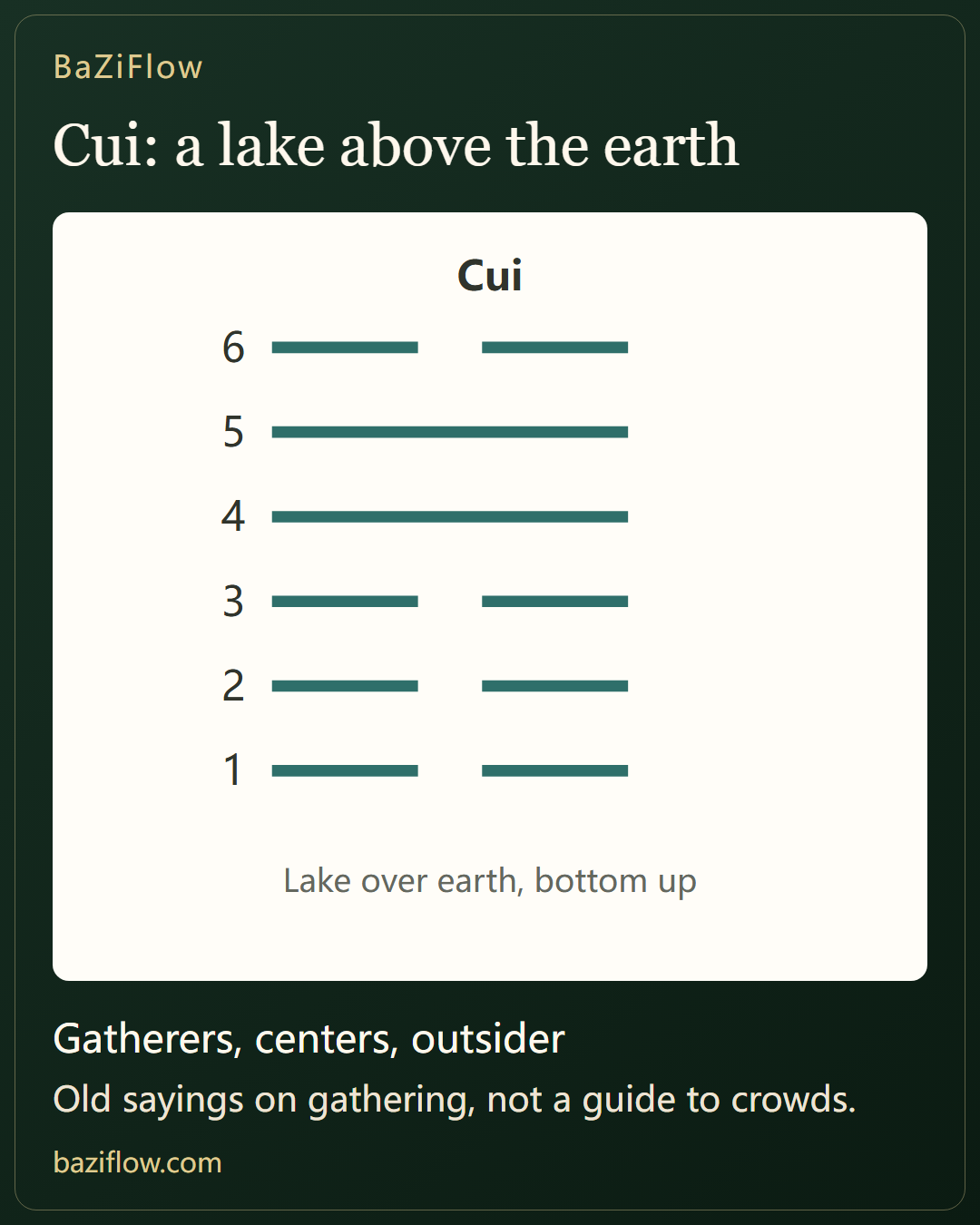
Cui is the 45th hexagram: Dui (lake) above Kun (earth), two yang lines in the middle. Read “look at what they gather around”, the Great Image on guarding, and the moods and reservations of its six lines.
The short version8 min read
Cui is about gathering, yet its Great Image ends on watchfulness. In the six statements the gatherers are confused and sighing, and the two lines at the center each carry a reservation after “great good fortune” and “a position”.
- Cui stacks Dui (lake) on Kun (earth). The Shuo Gua gives Kun “yielding” and Dui “gladness”, and says Kun also stands for the multitude: many things coming to one place, yielding and glad.
- The Commentary names two conditions for the gathering (yielding and glad, firm and central and answered), then closes on one sentence: look at what they gather around, and you see what heaven, earth and things truly are.
- The Great Image is about clearing weapons and guarding against the unforeseen. Line 4 has “great good fortune” and the Small Image adds “the position is not proper”; line 5 has “a position” and adds “the will is not yet bright”.
Read first
The Sixty-Four Hexagrams: How Upper and Lower Trigrams Form One Figure ↗
Judgment and Line Statements: Whole Hexagram or Single Line? ↗
A lake above the earth: Kun below, Dui above
Cui (萃) is Dui (lake) above and Kun (earth) below. Counting from the bottom, the lowest three lines are yin, which is Kun; lines four and five are yang and line six is yin, which together are Dui. The Shuo Gua gives Kun the word “yielding” and Dui the word “gladness”, and it adds that Kun stands for the multitude. Many things, yielding and glad, come toward one place: that is gathering.
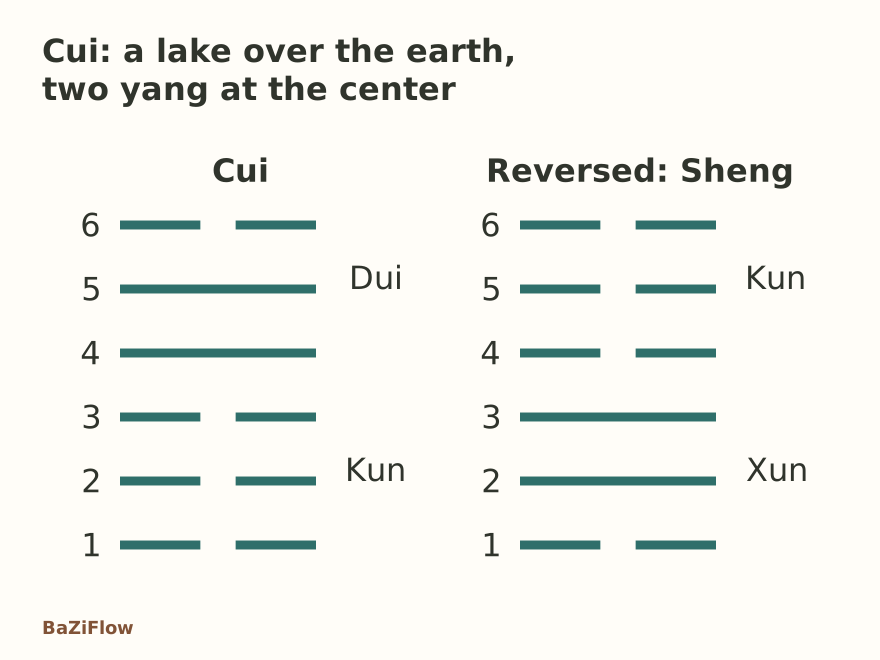
Cui and its reversed hexagram Sheng: the three yin lines at the bottom of Cui end up at the top of Sheng.
Enlarge diagram · scroll sideways to read
Three words in Cui
- Cui
- The Commentary on the Judgments and the Xu Gua both define it directly: Cui means gathering.
- Comes
- The word in “the king comes to the temple” is traditionally read as “arrives”: the king reaches the ancestral temple.
- Great sacrifice
- In “using a great sacrifice brings good fortune” it means large sacrificial animals; the whole phrase says that a grand offering is fortunate.
The judgment and the Commentary: why the gathering holds, and around what
The judgment of Cui is long and lists several matters in a row: the king comes to the temple; it is fitting to see a great person; success; fitting to stay on course; a great sacrifice brings good fortune; it is fitting to have somewhere to go. Ancestral rites, an audience with a great person, a large offering: each is an occasion on which people gather in one place.
Cui means gathering. Yielding and glad, with the firm at the center and answered: therefore they gather. “The king comes to the temple”: he brings filial offerings to their fullest. “Fitting to see a great person, success”: the gathering is upright. “A great sacrifice brings good fortune; fitting to have somewhere to go”: this follows the mandate of heaven. Look at what they gather around, and what heaven, earth and all things truly are will show itself.
Enlarge diagram · scroll sideways to read
The Commentary first explains why the gathering holds. The lower trigram, Kun, yields and the upper one, Dui, rejoices: “yielding and glad”. Line 5 is a yang line in the central place, and line 2 below it answers it: “the firm at the center and answered”. Then it goes back and gives each of the three matters in the judgment a phrase: filial offerings, an upright gathering, the mandate of heaven.
The last sentence reads: “look at what they gather around, and what heaven, earth and all things truly are will show itself.” What a crowd gathers around shows how things really stand. One way to read it: the sentence is about where things gather, not how many gather.
The Great Image: clear the weapons, guard against the unforeseen
The Great Image (大象) of Cui reads: a lake above the earth, Cui; the noble person clears the weapons and guards against the unforeseen.
Enlarge diagram · scroll sideways to read
For a hexagram of gathering, an Image that ends on guarding does not quite match the word “gather”. The word for “clear” in “clear the weapons” is traditionally read as “put in order, repair”, and “the unforeseen” is whatever was not expected. The Image gives no reason; it simply puts gathering and guarding in the same sentence. One way to read it: the more that has gathered, the more there is to be wary of.
Six lines: three gatherers, two centers, one outsider
Sorting the six lines by the shape of the figure is one possible reading: the three yin lines at the bottom are those who gather upward, the two yang lines in the middle are the center of the gathering, and the yin line at the top stands outside it.
Enlarge diagram · scroll sideways to read
Line 1: “there is sincerity but not to the end; so there is confusion, so there is gathering”. Sincerity that was not kept to the end brings confusion first and gathering afterward, and the Small Image says: the will is confused. The sentence that follows reads: if one calls out, a single grasp turns to laughter; do not worry, going is blameless. Readings of “a single grasp” differ, and only the turn from worry to laughter is kept here.
Line 2: “being drawn: good fortune, no blame”. This line is pulled along into the gathering. “With sincerity, even the simple offering is fitting”: where there is sincerity, a modest rite will do. The Small Image says the center has not changed, meaning the heart at the center stays as it was.
Line 3: “gathering, sighing; nothing is favorable”, then “going is blameless; slight regret”. The Small Image says “above, there is yielding”, where the word translated “yielding” is traditionally read as “compliant”.
Read together, the three lower lines run from confusion to being drawn along to sighing. The gatherers do not arrive in high spirits all the way.
Line 4: “great good fortune; no blame”. Four characters in the original, the shortest line in the hexagram. Yet the Small Image adds: the position is not proper. Line 4 puts a yang line in the fourth place, and that place belongs to yin. “No blame” still follows “great good fortune”, which can be taken to mean that within the good fortune one still has to watch for mistakes.
Line 5: “gathering with a position: no blame”. Then comes “where there is no trust”, and so “a primal and lasting steadfastness” is needed before regret vanishes. The Small Image says: the will is not yet bright.
Both centers carry a reservation: the position is not proper at line 4, the will is not yet bright at line 5. The Small Images place their reservations on the center of the gathering.
Line 6: “sighing and weeping, tears and mucus: no blame”. The Small Image says “not at ease at the top”: it is at the top and yet uneasy.
Sheng, Daxu and Jian: the neighbors and the Xu Gua
Turn Cui upside down and you get Sheng (升), so Sheng is its reversed hexagram (综卦): the three yin lines move from the bottom to the top. The inverse hexagram (错卦) is Daxu (大畜), which changes every line of Cui to the opposite polarity. The nuclear hexagram (互卦) is Jian (渐), made from the middle four lines of Cui: the lower three of them (yin, yin, yang) form Gen, the upper three (yin, yang, yang) form Xun, and Gen below Xun is Jian.
Enlarge diagram · scroll sideways to read
Here is how the Xu Gua fits Cui into the order: Gou is meeting, and only after meeting do things gather, so Cui follows Gou; and when what has gathered then goes upward, that is Sheng. Cui and Sheng are each other’s reversed hexagram, one gathered in one place and the other growing upward, standing side by side.
Questions readers ask next
Does Cui say that the more people gather, the better?
The text does not say that. The Commentary reads the judgment’s “fitting to see a great person, success” as a gathering that is upright, and the Great Image answers a gathering with guarding against the unforeseen. The two yang lines get “great good fortune” and “a position”, and each Small Image then adds a reservation.
What does “the king comes to the temple” mean?
Literally the king arrives at the ancestral temple; the word for “comes” is traditionally read as “arrives”. The Commentary explains the sentence as bringing filial offerings to their fullest.
How are Cui and Sheng related?
They are each other’s reversed hexagram: turn Cui upside down and you have Sheng. Cui’s three yin lines are at the bottom and Sheng’s are at the top. The Xu Gua says that what has gathered then goes upward, and that is why Sheng follows Cui.
Was this article helpful?
Sources & references
Continue reading
Gou: one yin line meets five yang, from “tied” and “wrapped” to “horns” ↗
Sheng: a tree grows in the earth, rising and offering by turns to “rising in darkness” ↗
The Sixty-Four Hexagrams: How Upper and Lower Trigrams Form One Figure ↗
Judgment and Line Statements: Whole Hexagram or Single Line? ↗