

Ding: from upturned feet to jade bar
Content version · · Sources & references
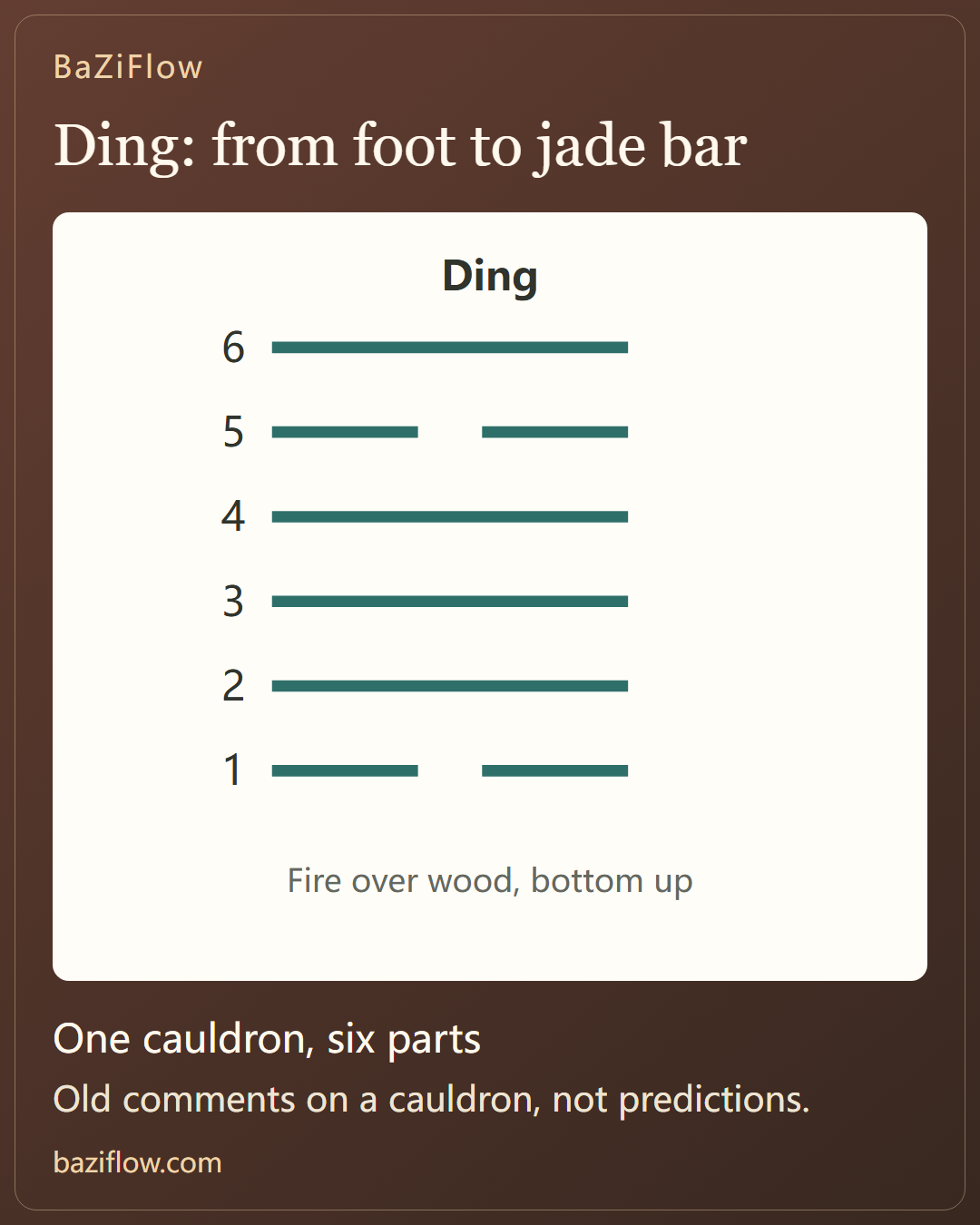
Ding is the 50th hexagram: Li (fire) above Xun (wood). Read the Commentary on cooking and nourishing, the Great Image on setting one’s place right, and six lines that run from a cauldron’s feet to its carrying bar.
The short version7 min read
The six lines of Ding inspect a cauldron one part at a time: feet, contents, ears, leg, carrying bar. When the foot goes wrong, “feet turned up” is blameless and “leg broken” is not.
- Ding stacks Li (fire) on Xun (wood). The Commentary says the name is an image of a vessel, then that wood goes into fire: that is cooking.
- The Commentary gives the cauldron two jobs: cooking for offerings to the High God, then cooking at large scale to nourish the wise. The Great Image turns to setting one’s place right and giving one’s charge a firm form.
- The lines name feet, contents, ears, a leg, ears with a bar, and a bar. The material of the bar moves from gold in line 5 to jade in the top line, which ends “great good fortune”.
Read first
The Sixty-Four Hexagrams: How Upper and Lower Trigrams Form One Figure ↗
Judgment and Line Statements: Whole Hexagram or Single Line? ↗
Wood below, fire above: the parts of a cauldron
A ding is a cooking vessel that also served in sacrifice: three legs holding up a belly for the food, two ears on the rim, and a bar threaded through the ears so that it can be lifted. The name of the hexagram takes that object as its image. Xun (wood) lies below and Li (fire) above: fire burning on wood.
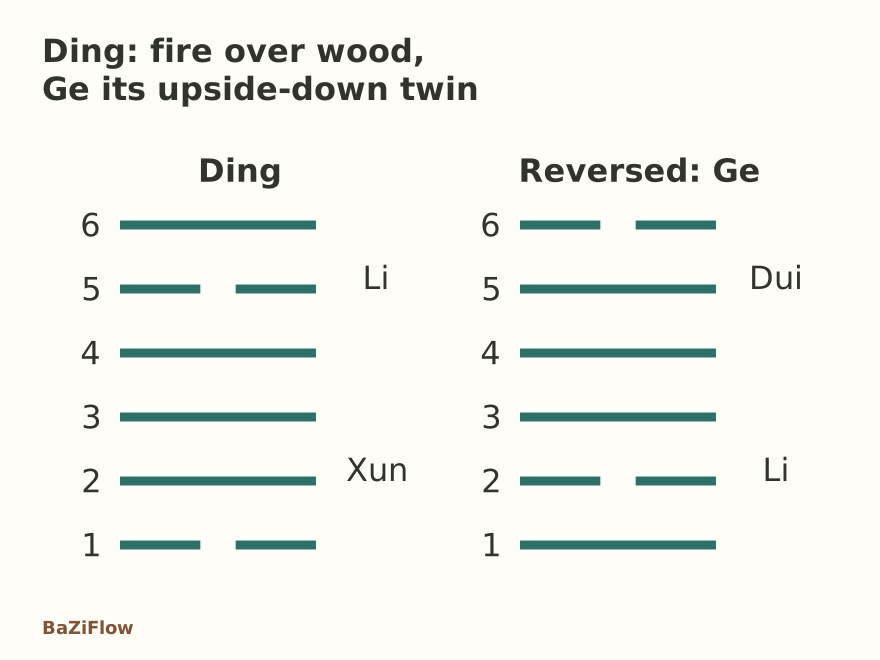
Ding and its reversed hexagram Ge: turn Ding upside down and you have Ge, and the Za Gua sets the two in a single line.
Enlarge diagram · scroll sideways to read
Four words to know first
- Feet and leg
- The supports of the cauldron. Line 1 says its feet are turned up, line 4 says its leg breaks: both are about trouble at the foot.
- Ears and bar
- The ears are the two handles on the rim; the bar is the rod run through them to lift the vessel. Lines 5 and 6 describe what the bar is made of.
- Contents
- What the cauldron holds. Line 2 begins with exactly that: the cauldron has contents.
- Stew
- The word spilled in line 4, “the duke’s stew”, is food cooked in a nobleman’s cauldron; tradition usually reads it as a thick soup.
The judgment and the Commentary: three characters and a pot on the fire
The judgment of Ding is only “primal good fortune; success”. The Commentary on the Judgments does not take the words one at a time. It first answers a different question: why is this hexagram called a cauldron?
Ding is an image. Wood goes into fire, and food is cooked. The sage cooks to make offerings to the High God, and cooks on a large scale to nourish the wise and worthy.
Enlarge diagram · scroll sideways to read
“Ding is an image” says the name is taken from the shape of a vessel. “Wood goes into fire”: the Shuo Gua says “Xun means entering” and “Xun is wood”, so wood is put into the fire and burns. The heng in “heng ren” is traditionally read as “peng”, to cook. Then the same cauldron does two jobs: first it makes offerings, then it cooks “on a large scale”, to nourish the wise.
After this the Commentary adds a few short clauses on the trigrams and the figure: “gentle, with ears and eyes keen and clear”, “the soft advances and goes upward”, “gains the middle and answers the firm”, and it ends on “therefore primal success”. Checked against the lines: line 5 is yin and sits at the center of the upper trigram, while line 2, its counterpart at the center of the lower trigram, is yang, so the pair answers across yin and yang. There is also a one-word difference between the two texts: the judgment reads “primal good fortune; success” and the Commentary closes with “primal success”, with no “good fortune”. Whoever quotes them should say which one is followed.
The Great Image: fire on wood, setting one’s place right
Above the wood there is fire: Ding. The noble person sets his place right and gives his charge a firm form.
Enlarge diagram · scroll sideways to read
Wood below is fuel and fire above is burning it; that is the image. The noble person takes two acts from it. “Setting the place right”: the place is where one stands, and to set it right is to put it in order. “Giving the charge a firm form”: the verb means to gather and settle, and the object is traditionally read as a charge or a mandate.
Neither act involves advancing or going out. The Image speaks of standing firm and of drawing together, which fits the vessel: a cauldron has to stand steady before it can cook, hold or be carried.
Six lines: feet, contents, ears, leg, bar
The six statements read like an inspection of a cauldron from the bottom up: first the feet, then what is inside, then the ears, the leg, and the bar that lifts it.
Enlarge diagram · scroll sideways to read
Start with the foot. Line 1: “the cauldron’s feet are turned up; it is fitting to pour out what is stale”. With the feet in the air, the old matter inside can be tipped out, so there is no blame. The Small Image says “not against what is right”, and of pouring out the stale, that it “follows what is noble”. Line 4: “the cauldron’s leg breaks and the duke’s stew is spilled”. The verdict is misfortune, and the Small Image asks, “what trust is left?” Same part of the vessel: one is overturned, the other is broken, and one lets the old go while the other loses a whole pot of food.
Then the two middle statements. Line 2 begins “the cauldron holds contents” and goes on: “my rival is ill and cannot come near me”. The Small Image adds “mind where it goes”, since a full cauldron needs care about where it is taken. Line 3 says “the ears are changed, its carrying is blocked”, so it cannot be lifted, and “the pheasant fat goes uneaten”. Then: “as rain is about to fall, regret lessens; in the end, good fortune”. The Small Image gives just one line: “the ears are changed; it loses what is fitting”.
At the top the lines turn to the bar, and its material improves. Line 5 is “yellow ears and a gold bar; fitting to stay on course”, and the Small Image says “the middle is the substance”, line 5 being the middle of the upper trigram. The top line is “a jade bar: great good fortune, nothing unfavorable”. The Small Image says, “the jade bar is at the top: firm and gentle in measure”, which tradition usually reads as firmness and softness fitted together. The last statement of the hexagram has no bad word in it.
Ge, Zhun and Guai: neighbors of Ding, and “taking the new”
Turn Ding upside down and you get Ge (革), so Ge is its reversed hexagram (see the figure above). The Xu Gua says that nothing changes old things better than a cauldron, and the Za Gua writes them as a pair: Ge drops the old, Ding takes the new.
The inverse hexagram (错卦) is Zhun (屯). The nuclear hexagram (互卦) is Guai (夬), which is made from the middle four lines of Ding: lines 2 to 4 are all yang and form the lower trigram, Qian; lines 3 to 5 read yang, yang, yin and form the upper trigram, Dui.
Enlarge diagram · scroll sideways to read
What follows Ding is Zhen (震). The Xu Gua gives a short reason: for managing vessels, no one is better than the eldest son, so after Ding comes Zhen, and in the Shuo Gua Zhen is exactly the eldest son. Ding is the vessel and Zhen is the one who looks after it.
Questions readers ask next
Why is Ding so often discussed together with Ge?
They are each other’s reversed hexagram: turn either upside down and you have the other. The Xu Gua places Ding right after Ge, and the Za Gua sets them in one line, one dropping the old and the other taking the new.
What does “the cauldron’s ears are changed” mean?
The text only says the ears are “changed” and adds that carrying is blocked, so the cauldron cannot be lifted easily. Tradition usually reads it as some change to the ears; the text does not say what kind.
Is the “heng” of the Commentary the same word as the judgment’s “heng”?
Not entirely. In “heng ren” and “heng to offer to the High God” it is traditionally read as “peng”, to cook. In the judgment and in the Commentary’s last line it is heng in the usual sense, getting through.
Was this article helpful?
Sources & references
Continue reading
Ge: fire inside the lake, from “the hide of a yellow ox” to the tiger’s change ↗
Zhen: how near the thunder falls, and what stays in the hand ↗
The Sixty-Four Hexagrams: How Upper and Lower Trigrams Form One Figure ↗
Judgment and Line Statements: Whole Hexagram or Single Line? ↗