

Select the role, then calculate the destination
Content version · · Sources & references
A three-row Yang-one example separates the star serving as duty chief from its changing palace, and tracks the duty door independently. Learn why a palace number cannot identify the star by itself.
The short version6 min read
Across the first three time labels of the Yang-one Yang Wood Rat group, Tian Peng travels through 1, 9 and 8 while Rest occupies 1, 2 and 3. The group head selects the role holders; separate operations locate them. A destination’s home star must not replace the selected identity.
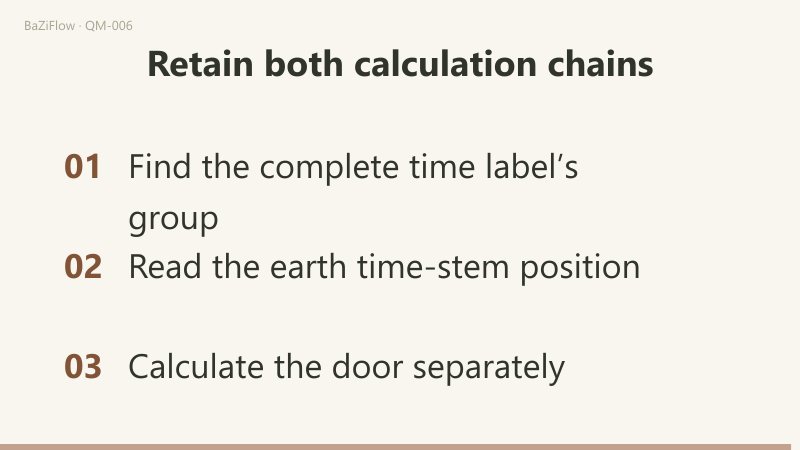
- Use the complete time label to find the group head and its earth-layer palace.
- Locate the duty star from the earth time-stem position and calculate the door destination separately.
- Movement within the group preserves the role holder; the spirit named Zhi Fu retains its own field.
Read first
A small data error can change the identity of a star
Suppose a note contains just “duty chief: palace 9.” A later reader looks up the home star of palace 9 and supplies Tian Ying. That reconstruction can be wrong even though the palace number was copied correctly. In the Yang-one, Yin Wood Ox (乙丑) example examined here, the duty chief is Tian Peng, arriving at palace 9.
The missing field is identity. A star can hold a role while its location changes; the home association of its destination does not rename it. Keeping role holder and current palace in separate columns prevents a correct position from turning into an incorrect star.
The traditional terms are Zhi Fu (值符), used here for the star serving as duty chief, and Zhi Shi (值使), the duty door. Zhi Fu also names a member of the spirit layer, so even the role label needs context. These are chart conventions, not official titles held by people in the real world.
Test the record against three consecutive time labels
The first volume of the Siku edition of Dun Jia Yan Yi gives this short sequence for Yang one. It is a worked arrangement with the configuration already supplied, not a conversion from a modern date and clock time.
| Time label | Duty star | Star palace | Duty door | Door palace |
|---|---|---|---|---|
| Yang Wood Rat (甲子) | Tian Peng | 1 | Rest | 1 |
| Yin Wood Ox | Tian Peng | 9 | Rest | 2 |
| Yang Fire Tiger (丙寅) | Tian Peng | 8 | Rest | 3 |
A useful reading test is to cover the position columns. Nothing changes in the role-holder columns. Now uncover the numbers: the two paths diverge immediately after the first row. Rest does not accompany Tian Peng to palace 9 merely because both have palace 1 as a home association.
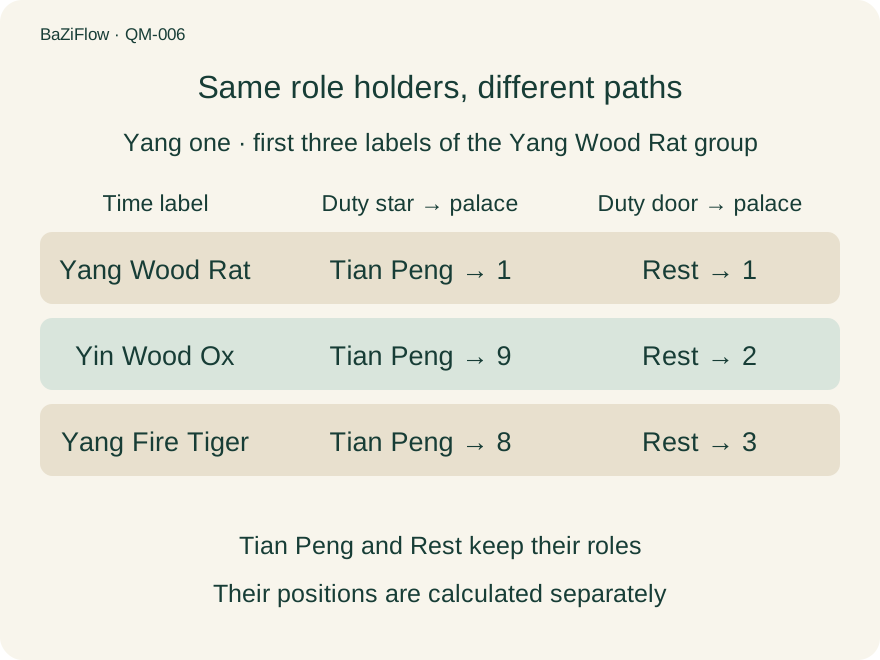
Original BaZiFlow comparison based on the Yang-one time examples in Dun Jia Yan Yi, Siku edition, volume one. No modern calendar date is calculated.
The illustration deliberately leaves out the other stars, doors and spirits. It checks a narrow claim without inventing a full chart. Nor does it identify a particular civil date: that would require time settings, a calendar calculation and a stated method of choosing the configuration.
Tian Peng
Rest
Yang one: Yang Wood Rat → Yin Wood Ox → Yang Fire Tiger
Work backwards to the ten-part group
Why do those three rows retain the same role holders? Yang Wood Rat, Yin Wood Ox and Yang Fire Tiger belong to the group of ten time labels running from Yang Wood Rat through Yin Water Rooster (癸酉). The next group starts at Yang Wood Dog (甲戌) and ends at Yin Water Goat (癸未). Yin Wood Pig (乙亥) belongs to that next group; sharing the stem Yin Wood (乙) with Yin Wood Ox does not give the two labels the same group head.
Qi Men Dun Jia Tong Zong selects the duty star and door from the home associations of the palace occupied by the group head on the earth layer. In Yang one, the Yang Wood Rat head is represented by Yang Earth (戊) at palace 1. Tian Peng and Rest therefore serve for this group. The Yang Wood Dog head is represented by Yin Earth (己) at palace 2, selecting Tian Rui and Death for the next group in this example.
Notice how much the words “in Yang one” matter. The example does not establish that every Yang Wood Rat group in every configuration must have Tian Peng as its chief. A group head associated with the center also raises a hosting rule; it cannot be resolved by silently applying an outer-palace example.
Yin Wood Ox
- Yang Wood Rat → Yang Earth
Yin Wood Pig
- Yang Wood Dog → Yin Earth
Two destinations require two calculations
For the star, the cited method places the duty chief over the earth-layer location of the current time stem. The Yin Wood stem is at palace 9 in this Yang-one base arrangement, sending Tian Peng to 9 for Yin Wood Ox. Yang Fire (丙) is at 8, sending it to 8 for Yang Fire Tiger. Consult the base arrangement in the wonders, instruments and plate layers before following those moves.
The input is the earth-layer stem position. Substituting the moving heaven-layer position would make the result depend on itself. A careful worksheet can expose that circular step even when the final chart looks plausible.
The door follows the separately specified time progression: Rest occupies 1, then 2, then 3 in these rows. Dun Jia Yan Yi explicitly pairs the star at 9 with the door at 2, then the star at 8 with the door at 3. These paired examples help resolve a confusing repeated heading in the online Tong Zong transcription, where a neighbouring passage discussing the door is headed with words about the chief and stem. The body and the parallel example matter more than the heading alone.
This short sequence does not supply a universal clockwise rule. Changing to a yin arrangement, encountering the center or selecting another placement method requires its own instructions. A correct three-row exercise is not evidence that all such settings have been handled.
Preserve the distinction when the spirit is added
Tong Zong also describes placing the spirit-layer Zhi Fu with the palace reached by the duty star. This explains why two labels can share a location without belonging to the same category. One record describes which star is serving; the other identifies a spirit-layer symbol.
For the middle row, a compact note can retain “Yang one; group head Yang Wood Rat; duty star Tian Peng at 9; duty door Rest at 2.” If the spirit layer is required, add a separately labeled field using the stated version. Do not compress all of it into “Zhi Fu 9.” The door, star and spirit inventory helps keep these categories visible.
The result is a reproducible piece of chart reading: another person can check the group, base positions and two destinations. It does not establish that a person is in charge, that an event will succeed or that rest will occur. Those claims cannot be recovered from a role name and a palace number alone.
Star role
- Tian Peng
Spirit label
- Zhi Fu
Questions readers ask next
Can “duty chief at nine” be expanded into Tian Ying?
The coordinate alone is insufficient. Recover the setup, group head and selected identity. The cited Yin Wood Ox row puts Tian Peng at nine, so substituting the home star would corrupt the record.
Why is the first 1/1 row insufficient for checking the method?
Both destinations coincide there. An incorrect procedure that ties the star and door together can still reproduce that row. The following 9/2 and 8/3 rows reveal whether the two calculations remain separate.
What has earth Yin Wood at nine established?
It supplies the duty star’s destination under this method. The selected star identity is still needed to write Tian Peng at nine. That input neither gives the door position nor supplies the entire chart setup.
Was this article helpful?
Part of a learning path
Sources & references
Continue reading
Rotating and Flying Qimen Plates: Check the Placement Rules ↗
Choosing a Qimen significator before looking for its palace ↗