

Void branches: decade first, day or hour second
Content version · · Sources & references
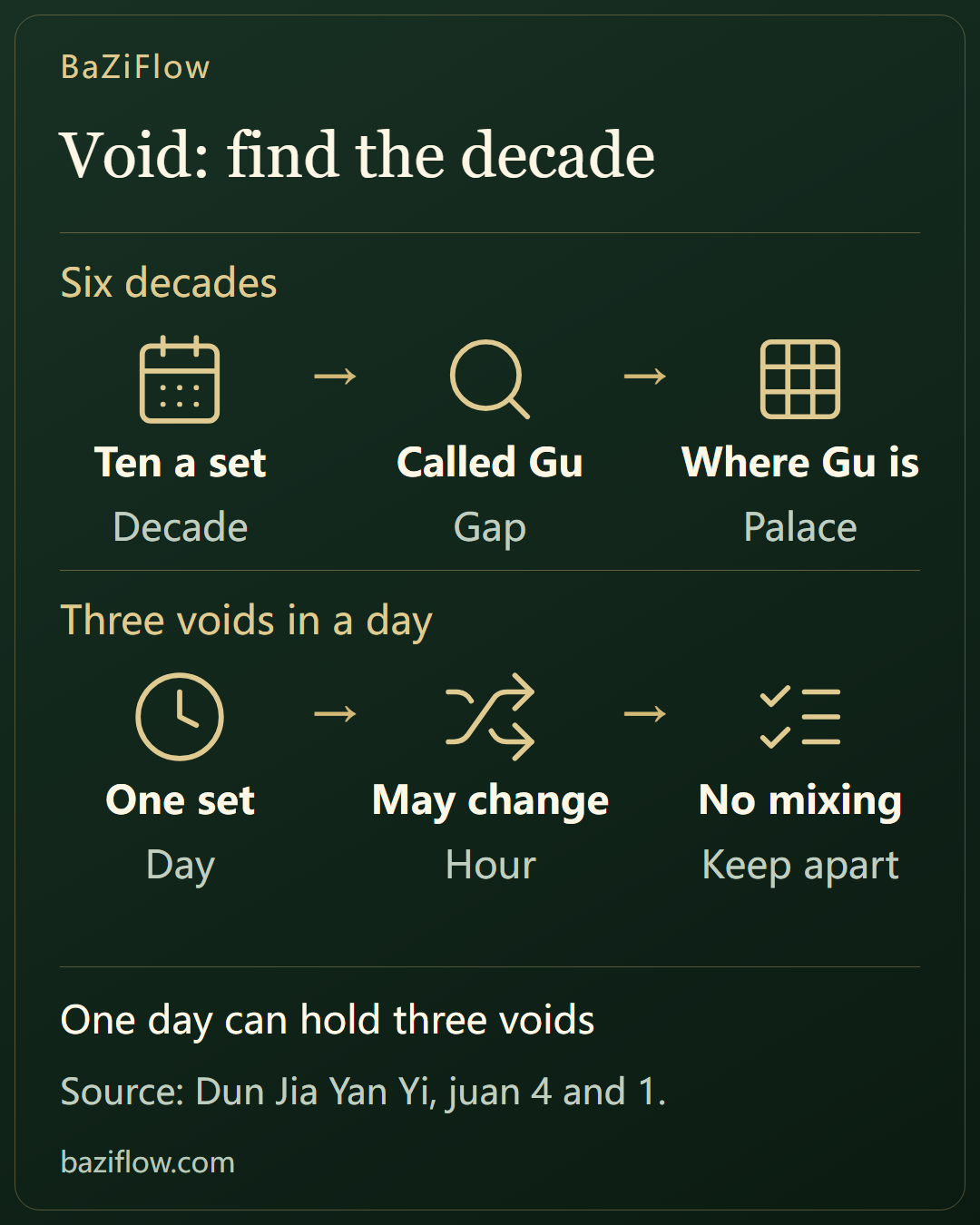
A void pair is the two branches a decade leaves out: find the decade, name the gap, then map it to palaces. The Gu-Xu chart of juan 4 is checked, and one day of twelve hours shows why day decade and hour decade differ.
The short version8 min read
A void pair is the two branches a decade never uses: find the decade the pillar belongs to, name the two missing branches, then map them to palaces; and since a day's decade and its hours' decades change, say which one is meant.
- A decade of ten pillars uses ten branches and leaves out two, the Gu pair; the two clashing with them are Xu. Across the six decades the Gu pairs split the twelve branches into six pairs, each serving once.
- One Bing Yin day holds three different voids: the day decade, Jia Zi, leaves out Dog and Pig; the first six hours fall in the Jia Shen decade, leaving out Horse and Goat; the last six in the Jia Wu decade, leaving out Dragon and Snake.
- Mapped to palaces, the Jia Zi and Jia Wu pairs each share one palace and the other four decades take two; Kun Two and Gen Eight each appear in two decades, and Center Five never.
Read first
Ten pillars to a decade, and two branches left over: Gu
Void branches start from the decade: the sixty-cycle splits into six groups of ten, a decade fills ten of the twelve branch positions, and two are left out.
Take the Jia Wu decade. Its ten pillars are Jia Wu, Yi Wei, Bing Shen, Ding You, Wu Xu, Ji Hai, Geng Zi, Xin Chou, Ren Yin and Gui Mao. They use Horse, Goat, Monkey, Rooster, Dog, Pig, Rat, Ox, Tiger and Rabbit, and Dragon and Snake never appear, so those two are this decade's void. Juan 4 of Dun Jia Yan Yi (遁甲演义) has a "Gu-Xu chart" attributed to Li Jing that calls the pair not "void" but Gu (孤, "lone"), and lists beside it the Xu (虚, "hollow"):
Jia Zi decade: Gu at Dog and Pig, Xu at Dragon and Snake. Jia Xu decade: Gu at Monkey and Rooster, Xu at Tiger and Rabbit.
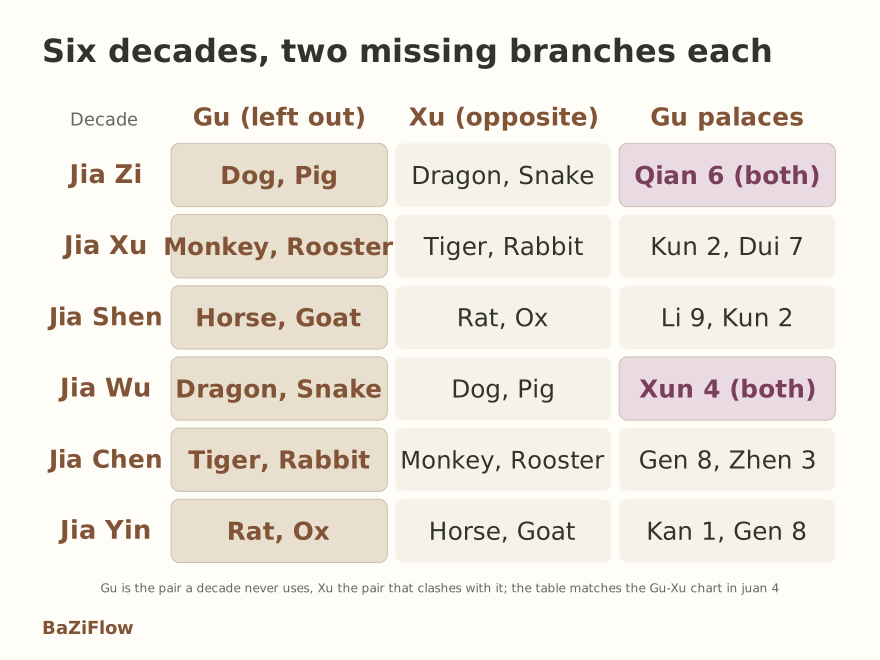
Gu-Xu table of the six decades: the pairs come from the Gu-Xu chart at the end of the games passage in juan 4 of Dun Jia Yan Yi and were recomputed decade by decade from the sixty-cycle; palaces follow the later-heaven placement of the twelve branches.
The picture sets the six decades out as a table. Gu is the pair left out, Xu is the pair that clashes with it, and the last column gives the palaces the Gu pair falls in. The table agrees item by item with the chart in juan 4, and it was recomputed decade by decade from the sixty-cycle.
Xu faces Gu: six pairs of branches, each serving once
The relation of Gu and Xu is tidy: Xu is the clash of Gu. In the Jia Wu decade Gu is Dragon and Snake, Xu is Dog and Pig, and Dragon clashes with Dog while Snake clashes with Pig.
Enlarge diagram · scroll sideways to read
The six Gu pairs are Dog and Pig, Monkey and Rooster, Horse and Goat, Dragon and Snake, Tiger and Rabbit, Rat and Ox. They divide the twelve branches into six pairs, and each pair is Gu in one decade only. The same pair in the opposite decade is Xu: Dog and Pig are Gu for Jia Zi and Xu for Jia Wu.
A day holds more than one decade: three voids in a Bing Yin day
Whichever decade a pillar belongs to, its missing pair follows that decade, and the twelve hours of a day do not all sit in the same one.
A Bing Yin day belongs to the Jia Zi decade, so the day void is Dog and Pig. But its twelve hours run like this: on a Yang Fire day the Rat hour is Wu Zi, followed by Ji Chou, Geng Yin, Xin Mao, Ren Chen and Gui Si, six hours in the Jia Shen decade, voiding Horse and Goat; then Jia Wu, Yi Wei, Bing Shen, Ding You, Wu Xu and Ji Hai, six hours in the Jia Wu decade, voiding Dragon and Snake.
Enlarge diagram · scroll sideways to read
So before "void" it must say whether the day decade or the hour decade is meant. On a Jia Zi day the first ten hours (Jia Zi to Gui You) share the day's Jia Zi decade and void the same Dog and Pig, and the decade only changes to Jia Xu at the Jia Xu and Yi Hai hours; on a Bing Yin day the hours are in a different decade from the first.
Gu on the palaces: Kun Two and Gen Eight appear twice
To turn two branches into palaces, look up where each branch lives in the later-heaven trigram layout: Rat in Kan, Ox and Tiger in Gen, Rabbit in Zhen, Dragon and Snake in Xun, Horse in Li, Goat and Monkey in Kun, Rooster in Dui, Dog and Pig in Qian. Dog and Pig share Qian and Dragon and Snake share Xun, so the Jia Zi and Jia Wu Gu pairs take just one palace and the other four decades take two.
Enlarge diagram · scroll sideways to read
Kun Two is reached by the Jia Xu decade (Monkey) and the Jia Shen decade (Goat), Gen Eight by the Jia Chen decade (Tiger) and the Jia Yin decade (Ox). Center Five never appears, because none of the twelve branches belongs to the center.
How the book uses it: one gambling rule, one line on void
The book treats Gu and Xu in juan 4, as a rule for a game of chance:
By the Yang Wood decade of the exact hour, the one seated on Gu wins and the one seated on Xu loses.
Read literally, it takes the decade of the "exact hour", which is the hour decade; whoever sits on Gu has the advantage and whoever sits on Xu loses. Here Gu is the favored side, the opposite of the later habit of reading a void as "coming to nothing"; the book gives no reason at this point and this site adds none.
The word for void branches itself appears once in juan 1, in a line of the opening note about how to choose for building:
Though you offend the void branches and the taboo baneful stars, ask only that this chart hold a wonder.
That is, even if a void and the forbidden stars are touched, all that is asked of this chart is a wonder. Neither passage says what happens when the void branches land on a palace, and neither separates the outcome by day decade and hour decade.
Find the decade first
Which two branches does the Jia Xu decade leave out, and which palaces do they map to?
It leaves out Monkey and Rooster. Monkey is in Kun and Rooster in Dui, so the palaces are Kun Two and Dui Seven; the Xu pair opposite is Tiger and Rabbit.
On a Bing Yin day, what is the decade of the Horse hour and which pair is void?
The Horse hour of a Yang Fire day is Jia Wu, in the Jia Wu decade, which leaves out Dragon and Snake, both in Xun Four.
The day void is Dog and Pig. Is that also the void of every hour that day?
No. On a Bing Yin day the first six hours void Horse and Goat and the last six Dragon and Snake; only on some days do some of the hours share the day's own decade, as the first ten hours of a Jia Zi day do.
Two branches missing from a decade take no star or gate away from the palace they map to. A way to read a void marker alongside Fu Yin and Fan Yin on the same chart is shown in reading Fu Yin, Fan Yin and the void branches; how the same word is used in Liuyao is in what separates a void from a month break; the state before this one is what makes Fan Yin hold.
Questions readers ask next
Are void branches, empty death and Gu the same thing?
As a calculation they name the same pair of branches, the two a decade does not use; the label differs by book. The Gu-Xu chart in juan 4 of Dun Jia Yan Yi says Gu and calls the clashing pair Xu, and the empty-death word appears once elsewhere. This site checks against that pair.
Why can a day void not stand in for an hour void?
The decade differs, so the missing pair differs. The whole Bing Yin day is in the Jia Zi decade, voiding Dog and Pig, but its hours from Rat to Snake fall in the Jia Shen decade and those from Horse to Pig in the Jia Wu decade, voiding Horse and Goat, then Dragon and Snake. The register also keeps day void and hour void as two entries.
When the two void branches land on a palace, is what stands there removed?
No. It is only a marker laid on a palace by mapping two branches through the later-heaven arrangement; the stars, gates, spirits and stems already there stay. The mapping itself, including lodging, is marked pending on this site.
Was this article helpful?
Sources & references
Continue reading
Fan Yin (反吟): The Position of Four Steps, or the Name of Jia Zi Against Jia Wu ↗
Strike Punishment (六仪击刑): Which Instrument, Which Branch, Which Palace ↗