

One figure, two levels of information
Content version · · Sources & references
Compare a supplied Qian bottom-line change across trigram roles and Najia line markers, preserving the differences in inputs, phases and focus selection.
The short version6 min read
With Qian’s bottom line moving, Meihua assigns upper Qian as Body and lower Qian as Use. Najia keeps self at line six, which carries Dog Earth. Qian metal and the self line’s earth can both be correct because they describe different objects; exchanging their levels creates the error.
- A supplied bottom-line change from Qian to Gou is reproducible, but it cannot recover an unrecorded date, numerical input or sequence of six throws.
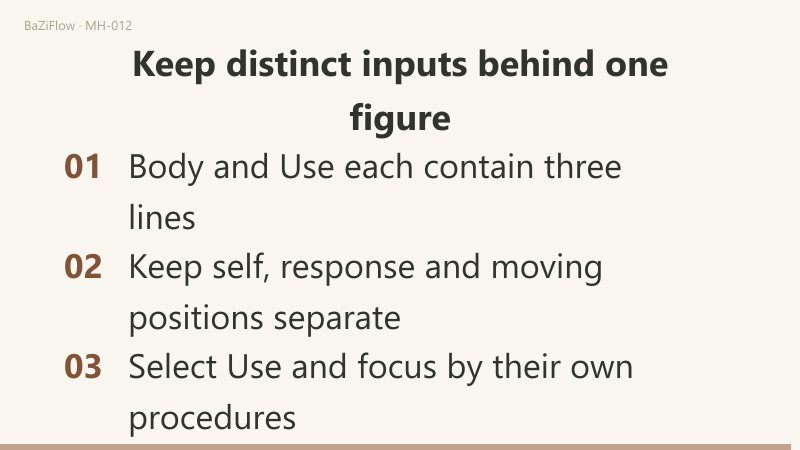
- Body and Use are three-line units; self and response are individual positions. A moving bottom line does not shift Qian’s self marker from six to one.
- The Use trigram follows the moving-position rule, while the useful spirit follows the question and relevant line category. Shared wording is not a shared procedure.
Read first
The same figure can hide two different records
Take a supplied Qian figure with its bottom line moving. Reversing that yang line produces Xun below Qian, the figure Gou. Meihua and Najia Liuyao can agree on this elementary line change while keeping very different information around it. A matching screenshot therefore does not establish that the two readings used equivalent inputs or reasoning.
The comparison here concerns a common single-moving-line body–use approach in the Meihua Yishu and the Najia line-based approach illustrated in the Zengshan Buyi. It does not cover every school that uses hexagrams, and it does not rank predictive accuracy. Qian with line 1 moving is a declared structural exercise, not a claim that both methods produced it from one historical casting.
Qian
Gou
Changing Qian’s bottom yang line to yin yields Gou; shared structure does not supply shared input records.
In Meihua, preserve the route from input to roles
Volume one of the Meihua Yishu gives several input procedures, including time and counted objects. They do not all use an interchangeable set of raw values. A complete record names the chosen procedure and preserves the numbers or observations it actually used. The common remainder-based moving-line procedure selects one position from a specified total.
For the supplied Qian exercise, the bottom line belongs to the lower Qian trigram. Under volume three's moving-versus-still allocation, lower Qian is use and upper Qian is body. Both trigrams belong to metal, producing same-phase accord at this level. Body and use are each three-line units, not labels for the top and bottom individual lines. See assigning body and use for that procedure.
No date or object count has been supplied here, so the original casting cannot be reconstructed. It would be possible to invent numbers yielding the desired figure, but those would be new inputs rather than recovered evidence. A structure exercise can be complete for its limited purpose while an actual case record would still be incomplete.
Qian
Given Qian line one moving, lower Qian is Use and upper Qian Body, each a three-line unit.
Najia adds information to individual lines
The Zengshan Buyi's chapters on branch placement, six relations and self–other positions provide additional layers. In its Qian example, the line branches upward are Rat Water, Tiger Wood, Dragon Earth, Horse Fire, Monkey Metal and Dog Earth. The self line is position 6 and the other line position 3. Marking line 1 as moving does not move the self marker to line 1.
| Feature of the supplied Qian | Meihua body–use level | Najia Liuyao level |
|---|---|---|
| Bottom line moves | Lower Qian contains it and becomes use | Position 1 moves; self remains at 6 |
| Upper three lines | Upper Qian metal is body | Horse Fire, Monkey Metal and Dog Earth are distinct line branches |
| Reference markers | Two trigram roles | Individual self and response positions: 6 and 3 |
Qian being assigned to metal does not make all six of its Najia lines metal. In this example the top self line is Dog Earth. Copying “upper Qian metal is body” into a Liuyao statement that the self line is metal would confuse two different layers, even though each original description was valid in its own setting.
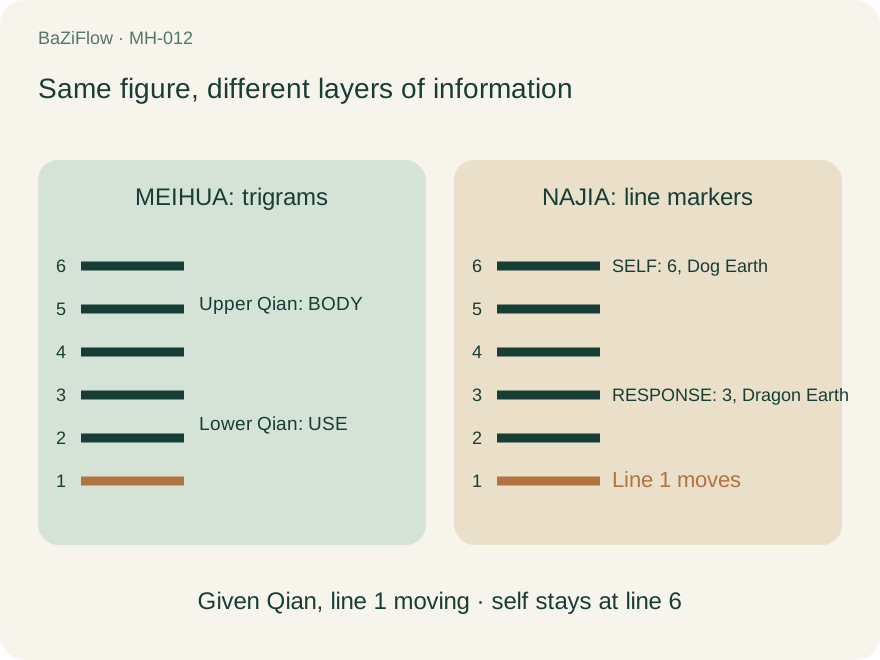
Original BaZiFlow structural comparison of a supplied figure and moving position, limited to the two named methods.
Figure level
- Qian metal
Line level
- Self 6: Dog Earth
Use trigram, useful spirit and self line are not synonyms
Meihua's initial use trigram is the three-line group selected by the body–use allocation. In Najia Liuyao, the useful spirit or focus is selected according to the subject of the question and checked against the relevant line categories. The Zengshan Buyi's chapter on selecting that focus gives different categories for different questions. A shared word in translation does not make the two selections interchangeable.
The self line is also a positional marker, not automatically the useful spirit for every question. A comparison should retain both where self is located and why a particular category is selected as the focus. Collapsing them into an unexplained “main line” removes the basis for checking the reading. The basics of Liuyao introduces these line-level records.
Time is not an exclusive property of either method. Najia records examine day and month conditions alongside moving lines and relations; Meihua also discusses seasonal strength. The useful question is how time enters a declared procedure: as a casting input, an interpretive condition, or both. Since this exercise gives no day or month, it cannot establish a cycle void, month break or specific line strength.
Use trigram
- Group containing movement
Useful spirit
- Question selects line category
Preserve every moving mark before comparing methods
The remainder procedure chosen for the Meihua side selects one moving position. A Najia record can have zero through six moving lines. The Zengshan Buyi states that unmoving lines do not change and also illustrates, in the edition transcribed on Wikisource, Xu changing to Song with lines one, three, four and six all moving. Removing one mark to fit a single-line worksheet would alter the record.
Using two methods to consider one question requires two clearly documented procedures. If a figure obtained by one method is then read through another framework, label the additional reading and identify what information is missing. Do not silently invent the original throws, values or time conditions from the final picture.
A common figure establishes a shared line pattern, not shared interpretive evidence. More terminology likewise does not by itself demonstrate greater accuracy. Continue with recording six casting results to see why a Najia record needs to retain its individual outcomes rather than only the finished hexagram name.
Meihua remainder rule
- One moving position
Najia throw record
- 0–6 moving lines
Questions readers ask next
How can Qian be metal while its self line is Dog Earth?
The metal classification belongs to the trigram or palace level. Najia branch assignment supplies different information to each line: Qian’s top line is Dog Earth and carries self. Copying the whole-figure phase onto that line confuses the two levels.
Does a moving bottom line shift Qian’s self position to the bottom?
No. The current primary figure retains separate moving and self fields: Qian has self at six and other at three, while one is moving. Discussing the changed Gou figure’s own self position is a separate record, not a rewrite of Qian.
Is a shared hexagram screenshot enough to compare complete readings?
No. A Meihua case needs the named input procedure and original values; a Najia case also needs individual results, day and month, line markers and question-based focus selection. The picture establishes only the common line pattern.
Was this article helpful?
Sources & references
Continue reading
What is Liu Yao? From a single question to an assembled hexagram chart ↗