

BaZi and Zi Wei: compare the reasoning, not the labels
Content version · · Sources & references
A method for reading two Chinese chart traditions side by side without inventing one-to-one equivalents or counting agreement as proof.
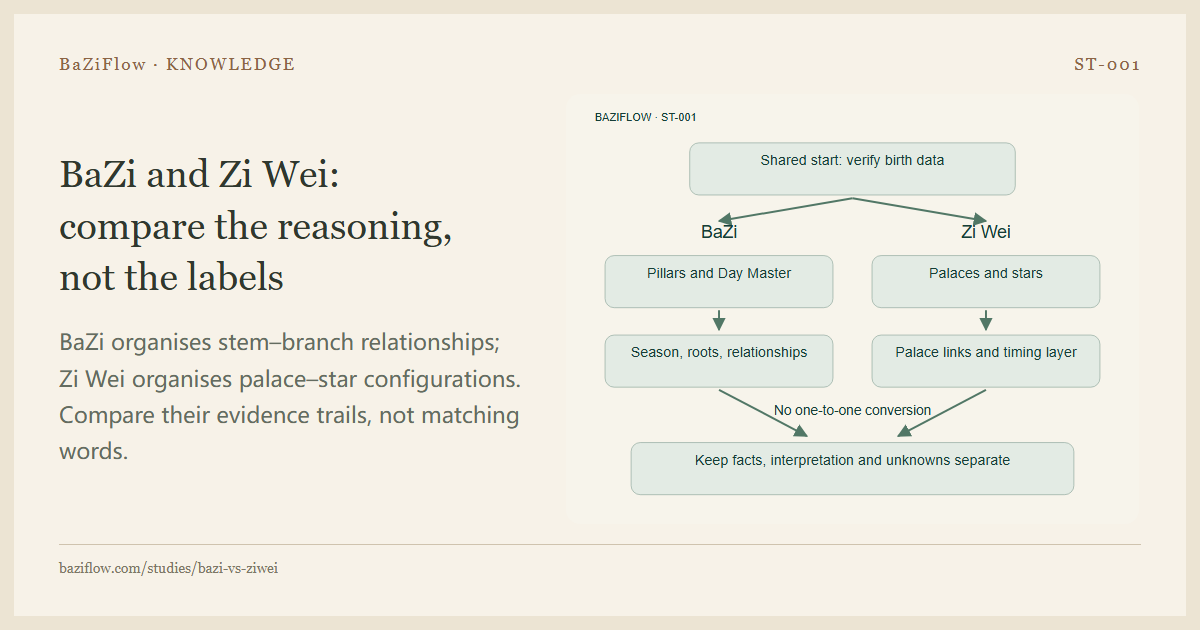
BaZi organises stem–branch relationships; Zi Wei organises palace–star configurations. Compare their evidence trails, not matching words.
The translation trap
“Wealth” appears in English discussions of both BaZi and Zi Wei. That does not make the two terms equivalent. In BaZi, a Wealth category describes a five-phase relationship relative to the Day Master. In Zi Wei, the Wealth palace is a location for a topic. One is a relational classification; the other is a compartment within a chart.
The same problem arises when Officer or Seven Killings is equated with the Career palace. Shared everyday associations do not establish a shared variable. A useful comparison starts by preserving the original definitions, even when that makes the side-by-side table less tidy.
Trace two different reading routes
In a basic BaZi study sequence, establish the four pillars and identify the Day Master. Then examine hidden stems, relational categories, seasonal conditions and combinations. Different approaches emphasise balancing, patterns or climate differently. Name the approach instead of treating every conclusion as the output of a universal algorithm.
Zi Wei begins with its palace and star-placement rules. Identify the Life and Body markers, the topic palace and the actual stars, then examine relationships using a stated school. Keep natal, decade and annual material separate. Similar stage terminology does not mean the timing boundaries or calculations match BaZi.
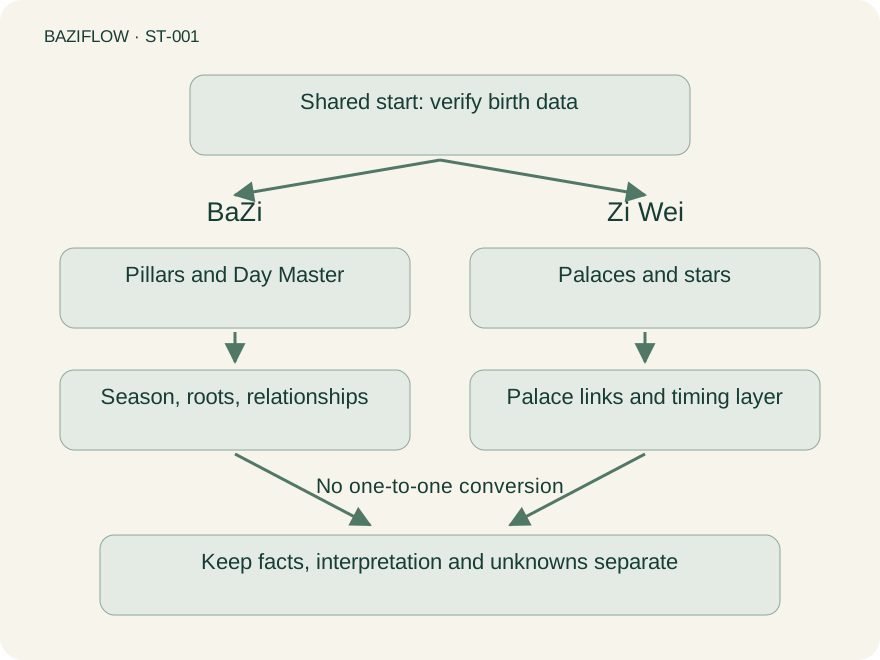
A conceptual guide, not a personal chart or a strength score.
A comparison worksheet that can expose disagreement
Use four columns: source data, claim within its own tradition, observable real-world information, and unresolved conditions. For a career question, job responsibilities and contract terms belong in the real-world column. A symbolic statement about resources must not quietly replace salary information.
Record a BaZi observation such as a stem–hidden-stem correspondence separately from the judgement built on it. Roots, exposed stems and season provides a worked example of that separation. For Zi Wei, use the introductory guide and the palace glossary to identify what the chart actually displays before interpreting it.
Test three outcomes, not just agreement
First, both readings recommend change. Ask whether each gives discriminating chart evidence or merely repeats a broad encouragement. Agreement between two flexible interpretive systems is not independent proof.
Second, one reading favours continuity while the other discusses movement. Check that both answer the same question over the same period. Then compare birth settings, calendar conventions, school and reasoning. Preserve a remaining disagreement rather than selecting whichever answer feels better.
Third, the birth time is uncertain. Identify which structures change in each tradition. Do not use an appealing paragraph from one system to manufacture a precise input for the other. That would turn an interpretation into supposed source data and conceal the original uncertainty.
What the historical sources establish
Zi Ping Zhen Quan discusses how season and whole-chart conditions can diverge; Zi Wei Dou Shu Quan Shu records procedures for palace and star placement. These sources document different internal methods. They do not establish that the systems validate each other's predictions.
The aim is not to crown a winner or build a dictionary of interchangeable symbols. It is to write a complete chain from data to interpretation in each framework, notice where assumptions enter, and keep practical decisions connected to evidence outside the charts. If the comparison yields only two sets of similar adjectives, it has not yet done that work.
Sources & references
Continue reading
Roots, exposed stems and seasonal support in BaZi ↗
What is Zi Wei Dou Shu? A first guide to palaces and stars ↗