

Zhen (震): one yang line below, and the first stop
Content version · · Sources & references
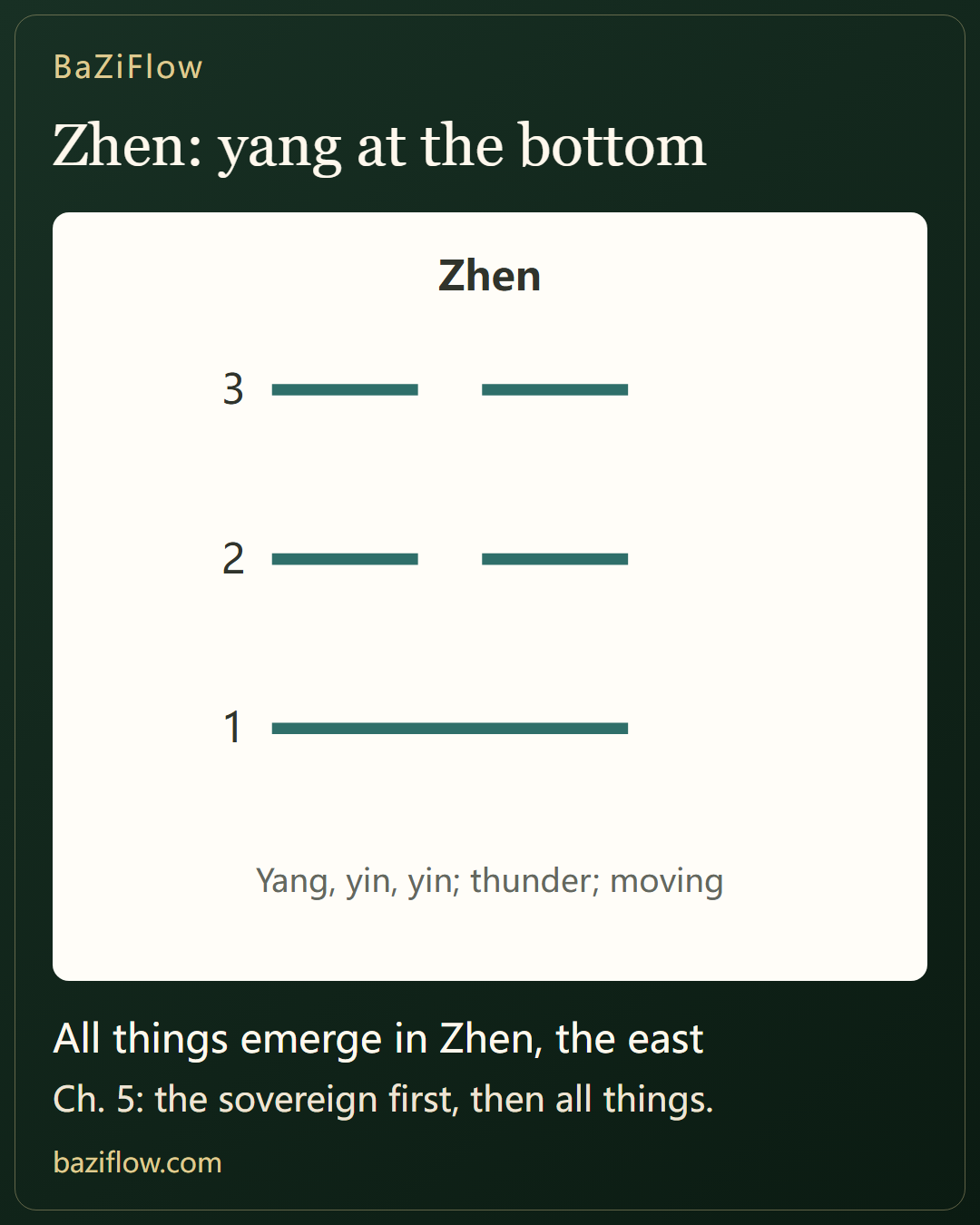
Zhen has a yang line at the bottom under two yin lines. See where that line sits among the one-yang trigrams, the chapter 5 journey that starts here, two wordings for thunder and wind, and how the chapter 11 list ends.
The short version5 min read
Chapter 5 of the Shuo Gua lays out a journey of eight stops, "the sovereign emerges in Zhen", and the first stop is Zhen; the chapter 11 list for Zhen ends with "its end is strength". The figure is a yang line at the bottom with two yin lines pressing down on it.
- Zhen, Kan and Gen each have one yang line and two yin lines; they differ only in where the yang line stands: bottom for Zhen, middle for Kan, top for Gen.
- Chapter 5 starts its eight-stop journey with "the sovereign emerges in Zhen" and adds "Zhen is the east".
- For thunder and wind, chapter 3 says they "press on each other" and chapter 6 says they "do not go against each other"; the chapter 11 list for Zhen ends with "its end is strength and abundant freshness".
Read first
Eight Trigrams: Three-Line Structure and Basic Images, Read Through the Shuo Gua ↗
Yang at the bottom: three trigrams with one yang line
Zhen (震) has a yang line at the bottom with two yin lines pressing down on it; the memory verse likens it to a bowl lying open face up. Three of the eight trigrams have one yang line and two yin lines, and they are made from exactly the same lines, with the yang line standing in a different place:
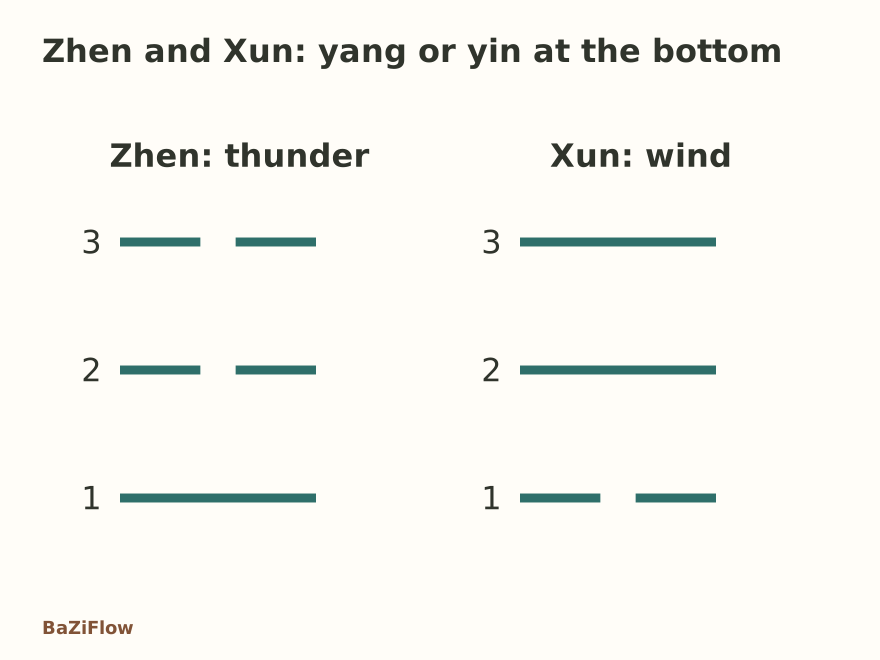
Zhen beside Xun: every line is opposite; Zhen has yang at the bottom and Xun has yin at the bottom.
Enlarge diagram · scroll sideways to read
Zhen's inverse is Xun (巽). Swap the polarity of every line of Zhen and the bottom line turns yin while the two above turn yang, which is Xun. Chapter 3 of the Shuo Gua (说卦) says "thunder and wind press on each other", and it means this pair.
"The sovereign emerges in Zhen": the first of eight stops
Chapter 5 opens with a journey of eight stops:
The sovereign emerges in Zhen, sets things even in Xun, meets them face to face in Li, has them serve in Kun, speaks with joy in Dui, contends in Qian, toils in Kan, and completes in Gen.
The subject is "the sovereign", and the journey begins at Zhen. The text then explains the trigrams one by one, and the first entry is Zhen:
All things emerge in Zhen. Zhen is the east.
Enlarge diagram · scroll sideways to read
The Later Heaven diagram was laid out in exactly this order, with Zhen in the east as the start of the circle. On the Prior Heaven diagram Zhen stands in the northeast, opposite Xun in the southwest.
Two ways of saying the same pair
Thunder and wind are a pair. Chapter 3 sets four pairs side by side, and chapter 6, describing how pairs working together bring about change, words them differently:
Enlarge diagram · scroll sideways to read
Thunder and wind are "press on each other" in chapter 3, drawing close, and become "do not oppose" in chapter 6. Water and fire are "do not shoot" in chapter 3 and "reach each other" in chapter 6. Mountain and lake have the same wording in both. One pair, described from different angles in different chapters.
Chapters 4 and 6 also give one sentence each to thunder alone: "thunder stirs them" and "of what sets the ten thousand things moving, none is quicker than thunder".
One seeking, and the eldest son
Chapter 10 hands out the family to the eight trigrams, and the line for Zhen reads:
Zhen, by one seeking, got a son; so it is called the eldest son.
Against the figure, "seeking" is to take: Kun is three yin lines, and when it seeks for the first time the yang line it receives lands at the bottom, which gives Zhen. That is a later reading of the picture; the text gives only "one seeking" and "eldest son".
Enlarge diagram · scroll sideways to read
The Xu Gua also mentions the eldest son when it gives the order of the sixty-four: the hexagram Zhen is attached to the one before it on the ground that "for keeping the ritual vessels, none is like the eldest son". The eldest son is on the chapter 11 list for Zhen as well. The six-line Zhen is read in Zhen, the hexagram, and its Great Image speaks of thunder arriving again and again.
The end of the list: "its end is strength"
The entry for Zhen in chapter 11 finishes with these two sentences:
Of the grain: sprouting upside down. Its end is strength and abundant freshness.
"Its end" means where it ends up: after a long run that includes thunder, the dragon and the eldest son, Zhen arrives at strength and abundant freshness. Strength is exactly Qian's word in chapter 7. The list for Xun also finishes with an "its end", and that one reads "restless".
Enlarge diagram · scroll sideways to read
The same word is a nature for Qian and an ending for Zhen. To read Qian, go on to the Qian trigram; for Xun, to the Xun trigram.
Questions readers ask next
Who is the sovereign in "the sovereign emerges in Zhen"?
The text writes only "sovereign" and never says who that is; when chapter 5 goes on to explain the trigrams one by one, the subject becomes "all things", and the entries give each trigram's place and what happens to things at that stop without coming back to the sovereign. All one can say is that the sovereign is the subject of the eight-stop journey. What it stands for needs support from elsewhere and cannot be drawn from this sentence.
Why is Zhen the eldest son by "one seeking"?
Chapter 10 says that Zhen got a son by one seeking, so it is called the eldest son. Read against the figure, among the trigrams with one yang line the one whose yang sits at the bottom is Zhen, so it comes first and is called eldest. That is a reading of the picture; the text gives only "one seeking" and "eldest son".
Do "press on each other" and "do not go against each other" contradict?
No. They sit in chapters 3 and 6. Chapter 3 lists four pairs, and pressing on each other means drawing close; chapter 6 says that pairs working together bring about change, and not going against each other means not opposing. The two describe the same pair and can stand together.
Was this article helpful?
Sources & references
Continue reading
Li (离): a broken line in the middle, the word "clinging" and facing the light ↗
Xun (巽): yin at the bottom, wind and wood, and "set even in Xun" ↗
Trigram imagery: why a round clay bowl has two possible routes ↗