

Gen (艮): yang on top, an end that begins
Content version · · Sources & references
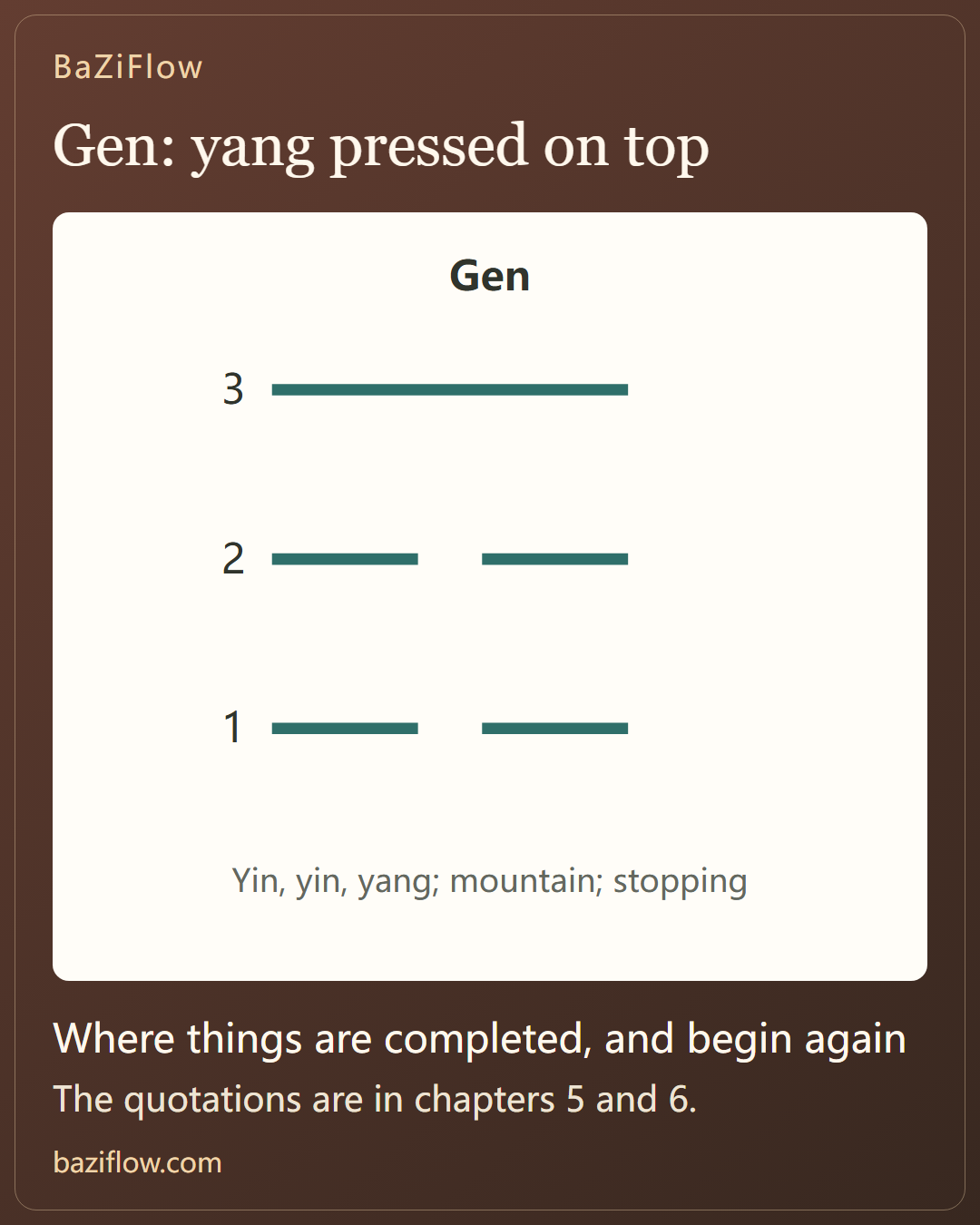
Gen has a yang line on top over two yin lines and is Zhen upside down. Read the last stop of the chapter 5 journey, an ending that becomes a beginning, the two verbs of chapter 6, the Xu Gua link and hexagram 52.
The short version5 min read
The eight-stop journey of chapter 5 sets out from Zhen and closes at Gen, where, the text says, all things complete their ending and their beginning. Gen's figure, a yang line on top of two yin lines, is Zhen turned upside down: one string of lines, first stop at one end and last stop at the other.
- Gen and Zhen are the two ends of one string of lines: yang at the bottom for Zhen and at the top for Gen; one is the first stop of the eight-stop journey and the other the last.
- Chapter 6 lists six things; the other five get one verb each, and Gen is given two: it ends things and it begins things.
- The Xu Gua attaches Gen right after Zhen because things cannot keep moving to the end and so stopping follows; the Commentary adds "stop when it is time to stop, move when it is time to move".
Read first
Eight Trigrams: Three-Line Structure and Basic Images, Read Through the Shuo Gua ↗
The two ends of one string of lines: Gen and Zhen
Gen (艮) has a yang line on top, pressing down on two yin lines, and the memory verse calls it "Gen is a bowl turned over". Turn it upside down and you have Zhen (震): the same one yang and two yin lines, with the yang line dropped from the top to the bottom.
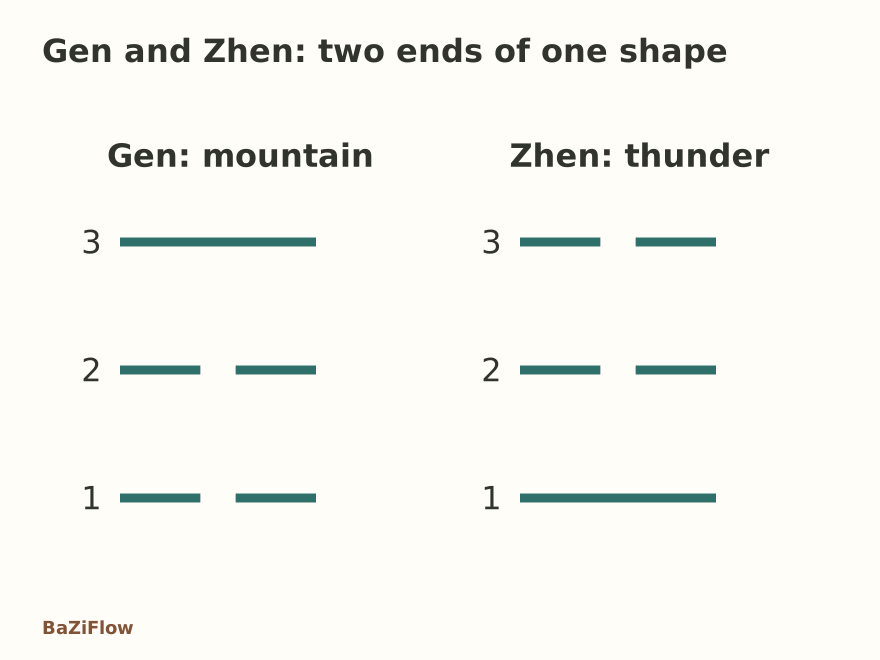
Gen beside Zhen: Gen has its yang line on top and Zhen at the bottom, and each is the other turned upside down.
Enlarge diagram · scroll sideways to read
In the eight-stop journey of chapter 5 of the Shuo Gua (说卦) the two trigrams hold the head and the tail: Zhen is where "the sovereign emerges" and Gen is where things are "completed". Chapter 10 puts Gen last among the three sons, "Gen, by a third seeking, got a son", the youngest son.
Stopping, and the places where one stops
Gen's nature is a single word, stopping. It appears in only a few places in the Shuo Gua:
Gen's stopping and its list
Gen stops them
Among the eight verbs, Gen receives "stop": to bring things to a halt.
Gen is stopping
One of the eight nature words.
Paths, gate towers, gatekeepers
Three items on the list have to do with roads and doors: a footpath, a gate tower, a keeper of the gate. Later readers often link them to stopping, but the text only lists them.
Gen's list begins with the mountain and goes on with a footpath, small stones, a gate tower, fruits and gourds, a gatekeeper, the finger, the dog, the rat and the creatures with dark beaks, and then opens one more sentence: "Of trees, hard and full of knots." Large and small things are mixed: the mountain is large, while small stones and the finger are small.
An ending that becomes a beginning: the northeast, the last stop
What chapter 5 says of Gen repays a close reading:
Gen is the trigram of the northeast. It is where all things complete their ending and complete their beginning. Therefore it is said, completed in Gen.
The northeast is Gen's place; the two phrases stand side by side, things completing their ending here and completing their beginning here, so the end and the start fall at one stop. Chapter 6 has one more line on Gen:
Of what ends things and begins things, none does it more fully than Gen.
Enlarge diagram · scroll sideways to read
Chapter 6 lists six things, and the first five get one verb each: thunder stirs, wind bends, fire dries, the lake delights, water moistens. Gen is given two, ending and beginning. The journey closes at Gen, and this line of Gen's joins the end back to the start. On the Prior Heaven diagram Gen stands in the northwest, opposite Dui in the southeast.
Moving and stopping: the Xu Gua and the Commentary
In the order of the sixty-four, Gen comes straight after Zhen, and the Xu Gua gives this as the reason:
Things cannot keep moving to the end; stopping follows.
That is, nothing can go on moving for good, so stopping takes over from moving. The Commentary on the Judgments adds a line at Gen to say that stopping is not standing still forever:
Enlarge diagram · scroll sideways to read
Stopping and moving follow each other, and both go by the moment: stop when the moment says stop, move when it says move. That is the measure the text gives to stopping.
Doubled mountains
The six-line Gen is hexagram 52, and its Great Image begins with two mountains laid on each other:
Doubled mountains: Gen.
What follows turns to the noble person's conduct: thought that does not leave its own position. The judgment has "keep to the back", while chapter 9 gives the trigram the hand; one takes the back and the other the hand, because different texts take different images, and there is no need to force them into one.
Enlarge diagram · scroll sideways to read
The six-line Gen is read in Gen, the hexagram; go back to the Zhen trigram for the first stop; the inverse of Gen is the Dui trigram; and the trigram that comes last in the series is the Kun trigram.
Questions readers ask next
Where does "stop when it is time to stop" come from, and how does it differ from chapter 7?
Chapter 7 writes only "Gen is stopping" and says nothing about how long. "Stop when it is time to stop, move when it is time to move" is from the Commentary on the Judgments of hexagram 52, which puts stopping back into its moment: stop when it is time, move when it is time, not a permanent standstill.
Why is Gen the youngest son?
Chapter 10 says that Gen, by a third seeking, got a son, so it is called the youngest son. Read against the figure, among the trigrams with one yang line the one whose yang sits at the top is Gen, so it comes last and is called youngest. That is a reading of the picture; the text gives only "third seeking" and "youngest son".
What does "all things complete their ending and their beginning" mean?
It is the sentence chapter 5 uses to explain Gen: the ending of things and their beginning are both completed at this one stop. The journey leaves from Zhen and closes at Gen, and this sentence joins the end back to the start.
Was this article helpful?
Sources & references
Continue reading
Kan (坎): a yang line held in the middle, and the words sinking, toil and return ↗
Kun (坤): three yin lines, Qian’s counterpart, and two sets of images for the earth ↗
Trigram imagery: why a round clay bowl has two possible routes ↗