

Opposite, flanking and convergence
Content version · · Sources & references
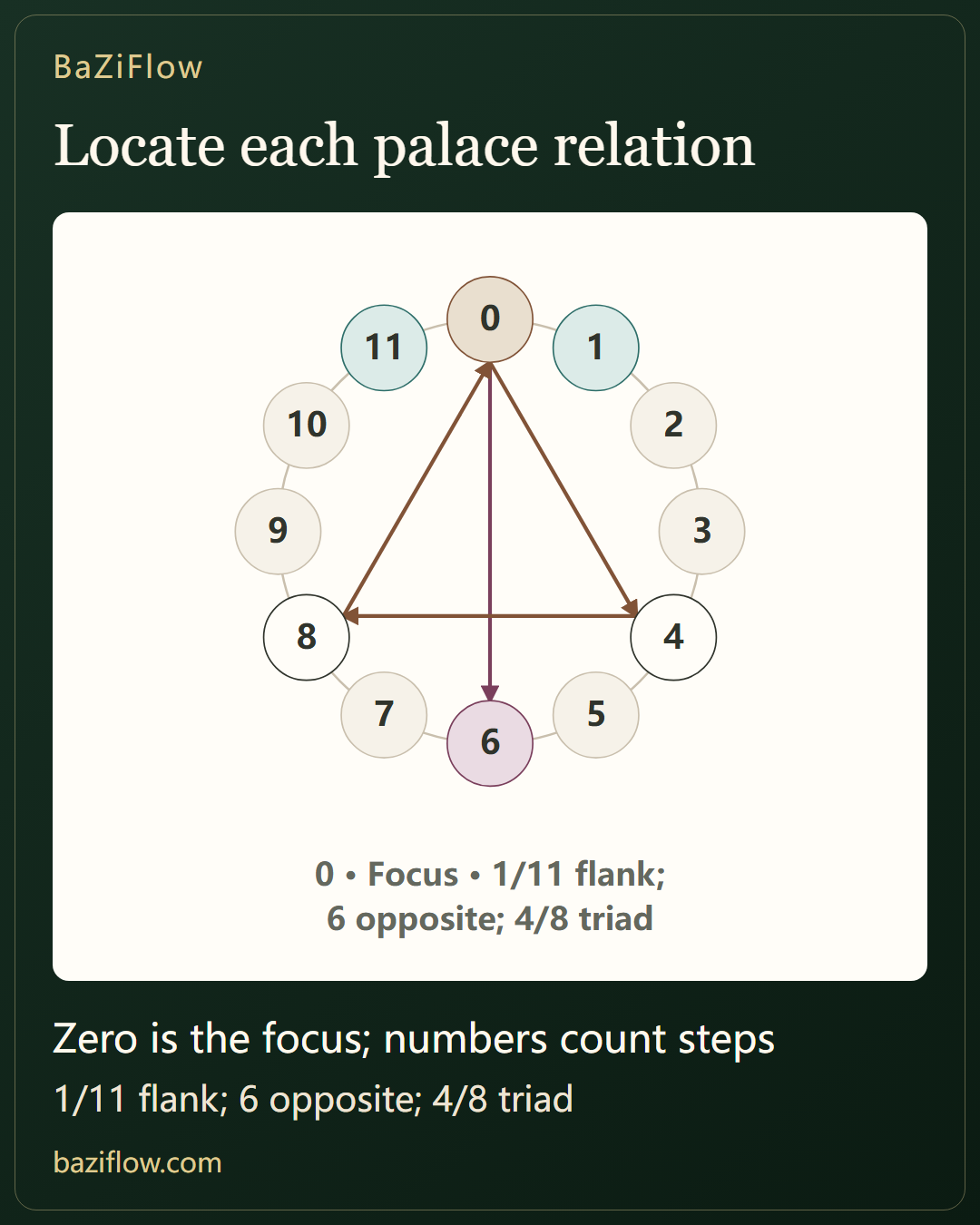
Use Monkey as a focus to distinguish its opposite, its immediate neighbors and its triad partners. Keep relationship words tied to checkable chart positions.
The short version6 min read
Saying that a star participates in a reading leaves its location unclear. It may reside in the focus, face it, flank it or belong to its triad. Count from a focus marked zero to distinguish the relations, then move the focus and test the rule again.
- The opposite lies six positions away; neighbors are one step on either side, and the other triad positions are four and eight steps away.
- Goat and Rooster neighbor Monkey. With Rat as the new focus, the neighboring pair becomes Pig and Ox instead.
- A named flanking pattern requires its specified stars as well as both adjacent positions; convergence needs a stated scope.
Read first
Three sides, four directions: the four palaces read together ↗
Turn a relationship word into a location
A reading may say that a star resides in, faces, flanks or converges on a palace. These expressions cannot be treated as interchangeable decoration around the star's name. They describe different positional conditions.
A star at Tiger (寅) can face a focus at Monkey (申) without also residing at Monkey. Two neighboring palaces can flank a focus without either being its opposite. If a note discards these distinctions, another reader cannot reconstruct which chart facts supported the interpretation.
This article uses an empty branch framework to practice the distinctions. No stars, birth date or personal outcome are invented. The task is to locate the relationship before deciding what any particular school makes of it.
Residence
- Tiger
Focus consulted
- Monkey
Three tests with Monkey as the focus
Choose Monkey as the target. Its opposite is Tiger, half a circuit away. Its immediate neighbors are Goat and Rooster. Its other triad positions are Rat and Dragon.
| Relationship to Monkey | Positions to inspect | What would be a mistake? |
|---|---|---|
| Opposite | Tiger | Calling it a next-door neighbor |
| Flanking neighbors | Goat and Rooster | Substituting Tiger for one side |
| Other triad positions | Rat and Dragon | Treating them as the adjacent pair |
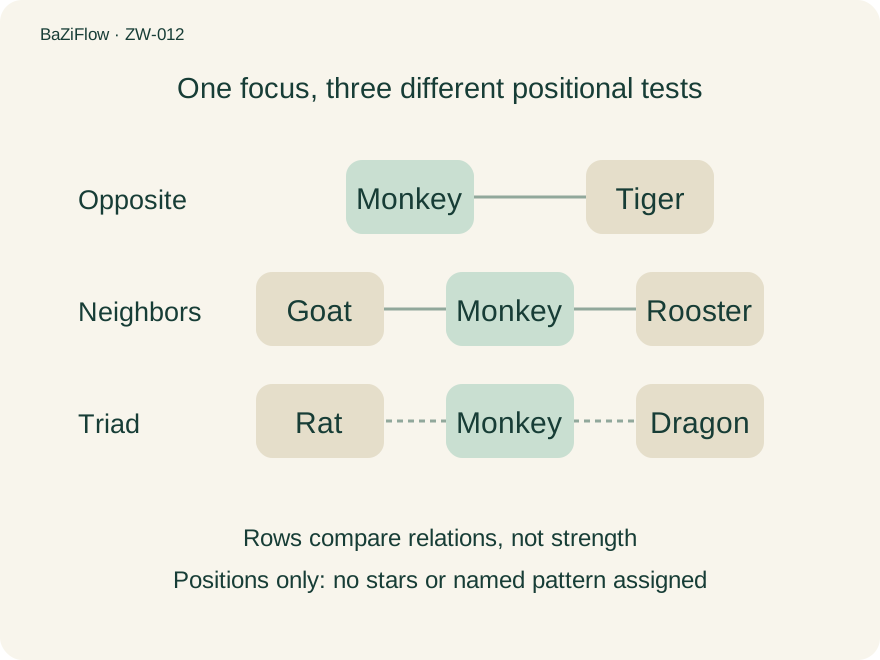
Original BaZiFlow relationship comparison. No stars are assigned and no outcome is inferred from the geometry.
Now move the focus to Rat. The opposite becomes Horse, the immediate neighbors become Pig and Ox, and the other triad positions become Monkey and Dragon. If the neighboring pair remains Goat and Rooster in your notes, you have preserved the previous picture instead of applying the relationship definition.
Screen distance is not a substitute for this test. A square chart can make several boxes look close together. Follow the twelve-position sequence and the selected focus, rather than estimating which label appears nearest on the display.
Count the focus as zero, not as the first step. Starting at Monkey gives Rooster 1, Dog 2, Pig 3, Rat 4, Ox 5, Tiger 6, Rabbit 7, Dragon 8, Snake 9, Horse 10 and Goat 11. Positions four and eight identify Rat and Dragon, six identifies Tiger, and one and eleven identify the neighbors. These numbers measure relative position, not stellar strength.
Compare two proposed pairs. Goat and Rooster occupy the two sides of Monkey. Goat and Tiger supply one neighbor and one opposite, so they cannot satisfy the same two-sided geometry. Even identical star names in the two proposed arrangements would not erase that difference. This counterexample uses an unpopulated palace framework rather than an invented birth chart.
0 · Focus
1/11 flank; 6 opposite; 4/8 triad
A named flanking configuration needs both sides
Flanking starts with the two immediate neighboring palaces. A particular named configuration may then require specified stars, their arrangement and additional conditions. Simply finding two appealing stars somewhere in the chart does not establish that configuration.
The first volume of Zi Wei Dou Shu Quan Shu contains language about assistants flanking the ruler, while its supplementary Tai Wei passage uses the idea of the two neighboring positions. These are useful examples of positional vocabulary. They do not justify applying every historical outcome attached to a configuration to a modern person.
If only one neighboring palace has been supplied, mark the two-sided condition as unverified. Do not move a second star from the focus palace into the missing side, and do not use an opposite-palace star as a substitute. Those changes would manufacture a different arrangement.
Goat + Rooster
- Both neighbors
Goat + Tiger
- Neighbor + opposite
Read convergence and illumination in their stated context
Terms translated as meeting, convergence or illumination often express relationships beyond one palace, but the exact scope depends on the author and method. Triad and opposite positions commonly matter. It is still a mistake to expand every occurrence of such a word to all twelve palaces, or to reduce every occurrence to co-residence.
Modern palace documentation defines the four-position framework through the focus, its opposite and its two triad partners; it specifically gives Rat and Dragon as Monkey's triad partners. The three sides and four directions guide develops that framework.
When writing a note, replace a vague “connected stars” list with the actual positions consulted. For Monkey, list Tiger separately from Rat and Dragon; if the reading also checks the neighbors, list Goat and Rooster in another field. The umbrella term then remains traceable instead of concealing which relationships were used.
Opposite
- Reference positions
- Tiger
Triad
- Reference positions
- Rat · Dragon
Neighbors
- Reference positions
- Goat · Rooster
Correct geometry is only the first check
The next question is whether the stated stars really occupy those positions. Brightness, transformations and timing layers also require supplied data. Knowing the Monkey–Rat–Dragon triad does not tell you which stars are there, and it does not automatically establish an elemental transformation borrowed from another system.
Location remains distinct from reference. If a star at Tiger is consulted while reading Monkey, preserve Tiger as its location. The borrowed-star guide uses the same principle to prevent an interpretive reference from becoming a false natal placement.
A timing overlay adds another condition. Natal stars, annual transformations and decade palace labels can share a display without belonging to the same layer. A relationship statement should say what is located where and which layer is under discussion.
Finally, ordinary English associations are not technical conclusions. “Opposite” does not prove personal conflict, “flanked” does not prove entrapment, and “converging” does not guarantee help. Such outcomes require more than a diagram.
For a compact reading exercise, divide a sentence into focus palace, actual star location, relationship type and interpretation rule. If the first two fields do not match the chart, repair the transcription before extending the interpretation. More elaborate star descriptions cannot compensate for a positional condition that never existed.
Questions readers ask next
Are opposite and flanking palaces both nearby positions?
No. The opposite lies half a twelve-position circuit away, while the neighbors immediately precede and follow the focus. For Monkey, Tiger is opposite and Goat–Rooster are adjacent. Screen spacing cannot replace branch order.
Do stars on both sides establish a named flanking pattern?
They establish only the positional part. A named pattern has requirements for particular stars and possibly further conditions. Any two favorable stars are not automatically that pattern, and a missing second side must not be assumed.
Does convergence include every star in the whole chart?
Not automatically. Its scope depends on the text and method. List the actual reference positions in the note—for Monkey, perhaps Tiger and the Rat–Dragon triad partners—so another reader can reconstruct the scope used.
Was this article helpful?
Sources & references
Continue reading
Why one Zi Wei palace cannot stand in for the whole chart ↗
Empty palaces and borrowed stars: keep the source location ↗