

The Fool: a step at the edge
Content version · · Sources & references
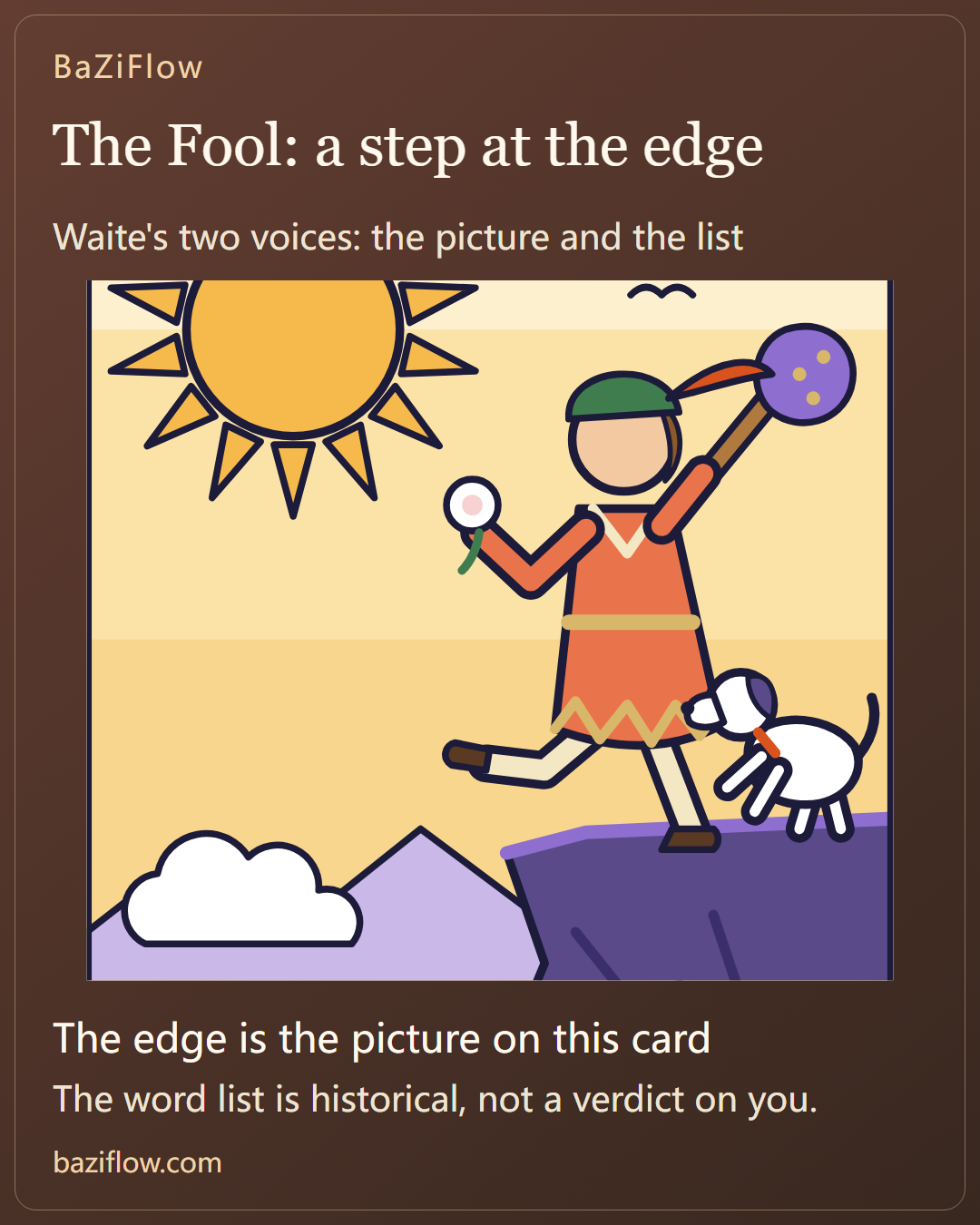
The Fool shows a young traveler pausing at a cliff edge, eyes on the distance. Separate Waite's picture commentary from his word list, then ask three questions about the bag, company and turning point.
The short version8 min read
The Fool is the card numbered 0: a young man paused at an edge, eyes on the distance, a dog still bounding at his feet. Waite speaks of it in two voices, so first tell which one you are reading.
- The picture: a young man in gorgeous vestments at the brink of a precipice, looking into the blue distance, a rose in one hand and a wand in the other with an embroidered wallet hanging from it. Waite calls him "the spirit in search of experience".
- The divinatory list has a different tone: folly, mania, extravagance, intoxication, delirium, frenzy. Waite also remarks that the Trumps Major had no original place in the card-counter arts of fortune-telling.
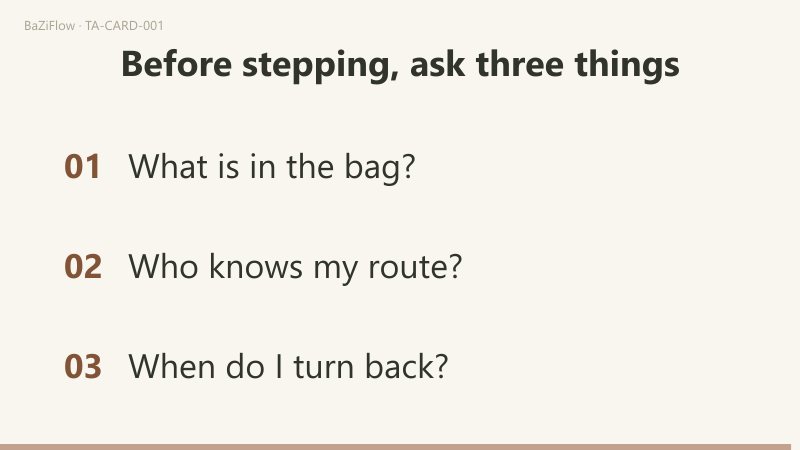
- To prepare a departure with it, rest on three questions: what is already in the bag, who goes with you or knows where you are going, and what condition makes you turn back.
Read first
Start with the picture: one step held at the edge, the stride still alive
Waite describes the Fool at greater length than most cards. A young man in gorgeous vestments pauses lightly at the brink of a precipice among the great heights of the world. He surveys the blue distance before him, "its expanse of sky rather than the prospect below".
His act of eager walking is still indicated, though he is stationary at the given moment, and his dog is still bounding. The edge "has no terror": it is as if angels were waiting to uphold him should he leap.
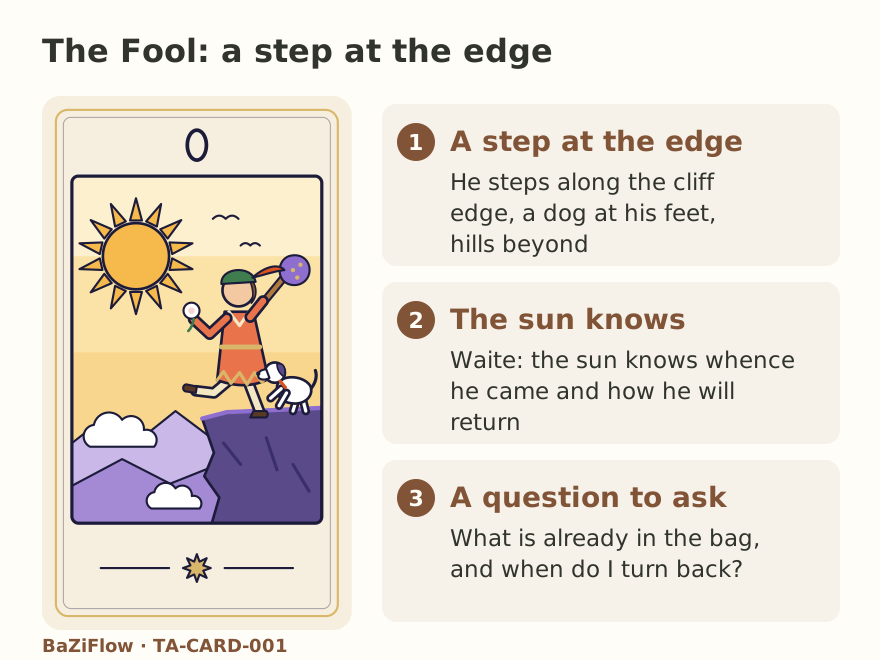
The Fool as BaZiFlow drew it for this article; the cliff, dog and sun are teaching choices, and the RWS original is composed differently.
In one hand he has a rose, in the other a costly wand, from which a curiously embroidered wallet hangs over his right shoulder. Waite calls him "a prince of the other world on his travels through this one", amid morning glory and keen air. The sun behind him knows whence he came, whither he is going, and how he will return by another path after many days.
In the Rider-Waite-Smith picture you can confirm these for yourself: the number 0 at the top; a white sun in a yellow sky; a red feather in the young man's cap, the staff over his shoulder with its small bundle, and a white flower in his other hand (Waite calls it a rose); a white dog leaping at his feet; snowy peaks in the distance. Three places hold the scene: underfoot is the edge, before the eyes is distant sky, and at his side are the flower, the staff, the bag and the dog.
Enlarge diagram · scroll sideways to read
Two voices in one book: a spirit seeking experience, and folly, mania, extravagance
Waite speaks about the Fool in two places in the book, and the tone is very different. In Part II, on the picture, he calls the young man "the spirit in search of experience", says that many symbols of the Instituted Mysteries are summarized in the card, and that it "reverses, under high warrants, all the confusions that have preceded it". He does not list which symbols he means.
In Part III, the divinatory list, the tone changes:
Folly, mania, extravagance, intoxication, delirium, frenzy, bewrayment.
The last word, bewrayment, is archaic English for something like "revealing" or "exposing".
Enlarge diagram · scroll sideways to read
Waite notices the gap himself. He remarks that the Trumps Major "had no place originally in the arts of psychic gambling", the fortune-telling in which cards serve as counters, so the Fool of the divinatory list is only how the card fares under those common arts. He also reports "conventional explanations": the Fool signifies the flesh, the sensitive life, and "by a peculiar satire" its subsidiary name was at one time the alchemist, as depicting folly at the most insensate stage.
Rose, wand and bag, dog, sun: who said what
The Fool carries little: a rose, a staff with a bag, a dog, the sun. The longest sentence Waite gives goes to the sun, because it alone carries a "whence" and a "how he will return".
Three things, and who said what
- Sun
- Behind the young man. Waite says it knows whence he came, whither he is going and how he will return by another path after many days. It is the only place in his description that speaks of coming back.
- Wand and wallet
- A "costly wand" with a curiously embroidered wallet hanging over the right shoulder. Waite describes the look of it and says nothing about what is inside.
- Dog
- Waite writes only that the dog is "still bounding", with no explanation. Reading it as a companion or as instinct is a later teaching borrowing.
Enlarge diagram · scroll sideways to read
The most popular reading, "a new beginning", is not in Waite's word list. It is a later teaching that takes the not-yet-stepped moment as a starting point. It is useful, as long as you label it as borrowed.
How to read it: three questions at the edge before leaving
The picture itself gives the shape of a practice: a person at an edge, a staff and bag in hand, a dog at the feet, a sun that knows the way back. Carry those four things over to a real departure and three questions are left: what is already in the bag, who is with you, and when you turn back.
What is already in the bag?
The bag on the staff is the only luggage in the picture. Read it as what is already prepared before leaving: tickets, a place to sleep, money and time you can actually spend. Write the items down and the gaps become visible.
Who is at your feet?
The dog bounds at his feet. In teaching it is read as "who goes with you, or at least knows where you are going". That is a borrowing, not Waite's sentence. Before leaving, tell one person the plan.
When do you turn back?
The sun knows how he will return. Before leaving, write one concrete condition for changing course: which part of the budget is gone, or what circumstance, sends you home. A condition written beforehand is easier to keep than one invented halfway.
Say you plan to spend three nights alone in a small town you have never visited. The three questions turn "I want to go" into three columns you can check:
Enlarge diagram · scroll sideways to read
Before leaving, what the card gives
What it gives
- You are standing before a departure
- What you already hold
What it leaves open
- That this step will go well
- Whether to risk it or give up
What you fill in
- Fill the empty right-hand cells
- Write the turn-back condition
Reversed and neighboring cards: absence, dispersal, vanity, and three cards that also walk
Waite's reversed list for the Fool sits in the main entry, beside the upright one:
Negligence, absence, distribution, carelessness, apathy, nullity, vanity.
Read as a whole, these words describe someone who is not present or not paying attention, which runs opposite to the upright list, whose words lean toward going too far. "Distribution" is Waite's word and can also mean handing out; in this company I read it as dispersal.
Neighboring cards and how each writes about moving on
Number 1: the person at the table
The next card. Waite puts the symbols of the four suits on the table before him like counters, to be adapted as he wills; the Fool carries only a staff and a bag.
A person leaving the cups
Waite describes a man of dejected aspect deserting the cups of his felicity and enterprise. The Fool's countenance is "full of intelligence and expectant dream": both are walking, and the cards describe different states.
Number 21: the last trump
Its list includes voyage, route, emigration and change of place, but it opens with "assured success" and "recompense". It also writes about travel, and its landing point is far from the Fool's list.
Enlarge diagram · scroll sideways to read
Questions readers ask next
Is the Fool simply "a new beginning"?
The phrase is not in Waite's word list. His picture commentary says "the spirit in search of experience", while the divinatory list says folly and mania. "A new beginning" is a later teaching reading, so say which tradition you are borrowing it from.
What does the Fool mean reversed?
Waite's reversed list leans toward a person who is not present or not paying attention: negligence, absence, apathy, and at the end nullity and vanity. It points the opposite way from the upright words, which lean toward going too far.
If I draw the Fool, am I being told to take a risk?
Waite draws no such conclusion. The figure is only paused at the edge for a moment. Using the card means laying out the preparation: the bag, the company and the condition for turning back. Whether to go depends on your actual situation.
Was this article helpful?
Sources & references
Continue reading
Waite, Marseille and Thoth: Sort Three Things Out Before You Switch Decks ↗
Reversals are not a universal minus sign ↗
The Magician: one hand to heaven, one to earth, and a table to take stock of ↗