

What repeated drawing is trying to confirm
Content version · · Sources & references
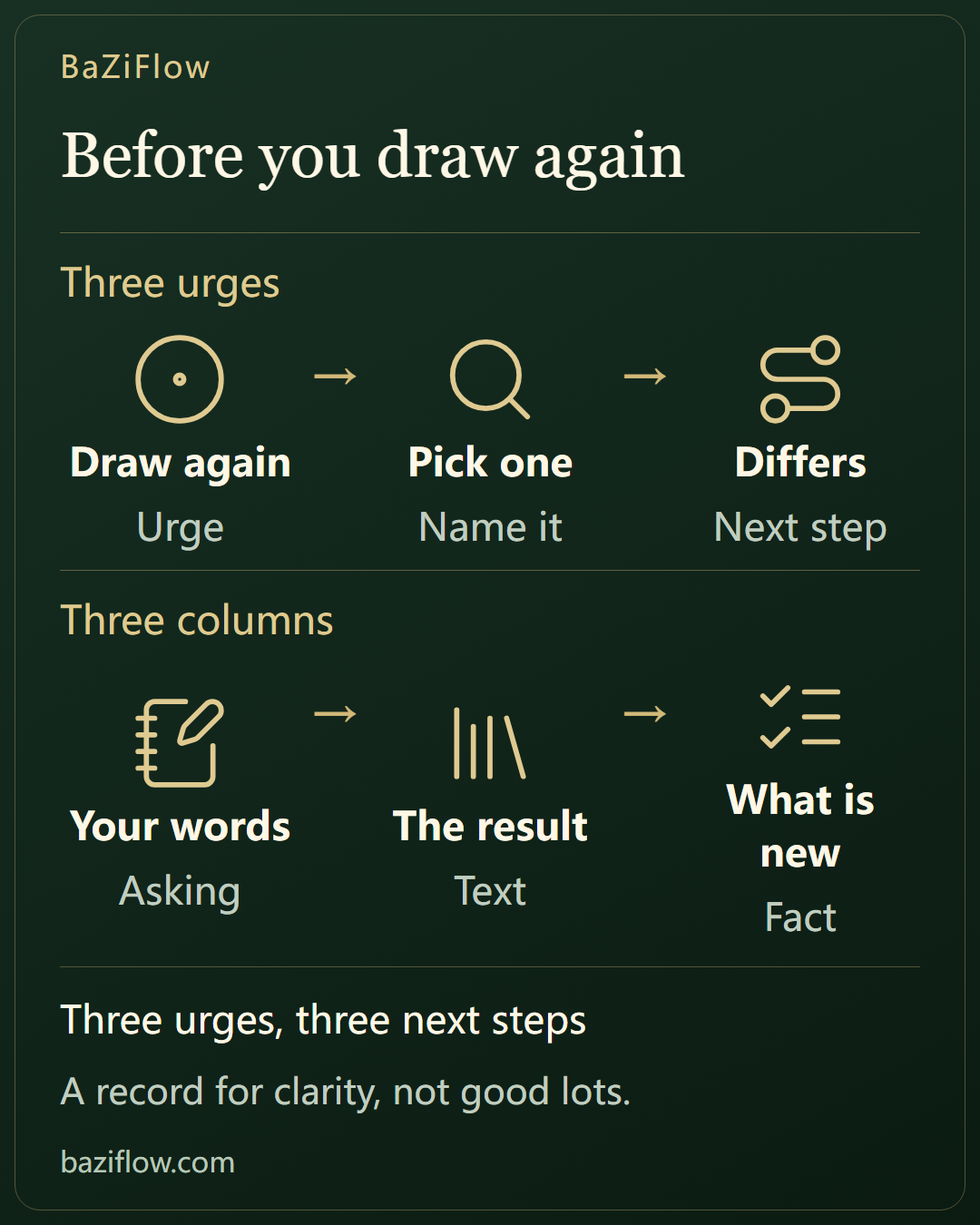
The urge to draw once more usually has one of three causes: the text was not understood, the question has changed, or another answer is wanted. A three-column record shows which one it is.
The short version5 min read
The urge to draw again is not one thing. Telling whether you did not understand, the question changed, or you want another answer decides what to do next.
- Three urges: the last text was not understood, the question has changed, or another answer is wanted. Each calls for a different next step.
- Record three columns each time: how you asked, what text you got, and which new fact appeared since the last draw. A repeat with no new fact only changes the result.
- The word you swapped when rewording often points at the real worry. Turn it into a new, concrete question and deal with it separately.
Read first
Name the urge before you draw again
Wanting to draw once more after you have drawn is a very common reaction. But "again" covers different things. Some people did not understand the last poem, some have found a new worry along the way, and some did not like the result and want another. The three call for different handling, and mixed together they turn into an endless loop of drawing.
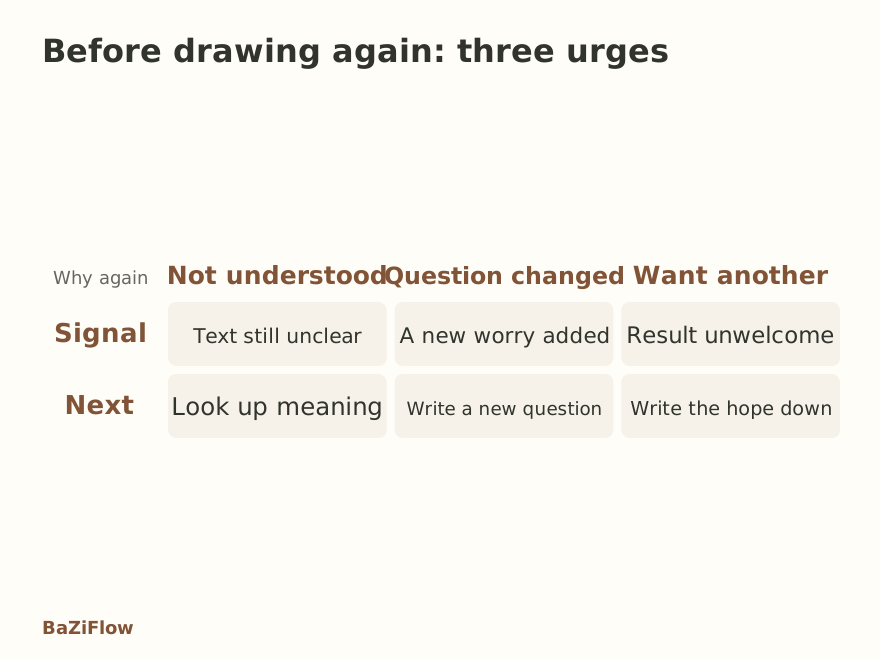
Three urges to draw again, each with its own next step.
The explanations at Hsing Tian Temple and Longshan Temple both pair one matter with one lot. The point of that practice is that each poem answers one question you can state clearly. When you want to draw again, ask yourself whether this is still the same question.
Record three columns: how you asked, the text, the new fact
The simplest way to tell the three urges apart is to keep a record. After each draw, write three columns: how you asked this time, what text you got, and what new fact has appeared since the last draw.
Suppose someone is deciding whether to attend a reunion with old classmates and draws three times:
Enlarge diagram · scroll sideways to read
Read the right-hand column. The second draw has a new fact: an old friend may come, and the question turned into "will he go too?" The first and third have nothing on the right. They only reworded the question and changed the result.
The word you swapped is often the real worry
Compare the wording from one draw to the next and look at the word that changed. From "should I go?" to "will he go too?" the worry moves from an event to a person. From there to "will it feel awkward?" the worry moves from whether something happens to how it feels.
Three common swaps
From an event to someone
"Should I go?" becomes "Will he be there?" The worry is a particular person, and the information you need is with that person.
From now to later
"Should I sign up?" becomes "Will I regret it next year?" The worry is a future feeling, which can get its own question: what would I do if I regretted it?
From can I to is it good
"Can I go?" becomes "Is going good?" The standard changed, so write down what "good" means first.
Turn the swapped word into a new, concrete question and handle it on its own. That shows what you are worried about more clearly than drawing again does.
Wanting another answer is a hope you can write down
Sometimes the wording never changes and the result is perfectly readable. It is just not the line you wanted. That is a real hope: to hear "go", or to hear "no need".
Enlarge diagram · scroll sideways to read
The advantage of writing it down is that it no longer decides for you. You can set it beside the fact column and see whether the hope has any basis in real life. If it has none, leave it in the hope column.
Two stops: before rewording, before a third draw
Setting two stops for repetition works better than regretting afterwards.
Before rewording, write the difference
When you want to ask in other words, first write how it differs from the last question. If you cannot, it is the same question.
Before a third draw, look for facts
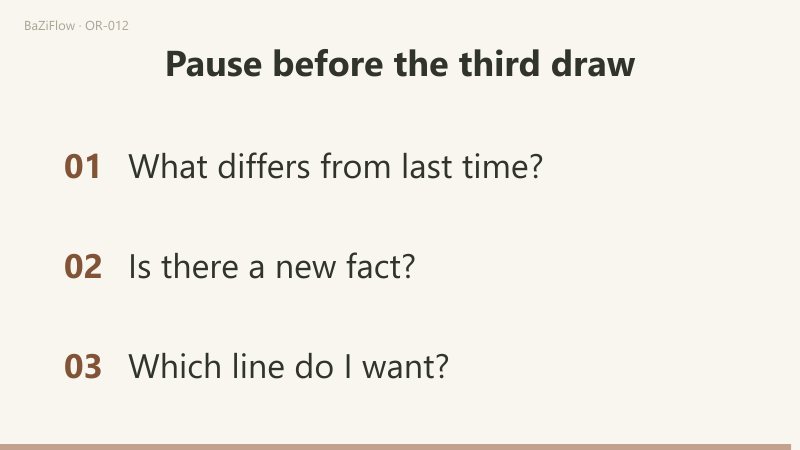
Look at the right-hand column: what has become known since last time? If nothing has, the repeat only changes the result and brings no information.
After stopping, check in real life
Pick out what you can ask or look up directly: the time of the reunion, who is coming, whether you want to go. Those answers are not in the poem.
Turn the repetition into a list you can check
Repeated drawing is not the problem itself. It is a signal that something has not been settled. Turn the signal into a list and you can check it item by item.
Enlarge diagram · scroll sideways to read
What counts as a new fact
Counts
- The reunion date moved
- You learned who is coming
Does not count
- A new way of phrasing
- Wanting to hear good news
How to record
- Facts go right, with a date
- The hope gets its own column
Questions readers ask next
If I cannot understand the poem, may I draw again?
Not yet. Not understanding is a problem of the words. Check the edition, the allusion and the commentary first. A second draw gives you another poem and does not make the first one clearer.
Is asking the same thing in new words still one matter?
It depends on what was swapped. A change of phrasing alone is still one matter. If the person, the time or the standard changed, there is a new question, and it should be recorded separately.
I keep going until I get a good one. What now?
Write down which line you want to hear. That is a real hope, and once it is on paper it stops quietly deciding whether you draw again.
Was this article helpful?
Sources & references
Continue reading
Turn a vague oracle-lot concern into one focused question ↗
Upper and lower oracle lots are labels, not event outcomes ↗
Turn a lot reading into checkable reflection without moving the goal ↗