

Wall: its character and its Mars-day pairing
Content version · · Sources & references
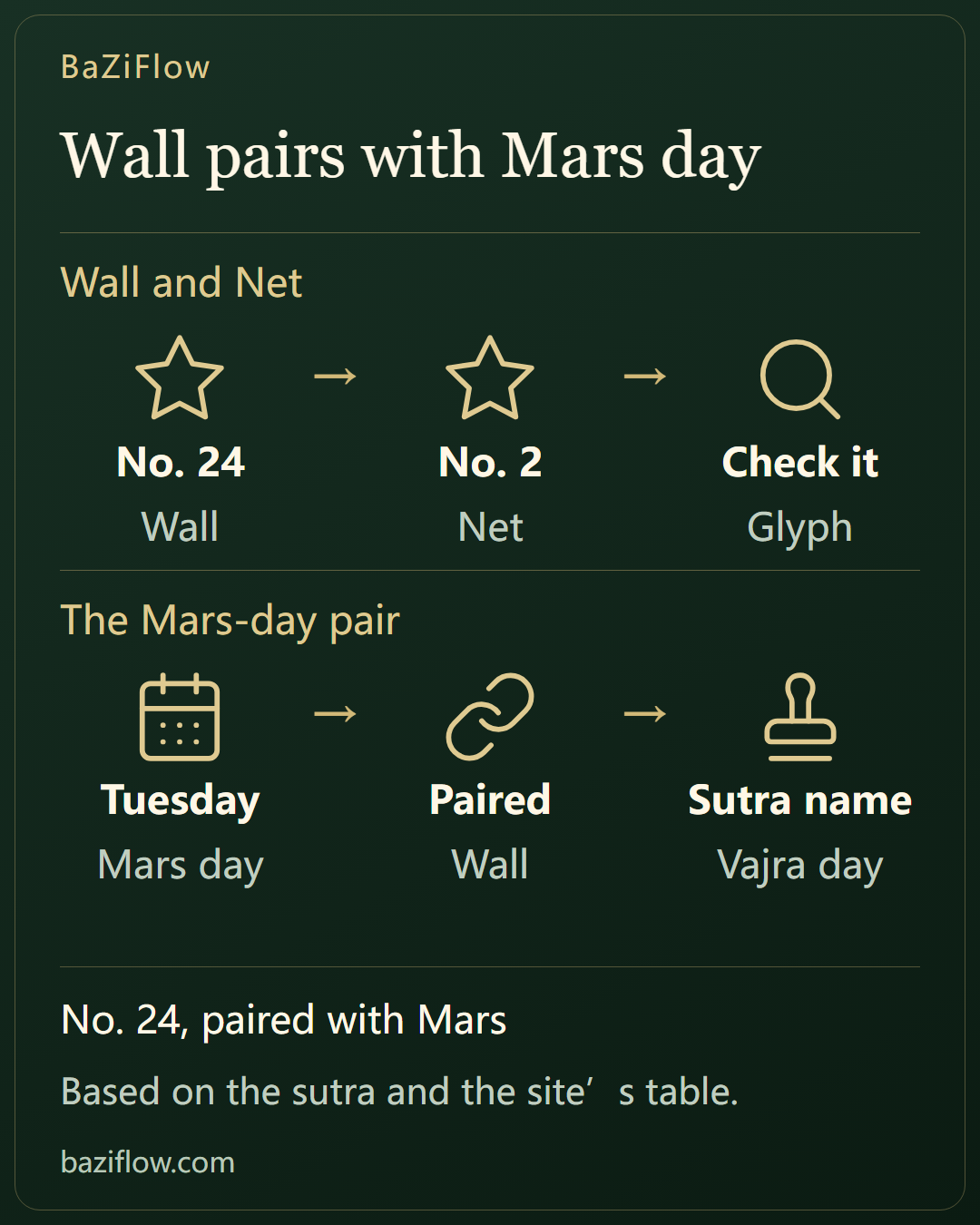
Wall (壁) is position 24 on the ring, the last of the northern run. Wikisource and Taishō both title its picture with a lookalike character; a sutra table pairs it with Mars day, tested on the site’s table.
The short version6 min read
Wall (壁, Heki in Japanese) is position 24 on the site’s ring and the last mansion of the northern run. In Mandarin its name sounds like that of Net, and a table in the sutra pairs it with Mars day.
- Wall closes the northern run, and Legs (奎), a western mansion, comes next. In both the Wikisource text and the Taishō text the Wall picture is titled with a lookalike character, though the text and every other mention say Wall (壁).
- The sutra’s weekday table has seven pairs, and Mars with Wall is the third. Together the seven are called Vajra Peak days, and their mansions lie far apart on the ring.
- By the site’s month table 2026 has 13 Wall days, and three of them fall on a Tuesday: 17 March, 14 April and 17 November. In 2027 only one of 14 Wall days is a Tuesday.
Read first
What is Sukuyō astrology? How a birth mansion is found ↗
Sukuyō 27 mansions vs the 28 lunar mansions: what is the difference? ↗
Wall, a lookalike jade disc, and Net: three characters easy to confuse
Wall (壁) is position 24 on the ring, after Encampment (室) and before Legs (奎). In Mandarin its name sounds like that of position 2, Net (毕), and in one place the text even writes it with a lookalike character (璧).
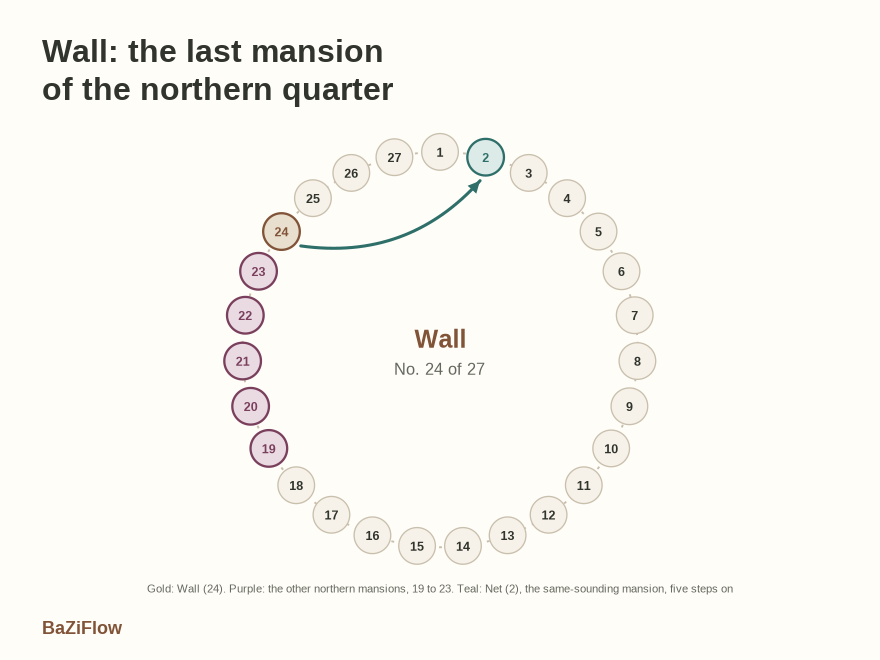
The ring lists the 27 mansions in the sutra’s order with even spacing, which says nothing about their widths in the sky; the purple run follows the quarters named in Jingfeng’s notes.
The gold circle is Wall and the teal one is Net, joined by an arc: counting on from Wall gives Legs, Bond (娄), Stomach (胃), Hairy Head (昴) and Net, exactly five steps. The five purple circles are the other northern mansions, Dipper (斗), Girl (女), Emptiness (虚), Rooftop (危) and Encampment, and Wall closes that run.
The Wall picture opens like this:
Wall has two stars, shaped like an upright pole.
The entry says (壁) while its title says (璧), and the sutra’s mansion lists, weekday table and class sentences all use the first. Both electronic texts, Wikisource and the Taishō edition on CBETA, give the lookalike in the title and Wall (壁) in the text, so the difference comes from the source copy or its transmission rather than from one transcriber’s slip. It cannot be checked against a printed copy here, so quote the book with the first form (壁) and note the inconsistency.
Enlarge diagram · scroll sideways to read
The last place of the northern quarter
After each picture Yang Jingfeng (杨景风) added a line from Chinese astronomy that also names a quarter of the sky. The one after the Wall picture reads:
In Chinese astronomy, Wall has two stars, governs books and secret methods, and is a mansion of the north.
With these labels the 27 mansions fall into four runs: seven in the Azure Dragon of the East, six in the Black Tortoise of the North, seven in the White Tiger of the West and seven in the Vermilion Bird of the South. The north has six because Ox, the 28-list mansion between Dipper and Girl, is absent from this ring, and Wall is the last of the six.
Enlarge diagram · scroll sideways to read
Legs follows Wall, and Jingfeng labels it a western mansion. The seam between Wall and Legs is therefore where the north turns into the west. Why the 28-list has one more mansion than this ring is explained in 27 versus 28 mansions.
Wall on Mars day: one pair of seven
Seven bodies run the week in the sutra’s scheme: the Sun and Moon first, then five planets, one for each weekday. A passage in the fifth chapter hands each of them a mansion; Wall comes in the third pair:
Wall on the Mars day ... these seven days are called Vajra Peak days.
Mars (火曜) on duty is Tuesday. Another passage on how the luminaries meet the Moon says "on Mars day the Moon joins Wall". Taken together the condition has two halves: the day is a Mars day, and the Moon is at Wall.
Enlarge diagram · scroll sideways to read
The seven mansions are scattered: positions 1, 5, 9 and 13 stand four apart, 16 and 17 are neighbors, and Wall is 24. The sutra has two more tables of the same shape, the Sweet Dew days and the Rakshasa days; the Nectar one is in the article on Room.
Testing it on the site’s calendar: which Tuesdays are Wall days
The site assigns mansions from its month table day by day, using old-calendar dates as Japan counts them (new moons judged in Tokyo), with no Moon position, so it can test only the first half of the pairing: a Tuesday that is a Wall day. In 2026 there are 13 Wall days, three on a Tuesday:
| Date | Old calendar | Weekday |
|---|---|---|
| 17 March 2026 | Month 1, day 29 | Tuesday |
| 14 April 2026 | Month 2, day 27 | Tuesday |
| 17 November 2026 | Month 10, day 9 | Tuesday |
The first two are exactly 28 days apart, four whole weeks. Of the 14 Wall days of 2027, only 17 August is a Tuesday.
If the table ran one unbroken lap of 27 days alongside a seven-day week, the same pair would recur only after 27 × 7 = 189 days. The month table restarts every month and breaks that spacing, so the number of Tuesday Wall days differs from year to year.
Two exercises
What weekday, old date and mansion is 17 March 2026?
A Tuesday, day 29 of old month 1. Month 1 opens on Encampment, and 28 steps on is Wall.
Why are 17 March and 14 April 2026 both Wall days, 28 days apart?
17 March is day 29 of month 1 and 14 April is day 27 of month 2; month 2 opens on Legs and 26 steps on is Wall. Both fall on a Tuesday because 28 days is four weeks.
Just before Wall is Encampment, and just after it is Legs.
Questions readers ask next
How do I tell the Wall mansion from the Net mansion?
The two names sound alike in Mandarin but sit far apart: Wall is position 24 in the north, Net is position 2 in the west, and Japanese reads them differently. Quote by character and position rather than by sound.
Does "Wall on Mars day" mean every Tuesday is Wall?
It states a pairing condition: Mars on duty and the Moon meeting Wall. The site’s table steps through old-calendar days without any Moon position, so it can only test the half "a Tuesday that is a Wall day". The other half needs the sky itself.
Why do some years have more Tuesday Wall days than others?
Because 27 and 7 share no factor, a pure day-by-day lap would bring the same pair back only every 189 days. The site’s table restarts each month, which scrambles that spacing: three Tuesdays in 2026 and one in 2027.
Was this article helpful?
Sources & references
Continue reading
Encampment (室): Month-1 Opener, the Name of Month 7 and a Split House ↗
Legs (奎): The Front-Pairing Run Starts Here, and the Verse Has Two Versions ↗