

Queen of Wands: leafy staff and sunflower
Content version · · Sources & references
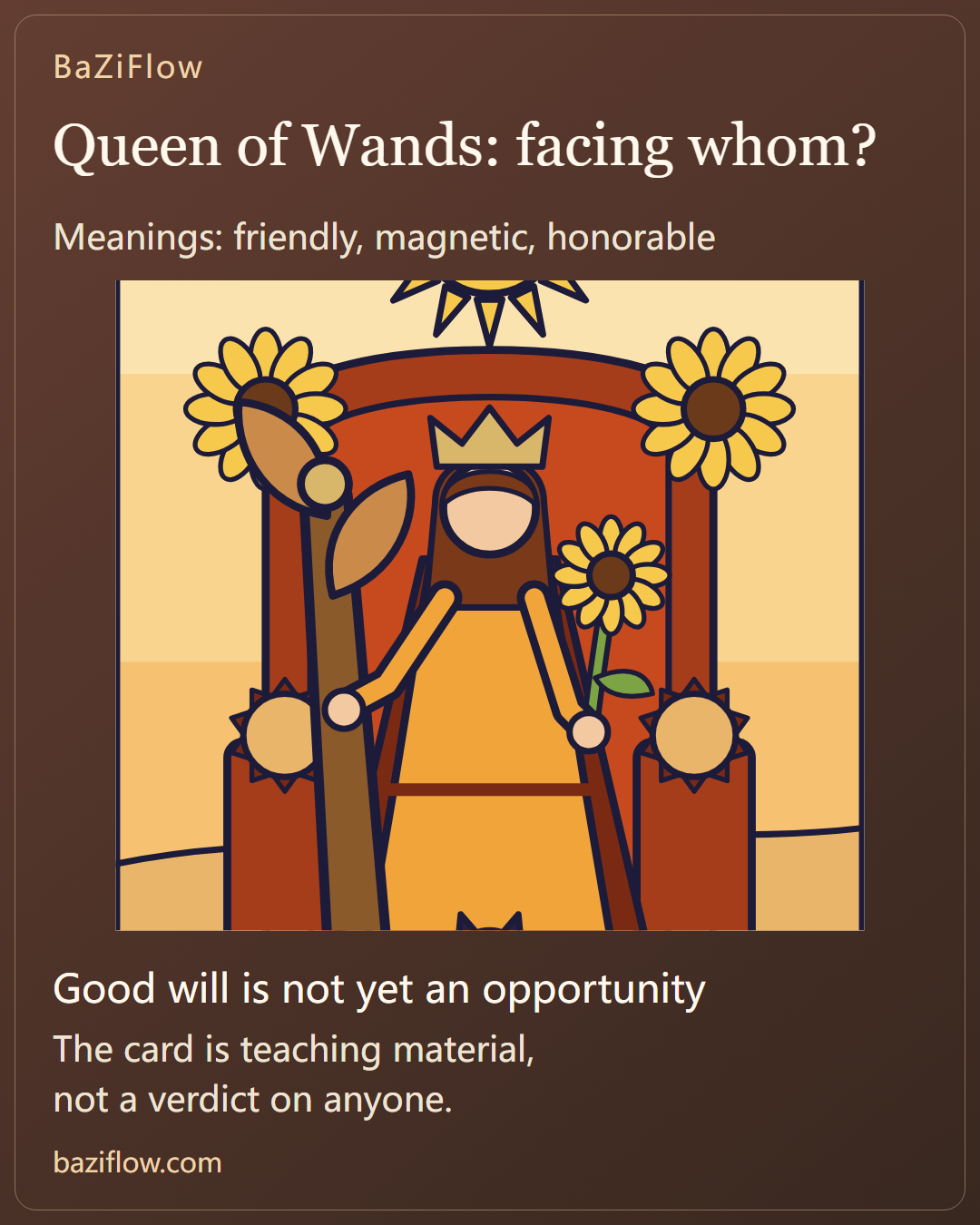
The Queen of Wands sits enthroned with a sunflower and a leafing staff. Separate the picture, Waite's word list and his extras, then split her good will into direction, visible signs and opportunity.
The short version6 min read
The Queen of Wands is an enthroned queen with a sunflower and a staff in leaf. Waite calls her "more magnetic", which only reads once it lands on a particular person and matter.
- Waite hardly describes the picture here and gives two points: the wands of this suit are always in leaf, a suit of life and animation, and the Queen's nature matches the King's but is more magnetic.
- The main list includes friendly, loving and honorable, plus "love of money" and a certain success in business; whom she favors depends on whether the neighboring card is a man or a woman.
- Reversed lists both sides: good, economical, obliging, serviceable, and also opposition, jealousy and deceit; the extras reverse to good will without the opportunity to use it.
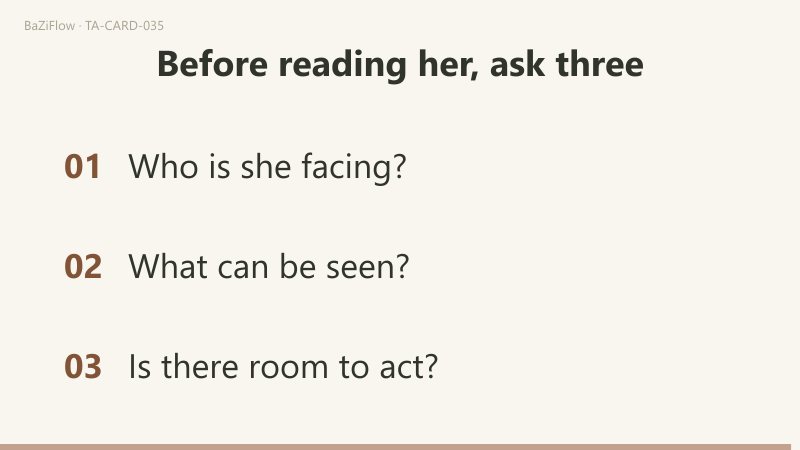
Read first
Start with the picture: a leafing staff, a sunflower and a cat at her feet
Under the Queen of Wands Waite leaves almost no description of the picture, only two statements. The wands of this suit are always in leaf, because it is a suit of life and animation. And emotionally and otherwise the Queen's personality corresponds to the King's, but is more magnetic.
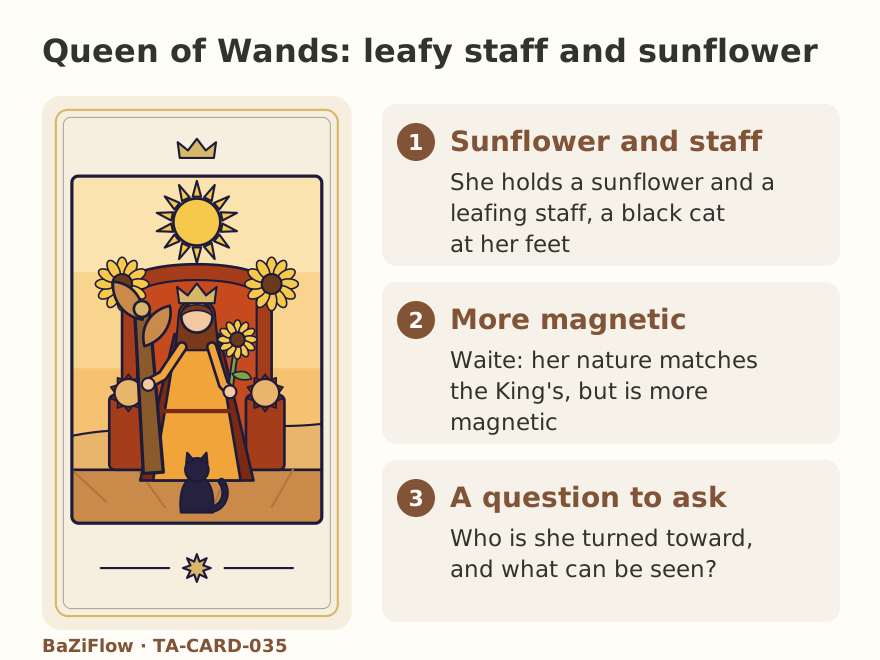
BaZiFlow original Queen of Wands with three labels
On the original RWS card the queen sits facing the viewer on a throne, wearing a crown with flowers and leaves, a yellow gown and a gray cloak. In one hand is a tall staff with a few leaves growing from it, in the other a sunflower. Lions are carved on the arms of the throne, and a red hanging behind her carries a lion design at the top. A black cat sits at her feet, with sandy hills far off on either side.
Enlarge diagram · scroll sideways to read
What Waite lists: friendly and honorable, with "love of money" and business success
The divinatory meanings run: a dark woman, countrywoman, friendly, chaste, loving, honorable. Then a condition: if the card beside her signifies a man, she is well disposed toward him; if a woman, she is interested in the Querent. One more line: also love of money, or a certain success in business.
A dark woman, countrywoman, friendly, chaste, loving, honourable. If the card beside her signifies a man, she is well disposed towards him...
Enlarge diagram · scroll sideways to read
The condition is worth a second look: her good will is not scattered evenly, and the neighbor sets its direction. That matches her magnetism, since a pull always goes toward some object. The extras, what other readers say, are brief: a good harvest, which may be taken in several senses; reversed, good will toward the Querent without the opportunity to exercise it.
Staff, sunflower, cat: who wrote it, who did not
Of the three most conspicuous things in the picture, only one is in Waite's words:
Staff, sunflower, cat: which one is in the text
- Staff in leaf
- Waite states it: the wands of this suit are always in leaf, as it is a suit of life and animation. The RWS staff shows exactly that.
- Sunflower
- Waite does not mention it under this card; the RWS picture adds it. That sunflowers turn toward the light is plain botany, and what it stands for on a card the text does not say.
- Black cat
- Another detail of the picture that Waite leaves out. Teaching books read it in different ways, with no single "original" meaning, so say whose reading you use.
Enlarge diagram · scroll sideways to read
How to read it: split her good will into direction, visible signs and room to act
"Magnetic" and "well disposed" sound like conclusions, but they break into three small questions you can check, each with a root in the text:
Whom is she facing?
The entry says her good will depends on the neighbor: toward a man she is friendly, toward a woman she is interested in the Querent. In teaching terms: see whom the neighboring card stands for, and the good will lands on that object.
What can be seen?
"Magnetic" is the fact that others get drawn in. Turn it into something observable: who came, how often, why they stayed.
Is there room to act?
The reversed extras separate the two: good will, but no opportunity to exercise it. Good will and opportunity are two things, one column each.
An example: a newly started book club whose host is warm to everyone and often says "do come along". Write that warmth out in three questions:
Enlarge diagram · scroll sideways to read
In one show of warmth, which columns are solid
Holds up
- Attendance each time
- Seats left at the venue
Guesswork
- Who came for her
- Whether she favors someone
To ask
- Ask the host about next plans
- Ask yourself what role you want
Reversed and neighboring cards: both faces side by side, and "the neighbor decides"
Waite's reversed main entry sets both faces side by side: good, economical, obliging, serviceable; and, in certain positions and near certain cards, opposition, jealousy, even deceit and infidelity. That line has two conditions (position and neighbors); it is not a verdict the reversal carries by itself. The extras reverse to good will toward the Querent but no opportunity to exercise it.
Three queens and a king
Matching nature, less magnetic
Waite says the Queen corresponds to the King, only more magnetic; his list is honest and conscientious.
Sees visions, and also acts
Waite writes that she sees as in a cup, but also acts, and her activity feeds her dream. See the Queen of Cups.
Contemplates her symbol
Also a queen, she looks at the coin in her hands and may see worlds in it; her list is opulence, generosity, security, liberty. See the Queen of Pentacles.
Enlarge diagram · scroll sideways to read
Questions readers ask next
Does the Queen of Wands mean a dark-haired woman?
The list says "dark woman", a 1910 label for a type of woman, set beside "countrywoman" and "chaste". Teaching today keeps the stance of friendly, honorable and caring, and does not use it to name someone you know.
Is the Queen of Wands good or bad reversed?
Waite's reversed entry writes both: good, economical, obliging, serviceable; and, in certain positions and near certain cards, opposition, jealousy and even deceit and infidelity. The extras say good will without opportunity. Say which entry you quote.
How does the Queen of Wands differ from the King?
Waite gives one comparison: her nature corresponds to the King's but is more magnetic. The King's entry lists ardent, lithe, impassioned, noble and honest; where the magnetism shows is not spelled out, so you have to ask it of a real situation.
Was this article helpful?
Sources & references
Continue reading
King of Wands: after "always signifies honesty", rules split into fixed and open ↗