

Knight of Wands: horse and staff on the road
Content version · · Sources & references
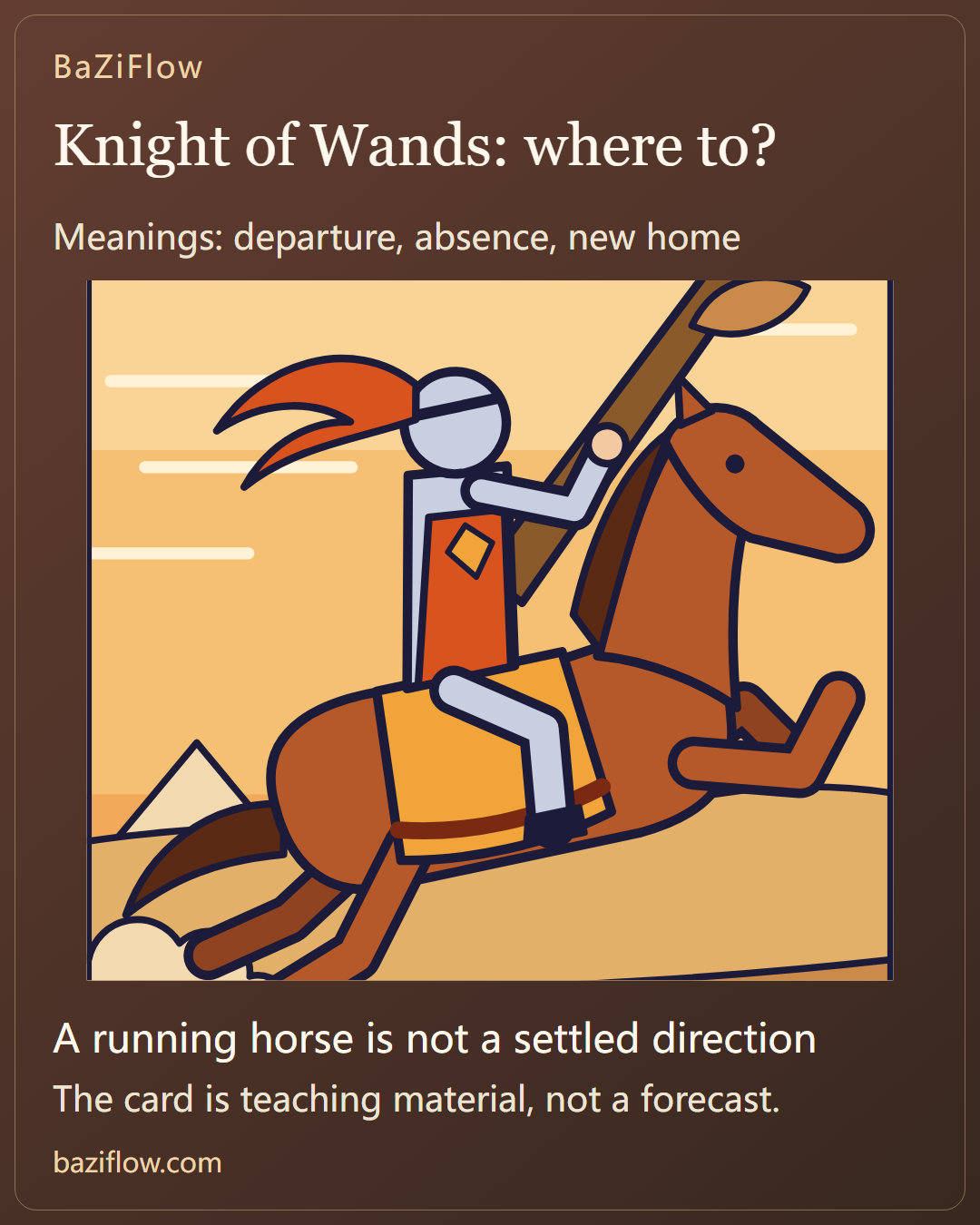
The Knight of Wands is an armored rider on a leaping horse, not going to war. Separate the picture, Waite's list and the extras, then split a departure into leaving, heading and pace.
The short version6 min read
The Knight of Wands is an armored rider who is not going to war, passing mounds on a leaping horse. The question is about motion: toward what, and how fast.
- Waite's description: the rider is shown as if upon a journey with a short wand, mailed but not on a warlike errand, passing mounds or pyramids; the horse's motion is a key to the rider's precipitate mood.
- The main list gives departure, absence, flight, emigration, change of residence, and "a dark young man, friendly"; reversed it is rupture, division, interruption, discord. The extras call it a bad card, with "alienation" in some readings.
- The exercise is about leaving: in one departure, what you leave, where you head and how fast are three separate things, written apart so the horse does not do the thinking.
Read first
Start with the picture: in armor, but not going to war
Every sentence Waite writes for this card is about motion. He pictures a man traveling with a short wand; the mail he wears does not make this a campaign, and he passes mounds or pyramids on the way. The heaviest line comes last: how the horse moves tells you the rider's character, and Waite reads it as a hurried, rash mood.
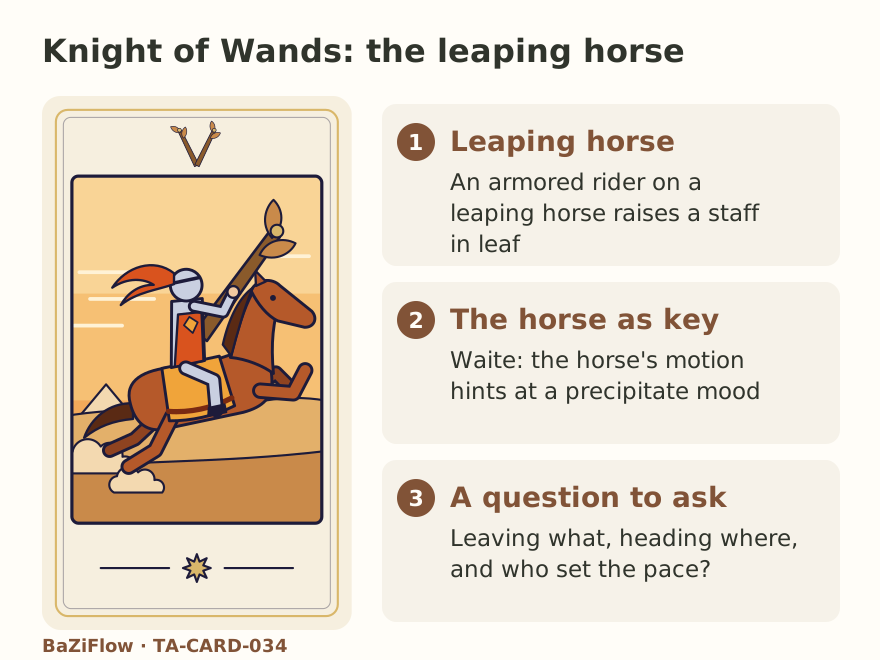
BaZiFlow original Knight of Wands with three labels
On the original RWS card the horse's forelegs are off the ground, almost rearing. The rider wears a helmet with a flame-colored plume and a yellow surcoat marked with dark figures, and raises a long staff with a few leaves on it. The staff rises well above the helmet, longer than "short wand" suggests. At the lower left are sandy hills shaped like pyramids, and the ground is a strip of yellow sand.
Enlarge diagram · scroll sideways to read
What Waite lists: departure, absence, flight, and a new home
Waite's divinatory meanings are: departure, absence, flight, emigration; a dark young man, friendly; change of residence. Not one of these words is about winning or attacking, which agrees with his opening line about the rider not being on a warlike errand. The extras, what other readers say, are brief: a bad card, in some readings alienation; reversed, for a woman, marriage, but probably frustrated.
Departure, absence, flight, emigration. A dark young man, friendly. Change of residence.
Enlarge diagram · scroll sideways to read
The four main words are not the same thing: departure is a direction, absence is the gap left behind, flight carries urgency, and a change of residence is the settling afterward. The reversed words all concern a connection that breaks: rupture, division, interruption, discord.
Galloping horse, short wand, pyramids: who vouches for each
Three items are the easiest to take as settled conclusions, and each comes from a different place:
Three points and their sources
- The horse
- The core of what Waite states: the horse's motion is a key to the rider's character and suggests a precipitate mood. It is the point he makes most clearly on this card.
- Mail and short wand
- Waite writes "mailed" but not on a warlike errand, and a short wand. The RWS staff is on the long side and carries leaves; leaves are shared by the suit, and Waite says under the Queen of Wands that the wands are always in leaf.
- Mounds or pyramids
- Waite writes only "passing" them and gives no explanation. Pyramids make modern readers think of distance and faraway lands, but that is a later association, not his text.
Enlarge diagram · scroll sideways to read
How to read it: split a departure into leaving, heading and pace
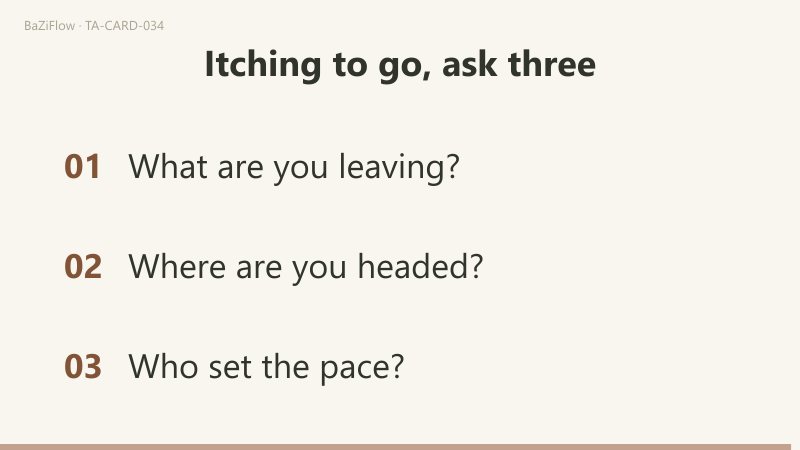
Waite says the horse is the key to the rider, so the most useful question about this card is not "go or stay" but "why so fast". Inside one departure there are three separate things:
What are you leaving?
Absence and flight in the list are about the space left behind. Write down which piece you are putting down: a place, a habit or a relationship.
Where are you heading?
A change of residence is the settling after arrival. A departure with no destination has only the "flight" half of the word.
Who set the pace?
Waite stresses the horse's motion. List the dates, deadlines and other people's pushing, and see which you set yourself and which the horse is carrying you through.
An example: the host of a podcast wants to move the show from an old hosting platform to a new one, and has already uploaded part of the back catalog to the new place. Write it as three rows:
Enlarge diagram · scroll sideways to read
What each column of the move list does
Written clearly
- Episodes to carry over
- Day the old link ends
Still blank
- How listeners learn the new address
- The new host's listing rules
Add one line
- Date both feeds run together
- Date the old link closes
Reversed and neighboring cards: rupture, and two very different knights
The reversed words in the main entry are rupture, division, interruption, discord. Upright speaks of a change of place, reversed of a change of ties: the path is broken off, or the two sides cannot agree. The extras reverse to "for a woman, marriage, but probably frustrated", which is 1910 wording and not read as a prediction about any woman today. If you read reversals, say which entry you follow.
Three knights, three horses
A slow, enduring, heavy horse
Waite says the rider's aspect matches the horse; the list is utility, responsibility, rectitude. Same rank, opposite tempo: Knight of Pentacles.
Riding in full course, scattering enemies
The Knight of Swords lists skill, bravery, enmity and opposition; the Knight of Wands is "not on a warlike errand". The two face different ways.
Standing and proclaiming
The younger rank in the same suit: a faithful bearer, the person fixed in place while the word travels.
Enlarge diagram · scroll sideways to read
Questions readers ask next
Is the Knight of Wands a bad card?
Waite's main entry does not judge it that way. His list is departure, absence, flight, emigration, and he says the rider is not on a warlike errand. "A bad card" comes from the extras, which give what other readers say; label that layer when you quote it.
What does the Knight of Wands mean reversed?
In the main entry the reversed words are rupture, division, interruption, discord. The extras add "for a woman, marriage, but probably frustrated", which is period wording and not a statement about any woman today.
If I draw the Knight of Wands, am I going to move house?
The list does include "change of residence" and emigration, but the picture itself shows a journey. A safer use is when you are already thinking of leaving: check what you leave and where you head, instead of treating the card as a notice of relocation.
Was this article helpful?
Sources & references
Continue reading
Page of Wands: a faithful bearer and strange tidings, kept in two columns ↗