

Wu wei: beyond doing nothing
Content version · · Sources & references
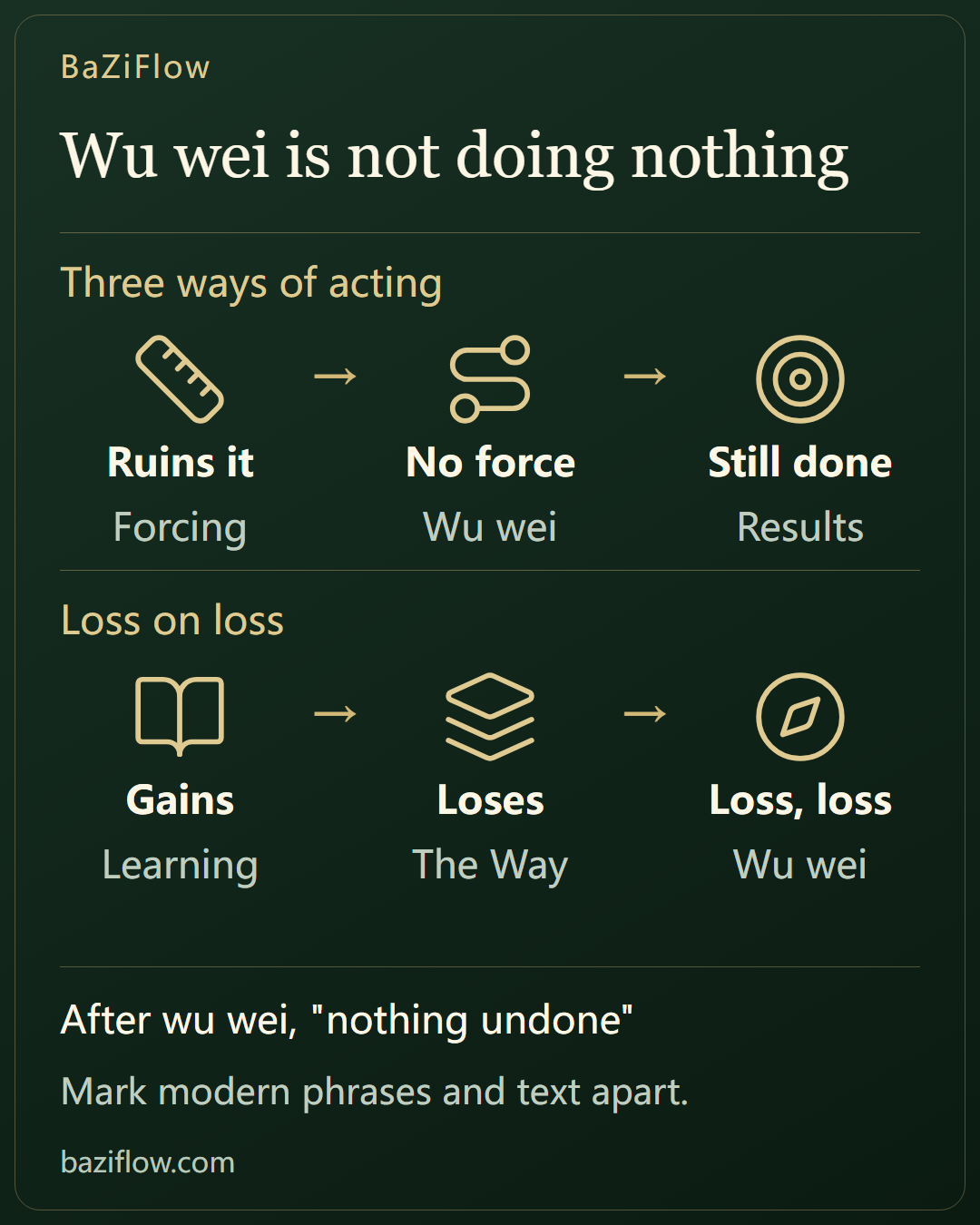
A three-column comparison, the "loss on loss" chain of chapter 48 and the three moves of chapter 64 read wu wei: the text writes "nothing left undone", and "lying flat" is a modern borrowing.
The short version9 min read
"Wu wei" (无为) is the Laozi’s way of acting: not forcing, not acting recklessly, and not doing nothing; the text itself writes "wu wei, and nothing left undone".
- Chapters 37 and 48 both write wu wei together with "nothing left undone": wu wei describes how to act, and what follows it is that nothing is left undone, so things are still being done.
- Chapters 3 and 57 speak to lords and sages about ruling, with fewer prohibitions and fewer undertakings; chapter 64 speaks of doing a task: start early, go step by step, do not grip.
- "Lying flat" is a modern phrase; what the text criticizes is the forcing of "those who force it ruin it, those who grip it lose it", and acting as such is not rejected.
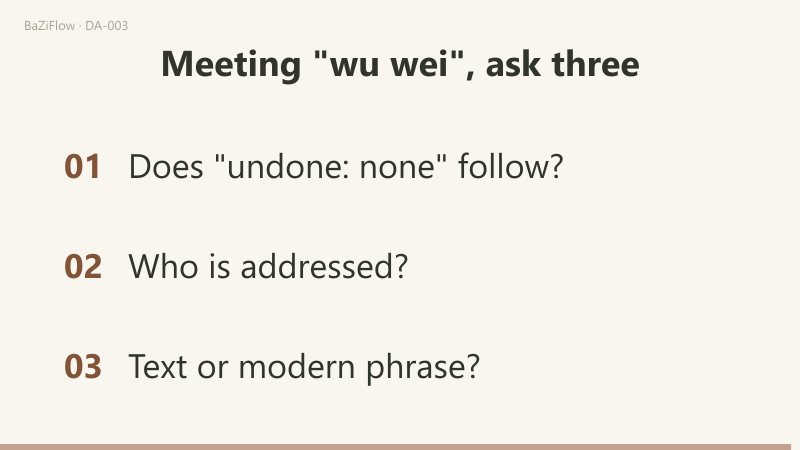
Read first
Dao and De in the Laozi: Reading Chapters 1, 21, 25, 38 and 51 ↗
Wu wei and "nothing left undone", in one sentence of the text
In one plain sentence: wu wei (无为) is about how to act, without forcing and without clamping down, so that things grow by their conditions. Literally it is "without doing", yet the text goes straight on to say "nothing left undone".
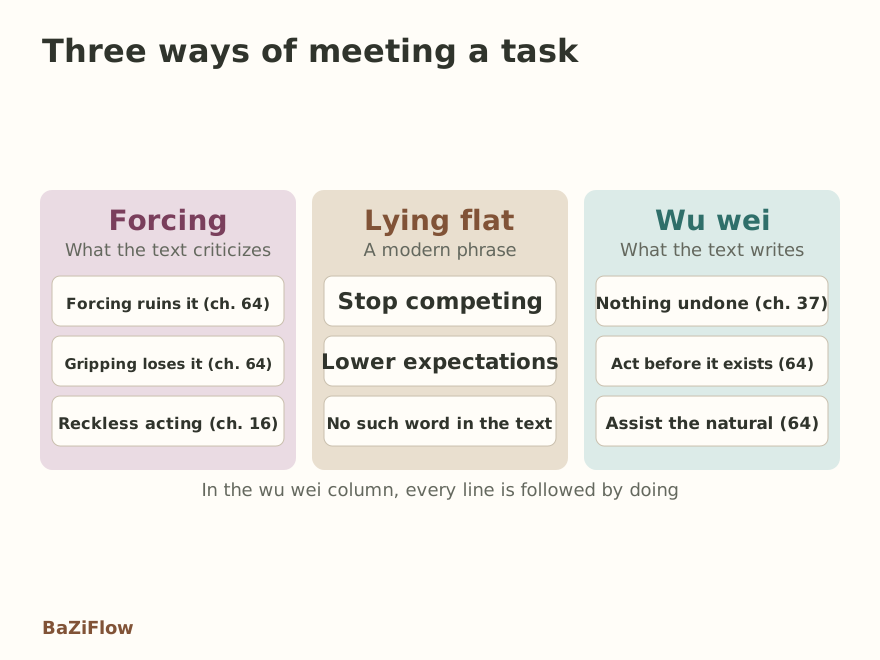
Comparison sketch: chapter numbers follow the received (Wang Bi) text; the "lying flat" column is a modern phrase put in only for contrast, and only the two text columns carry passage references.
The figure sets three ways of meeting a task side by side. On the left is "forcing", which the text criticizes; on the right is wu wei, which the text writes; between them is "lying flat" (tang ping, 躺平), a modern phrase with no counterpart in the text. In the wu wei column every line is followed by doing.
Dao is constantly without doing, and yet there is nothing it does not do. If lords and kings could hold to it, the myriad things would transform of themselves.
Chapter 37 writes "without doing" and "nothing it does not do" in one sentence: the first half says Dao is constantly "without doing", the second half says there is nothing it does not do. Now the sage in chapter 2:
Therefore the sage dwells in the affairs of non-doing and carries out the teaching without words. The myriad things arise and he does not turn them away; he gives life and does not possess, acts and does not presume, completes the work and does not dwell in it. Because he does not dwell in it, it does not leave him.
The sage has not left the affairs of the world: he "dwells" in the affairs of non-doing, and when the myriad things arise he does not turn them away; he gives life without possessing, acts without presuming, completes the work without claiming it. "Teaching without words" is usually read in the tradition as influencing people by what one does and not by spoken orders.
Loss on loss: learning and the Way in chapter 48
In learning one gains more each day; in the Way one loses more each day. Loses and loses again, until one reaches non-doing. Non-doing, and nothing left undone. To win the world, always go by having no undertakings; once there are undertakings, one is not fit to win the world.
Enlarge diagram · scroll sideways to read
Learning is a daily increase and the Way a daily decrease. At the end of the subtracting the text says "until one reaches non-doing": wu wei is the end point of the subtraction, not the starting point. The tradition usually reads it as dropping what is surplus in contrivance and in gripping. After the subtraction nothing is left empty; what follows is "nothing left undone".
The last two lines speak of the one who governs: "always go by having no undertakings", and once there are undertakings, one is no longer fit to win the world. The tradition reads "undertakings" here as the troubles a ruler keeps starting.
When the text turns to the opposite it also uses a specific word. Chapter 16 says: "Not knowing the constant, one acts recklessly and meets misfortune." What is bad is "reckless" action and not action itself.
Wu wei in ruling: chapters 3, 57 and 37
In one plain sentence: these chapters speak to rulers, and they are about giving fewer orders and starting fewer undertakings so that the people settle by themselves.
Do not exalt the worthy, and the people will not compete; do not prize goods hard to get, and the people will not turn thief; do not show what can be desired, and the people’s hearts will not be disturbed. ... Do the not-doing, and nothing goes unordered.
Chapter 3 lists a few things a ruler can "not do": not exalt the worthy, not prize goods hard to get, not display what stirs desire. Each is followed by a clause beginning "so that the people".
Enlarge diagram · scroll sideways to read
Chapter 57 writes both sides:
The more prohibitions there are under heaven, the poorer the people; the more sharp tools the people have, the more confused the state; the more cleverness people have, the more strange things arise; the more laws are displayed, the more thieves and robbers there are. So the sage says: "I do not act, and the people transform themselves; I love stillness, and the people set themselves right; I have no undertakings, and the people prosper of themselves; I have no desires, and the people become simple of themselves."
The first half is "the more", the second half "the less": the more bans, the poorer the people; the more laws on display, the more thieves. In each of the sage’s four lines the subject is "I": he acts less himself, and only then do the people act of their own accord. Chapter 60 says the same in an everyday picture:
Governing a large state is like cooking a small fish.
The tradition usually reads it this way: do not keep turning a small fish, because too much turning breaks it, and a large state should not be fussed over either.
Wu wei in doing a task: three moves in chapter 64
Chapter 64 is about how a matter grows from small to large, and its second half names "the people at their undertakings", that is, people at work.
Act on it before it exists; set it in order before disorder comes. A tree of a full armspan grows from a tiny shoot; a tower of nine tiers rises from a heap of earth; a journey of a thousand li begins beneath one’s feet. Those who force it ruin it; those who grip it lose it. So the sage does not force and therefore does not ruin, does not grip and therefore does not lose.
Enlarge diagram · scroll sideways to read
Three moves
Act before it exists, order before disorder
Move while the matter is still unformed. A comparison: a thin crack in a wall takes one stroke to fill early, and far more work once it has split open. The comparison is not in the text.
From a heap of earth, from beneath the feet
A big matter starts with small pieces; the text names three concrete things, a tree, a tower and a road.
Not gripping, so not losing
"Gripping" means clamping down. People at work who hold too tight spoil it just as it is about to succeed.
The text goes on:
In their undertakings people often fail just as they are about to succeed. Be as careful at the end as at the beginning and nothing fails. ... So as to assist the natural course of the myriad things, and not dare to act.
"Be as careful at the end as at the beginning" spreads the effort evenly from start to finish. In the last line, the "not dare to act" says not daring to force; the "assist" before it is still a kind of doing.
Three readings: statecraft, conduct, and "lying flat"
On meeting wu wei it helps to sort the three settings first:
Enlarge diagram · scroll sideways to read
In the statecraft column the text names whom it addresses; the conduct column is the people at work in the "learning", the "Way" and the "undertakings" of chapters 48 and 64. The modern column is where the reader brings today’s words in. Take "lying flat": it describes dropping competition and lowering expectations, while each passage on wu wei quoted here is tied to doing, with "nothing left undone", "nothing goes unordered" and "the people transform themselves" following it.
Questions readers ask next
Does wu wei mean doing nothing at all?
In the text the sage still "dwells in the affairs of non-doing", and chapter 64 teaches acting "before it exists", while the matter is still unformed. The tradition usually reads wu wei as not acting recklessly and not forcing, not as refusing to act.
How does wu wei differ from "lying flat"?
Lying flat is a modern internet phrase for dropping out of competition and lowering expectations; the text has no such phrase. Wu wei is about how to act: do not strain, do not clamp down, which is why "nothing left undone" follows it. The two may look alike on the surface but start from different places and address different people.
Is wu wei advice for rulers or for ordinary people?
Both settings occur. Chapters 3 and 57 plainly address lords and sages and speak of ruling; the "learning", the "Way" and the "people’s undertakings" in chapters 48 and 64 read more like talk of anyone at work. Traditional commentary has both readings, so each chapter should be taken in its own context.
Was this article helpful?
Part of a learning path
Sources & references
Continue reading
Dao and De in the Laozi: Reading Chapters 1, 21, 25, 38 and 51 ↗
Ziran: Read It as "So of Itself" First, Then Talk About Landscape ↗