

Learning between articles and tools
Content version · · Sources & references
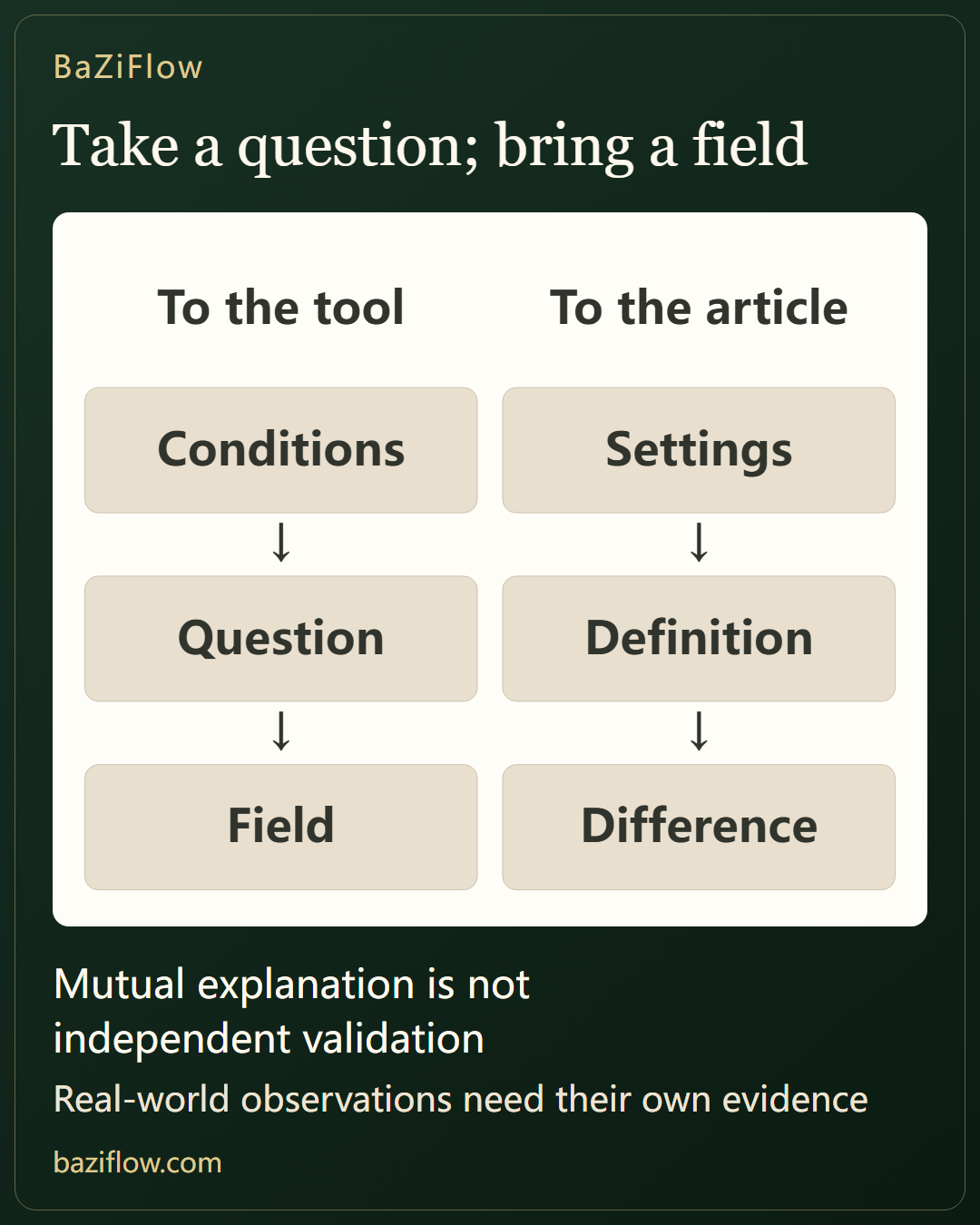
Turn a concept into one inspectable question, then bring a specific field back to the explanation. Keep instructional examples, calculated outputs and personal conclusions in their proper roles.
The short version5 min read
After recognizing a term in an article, what should you inspect in a tool? Turn the term into a question with a visible target, then bring back the field, settings and time scope.
- A teaching example explains a relationship rather than supplying your personal data.
- A changed field and changed prose require different checks.
- Keep unknown conventions explicit instead of changing inputs until the result feels right.
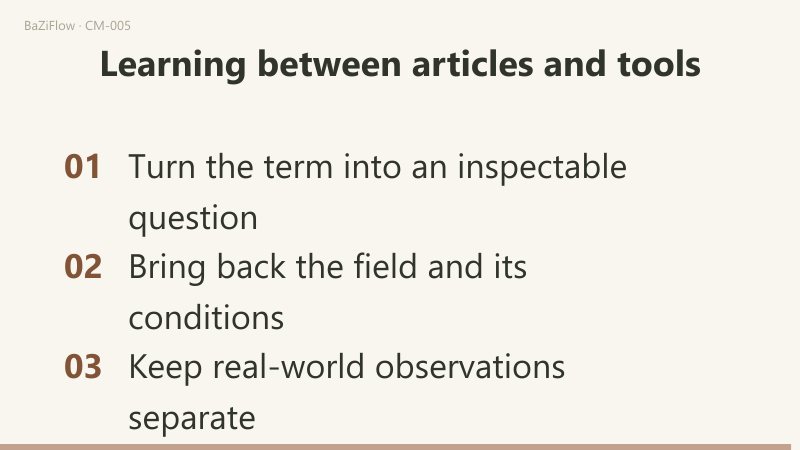
Read first
Make the question inspectable
Before moving from a BaZiFlow article to a tool, decide what you want to find. Which displayed field corresponds to this term? Which time layer does the result concern? What setting does this calculation require? A question with a visible target is easier to investigate than a general hope that the result will feel personally accurate.
The article explains a concept or method; the tool presents an output under particular conditions. A teaching example is not automatically your data, and a sentence in your result is not automatically a rule for an entire tradition. Keeping these roles separate makes it possible for the two resources to help each other without turning either one into an unquestioned authority.
Article
- Concept and conditions
Tool
- Output for particular inputs
Definitions and outputs have different jobs
- Teaching example
- Selected material used to explain a relationship, not automatically the reader’s own input.
- Field
- A specific output item that must be read with its subject and time scope.
Plan a small inspection rather than a broad verdict
Write the question before reviewing the result. Then identify the information needed to answer it. If you are studying a time scale, locate whether the field belongs to a natal structure, a longer phase or a selected moment. Several panels containing dates may still concern different kinds of time.
| Question to take with you | Material to bring back |
|---|---|
| What does this term refer to? | The field and its subject or time scope |
| Which conditions matter? | The relevant settings and any unknown conventions |
| How was this conclusion reached? | The exact claim and its stated support |
Do not change the input just because the first result is unfamiliar. Start with verified birth data when personal data are relevant. If the task can be learned from an instructional example, unnecessary personal information does not improve the exercise.
Time scope
- Bring back
- Natal, phase or selected moment
Setting
- Bring back
- Current value and unknowns
Interpretation
- Bring back
- Claim and its stated support
Read the article for conditions, not only keywords
Find the definition and its qualifications. A diagram may make the structure easier to see while leaving details to the surrounding prose. Treat it as part of the explanation. A familiar keyword in the image is not enough to establish that every nearby interpretation applies to your situation.
BaZiFlow article pages place the body, references and further reading in a common reading route, with language choices available. Prerequisite material appears when the article's relationships and available content provide it; not every page needs the same list. If a definition depends on an unfamiliar term, follow that dependency before expanding the exercise.
The text on the share card preserves a point to remember, rather than the entire argument. Return to the text for conditions before using a summary to evaluate a personal result. The guide to saving and sharing knowledge cards explains how to keep a route back to the full article.
Diagnose a mismatch before asking for more output
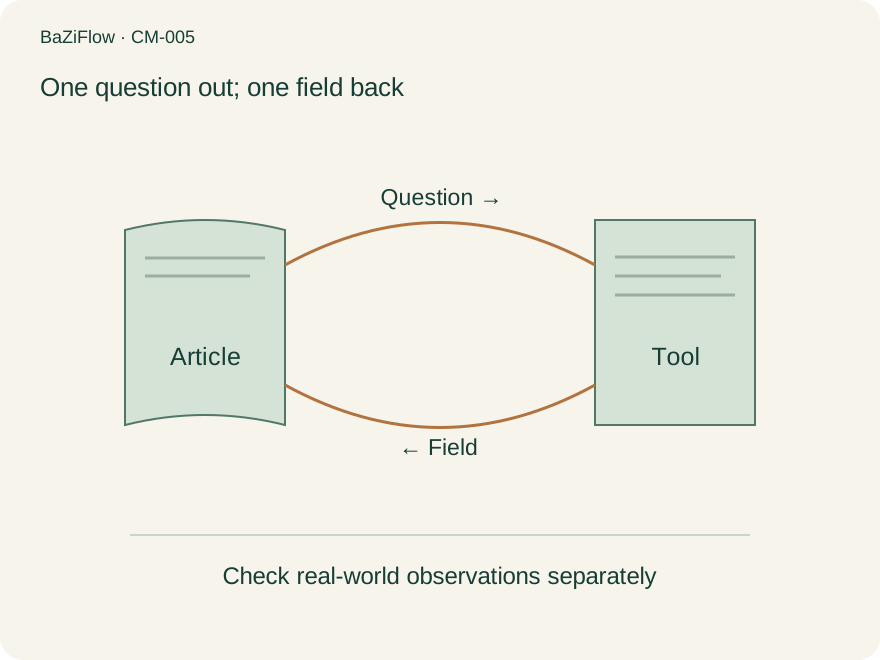
Original BaZiFlow learning-loop diagram. This is a relationship sketch, not a screenshot or a promise of interface features.
In the diagram a question travels toward the tool and a field returns toward the article. Real-world observation sits separately beneath the loop. The separation matters: an article explaining an output is not independent evidence that the interpretation predicts events. You can understand a method's operation while remaining uncertain about its application.
If a field differs from the example, check the premises. The example may simplify a situation or use a specified convention. If the premises match but the field differs, the calculation deserves examination. If the fields match but the prose differs, investigate interpretation, selection and scope instead of repeatedly changing the birth data.
An undocumented convention can remain unknown. Preserve that limitation instead of inventing a default. Generating more results under changing conditions may create more material without answering the original question. The productive next step is the one that resolves the identified gap.
Different fields
- Compare inputs and method
Same field, different prose
- Check selection and scope
End with a statement of what you learned
For instance, you might write that you located the relevant field and distinguished it from the explanation attached to it, but could not confirm one setting. That is a useful outcome. It states the gain and the limit without giving the entire result an unsupported verified label.
The Education Endowment Foundation describes planning, monitoring and evaluating learning in its guidance for schools. This article borrows that organization for a reading task. NIST's treatment of experimental design likewise illustrates matching a method to an objective. Neither reference evaluates BaZiFlow's predictive performance, and this small personal exercise is not presented as a scientific experiment.
Keep the original question, the field you found, the definition you clarified and the remaining condition in a short note. At another session, try a structurally different example. If you can repeat the distinction without relying on the previous page's arrangement, the loop has produced a more usable understanding.
Features and interfaces can change, so follow the controls actually available to you. The workflow described here is a way of reading, not a requirement to purchase a service or repeatedly generate reports. Its measure of progress is what you can now explain with a specific basis, including the point where you still need to stop and check.
Understood
- Outcome
- Field and explanation differ
Unknown
- Outcome
- One convention is undocumented
Next task
- Outcome
- Find the method, not more output
Choose a time question
Ask whether a dated item is natal or belongs to a selected moment, then locate it.
Record visible conditions
Keep the field and settings; do not invent a default for an undocumented convention.
Return to the definition
If the example uses a different scope, state that difference before comparing results.
Questions readers ask next
Does a mismatch prove that a tool is wrong?
Compare inputs, time scope and conventions first. Teaching examples may simplify conditions. A remaining field difference under matched premises calls for the relevant calculation check.
Why separate real-world observations?
An article may explain how an output is produced without providing independent evidence of predictive performance. Effects in the world require an appropriate observation and comparison process.
Must I generate many reports for this exercise?
No. One identifiable field can be enough. A note connecting the definition, conditions and remaining question is more useful than changing inputs until the prose feels familiar.
Was this article helpful?
Sources & references
Continue reading
Verify Birth Data Without Overwriting the Original Record ↗