

Shi: one yang line, six posts
Content version · · Sources & references
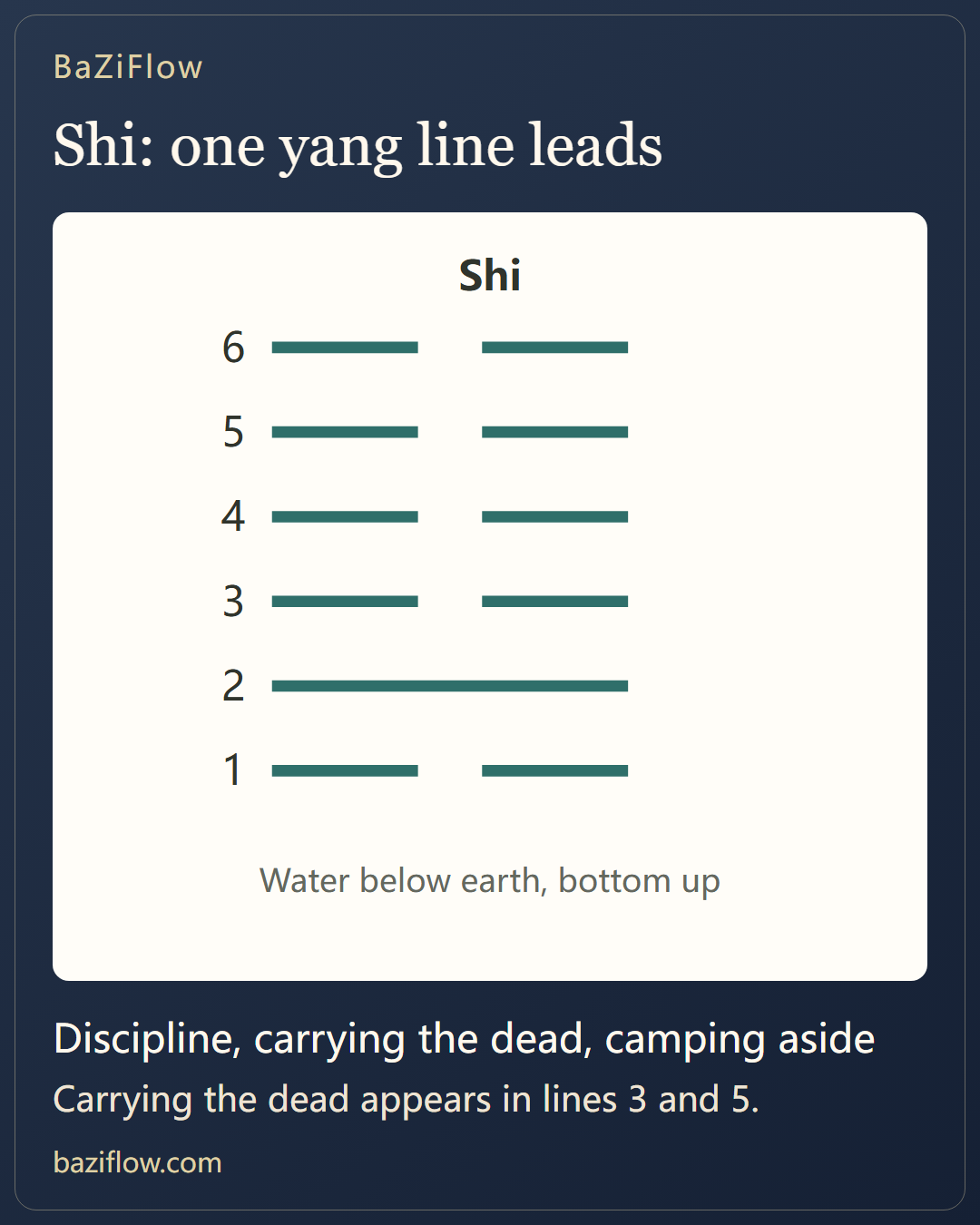
Shi is the seventh of the 64 hexagrams, water below and earth above, with a single yang line among five yin lines that stand for the multitude. Read the judgment, the Great Image, and six lines of army posts.
The short version7 min read
Only one of Shi's six lines is yang, line 2, and the five yin lines are the multitude. The six line statements circle around one question: who leads the army? Discipline, the commander, carrying the dead, camping aside, elder and younger sons, the great ruler and petty persons.
- Shi has one yang line, line 2, and five yin lines. The Commentary on the Judgments, the Xu Gua and the Shuo Gua entry for earth all come down to one word: the multitude.
- The Commentary on the Judgments carries "steadfast, a respected elder" on to "one may become king", adding "acting in danger, yet compliant". The Great Image is "water within the earth; holds the people, nurtures the multitude".
- The six lines give six posts in an army: rules, the commander, carrying the dead, camping aside, elder and younger sons, the great ruler and petty persons. "Carrying the dead" occurs once in line 3 and once in line 5.
Read first
The Sixty-Four Hexagrams: How Upper and Lower Trigrams Form One Figure ↗
Judgment and Line Statements: Whole Hexagram or Single Line? ↗
Five yin, one yang: line 2 and the multitude it leads
In Shi (師) only one line is yang and the other five are broken yin lines: from the bottom, first six, nine in the second place, six in the third, fourth and fifth places, and top six. The one yang line is the second. The lower trigram is water and the upper is earth (the images of the two trigrams are in the eight trigrams).
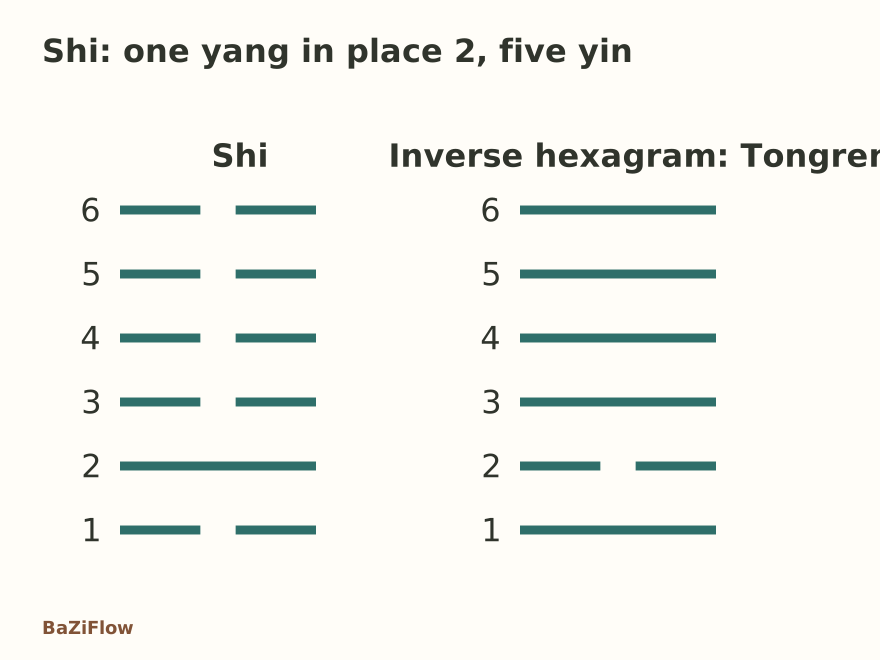
Shi and its inverse hexagram Tongren: the inverse changes every line to the opposite polarity.
The name is a single character, and three passages of the text explain it with one word. The Commentary on the Judgments (彖传) says: "Shi means the multitude." The Xu Gua says: "Shi is the multitude." And in the Shuo Gua's list of images for earth, the multitude is there too.
Enlarge diagram · scroll sideways to read
One yang line leading five yin lines is the basic shape of this hexagram: a central firm line facing a crowd of soft ones, and the upper trigram, earth, is "compliant" in the Shuo Gua, which matches that crowd.
The judgment and the Judgments: a respected elder, acting in danger yet compliant
Shi's judgment has only a few words: "Steadfast, a respected elder: good fortune, no blame." Steadfast is holding to what is right, and the elder is an older, honored man. The Commentary on the Judgments does not gloss the elder word by word, but it explains the whole judgment in a run of sentences.
Shi means the multitude. Zhen means upright. Able to lead the multitude uprightly, one may become king. The firm is central and answered; acting in danger, yet compliant. With this he afflicts the world, and the people follow him: good fortune, and what blame could there be?
Enlarge diagram · scroll sideways to read
The Commentary on the Judgments first glosses "zhen" as "upright", and then says "able to lead the multitude uprightly, one may become king": whoever can lead a crowd and stay upright can become king. The next two clauses speak to the figure. "The firm is central and answered": the firm is line 2, central because it holds the middle of the lower trigram, and "answered" is traditionally taken to mean that line 2 and line 5 respond to each other (the idea of response between lines is in line positions). "Acting in danger, yet compliant": the lower trigram, water, is danger, and the upper trigram, earth, is compliance.
Last comes "with this he afflicts the world, and the people follow him". The word rendered "afflicts" is literally "poisons", and tradition reads it in more than one way, so only the sentence itself is quoted here. The whole passage ends: "good fortune, and what blame could there be?"
Water within the earth: holding the people, nurturing the multitude
The Great Image (大象) for Shi gives a picture of water inside the earth, matching the upper trigram, earth, and the lower, water.
Water within the earth: Shi. The noble person holds the people in keeping and nurtures the multitude.
What the noble person does is "hold the people, nurture the multitude": to hold is to take in, and to nurture is to feed and raise. So the people are held inside, and the multitude is fed up.
Enlarge diagram · scroll sideways to read
The multitude in the Great Image is the same word as in the Commentary on the Judgments and the Xu Gua. The Commentary on the Judgments' words are about taking the multitude out to act, "with this he afflicts the world"; the Great Image's are about first taking the multitude in and feeding it. Set side by side, one sentence uses the multitude outward and the other nurtures it inward.
Who leads: rules, commander, carrying the dead, camping aside, elder son, great ruler
Each of Shi's six lines names a role or an act in an army: rules, the commander, carrying the dead, camping aside, elder and younger sons, the great ruler and petty persons.
Enlarge diagram · scroll sideways to read
Line 1: "The army sets out under rules. Not good: ominous." The line reads "not good" as a failing of the rules, in a reading that is traditional; the Small Image boils the whole sentence down to "to lose the rules is ominous".
Line 2: "In the midst of the army: good fortune, no blame. The king three times confers commands." The commander is inside the army, and the king commands him three times. The Small Image has two remarks: "it receives heaven's favor", and "it cherishes the myriad states". This is the one yang line of the hexagram, and the line that reads most smoothly.
Line 3: "The army perhaps carries the dead in carts: ominous." The cart carries the dead, which is the usual reading. The Small Image says "a great lack of achievement".
Line 4: "The army camps to the left: no blame." To camp is to halt and encamp, and camping to the left is traditionally read as withdrawing to camp, with no blame. The Small Image says "it has not lost what is constant".
Line 5: "There is game in the field; fitting to hold to a word; no blame." The phrase "hold to a word" is usually read as having a justified declaration. Then comes a pair: "The elder son leads the army; the younger sons carry the dead in carts. Steadfast: ominous." The Small Image judges the two halves apart: "the elder son leads the army", "acting from the center"; "the younger sons carry the dead", "the one sent is not suitable".
Line 6: "The great ruler issues a command, founds states and carries on houses. Petty persons are not to be used." The Small Image says "it sets merit right" and "petty persons are not to be used: it would surely throw the state into disorder".
"Carrying the dead" occurs in line 3 and in line 5, both times ominous, and the Small Image gives different reasons: one is "a great lack of achievement", the other "the one sent is not suitable".
Shi and Bi: the yang line moves from place 2 to place 5
Turn Shi upside down and you get Bi (比), its reversed hexagram. Shi's only yang line is in the second place; after the turn it lands in the fifth place, so Bi is also one yang and five yin, with the yang line at the fifth. The Xu Gua strings the hexagrams together: where a dispute stirs people up, there is Shi; where a multitude gathers, it must have something to cling to, and that is Bi.
Enlarge diagram · scroll sideways to read
Shi's inverse hexagram is Tongren (同人) and its nuclear hexagram is Fu (復).
Questions readers ask next
Why is "Shi" both an army and "the multitude"?
The name is one character and the Commentary on the Judgments glosses it at once: "Shi means the multitude." The Xu Gua says "Shi is the multitude", and the Shuo Gua's list of images for earth also contains "the multitude". The lines speak of "the army sets out" and "leads the army", so here the multitude is a force marching out.
Are "the younger sons carry the dead" and "the army perhaps carries the dead" the same thing?
Both phrases contain "carrying the dead in carts" and both end in "ominous". The Small Image to line 3 says "a great lack of achievement"; for line 5 it separates "the elder son leads the army", "acting from the center", from "the younger sons carry the dead", "the one sent is not suitable". Whether the two refer to the same event, the text does not say.
Who is the "respected elder" in the judgment?
The phrase literally means an older, honored man. The judgment says only "steadfast, a respected elder: good fortune, no blame" and does not give his post in the army; the Commentary on the Judgments does not gloss him word by word either, saying only "able to lead the multitude uprightly, one may become king".
Was this article helpful?
Sources & references
Continue reading
Song: the judgment sees the end, the Great Image the start, six lines the ways it ends ↗
Bi (比): five yin lines, one yang, and the question of whom to join ↗
The Sixty-Four Hexagrams: How Upper and Lower Trigrams Form One Figure ↗
Judgment and Line Statements: Whole Hexagram or Single Line? ↗