

Weiji: the last hexagram, not yet across
Content version · · Sources & references
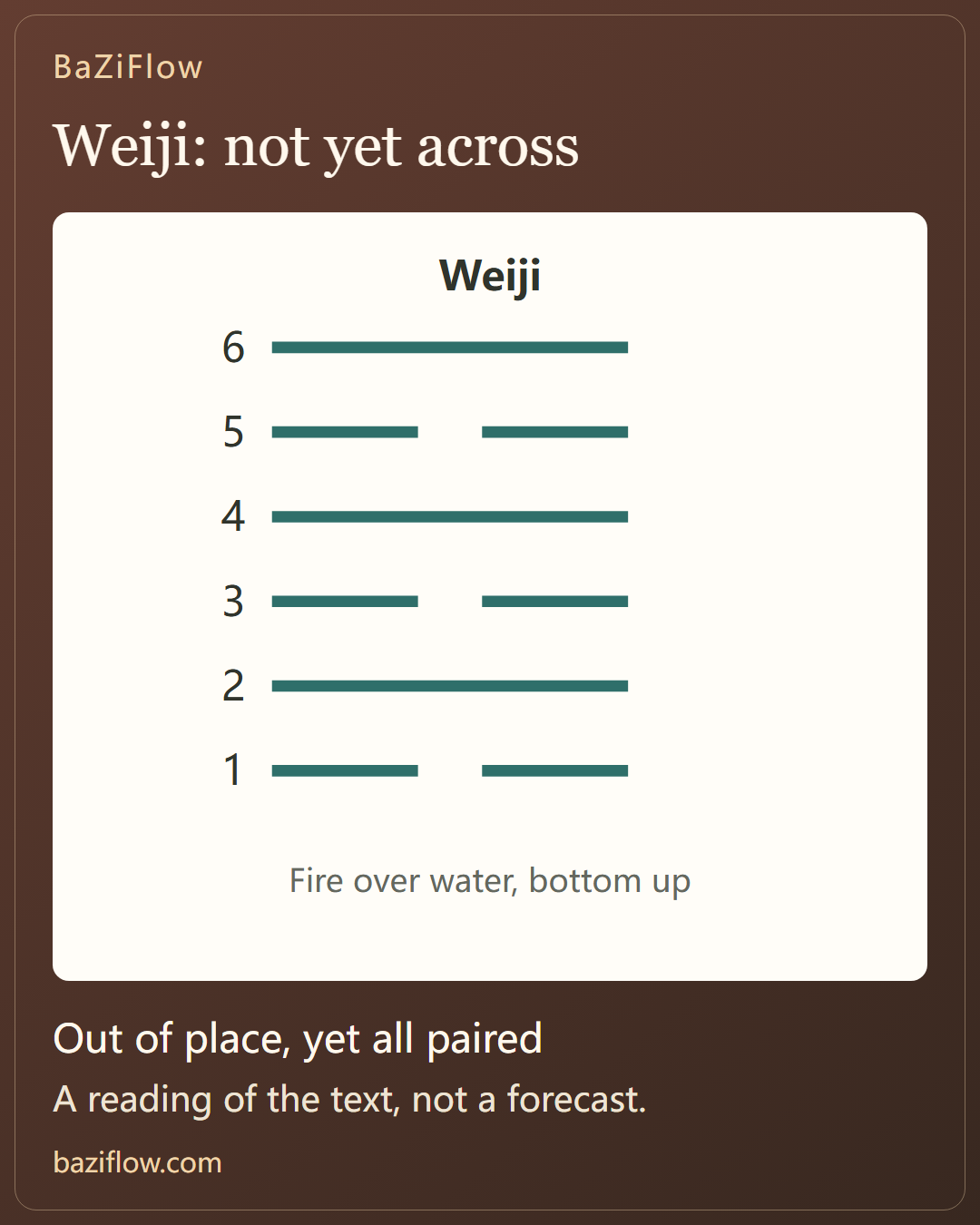
Weiji is the 64th and last hexagram: fire over water, every line out of place yet answering another. Read the little fox, "settle each in its quarter", the twin "also does not know", and the Xu Gua ending.
The short version9 min read
Weiji comes last among the sixty-four. Its name means "not yet crossed", its Judgment shows a little fox almost at the far bank, and the Xu Gua closes on two characters: and here it ends.
- Weiji puts Li (fire) above Kan (water), with no line in its own place. The Commentary on the Judgments says "though the places are not fitting, the firm and the soft answer": lines 1 and 4, 2 and 5, 3 and 6 are each a yin line with a yang line.
- The Great Image is "carefully tell things apart and settle each in its own quarter". The Shuo Gua assigns Li to the south and Kan to due north, so the two trigrams stand at opposite ends.
- The first and last Small Images both say "also does not know": line 1 "the limit", line 6 "restraint". The Xu Gua places Weiji last and closes on two characters: and here it ends.
Read first
The Sixty-Four Hexagrams: How Upper and Lower Trigrams Form One Figure ↗
Judgment and Line Statements: Whole Hexagram or Single Line? ↗
Fire over water: no line in its own place
Weiji (未濟) is the last of the sixty-four hexagrams. Its upper trigram is Li (fire) and its lower is Kan (water), which is Jiji with its two trigrams swapped. In the Shuo Gua, Li is "clinging" and Kan is "sinking". Reading upward, the pattern is yin, yang, yin, yang, yin, yang: yin lines sit in the yang places 1, 3 and 5, and yang lines sit in the yin places 2, 4 and 6. Not one line is in its own place, which sets it apart from every other hexagram. It is also the inverse hexagram (错卦), the reversed hexagram (综卦) and the nuclear hexagram (互卦) of Jiji, all three at once; the working-out is in the article on Jiji.
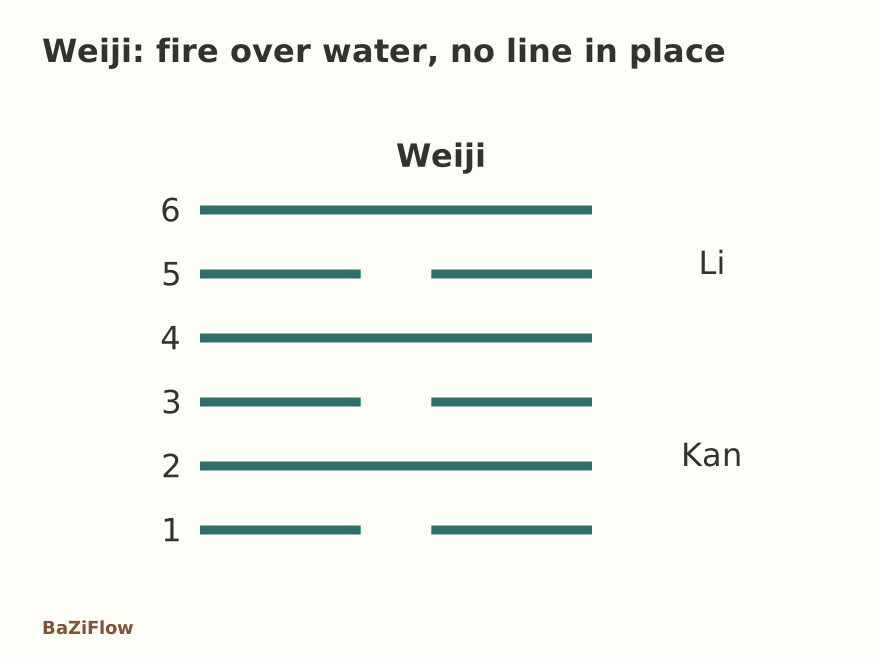
The six lines of Weiji: yin in places 1, 3, 5 and yang in places 2, 4, 6, none in its own place. It is the inverse, the reversed and the nuclear hexagram of Jiji at once.
Enlarge diagram · scroll sideways to read
Three terms to know first
- Weiji
- Literally "not yet crossed". It stands against the hexagram before it: ji means "already" and wei means "not yet".
- Qi (almost)
- The word in the Judgment's "the little fox has almost crossed". Tradition usually reads it as "almost, on the point of": the fox is close to the far bank.
- Ying (answer)
- The first place pairs with the fourth, the second with the fifth, the third with the sixth. When a pair holds one yang line and one yin line, the text says "the firm and the soft answer". Why places are counted this way is explained in the line-positions article.
The Judgment and the Commentary: the little fox wets its tail
The Judgment of Weiji is a picture:
Success. The little fox has almost crossed, and wets its tail. There is nothing it can gain.
The first word is "success", and unlike Jiji it is not limited to "the small ones". What follows is a little fox that has nearly reached the far bank and gets its tail wet, with nothing to gain. The Commentary on the Judgments takes the phrases one at a time:
Weiji: success; the soft holds the middle. "The little fox has almost crossed": it has not yet come out of the middle. "Wets its tail, nothing is gained": it does not continue to the end. Though the places are not fitting, the firm and the soft answer each other.
Enlarge diagram · scroll sideways to read
"Success" is tied to line 5: a yin line in the middle place of the upper trigram is what "the soft holds the middle" points at. Of "the little fox has almost crossed" the Commentary says "it has not yet come out of the middle", which tradition usually reads as not yet out of the water. "Wets its tail" is "it does not continue to the end": it does not manage to go on to the finish.
The last sentence is the turn in the passage: "though the places are not fitting, the firm and the soft answer." All six lines stand in the wrong place, yet line 1 answers line 4, line 2 answers line 5, and line 3 answers line 6, and each of the three pairs holds one yin and one yang. The Commentary reads as if adding one more word to "success": the places are wrong, but the lines are matched.
The Great Image: tell things apart, settle each in its quarter
Fire above water: Weiji. The noble person is careful to tell things apart and to settle each in its own quarter.
The Great Image (大象) has three phrases. "Careful" is to take care. "Tell things apart" is to distinguish what is what. "Settle each in its quarter" is usually read by tradition as putting each thing where it belongs. The word for "quarter" is the word for direction in the Shuo Gua: Li is the hexagram of the south and Kan the hexagram of due north. The two trigrams of Weiji stand one in the south and one in the north, at opposite ends.
Enlarge diagram · scroll sideways to read
All six lines of this hexagram are out of place, and the act the Image gives is exactly to tell apart and to settle: sort things out first, then put each where it belongs. One way to read it: the figure has every place wrong, and the Image hands the question of place to the noble person.
Six lines: the first and the last Small Image say "also does not know"
Enlarge diagram · scroll sideways to read
Line 1, "wets its tail: humiliation", repeats the Judgment's "wets its tail", but this time the verdict is "humiliation" and no longer "nothing is gained". The Small Image says "also does not know the limit".
Line 2, "drags its wheel: holding firm brings good fortune". The wheel is held back as before, and here the verdict is good fortune. In the Small Image, "in the middle" refers to line 2 being a yang line at the center of the lower trigram.
Line 3 is the only line that has the name of the hexagram inside it: "not yet across, going on brings misfortune, fitting to cross the great river". Two phrases that pull against each other sit side by side in one line, and later readers do not agree about it, so it is translated here as written. The Small Image says only "the place is not fitting".
Line 4: "holding firm brings good fortune, regret vanishes; he stirs himself to attack the Guifang, and after three years there is a reward from a great state" (some versions have "land" where this has "state"). The word for "stirs" literally means to rouse or to shake. A campaign of three years ends here in a reward, and the Small Image says "his purpose is carried out".
Line 5, "the light of the noble person; there is trust: good fortune". The Small Image says "its brightness is good fortune". Both "light" and "brightness" are words of light, and line 5 is the middle line of the upper trigram Li, to which the Shuo Gua gives the word "bright".
Line 6, "trust while drinking wine: no blame; wets its head; with trust, loses what is right". The same trust, first in the drinking without blame, then at "wets its head" it becomes "loses what is right". The last phrase literally means losing "the right", which tradition usually reads as losing the correct way of doing things. The Small Image says "also does not know restraint".
Set the Small Images side by side. Line 1: "wets its tail, also does not know the limit". Line 6: "drinks wine and wets its head, also does not know restraint". Of the six, only these two say "also does not know", one at each end, one about the limit and one about restraint, and the whole hexagram is held between them.
The Xu Gua's last word: things cannot be exhausted
The Xu Gua ends with this sentence:
Things cannot be exhausted, so it is followed by Weiji. And here it ends.
Sentences of the form "things cannot ... to the end" occur many times in the Xu Gua: not through to the end, not blocked to the end, not moving, not stopped, not parted to the end. Each says that one state cannot go on forever, and so the next hexagram follows. At the very last place the form changes: "things cannot be exhausted". To be exhausted is to reach the limit.
Enlarge diagram · scroll sideways to read
The word "exhausted" has come up before. The Commentary on Jiji says its road has come to an end, and the Za Gua calls Weiji "the man's dead end". The Xu Gua says that things cannot be exhausted, so what is placed last is "Weiji". As for the two closing characters, tradition usually understands them this way: the sequence ends here. It ends on a hexagram that means "not yet crossed", and not on one that means "crossed".
Before the sequence closes, the text has already said again the phrases the hexagram before it used, with different verdicts:
Enlarge diagram · scroll sideways to read
Questions readers ask next
Is Weiji a hexagram of failure?
The first word of the Judgment is "success", and the Commentary adds "the soft holds the middle" and "the firm and the soft answer". Line 5 says "the light of the noble person" and line 4 "regret vanishes". The text has both "nothing is gained" and "good fortune": it shows the many ways a thing looks while it is still under way.
What does qi mean in "the little fox has almost crossed"?
Tradition usually reads it as "almost, on the point of", so the fox is close to the far bank. The Commentary then says "it has not yet come out of the middle", that is, it is still in the water, which matches the wet tail.
Are "going on brings misfortune" and "fitting to cross the great river" in line 3 a contradiction?
On the page the two phrases do sit side by side in one line, and later readers do not agree on them. What can be confirmed is only the text itself: the Small Image comments on this line with one sentence, that the place is not fitting.
Was this article helpful?
Sources & references
Continue reading
Jiji: water above fire, after every line has found its place ↗
The Sixty-Four Hexagrams: How Upper and Lower Trigrams Form One Figure ↗
Judgment and Line Statements: Whole Hexagram or Single Line? ↗