

Twelve life stages and void branches
Content version · · Sources & references
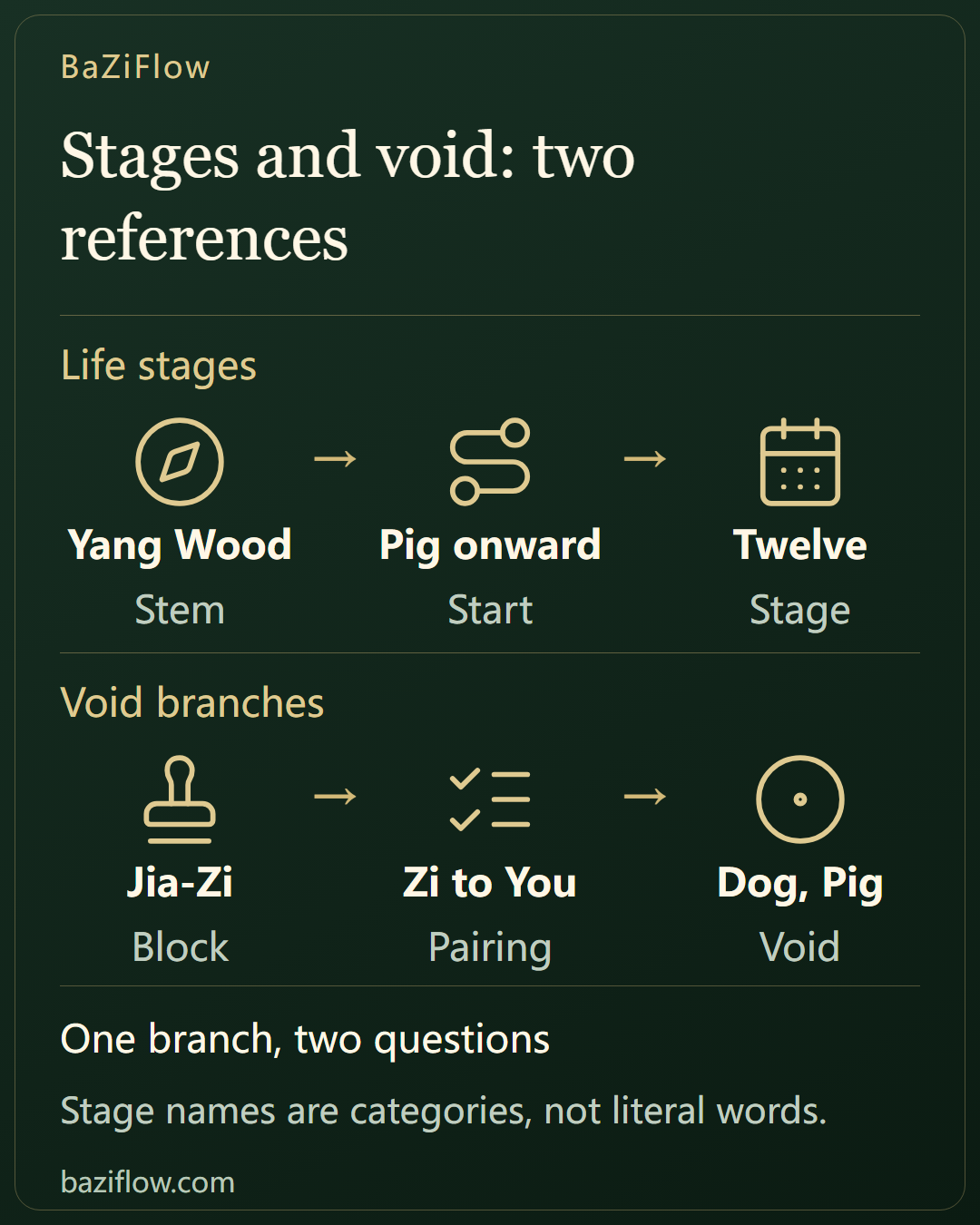
The twelve life stages ask where a stem falls on a branch; void branches ask which two branches are left when ten stems meet twelve. A Yang Wood circuit, the six blocks and a Geng-Wu example keep the references apart.
The short version5 min read
The twelve life stages ask where a stem sits when it lands on a branch; void branches ask which two branches are left after ten stems are paired with twelve. The references differ, so both can hold at once.
- The twelve life stages run forward for Yang stems and in reverse for Yin: Yang Wood starts at Pig and moves forward, Yin Wood starts at Horse and moves backward, so Yang Wood's table cannot be copied for Yin Wood.
- The six blocks leave Dog-Pig, Monkey-Rooster, Horse-Goat, Dragon-Snake, Tiger-Rabbit and Rat-Ox void; the lookup uses the whole stem-branch pair, not one character.
- Stage names such as Death or Severance, and the word void, are traditional categories rather than events; a void branch stays in the chart.
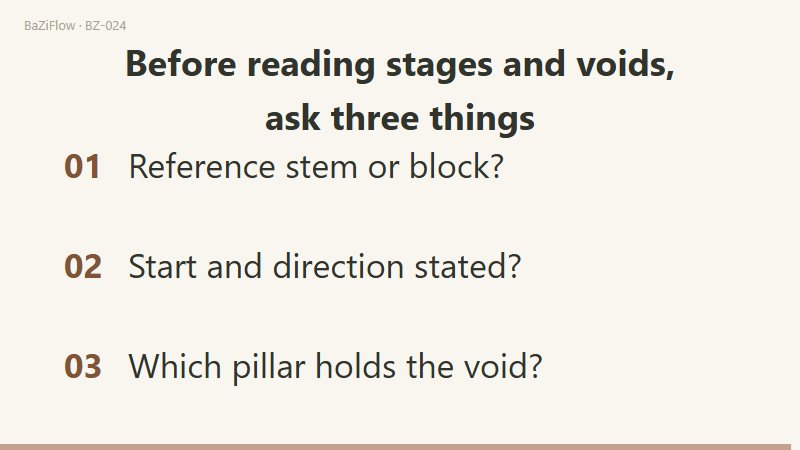
Read first
One Pig, labelled both Growth and void
Picture a teaching record in which the Pig branch carries two notes: "Growth" and "void". Which is wrong? Neither. They answer different questions.
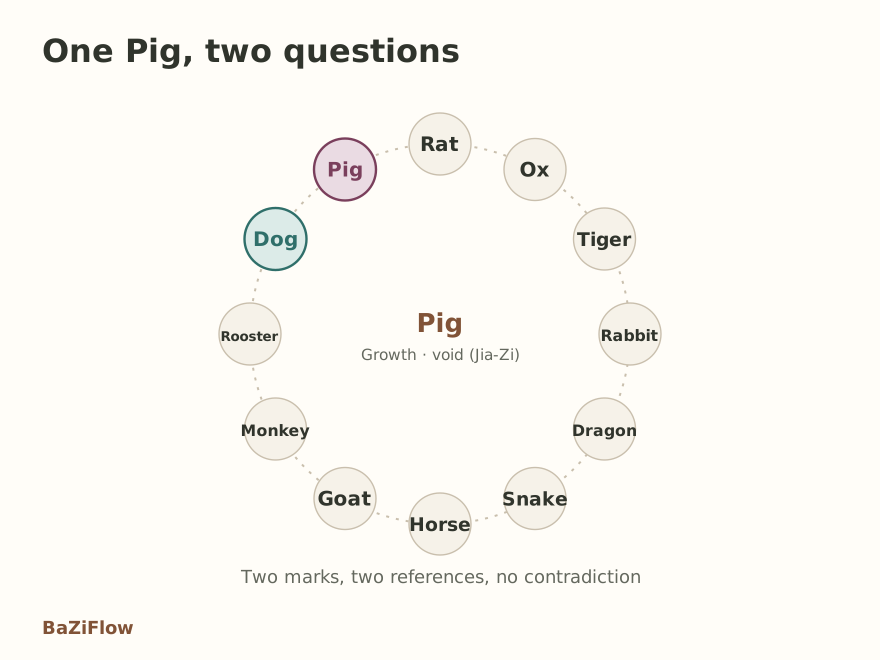
Reference sketch: Pig is Yang Wood's Growth and also falls in the Jia-Zi void range. The two marks answer different questions and do not cancel each other.
Enlarge diagram · scroll sideways to read
Twelve life stages: choose a stem, then run a full circuit
Zi Ping Zhen Quan, in its chapter on Yin and Yang, birth and death, explains that Yang runs forward and Yin in reverse, with Yang Wood and Yin Wood as its example: Yang Wood is born at Pig, Yin Wood at Horse. It also says that names like Growth and Bath are borrowed figures of speech. Here is the full circuit for Yang Wood, starting at Pig and following the order of the branches.
Enlarge diagram · scroll sideways to read
Enlarge diagram · scroll sideways to read
Void branches: ten stems, twelve branches, two left over
There are ten stems and twelve branches. Start at Jia-Zi (Yang Wood Rat) and pair the two cycles side by side. After ten entries you reach Gui-You, the stems are used up, and Dog and Pig have not had their turn. So the Jia-Zi block has Dog and Pig void. The Hong Kong Observatory's sixty-pair table lets you verify this entry by entry.
Enlarge diagram · scroll sideways to read
The next block begins at Jia-Xu and ends at Gui-Wei, leaving Monkey and Rooster. The six blocks give:
Enlarge diagram · scroll sideways to read
Count the position
Jia-Zi 1, Yi-Chou 2, Bing-Yin 3, Ding-Mao 4, Wu-Chen 5, Ji-Si 6, Geng-Wu 7.
Find the block
Position 7 lies in the Jia-Zi block, so Geng-Wu (Yang Metal Horse) has Dog and Pig void.
Use the whole pair
The lookup uses the complete pair, not the word Horse alone. If the method starts from the day pillar, keep the whole day pillar.
A void branch is still in the chart
Continue with the same record: day pillar Geng-Wu, and a natal pillar that really does contain Pig. You may annotate that this Pig falls in the void range of the selected day block. The natal Pig is still there, and its position and hidden stems do not disappear.
Enlarge diagram · scroll sideways to read
Day pillar Geng-Wu, a natal pillar with Pig
You may note
- This Pig falls in the void range of the selected day block
- Say the void was counted from the day pillar
You may not infer
- That the Pig disappears from the chart
- That its generating, controlling and combining relationships cancel
Still to state
- Whose day pillar the void was counted from
- A Pig only in a future year is an annual-layer encounter
When two results disagree, check the fields one by one
With the fields complete, a difference between two tools becomes a question about one specific step, instead of an argument about which term sounds luckier.
Enlarge diagram · scroll sideways to read
To judge the whole chart's strength, read strong and weak Day Masters. For another family of lookup marks, see the place of symbolic stars.
Questions readers ask next
Do "Death" and "Severance" among the life stages mean death or a break?
No. They are traditional names for twelve positions, saying only where a stem stands on a branch. They are not a forecast of health, lifespan or relationships.
Does a void branch mean that branch does nothing, as if deleted?
No. The void mark only names the two branches left over after ten stems are paired. The natal branch stays, with its pillar and hidden stems. How to interpret the mark is the next step of the method.
Why do two tools show different life stages or voids?
Check the reference first: which stem starts the stages, how direction and starting point are set, and whether the void block was counted from the day pillar or another pillar. With the fields written down, the difference traces to one step.
Was this article helpful?
Sources & references
Continue reading
Strong and weak Day Masters: references, relationship directions and evidence ↗
Symbolic Stars in BaZi: Check the Reference and Rule Before the Meaning ↗