

The conjunction (0°): conditions and orbs
Content version · · Sources & references
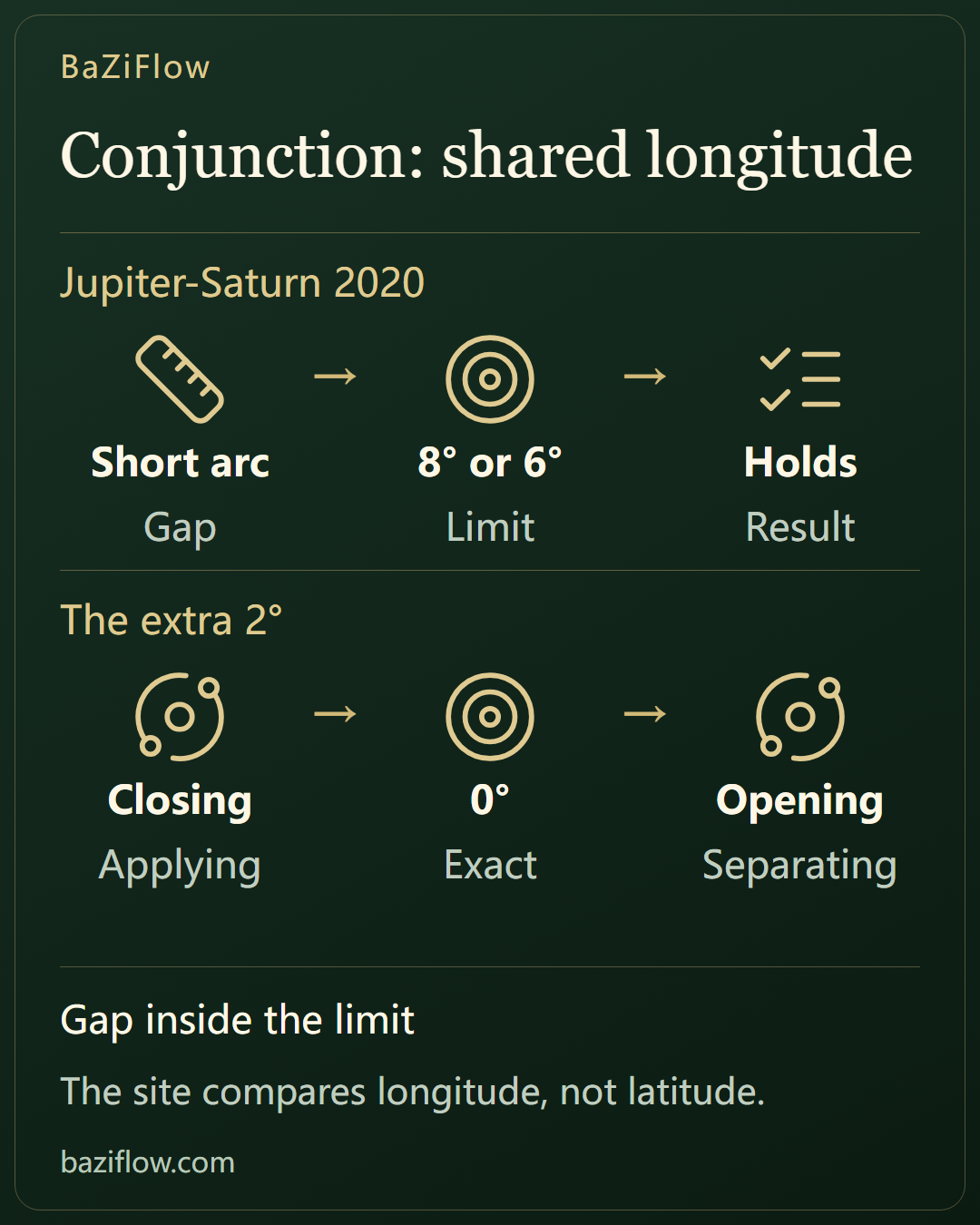
A conjunction is two longitudes inside the orb. Jupiter and Saturn in 2020 show the 6° window, applying and separating, the extra 2° for the Sun and Moon, and why shared longitude is not shared sky.
The short version6 min read
A conjunction is two bodies whose longitude gap falls inside the orb: up to 8° when the Sun or Moon is involved, up to 6° otherwise. It does not need a shared sign, and it does not need the two to be close together in the sky.
- The site tests a conjunction on longitude alone: the shorter gap must not exceed the limit. Sign borders and latitude play no part, so every result can be recomputed.
- In 2020 Jupiter and Saturn crossed into the 6° window twice before meeting at 0°29′ Aquarius on December 21, so one pair can apply, separate and apply again in a single year.
- When Ptolemy lists the signs that are in aspect with each other (Book I chapter 13), the conjunction is not among them; it turns up only in later chapters. The site's table lists it as a degree test, which measures a different thing.
Read first
Aspects and orbs in astrology: how to calculate the angle between two planets ↗
Not on Ptolemy's list: his "relations" versus a software "aspect"
In plain words first: when the site says two planets are in conjunction, it only compares their longitudes, and a small enough gap is a conjunction. That is a different ruler from the sign relations Ptolemy wrote about.
The Tetrabiblos, Book I chapter 13 (numbered XVI in Ashmand's English translation), lists the signs that are in aspect with one another: opposition across six signs (180°), trine across four (120°), quartile across three (90°) and sextile across two (60°). In a footnote the translator points out that this chapter has no conjunction, because a part of the zodiac cannot be configured with itself; the conjunction turns up in later chapters.
Enlarge diagram · scroll sideways to read
Jupiter and Saturn crossed the window twice in 2020
Start with an example that has a full set of readings. The engine puts Jupiter and Saturn on exactly the same longitude at 18:26 UTC on December 21, 2020, both at 0°29′ Aquarius. Before that moment they had already gone in, out and in again.
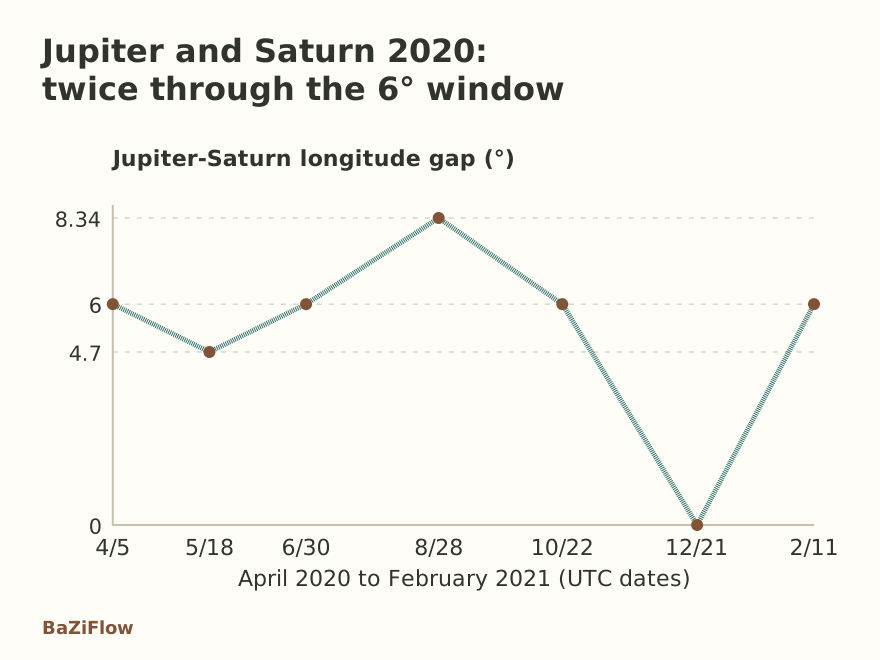
Data from the site engine: 4/5, 6/30, 10/22 and 2/11 are the hours when the gap equals 6° (hourly sampling), 5/18 is the lowest value in the first window, and 8/28 and 12/21 are readings for those days.
On April 5 the gap fell to 6° and the window opened; on May 18 it was smallest at 4.70°. In mid-May Saturn (May 11) and Jupiter (May 14) turned retrograde, both moving backward, and the gap opened again. It left the window on June 30 and passed 8° at the end of August. Jupiter (September 13) and Saturn (September 29) turned direct, the gap re-entered the window on October 22, closed to nothing on December 21 and left on February 11, 2021.
Applying and separating: six readings of one pair
Applying means the two are closing, separating means they are opening. In Book I chapter 24 (numbered XXVII in Ashmand), when distances are small the planet that goes ahead is said to apply to the one that follows, and the follower to separate from the leader. The site uses a more mechanical test: it compares the longitudes an hour later, and if the gap shrinks the pair is applying; for a conjunction the gap is the deviation, so here the test agrees with the traditional definition.
Enlarge diagram · scroll sideways to read
The 0.03° at 12:00 on December 21 is still applying because the exact moment, 18:26 that day, has not arrived. A few hours is all it takes for the same angle to flip its status.
The limit is 8° or 6°: first ask whether a luminary is involved
The orb is not one number. It depends on who takes part: the Sun or Moon on either side gives 8°, otherwise 6°, and the wider of the two ends is used. The Ascendant and Midheaven take 6°, and every minor aspect takes 3°.
Enlarge diagram · scroll sideways to read
Sign names play no part at all. On October 28 the Sun was at 5°04′ Scorpio and Venus at 28°07′ Libra, across a sign border and still conjunct. The same day Mars (16°50′ Leo) and Jupiter (23°52′ Leo) shared a sign but stood 7.04° apart, beyond 6°, so no conjunction.
Shared longitude is not shared sky
The same chapter (Book I chapter 24) adds something for the "bodily conjunction": when judging its application and separation, the actual latitudes of the bodies must be watched, so that only a passage through the same part of the zodiac counts. For the other aspects this is not needed, because their rays all converge on the earth. The site engine has longitude only and skips that step.
Enlarge diagram · scroll sideways to read
Both rows have exactly equal longitudes, yet the true gaps in the sky differ more than sixtyfold. Jupiter and Saturn had latitudes of −0.48° and −0.38°, nearly on top of each other; Venus stood 6.52° south of the ecliptic, a long way from the Sun. When a table says "conjunction", it says it about one coordinate, longitude.
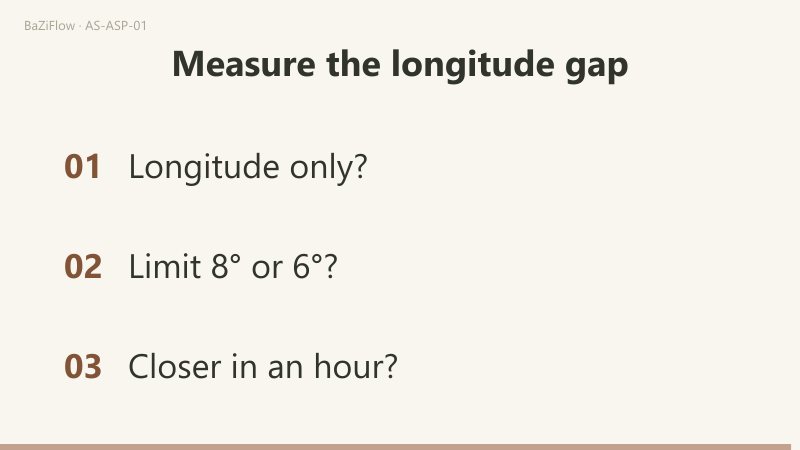
Take the shorter arc first
Subtract the two longitudes; if the result passes 180°, take it away from 360°.
Then choose the limit
8° with the Sun or Moon, 6° otherwise, 3° for minor aspects; write the limit beside the gap.
Finally mark the direction
If the gap an hour later is smaller the pair is applying; if larger, separating.
Whether a conjunction is good or bad is not in the angle; see why conjunction, opposition and square cannot be read straight as good or bad. The arithmetic of gaps and limits is practiced in aspect angles and orbs, and the next row of the table is the sextile (60°).
Questions readers ask next
If one planet is at 29° and the other at 1° of the next sign, is it still a conjunction?
Yes. The site compares two longitudes and nothing else, so a 2° gap inside the limit holds whatever the sign names. On June 29, 2020 Jupiter stood in Capricorn and Saturn in Aquarius, 5.97° apart, and the engine still called it a conjunction.
Why does the Sun 6.8° from Mercury count while Mars 6.6° from Mercury does not?
The limit follows who takes part: the Sun or the Moon on either side gives 8°, two planets give 6°. The second pair is closer but its limit is smaller, so it falls outside.
If Venus and the Sun share a longitude, can you see them touching?
Not necessarily. On October 24, 2026 their longitudes matched while Venus sat 6.5° south of the ecliptic, so the true gap was about 6.5°. The site compares longitude only, so that moment counts as an exact conjunction.
Was this article helpful?
Sources & references
Continue reading
The Sextile (60°): A Third of a Half-Circle, Checked on Three Real 2026 Readings ↗
Conjunction, opposition and square aspects: measure the angle before judging good or bad ↗