

Page of Wands: the faithful bearer
Content version · · Sources & references
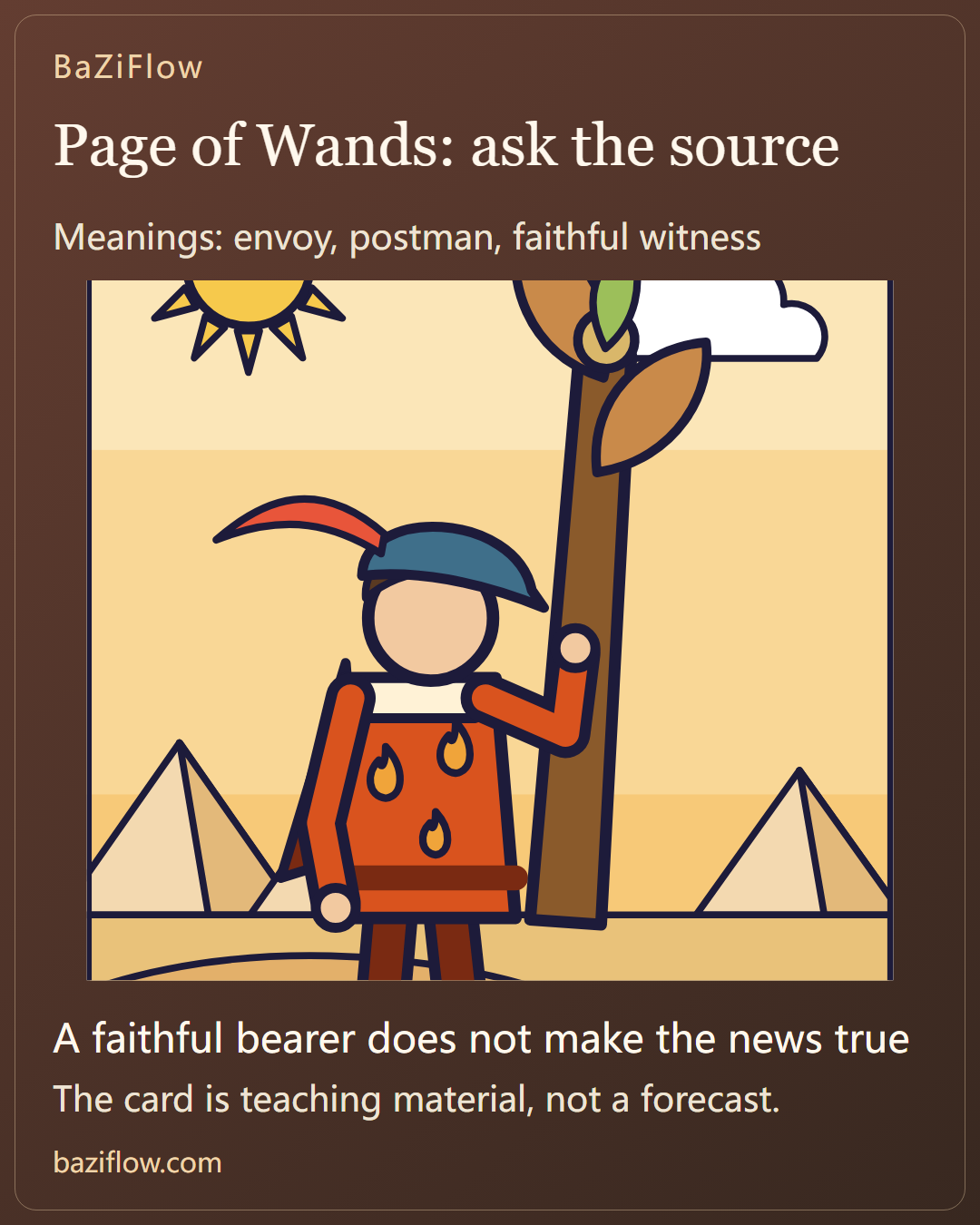
The Page of Wands shows a young figure grasping a leafing staff and proclaiming something. Separate the picture, Waite's word list and his extras, then practice reading the bearer and the message as two different things.
The short version6 min read
The Page of Wands is a young figure with a leafing staff, looking up as if to announce something. Read it by keeping the bearer and the message in two columns.
- Waite describes the picture in two sentences: a young man stands in the act of proclamation, unknown but faithful, with strange tidings. The main list includes envoy, postman and lover.
- The reversed main entry gives anecdotes, announcements and evil news, plus indecision; the extras describe a young man of family seeking a young lady, with just "bad news" reversed.
- The exercise here is about relayed news: whether the bearer is reliable and whether the message is confirmed are two questions, one column each.
Read first
Start with the picture: a bearer looking up at his staff
Waite's description of this card is two sentences. In a scene similar to the former, a young man stands in the act of proclamation. He is unknown but faithful, and his tidings are strange. The "former" is the Knight of Wands, whose entry has the rider passing mounds or pyramids.
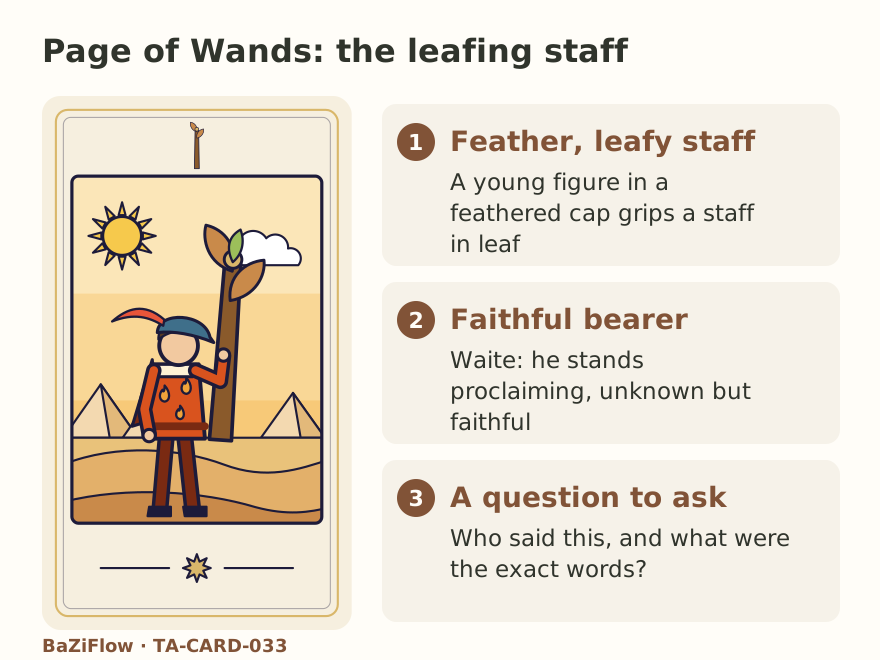
BaZiFlow original Page of Wands with three labels
On the original RWS card the young figure stands in profile in a feathered cap and cloak, both hands on a staff from which a few leaves are sprouting, and tips his face up toward the top of it. Behind him are sandy ground, orange hills in the distance and a small tree. "Proclamation" is Waite's word; what the picture shows is looking. That gap is where the exercise below starts.
Enlarge diagram · scroll sideways to read
What Waite lists: a faithful envoy, and strange tidings
The divinatory meanings run: a dark young man, faithful, a lover, an envoy, a postman. Beside a man, he will bear favorable testimony concerning him. He is a dangerous rival if followed by the Page of Cups. He has the chief qualities of his suit, and may signify "family intelligence", a phrase in which "intelligence" then commonly meant news.
Dark young man, faithful, a lover, an envoy, a postman. Beside a man, he will bear favourable testimony concerning him.
The list mixes roles (envoy, postman), a quality (faithful) and two conditions that depend on neighboring cards. The reversed list is on its own line: anecdotes, announcements, evil news, and also indecision with the instability that comes with it.
Enlarge diagram · scroll sideways to read
The additional meanings are what other readers say: "Young man of family in search of young lady. Reversed: Bad news." It does not overlap with the main entry's envoy and faithfulness, so the two should not be blended into one passage of the original.
Dark young man, envoy, leafing staff: three points, three origins
Three things are the easiest to take for settled facts, and each comes from somewhere different:
Three points, and who said each
- Staff in leaf
- In the RWS picture the staff has leaves. Waite does not mention the staff in this entry; the leaves belong to the whole suit, and he explains them under the Queen of Wands.
- Dark young man
- Waite's own words: a 1910 way of sorting court figures by complexion and coloring, used for several of the court cards of this suit.
- Envoy and postman
- Two jobs Waite lists, both of someone who carries another person's words. What those words are, the list does not say.
Enlarge diagram · scroll sideways to read
How to read it: two columns, the bearer and the words
Waite writes this figure with a turn: unknown, but faithful; the tidings strange. Two adjectives sit on two different things, one on the person and one on the message. The reading starts from there, and only three steps remain:
Is the bearer reliable?
"Faithful" speaks of the bearer: he does not alter what he was given. It does not vouch for what the message says.
What is the message itself?
"Strange" can be read as unseen and unverified. A message without a source goes into the "to check" column first.
Whom is he testifying about?
The entry says he bears favorable testimony beside a man: the subject is a third person, not the bearer himself.
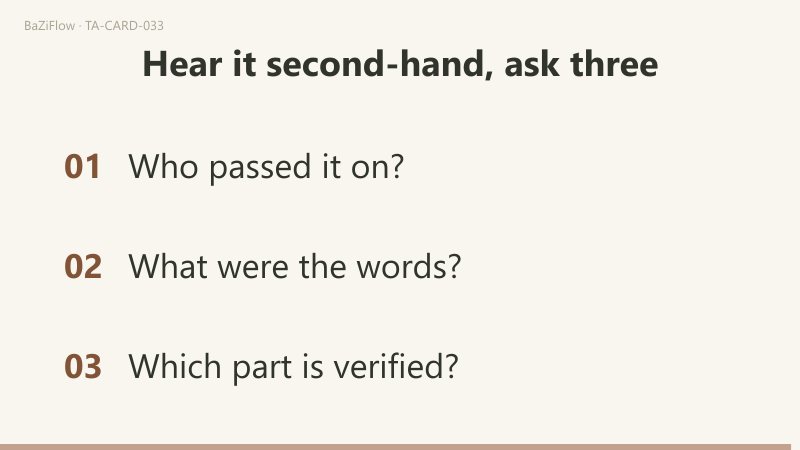
An example: a friend in your writing group tells you, "I heard the magazine's editor read your submission and liked it." Split that sentence into three rows:
Enlarge diagram · scroll sideways to read
In one relayed report, what is in hand
In hand
- A message on its way
- A bearer who is usually exact
Not in hand
- The editor's own words
- Where the piece ends up
Fill in first
- Ask the bearer for the source
- Wait for the editor's reply
Reversed and neighboring cards: "proclamations" stays in the reversed list
Waite's reversed main entry reads: anecdotes, announcements, evil news; also indecision and the instability that accompanies it. "Announcements" is the same word as upright, so here the reversal is not an opposite; what is added is anecdotes (idle talk), evil news and indecision. The additional list's reversed entry is shorter: just "bad news". If you use reversals, say which entry you follow.
Three cards beside the Page
A hand grips the staff
Waite lists creation, a starting point and a source; there is no "to whom" yet.
Staves flying over open country
"Swiftness, as that of an express messenger": things on the move, not the words someone brings.
A pairing the entry names
Waite writes that the Page of Wands followed by the Page of Cups is a dangerous rival; the Page of Cups' own list gives news, message and meditation.
Enlarge diagram · scroll sideways to read
Questions readers ask next
Does the Page of Wands stand for a particular young person?
Waite's list says "dark young man", a 1910 way of sorting court figures by looks. A safer modern reading is a way of acting that belongs to the suit of Wands, one that speaks and moves first, not a portrait of anyone in real life.
What does the Page of Wands mean reversed?
In the main entry the reversed words are anecdotes, announcements and evil news, together with indecision and the instability that goes with it. The additional list gives only "bad news". Say which of the two you are using.
If I draw the Page of Wands, will news arrive?
The list has envoy and postman and the picture shows someone proclaiming, but Waite never writes that news will come. A more practical use is for when you are already holding a second-hand report: the card reminds you to ask for its source.
Was this article helpful?
Sources & references
Continue reading
Ace of Wands: a hand grips a staff in leaf, and Waite's list looks back to origins ↗