

The Empress: grain ahead, water behind
Content version · · Sources & references
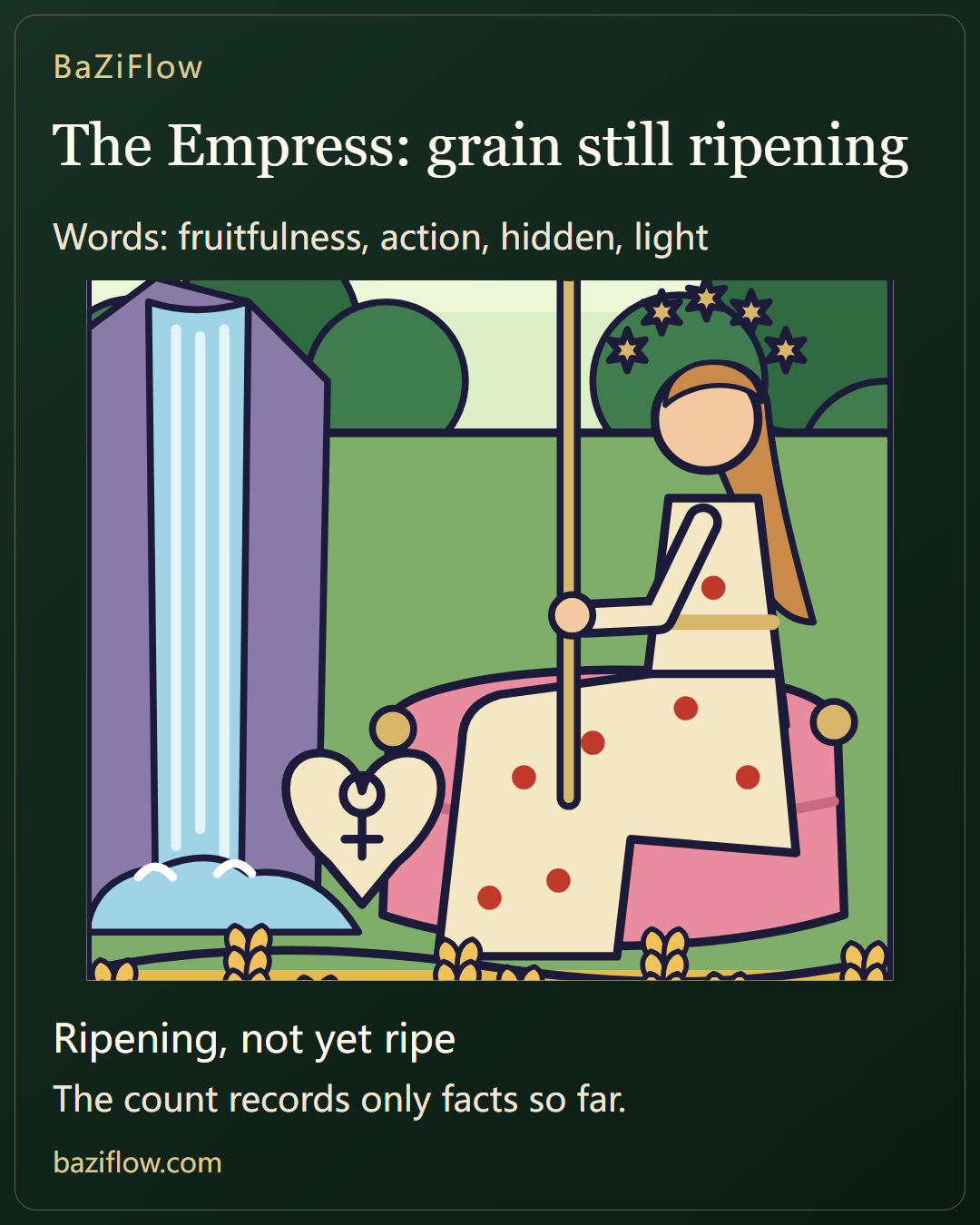
The Empress sits before ripening grain, a waterfall behind her, a star crown above and Venus on her shield. Separate Waite's picture, words and symbols, then take stock of a new skill in three places.
The short version7 min read
The Empress has grain close by and water far off. Waite's verb is "ripening": the grain is growing, not harvested. When this card comes up, first see how far along the growing is.
- Waite's picture: a stately seated figure with a diadem of twelve stars gathered in a cluster, the symbol of Venus on a shield beside her, and a sceptre topped with the globe; grain ripening in front, a fall of water beyond.
- The first half of the upright list is fruitfulness, action, initiative, length of days; the second half is the unknown, clandestine, difficulty, doubt, ignorance. The reversed words (light, truth, the unravelling of involved matters) face that second half.
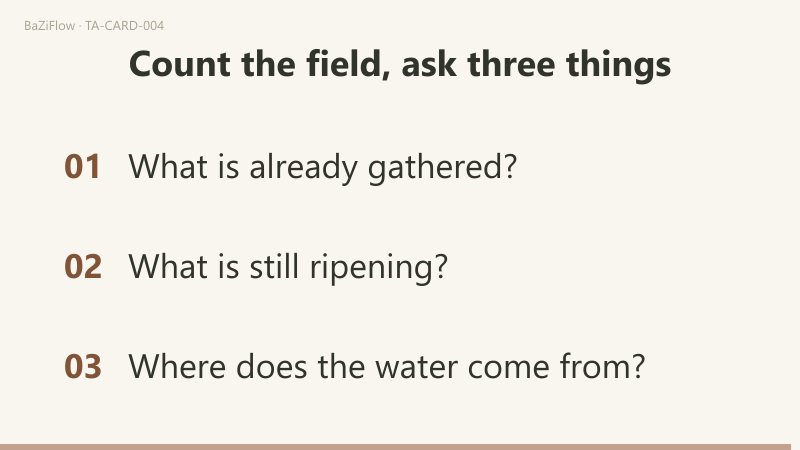
- For practice, take something you are learning and count it in three places: what is already gathered, what is still ripening, and the source that keeps the water coming.
Read first
Start with the picture: a star crown, a Venus shield, grain ahead and water behind
Waite opens the Empress with a sense of presence: a stately figure, seated, having rich vestments and a royal aspect, as of a daughter of heaven and earth. Her diadem is of twelve stars, gathered in a cluster. The symbol of Venus is on the shield which rests near her, and the sceptre she bears is surmounted by the globe of this world. A field of corn is ripening in front of her, and beyond there is a fall of water.
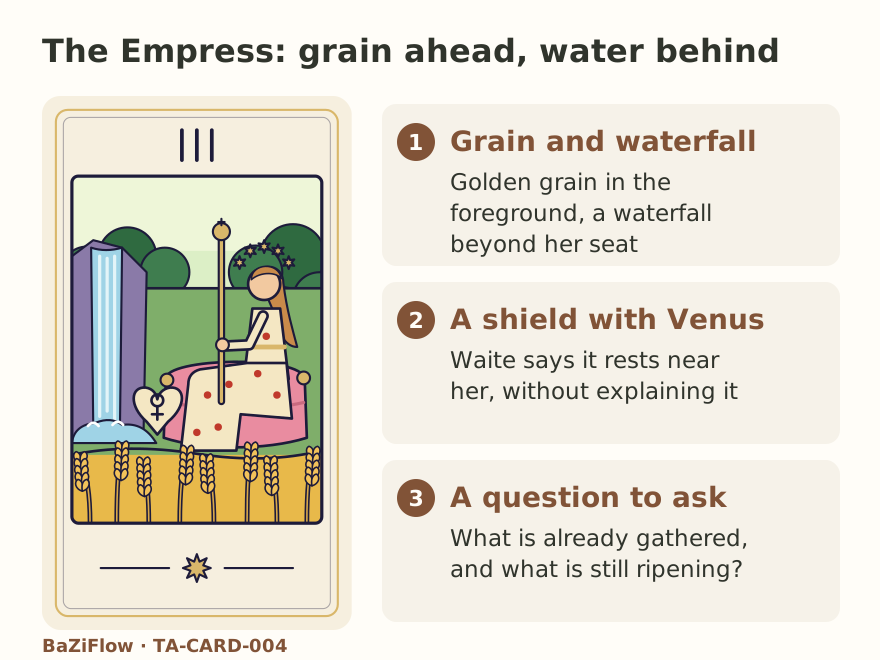
The Empress: BaZiFlow's card with three prompts
On the Rider-Waite-Smith original, these are the points worth checking with your own eyes: the Roman numeral III at the top and a yellow sky; a star crown, and a staff topped with a round globe raised in one hand; a heart-shaped shield leaning beside her with the Venus sign (a circle over a cross) on it; a broad field of golden stalks at her feet, and woods and a falling stream at the right. In Waite's order the picture has three places: the crown above, the staff and shield at hand, and around her the grain in front and the water behind.
Enlarge diagram · scroll sideways to read
What Waite lists: fruitfulness and action, and a dark half on the same line
The Empress's divinatory meaning is: fruitfulness, action, initiative, length of days; the unknown, clandestine; also difficulty, doubt, ignorance. Reversed: light, truth, the unravelling of involved matters, public rejoicings; according to another reading, vacillation.
Fruitfulness, action, initiative, length of days; the unknown, clandestine; also difficulty, doubt, ignorance. Reversed: Light, truth, the unravelling of involved matters, public rejoicings.
Enlarge diagram · scroll sideways to read
The upright line's second half stays in the dark: clandestine, doubt, ignorance. The first reversed words read like an answer to it: light, truth, the unravelling of involved matters, plus public rejoicings, all of them bringing things into the open. Only the other reading, vacillation, turns against the first half's initiative. So the reversed Empress reads less like abundance lost and more like a list of things made clear.
Star crown, Venus shield, grain and water: what Waite wrote
Part II on the Empress is not short. Waite calls her the inferior Garden of Eden, the Earthly Paradise, all that is symbolized by the visible house of man; the fruitful mother of thousands; above all things universal fecundity and the outer sense of the Word. He remarks that no direct message has been given to man like that borne by woman, though she does not herself carry its interpretation.
Three places in the picture and who is speaking
- The crown of twelve stars
- Waite writes only "twelve stars, gathered in a cluster". Among the descriptions he accepts for her is "the woman clothed with the sun"; in Revelation that woman wears a crown of twelve stars, a common-lore link that is not his explanation in this entry.
- The shield with the sign of Venus
- Waite writes that the symbol of Venus is on the shield near her and does not say what it stands for. Further on, he says the card is the door by which one enters this life, "as into the Garden of Venus".
- Grain ahead, waterfall behind
- Grain ripening in front, a fall of water beyond. Waite sums them up as the inferior Garden of Eden. That grain means growth and water means supply is a later teaching borrowing.
Enlarge diagram · scroll sideways to read
Waite also sets out a quite specific structure: the Empress is the door, and people enter this life by her; the way which leads out of it, into that which is beyond, is the secret known to the High Priestess. That puts two neighboring cards at the two ends of one road: one for the entrance, one for the exit.
How to read it: the grain, the water and the part not yet yellow
The picture is already a counting sheet: the grain close by can be seen, the part not yet yellow reminds you that it is still growing, and the far water is the source that keeps feeding them. Carried over to learning a new skill, these three places become three questions.
The grain at hand: what is already gathered?
Write only what you can show someone: songs you can play through, chords you can hold cleanly, days of practice completed. What can be counted counts as gathered.
The part not yet yellow: what is still growing?
Waite writes "ripening". List the half-done things separately and estimate roughly how many weeks they still need, without folding them into "already know".
The distant water: what keeps supplying?
A weekly lesson, a fixed practice slot, a course you can follow. If the water stops, both earlier columns stop, so write it down on its own.
An example: you have practiced the ukulele daily for six weeks. The three questions split "how am I doing" into three columns:
Enlarge diagram · scroll sideways to read
After counting the field
Visible
- Days in the practice log
- Songs played through
Not visible
- The day you "have learned it"
- Whether you could perform
Do next
- Mark one patch to gather next week
- Check the water has not stopped
Reversed and neighboring cards: light and truth, and three cards on "entrance" and "plenty"
The reversed Empress is a surprise, a column turned toward the open:
Light, truth, the unravelling of involved matters, public rejoicings; according to another reading, vacillation.
The "other reading", vacillation, is the only leaning-negative word in the whole reversed list; say which reading you use.
Neighboring cards and how each houses "plenty"
The secret of the exit
The card before. In the Empress entry Waite writes that the Empress is the door into this life, and the way out of it, into what is beyond, is the secret known to the High Priestess.
The other of the pair
In the Emperor entry Waite writes that these two cards "do not precisely represent the condition of married life, though this state is implied"; the Emperor's list is stability, power, protection, realization.
A garden full of vines
Waite writes a woman amid a great abundance of grapevines, "suggesting plenty in all things"; the list runs prudence, safety, success, accomplishment. A picture of plenty already there, set beside the Empress's ripening grain, differs by one verb.
Enlarge diagram · scroll sideways to read
Questions readers ask next
Is the Empress only a "mother" or "harvest" card?
The first half of Waite's list is fruitfulness, action, initiative, length of days, but the second half of the same line is the unknown, clandestine, difficulty, doubt, ignorance. In Part II he also calls her the door by which one enters this life. Reading only "harvest" drops the second half.
What does the Empress mean reversed?
Waite's reversed words are light, truth, the unravelling of involved matters, public rejoicings, and by another reading vacillation. The first ones face the upright "clandestine": a move from the dark into the open. Phrases like "stagnation" or "lost nurture" come from later methods.
What is the symbol on the Empress's shield?
Waite writes that it is the symbol of Venus, on a shield resting near her. On the Rider-Waite-Smith card it is a heart-shaped shield bearing the Venus sign. He does not explain what it means on this card.
Was this article helpful?
Sources & references
Continue reading
Waite, Marseille and Thoth: Sort Three Things Out Before You Switch Decks ↗
Reversals are not a universal minus sign ↗
The Emperor: a staff and a globe on a stone seat, and a description made of objects ↗