

Review every journal entry
Content version · · Sources & references
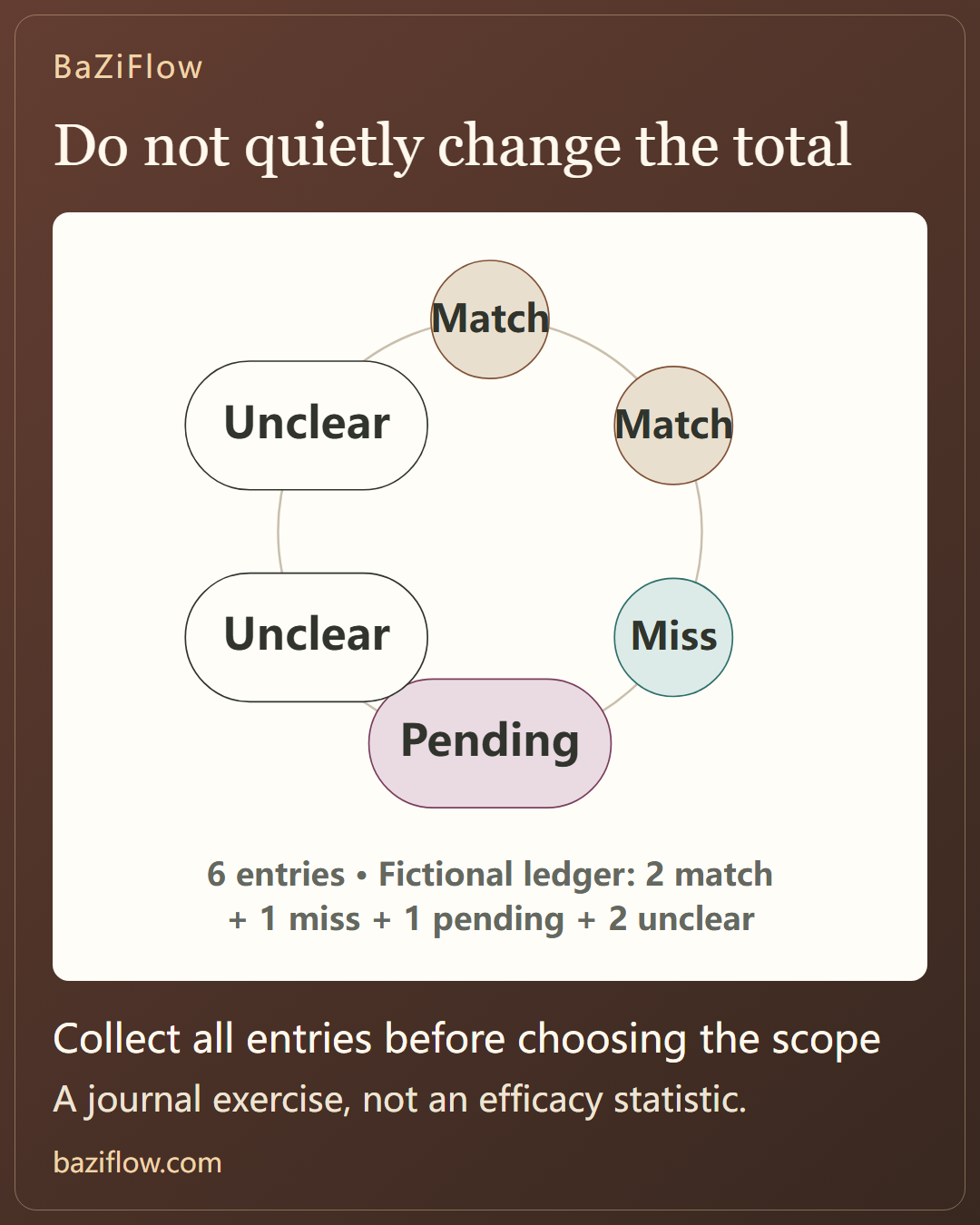
A six-entry fictional ledger shows why changing the denominator, extending deadlines or replacing an event claim with a feeling can make a journal look more accurate without adding evidence.
The short version7 min read
A fictional six-entry journal contains two matches, one miss, one pending entry and two unclear ones. Keeping all six exposes changed wording, extended deadlines and shifting denominators. Useful actions can be recorded separately for what they actually improved.
- Choose the review period and recover every entry before classifying it. Record missing notes instead of reconstructing original evidence from memory.
- Preserve the original claim alongside later facts: receiving a reply late and missing the original deadline can both be true.
- Two out of six and two out of three describe different scopes. A larger fraction does not mean the cards became more accurate.
Read first
Account for the entries that resist classification
Suppose a journal contains six entries. Two match their original event descriptions, one does not, one has not reached its deadline, and two are too vague to judge. If you remember only the two matches, you have not reviewed six entries. You have selected two of them.
Even an explicit fraction needs care. Two out of six describes the share assigned to one category in this fictional ledger. Two out of the three presently classifiable entries describes something else. Neither is automatically a measure of tarot's predictive accuracy. Choosing the more impressive fraction without explaining what happened to the other entries hides an important part of the record.
The exercise here is therefore to account for every entry in a chosen period, including missing records. It is an original journal-organizing method, not a validated psychological scale or a complete experimental design. If the month was not recorded consistently, write that limitation instead of reconstructing a complete-looking dataset from memory.
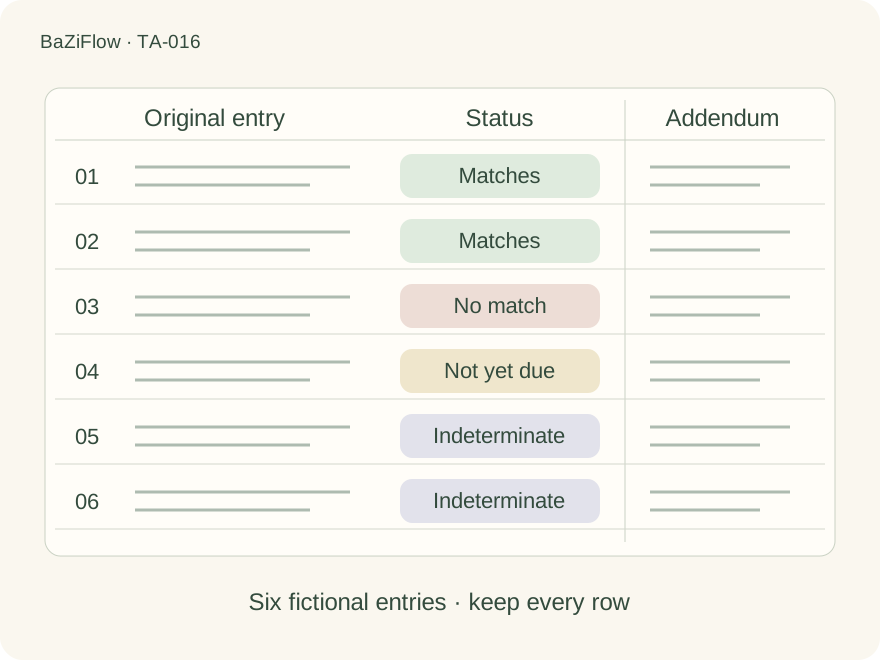
An original fictional ledger for inspecting records. Its categories are not a validated measure of tarot accuracy.
Which version are you reviewing?
An old journal entry now says “the organizer will respond soon.” A saved copy from the day of the draw says “the organizer will confirm by Friday.” Before comparing either sentence with events, establish which one existed when. A cleaner-looking current document can conceal the very change the review needs to examine.
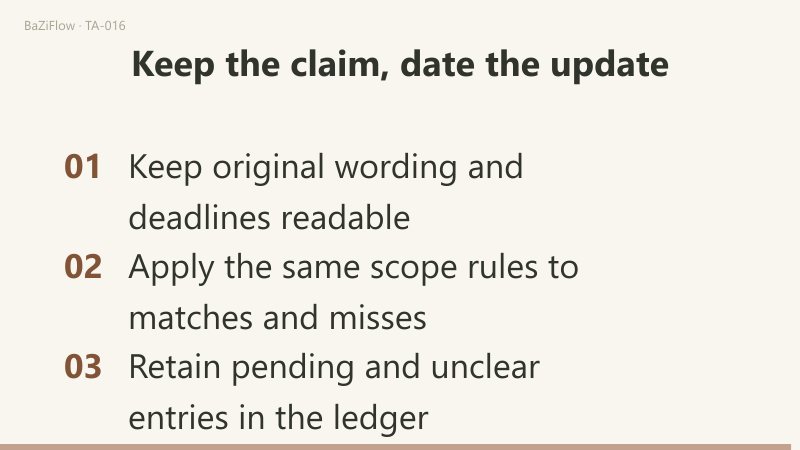
Keep the earlier wording, the later amendment and their dates together. If confirmation arrived on Sunday, the original Friday deadline was missed and a later confirmation also occurred. Those two observations can coexist. There is no need to erase the arrival or broaden the deadline to make the record look consistent.
The National Archives' written-document worksheet asks about authorship, date, purpose and other evidence. Applied here, those questions help identify a note's history. They do not give an institutional endorsement to divination. The review method below is an original journal-organizing exercise, not a validated predictive test.
Friday deadline · 0
Before ↔ After
- Original deadline · 0
- Sunday receipt · 2
Days relative to the original deadline; receipt two days later is an addendum
Preserve the claim that existed before the outcome
An entry should distinguish the question, date, deck and method, the interpretation written at the time, and any event conditions it proposes. Later information belongs in a dated addendum. An editable document can still serve this purpose if you preserve the earlier version rather than silently replacing it.
The same issue occurs when the subject changes. A statement about a named project cannot become a statement about an unrelated project merely because something similar happened there. Nor can a claim about another person's thoughts be confirmed only by the writer's own sense that the person must secretly agree.
| Review status | What supports the label | What the label does not do |
|---|---|---|
| Matches the original claim | The stated event occurred within the stated scope | Prove a general predictive ability |
| Does not match | A clear, due claim conflicts with the observed outcome | Judge every possible use of the practice |
| Not yet due | The period is open and the event is unresolved | Permit indefinite extensions |
| Indeterminate | The claim or available evidence is insufficient | Count as a hidden success |
Apply the labels to the wording that was saved, not to the most generous interpretation you can now invent. A genuine ambiguity should remain visible. If a new event later supplies missing evidence, date the update so a reader can see when the status changed.
Scope
All entries
- Matches
- 2
- Denominator
- 6
- Share
- 33.3%
Classifiable
- Matches
- 2
- Denominator
- 3
- Share
- 66.7%
Rounded to one decimal; two scopes, not two measured accuracy rates
Interpretive flexibility needs a version history
At the end of his additional meanings for the Lesser Arcana, Waite notes disagreement among meanings and modification by position in a sequence. That historical observation does not settle the value of every interpretation. It does show why a journal must specify which interpretation was actually used when the claim was made.
Otherwise the review can move between alternatives until one fits. An event becomes a mood, a week becomes a season, or one person becomes someone else. A new association is allowed as a new association. It should not be credited to the earlier wording as though it had been there all along.
Keep revisions useful and visible. You might write, “I initially understood this as a reply from the organizer; after the meeting I began to use it as a prompt about my own hesitation.” That is a report of changed interpretation. It is not evidence that the original prediction succeeded.
Also account for your actions. If the entry encouraged you to send a draft and you then sent it, the completed action is observable. Yet your decision and effort helped produce that result. A personal journal has not isolated an independent forecasting effect simply because an anticipated action occurred.
The guide to repeating a question addresses another way records can drift: adding draws until a satisfying explanation appears. Save the additional draws as additional draws. They do not erase the initial statement or reset its deadline.
Change
Subject
- Original
- Project A
- Later
- Project B
Time
- Original
- This week
- Later
- Six months
Event
- Original
- Receive reply
- Later
- Feel reassured
A new interpretation can be dated separately, not credited to the original claim
Record usefulness on its own terms
A reading may help you notice that an invitation lacks a meeting point. You add the address, and the notice becomes clearer. That is a concrete contribution worth recording, even if the reading made no testable event prediction. Preserve the change rather than turning it into a claim that the cards foresaw the event.
Similarly, feeling reassured is a report about your experience. It should not be merged with evidence about an external outcome. Keeping experience, action and event comparison in separate fields tells you what was useful and what remains unknown.
At the end of a review period, read one match, one nonmatch and one indeterminate entry side by side. Use the same scope rules for all three. Ask whether an unfamiliar reader could see why each received its label. You do not need to invent a score when the records cannot support one.
If you share a case, remove names and unnecessary personal details, especially information about people who did not choose to publish their experiences. A brief anonymized context can explain the reasoning without exposing private material. For the fields to preserve before the draw, return to drawing and recording. A journal is more informative when its unresolved entries remain readable than when every page is edited toward a successful ending.
Experience
Record reassurance or disappointment without making it evidence about another person or event.
Action
Preserve the actual change, such as an added address or item number.
Event
Compare with the original subject and deadline, including real processes that shaped the outcome.
Questions readers ask next
Does a Sunday reply fulfill a claim that it would arrive by Friday?
It does not meet that original time condition, but the Sunday receipt remains a later fact worth recording. Keeping both is more informative than changing Friday to soon and treating the amended sentence as the original claim.
Must every entry remain pending until its deadline?
No. If a claim says a reply will arrive by Friday and it arrives Thursday, the stated event can already be checked. If Thursday passes without a reply, that alone is not a miss. Distinguish completed events from ones still awaiting observation.
Can I divide the two matches by the three classifiable entries?
You may report that defined subset, while also displaying the one pending and two unclear entries omitted from its denominator. It answers a different question from the share of all six entries; neither fraction alone establishes general predictive accuracy.
Was this article helpful?
Theme: Reflection & emotions
Part of a learning path
Tarot: from the question to the review · Step 6 of 6 available
Sources & references
Continue reading
Repeated tarot questions change what you end up selecting ↗
Relationship readings without speaking for the other person ↗