

Distance means a position gap
Content version · · Sources & references
Apply a named practitioner convention to 27-position offsets, test the excluded gaps and keep distance bands distinct from roles, addresses and relationship evidence.
The short version6 min read
Near, middle and far describe positions under a chosen Sukuyō convention, not kilometres or emotional closeness. This article uses Koseido’s arrangement: take the shorter path around the 27-position cycle before assigning a band. Offsets one and twenty-six share gap one, while offset eighteen gives the unbanded Ye–Tai gap nine.
- Take the shorter of the two paths around the declared 27-position cycle, then apply the named convention; reversing references preserves that gap.
- Here gaps one to four are near, five to eight middle and ten to thirteen far. Zero and nine belong to Ming and Ye–Tai without a distance band.
- The three-nine row number is not a distance band: offset twenty-six appears late in writing but is only one step from the reference.
Read first
Three rows of nine do not mean three distance bands
A tempting shortcut is to rename the three rows of nine as near, middle and far. Test that shortcut before using a distance chart. The three-nine sequence in T1299 arranges 27 positions in three rows beginning with Ming, Ye and Tai. The modern Koseido distance explanation instead compares the six positions belonging to each of four paired groups. These organisations answer different questions. Having three parts does not make them interchangeable.
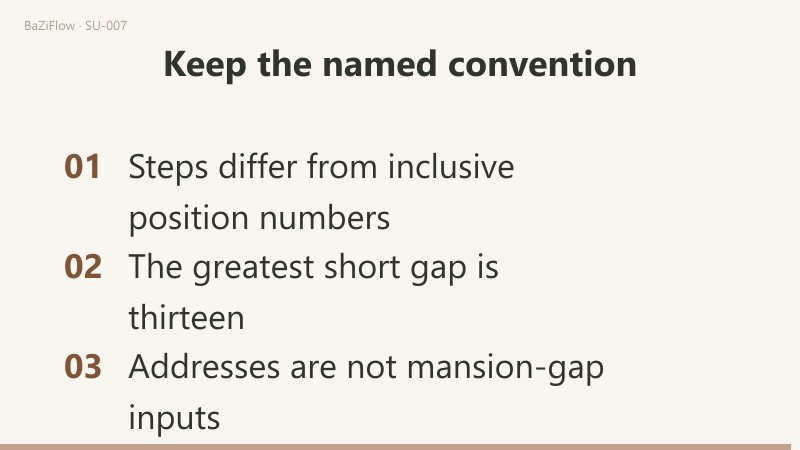
Offset 26 gives a simple counterexample to calling the last row “far”. It sits late in the written ordering but immediately next to the origin on the circle. Its short gap is one. Under the convention used here, it belongs with offset 1 in the near band, not with the most distant positions.
Keep the historical source and the modern convention named separately. The scripture supplies the ordering discussed in the reciprocal-label article; the practitioner guide supplies this distance classification. Neither citation turns the resulting label into evidence that an encounter must happen soon or that a partnership will develop slowly.
Written row
- Offset 26: third row
Circle gap
- One reverse step: near
Short gap first, category second
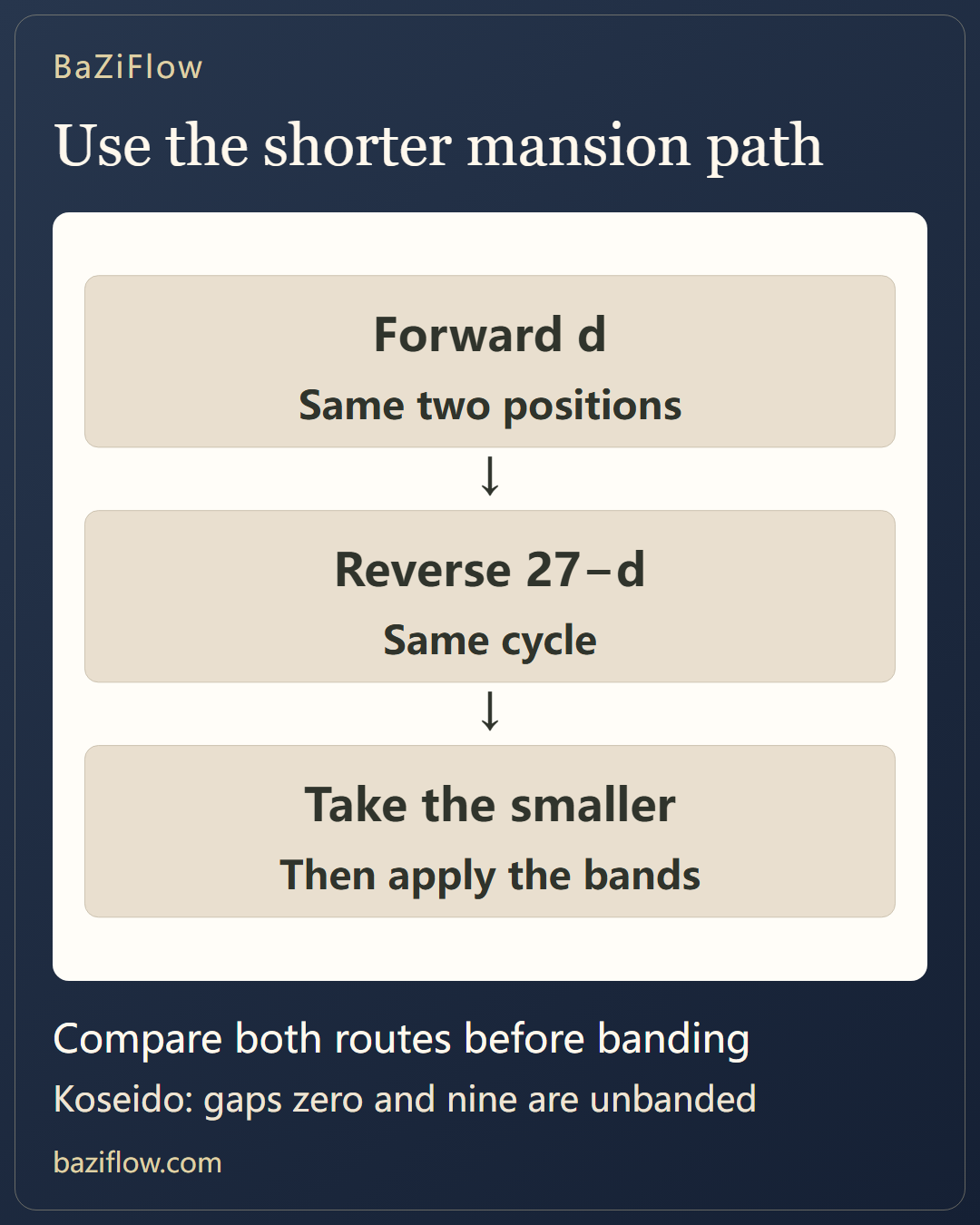
The examples can be generalised by measuring the shorter path around the declared 27-position circle. Let d be the forward offset, with the starting position numbered zero. Compare d with 27 − d and take the smaller value. At d = 0 the result is zero. These are steps between mansion positions, not kilometres, years of acquaintance or units of affection.
| Short gap under this convention | Distance field |
|---|---|
| 1–4 | Near |
| 5–8 | Middle |
| 10–13 | Far |
| 0 | No distance category: Ming |
| 9 | No distance category: Ye–Tai |
Offset 18 is a useful check. Its shorter side is 9, so it receives no distance category here. Calling it far simply because eighteen is a large forward count would be incorrect under the stated rule. An intentionally inapplicable field is different from missing data.
Because the circle has 27 positions, the greatest short gap between two positions is 13. There is no mansion exactly thirteen and a half steps away. This arithmetic fact says nothing about an opposite personality: a geometric description cannot establish a psychological one.
Ye–Tai: no distance band
One group, three checked examples
To find out what the named convention actually does, start with its worked positions. In Takemoto Kosei's Koseido chart guide, with Mao as the reference, Bi is near Rong, Zhang is middle Qin and Zhen is far Rong. The forward offsets in the adopted 27-name order (Mao 昴, Bi 畢, Zi 觜, Shen 參, Jing 井, Gui 鬼, Liu 柳, Xing 星, Zhang 張, Yi 翼, Zhen 軫, Jiao 角, Kang 亢, Di 氐, Fang 房, Xin 心, Wei 尾, Ji 箕, Dou 斗, Nu 女, Xu 虛, Wei 危, Shi 室, Bi 壁, Kui 奎, Lou 婁, Wei 胃) are 1, 8 and 10. Their short gaps are also 1, 8 and 10, so the examples fall into near, middle and far respectively.
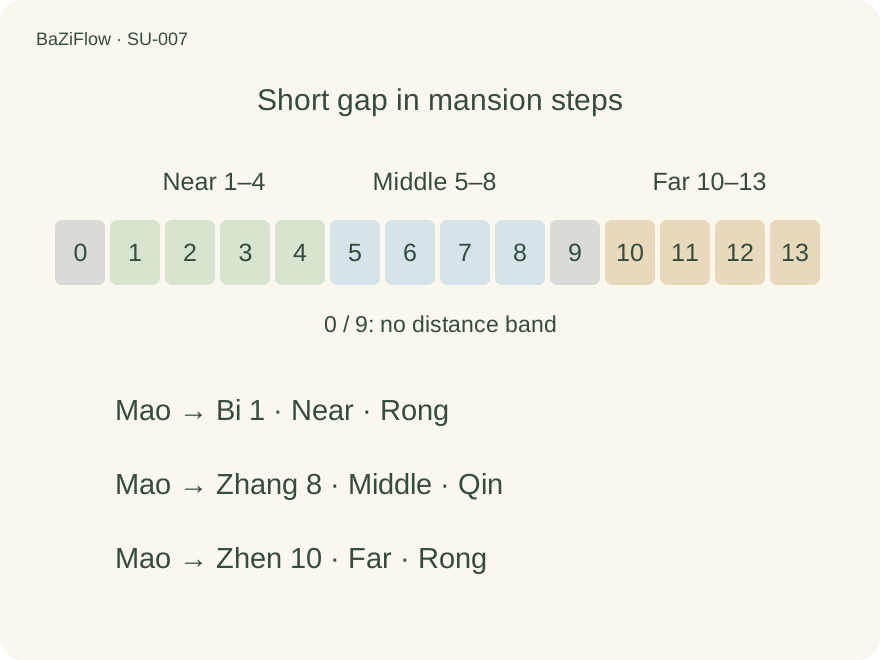
Original classification scale for the stated modern convention; colours identify bands, not quality.
All three belong to Rong–Qin, yet the directional label is not the same in every row. The figure deliberately keeps label and distance separate. It is not a ladder of relationship quality. Reversing Mao and Bi changes the forward offset from 1 to 26 while leaving the short gap at 1; the relative role must be read in the reversed direction, but the near category remains.
Symmetry of this category is a property of the calculation. It does not mean both people feel equally close, want the same contact frequency or contribute equally to a project. Those are independent questions about the people. For the underlying reciprocal labels, see six relationship groups.
Complete the group by adding the other three targets from the cited guide. From Mao, Bi at offset 1 and Wei (Stomach) at 26 both have short gap 1; Zhang at 8 and Nü at 19 both have gap 8; Zhen at 10 and Ji at 17 both have gap 10. These are the guide’s full six Rong–Qin positions across the three bands.
This does not make one, eight and ten the only possible gaps for every relationship group. They are the gaps in this particular Rong–Qin comparison. An–Huai, for example, has near offsets three and twenty-four, each with short gap three. Reading the group’s actual positions before assigning a band explains why several short gaps can belong to near.
Near: 1
- Bi 1 / Wei 26
Middle: 8
- Zhang 8 / Nü 19
Far: 10
- Zhen 10 / Ji 17
Reverse the references to check the result
Suppose A is one step from B in a fixed direction around a 27-position cycle. Returning from B to A in that same direction takes 26 steps. Those numbers describe adjacent positions, not one close relationship and one distant relationship. A method based only on the size of the forward offset would confuse direction with separation.
The unchanged short gap is a useful check on the calculation, while the directional role still needs to be read from the new reference. This short-gap formula is a reconstruction of the named practitioner’s arrangement, not a quotation of a universal ancient rule. A different school must document its own convention rather than borrowing the names and silently changing the arithmetic.
Read physical and social distance from their own evidence
Imagine two people organising a small reading group. They may live nearby but have incompatible schedules, or live far apart and exchange notes regularly. Their addresses, travel options, interest and availability describe actual conditions. A mansion-distance field does not contain those inputs and cannot replace them.
Moving house can change practical access without changing a pair of fixed birth labels. Similarly, assigning a near category does not authorise someone to accelerate a relationship or disregard another person's preference. The classification can remain part of a cultural reading while plans are based on the participants' stated choices.
When comparing reports, watch for advice that changes only an adjective when the distance category changes. “Closer”, “steadier” or “slower” may sound tailored while leaving the same unsupported story underneath. Useful discussion of a real situation needs its actual constraints and observations, not just a more elaborate label.
A reproducible note should keep the adopted convention, both birth labels, both directed offsets, the short gap and the final distance field. If the birth labels are later corrected, revisit that chain from the beginning. Do not choose a preferred distance by asking which narrative best resembles a remembered relationship. Calculation-method differences explains how to verify the starting labels before using them here.
Questions readers ask next
Does a far Sukuyō category mean two people live far apart?
No. Its unit here is steps between mansion positions. Addresses and journey times are not calculation inputs. Moving home changes practical access but does not automatically change the short gap between fixed birth references.
Why is forward offset eighteen not classified as far?
The other path is twenty-seven minus eighteen, or nine steps, so the short gap is nine. Under the named Koseido arrangement used here, that belongs to Ye–Tai without a distance category. The unbanded result is intentional, not missing data.
Why not call the three rows near, middle and far?
Rows group the written sequence into sets of nine, whereas distance uses the shorter route around the circle. Offset twenty-six is in the late written segment but only one reverse step away, placing it in the near band under this convention.
Was this article helpful?
Sources & references
Continue reading
Why Sukuyō Natal Mansion Methods Differ: Tell Lookup from Zoning, Then Check the Rule ↗