

Record an oracle lot’s source
Content version · · Sources & references
Use museum catalog examples to separate lot numbers from accession identifiers, preserve originals and transcriptions, and record unknown provenance honestly.
The short version6 min read
A perfectly copied number can still identify the wrong thing. Read its field label first, then keep the source, transcription and correction history separate so another reader can reconstruct the record.
- Lot 176 is not the accession identifier’s final 0087.
- A cataloging or access date does not establish when an object was made.
- Distinguish an original image, normalized transcription and proposed restoration.
Read first
What are oracle lots? Numbers, poems, and narrative references ↗
Why the same oracle-lot number can have different versions ↗
A catalog date is not a manufacture date
The National Museum of Taiwan History records a bamboo lot stick bearing number 176 under accession identifier 2003.001.0989.0087. The lot number and the catalog identifier serve different purposes. The record also gives a cataloging date of 1 October 2018 while leaving the historical period unknown.
It would be a mistake to turn 2018 into the object's manufacture year, or to infer manufacture in 2003 from the start of its identifier. This article uses published catalog fields as a documentation exercise; the object itself was not physically examined for this article.
Lot on the object
- 176
Identifier ending
- 0087
Identifiers and dates have different jobs
- Field label
- The name specifying what a value identifies, such as a lot number or cataloging date.
- Transfer route
- How material reached the recorder, which is not necessarily where it was produced.
Preserve the path back to the material
A personal record need not resemble a museum database, but another reader should be able to locate the same source. For a temple slip, record the city, temple, and collection name, adding the particular hall when relevant. For a slip received from a friend, record that transfer rather than claiming to have obtained it on site.
Keep the full wording and any edition marks, not just the favorable sentence. Where photography is permitted, an image of both sides and the margins can preserve information a tight crop would lose. Where it is not permitted, make an identified transcription. A webpage needs its address and access date; a booklet needs its title, edition or issue, and page.
These are practical documentation suggestions, not added ritual requirements. They do not require publishing the questioner's private circumstances or uploading the record to a service.
Put each known value in the right field
The museum example demonstrates why labels matter even when the values look precise. A long identifier can be copied perfectly and still be used incorrectly if it is placed in the lot-number field.
| Field in the public record | Value | What it must not replace |
|---|---|---|
| Number on the stick | 176 | The accession identifier |
| Accession identifier | 2003.001.0989.0087 | The lot number |
| Cataloging date | 2018-10-01 | Date of manufacture |
| Historical period | Unknown | A guessed year from another field |
This is not a record of someone drawing that lot, nor does it establish which current temple collection it belongs to. It simply shows that identifying an object, identifying its number, and dating its creation are different tasks.
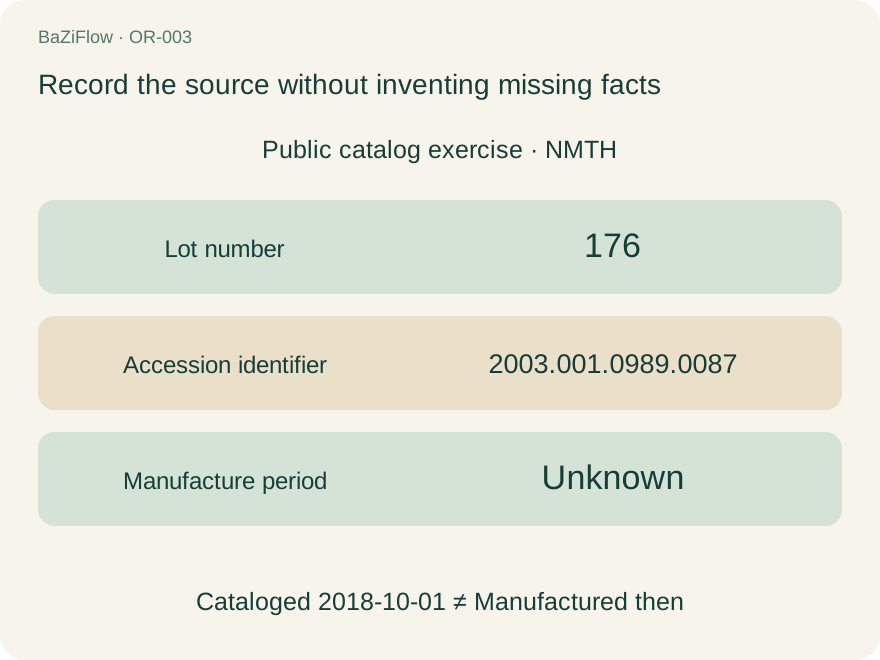
Original BaZiFlow field diagram based on catalog metadata, without reproducing the museum's object photographs.
176
- Value
- Object’s lot number
- Role
- Not 0087
2018-10-01
- Value
- Cataloging date
- Role
- Not manufacture date
Unknown period
- Value
- An unresolved field
- Role
- Not inferred from 2003
Keep the original apart from the reading copy
When a source image or page can be retained, preserve it as the reference for the transcription. Keep line order and mark unclear characters. A normalized character form, added punctuation, or a plain-language explanation belongs in a separate reading layer, not silently inside the purported original.
If a clearer image later reveals a missing line, add a dated correction and identify that image. If a proposed character comes only from another edition, label it as a candidate rather than a recovered original. The distinction between a variant and a copying error is discussed in same number, different versions.
The introductory account of numbers, poems, and story headings can help organize the fields. A missing heading should remain missing until evidence supplies it; a modern explanation should retain its own author and date.
Source image
The reference for comparison
Transcription
Marked gaps and normalization
Correction
New evidence and its date
Unknown is a valid value
A second museum entry, a two-poem printing block with identifier 2003.008.0759.0013, distinguishes the identifiable Yang Wood–Rat (甲子) and Yang Wood–Tiger (甲寅) headings from a lower layer of lettering that has been removed and cannot be read. A source can therefore preserve some information while leaving another field unresolved.
The same principle applies to a fragmentary photograph. Record who supplied it, when it was received, and what is legible. If the temple is uncertain, leave it uncertain. A later similar webpage may be a candidate source without becoming a confirmed match.
Do not fill a damaged passage from another version and then present the result as a full transcription of the object. Keeping the gap identifies the next research question and prevents speculation from contaminating what is already known.
Legible heading
- Record what can be read
Removed lettering
- Retain the unresolved gap
Dates and places need their own roles
Creation or publication date concerns the material's production. Acquisition date concerns when you received it. Access date concerns when you inspected an online source. They can differ by years, and a file's save time is not a substitute for an unknown publication date.
Likewise, the institution currently holding an object is not automatically its place of manufacture. A paper mailed from a city need not have been printed there. Record the transfer route separately from the original production location, and do not make a precise-sounding provenance story out of a guess.
The source of a literary allusion is yet another relationship. Finding the story in a historical book does not date the printed lot slip. The article on checking allusion sources handles that separate research path.
Share the reference without sharing unnecessary private material
A public edition record usually needs the place, collection, identifier, relevant wording, and source location. It does not need the person's home address, contact details, or private question. Keep a protected original apart from a sharing copy when handwritten notes or personal markings are present.
The finished record should make clear what comes from the object, what comes from a catalog or another person's account, what has been corrected, and what remains unknown. A modest but traceable record is more useful than an apparently complete one assembled from assumptions.
Mailed from a city
- Established
- The transfer route
- Not established
- The printing location
Viewed today
- Established
- The access date
- Not established
- The publication date
Locate the field for 176
Read the catalog name and description before recording the object’s lot number. Do not replace it with an identifier suffix.
Preserve the date’s stated role
Record 2018-10-01 as the cataloging date. Leave the historical period unknown rather than inferring manufacture from a precise-looking number.
Document the evidence for a correction
If a clearer image reveals one line, identify the image and the date of the addition. Other unclear characters remain unresolved.
Questions readers ask next
Can a year-like part of an accession identifier date manufacture?
Not without evidence for that interpretation. Consult the identifier scheme and an explicit dating field; the example here retains an unknown period.
Is an unidentified fragment worth recording?
Yes. Preserve legible text, transfer history and date while marking its place as unconfirmed.
May another edition supply a missing character?
It may support a labeled candidate reading. It does not make the damaged original legible or establish a recovered transcription.
Was this article helpful?
Sources & references
Continue reading
Read the poem, allusion, and commentary as distinct layers ↗
Check an oracle-lot allusion against the passage, not a title ↗