

Ascendant, Descendant, Midheaven and IC: two axes, four points
Content version · · Sources & references
Learn how the horizon and the meridian each cut the ecliptic, why the Midheaven is not the zenith, and why ASC and MC are rarely 90° apart.
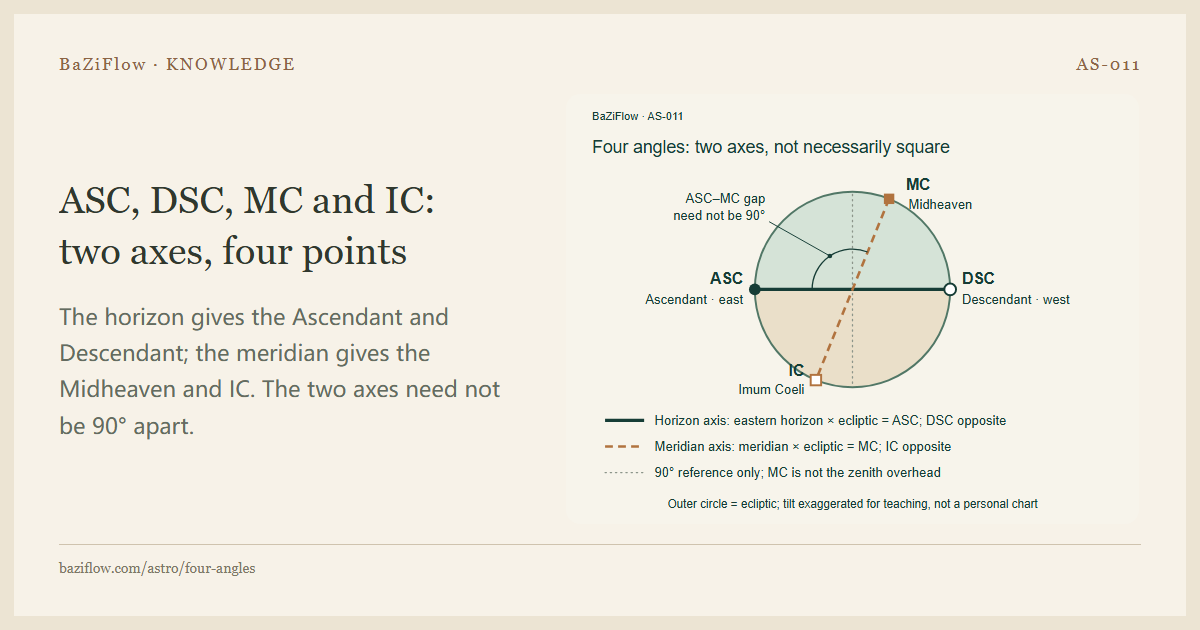
The horizon gives the Ascendant and Descendant; the meridian gives the Midheaven and IC. The two axes need not be 90° apart.
Read first
Try a subtraction first
Open any chart wheel and find the degrees printed beside ASC and MC. Convert both to zodiac longitude (Aries 0° = 0°, Taurus 0° = 30°, and so on) and subtract. The result is rarely exactly 90°, because the four angles are not a fixed cross laid over the zodiac. They come from two different axes, each defined by the local sky at the birth moment.
The Ascendant (ASC), Descendant (DSC), Midheaven (MC) and Imum Coeli (IC) are geometric points, not planets. For the basic chart components, see planets, signs, houses and aspects.
The horizon axis: Ascendant and Descendant
The local horizon is a great circle separating sky from ground; the ecliptic, the Sun's apparent yearly path, is another. They cross at two points. The eastern crossing is the Ascendant; the western crossing is the Descendant. They are exactly 180° apart, so the Descendant is simply the Ascendant's opposite point.
Chart wheels conventionally place the Ascendant on the left end of the horizontal line and the Descendant on the right. That reverses the map habit of east on the right.
The meridian axis: Midheaven and IC
The local meridian is the great circle running through the point directly overhead, the celestial poles, and the north and south points of the horizon. It too crosses the ecliptic twice; the crossing on the culminating side is the Midheaven (Medium Coeli, MC); its opposite, 180° away, is the Imum Coeli (IC).
Do not confuse it with the zenith, the point directly above the observer. The Midheaven always lies on the ecliptic, and the ecliptic usually does not pass overhead, so the MC is usually not at the zenith. Astronomy texts note that the noon Sun crosses the meridian and is highest for that day, yet is not necessarily at the zenith. Nor is the MC "whichever planet is highest right now": it is a degree of the ecliptic, possibly with no body there.
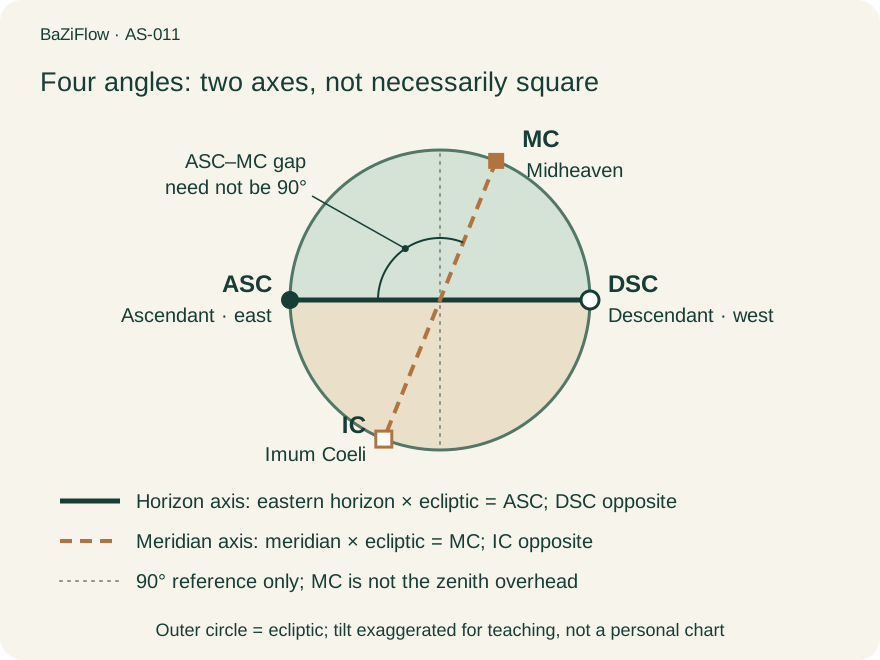
Original BaZiFlow teaching diagram; schematic geometry, not a personal chart.
Why the gap between ASC and MC changes
The horizon and the meridian are perpendicular, but the ecliptic is tilted relative to both, so the points where they meet it are generally not 90° apart in longitude. The gap depends on the moment (local sidereal time) and on latitude. Near the equator it tends to stay fairly close to 90°, though not always exactly 90°; at higher latitudes it can depart from 90° much more. Standard spherical formulas confirm this without personal data.
That is why the quadrants on a wheel can be visibly unequal. If a display always places the MC straight up, trust the printed degree rather than the picture.
In quadrant house systems such as Placidus and Koch, the Ascendant is the first-house cusp and the Midheaven is the tenth-house cusp; the Descendant and IC are the seventh and fourth cusps. Whole Sign and equal houses treat the MC differently, which is covered in house systems.
High latitudes: where the axes need care
The Swiss Ephemeris documentation explains that beyond the polar circles, Placidus and Koch cusps sometimes can and sometimes cannot be computed; the library then switches to Porphyry houses with a warning. There the MC can also fall below the horizon. Swiss Ephemeris gives priority to the Ascendant as the eastern rising point and accepts an MC below the horizon, while programs following the older Placalc approach keep the MC above the horizon and flip the Ascendant by 180° when needed. The same polar birth data can therefore yield different angles in different programs. Typical mid-latitude birthplaces are unaffected; for polar data, check the warnings and the method actually used.
Traditional meanings are conventions
Many modern textbooks pair the Ascendant–Descendant axis with self and others, or how one meets people, and the Midheaven–IC axis with public role and private roots. These are symbolic conventions that traditions weigh differently; the geometry proves none of them, and this article draws no personal conclusion from an angle's sign. Similar-sounding terms in other systems carry different meanings; see why similar terms are not interchangeable.
Part of a learning path
Astrology: from four components to the whole chart · Step 3 of 3 available
Sources & references
Continue reading
Why a birth chart needs both time and place ↗