BaZiFlow

The map and planet lines are free — no sign-up

Free Astrocartography Chart and Relocation Map

  • The map and planet lines are free, no card needed
  • 12 line sets (10 planets plus lunar nodes)
  • Just a birth date, birthplace and gender

Create your relocation map

Birth time is optional; without it there is no year track.

Real walkthrough

Read a relocation map in three steps

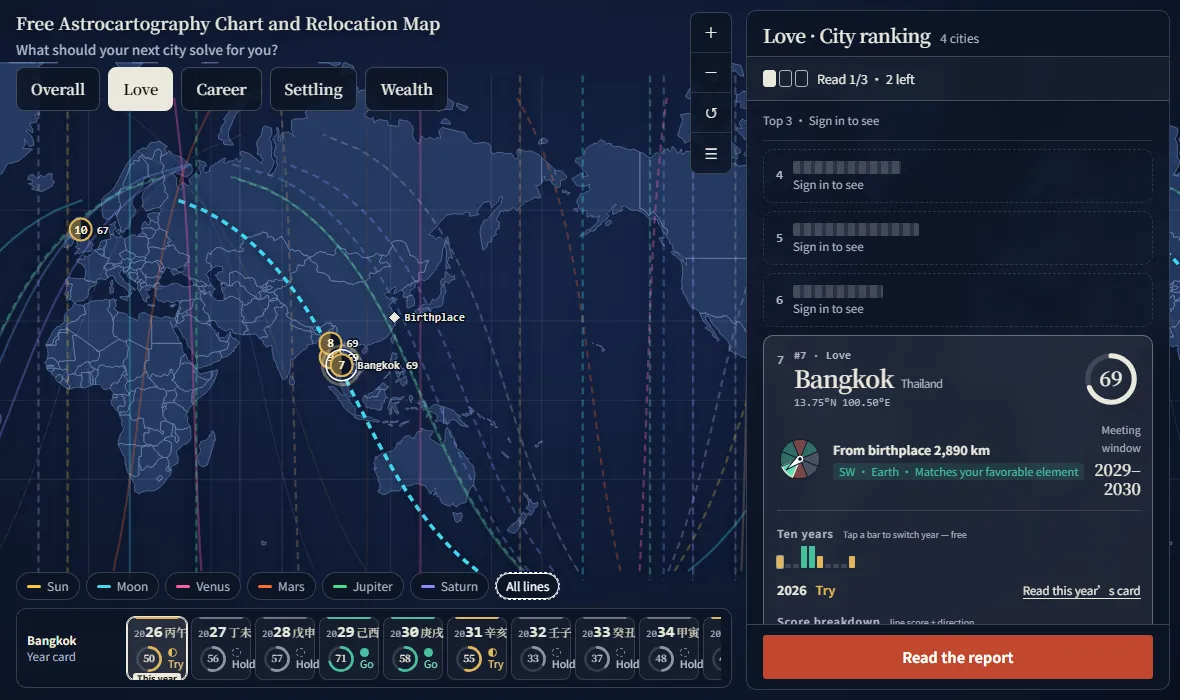
  1. 1Tap the map, read the lines
  2. 2Browse five city rankings
  3. 3Open the ten year cards

Understand your relocation map

What questions a relocation map can answer

Where to move, and when, are the two questions people circle around the longest. A relocation map — also called an astrocartography chart or locational astrology — does not make the decision for you. It breaks “should I live somewhere else?” into steps you can check: which planets in your birth chart are amplified at which places on Earth; how the cities near those places score for love, career, home and wealth; whether each city’s direction from your birthplace matches the elements favoured by your BaZi chart; and which of the next ten years is better for moving.

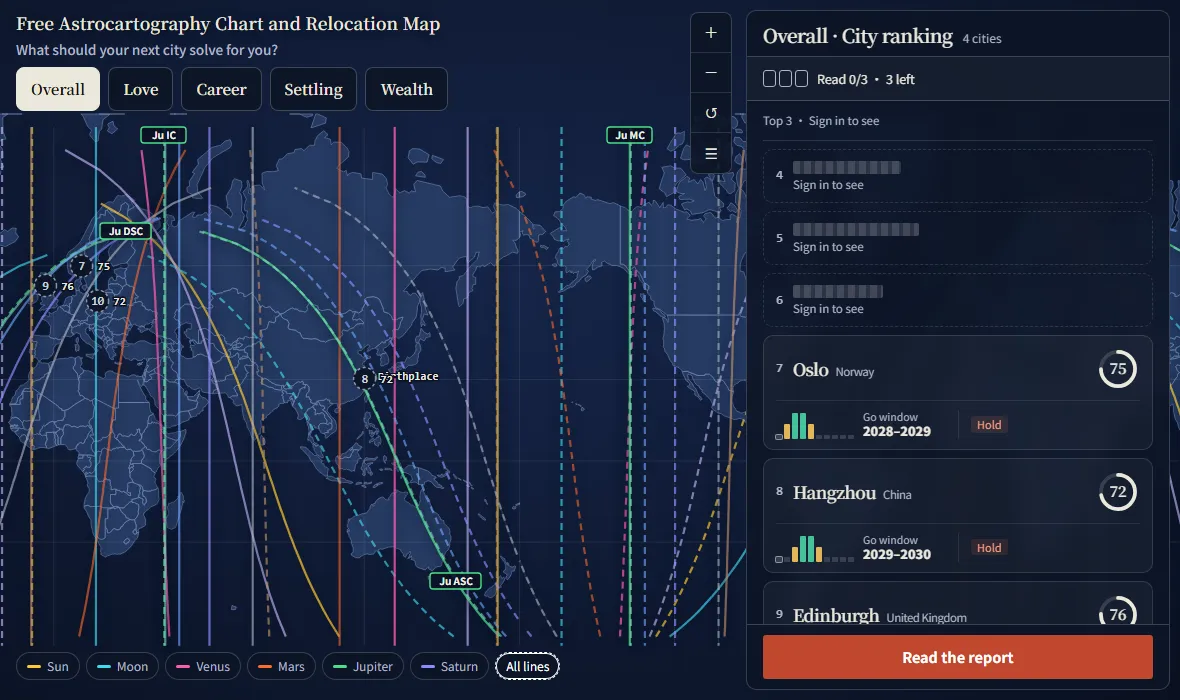
That is why the page has five rankings. Overall combines the four directions and suits someone who has not yet decided what to solve. Love is about meeting people and relationships, career about being lifted into a better position, settling about whether you can truly put down roots, and wealth about whether money flows more easily. Pick the one you care about most right now and read the top cities there — it is more useful than staring at a single total.
What questions a relocation map can answer

How the map and the ranking connect

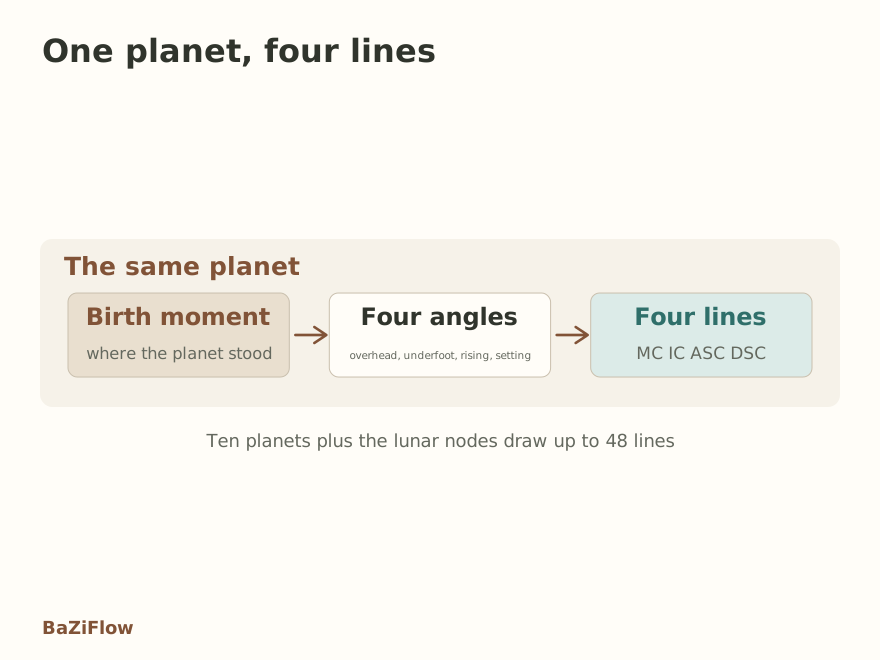
At birth every planet sits at four angles: overhead (MC), underfoot (IC), rising in the east (ASC) and setting in the west (DSC). Each angle draws a line across the Earth, so the map carries dozens of lines. The closer a city is to a line, the more that planet’s theme shows there; this site scores within 600 km and groups distance into “on the line” (within 150 km), “near” (within 500 km) and “far”.

A city’s score has three parts: the line score (each line weighted by how relevant it is to the goal and how near the city is), a direction adjustment (with your birthplace as the origin, the city falls in one of eight directions, each tied to an element — matching your favourable element adds, matching an unfavourable one subtracts) and a deduction for pressure lines. Tap any point on the map and you also see the nearest city, the three nearest lines and their distance, without first finding it in the ranking.

MCICASCDSC

BaZi and the year: why it matters which year you move

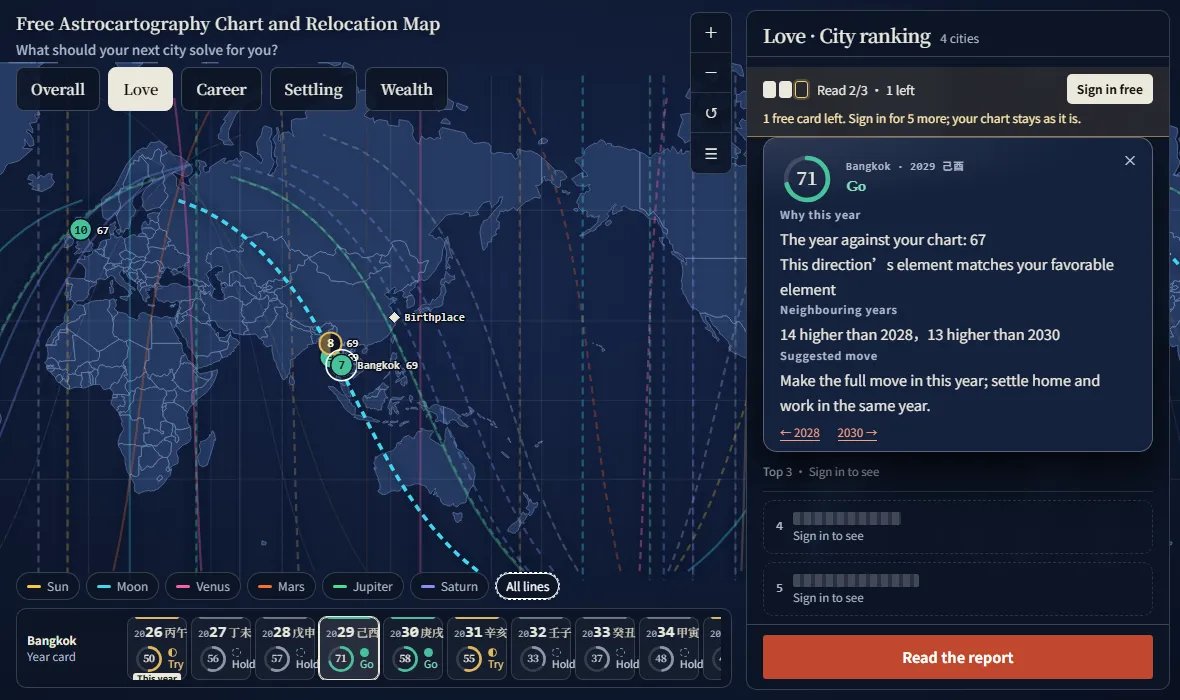
The same city helps the same person differently in different years. This site sets your BaZi year pillars beside each city’s direction and gives every year one of three states: go, try or hold. Whether the year’s stem and branch help or drain your chart is the base; when the city’s direction element matches the year the effect is amplified; a city sitting in that year’s Tai Sui or Sui Po direction is not a year to move in; and a year in which your luck pillar changes is flagged so you can decide a year earlier or later.

These ten states sit under the map as a strip of year cards. The thumbnail is always free; opening a card shows why that year is rated as it is, how it compares with the years either side, and one suggested move. If the birth time is unknown, the hour pillar is missing and year readings would be unreliable, so the year track is withheld and you get only the map and rankings.

BaZi and the year: why it matters which year you move

What is free, the reading allowance and the full report

The map and every planet line are always free, with no sign-up. In the ranking, visitors do not see the top three, ranks 4–6 need a sign-in and ranks 7 and below are readable straight away; once signed in the top three appear as sealed cards showing only a score and bands, and their names are revealed by any real-money payment — a credit pack, this report, a membership or another tool’s report.

Opening a city dossier or a year card uses 1 reading card each: 3 for visitors and 5 more after signing in; reopening a card you have read is free and a payment lifts the limit. The full relocation report is a one-time payment of 100 credits, six sections — overall, love, career, settling, wealth and the year track — written about your chart’s own cities and years. It is not a subscription.

What is free, the reading allowance and the full report

Limits to know before you use it

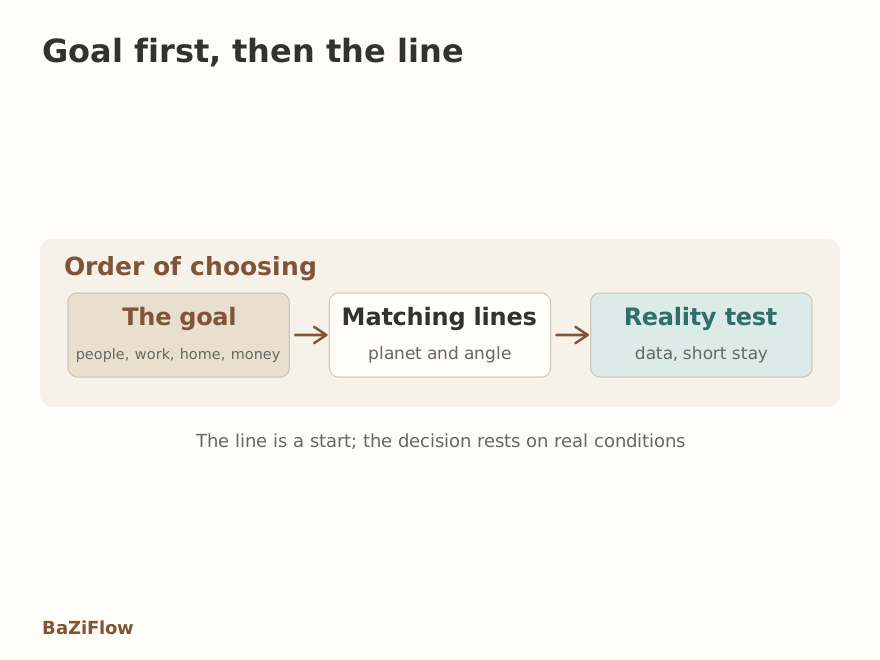
An astrocartography map is guidance, not prediction. A line only says which theme may be amplified at a place; it does not promise you will meet someone, be promoted or be unhappy there. Visas, work, family and budget always come first; the lines only help rank options once those are workable.

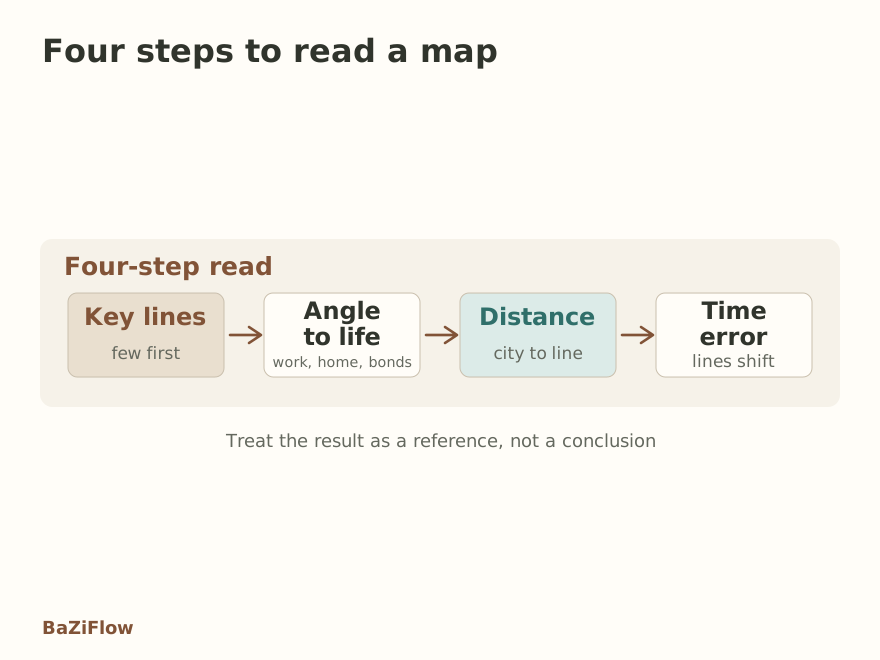
Birth-time error moves the lines: every 4 minutes shifts a line about 1 degree of longitude, roughly 111 km near the equator, so with an uncertain birth time the Ascendant and Midheaven lines are only approximate. Whatever the ranking says, try a short stay before deciding on a long-term move.

0°2°4°6°8°0102030Time error (minutes)Line shift (degrees)
Every 4 minutes of error moves a line about 1 degree (about 111 km near the equator). · Schematic

Four lines, four themes

  • MCCareer and reputation
  • ICHome and roots
  • ASCSelf and fresh starts
  • DSCPartners and relationships

The map is free; go deeper when you need to

Free

Map and planet lines

  • Every line on a world map
  • Tap any spot to explore
  • Ranks 7 and below readable
Reading allowance

Dossiers and year cards

  • 3 for visitors, 5 more signed in
  • Reopening is free
  • Any real payment lifts it
Full report

Relocation report

  • Six sections, one per chart
  • Top-three names and exact scores
  • One-time payment, no subscription

What it isYour birth chart on a world map, with a line where a planet was rising, setting, overhead or underfoot.

What it is notNot a prediction. A line hints where a theme stands out; it guarantees nothing.

What you needBirth date, birthplace and gender; without a birth time lines are only approximate.

How the map is calculated

  1. 1Prepare dataDate, coordinates, time zone to universal time
  2. 2Compute the skyEach planet at the birth moment
  3. 3Find the axesRising, setting, culminating, anti-culminating
  4. 4Project to EarthTrace each crossing as a map line
  5. 5Rank citiesDistance, BaZi directions and year pillars

Further reading

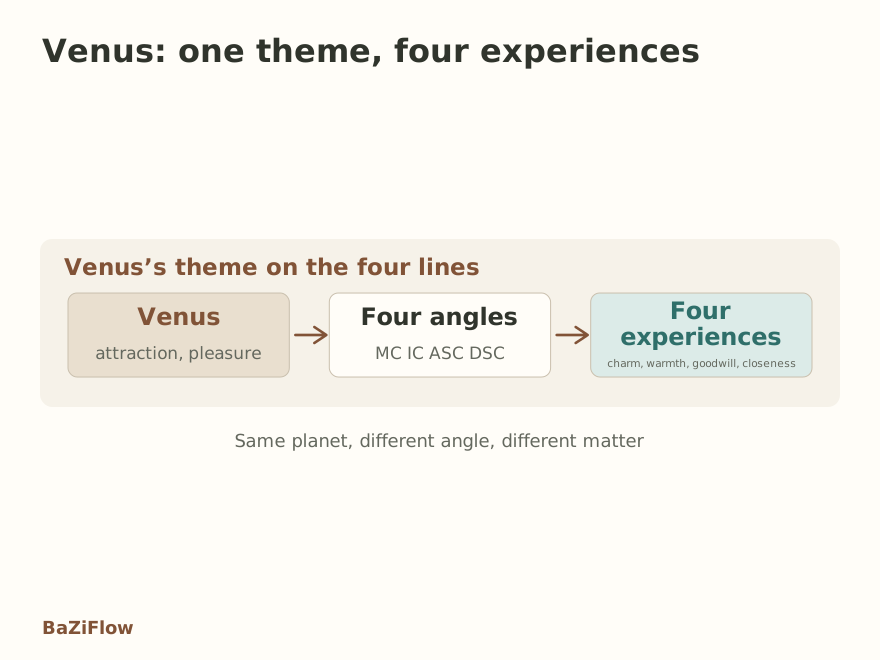
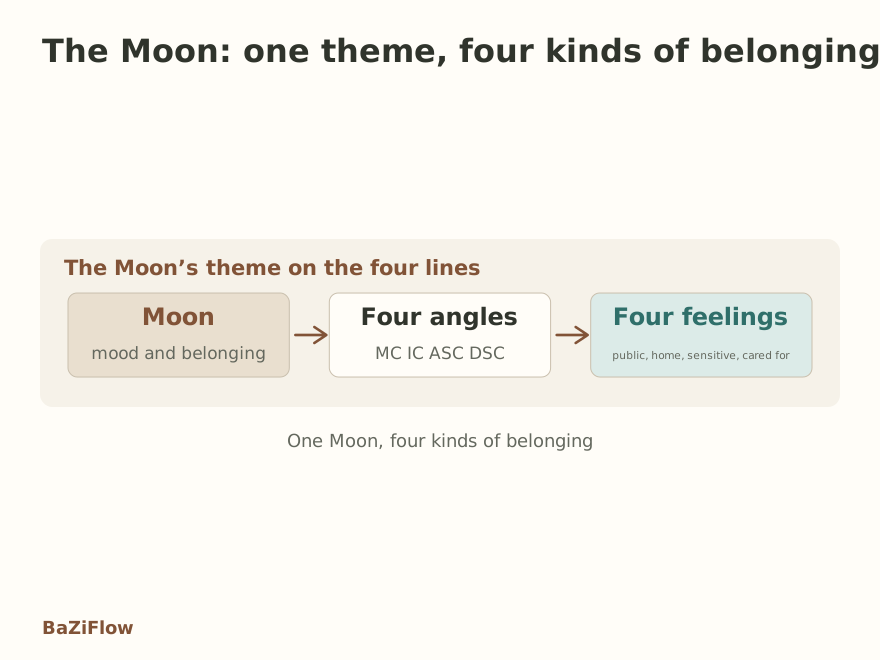
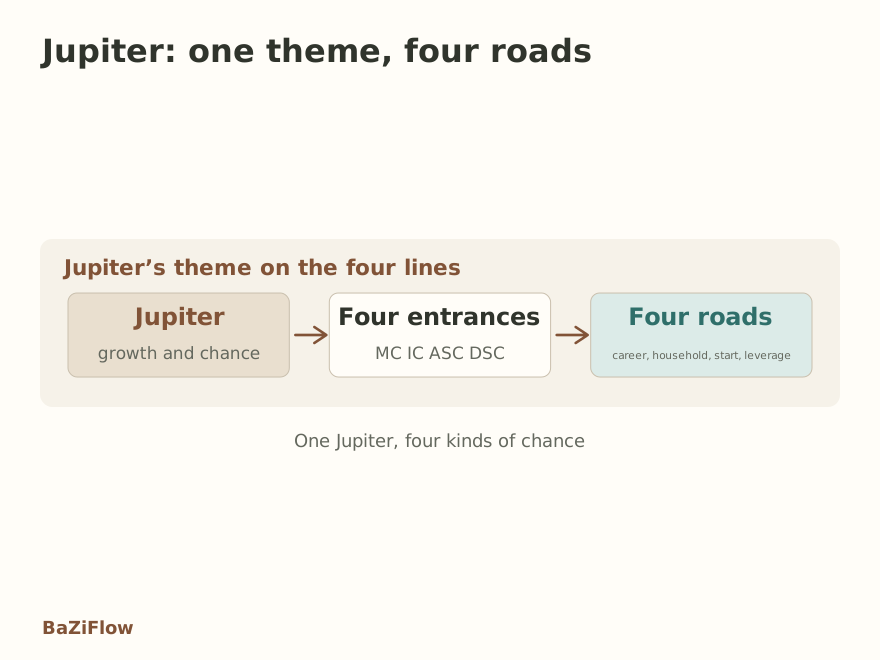
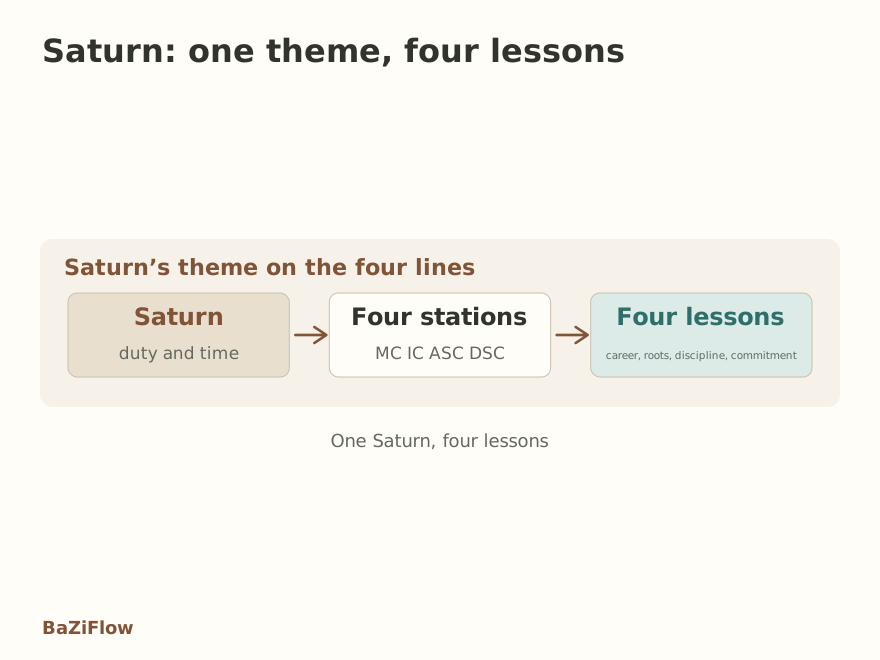
Reading Astrocartography Lines: MC, IC, ASC, DSC and DistanceAn astrocartography map projects where every planet stood at your birth onto the Earth and joins the points into lines. A line is not a verdict; it only says where on Earth that planet’s theme may be turned up.Read →How to Read an Astrocartography Map: Four Steps and Birth-Time ErrorA map can carry up to 48 lines, and the first look is dizzying. If you follow a fixed order and answer one small question at a time, that crowd of lines turns into a handful of useful prompts.Read →Which Astrocartography Lines to Read When Choosing Where to LiveA map full of colored lines makes it hard to know where to start. An easier way is to work backwards: ask what the move is supposed to fix, read only the lines related to that, and then test each shortlisted city against real life.Read →What a Venus Line Means in Astrocartography: MC, IC, ASC, DSCVenus rules attraction, relationships, taste and pleasure. Places on a Venus line tend to feel easier to relax in, easier to be liked in, and easier to spend a little more on comfort in.Read →What a Moon Line Means in Astrocartography: MC, IC, ASC, DSCThe Moon rules mood, belonging and daily rhythm. Places on a Moon line make people unusually aware of home, of being cared for, and of their own emotional weather.Read →What a Jupiter Line Means in Astrocartography: MC, IC, ASC, DSCJupiter rules growth, opportunity, resources and confidence. Places on a Jupiter line are often described as “the road is easier, helpers appear, and it feels natural to think bigger”.Read →What a Saturn Line Means in Astrocartography: MC, IC, ASC, DSCSaturn rules responsibility, structure, limits and time. Places on a Saturn line often feel hard and testing — and are often where long-term achievements are made.Read →

FAQ

Is the astrocartography map free?

The map and every planet line are free with no sign-up; rankings and year cards have a free allowance; the top-three names and the full report are paid, the report as a one-time payment.

Can I use it without a birth time?

Yes, but the map is drawn for noon: Ascendant and Midheaven lines are approximate and there is no year track.

Can a line guarantee a better life there?

No. It is guidance, not a guarantee; visas, work, family and budget are yours to decide — try a short stay first.

Why ask for gender?

The year readings use your BaZi luck pillars, whose direction depends on gender; it is used only for that.

How is the ranking made?

It combines your planet lines, each city’s distance from them and your BaZi favorable directions, ranked separately for love, career, settling and wealth.

Why does the ranking show only 10 cities?

Each goal shows the ten cities most worth looking at first, to avoid overload; you can also tap any point on the map to see the nearest city and lines there.

Where does the real-world city data come from?

Cost of living, climate, air, safety and life expectancy come from public datasets (such as GeoNames, NASA POWER and the World Bank); missing fields stay empty — nothing is filled in or invented, and none of it counts toward the score.

How does this relate to BaZi luck pillars and the time map?

The relocation map reads “where”, using astrological planet lines plus your BaZi favourable directions and year pillars; BaZi luck pillars and the time map read “when”. They corroborate each other rather than replace each other.