

Empty houses and rulers
Content version · · Sources & references
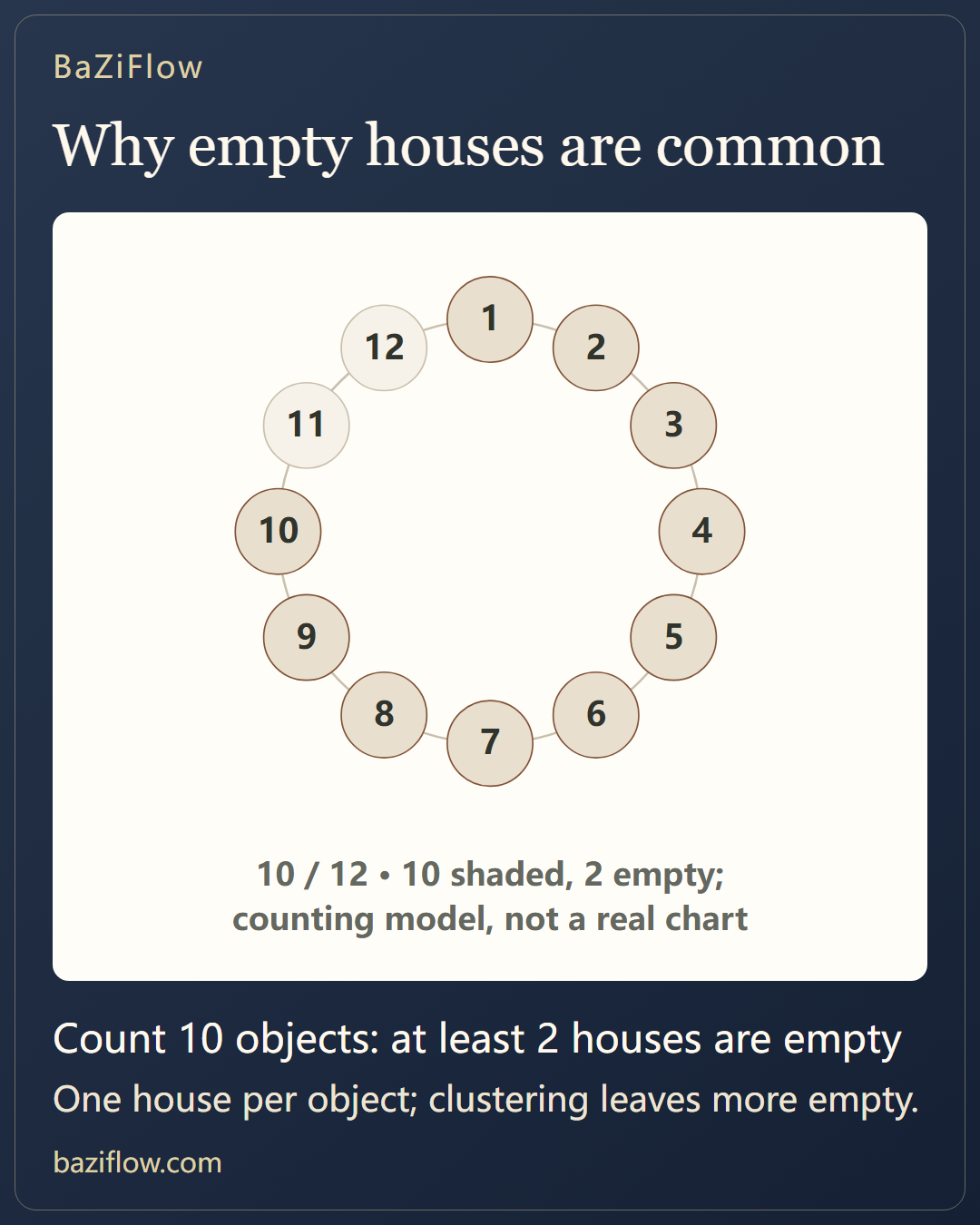
Define the object set before calling a house empty. A counting exercise and a ruler lookup separate occupancy from rulership without turning a blank chart sector into a prediction.
The short version6 min read
An empty house contains none of the selected objects. Start with twelve boxes and ten markers, then follow the cusp sign to its ruler. Looking up a relationship never moves that ruler into the empty sector.
- Twelve houses and ten objects leave at least two houses empty when each object belongs to one house; clustering leaves more.
- Occupancy, cusp sign and ruler are separate records. A Taurus cusp refers to Venus, whose actual position remains unchanged.
- Object selection, house method, time layer and subject belong to the record; changing them does not rewrite natal occupancy.
Read first
Four Chart Components: Read the Object, Position and Relationship ↗
House Systems: Why One Planet Can Receive a Different House ↗
Try the counting argument without a horoscope
Draw twelve boxes and take ten markers. Assign each marker to exactly one box. At most ten boxes can be occupied, so at least two are unoccupied. If several markers share a box, even more boxes remain empty. This is a counting demonstration, not a simulation of possible planetary positions; no birth data are involved.
A common modern inventory consists of the Sun, Moon and Mercury through Pluto: ten objects. Calling them objects avoids claiming that astronomy classifies the Sun and Moon as planets. With that inventory and twelve exclusive house assignments, the arithmetic makes some empty houses unsurprising. It says nothing about how complete, successful or important a person's life is.
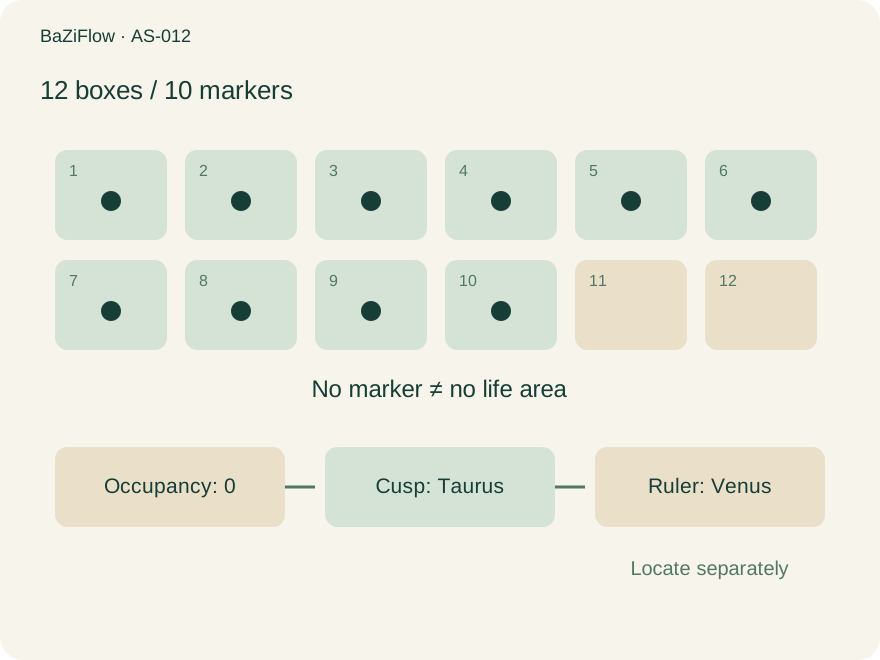
Original BaZiFlow teaching diagram; marker allocation illustrates counting, not a physically realised chart.
The exercise also shows why the inventory matters. Change the number of markers and you change the counting question. Adding more points merely to remove blank spaces is not a discovery about lived experience. It may instead make two readings incomparable because they no longer use the same selection rule.
What exactly is absent?
An empty house is empty of something. Specify the selected objects, chart layer and house method before using the label. A chart that displays only a familiar set of major objects may leave a sector blank; adding asteroids or calculated points can change what appears there. The change is in the selected inventory, not evidence that a person's life acquired a new dimension.
For this article, empty means that none of the objects being counted is assigned to that house in the specified chart. The house itself has not disappeared. Nor have its cusp, the sign associated with that cusp or the rulership relations used by the chosen tradition. Occupancy is one field in a larger record.
This narrow definition immediately limits the conclusion. “No selected object occupies this sector” does not logically imply “this area of life is absent.” An extra argument would be needed, and a blank space on a wheel does not supply it. The twelve houses as areas of inquiry explains the thematic layer separately.
Hypothetical lookup: Venus stays at its actual position
Does “house of Venus” mean the same kind of house?
An old text saying that Taurus is a house of Venus and a chart showing an empty numbered sector do not contradict each other. First identify what the author means by house. Looking for Venus inside the empty sector would answer neither question correctly.
In Book I, chapter 17 of Ptolemy's Tetrabiblos, the “houses” of planets concern their domiciles in signs, including the assignment of Taurus and Libra to Venus. William Lilly's chapter on the twelve houses in Christian Astrology concerns numbered houses and their topics. The shared English word does not make those two meanings interchangeable.
This distinction matters when consulting historical sources for a modern chart. A passage about a planet's domicile cannot simply be treated as a statement that it naturally rules a numbered house. Likewise, a historical catalogue of topics does not validate every prediction attached to those topics. Read the term in its source context and separate the inherited framework from an empirical claim.
The common practice of examining an empty house through its cusp ruler belongs to that interpretive framework. It keeps relationships available for study; it does not guarantee that a specified event will occur. No amount of tracing arrows makes missing personal evidence appear.
Ptolemy I.17
- Planetary houses
- Domicile signs
Lilly: 12 houses
- Numbered sectors
- Life topics
Follow a relation without moving an object
Now suppose a particular house has no selected occupants and its cusp is in Taurus. Under the traditional sign-rulership scheme, Venus rules Taurus. The next lookup is Venus's actual position and relationships in the chart. Venus is not moved into the empty house to fill it. Ruling a cusp's sign and occupying that house are different relations.
| Field in the example | What has been stipulated | What remains to be examined |
|---|---|---|
| Occupancy | No selected objects in the house | The selection rule and boundaries |
| Cusp sign | Taurus | Whether the adopted house calculation supports it |
| Sign ruler | Venus under the stated scheme | Venus's actual sign, house and aspects |
| Personal outcome | Nothing supplied | Relevant reality and a separately justified interpretation |
The example deliberately does not identify a house number or promise an outcome. Taurus is not automatically the second house. A sign and a numbered house are different structures, even though both lists have twelve entries. The lookup can be understood without adding a story about money or relationships.
For some signs, traditional and modern authors use different rulership assignments. Taurus and Venus avoid that disagreement in this basic example. Where a method differs, name it before drawing a conclusion; do not select whichever ruler seems to support a preferred narrative. Signs, houses and rulers together develops the broader reading method.
Keep the count
Record the object set, time layer and occupants of the house.
Read the cusp sign
Use calculated boundaries rather than guessing a sign from a house number.
Locate the ruler
Follow the declared scheme to the body’s actual position without filling the empty sector.
Keep the original chart layer intact
If a transit later crosses an empty natal house, the natal inventory has not changed retroactively. Record a transiting object in relation to a natal house. If another person's planet is placed there in a comparison, keep that other subject attached to the planet. Removing the time layer or subject can turn a valid relation into a false statement about natal occupancy.
Changing house methods can also change boundaries and assignments. An uncertain birth time may make some boundary placements uncertain. Check those conditions before treating “empty” and “occupied” as a disagreement about the same calculation. House systems explains why the chosen method belongs in the record.
A blank sector therefore offers neither a promise of ease nor a sentence of deprivation. It does not justify conclusions about marriage, children, health or financial outcomes. Preserve the modest factual statement, then investigate any further interpretation on its own evidence. A chart can remain visually sparse while the person's actual life remains complex.
Natal
- Birth objects
- Keep the record
Transit
- Later objects
- New time layer
Questions readers ask next
Why do ten objects leave at least two houses empty?
Each object belongs to one of twelve boxes. Ten objects can fill at most ten boxes, leaving at least two empty. Sharing a box reduces the occupied count further. This is arithmetic, not a score for a life.
Does a house ruler have to occupy the house it rules?
No. The cusp sign identifies its ruler under a declared scheme, while actual coordinates determine the ruler’s house. A Taurus cusp refers to Venus without relocating Venus into that sector.
Does a transit erase an empty natal house?
No. The birth inventory remains unchanged. Record the later object passing through a natal house as a transit relation, while retaining the original natal occupancy. These are different time layers.
Was this article helpful?
Sources & references
Continue reading
The twelve houses as topics, not twelve verdicts ↗
House ruler, occupant and dispositor: keep the roles distinct ↗