

Tian Kui: a pair of branches from the stem
Content version · · Sources & references
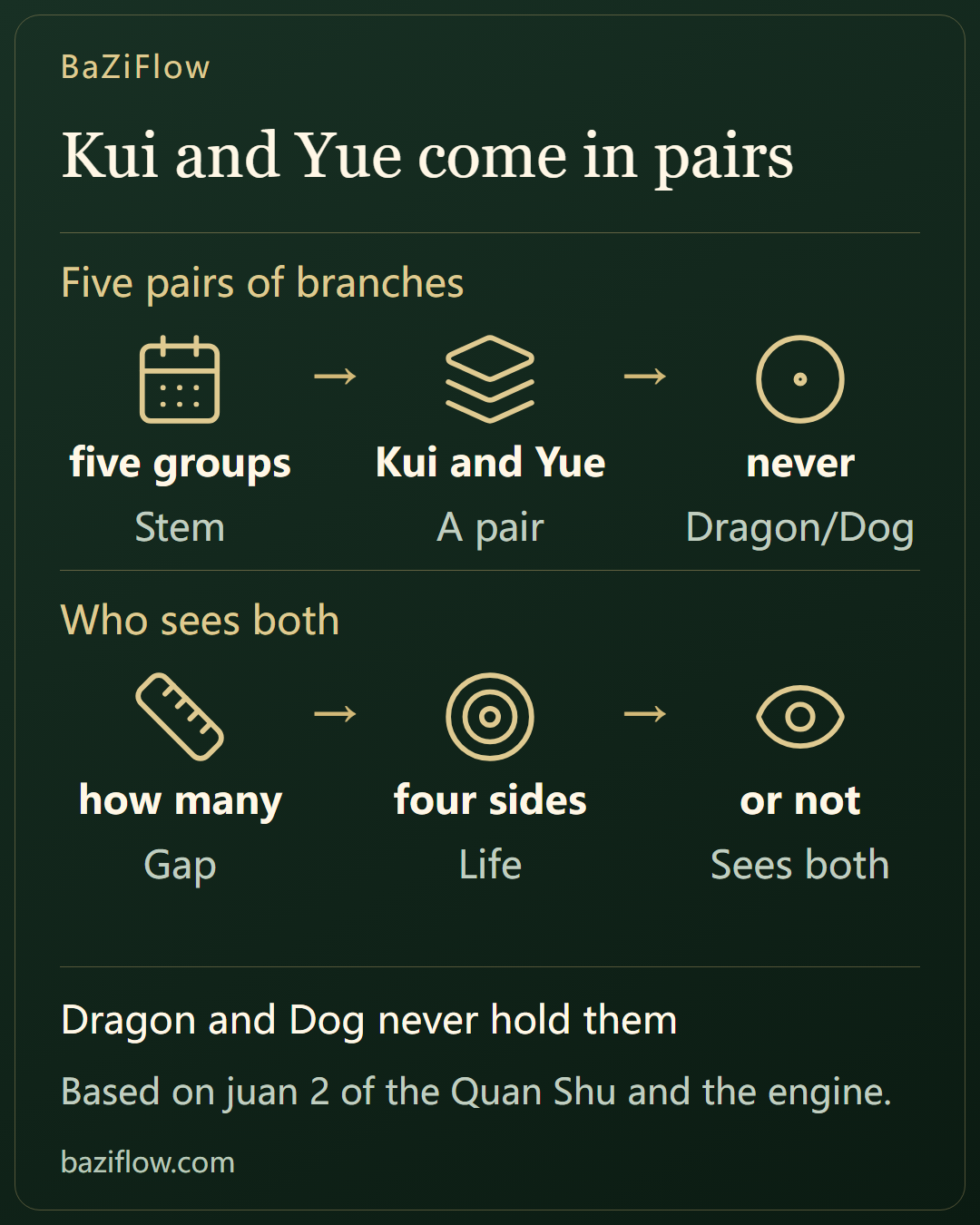
Tian Kui and Tian Yue are placed as a pair from the birth-year stem, ten stems giving five pairs. A ring, the verse against the assignment, who sees both and the yearly pair show the pattern.
The short version7 min read
Tian Kui has no placement of its own; it shares one verse with Tian Yue. The birth-year stem gives a pair of branches, ten stems fold into five groups, and so Tian Kui can only land on Rat, Ox, Rabbit, Horse or Pig.
- Kui and Yue come as a pair: five stem groups give five pairs of branches, and apart from Dragon and Dog each of the other ten cells belongs to exactly one pair.
- The verse names two animals but not which is Kui and which Yue. The engine's assignment runs against the verse's order for Yin Metal, and the only positional example in the book that confirms an assignment is Kui at the Rabbit with Yue at the Snake.
- The gap differs: Ox and Goat are opposite, Rat-Monkey and Horse-Tiger form a trine, Pig-Rooster and Rabbit-Snake have one cell between. That decides which Life palaces see both, and why one-sitting-one-facing arises only for the first two kinds.
Read first
What do Zi Wei's supporting, malefic and minor stars actually do? ↗
Ten stems, five pairs of branches, and only five cells for Tian Kui
Tian Kui (天魁) always arrives with Tian Yue (天钺): the verse gives a pair of branches for the birth-year stem, and the ten stems fold into five groups. Among the twelve branches Tian Kui can therefore land only on the Rat, Ox, Rabbit, Horse or Pig, and Tian Yue only on the Tiger, Snake, Goat, Monkey or Rooster.
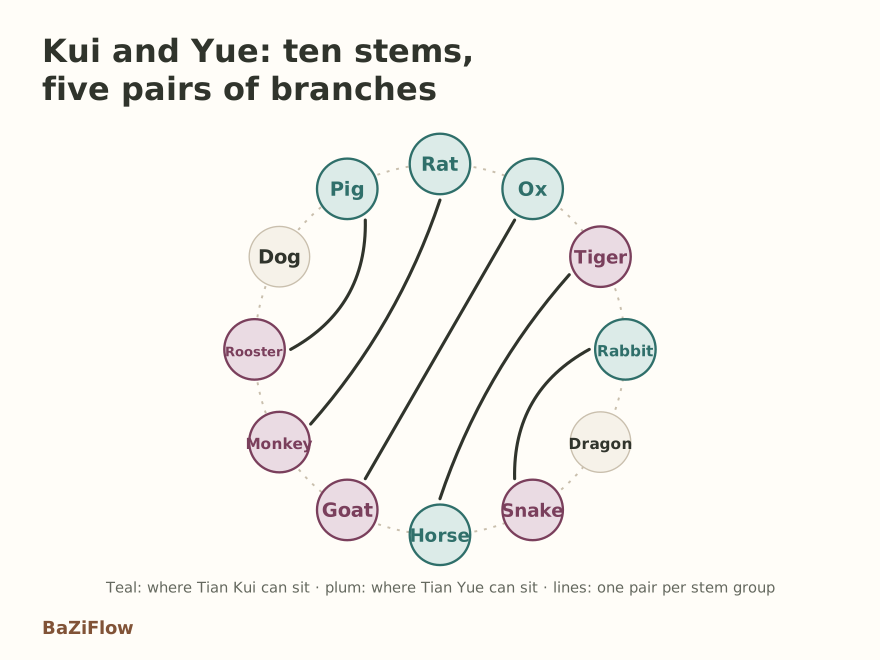
Sketch: the twelve branches run clockwise with the Rat at the top; lines join the Tian Kui and Tian Yue of one stem group, with positions checked for all ten stems on the site engine.
In the picture the five teal cells are those Tian Kui can take and the five plum cells those Tian Yue can take; the lines join the pair of one stem group: Ox with Goat, Rat with Monkey, Pig with Rooster, Horse with Tiger, Rabbit with Snake.
The verse writes pairs of branches, not which one is Kui
The verse called "An Tian Kui Tian Yue Jue" (安天魁天钺诀) belongs to the Quan Shu, the classic text behind this series; it is keyed to the birth-year stem, and its first three lines read:
Yang Wood, Yang Earth, Yang Metal: ox and goat; Yin Wood, Yin Earth: rat and monkey; Yin Metal meets the tiger and the horse.
Ox and goat are the Ox and Goat branches, rat and monkey the Rat and Monkey, tiger and horse the Tiger and Horse. The same verse also covers Yin Water with Yang Water and Yang Fire with Yin Fire; the Fire line in the Wikisource text differs from the engine and is left for the article on Tian Yue. Note that each line lists two animals without saying which belongs to Kui and which to Yue. The engine gives the first-named animal to Kui, with one exception: for Yin Metal the verse says "tiger and horse", yet the engine puts Kui at the Horse and Yue at the Tiger. The book confirms an assignment in only one place, a positional example in juan 3 with "Kui at the Rabbit, Yue at the Snake", which agrees with the engine for the Water stems. The other four assignments rest on the engine's convention.
Enlarge diagram · scroll sideways to read
One pair, and which Life palaces see both
The gap between the two stars differs by group, and so do the Life palaces that can see both. Around a Life palace the three sides and four directions are the palace itself, the opposite palace and the two trine palaces; a pair is seen together only when both land inside those four cells:
Enlarge diagram · scroll sideways to read
An entry in the term list of juan 1 explains zuo gui xiang gui, "sitting with the noble, facing the noble", with the words "take turns sitting in and facing"; read literally, one star sits in the Life palace while the other faces it:
Zuo gui xiang gui: Kui and Yue take turns sitting in and facing the Life palace.
On that reading the table settles where it can occur: only in the opposite and trine groups. The pairs for the Fire and Water stems have one cell between them, which is neither opposite nor trine, so no Life palace can have one of them sitting inside it and the other among its three sides and four directions. A chart of a Fire or Water year can never form it.
The year has a pair too: yearly Kui and Yue
The same table is used for the year. Take the stem of the year, look up the pair, and the chart shows a yearly Kui (流魁) and yearly Yue (流钺), recorded apart from the natal ones.
Enlarge diagram · scroll sideways to read
The natal pair is fixed by the birth-year stem and does not move for life; the yearly pair follows the stem of each year. Yang Fire and Yin Fire years share a pair, as do Yin Wood and Yin Earth years (Rat and Monkey), so neighboring years can be identical. When reading a year, state that this is the yearly pair; it should not be used to answer questions about the natal chart.
Two lookups to try
Born in a Yang Earth year with Life at the Goat: where are Kui and Yue, and which sits in Life?
Yang Earth puts Kui at the Ox and Yue at the Goat. With Life at the Goat, Yue sits in Life and Kui is in the opposite palace at the Ox: one sitting, one facing.
Born in a Yin Wood year with Life at the Dragon: can Life see both stars?
Yin Wood puts Kui at the Rat and Yue at the Monkey. Both share a trine with the Dragon, so Life at the Dragon sees both, though neither sits in Life.
Its partner in the pair is Tian Yue; how the three sides and four directions are worked out is in what the three sides and four directions are, and keeping the natal and yearly layers apart is in natal, decade and annual layers.
Questions readers ask next
Does everyone born in the same year have Tian Kui on the same branch?
Yes. Only the birth-year stem counts, not month, day or hour. People of one year share the branch but often have different Life palaces, so that branch carries different palace names on different charts.
What grade does the Miao/Wang table give Tian Kui and Tian Yue?
None. The juan 3 grading lines grade the major stars and Wen Chang, Wen Qu, Qing Yang, Tuo Luo, Huo Xing and Ling Xing, and Kui and Yue are not among them; the engine leaves their grade column empty too.
Are the yearly Kui and Yue the same set as the natal ones?
They come from the same table, but with the stem of the year instead of the birth-year stem. Yang Fire and Yin Fire years share a pair, so two neighboring years can give identical yearly stars.
Was this article helpful?
Sources & references
Continue reading
Ling Xing (铃星): Three Groups Start at the Dog, and the Gap to Huo Xing Varies ↗
Tian Yue (天钺): The Heavenly Nobleman Table, and Two Versions of the Fire Line ↗