

Two totals in time-based casting
Content version · · Sources & references
Recalculate the classical 34-and-43 example while separating the original moment, calendar conversion, branch values and boundary conventions in a reproducible record.
The short version7 min read
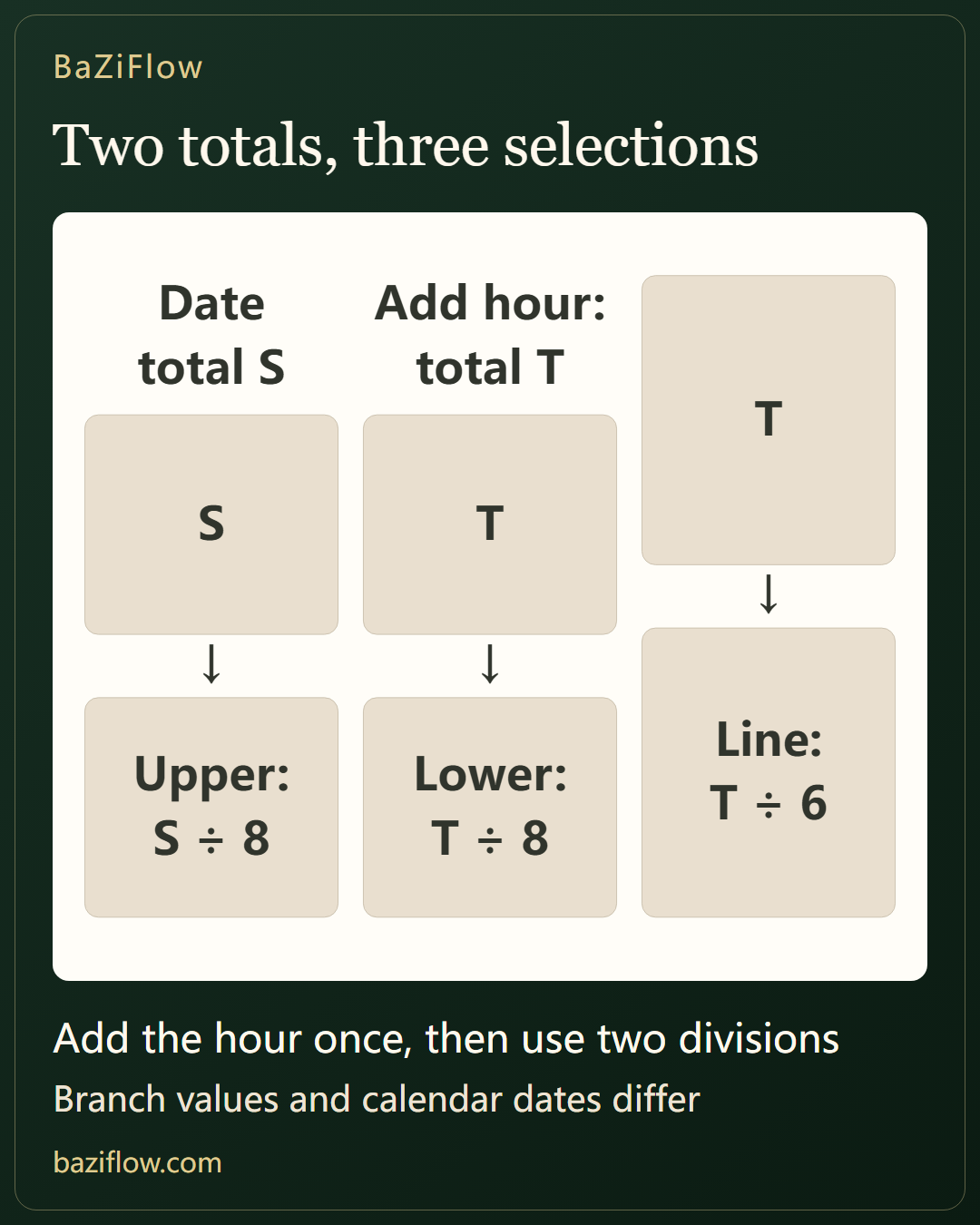
The transmitted time procedure adds the year-branch value, month and day for the upper trigram. Adding the hour-branch value produces a second total, reused for the lower trigram and moving line. The classical totals 34 and 43 show these roles; changing only the hour value reveals which outputs depend on it.
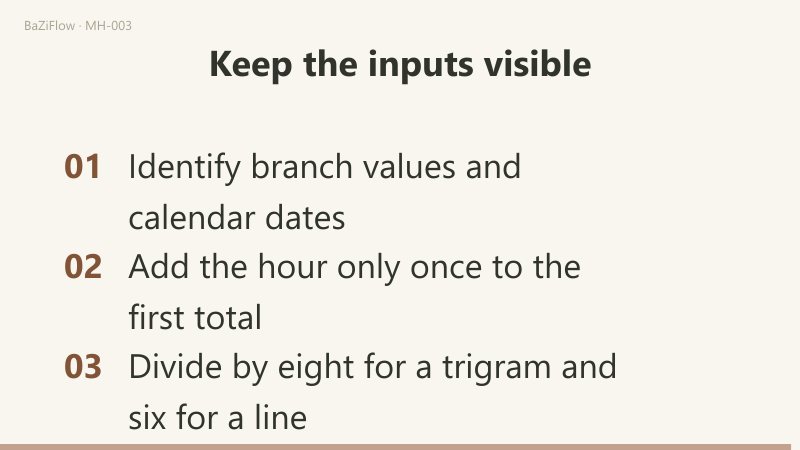
- Year and hour use branch positions from 1 through 12, while month and day use the selected traditional calendar. A Gregorian year or clock hour is a different input.
- The classical total 34 selects upper Dui. Add hour value 9 to obtain 43, then divide that same 43 by eight for lower Li and by six for moving line one.
- Keep 5, 12 and 17 fixed and change hour 9 to 10: upper Dui remains, while total 44 gives lower Zhen and moving line two. Each change has an identifiable dependency.
Read first
A date is not yet a casting input
Two notes both say “month 12, day 17.” One uses the date shown on a modern Gregorian calendar; the other uses the traditional calendar required by its chosen procedure. Identical numerals do not make them identical inputs. Before taking a remainder, a time-based Meihua record must state what each number represents.
Volume 1 of Meihua Yi Shu gives a year-month-day-hour procedure. The year is represented by its branch position, from Rat as 1 through Pig as 12; the hour uses the same branch sequence. The month and day are traditional calendar values. This article follows that transmitted route, rather than quietly substituting a four-digit Gregorian year, a clock hour or a BaZi solar-term month. The trigram and hexagram introduction explains the eight-number correspondence used below.
Year branch
Rat 1 through Pig 12
Month and day
Selected traditional date
Hour branch
Rat 1 through Pig 12
Reproduce the arithmetic without retelling the prediction
Take only the structural inputs of the manual's plum-blossom example: Dragon year gives 5, the month gives 12, the day gives 17 and Monkey hour gives 9. No modern Gregorian date is assigned here. We are checking the procedure, not recreating the characters or outcome of the story.
First add 5 + 12 + 17 = 34. Dividing 34 by 8 leaves 2, which selects Dui as the upper trigram. Add the hour value once: 34 + 9 = 43. Dividing 43 by 8 leaves 3, selecting Li as the lower trigram. Use that same total, 43, for the moving line: 43 = 6 × 7 + 1, so line 1 moves. Dui above Li forms Ge, Lake over Fire.
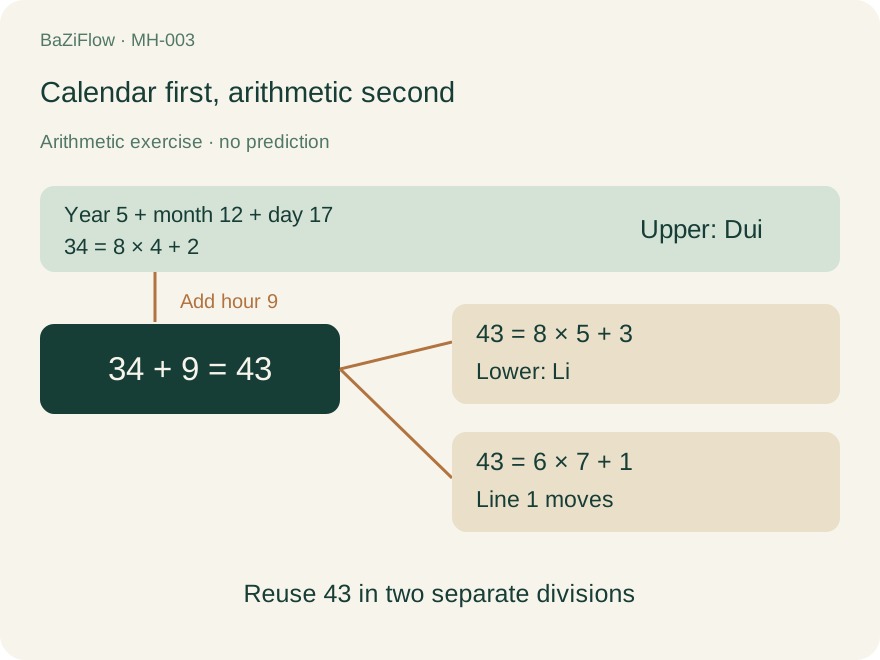
Original BaZiFlow teaching diagram recalculating a transmitted numerical example; no modern personal data or predicted outcome is used.
The diagram splits 43 into two calculations because it is reused, not added to 34 again. Keeping the dividend visible prevents the misleading shortcut of adding the upper-trigram total to the lower-trigram total and counting some inputs twice.
There is a further line-by-line check. Lower Li is yang, yin, yang from the bottom. Changing its first line gives yin, yin, yang, the Gen trigram. Upper Dui stays unchanged, so the changed figure is Xian, Lake over Mountain. This verifies the stated arithmetic and geometry. It does not verify the historical narrative's claimed success. See determining the moving line for that separate operation.
Make a separate comparison with just one changed input. Keep the year-branch value 5, month 12 and day 17, but replace Monkey-hour value 9 with Rooster-hour value 10. The first total remains 34, so the upper trigram is still Dui. The second total is now 44: 44 = 8 × 5 + 4 selects lower Zhen, and 44 = 6 × 7 + 2 selects moving line two. This compares explicitly assigned values without attaching them to a modern date.
If a calculation changes the upper trigram while claiming that only the hour value changed, check whether it wrongly included the hour in the first total. The simultaneous changes to the lower trigram and moving line are expected here: they come from applying two divisors to the same new total, not from introducing another casting method.
Upper total
- Hour value 9
- 34 → Dui
- Hour value 10
- 34 → Dui
Second total
- Hour value 9
- 43
- Hour value 10
- 44
Lower / line
- Hour value 9
- Li / 1
- Hour value 10
- Zhen / 2
Preserve three layers of time information
A usable record starts with an original moment, converts it using a declared calendar convention, and only then assigns casting values. Saving only the sum loses the evidence needed to identify a disagreement.
| Layer | Keep in the record | An inadequate substitute |
|---|---|---|
| Original moment | Date, clock time and time zone; location when relevant | “In the afternoon” |
| Calendar conversion | Traditional month and day, leap-month flag, year branch | Gregorian month number alone |
| Assigned values | Year-branch number, month, day, hour-branch number | The four digits of a Gregorian year |
| Calculation | Dividends and remainders for both trigrams and the line | Final hexagram name alone |
The Hong Kong Observatory's Gregorian–lunar calendar tables can support a date check. They are calendar data, not instructions for a Meihua school's treatment of leap months, year boundaries or day boundaries. A reliable date source and an explicitly chosen divination convention are two different requirements.
For the same reason, a calendar month should not silently become a BaZi month divided by solar terms. Such a change alters the definition of an input even when the arithmetic remains neat. If a teaching method intentionally uses a different calendar route, name it and retain the difference.
Boundary choices must survive in the saved record
The short classical procedure does not resolve every setting encountered in modern software. In a leap month, retain the leap flag and state how the selected teaching convention assigns its month value. A field containing only a number from 1 to 12 can erase that distinction. The chosen point for changing the year branch or changing the day also belongs in the record.
Time-zone handling and apparent solar-time correction are not interchangeable labels for the same operation. If a tool applies a local-time correction, preserve both the original and corrected moments and identify which one determines the hour branch. Near a boundary, different settings can produce different hour values. That difference should be traced to the setting, not presented as a second mysterious message from the chart.
This article does not select a universal rule for leap months, midnight or time correction. It asks that the adopted rule be explicit and stable before the result is interpreted. Missing calendar or time-zone information is a data limitation; obtaining another figure does not repair it.
Leap-month flag
Preserve the month status
Year and day boundaries
Declare the adopted rule
Time correction
Keep original and used moments
BaZiFlow uses the Chinese lunar calendar with the civil date in your time zone. The year branch changes at Lunar New Year; a leap month retains its ordinary month number and a visible flag. At 23:00 the hour becomes Rat, but the date stays unchanged. No apparent solar-time correction is applied. Separate comparison settings can use a solar-term month, change the year at Start of Spring, or advance the date at 23:00.
Locate a disagreement before judging the answer
When two outputs differ, compare the four assigned values first. If they differ, investigate the calendar conversion or boundary settings. If they match but the trigrams differ, inspect the remainder mapping and the handling of exact division. If the trigrams match but the moving line differs, check whether an input was counted twice or a different total was used.
This order separates a calendar question from an arithmetic question. It also prevents a time-based procedure from being blended with a separately agreed number-casting method simply because both happen to use division. A complete record makes the selected route reproducible; an incomplete one should remain incomplete rather than being repaired with a more agreeable interpretation.
Questions readers ask next
Why is the same total 43 used for the lower trigram and moving line?
The cited procedure uses the year-month-day sum for the upper trigram, then adds the hour value and reuses that total in two divisions. The 43 already includes 5, 12, 17 and 9. Adding 34 again would count the first three inputs twice.
Which outputs change if hour value nine becomes ten?
In this separate exercise, hold the other inputs at 5, 12 and 17. Their sum stays 34, so upper Dui remains. Total 44 leaves remainder four on division by eight, selecting lower Zhen, and remainder two on division by six, selecting line two. No modern date is assigned.
Does a calendar table determine leap-month and day-boundary conventions?
It can support the Gregorian-to-traditional-date conversion, but a teaching convention must separately specify leap-month treatment and the day boundary. Preserve the original moment, conversion and chosen procedure rather than keeping only the final total.
Was this article helpful?
Part of a learning path
Sources & references
Continue reading
Determining a moving line: position first, then the change ↗
True solar time: separate civil offsets, longitude and the equation of time ↗