

Xu: six places of waiting
Content version · · Sources & references
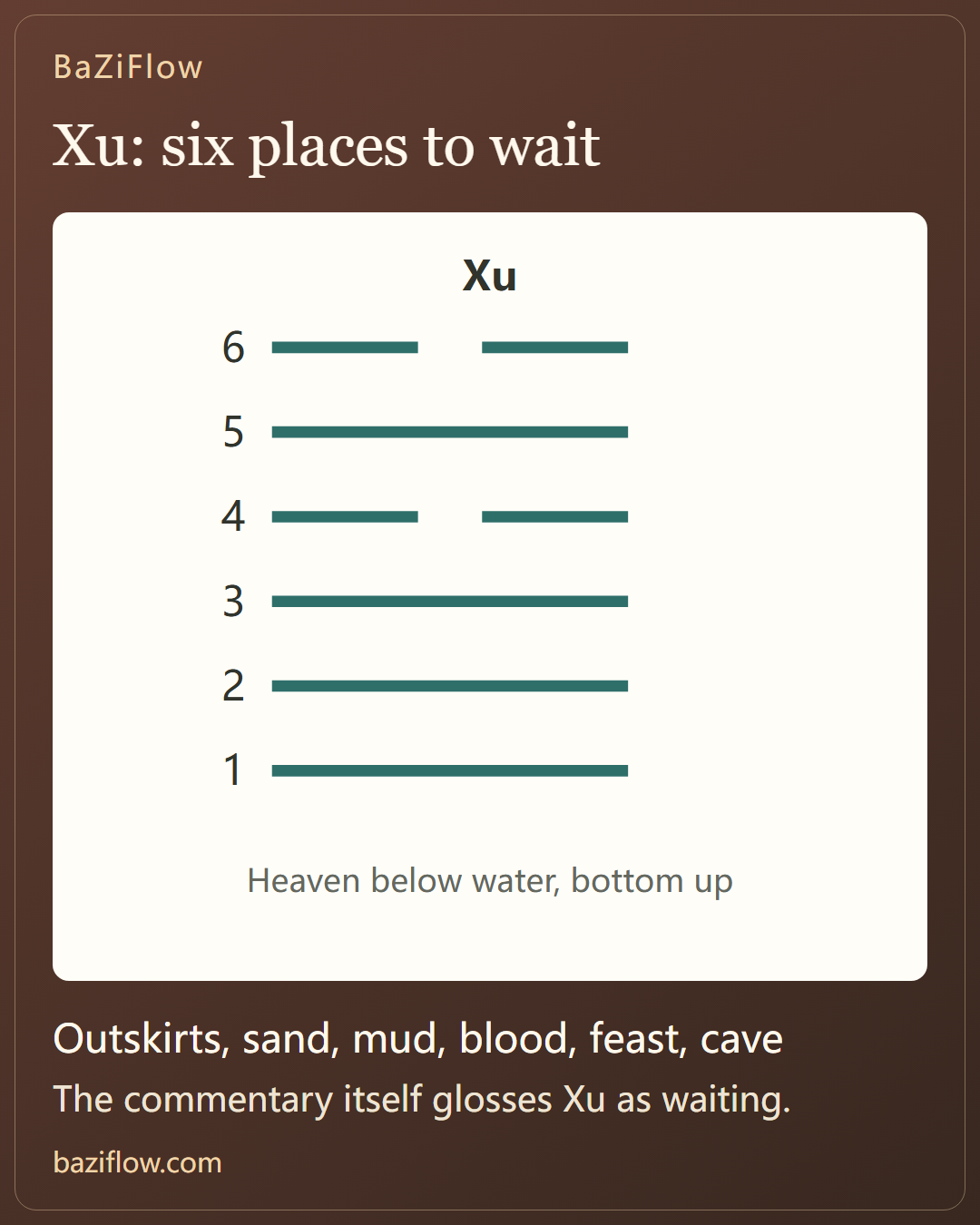
Xu is the fifth of the 64 hexagrams, heaven below and water above; its name means waiting. Read the judgment, the Great Image of eating and drinking, and six lines that name six places to wait.
The short version6 min read
Nearly every line of Xu names a place: the outskirts, sand, mud, blood, then wine and food at line 5, and a cave at the top. The same word, waiting, moves step by step from outside the city into the cave.
- Xu puts heaven below water, and the Commentary on the Judgments opens by glossing the name: "Xu means waiting: danger lies ahead; being firm and strong, it does not fall in". The name is simply to wait.
- Eating and drinking appears three times: the Xu Gua says what xu is, the Great Image says "eats and drinks and feasts in comfort", and line 5 reads "waiting with wine and food".
- The six lines run outskirts, sand, mud, blood, wine and food, cave. The word cave comes twice, "coming out of the cave" in line 4 and "entering the cave" in line 6.
Read first
The Sixty-Four Hexagrams: How Upper and Lower Trigrams Form One Figure ↗
Judgment and Line Statements: Whole Hexagram or Single Line? ↗
Heaven below, danger ahead: "Xu means waiting"
Xu (需) is the fifth hexagram: heaven below, water above. Reading up from the base, the six lines are yang, yang, yang, yin, yang, yin. The three yang lines at the bottom make the trigram of heaven; above them one yang line between two yin lines makes water. The Shuo Gua says "heaven is strong" and "water is a pit" (the images behind the eight trigrams are in the eight trigrams). The Commentary on the Judgments (彖传) starts with the name itself.
Xu means waiting: danger lies ahead. Being firm and strong, it does not fall in; its rightness does not run into want or exhaustion.
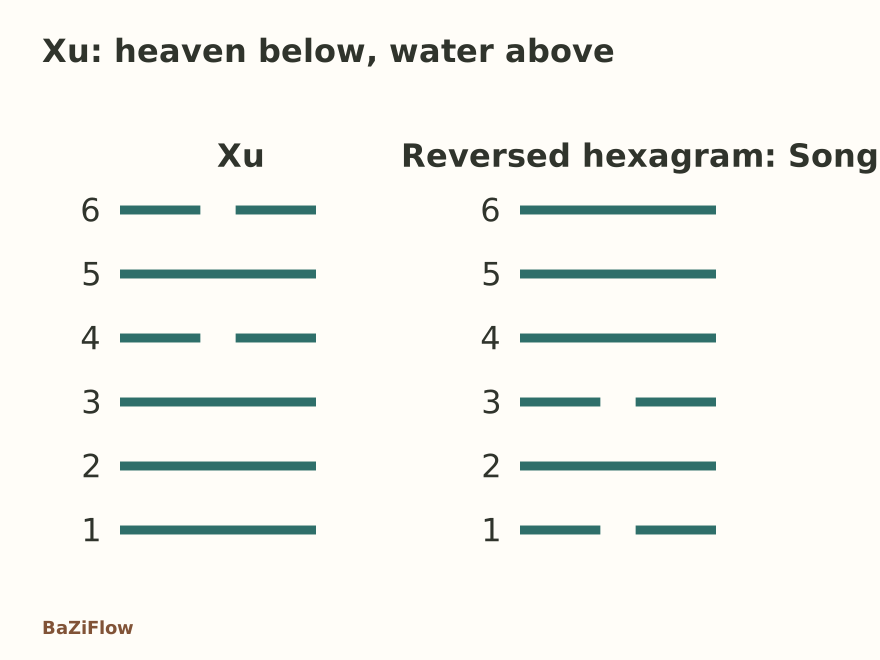
Xu and its reversed hexagram Song: the reversed hexagram turns the whole figure over, and heaven and water trade places.
"Waiting" is the plain meaning of the word. What follows can be taken in three layers: danger lies ahead, one is firm and strong, so one does not fall into it, and the reasoning never leads to being cornered.
Enlarge diagram · scroll sideways to read
Set against the figure, the danger ahead is the upper trigram, water, and the strength is below it in the lower trigram, heaven: danger in front, strength behind.
The judgment: trust, bright passage, and crossing the great river
Xu's judgment reads: "Having trust; bright and free-flowing. Steadfast, good fortune. Fitting to cross the great river." Having trust is being sincere, bright and free-flowing is light and open passage, steadfast good fortune is that holding to what is right brings good, and fitting to cross the great river says that fording water is a good thing. The name is waiting, yet the judgment runs from passage to fortune to crossing, and the Commentary on the Judgments answers it clause by clause.
Enlarge diagram · scroll sideways to read
The sentence "it holds the seat of heaven, by being upright and central" is traditionally taken to point at line 5, which holds the central place of the upper trigram; how to check that is shown in the worked example of line positions, so it is not repeated here. On crossing the river the Commentary on the Judgments says only "to go brings achievement". There is danger ahead and the judgment still calls the crossing fitting; nowhere in it is there a sentence that says do not move.
Clouds above heaven: eating and drinking in the Great Image (大象)
The Great Image for Xu reads: "clouds above heaven: Xu. The noble person eats and drinks and feasts in comfort." Clouds have risen into the sky, matching heaven below and water above. What the noble person does comes down to eating, drinking and feasting.
Clouds above heaven: Xu. The noble person eats and drinks and feasts in comfort.
Food and drink show up three times in the text of this hexagram: once in the Xu Gua, once in the Great Image and once in line 5.
Enlarge diagram · scroll sideways to read
Side by side, the three place waiting in this hexagram next to eating and drinking.
Outskirts, sand, mud, blood, wine and food, cave: six places
In the six line statements, waiting is followed by a place: the outskirts, sand, mud, blood, wine and food, while the last line switches to "entering the cave". Each place is followed by a verdict, and the Small Image (小象) adds a remark.
Enlarge diagram · scroll sideways to read
The lower three lines are on the ground: outskirts, sand, mud. Tradition often reads them as drawing steadily nearer the water, since the danger lies ahead. Line 1, "fitting to be constant; no blame", gets "it does not venture into hardship". Line 2, "a little gossip; the end is good fortune", ends well. Line 3, "it brings robbers to come", has the Small Image with the sharpest turn: "the disaster is still outside"; "it is I who bring the robbers"; "with respect and care, there is no defeat".
The upper three lines are exactly the trigram of water. Line 4, "waiting in blood, coming out of the cave", gets only four words from the Small Image: "compliant, and listening". At line 5 it is wine and food, "steadfast, good fortune". Line 6 reads: "Entering the cave. Three uninvited guests arrive. Treat them with respect, and the end is good fortune." In the Shuo Gua water is a pit, and a cave is also a place sunk down, so the two can be read together; line 4 has "coming out of the cave" and line 6 "entering the cave", the same word, once out and once in.
Xu and Song: two trigrams trade places
The reversed hexagram of Xu is Song (訟): turn Xu upside down and the lower trigram of heaven and the upper trigram of water change places, giving water below and heaven above. In Xu the danger is ahead and the strength is below; the Commentary on the Judgments of Song says "firm above, danger below".
The Xu Gua first defines xu as the way of eating and drinking, and goes on to say that with eating and drinking there will be disputes, so the next hexagram is Song. Xu's inverse hexagram is Jin (晉) and its nuclear hexagram is Kui (睽).
Enlarge diagram · scroll sideways to read
Questions readers ask next
Is Xu telling you to do nothing and only wait?
The word is indeed waiting, but the judgment reads "having trust; bright and free-flowing" and "fitting to cross the great river", line 5 waits among wine and food, and the Great Image acts by "eating and drinking and feasting". Waiting here is tied to trust, to food and to crossing, and no line says only "do not move".
Who are the three guests in "three uninvited guests arrive"?
The text does not say. "Uninvited" means not summoned and "three" is just a number. The Small Image offers "treat them with respect and the end is good fortune" and "though it is not in its proper place, it has not lost much". Who the three are, the text does not give.
Does "waiting in blood" mean bloodshed?
Literally one waits at "blood", followed by "coming out of the cave", and the Small Image says "compliant, and listening". The text does not say what blood this is or which cave it leaves. It can be set beside the "pit" of the upper trigram, but that is one way of reading, not a definition in the text.
Was this article helpful?
Sources & references
Continue reading
Meng: from "it is not I who seek the young" to opening, embracing and striking ↗
Song: the judgment sees the end, the Great Image the start, six lines the ways it ends ↗
The Sixty-Four Hexagrams: How Upper and Lower Trigrams Form One Figure ↗
Judgment and Line Statements: Whole Hexagram or Single Line? ↗