

Feng: the Dipper at midday, a screen made great
Content version · · Sources & references
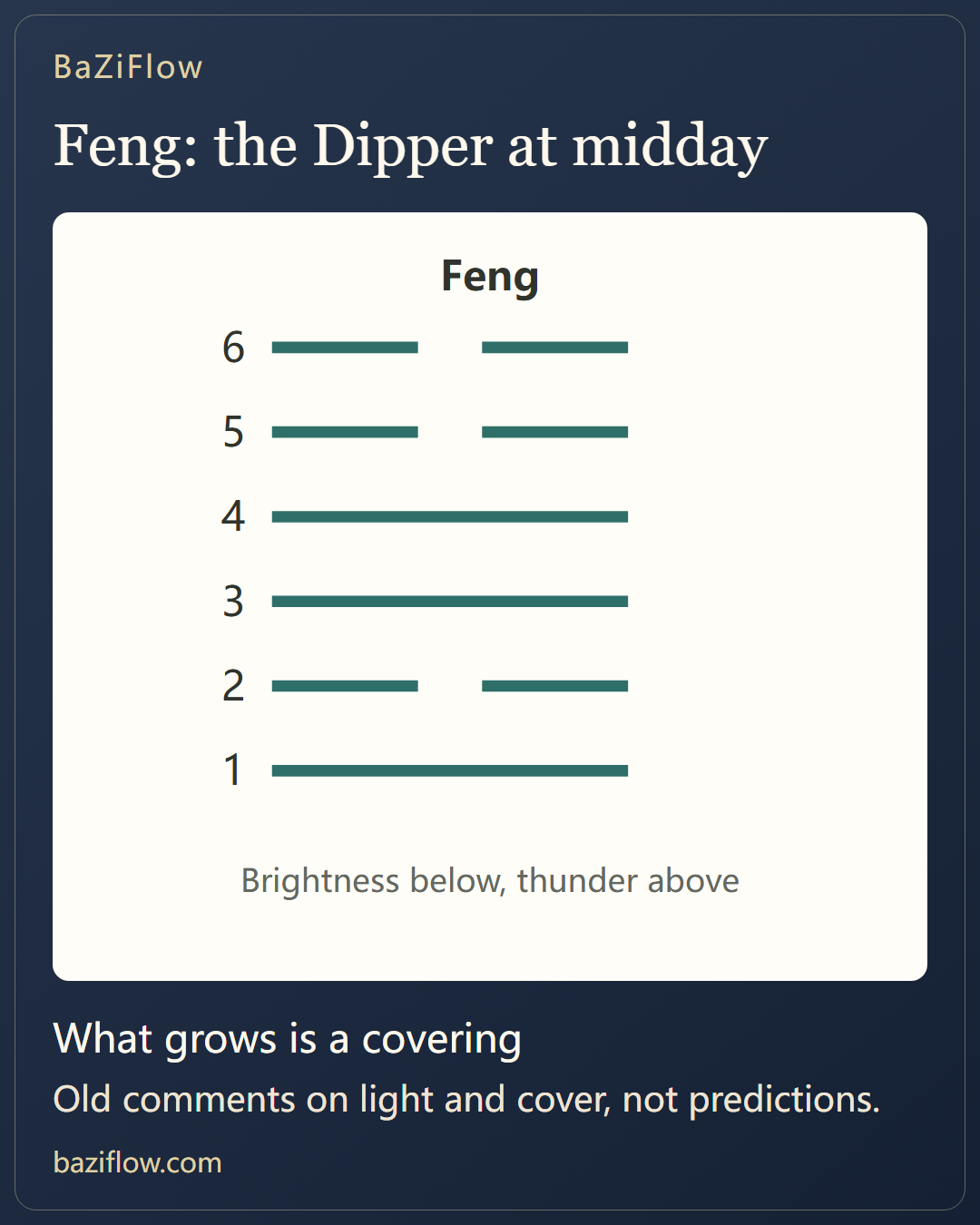
Feng is the 55th hexagram: Li (brightness) below Zhen (movement). Read the Commentary’s “fitting to be at midday” followed by “midday then tilts”, and six lines in which what is made great is a screen, a curtain, a roof.
The short version8 min read
Feng means great. Yet in the six lines what is made great is almost always something that covers the light: a screen, a curtain, a roof. So at midday one can see the Dipper.
- Feng stacks Zhen (movement) on Li (brightness). The Commentary says “brightness in motion: therefore great”; the judgment ends “fitting to be at midday”, and the Great Image says thunder and lightning arrive together.
- The Commentary uses “midday” twice. First “fitting to be at midday”, fitting to shine on all under heaven; then straight away “when the sun is at midday it tilts, when the moon is full it is eaten away”.
- Four lines say “made great”: screens, curtains, screens, a roof, almost all things that cover the light. Lines 2 and 4 share the sentence “at midday one sees the Dipper”; one is answered by “sincerity”, the other by “meeting his peer-host”.
Read first
The Sixty-Four Hexagrams: How Upper and Lower Trigrams Form One Figure ↗
Judgment and Line Statements: Whole Hexagram or Single Line? ↗
Brightness below, movement above
Feng (豐) is the 55th hexagram: Li below and Zhen above. In the Shuo Gua Li is “clinging” and also brightness, with the images of fire, sun and lightning; Zhen is “moving”, with the image of thunder. The Commentary on the Judgments opens with a definition: “Feng means great”, and then “brightness in motion: therefore great”. Brightness below and motion above are the reason the hexagram has its name.
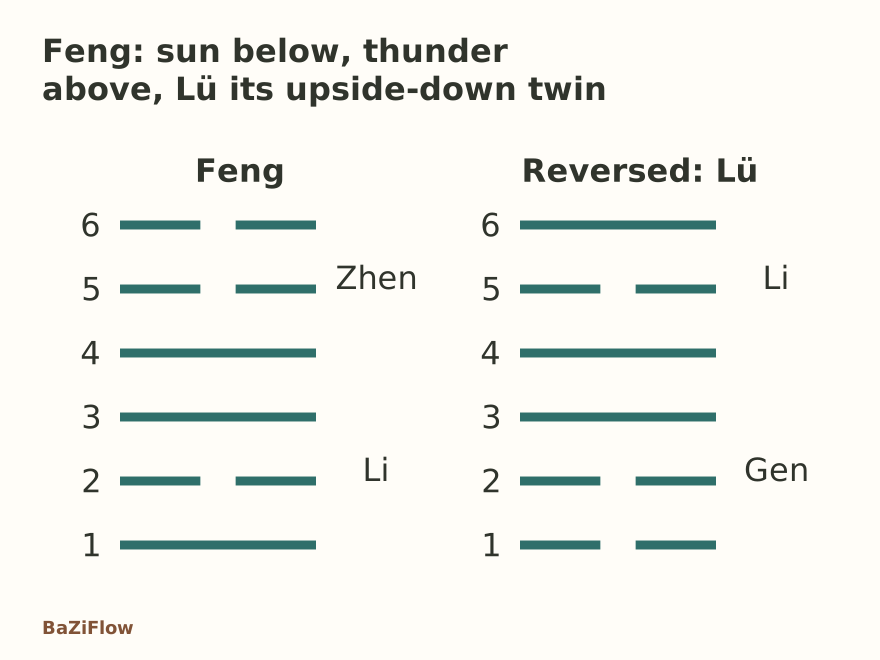
Feng and its reversed hexagram Lü: turn Feng upside down and you have Lü, so the Li (sun) that sits below in Feng ends up on top.
Enlarge diagram · scroll sideways to read
Four terms in Feng
- Screen and curtain
- Tradition usually reads both as things that block light: the screen as something like a covering mat, the curtain as a larger hanging. The lines say “made great” of exactly these.
- Dipper and dim star
- The Dipper is the Big Dipper; the other word is traditionally read as a smaller, dimmer star. “At midday one sees the Dipper” and “one sees the dim star” mean stars are visible at noon.
- Midday and tilting
- Midday is noon and tilting is the sun slipping to the west. The Commentary uses them to speak of fullness and decline.
- Reaches
- Tradition usually reads the verb as “arrive”. In the judgment, “the king reaches it” means the king comes here.
The judgment and the Commentary: “fitting to be at midday”, and then “midday tilts”
The judgment of Feng reads: success; the king reaches it; do not worry; it is fitting to be at midday. The Commentary answers it clause by clause, and in one passage it uses “midday” twice.
Feng means great. Brightness in motion: therefore great. “The king reaches it”: he values greatness. “Do not worry, it is fitting to be at midday”: it is fitting to shine on all under heaven. When the sun is at midday it then tilts, and when the moon is full it is then eaten away; heaven and earth fill and empty, wane and wax with the season. How much more so for people? How much more so for spirits?
Enlarge diagram · scroll sideways to read
The first half follows the judgment. “Brightness in motion”: the lower trigram is bright and the upper moves, hence Feng. “The king reaches it: he values greatness.” “Do not worry; it is fitting to be at midday” means it is fitting to shine over all under heaven, as the sun does at noon.
The second half turns. “When the sun is at midday it then tilts, and when the moon is full it is then eaten away.” The same word, midday, now describes a sun that has just reached its height and starts to slip west; a full moon starts to wane (the verb for “eaten”, tradition usually reads as an eclipse or loss). “Heaven and earth fill and empty, wane and wax with the season”: even heaven and earth do this, so how much more people, and spirits.
The Great Image: thunder and lightning arrive together
Thunder and lightning both arrive: Feng. The noble person decides cases and carries out penalties.
Enlarge diagram · scroll sideways to read
“Both arrive” means that thunder and lightning come at the same time, the force of Zhen together with the light of Li. From this the noble person takes his conduct: to decide cases and to carry out penalties.
The Great Image of Shihe also has thunder and lightning, but there it says that the ancient kings “make penalties clear and put the laws in order”, which is to fix penalties and laws first. In Feng it is the individual case that gets judged, and then penalties follow. The same thunder and lightning, once in setting the rules and once in deciding a case.
Six lines: what is made great is what covers the light
“Made great” (the same word as the hexagram’s name, written before an object) appears four times in the six statements: the screen, the curtain, the screen, the roof. What follows is almost always something that covers the light, which is why the Dipper is seen at midday.
Enlarge diagram · scroll sideways to read
Line 1: “he meets his matching host; even for ten days, no blame; to go forward is to be esteemed”. The word for “ten days” has two traditional readings: ten days, or equal measure. The Small Image says “beyond ten, calamity”: past that limit it becomes a disaster.
Lines 2 and 4 contain one sentence word for word: “the screens are made great; at midday one sees the Dipper”, a covering so big that stars appear at noon. After that they part. Line 2 continues “going brings suspicion and illness; with sincerity it opens out: good fortune”, and its Small Image says “trust brings out the aim”. Line 4 continues “he meets his peer-host: good fortune”, and its Small Image first gives reasons, “the position is not fitting” (line 4 is yang in the fourth place) and “dim, not bright”, and only then says “meeting his peer-host: good fortune, going on”. Line 1 says “he meets his matching host”, line 4 “his peer-host”; lines 1 and 4 are a pair of corresponding places in the two trigrams.
Line 3: “the curtains are made great; at midday one sees the dim stars; he breaks his right arm; no blame”. Tradition reads the curtain as larger than the screen, and what this line sees at noon is not the Dipper but the dim star. The right arm is broken, yet there is no blame. The Small Image says “no great work can be done” and “in the end it cannot be used”.
Line 5, like line 1, has neither a covering nor “midday”; it speaks of brightness arriving: “brightness comes; celebration and praise: good fortune”. The word for brightness is traditionally read as radiance or elegance, and the Small Image says “there is cause to celebrate”.
Top line: “the house is made great and the family screened; peering through the door, it is silent and empty, no one there; for three years no one is seen: misfortune”. The Small Image comments in two parts: “the house is made great: flying to the edge of heaven”, and “peering through the door, silent and empty: hiding himself”. From “the screen made great” to “the house made great”, the covering keeps growing until the thing it hides is the person.
Lü, Huan and Daguo: neighbors of Feng, and “one who takes greatness to the limit”
Flip Feng over and it becomes Lü (旅), which makes Lü the reversed hexagram of Feng, as the opening figure shows. The inverse hexagram (错卦) is Huan (涣). The nuclear hexagram (互卦) is Daguo (大过): lines 2, 3, 4 of Feng (yin, yang, yang) give Xun, lines 3, 4, 5 (yang, yang, yin) give Dui, and Xun below with Dui above is Daguo.
Enlarge diagram · scroll sideways to read
The Xu Gua puts Feng after Guimei because whatever has found where it belongs grows large. After Feng comes Lü, and the reason given is that someone who pushes greatness to its end must lose his dwelling, so a journey follows. Look back at the top line: “the house is made great”, yet “silent and empty, no one there”, a big house with nobody in it, and the two passages can be read side by side. The Za Gua also sets Feng and Lü in one line, Feng as “many happenings”, Lü as “few kin”.
Questions readers ask next
Is Feng about abundance and plenty?
The Commentary first glosses the name as “great”. What the lines make great, though, are a screen, a curtain and a roof, things that cover, and stars appear by day. In this text feng means great, and not only plenty.
How can “at midday one sees the Dipper” happen?
The text gives no cause. It only says the screen is made great, so great that stars show at noon, and the Small Image comments “dim, not bright”. Tradition reads the word for screen as something that blocks light; the text does not say what it is.
How are Feng and Lü related?
They are each other’s reversed hexagram: Feng upside down is Lü. The Xu Gua says “one who takes greatness to the limit must lose his dwelling”, which is why Lü comes next, and the Za Gua sets them in one line: Feng is “many happenings”, Lü is “few kin”.
Was this article helpful?
Sources & references
Continue reading
Guimei: from the junior sister to the empty basket ↗
Lü (旅): fire on a mountain, from “petty and fussy” to the burned nest ↗
The Sixty-Four Hexagrams: How Upper and Lower Trigrams Form One Figure ↗
Judgment and Line Statements: Whole Hexagram or Single Line? ↗