

Dui: where delight comes from
Content version · · Sources & references
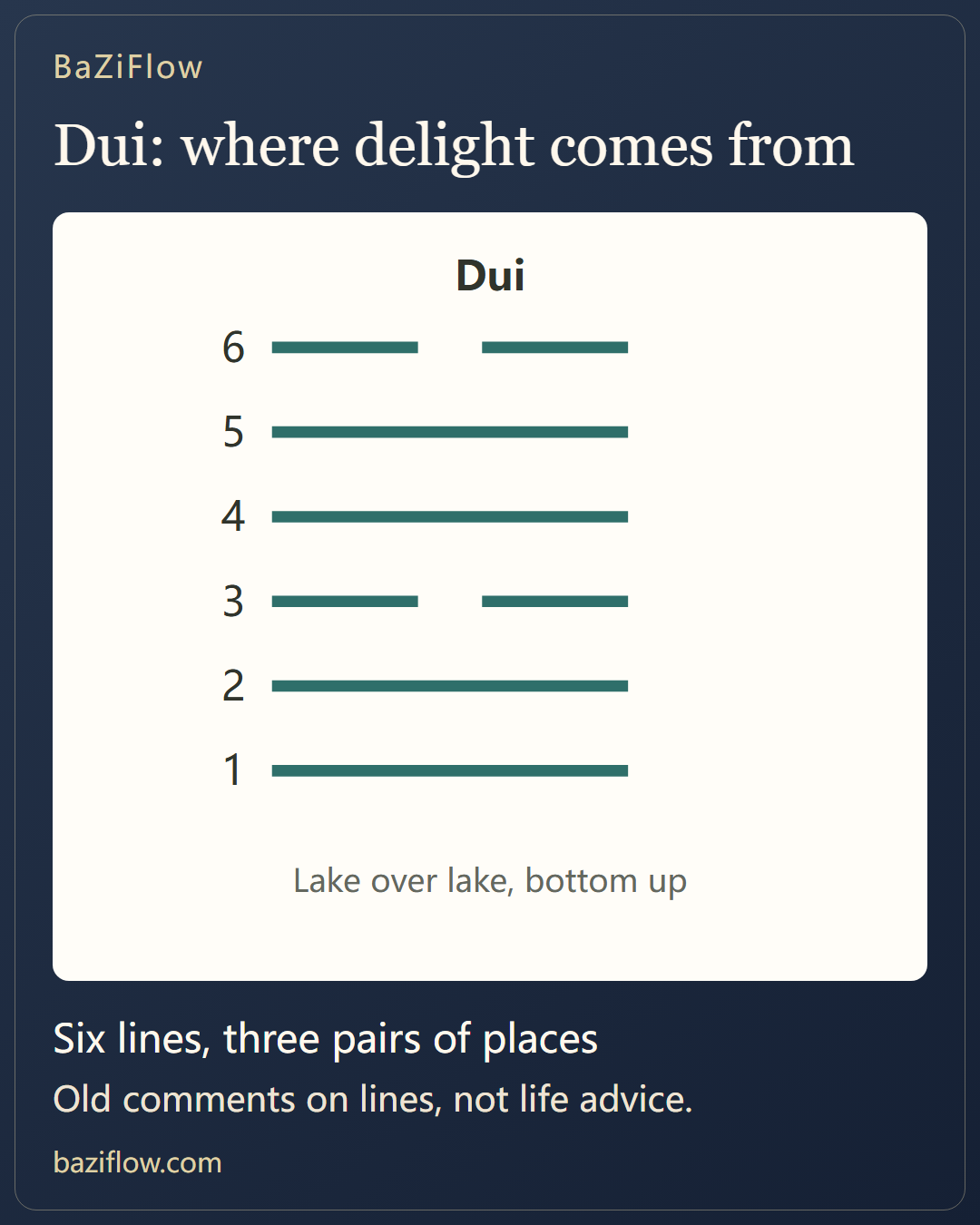
Dui (兌) is the 58th hexagram, lake over lake. Read “firm in the center, yielding outside”, the Great Image of friends at study, and six lines that pair up by place within the trigram.
The short version7 min read
Dui means delight, and the word that glosses it also means to speak. One trigram is set down twice, so the six lines pair up: the two lowest talk of harmony and conferring, the middle two of trust, the top two of “coming” and “drawing”.
- Dui stacks two Dui (lake), each two yang lines under one yin line. The Shuo Gua says “Dui is delight”, and it also lists the mouth among the trigram’s images.
- The Commentary on the Judgments calls it “firm in the center, yielding outside”: lines 2 and 5 are the central yang lines, lines 3 and 6 the outer yin ones. The Great Image ends on friends discussing and practicing.
- Seen by place within a trigram, the lines form three pairs: lines 1 and 4 are harmony and conferring, 2 and 5 are trust, 3 and 6 are “coming” and “drawing”. The Small Images name position twice.
Read first
The Sixty-Four Hexagrams: How Upper and Lower Trigrams Form One Figure ↗
Judgment and Line Statements: Whole Hexagram or Single Line? ↗
Lake over lake: a yin line atop each trigram
Dui (兌) is built from two Dui (lake). Each is two yang lines under one yin line: from the bottom yang, yang, yin, and then yang, yang, yin again. The Shuo Gua says “Dui is delight”, takes the lake as its image, and also the youngest daughter, with the mouth among its images; in its account of the directions it calls Dui true autumn, “where all things delight”.
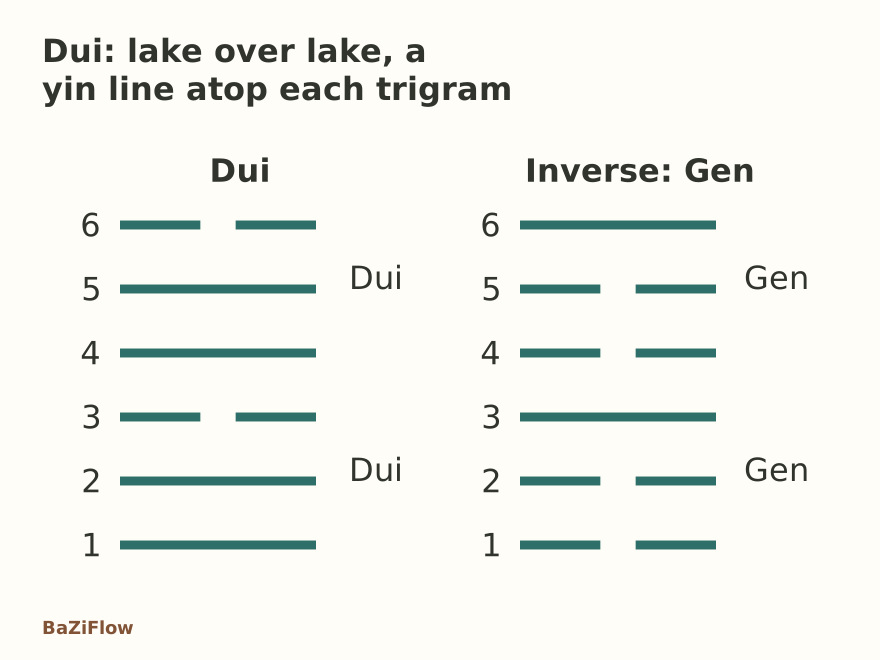
Dui and its inverse Gen: the Shuo Gua puts them side by side, with Gen to stop things and Dui to delight them.
Enlarge diagram · scroll sideways to read
Three terms before reading
- Delight
- “Dui is delight.” The same written word also means to speak. The Shuo Gua lists the mouth among the trigram’s images, and tradition often reads the two senses together; the Shuo Gua itself does not say so.
- Lake
- A hollow holding water. The Shuo Gua gives Dui the lake, the youngest daughter and the mouth.
- Place within a trigram
- The two trigrams of Dui are identical, so each line has a partner in the same place: lines 1 and 4, lines 2 and 5, lines 3 and 6.
The judgment and the Commentary: firm in the center, yielding outside
The judgment of Dui is three characters in the original: success; steadfastness is fitting. The Commentary on the Judgments first glosses the name as “delight”, then says from the figure what kind of delight it is.
Dui means delight. The firm is in the center and the yielding on the outside; delight that is fitting and steadfast is therefore in accord with heaven and answers to people. When delight leads the people, they forget their toil; when delight meets danger, they forget death. How great is delight: the people are encouraged!
Enlarge diagram · scroll sideways to read
“Firm in the center, yielding outside” can be seen at a glance. The two yang lines, 2 and 5, are the middle line of each trigram. The two yin lines, 3 and 6, are the top line of each trigram, which makes them the outermost. The sentences after that carry delight out among people: delight leads them, and the people forget their toil; delight faces danger, and the people forget death. The last cry, “how great is delight”, is an exclamation about how delight encourages them.
The Great Image: joined marshes, friends at discussion and practice
The Great Image of Dui reads:
Joined marshes: Dui. The noble person holds discussion and practice with friends.
“Joined marshes” is two bodies of water side by side. Tradition usually reads it this way: two sheets of water joined, each moistening the other. The noble person’s share of it is “discussion and practice with friends”: talking things through and going over them in company.
Enlarge diagram · scroll sideways to read
The Commentary glosses the name as “delight”, and the Great Image lands that on discussion and practice: delight, here, is the kind that comes from talking and going over things together. The Image writes nothing about a solitary joy.
Six lines: one trigram twice, so three pairs
The upper and lower trigrams of Dui are identical, so the six lines can be paired by their place inside their own trigram: line 1 with line 4 at the foot, line 2 with line 5 in the middle, line 3 with line 6 at the top.
Enlarge diagram · scroll sideways to read
The pair at the foot is about how delight begins. Line 1 says “harmonious delight: good fortune”, and the Small Image (小象) says his conduct raises no doubt. Line 4 says “delight under discussion, not yet at ease”: discussion is conferring, and ease has not come. Tradition usually reads the next clause as keeping a small ailment at bay, and then there is joy; the Small Image says there is cause for celebration.
The middle pair both carry the word for trust. Line 2 says “delight in trust: good fortune; regret vanishes”, and the Small Image says it is his aim that is trusted. Line 5 says “trusting what strips away: danger”. The Small Image says its place is right and fitting, so the place is not the trouble; the trouble is what is trusted. Tradition usually reads the stripping thing as a yin line that wears away yang, and in this figure the top yin line stands directly above line 5.
The pair at the top are the two yin lines, both outermost. Line 3 says “delight that comes asking: misfortune”, delight that offers itself unasked, and the Small Image says the place is not proper: a yin line in the third place, a yang place. Line 6 has just two words, “delight that draws”, bringing delight in, with neither fortune nor misfortune attached; the Small Image calls it “not yet bright”.
Read through the pairs, the foot lines are harmony and conferring, the middle ones trust, the top ones being come to and being drawn. In the Shuo Gua, Dui is the mouth; harmony, conferring and trust are all things said between people.
Xun, Gen and Jia Ren: neighbors of Dui and its place after Xun
Dui has three close neighbors. Its inverse hexagram (错卦) is Gen, drawn in the figure above. Flip Dui over and Xun (巽) appears: that is its reversed hexagram (综卦). Regroup the four middle lines, 2 to 5, and the result is its nuclear hexagram (互卦), Jia Ren (家人), with Li (yang, yin, yang) below and Xun (yin, yang, yang) above.
Enlarge diagram · scroll sideways to read
The yin lines of Dui, at 3 and 6, are the top lines of their trigrams; flip the figure and they land at 1 and 4, which is Xun. In the Xu Gua, Dui stands after Xun and before Huan:
After entering comes delight in it, so what follows is Dui; Dui means delight.
First entering, then delight. One step further, the Xu Gua says delight is followed by scattering, and Huan (渙) comes next. The Za Gua has a sentence that sets Dui and Xun together:
Dui shows itself while Xun lies hidden.
Dui is the one that shows, Xun the one that lies low. The Shuo Gua also pairs Dui with its inverse Gen: Gen is for stopping things, Dui for delighting them.
Questions readers ask next
What is “delight” in Dui, and does it mean speaking too?
The word used to gloss Dui has both meanings, delight and speech. The Shuo Gua says Dui is “delight”, speaks of “delight in Dui” in the autumn when all things are glad, and lists the mouth among its images; tradition often links the two senses, though the text does not spell that out.
Line 5 is in a proper place, so why “danger”?
The Small Image says its place is right and fitting, so the place is not the problem. The danger lies in “trusting what strips away”. Tradition usually reads the stripping thing as a yin line that wears down yang, and in the figure line 5 has the top yin line directly above it.
How are Dui and Xun related?
They are each other’s reversed hexagram: Dui turned upside down is Xun (巽). The Xu Gua links them as entering, then delight, and the Za Gua adds one sentence of its own, in which Dui shows itself while Xun lies low.
Was this article helpful?
Sources & references
Continue reading
Xun: wind over wind, and “beneath the bed” written twice ↗
Huan: wind over water, and what “scatter” takes as its object ↗
The Sixty-Four Hexagrams: How Upper and Lower Trigrams Form One Figure ↗
Judgment and Line Statements: Whole Hexagram or Single Line? ↗