

What relocation preserves
Content version · · Sources & references
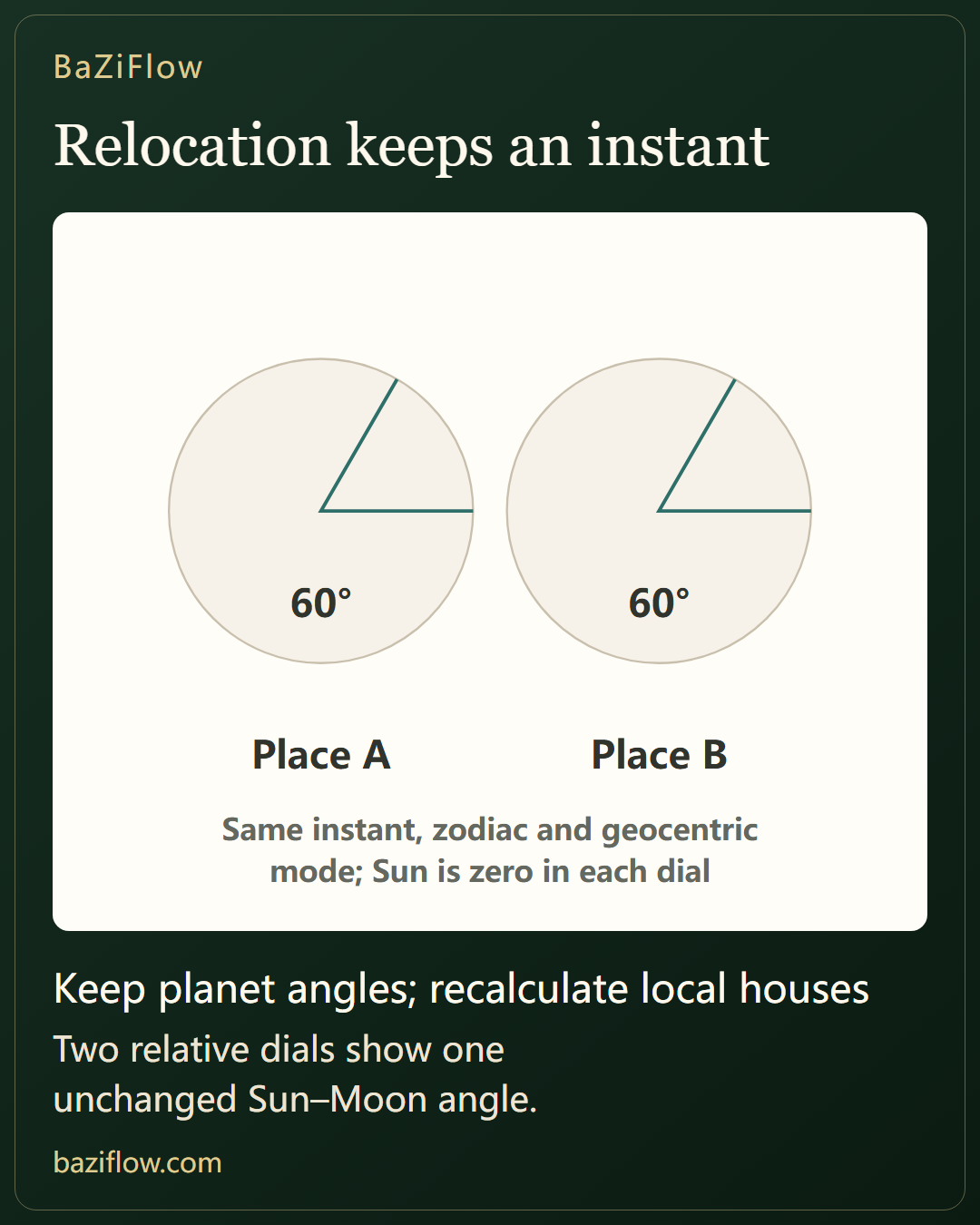
Audit the unchanged geocentric positions before reading local angles. A clock-offset example and location checklist distinguish a true relocation comparison from changed inputs.
The short version6 min read
Relocation normally keeps the birth instant and changes the calculation place. Geocentric Sun and Moon longitudes stay fixed while local angles and houses are recalculated. Understanding that distinction requires separating clock display, universal instant and coordinates.
- With birth instant, zodiac and geocentric settings fixed, changing cities does not alter planetary longitudes or their mutual longitude angles.
- 06:00 UTC and 14:00 at an assumed UTC+8 offset label one instant. Entering 14:00 as UTC instead moves it eight hours later.
- Local angles and houses need new coordinates. Topocentric positions also use observer data, so the reference mode must remain explicit.
Read first
The twelve houses as topics, not twelve verdicts ↗
Tropical vs sidereal zodiac: what is the difference between the two readings? ↗
Audit what should stay the same
Before interpreting a relocated chart, check its invariants. In the ordinary geocentric comparison used here, the birth instant and zodiac convention stay fixed while the location changes. The planets' geocentric longitudes and the longitude separations between them should therefore remain the same. Local angles and houses are the quantities to recalculate.
Use a deliberately small invented example: Sun 100° and Moon 160°, separated by 60°. Replacing place A with place B does not turn those positions into a new Sun and Moon. Under the stated conditions the separation is still 60°, even if the planets fall in different houses. A changed house label does not erase a natal aspect.
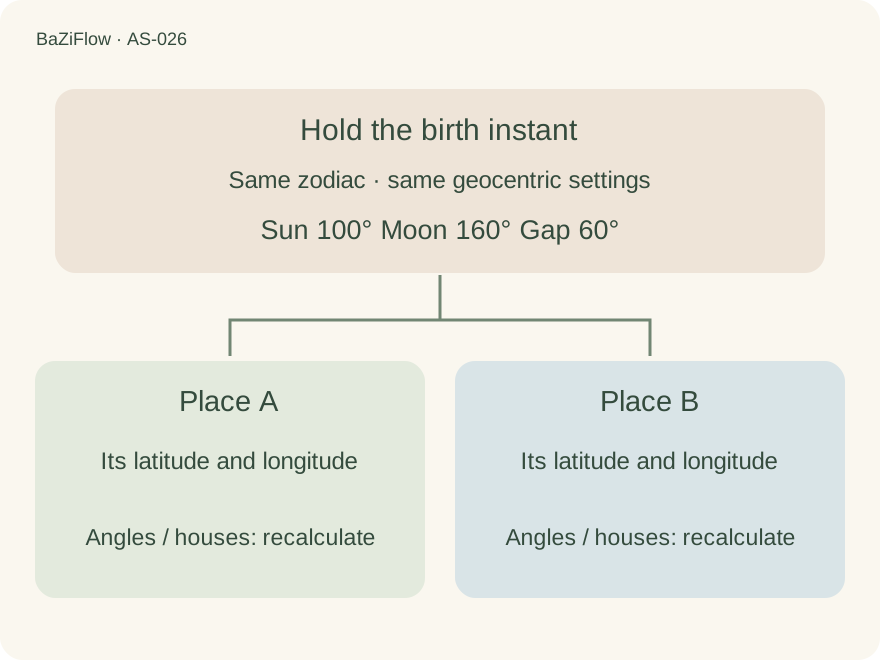
Original input diagram with invented longitudes; no actual local angles or city chart have been calculated.
The diagram leaves the local angles unnumbered because no actual ephemeris or house calculation has been supplied. A complete-looking wheel with invented cusps would obscure that limit. The TimePassages manual describes relocation as preserving the birth moment and changing place; the example illustrates the data distinction without claiming a particular city's chart.
A matching clock display can conceal a different instant
Suppose the relevant instant is 06:00 UTC. At a hypothetical UTC+8 offset, its clock display is 14:00. These are two labels for one instant. Entering 14:00 as UTC instead shifts the calculation eight hours later. The new chart then differs in both place and time, defeating the intended comparison.
This is an offset exercise, not a statement about the historical time zone of any named country. Real birth records need the applicable date and time convention. A program may already convert the display when a location is changed, so adding a manual correction without checking can introduce the very error you were trying to remove.
Keep the original local record and the resolved instant together. When comparing outputs, inspect the latter before deciding that different clock numbers are a problem. Conversely, identical numbers on two local clocks do not establish that the calculations refer to the same moment.
UTC
- 06:00
UTC+8
- 14:00
Two clock displays for one instant; assumed offset
Inspect the selected point, not just its label
Swiss Ephemeris treats the time, geographic latitude, longitude and house system as separate house-calculation inputs. A city name is a route to coordinates, not a substitute for checking them. A location in the wrong country or an east–west sign error can still produce a neat-looking chart.
| Input to inspect | Why the name alone is insufficient |
|---|---|
| Country and administrative area | Different places can share a name |
| Latitude and longitude | These identify the selected geographic point |
| East or west designation | Reversing the sign changes the location |
| Area or exact site | A regional representative point is not a known address |
If the destination is only a large region, state which representative point was used and what remains undecided. Additional decimal places cannot make that assumption into a confirmed residence. Whether a different point materially changes the relevant result needs an actual comparison, not a blanket claim that location precision either never matters or always changes everything.
Time zones are also not geographic longitudes. The clock offset is needed to identify the instant; coordinates are used for the local geometry. Treating them as interchangeable hides which part of the input changed.
Resolve the instant
Compute local frame
The geocentric qualification matters
Topocentric planetary positions use the observer's location rather than Earth's center as their reference. Swiss Ephemeris provides separate observer longitude, latitude and altitude settings for that calculation. The invariance described at the beginning therefore should not be extended to every possible coordinate mode.
When two products disagree, first establish whether they use the same reference center, zodiac and house method. If both the destination and the house system change, a different house position cannot be attributed to destination alone. Make one controlled comparison with the other settings held fixed, then label any further comparison separately.
Birth-time uncertainty must travel with the data as well. Precise destination coordinates cannot repair an estimated birth time. A report should preserve the limits relevant to its angles rather than presenting the relocation operation as an increase in certainty.
These checks concern whether the stated calculation has been performed. Passing them does not establish the truth of a claim that a location will bring professional success, a particular relationship or a change in personality. The interpretation and the input audit remain different questions.
Geocentric
- Earth-centered reference
- Place does not change these longitudes
Topocentric
- Observer-centered reference
- Coordinates and height enter calculation
Compare places using information a chart cannot supply
Imagine two possible bases for a research visit. One is near the archive; the other offers practical help from a colleague. Archive access, travel time and the colleague's availability are facts to investigate directly. A symbolic description of either place cannot fill those fields or confirm another person's willingness to help.
A useful comparison can retain separate notes for calculated differences, reflective questions and verified practical conditions. If the visit goes well, preserve the work arrangements and support that contributed. If something does not match the reading, keep that observation too rather than selecting only the experiences that fit a planetary theme.
The relocation reference is normally the birth instant, not the moment you decide to move or arrive. Those later events can be recorded in their own right, but substituting one silently changes the task. The house topics guide helps distinguish local house placement from zodiac longitude. A solar return chart starts from a different time condition, even though location is relevant to its houses too.
The archive option
Check access hours and actual travel time.
The colleague option
Confirm the colleague’s availability and the help offered.
Compare separately
Place calculated local-frame differences alongside those practical conditions.
Questions readers ask next
Does the Sun changing house mean that it changes zodiac sign?
No. At the same instant under the same zodiac and geocentric settings, its longitude is unchanged. A new location changes the local house framework, so house placement and zodiac position are different relations.
Why can the new clock display differ from the birth record?
One instant has different local-clock labels. In the example 06:00 UTC equals 14:00 at an assumed UTC+8 offset. If software already converts that display, a second manual correction would change the instant.
Are planetary longitudes invariant in every coordinate mode?
No. The statement concerns geocentric positions. Topocentric calculations refer to a particular observer and use longitude, latitude and altitude, so location enters the planetary calculation itself.
Was this article helpful?
Sources & references
Continue reading
Solar returns: solve the time, then choose the chart location ↗